<?xml version="1.0" encoding="utf-8"?>
<feed xmlns="http://www.w3.org/2005/Atom">
  <id>http://www.chimpfeedr.com/</id>
  <title><![CDATA[Jisc Transformations Programme]]></title>
  <updated>2013-02-06T10:23:44+00:00</updated>
  <link rel="self" href="http://www.chimpfeedr.com/"/>
  <generator>http://www.chimpfeedr.com/</generator>
  <entry>
    <id>http://transform.jiscinvolve.org/wp/?p=38</id>
    <title><![CDATA[Action Learning in Preston]]></title>
    <updated>2013-02-05T13:23:37+00:00</updated>
    <link rel="alternate" href="http://transform.jiscinvolve.org/wp/2013/02/05/action-learning-in-preston/"/>
    <summary><![CDATA[Thanks to Lucy for hosting the Action Learning Set at UCLAN last week. It was really good to meet others and find that two of them are, like me, new to their projects. I thought the principles of Action Learning &#8211; something else that is new to me &#8211; worked really well, as we took [...]]]></summary>
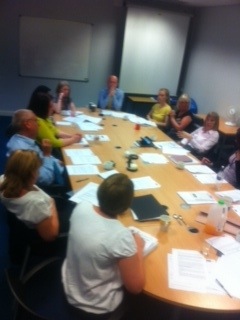
    <content type="html"><![CDATA[<p>Thanks to Lucy for hosting the Action Learning Set at UCLAN last week. It was really good to meet others and find that two of them are, like me, new to their projects. I thought the principles of Action Learning &#8211; something else that is new to me &#8211; worked really well, as we took it in turns to listen to each other talk about project issues, ask helfpul questions and make practical suggestions. I noticed how often people said &#8221;thanks, that&#8217;s a really great idea!&#8221; People seemed to find the human contact reassuring.</p>
<p>What I learned:</p>
<ul>
<li>Many projects start out with an over ambitious scope and have to be adapted to become more realistic</li>
<li>It can be really hard to secure buy-in and decision-making from senior management, a common cause of project bottlenecks.  People are sometimes appointed to chair project boards because of their seniority, but the  skills required to chair meetings effectively, and drive decision-making, are often underestimated. Tactics to combat this include making efforts to win support by briefing key individuals outside meetings</li>
<li>Sometimes small changes can be introduced almost  &#8220;by stealth&#8221;, but real strategic change requires concensus and organisational maturity</li>
<li>There are risks associated with an over-reliance on technology - we need to be aware of the pitfalls of platforms disappearing and changing, and upgrades and migrations</li>
<li>If we don&#8217;t have time to do justice to the outcomes of consultation exercises and workshops, it might be worth considering delegating some of the analysis to the participants, who might have an interest in resolving issues</li>
<li>One way for a project leader to draw a line at the end of a project, and extricate themselves, is to foster and empower a community of practice to continue the good work</li>
<li>When it&#8217;s hard to identify obvious indicators to measure progress, consider looking for metrics that reveal inefficiencies &#8211; eg how long it takes to find information, how many people are involved in achieving something &#8211; and demonstrate how this has changed</li>
<li>Plan consultation carefully, considering which methods are most effective for what you want to find out and, above all, consider at the outset how you plan to use the results</li>
</ul>
<p>Thanks also to Sarah for chairing so supportively, and effectively by ensuring that we all agreed to some specific actions. This should ensure the day has practical outcomes that help us move our projects on, rather than being a talking shop or group therapy session, however valuable that might be!</p>
]]></content>
  </entry>
  <entry>
    <id>http://apple.jiscinvolve.org/wp/?p=8</id>
    <title><![CDATA[Surveys]]></title>
    <updated>2013-02-05T12:21:54+00:00</updated>
    <link rel="alternate" href="http://apple.jiscinvolve.org/wp/2013/02/05/surveys/"/>
    <summary><![CDATA[A number of surveys have now been completed for some student groups and more are due soon. This survey collected data about the kinds of assessments the students experienced, which they preferred and why. Surveys of staff are under way &#8230; <a href="http://apple.jiscinvolve.org/wp/2013/02/05/surveys/">Continue reading <span class="meta-nav">&#8594;</span></a>]]></summary>
    <content type="html"><![CDATA[<p>A number of surveys have now been completed for some student groups and more are due soon. This survey collected data about the kinds of assessments the students experienced, which they preferred and why. Surveys of staff are under way and will be collated soon.</p>
<p>This work is running alongside the <a href="http://letr.org.uk/" target="_blank" onclick="javascript:urchinTracker ('/outbound/article/letr.org.uk');">legal education and training review (LETR)</a> that is due to publish its report soon. Members of the team have attended a lecture by Professor Richard Susskind OBE who has produced a working paper for the LETR called <a href="http://letr.org.uk/wp-content/uploads/2012/10/Susskind-LETR-final-Oct-2012.pdf" target="_blank" onclick="javascript:urchinTracker ('/outbound/article/letr.org.uk');">Provocations and Perspectives</a>.</p>
]]></content>
  </entry>
  <entry>
    <id>http://glamorganeportfolios.wordpress.com/?p=146</id>
    <title><![CDATA[What our students say]]></title>
    <updated>2013-02-04T16:41:23+00:00</updated>
    <link rel="alternate" href="http://glamorganeportfolios.wordpress.com/2013/02/04/what-our-students-say/"/>
    <summary><![CDATA[In spite of the snow, I was really pleased that the student focus groups I&#8217;d set up a week or so ago were fairly well attended. There was a good mix of UK and International students and representatives from each &#8230; <a href="http://glamorganeportfolios.wordpress.com/2013/02/04/what-our-students-say/">Continue reading <span class="meta-nav">&#8594;</span></a><img alt="" border="0" src="http://stats.wordpress.com/b.gif?host=glamorganeportfolios.wordpress.com&#038;blog=36131506&#038;post=146&#038;subd=glamorganeportfolios&#038;ref=&#038;feed=1" width="1" height="1" />]]></summary>
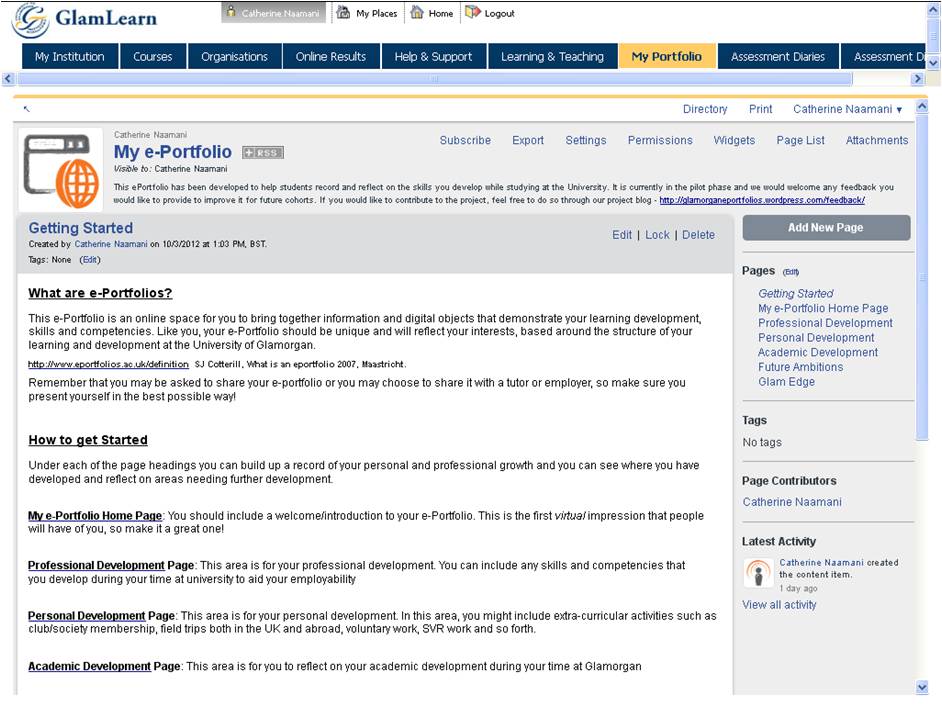
    <content type="html"><![CDATA[<p>In spite of the snow, I was really pleased that the student focus groups I&#8217;d set up a week or so ago were fairly well attended. There was a good mix of UK and International students and representatives from each of the Faculties. They all had something useful and productive to say and confirmed that students are increasingly aware of the need to establish a positive online presence. I was disappointed that so few of them had actually seen or used our e-Portfolio, but they gave useful pointers as to how we can encourage more students to use it. Quite a few students mentioned that they had set up a LinkedIn profile in their search for a job,  but agreed that it wasn&#8217;t necessarily a case of either/or. Indeed the focus group that met in the Atrium (Faculty of Creative &amp; Cultural Industries) seem to prefer an approach which uses a variety of tools, such as YouTube, Tumblr and Blogs to target different audiences, but felt that an e-Portfolio which might point to all of these would be useful.</p>
<p>All the students I met have agreed to try out the e-Portfolio and feed back in some follow-up sessions later on in the project.</p>
<br />  <a rel="nofollow" href="http://feeds.wordpress.com/1.0/gocomments/glamorganeportfolios.wordpress.com/146/"><img alt="" border="0" src="http://feeds.wordpress.com/1.0/comments/glamorganeportfolios.wordpress.com/146/" /></a> <img alt="" border="0" src="http://stats.wordpress.com/b.gif?host=glamorganeportfolios.wordpress.com&#038;blog=36131506&#038;post=146&#038;subd=glamorganeportfolios&#038;ref=&#038;feed=1" width="1" height="1" />]]></content>
  </entry>
  <entry>
    <id>http://blog.westminster.ac.uk/jisc-employability/?p=152</id>
    <title><![CDATA[Baseline data]]></title>
    <updated>2013-02-01T14:55:07+00:00</updated>
    <link rel="alternate" href="http://blog.westminster.ac.uk/jisc-employability/2013/02/01/baseline-data/"/>
    <summary><![CDATA[Shortly before Christmas Boris, our doctoral researcher, presented the findings of our student questionnaire to the Project Board and Delivery Group and it made for an interesting meeting.  The questionnaire asked students about their use of digital technology and applications [...]]]></summary>
    <content type="html"><![CDATA[<p>Shortly before Christmas Boris, our doctoral researcher, presented the findings of our student questionnaire to the Project Board and Delivery Group and it made for an interesting meeting.  The questionnaire asked students about their use of digital technology and applications as well as testing their attitudes to digital skills as they relate to employability.  Since some schools were under represented in the early findings we extended the life of the questionnaire and these additional data brought the total number of respondents to 563.</p>
<p>The headline findings from the total survey are that 87.6% students love digital technology and 81.5% believe themselves to be digitally literate. This latter figure leads us to conclude that any marketing of sessions focussing on digital literacy will need a more sophisticated hook than &#8221; Come and learn digital literacy&#8221; if it is to appeal to this significant majority who believe they already have these skills.</p>
<p>Further finding were encouraging:</p>
<ul>
<li>Academic staff were considered digitally literate by 64.9% and support staff got a similar rating by 69.2% of respondents</li>
<li>92.3% of respondents consider it important for students to develop digital skills</li>
<li>55.9%  agreed with the statement, &#8220;The university has the responsibility to equip me with the digital literacy skills I need&#8221;</li>
</ul>
<p>In terms of ownership/access to digital tools:</p>
<ul>
<li>91.6% own a smartphone</li>
<li>93.3% have a laptop</li>
<li>79% have access to a desktop PC</li>
<li>39.1% have a tablet</li>
<li>28.4% have an e-reader</li>
</ul>
<p>For technology based applications the findings were as follows:</p>
<ul>
<li>97.9% use Blackboard</li>
<li>85.8% use Skype</li>
<li>85.4% use facebook</li>
<li>75.8% use iTunes</li>
</ul>
<p>There were some variations in attitudes by school, for example:</p>
<ul>
<li>Students from the Business School agreed significantly more with the statement that it is the University of Westminster’s responsibility to equip them with the digital literacy skills that are required, than did the students affiliated to the School of Law</li>
<li>Students in the School of Law felt a significantly lower need for training regarding digital literacy than reported by their counterparts from the School of Media, Arts and Design or Business School</li>
<li>The difference with the highest significance was found with regard to the statement that the digital literacy skills needed in the courses get more complex as students progress through the course. Students from the Business School agreed significantly more with this statement than did students from the School of Law, Social Sciences, Humanities and Languages or Architecture</li>
</ul>
<p>In addition:</p>
<p>Overall, 95.7% of the participants agreed that using technology is essential to their studies, with 90.0% seeing it as essential for teaching and 90.6% regarding it as essential for learning. In terms of assessment, only 5.6% of the participants regarded the use of technology as not being essential.</p>
<p>Approximately 56% of the participants agreed that, in their opinion, most students like to engage with learning material while travelling and 81.9% use their laptops for study/all aspects of their life whilst only 1.6% use their smartphone for study.</p>
<p>We have yet to fully digest the figures and share them more widely with our colleagues both in the Schools and in Corporate Services but we hope they will contribute to a clearer understanding of our students&#8217; current  use of technology alongside their understanding of and attitudes to digital skills. The findings will also feed into wider university work such as the Learning Futures project.</p>
<p>On March 21st we are hosting an event of workshops and seminars for students that will further explore the link between digital skills and employability. The marketing plans for this event will draw on some of the questionnaire findings.</p>
]]></content>
  </entry>
  <entry>
    <id>http://collab.northumbria.ac.uk/esubmit/?p=220</id>
    <title><![CDATA[Release of the code]]></title>
    <updated>2013-01-30T11:56:34+00:00</updated>
    <link rel="alternate" href="http://collab.northumbria.ac.uk/esubmit/?p=220"/>
    <summary><![CDATA[We have released the code to Marjon University College, Plymouth and working with them to install the software onto their infra structure.]]></summary>
    <content type="html"><![CDATA[<p>We have released the code to Marjon University College, Plymouth and working with them to install the software onto their infra structure.</p>
]]></content>
  </entry>
  <entry>
    <id>http://uclantissue.jiscinvolve.org/wp/?p=80</id>
    <title><![CDATA[Project Update 30/01/13]]></title>
    <updated>2013-01-30T09:30:10+00:00</updated>
    <link rel="alternate" href="http://uclantissue.jiscinvolve.org/wp/2013/01/30/project-update-300113/"/>
    <summary><![CDATA[Since the last TISSUE Project Delivery Group, the project manager has discussed with the new owners of the student portal, MyUCLan, a suitable location for the student support graphic developed.  The proposed location is the home page of the student support tab, which currently features the home page of The ‘i’.  The hope is that [...]]]></summary>
    <content type="html"><![CDATA[<p>Since the last TISSUE Project Delivery Group, the project manager has discussed with the new owners of the student portal, MyUCLan, a suitable location for the <a href="http://uclantissue.jiscinvolve.org/wp/files/2013/01/STUDENTinfo_6.pdf"title="Student Support Graphic"  >student support graphic developed</a>.  The proposed location is the home page of the student support tab, which currently features the home page of The ‘i’.  The hope is that the different elements of the graphic will then link to the different services identified &#8211; particularly the Key Contacts.</p>
<p>The Unified Corporate Communications Policy became a very long document and it was agreed to strip it down to a basic policy with a separate guidance and best practice document.</p>
<p>Following the catch up with the critical friend, it was noted that the impact measures of NSS scores, retention, etc would not be relevant until the next round of NSS.  Therefore to collect some initial feedback the critical friend suggested collecting staff stories of how they used the information to improve services to students and the experience of getting that information during the year.</p>
<p>&nbsp;</p>
]]></content>
  </entry>
  <entry>
    <id>http://transform.jiscinvolve.org/wp/?p=34</id>
    <title><![CDATA[Applying Enterprise Architecture webinar]]></title>
    <updated>2013-01-25T16:12:35+00:00</updated>
    <link rel="alternate" href="http://transform.jiscinvolve.org/wp/2013/01/25/applying-enterprise-architecture-webinar/"/>
    <summary><![CDATA[We found last week&#8217;s JISC Infonet webinar Applying Enterprise Architecture interesting and informative. It showcased the experience of two universities, Staffordshire University and the University of Bolton. For those who missed it, here&#8217;s a link to the recording: http://emergingpractices.jiscinvolve.org/wp/webinar-applying-ea Their experiences shared confirmed our feeling that it can be a real challenge finding a common [...]]]></summary>
    <content type="html"><![CDATA[<p>We found last week&#8217;s JISC Infonet webinar Applying Enterprise Architecture interesting and informative. It showcased the experience of two universities, Staffordshire University and the University of Bolton. For those who missed it, here&#8217;s a link to the recording: http://emergingpractices.jiscinvolve.org/wp/webinar-applying-ea</p>
<p>Their experiences shared confirmed our feeling that it can be a real challenge finding a common language for effective communication between IT, Information Management and people working in the business units.</p>
<p>Applying Enterprise Architecture involves taking a more holistic approach to connecting people, processes and technology than earlier business re-engineering models might have done. It can usefully “wrap around” other disciplines and methodologies.</p>
<p>One participant asked how it relates to Action Research (a form of self-reflective enquiry undertaken by a community of practice to improve the way issues are addressed and problems solved, involving active participation in organizational change). The answer suggested that Action Research could almost be considered a lightweight version of Enterprise Architecture.</p>
<p>There was some discussion about which tools people found useful. Staffordshire found the CETIS Archimate modelling tool http://archi.cetis.ac.uk/ preferable to Visio, liking the way its flexibility enabled them to tailor presentations to different audiences, to convey messages in a professional way that boosted credibility. Someone else found the Ketso Creativity Kit was good for generating ideas, identifying problems and priorities http://www.ketso.com/learn-about-ketso. Another participant used the Moodle Virtual Learning Environment to bring 40 individuals together.</p>
<p>Whilst diagrams have a role in cutting across the silos that can develop, forming barriers between IT, Information Management and the business, we are all keen to bring about actual change rather than just keep mapping things.</p>
<p>Sadly, there are no magic answers. It was acknowledged that raising awareness &#8211; and the professionalization of process review – is a long game!</p>
<p>Thanks to Andy Stewart and everyone else involved for a stimulating session.</p>
]]></content>
  </entry>
  <entry>
    <id>http://pebblepad.wlv.ac.uk/viewasset.aspx?oid=3718278</id>
    <title><![CDATA[WBL Toolkit CAMEL Meeting Presentation]]></title>
    <updated>2013-01-25T15:08:47+00:00</updated>
    <link rel="alternate" href="http://pebblepad.wlv.ac.uk/viewasset.aspx?oid=3718278&amp;type=thought"/>
    <summary><![CDATA[PowerPoint Presentation]]></summary>
    <content type="html"><![CDATA[PowerPoint Presentation]]></content>
  </entry>
  <entry>
    <id>http://episa.jiscinvolve.org/wp/?p=11</id>
    <title><![CDATA[EPISA Event]]></title>
    <updated>2013-01-25T14:44:27+00:00</updated>
    <link rel="alternate" href="http://episa.jiscinvolve.org/wp/2013/01/25/episa-event/"/>
    <summary><![CDATA[Anni Hollins, Paul Dobson and Ben Scoble met to discuss moving the EPISA project forward. EPISA networking event: &#8216;Impacting on future talent&#8217; It was decided to develop and deliver a networking event at the end of February 2013. The focus of this event was very much about the idea of getting businesses involved in student [...]]]></summary>
    <content type="html"><![CDATA[<p><a href="http://episa.jiscinvolve.org/wp/files/2013/01/model_logo1.png" ><img style="float: right" src="http://episa.jiscinvolve.org/wp/files/2013/01/model_logo1.png" alt="" width="166" height="166" /></a>Anni Hollins, Paul Dobson and Ben Scoble met to discuss moving the EPISA project forward.</p>
<p><strong>EPISA networking event: <em>&#8216;Impacting on future talent&#8217;</em></strong></p>
<p>It was decided to develop and deliver a networking event at the end of February 2013. The focus of this event was very much about the idea of getting businesses involved in student learning activities and assessment.</p>
<p><em> [click the logo to enlarge]</em></p>
<p><strong>Opportunities for engagement model</strong></p>
<p>A framework model was discussed and developed that outlined 4 scenarios (opportunities)  in which businesses could engage with the business school.  The important dimensions of  &#8217;Commitment&#8217; and &#8216;Impact&#8217; were identified, as these were suggested as the 2 key areas that would influence business involvement. Through defining 4 opportunities we have an opportunity to provide examples and raise interest; showing was is possible.</p>
<p style="text-align: center"><a href="http://episa.jiscinvolve.org/wp/files/2013/01/Model_Diagram1.jpg" ><img class="aligncenter  wp-image-24" src="http://episa.jiscinvolve.org/wp/files/2013/01/Model_Diagram1.jpg" alt="" width="367" height="378" /></a></p>
<p>&nbsp;</p>
<p style="text-align: center"><em> [click the matrix to enlarge]</em></p>
<p><strong>Moving forward</strong></p>
<p>A draft outline of the event has now been produced and the EPISA team are now gearing up to resourcing and finalizing the event:</p>
<ul>
<li>Inviting participants: including key note speaker and presenter</li>
<li>Visiting the event location</li>
<li>Resourcing the event</li>
<li>Producing literature for the event</li>
<li>Finalizing the process for developing a partnership with interested parties</li>
</ul>
]]></content>
  </entry>
  <entry>
    <id>http://pebblepad.wlv.ac.uk/viewasset.aspx?oid=3718152</id>
    <title><![CDATA[WBL Toolkit CAMEL Meeting]]></title>
    <updated>2013-01-25T12:47:11+00:00</updated>
    <link rel="alternate" href="http://pebblepad.wlv.ac.uk/viewasset.aspx?oid=3718152&amp;type=thought"/>
    <summary><![CDATA[Alison and I travelled to Cardiff on Monday 14th January to participate in a CAMEL Group. Luckily for us we were able to make the journey despite the snowThe meeting agenda was a belowSharing ...]]></summary>
    <content type="html"><![CDATA[Alison and I travelled to Cardiff on Monday 14th January to participate in a CAMEL Group. Luckily for us we were able to make the journey despite the snowThe meeting agenda was a belowSharing ...]]></content>
  </entry>
  <entry>
    <id>http://lisuclan.jiscinvolve.org/wp/?p=61</id>
    <title><![CDATA[Structural change arising from our TSAP project]]></title>
    <updated>2013-01-25T12:00:01+00:00</updated>
    <link rel="alternate" href="http://lisuclan.jiscinvolve.org/wp/2013/01/25/structural-change-arising-from-our-tsap-project/"/>
    <summary><![CDATA[During the initial discussions about the creation of the TSAP project, we generated a number of ideas relating to the significant amount of ‘dead time’ in processes caused by hand-offs (which probably won&#8217;t come as a surprise to anyone working &#8230; <a href="http://lisuclan.jiscinvolve.org/wp/2013/01/25/structural-change-arising-from-our-tsap-project/">Continue reading <span class="meta-nav">&#8594;</span></a>]]></summary>
    <content type="html"><![CDATA[<p>During the initial discussions about the creation of the TSAP project, we generated a number of ideas relating to the significant amount of ‘dead time’ in processes caused by hand-offs (which probably won&#8217;t come as a surprise to anyone working in HE &#8211; and is well recognised in all sorts of business process review methodologies e.g. LEAN, Six Sigma etc).</p>
<p>The TSAP team have discussed this with senior management and this has contributed to a real recognition of the issues within our organisation. Whilst this could be considered as an achievement in itself &#8211; it&#8217;s <em>also</em> been extrapolated to other areas of the business outside of the School Admin Teams. We have just seen the appointment of a Chief Operating Officer at UCLan;  a Directorate level post with line management for many of the central services. This new post will review how the Services support the Schools and streamline processes, to ensure School Admin Teams do not have to have long and protracted conversations with one or more services to get things done.</p>
<p>The new COO has already adopted the business process review methodology we have been using in TSAP together with picking up a number of the ideas from the JISC research we have been using, e.g. the productive department checklist from the Working with IT project.</p>
<p>This is a real example of what the transformations projects are all about – a relatively small sum of money being used to instigate real change in the business.</p>
]]></content>
  </entry>
  <entry>
    <id>http://blogs.herts.ac.uk/carbs/?p=32</id>
    <title><![CDATA[Still trying…]]></title>
    <updated>2013-01-24T15:36:02+00:00</updated>
    <link rel="alternate" href="http://blogs.herts.ac.uk/carbs/2013/01/24/still-trying/"/>
    <summary><![CDATA[We&#8217;ve had three attempts so far to install the hardware to start collecting environmental data from our Oracle/Sun system, but none of these have been successful.  We delayed the first install in order to get the latest software and then, when the engineer came on site, he was unable to get the environmental sensors to [...]]]></summary>
    <content type="html"><![CDATA[<p>We&#8217;ve had three attempts so far to install the hardware to start collecting environmental data from our Oracle/Sun system, but none of these have been successful.  We delayed the first install in order to get the latest software and then, when the engineer came on site, he was unable to get the environmental sensors to be recognised.  This, he found out after, was due to a s/w bug.  The next visit brought a new installation team and a new Command server that failed to work with our specific configuration.  the team left with it after a few hours to return another day.  Finally, notification came through a few weeks ago that the specific issue that prevented our configuration from working had been resolved and that the team would be back again 23 January 2013 to complete the install.  Unfortunately, bad weather caused this to be postponed and we are now set to go again 29 January 2013.  With more than 8 months passed since the start of the project and no data to show for it yet, this leaves us with an uphill challenge to get all the objectives realised from the project by May &#8217;13.  After 29 January, we will have to re-evaluate where we are and what can be achieved.</p>
]]></content>
  </entry>
  <entry>
    <id>http://amburnham.jiscinvolve.org/wp/?p=59</id>
    <title><![CDATA[Launching into 2013]]></title>
    <updated>2013-01-23T15:38:57+00:00</updated>
    <link rel="alternate" href="http://amburnham.jiscinvolve.org/wp/2013/01/23/launching-into-2013/"/>
    <summary><![CDATA[ Returning back to work after the Christmas break all things RDM related have picked up pace and urgency.  Things to report include…  UoL RDM @ IDCC8 … or to put it another way, the University was represented at the recent International Data Curation Conference in Amsterdam.  Jonathan Tedds took along our RDM poster to be [...]]]></summary>
    <content type="html"><![CDATA[<p> Returning back to work after the Christmas break all things RDM related have picked up pace and urgency.</p>
<p> Things to report include…</p>
<p> <strong>UoL RDM @ IDCC8<br />
</strong>… or to put it another way, the University was represented at the recent International <a href="http://www.dcc.ac.uk/events/idcc13" onclick="javascript:urchinTracker ('/outbound/article/www.dcc.ac.uk');">Data Curation Conference in Amsterdam</a>.  Jonathan Tedds took along our RDM poster to be included in poster presentations there and was happy to report that it was judged by attendees as number 3 amongst approximately 50 posters from around the world &#8211; <a href="http://www.dcc.ac.uk/events/idcc13/posters-and-demonstrations" onclick="javascript:urchinTracker ('/outbound/article/www.dcc.ac.uk');">http://www.dcc.ac.uk/events/idcc13/posters-and-demonstrations</a>.  The poster features the question “What would you do if you lost your research data tomorrow?” as featured on our <a href="http://www.le.ac.uk/researchdata" onclick="javascript:urchinTracker ('/outbound/article/www.le.ac.uk');">website</a> and <a href="http://www2.le.ac.uk/services/research-data/documents/UoLeic_RDMLeaflet_201210.pdf" onclick="javascript:urchinTracker ('/outbound/article/www2.le.ac.uk');">leaflets</a>.</p>
<p><strong>“RDM User Group” Launch<br />
</strong>On 22 January we held a launch event for what may or may not henceforth be called an “RDM User Group”.  In other words we invited researchers from across the University to attend an afternoon of presentations by internal and external speakers to look at the broad RDM context and what is happening here at Leicester.  This is with a view to creating an on-going relationship and communications channel with and between all Departments and corporate functions that have a concern for RDM issues.</p>
<p>We were very pleased with the turnout from the University, and many thanks to Veerle Van den Eyden (<a href="http://data-archive.ac.uk/" onclick="javascript:urchinTracker ('/outbound/article/data-archive.ac.uk');">UK Data Archive</a> – “Best Practice in Research Data Management for Data Sharing”) and Alex Ball (<a href="http://www.ukoln.ac.uk/" onclick="javascript:urchinTracker ('/outbound/article/www.ukoln.ac.uk');">UKOLN</a>, University of Bath – “Tackling Challenges in Research Data Management”) for making it from long distance across the snowy wastes to Leicester. Importantly I can report that the sandwiches were really good.</p>
<p><strong>RDM Sustainability<br />
</strong>Like many other institutions we are currently considering long-term sustainability of RDM improvement efforts, and defining and implementing an RDM Support Service.  As and when progress is made I will post information.</p>
]]></content>
  </entry>
  <entry>
    <id>http://ljmu.jiscinvolve.org/wp/?p=71</id>
    <title><![CDATA[Still plodding on  ……….]]></title>
    <updated>2013-01-23T13:16:03+00:00</updated>
    <link rel="alternate" href="http://ljmu.jiscinvolve.org/wp/2013/01/23/still-plodding-on/"/>
    <summary><![CDATA[We live in a fluid working environment. The last post from LJMU explained the move of part of the Programme Office to the Strategy Support Office and its more corporate re-alignment. Since then, work has been at a rapid pace. Doing Digital never far from our thoughts and it weaves its way through many of the [...]]]></summary>
    <content type="html"><![CDATA[<p>We live in a fluid working environment. The last post from LJMU explained the move of part of the Programme Office to the Strategy Support Office and its more corporate re-alignment.</p>
<p>Since then, work has been at a rapid pace. Doing Digital never far from our thoughts and it weaves its way through many of the activities curently on-going.</p>
<p>In our original remit we were planning to focus our project on &#8220;Workflow&#8221; and its usage and &#8220;More On-line Assessment&#8221;.  As we enter the &#8220;Implemetation&#8221; phase of our project, the project team felt a need to review this statement as we chose our &#8220;Pilot&#8221; Group.</p>
<p>In the pass few months, there have been wide consultation with stakeholder groups. Not purely with a &#8220;Doing Digital&#8221; focus, but by default looking at IT and related strategy. These meetings had obtained a raft of feedback  and a strong message from users was the need to undersatnd &#8220;the big picture&#8221;. Success in &#8220;Doing Digital&#8221; is in a large part dependant on users understanding how things fit together  and the domino effect that their interaction with various bits of the system can have.</p>
<p>Looking back at a previous post, with the help of our mentor David, we stated our outcomes. With the feedback we have received we can review these:</p>
<p>Intended Outcome 1 – Benchmarks – Answers to “How far do staff currently make effective use of IT for University processes?”</p>
<p><strong>- Based on the feedback we can see that use of IT can be far more effective IF the user understands the big picture.</strong></p>
<p>Intended Outcome 2 &#8211; Staff relate their own work to bigger University systems and processes.</p>
<p><strong>- The better they can understand this, the more effective they can be.</strong></p>
<p>Intended Outcome 3 – A clear, accepted and evolving account of what Doing Digital means.</p>
<p><strong>- This in some ways has been the hardest bit. &#8220;Doing Digital&#8221; can apply, by definition, to a wide ranging set of activities. Bu identifying a pilot group we can firm up a methodology that can be applied to the various applications.</strong></p>
<p>Intended Outcome 4 &#8211; Proven strategies and methods for getting from baseline to goal.</p>
<p><strong>- This is the outcome we hope to achieve with the identified pilot group.</strong></p>
<p>Intended Outcome 5 &#8211; Staff make effective use of IT for University processes.</p>
<p><strong>- As stated in the previous posts. Our ultimate aim.</strong></p>
<p>The pilot group has been identified as the &#8220;SIS Stabilisation Project&#8221; – this is a project focused on tuning the operations of our new Student Information System to better support core processes, to encourage acceptance by the user community and promote effective interaction with it. An essential element of this, which has been clear from various workshops as referenced above, is the need to understand how the system supports the entire student lifecycle, rather than just the silo within which an individual might operate.  It is hoped that as this is a project that is strategically important to the University it will will have a visibility  that will support the successful achievement of the “Doing Digital” project.</p>
<p>&nbsp;</p>
]]></content>
  </entry>
  <entry>
    <id>http://amdash.jiscinvolve.org/wp/?p=40</id>
    <title><![CDATA[New Year, Next Goals]]></title>
    <updated>2013-01-22T12:55:05+00:00</updated>
    <link rel="alternate" href="http://amdash.jiscinvolve.org/wp/2013/01/22/new-year-next-goals/"/>
    <summary><![CDATA[New Year means a new start for the project, and Doug and myself are now reviewing the next stage in the project. The good news is that we have now recruited our Data Warehouse Architect, who looks like he will &#8230; <a href="http://amdash.jiscinvolve.org/wp/2013/01/22/new-year-next-goals/">Continue reading <span class="meta-nav">&#8594;</span></a>]]></summary>
    <content type="html"><![CDATA[<p>New Year means a new start for the project, and Doug and myself are now reviewing the next stage in the project. The good news is that we have now recruited our Data Warehouse Architect, who looks like he will hit the ground running.</p>
<p>We still have some tidying up to do &#8211; particularly writing up the analysis done about quality assurance of source data and change control over models. We also need to produce our final data models for the warehouse staging area.</p>
<p>The bad news is that the message has not got through to all stakeholders that what the institution &#8216;needs&#8217; is not a report writer, and that the project will be providing something far more valuable &#8211; a robust data warehouse that will all end users to safely and accurately produce reports that are consistent and meaningful, and ultimately we will be satisfying the need to report on all institutional KPIs &#8211; not just one or two. Clearly we have a communications activity that we need to put our energies into.</p>
]]></content>
  </entry>
  <entry>
    <id>http://ucfact.jiscinvolve.org/wp/?p=31</id>
    <title><![CDATA[Roll Out Planning]]></title>
    <updated>2013-01-22T12:42:44+00:00</updated>
    <link rel="alternate" href="http://ucfact.jiscinvolve.org/wp/2013/01/22/roll-out-planning/"/>
    <summary><![CDATA[We now have the go-ahead in principle to roll out My Timetable across all academic areas so we will be shortly looking for key influencers and lead academics in each area. Collection of data from our early adopters is due to start in February and a form has been provided for them to record their [...]]]></summary>
    <content type="html"><![CDATA[<p>We now have the go-ahead in principle to roll out My Timetable across all academic areas so we will be shortly looking for key influencers and lead academics in each area.</p>
<p>Collection of data from our early adopters is due to start in February and a form has been provided for them to record their findings based on a simple cycle of tasks: Updating their timetable each day, checking that they can access each timetabled activity and reporting any errors or difficulties. <a href="http://ucfact.jiscinvolve.org/wp/files/2013/01/My-Timetable-Journal-DRAFT-A2.pptx" >My Timetable Journal DRAFT A2</a></p>
<p>In term sof the backend the system is now stable, and daily cloning of the main timetabling system into the new front end is operating smoothly.</p>
]]></content>
  </entry>
  <entry>
    <id>http://processreview.wordpress.com/?p=175</id>
    <title><![CDATA[]]></title>
    <updated>2013-01-22T01:03:09+00:00</updated>
    <link rel="alternate" href="http://processreview.wordpress.com/2013/01/22/175/"/>
    <summary><![CDATA[<img alt="" border="0" src="http://stats.wordpress.com/b.gif?host=processreview.wordpress.com&#038;blog=36956633&#038;post=175&#038;subd=processreview&#038;ref=&#038;feed=1" width="1" height="1" />]]></summary>
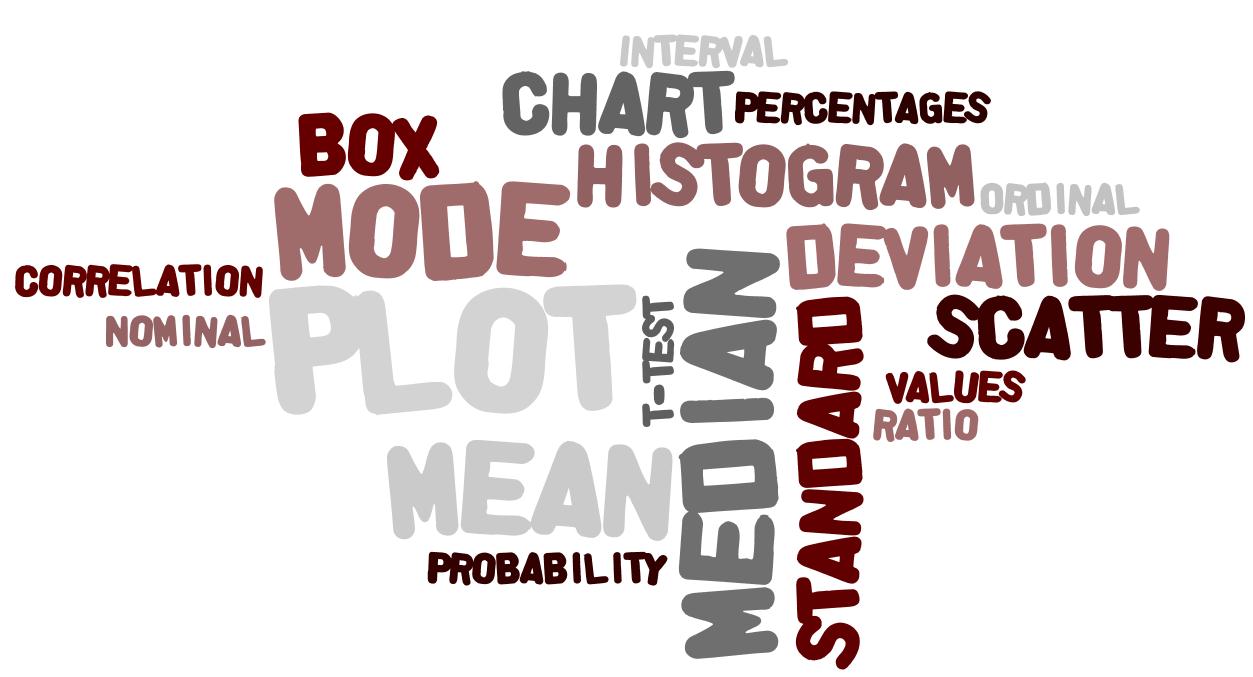
    <content type="html"><![CDATA[<p style="text-align:center;"><a href="http://processreview.files.wordpress.com/2013/01/wordle1.gif"><img class="alignnone size-medium wp-image-179" alt="wordle" src="http://processreview.files.wordpress.com/2013/01/wordle1.gif?w=428&#038;h=262" width="428" height="262" /></a></p>
<br />  <a rel="nofollow" href="http://feeds.wordpress.com/1.0/gocomments/processreview.wordpress.com/175/"><img alt="" border="0" src="http://feeds.wordpress.com/1.0/comments/processreview.wordpress.com/175/" /></a> <img alt="" border="0" src="http://stats.wordpress.com/b.gif?host=processreview.wordpress.com&#038;blog=36956633&#038;post=175&#038;subd=processreview&#038;ref=&#038;feed=1" width="1" height="1" />]]></content>
  </entry>
  <entry>
    <id>http://uclansp4collaboration.jiscinvolve.org/wp/?p=63</id>
    <title><![CDATA[Project update 18/01/13]]></title>
    <updated>2013-01-18T10:24:59+00:00</updated>
    <link rel="alternate" href="http://uclansp4collaboration.jiscinvolve.org/wp/2013/01/18/project-update-180113/"/>
    <summary><![CDATA[The facilitation of the annual monitoring process on SharePoint is progressing well and set to be released with the next cycle of annual monitoring. The organisation of meetings has hit a slight snag.  Microsoft have announced that in SharePoint 2013 they will not be using meeting spaces, which the project has based its processes around. [...]]]></summary>
    <content type="html"><![CDATA[<p>The facilitation of the annual monitoring process on SharePoint is progressing well and set to be released with the next cycle of annual monitoring.</p>
<p>The organisation of meetings has hit a slight snag.  Microsoft have announced that in SharePoint 2013 they will not be using meeting spaces, which the project has based its processes around.  The overall ethos of the process and recommendations are still sound, however it does highlight an issue with the reliance on technology.  This has triggered several discussions with the project and the Digital Services Team who are responsible for SharePoint.  These discussions have focuses on the challenges the university has faced migrating from SP 2007 to SP 2010, particularly with solutions that have been developed internally.  While some basic solutions developed will transfer with little issue, any solutions with coding will not migrate.</p>
<p>Therefore the approach is to try to meet the needs of the business with the functionality available on SharePoint out of the box and only if there is a significant and justifiable business need, will bespoke solutions be considered.   The SP Operational group are also considering the value of updating to the latest version of SP each time it is released.  The challenges not updating presents are the University’s policy is to have the latest up to date version of software to ensure students have  access to the most up to date software for employability purposes.</p>
<p>However, if we chose to not to update to the latest version of SharePoint then there could be potential issues with the integration with other MS Office packages such as word and excel.  There are also discussions as to whether there could be separate images for staff and students, however this poses the challenge for people who are both.</p>
<p>The project is now looking into alternative solutions to the meeting workspaces.</p>
]]></content>
  </entry>
  <entry>
    <id>http://uclanbusinessupgrade.jiscinvolve.org/wp/?p=67</id>
    <title><![CDATA[Project Update 18/01/13]]></title>
    <updated>2013-01-18T09:39:45+00:00</updated>
    <link rel="alternate" href="http://uclanbusinessupgrade.jiscinvolve.org/wp/2013/01/18/project-update-180113/"/>
    <summary><![CDATA[Activity with the project has picked up again since the Christmas break, the recommendations to the project board was converted into an actions lists and progress has been made. Action: Review Project Board Roles The project recognises that there may need to be some flexibility in the roles and structure of the project board depending [...]]]></summary>
    <content type="html"><![CDATA[<p>Activity with the project has picked up again since the Christmas break, the recommendations to the project board was converted into an actions lists and progress has been made.</p>
<p><strong>Action: Review Project Board Roles</strong></p>
<p>The project recognises that there may need to be some flexibility in the roles and structure of the project board depending on the size and nature of the project.  However, it is clear that the roles should be clarified and agreed to at the start of the project so all involved are aware of their responsibilities.  A template for a Project Board Charter and a Project Team Charter have been created.  This template includes the Terms of Reference for the Project Board , the suggested roles, the position (level, responsibility and area of the business) of the member of staff that should fill that role and their responsibilities.   A similar Project  Team Charter has also been created with the recommendation that the team should represent the Project Board at an operational level.</p>
<p><strong>Action: Change Management, Communications Policies</strong></p>
<p>It was noted when looking at change management and communication strategies that it was not possible to have one without the other and there was also a lot of cross over between the two with benefits realisation and stakeholder mapping.  Therefore a new template was created that takes the project manager through a series of stages that enable them to develop an effective change management and communication policy.</p>
<p>These stages are;</p>
<p>Phase one: Initial Analysis &#8211; this stage of the process considers the high level stakeholders and the potential benefits and impact of the project.  It is intended to be an initial consideration of the project deliverables  and the intended benefits.  This stage uses the e3 Benefits grid.</p>
<p>Phase two: Communication Strategy</p>
<p>The initial analysis identifies the stakeholders and the plan of how the project should be communication to them can start to form this is table based and considered; the stakeholder, their required involvement in the project, how the deliverables will affect them, the key messages they need to receive and the method with rough timings.</p>
<p>Phase three: Benefits Mapping</p>
<p>Once the project manager has considered the benefits to the stakeholders, and has identified the high level benefits of the project in the PID, it is time to tie them up with a benefits map.  This is a useful exercise to undertake with the Project Board or key stakeholders in the project to really focus them on the benefits of the project deliverables rather than the project itself.  Benefits mapping as presented by Niki Rogers at the EA workshops is used at this stage.  The intent is to link the deliverables from the project to the interim / immediate benefits through to the end benefits and ultimately the strategic objectives.</p>
<p>&nbsp;</p>
<p>Phase four:  Change management strategy</p>
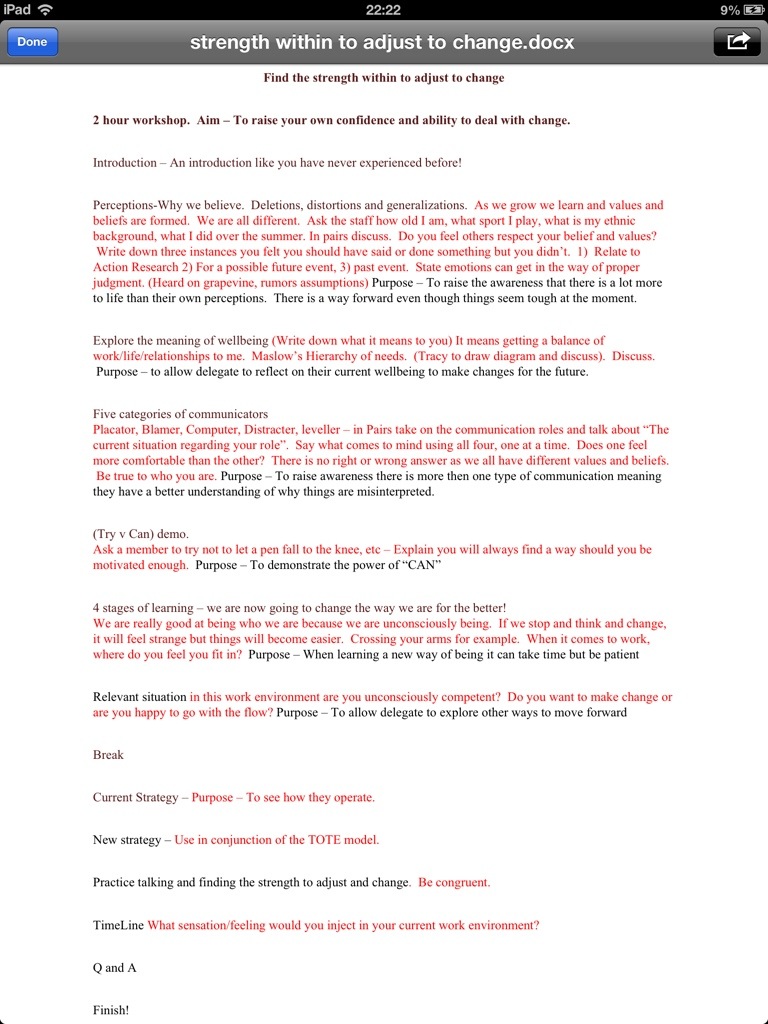
<p>This was influenced by the JISC InfoNet Chanage Manage workshop the project manager attended. Project outputs often impact a range of staff across the institution, requiring their involvement from strategic leadership to operational engagement.   Effective change management can ensure that buy-in is secured from relevant stakeholders to achieve successful delivery and implementation of project outputs.  The impact of the people’s attitudes and behaviour on projects, their deliverables and on-going benefits should not be underestimated. <strong></strong></p>
<p>This document should be used to plan a change management strategy, to be implemented and refined throughout a project’s lifecycle to help achieve successful delivery.</p>
<p><strong> </strong>Successful change management requires an understanding of a project’s stakeholders beyond high level impact or involvement required.  In addition it is important to be aware that people in a group of stakeholders are likely to react differently to a project and it is important to consider the roles within the stakeholder group, for example within the “academics” group there are course leaders, Principle Lecturers, Lecturers, Ad Hoc Lecturers who may need to be considered separately.  You may also find that you need to consider individuals as the project progresses, particularly when if they are a key influencer or have the potential to be a champion.</p>
<p>When analysing stakeholders, a project should consider;</p>
<ul>
<li>Who are the influencers and who they influence</li>
<li>What reaction individuals are likely to have to the change</li>
<li>What barriers might there be to individuals buying into the change</li>
<li>How can those barriers be addressed</li>
<li>What benefits will there be to the individual – not just the benefits to the university</li>
<li>What activities may be required to secure buy-in</li>
<li>Identify if there are any groups that are likely to produce a change champion</li>
</ul>
<p>A table sis used to capture the stakeholder, how they can be influenced, who they influence, what barriers they might perceive to engaging, if any individuals should be targeted and potential activities.</p>
<p>In addition the template includes a table for capturing potential change champions throughout the project.</p>
<p>Phase five: Communication and Change Management Plan</p>
<p>This is the key section of the document and is an amalgamation of the information captured in the phases above.  It is suggested that project managers may wish to embed this in their MS Project plan rather than a separate table.   The table includes timing, activity, key message, target audience and who the task is assigned to.</p>
<p>In addition recommendations are being made as to the layout and content of project sites on the intranet to ensure consistent communication about the project.</p>
<p>Action: Project Close down</p>
<p>New documents have been developed outlining the requirements for owners of project deliverables and their responsibilities.</p>
<p>In addition to the actions above a new process is being introduced for the new round of strategic projects that are just starting.  This is a gate process and outlines requirements the projects have to meet to progress through each gate.</p>
<p>These documents are subject to approval from the board but will be released with the project outputs.</p>
]]></content>
  </entry>
  <entry>
    <id>http://cubusinessengagement.jiscinvolve.org/wp/?p=55</id>
    <title><![CDATA[Action Learning Sets: Number Three]]></title>
    <updated>2013-01-18T08:00:04+00:00</updated>
    <link rel="alternate" href="http://cubusinessengagement.jiscinvolve.org/wp/2013/01/18/action-learning-sets-number-three/"/>
    <summary><![CDATA[Last Friday I participated in my third Action Learning Set. I have to admit I was skeptical about how useful these would be when we were first asked to participate in them but they&#8217;re actually incredibly helpful &#8211; for both reassurance and shared learning. We spent a lot of time in this session talking about [...]]]></summary>
    <content type="html"><![CDATA[<p>Last Friday I participated in my third Action Learning Set. I have to admit I was skeptical about how useful these would be when we were first asked to participate in them but they&#8217;re actually incredibly helpful &#8211; for both reassurance and shared learning.</p>
<p>We spent a lot of time in this session talking about ensuring our projects are sustainable, that they have an impact that goes beyond the life of the project and that they become part of what your Institution does in the long term. In fact when I first started this project my biggest concern was how I could turn a relatively small project into real institutional change. I&#8217;ve been lucky however in that my work has coincided with two things: the design of a brand new Coventry University, designed to be much more social and the arrival of our new Marketing &amp; Communications Director, who is very keen to make the University a leader in social media. This project is of course about business engagement which is <strong>not</strong> the same thing as marketing but it&#8217;s encouraging to see the University dedicating more resource to supporting social media &#8211; this makes me very optimistic that my work will have a life beyond the end of this project.</p>
<p>We also spent a bit of time talking about some of the outcomes we have to deliver as part of our funding agreements with Jisc &#8211; both a written and a video case study. I have to admit I haven&#8217;t spent much time thinking about either so far which means my key actions from this Action Learning Set are as follows:</p>
<ul>
<li>Start working on written case study template as provided by Jisc</li>
<li>Begin planning video case study, including thinking about other people who could participate</li>
</ul>
<p>I also want to continue to think about ensuring the sustainability of the project by getting other members of our business development staff involved with using social media to engage with businesses. We also briefly discussed social media policies and whether they need to be tailored to suit specific activities so this will be something I take forwards as we start to use social media in a business context.</p>
<p>&nbsp;</p>
]]></content>
  </entry>
  <entry>
    <id>http://processreview.wordpress.com/?p=181</id>
    <title><![CDATA[Jisc Enterprise Architecture, Emerging Practices Webinar (16th January)]]></title>
    <updated>2013-01-17T09:27:31+00:00</updated>
    <link rel="alternate" href="http://processreview.wordpress.com/2013/01/17/jisc-enterprise-architecture-emerging-practices-webinar-16th-january/"/>
    <summary><![CDATA[The outcomes of the Process Review project were presented as part of the Jisc Emerging Practices series of webinar, taking an enterprise architecture perspective. JISC EA presentation<img alt="" border="0" src="http://stats.wordpress.com/b.gif?host=processreview.wordpress.com&#038;blog=36956633&#038;post=181&#038;subd=processreview&#038;ref=&#038;feed=1" width="1" height="1" />]]></summary>
    <content type="html"><![CDATA[<p>The outcomes of the Process Review project were presented as part of the Jisc Emerging Practices series of webinar, taking an <a href="http://emergingpractices.jiscinvolve.org/wp/webinar-applying-ea/">enterprise architecture perspective</a>.</p>
<p><a href="http://processreview.files.wordpress.com/2013/01/jisc-ea-presentation.pptx">JISC EA presentation</a></p>
<br />  <a rel="nofollow" href="http://feeds.wordpress.com/1.0/gocomments/processreview.wordpress.com/181/"><img alt="" border="0" src="http://feeds.wordpress.com/1.0/comments/processreview.wordpress.com/181/" /></a> <img alt="" border="0" src="http://stats.wordpress.com/b.gif?host=processreview.wordpress.com&#038;blog=36956633&#038;post=181&#038;subd=processreview&#038;ref=&#038;feed=1" width="1" height="1" />]]></content>
  </entry>
  <entry>
    <id>http://collab.northumbria.ac.uk/esubmit/?p=213</id>
    <title><![CDATA[Proof of Concept Feedback]]></title>
    <updated>2013-01-16T15:29:41+00:00</updated>
    <link rel="alternate" href="http://collab.northumbria.ac.uk/esubmit/?p=213"/>
    <summary><![CDATA[We met with colleagues undertaking proof of concept work today. Proof of concept work was undertaken in December 2012 and January 2013 by a number of academic and administrative staff with experience of various aspects of electronic assessment as well as Students’ Union representatives. Staff involved given full access to the eSAM tool that had [...]]]></summary>
    <content type="html"><![CDATA[<p>We met with colleagues undertaking proof of concept work today. Proof of concept work was undertaken in December 2012 and January 2013 by a number of academic and administrative staff with experience of various aspects of electronic assessment as well as Students’ Union representatives. Staff involved given full access to the eSAM tool that had been populated with both dummy students and dummy modules. Students’ Union representatives were able to view assignment submission method plus provision of assignment feedback.</p>
<p>Feedback was provided in two ways. Firstly by completion of a short questionnaire asking three questions:</p>
<ol>
<li>What was good about the tool?</li>
<li>How can the tool be improved?</li>
<li>Did you find any aspects of the tool not working or appear confusing?</li>
</ol>
<p>Secondly by a face to face meeting that enabled colleagues expand on comments made in the questionnaire.</p>
<p>Overall feedback has been very positive, with all involved believing the eSAM tool provided a range of appropriate functionality for submission, marking, feedback provision and management of assignments. A small number of technical faults were discovered, though a number of these relate to the SITS integration that was not used for the pilot. No major functionality issues identified and all able to use the tool once became familiar with a technology reviewers had not previously used.</p>
<p>A number of enhancements to the tool were suggested, including:</p>
<ul>
<li> A student guide to file conversion</li>
<li>Any file type option</li>
<li>The ability to extract information about student groups from Timetabling software when allocating markers</li>
<li>Formative assessment has ‘feedback only’ option</li>
<li>Extension detail confidentiality message</li>
<li>The ability to block Late Approved submissions when  supporting evidence has not been submitted</li>
<li>Marking scheme same as SITS, no decimals or 9s for summative assessments</li>
<li>Marker &amp; Faculty Office e-mail alert when mark submission due date imminent</li>
<li>The error messages to contain an explanation of the fault plus guidance on solution/help</li>
</ul>
<p>Not only did all concerned provide positive feedback, but also expressed the opinion that both technical development work and staff/student preparation should continue with a view to conducting initial pilot work in 2012/13 and then more extensive use of the eSAM tool in September 2013 onwards.</p>
]]></content>
  </entry>
  <entry>
    <id>http://ucfsvap.jiscinvolve.org/wp/?p=78</id>
    <title><![CDATA[Workshop Vision]]></title>
    <updated>2013-01-16T12:31:47+00:00</updated>
    <link rel="alternate" href="http://ucfsvap.jiscinvolve.org/wp/2013/01/16/workshop-vision/"/>
    <summary><![CDATA[A number of project workshops were undertaken through the first weeks of January to establish the cross service vision for the new IT system. The dissemination of information relating to the project, capture of ideas and establishment of stakeholder buy in were important elements running through them. The workshops were attended by 10-20 members of  the student support service staff at a time under the [...]]]></summary>
    <content type="html"><![CDATA[<p>A number of project workshops were undertaken through the first weeks of January to establish the cross service vision for the new IT system. The dissemination of information relating to the project, capture of ideas and establishment of stakeholder buy in were important elements running through them. The workshops were attended by 10-20 members of  the student support service staff at a time under the following session banners:</p>
<ul>
<li>Overview and objectives of the project, review of services&#8217; and service requirements</li>
<li>Breakout groups on defining generic cross service sub processes</li>
<li>Future Process / Vision</li>
</ul>
<p> Some important key points and themes were formulated and presented in the last session:</p>
<ul>
<li>Full integration of elements delivered by separate services is possible</li>
<li>Keeping a Personal feeling in delivery of services is important</li>
<li>Requirements surrounding confidentiality and visibility of information is complex and needs to be service specific</li>
<li>Many Services might benefit from the reduction in manual data inputting</li>
<li>Improved Management Information will further benefit all services</li>
</ul>
<p> These key points and themes are the basis for the future requirements. The outputs from the workshops will form the future requirements used to procure the new system.</p>
]]></content>
  </entry>
  <entry>
    <id>https://processreview.wordpress.com/?p=105</id>
    <title><![CDATA[Outcomes]]></title>
    <updated>2013-01-15T15:00:57+00:00</updated>
    <link rel="alternate" href="http://processreview.wordpress.com/2013/01/15/celebrating-success/"/>
    <summary><![CDATA[Each action research group is at a different stage in terms of outcomes for their process review. Applications Process To date, this group have achieved the following: Mapped the orginal process on paper Mapped the process digitally Agreed on elements for &#8230; <a href="http://processreview.wordpress.com/2013/01/15/celebrating-success/">Continue reading <span class="meta-nav">&#8594;</span></a><img alt="" border="0" src="http://stats.wordpress.com/b.gif?host=processreview.wordpress.com&#038;blog=36956633&#038;post=105&#038;subd=processreview&#038;ref=&#038;feed=1" width="1" height="1" />]]></summary>
    <content type="html"><![CDATA[<p>Each action research group is at a different stage in terms of outcomes for their process review.</p>
<p><strong>Applications Process</strong></p>
<p>To date, this group have achieved the following:</p>
<ul>
<li>Mapped the orginal process on paper</li>
<li>Mapped the process digitally</li>
<li>Agreed on elements for enhancement</li>
<li>Invited the Admissions Team Leader to review the proposed enhancements</li>
<li>Remapped the process digitally following further adjustments.</li>
</ul>
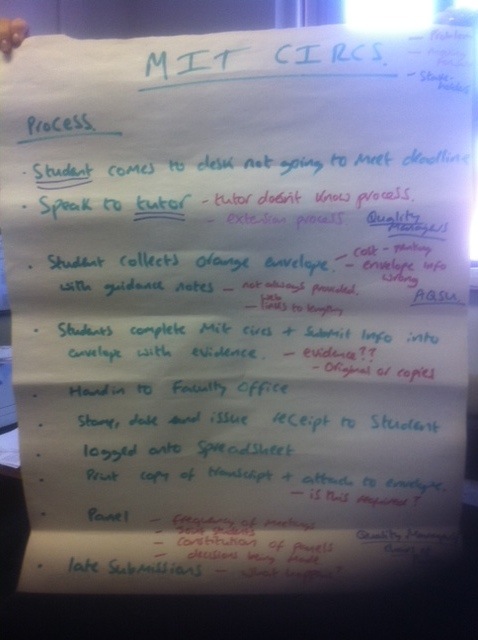
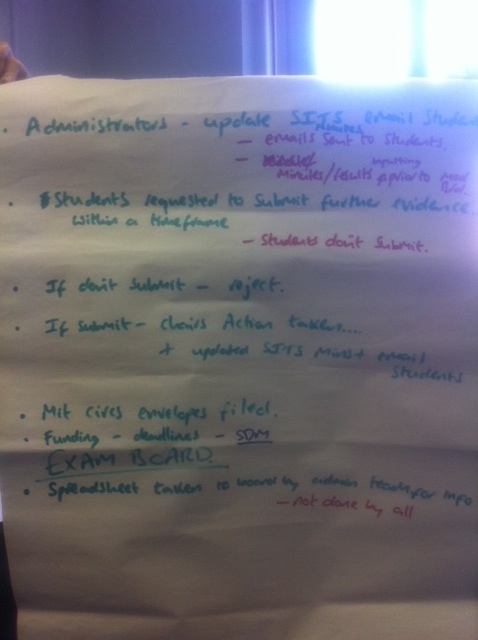
<p>The process has now been modified and has evolved from being a predominantly manual administrative process to a virtually online process.  This has been made possible by incorporating application and interview details for prospective students in the SITS Student Database and then running a report through Microsoft Reporting Services that sends a weekly email to all those involved in student recruitment to allow them to view current application and recruitment data.  It is then possible for those involoved to enter data, via an online portal, to indicate success of application, and associated information, which is captured and imported into the student database automatically.</p>
<p>Following this change, all those administrators and academics involved with interviewing and processing applications for prospective students have undertaken training.</p>
<p>The following documents were used in the training, to provide a simple explanation of the old and new process.</p>
<p><a href="http://processreview.files.wordpress.com/2013/01/course-outline.docx">Course outline</a></p>
<p><a href="http://processreview.files.wordpress.com/2013/01/interviewing-course-application-process-2013-141.docx">Interviewing/Application Process 2013-14</a></p>
<p><a href="http://processreview.files.wordpress.com/2013/01/activities-associated-with-interviewing.pptx">Activities associated with applications and interviewing</a></p>
<p><strong>Mitigating Circumstances Process</strong></p>
<p>??????????</p>
<p><strong>Exam Board Process</strong></p>
<p>To date, this group have achieved the following:</p>
<ul>
<li>Mapped the orginal process on paper</li>
<li>Mapped the process digitally</li>
<li>Agreed on elements for enhancement</li>
</ul>
<p>The work of this action research group can not be concluded at this time, as their proposals involved potential modifications to the database software used to display and record exam board activities and this was not seen as a business critical area for review at this time.   Another contributing factor that has caused the research to be halted is the changing positions and roles of the identified stakeholders due to restructuring activities.</p>
<br />  <a rel="nofollow" href="http://feeds.wordpress.com/1.0/gocomments/processreview.wordpress.com/105/"><img alt="" border="0" src="http://feeds.wordpress.com/1.0/comments/processreview.wordpress.com/105/" /></a> <img alt="" border="0" src="http://stats.wordpress.com/b.gif?host=processreview.wordpress.com&#038;blog=36956633&#038;post=105&#038;subd=processreview&#038;ref=&#038;feed=1" width="1" height="1" />]]></content>
  </entry>
  <entry>
    <id>http://killawhats.co.uk/?p=187</id>
    <title><![CDATA[Cool and the Gang…..]]></title>
    <updated>2013-01-15T13:49:59+00:00</updated>
    <link rel="alternate" href="http://killawhats.co.uk/2013/01/15/cool-and-the-gang/"/>
    <summary><![CDATA[With the festive break over, and many new resolutions being adhered to (!), we have been busy making progress with Killawhats so read on…… The design requirements phase of Killawhats is complete after a rigorous analysis of the large corpus of design challenge data using a thematic analysis approach. The design data was produced by [...]]]></summary>
    <content type="html"><![CDATA[<p>With the festive break over, and many new resolutions being adhered to (!), we have been busy making progress with Killawhats so read on……</p>
<p>The design requirements phase of Killawhats is complete after a rigorous analysis of the large corpus of design challenge data using a thematic analysis approach. The design data was produced by participants in workshops, focus groups, interviews and surveys by over 100 students. Quality of the work produced was excellent and really helped to focus the requirements for the Killawhats intervention. Some examples of participant’s paper-prototyping sessions are below:</p>
<p><a href="http://killawhats.co.uk/wp-content/uploads/2013/01/DSC00158.jpg"><img class="aligncenter size-medium wp-image-188" title="DSC00158" src="http://killawhats.co.uk/wp-content/uploads/2013/01/DSC00158-300x285.jpg" alt="" width="300" height="285" /></a></p>
<p><a href="http://killawhats.co.uk/wp-content/uploads/2013/01/20121115_114133.jpg"><img class="aligncenter size-medium wp-image-189" title="20121115_114133" src="http://killawhats.co.uk/wp-content/uploads/2013/01/20121115_114133-300x233.jpg" alt="" width="300" height="233" /></a></p>
<p>Our findings from the thematic analysis formed the basis of an academic paper and poster we submitted to the CHI2013 conference to be held this April in Paris. Abstract of the paper:</p>
<p><em>“Interventions that aim to motivate students in halls of residence to engage in more eco-friendly behaviour face a number of unique problems. Specifically, a large portion of university accommodation provides utilities such as electricity, water and gas at fixed cost as part of tenancy contracts. In the absence of financial motivators, energy interventions for special groups such as students require a stronger focus on participatory and experience design to understand the design implications of successful technology-led energy interventions. This work presents the findings of a thematic analysis drawn from a large corpus of qualitative design challenge data including focus groups, questionnaires and interviews. Findings provided design insights for developing ‘cool’ and engaging energy interventions for students.”</em></p>
<p><a href="http://killawhats.co.uk/wp-content/uploads/2013/01/cool-and-the-gang-wip-poster-final_001.png"><img class="aligncenter size-full wp-image-190" title="cool and the gang wip poster final_001" src="http://killawhats.co.uk/wp-content/uploads/2013/01/cool-and-the-gang-wip-poster-final_001.png" alt="" width="596" height="843" /></a></p>
<p>The paper is currently under peer review; if you want to read the draft version of the paper in full then please download from <a href="https://dl.dropbox.com/u/10138924/Papers%20-%20Public/cool%20and%20the%20gang%20DRAFT_Derek%20foster.pdf" target="_blank">here</a>. The main findings of the paper provided us with four main design guidelines with eleven sub-themes, on which to base the Killawhats intervention trials on, see diagram below:</p>
<p><a href="http://killawhats.co.uk/wp-content/uploads/2013/01/killawhats-poster_test.png"><img class="aligncenter size-medium wp-image-191" title="killawhats poster_test" src="http://killawhats.co.uk/wp-content/uploads/2013/01/killawhats-poster_test-300x265.png" alt="" width="300" height="265" /></a></p>
<p>&nbsp;</p>
<p>Smart Meters</p>
<p>Our smart meter infrastructure on the Lincoln campus underwent a large refurbishment program throughout December and is due to go live any day now. There are residual issues with smart meter data reporting at the moment but this should be resolved imminently. As soon as we have reliable data from the smart meters we will be moving to the intervention trial stage of the project.</p>
]]></content>
  </entry>
  <entry>
    <id>http://cubusinessengagement.jiscinvolve.org/wp/?p=53</id>
    <title><![CDATA[Happy New Year!]]></title>
    <updated>2013-01-11T09:22:38+00:00</updated>
    <link rel="alternate" href="http://cubusinessengagement.jiscinvolve.org/wp/2013/01/11/happy-new-year/"/>
    <summary><![CDATA[It&#8217;s been a pretty busy start to the year here at Coventry, I&#8217;ve already had three meetings with our Marketing team to discuss implementation of some of the key actions from last year&#8217;s Focus Group and I&#8217;ve commissioned a couple of pieces of physical marketing material which incorporate some interactive and virtual reality elements. We [...]]]></summary>
    <content type="html"><![CDATA[<p>It&#8217;s been a pretty busy start to the year here at Coventry, I&#8217;ve already had three meetings with our Marketing team to discuss implementation of some of the key actions from last year&#8217;s Focus Group and I&#8217;ve commissioned a couple of pieces of physical marketing material which incorporate some interactive and virtual reality elements. We should hopefully have these available to use by next month.</p>
<p>In terms of social media I have a plan of action for both Twitter and LinkedIn, in both instances using the University&#8217;s existing official accounts to start to engage more business followers. I&#8217;m going to start actually adding content from next week, primarily using Twitter in the first instance and then moving on to LinkedIn as this is part of a larger strategy being developed by our marketing department.</p>
<p>Watch this space for further developments!</p>
]]></content>
  </entry>
  <entry>
    <id>http://glamorganeportfolios.wordpress.com/?p=141</id>
    <title><![CDATA[New Year – but time is passing!]]></title>
    <updated>2013-01-10T16:02:40+00:00</updated>
    <link rel="alternate" href="http://glamorganeportfolios.wordpress.com/2013/01/10/new-year-but-time-is-passing/"/>
    <summary><![CDATA[It&#8217;s been a busy time since I last posted about the project with a focus on getting students to start to use the e-portfolio and thinking about the most appropriate input for employers. It&#8217;s not been easy, I must admit, &#8230; <a href="http://glamorganeportfolios.wordpress.com/2013/01/10/new-year-but-time-is-passing/">Continue reading <span class="meta-nav">&#8594;</span></a><img alt="" border="0" src="http://stats.wordpress.com/b.gif?host=glamorganeportfolios.wordpress.com&#038;blog=36131506&#038;post=141&#038;subd=glamorganeportfolios&#038;ref=&#038;feed=1" width="1" height="1" />]]></summary>
    <content type="html"><![CDATA[<p>It&#8217;s been a busy time since I last posted about the project with a focus on getting students to start to use the e-portfolio and thinking about the most appropriate input for employers. It&#8217;s not been easy, I must admit, but we&#8217;ve now got some focus groups with students lined up over the next few weeks and I&#8217;m working with some colleagues on developing a model for employers to come and deliver some workshops to students in particular subject areas on the sorts of things they might be looking for when recruiting graduates.</p>
<p>Watch this space for feedback from both students and employers!</p>
<br />  <a rel="nofollow" href="http://feeds.wordpress.com/1.0/gocomments/glamorganeportfolios.wordpress.com/141/"><img alt="" border="0" src="http://feeds.wordpress.com/1.0/comments/glamorganeportfolios.wordpress.com/141/" /></a> <img alt="" border="0" src="http://stats.wordpress.com/b.gif?host=glamorganeportfolios.wordpress.com&#038;blog=36131506&#038;post=141&#038;subd=glamorganeportfolios&#038;ref=&#038;feed=1" width="1" height="1" />]]></content>
  </entry>
  <entry>
    <id>http://newsamnews.ioe.ac.uk/?p=4034</id>
    <title><![CDATA[Meta-morphosis: what’s the plan?]]></title>
    <updated>2013-01-10T15:50:43+00:00</updated>
    <link rel="alternate" href="http://newsamnews.ioe.ac.uk/?p=4034"/>
    <summary><![CDATA[It&#8217;s that time of year where we regroup after Christmas and take stock of progress during the past six months. We have spent much of that time completing pilots, attempting to customise our software and attending JISC mash-up sessions. In the main, however, the team has been reading extensively around the subject to try and [...]]]></summary>
    <content type="html"><![CDATA[<p>It&#8217;s that time of year where we regroup after Christmas and take stock of progress during the past six months. We have spent much of that time completing pilots, attempting to customise our software and attending JISC mash-up sessions. In the main, however, the team has been reading extensively around the subject to try and garner as much knowledge as possible from the various guidelines, toolkits, workbooks and case studies already written on the subject of digital archives.</p>
<p>The time has now come to begin creating detailed guidance and procedures for our archive depositors, both present and future, who wish to give us digital material. During the next three or four months we will be creating:</p>
<p>Revised donation and deposit agreements for archive material. These are the standard agreements signed by anyone that gives us their archive, which will now have to incorporate clauses relating to the ownership and preservation of, and access to, digital materials.</p>
<p>An additional guideline document for depositors with regard to their digital archives, which will include: initial questions and considerations around issues such as size, format, hardware and software; actions to undertake before the material can pass to the archive; and an outline of what the Institute of Education will be able to take.</p>
<p>A step-by-step procedural document for the intake and processing of digital materials by archive staff &#8211; in other words, the workflow for taking them into the Archive.</p>
<p>A metadata template to give to depositors incorporating all the fields the archivists need to add digital materials to CALM and e-prints.</p>
<p>Naming convention and version control guidance for depositors.</p>
<p>As a final output, the Archive team hope to write a detailed LibGuide containing all the information required by potential depositors when they give us their paper, hybrid and digital archive collections.</p>
<p>It all sounds like a lot of hard work and no doubt the documents will be revised and altered many times in the weeks and months to come, but it really feels like the JISC Transformations project will result in a fantastic set of guidelines and best practice. We&#8217;ll keep you posted.</p>
]]></content>
  </entry>
  <entry>
    <id>tag:blogger.com,1999:blog-4605249455692956519.post-1641904316803971975</id>
    <title><![CDATA[Let’s ALL make mentoring better]]></title>
    <updated>2013-01-10T14:20:00+00:00</updated>
    <link rel="alternate" href="http://makingmentoringbetter.blogspot.com/2013/01/lets-all-make-mentoring-better.html"/>
    <summary><![CDATA[<!--[if gte mso 9]><xml> <o:OfficeDocumentSettings>  <o:AllowPNG/> </o:OfficeDocumentSettings></xml><![endif]--><br /><!--[if gte mso 9]><xml> <w:WordDocument>  <w:View>Normal</w:View>  <w:Zoom>0</w:Zoom>  <w:TrackMoves/>  <w:TrackFormatting/>  <w:PunctuationKerning/>  <w:ValidateAgainstSchemas/>  <w:SaveIfXMLInvalid>false</w:SaveIfXMLInvalid>  <w:IgnoreMixedContent>false</w:IgnoreMixedContent>  <w:AlwaysShowPlaceholderText>false</w:AlwaysShowPlaceholderText>  <w:DoNotPromoteQF/>  <w:LidThemeOther>EN-GB</w:LidThemeOther>  <w:LidThemeAsian>X-NONE</w:LidThemeAsian>  <w:LidThemeComplexScript>X-NONE</w:LidThemeComplexScript>  <w:Compatibility>   <w:BreakWrappedTables/>   <w:SnapToGridInCell/>   <w:WrapTextWithPunct/>   <w:UseAsianBreakRules/>   <w:DontGrowAutofit/>   <w:SplitPgBreakAndParaMark/>   <w:EnableOpenTypeKerning/>   <w:DontFlipMirrorIndents/>   <w:OverrideTableStyleHps/>  </w:Compatibility>  <m:mathPr>   <m:mathFont m:val="Cambria Math"/>   <m:brkBin m:val="before"/>   <m:brkBinSub m:val="&#45;-"/>   <m:smallFrac m:val="off"/>   <m:dispDef/>   <m:lMargin m:val="0"/>   <m:rMargin m:val="0"/>   <m:defJc m:val="centerGroup"/>   <m:wrapIndent m:val="1440"/>   <m:intLim m:val="subSup"/>   <m:naryLim m:val="undOvr"/>  </m:mathPr></w:WordDocument></xml><![endif]--><!--[if gte mso 9]><xml> <w:LatentStyles DefLockedState="false" DefUnhideWhenUsed="true"   DefSemiHidden="true" DefQFormat="false" DefPriority="99"   LatentStyleCount="267">  <w:LsdException Locked="false" Priority="0" SemiHidden="false"    UnhideWhenUsed="false" QFormat="true" Name="Normal"/>  <w:LsdException Locked="false" Priority="9" SemiHidden="false"    UnhideWhenUsed="false" QFormat="true" Name="heading 1"/>  <w:LsdException Locked="false" Priority="9" QFormat="true" Name="heading 2"/>  <w:LsdException Locked="false" Priority="9" QFormat="true" Name="heading 3"/>  <w:LsdException Locked="false" Priority="9" QFormat="true" Name="heading 4"/>  <w:LsdException Locked="false" Priority="9" QFormat="true" Name="heading 5"/>  <w:LsdException Locked="false" Priority="9" QFormat="true" Name="heading 6"/>  <w:LsdException Locked="false" Priority="9" QFormat="true" Name="heading 7"/>  <w:LsdException Locked="false" Priority="9" QFormat="true" Name="heading 8"/>  <w:LsdException Locked="false" Priority="9" QFormat="true" Name="heading 9"/>  <w:LsdException Locked="false" Priority="39" Name="toc 1"/>  <w:LsdException Locked="false" Priority="39" Name="toc 2"/>  <w:LsdException Locked="false" Priority="39" Name="toc 3"/>  <w:LsdException Locked="false" Priority="39" Name="toc 4"/>  <w:LsdException Locked="false" Priority="39" Name="toc 5"/>  <w:LsdException Locked="false" Priority="39" Name="toc 6"/>  <w:LsdException Locked="false" Priority="39" Name="toc 7"/>  <w:LsdException Locked="false" Priority="39" Name="toc 8"/>  <w:LsdException Locked="false" Priority="39" Name="toc 9"/>  <w:LsdException Locked="false" Priority="35" QFormat="true" Name="caption"/>  <w:LsdException Locked="false" Priority="10" SemiHidden="false"    UnhideWhenUsed="false" QFormat="true" Name="Title"/>  <w:LsdException Locked="false" Priority="1" Name="Default Paragraph Font"/>  <w:LsdException Locked="false" Priority="11" SemiHidden="false"    UnhideWhenUsed="false" QFormat="true" Name="Subtitle"/>  <w:LsdException Locked="false" Priority="22" SemiHidden="false"    UnhideWhenUsed="false" QFormat="true" Name="Strong"/>  <w:LsdException Locked="false" Priority="20" SemiHidden="false"    UnhideWhenUsed="false" QFormat="true" Name="Emphasis"/>  <w:LsdException Locked="false" Priority="59" SemiHidden="false"    UnhideWhenUsed="false" Name="Table Grid"/>  <w:LsdException Locked="false" UnhideWhenUsed="false" Name="Placeholder Text"/>  <w:LsdException Locked="false" Priority="1" SemiHidden="false"    UnhideWhenUsed="false" QFormat="true" Name="No Spacing"/>  <w:LsdException Locked="false" Priority="60" SemiHidden="false"    UnhideWhenUsed="false" Name="Light Shading"/>  <w:LsdException Locked="false" Priority="61" SemiHidden="false"    UnhideWhenUsed="false" Name="Light List"/>  <w:LsdException Locked="false" Priority="62" SemiHidden="false"    UnhideWhenUsed="false" Name="Light Grid"/>  <w:LsdException Locked="false" Priority="63" SemiHidden="false"    UnhideWhenUsed="false" Name="Medium Shading 1"/>  <w:LsdException Locked="false" Priority="64" SemiHidden="false"    UnhideWhenUsed="false" Name="Medium Shading 2"/>  <w:LsdException Locked="false" Priority="65" SemiHidden="false"    UnhideWhenUsed="false" Name="Medium List 1"/>  <w:LsdException Locked="false" Priority="66" SemiHidden="false"    UnhideWhenUsed="false" Name="Medium List 2"/>  <w:LsdException Locked="false" Priority="67" SemiHidden="false"    UnhideWhenUsed="false" Name="Medium Grid 1"/>  <w:LsdException Locked="false" Priority="68" SemiHidden="false"    UnhideWhenUsed="false" Name="Medium Grid 2"/>  <w:LsdException Locked="false" Priority="69" SemiHidden="false"    UnhideWhenUsed="false" Name="Medium Grid 3"/>  <w:LsdException Locked="false" Priority="70" SemiHidden="false"    UnhideWhenUsed="false" Name="Dark List"/>  <w:LsdException Locked="false" Priority="71" SemiHidden="false"    UnhideWhenUsed="false" Name="Colorful Shading"/>  <w:LsdException Locked="false" Priority="72" SemiHidden="false"    UnhideWhenUsed="false" Name="Colorful List"/>  <w:LsdException Locked="false" Priority="73" SemiHidden="false"    UnhideWhenUsed="false" Name="Colorful Grid"/>  <w:LsdException Locked="false" Priority="60" SemiHidden="false"    UnhideWhenUsed="false" Name="Light Shading Accent 1"/>  <w:LsdException Locked="false" Priority="61" SemiHidden="false"    UnhideWhenUsed="false" Name="Light List Accent 1"/>  <w:LsdException Locked="false" Priority="62" SemiHidden="false"    UnhideWhenUsed="false" Name="Light Grid Accent 1"/>  <w:LsdException Locked="false" Priority="63" SemiHidden="false"    UnhideWhenUsed="false" Name="Medium Shading 1 Accent 1"/>  <w:LsdException Locked="false" Priority="64" SemiHidden="false"    UnhideWhenUsed="false" Name="Medium Shading 2 Accent 1"/>  <w:LsdException Locked="false" Priority="65" SemiHidden="false"    UnhideWhenUsed="false" Name="Medium List 1 Accent 1"/>  <w:LsdException Locked="false" UnhideWhenUsed="false" Name="Revision"/>  <w:LsdException Locked="false" Priority="34" SemiHidden="false"    UnhideWhenUsed="false" QFormat="true" Name="List Paragraph"/>  <w:LsdException Locked="false" Priority="29" SemiHidden="false"    UnhideWhenUsed="false" QFormat="true" Name="Quote"/>  <w:LsdException Locked="false" Priority="30" SemiHidden="false"    UnhideWhenUsed="false" QFormat="true" Name="Intense Quote"/>  <w:LsdException Locked="false" Priority="66" SemiHidden="false"    UnhideWhenUsed="false" Name="Medium List 2 Accent 1"/>  <w:LsdException Locked="false" Priority="67" SemiHidden="false"    UnhideWhenUsed="false" Name="Medium Grid 1 Accent 1"/>  <w:LsdException Locked="false" Priority="68" SemiHidden="false"    UnhideWhenUsed="false" Name="Medium Grid 2 Accent 1"/>  <w:LsdException Locked="false" Priority="69" SemiHidden="false"    UnhideWhenUsed="false" Name="Medium Grid 3 Accent 1"/>  <w:LsdException Locked="false" Priority="70" SemiHidden="false"    UnhideWhenUsed="false" Name="Dark List Accent 1"/>  <w:LsdException Locked="false" Priority="71" SemiHidden="false"    UnhideWhenUsed="false" Name="Colorful Shading Accent 1"/>  <w:LsdException Locked="false" Priority="72" SemiHidden="false"    UnhideWhenUsed="false" Name="Colorful List Accent 1"/>  <w:LsdException Locked="false" Priority="73" SemiHidden="false"    UnhideWhenUsed="false" Name="Colorful Grid Accent 1"/>  <w:LsdException Locked="false" Priority="60" SemiHidden="false"    UnhideWhenUsed="false" Name="Light Shading Accent 2"/>  <w:LsdException Locked="false" Priority="61" SemiHidden="false"    UnhideWhenUsed="false" Name="Light List Accent 2"/>  <w:LsdException Locked="false" Priority="62" SemiHidden="false"    UnhideWhenUsed="false" Name="Light Grid Accent 2"/>  <w:LsdException Locked="false" Priority="63" SemiHidden="false"    UnhideWhenUsed="false" Name="Medium Shading 1 Accent 2"/>  <w:LsdException Locked="false" Priority="64" SemiHidden="false"    UnhideWhenUsed="false" Name="Medium Shading 2 Accent 2"/>  <w:LsdException Locked="false" Priority="65" SemiHidden="false"    UnhideWhenUsed="false" Name="Medium List 1 Accent 2"/>  <w:LsdException Locked="false" Priority="66" SemiHidden="false"    UnhideWhenUsed="false" Name="Medium List 2 Accent 2"/>  <w:LsdException Locked="false" Priority="67" SemiHidden="false"    UnhideWhenUsed="false" Name="Medium Grid 1 Accent 2"/>  <w:LsdException Locked="false" Priority="68" SemiHidden="false"    UnhideWhenUsed="false" Name="Medium Grid 2 Accent 2"/>  <w:LsdException Locked="false" Priority="69" SemiHidden="false"    UnhideWhenUsed="false" Name="Medium Grid 3 Accent 2"/>  <w:LsdException Locked="false" Priority="70" SemiHidden="false"    UnhideWhenUsed="false" Name="Dark List Accent 2"/>  <w:LsdException Locked="false" Priority="71" SemiHidden="false"    UnhideWhenUsed="false" Name="Colorful Shading Accent 2"/>  <w:LsdException Locked="false" Priority="72" SemiHidden="false"    UnhideWhenUsed="false" Name="Colorful List Accent 2"/>  <w:LsdException Locked="false" Priority="73" SemiHidden="false"    UnhideWhenUsed="false" Name="Colorful Grid Accent 2"/>  <w:LsdException Locked="false" Priority="60" SemiHidden="false"    UnhideWhenUsed="false" Name="Light Shading Accent 3"/>  <w:LsdException Locked="false" Priority="61" SemiHidden="false"    UnhideWhenUsed="false" Name="Light List Accent 3"/>  <w:LsdException Locked="false" Priority="62" SemiHidden="false"    UnhideWhenUsed="false" Name="Light Grid Accent 3"/>  <w:LsdException Locked="false" Priority="63" SemiHidden="false"    UnhideWhenUsed="false" Name="Medium Shading 1 Accent 3"/>  <w:LsdException Locked="false" Priority="64" SemiHidden="false"    UnhideWhenUsed="false" Name="Medium Shading 2 Accent 3"/>  <w:LsdException Locked="false" Priority="65" SemiHidden="false"    UnhideWhenUsed="false" Name="Medium List 1 Accent 3"/>  <w:LsdException Locked="false" Priority="66" SemiHidden="false"    UnhideWhenUsed="false" Name="Medium List 2 Accent 3"/>  <w:LsdException Locked="false" Priority="67" SemiHidden="false"    UnhideWhenUsed="false" Name="Medium Grid 1 Accent 3"/>  <w:LsdException Locked="false" Priority="68" SemiHidden="false"    UnhideWhenUsed="false" Name="Medium Grid 2 Accent 3"/>  <w:LsdException Locked="false" Priority="69" SemiHidden="false"    UnhideWhenUsed="false" Name="Medium Grid 3 Accent 3"/>  <w:LsdException Locked="false" Priority="70" SemiHidden="false"    UnhideWhenUsed="false" Name="Dark List Accent 3"/>  <w:LsdException Locked="false" Priority="71" SemiHidden="false"    UnhideWhenUsed="false" Name="Colorful Shading Accent 3"/>  <w:LsdException Locked="false" Priority="72" SemiHidden="false"    UnhideWhenUsed="false" Name="Colorful List Accent 3"/>  <w:LsdException Locked="false" Priority="73" SemiHidden="false"    UnhideWhenUsed="false" Name="Colorful Grid Accent 3"/>  <w:LsdException Locked="false" Priority="60" SemiHidden="false"    UnhideWhenUsed="false" Name="Light Shading Accent 4"/>  <w:LsdException Locked="false" Priority="61" SemiHidden="false"    UnhideWhenUsed="false" Name="Light List Accent 4"/>  <w:LsdException Locked="false" Priority="62" SemiHidden="false"    UnhideWhenUsed="false" Name="Light Grid Accent 4"/>  <w:LsdException Locked="false" Priority="63" SemiHidden="false"    UnhideWhenUsed="false" Name="Medium Shading 1 Accent 4"/>  <w:LsdException Locked="false" Priority="64" SemiHidden="false"    UnhideWhenUsed="false" Name="Medium Shading 2 Accent 4"/>  <w:LsdException Locked="false" Priority="65" SemiHidden="false"    UnhideWhenUsed="false" Name="Medium List 1 Accent 4"/>  <w:LsdException Locked="false" Priority="66" SemiHidden="false"    UnhideWhenUsed="false" Name="Medium List 2 Accent 4"/>  <w:LsdException Locked="false" Priority="67" SemiHidden="false"    UnhideWhenUsed="false" Name="Medium Grid 1 Accent 4"/>  <w:LsdException Locked="false" Priority="68" SemiHidden="false"    UnhideWhenUsed="false" Name="Medium Grid 2 Accent 4"/>  <w:LsdException Locked="false" Priority="69" SemiHidden="false"    UnhideWhenUsed="false" Name="Medium Grid 3 Accent 4"/>  <w:LsdException Locked="false" Priority="70" SemiHidden="false"    UnhideWhenUsed="false" Name="Dark List Accent 4"/>  <w:LsdException Locked="false" Priority="71" SemiHidden="false"    UnhideWhenUsed="false" Name="Colorful Shading Accent 4"/>  <w:LsdException Locked="false" Priority="72" SemiHidden="false"    UnhideWhenUsed="false" Name="Colorful List Accent 4"/>  <w:LsdException Locked="false" Priority="73" SemiHidden="false"    UnhideWhenUsed="false" Name="Colorful Grid Accent 4"/>  <w:LsdException Locked="false" Priority="60" SemiHidden="false"    UnhideWhenUsed="false" Name="Light Shading Accent 5"/>  <w:LsdException Locked="false" Priority="61" SemiHidden="false"    UnhideWhenUsed="false" Name="Light List Accent 5"/>  <w:LsdException Locked="false" Priority="62" SemiHidden="false"    UnhideWhenUsed="false" Name="Light Grid Accent 5"/>  <w:LsdException Locked="false" Priority="63" SemiHidden="false"    UnhideWhenUsed="false" Name="Medium Shading 1 Accent 5"/>  <w:LsdException Locked="false" Priority="64" SemiHidden="false"    UnhideWhenUsed="false" Name="Medium Shading 2 Accent 5"/>  <w:LsdException Locked="false" Priority="65" SemiHidden="false"    UnhideWhenUsed="false" Name="Medium List 1 Accent 5"/>  <w:LsdException Locked="false" Priority="66" SemiHidden="false"    UnhideWhenUsed="false" Name="Medium List 2 Accent 5"/>  <w:LsdException Locked="false" Priority="67" SemiHidden="false"    UnhideWhenUsed="false" Name="Medium Grid 1 Accent 5"/>  <w:LsdException Locked="false" Priority="68" SemiHidden="false"    UnhideWhenUsed="false" Name="Medium Grid 2 Accent 5"/>  <w:LsdException Locked="false" Priority="69" SemiHidden="false"    UnhideWhenUsed="false" Name="Medium Grid 3 Accent 5"/>  <w:LsdException Locked="false" Priority="70" SemiHidden="false"    UnhideWhenUsed="false" Name="Dark List Accent 5"/>  <w:LsdException Locked="false" Priority="71" SemiHidden="false"    UnhideWhenUsed="false" Name="Colorful Shading Accent 5"/>  <w:LsdException Locked="false" Priority="72" SemiHidden="false"    UnhideWhenUsed="false" Name="Colorful List Accent 5"/>  <w:LsdException Locked="false" Priority="73" SemiHidden="false"    UnhideWhenUsed="false" Name="Colorful Grid Accent 5"/>  <w:LsdException Locked="false" Priority="60" SemiHidden="false"    UnhideWhenUsed="false" Name="Light Shading Accent 6"/>  <w:LsdException Locked="false" Priority="61" SemiHidden="false"    UnhideWhenUsed="false" Name="Light List Accent 6"/>  <w:LsdException Locked="false" Priority="62" SemiHidden="false"    UnhideWhenUsed="false" Name="Light Grid Accent 6"/>  <w:LsdException Locked="false" Priority="63" SemiHidden="false"    UnhideWhenUsed="false" Name="Medium Shading 1 Accent 6"/>  <w:LsdException Locked="false" Priority="64" SemiHidden="false"    UnhideWhenUsed="false" Name="Medium Shading 2 Accent 6"/>  <w:LsdException Locked="false" Priority="65" SemiHidden="false"    UnhideWhenUsed="false" Name="Medium List 1 Accent 6"/>  <w:LsdException Locked="false" Priority="66" SemiHidden="false"    UnhideWhenUsed="false" Name="Medium List 2 Accent 6"/>  <w:LsdException Locked="false" Priority="67" SemiHidden="false"    UnhideWhenUsed="false" Name="Medium Grid 1 Accent 6"/>  <w:LsdException Locked="false" Priority="68" SemiHidden="false"    UnhideWhenUsed="false" Name="Medium Grid 2 Accent 6"/>  <w:LsdException Locked="false" Priority="69" SemiHidden="false"    UnhideWhenUsed="false" Name="Medium Grid 3 Accent 6"/>  <w:LsdException Locked="false" Priority="70" SemiHidden="false"    UnhideWhenUsed="false" Name="Dark List Accent 6"/>  <w:LsdException Locked="false" Priority="71" SemiHidden="false"    UnhideWhenUsed="false" Name="Colorful Shading Accent 6"/>  <w:LsdException Locked="false" Priority="72" SemiHidden="false"    UnhideWhenUsed="false" Name="Colorful List Accent 6"/>  <w:LsdException Locked="false" Priority="73" SemiHidden="false"    UnhideWhenUsed="false" Name="Colorful Grid Accent 6"/>  <w:LsdException Locked="false" Priority="19" SemiHidden="false"    UnhideWhenUsed="false" QFormat="true" Name="Subtle Emphasis"/>  <w:LsdException Locked="false" Priority="21" SemiHidden="false"    UnhideWhenUsed="false" QFormat="true" Name="Intense Emphasis"/>  <w:LsdException Locked="false" Priority="31" SemiHidden="false"    UnhideWhenUsed="false" QFormat="true" Name="Subtle Reference"/>  <w:LsdException Locked="false" Priority="32" SemiHidden="false"    UnhideWhenUsed="false" QFormat="true" Name="Intense Reference"/>  <w:LsdException Locked="false" Priority="33" SemiHidden="false"    UnhideWhenUsed="false" QFormat="true" Name="Book Title"/>  <w:LsdException Locked="false" Priority="37" Name="Bibliography"/>  <w:LsdException Locked="false" Priority="39" QFormat="true" Name="TOC Heading"/> </w:LatentStyles></xml><![endif]--><!--[if gte mso 10]><style> /* Style Definitions */  table.MsoNormalTable  {mso-style-name:"Table Normal";  mso-tstyle-rowband-size:0;  mso-tstyle-colband-size:0;  mso-style-noshow:yes;  mso-style-priority:99;  mso-style-parent:"";  mso-padding-alt:0cm 5.4pt 0cm 5.4pt;  mso-para-margin-top:0cm;  mso-para-margin-right:0cm;  mso-para-margin-bottom:10.0pt;  mso-para-margin-left:0cm;  line-height:115%;  mso-pagination:widow-orphan;  font-size:11.0pt;  font-family:"Calibri","sans-serif";  mso-ascii-font-family:Calibri;  mso-ascii-theme-font:minor-latin;  mso-hansi-font-family:Calibri;  mso-hansi-theme-font:minor-latin;  mso-bidi-font-family:"Times New Roman";  mso-bidi-theme-font:minor-bidi;  mso-fareast-language:EN-US;} </style><![endif]--> <br /><div class="MsoNormal"></div><span style="font-family: Arial,Helvetica,sans-serif;"></span><span style="font-size: small;"><span style="font-family: Arial,Helvetica,sans-serif;">Well Happy New Year and welcome back to ‘Making Mentoring Better’ for 2013 – the year of more and better mentoring.</span></span><br /><div class="MsoNormal" style="text-align: justify;"><br /></div><span style="font-size: small;"><span style="font-family: Arial,Helvetica,sans-serif;"> </span></span><br /><div class="MsoNormal" style="text-align: justify;"><span style="font-size: small;"><span style="font-family: Arial,Helvetica,sans-serif;">Before we start looking forward though, I just want to back-track a little to September 2012. At the start of that month I attended the <a href="http://www.vitae.ac.uk/researchers">Vitae</a>Researcher Development International Conference in Manchester. This is an annual event focussing on professional and career development for researchers in higher education. Earlier in the year I had submitted a workshop proposal for the one of the breakout sessions. And guess what theme of the workshop was… yes, correct, ‘mentoring’.</span></span></div><div class="MsoNormal" style="text-align: justify;"><br /></div><span style="font-size: small;"><span style="font-family: Arial,Helvetica,sans-serif;"> </span></span><br /><div class="MsoNormal" style="text-align: justify;"><span style="font-size: small;"><span style="font-family: Arial,Helvetica,sans-serif;">Vitae, the organisation hosting the conference asked me to partner up with another Scottish HE colleague who had proposed a similar workshop theme. I duly met up with Gillian Johnstone from the University of Strathclyde, and together we developed an 80 minute workshop session about setting up mentoring schemes, based on the experiences from our own institutions.</span></span></div><div class="MsoNormal" style="text-align: justify;"><br /></div><span style="font-size: small;"><span style="font-family: Arial,Helvetica,sans-serif;"> </span></span><br /><div class="MsoNormal" style="text-align: justify;"><span style="font-size: small;"><span style="font-family: Arial,Helvetica,sans-serif;">I am pleased to say that the workshop was well attended and was great fun – and even better, we got terrific feedback from participants. This workshop was a great opportunity for Gillian and I to share some of what we have learned about setting up and managing mentoring schemes to other colleagues in higher education, and to try to communicate our enthusiasm for mentoring as a really effective way to support staff in their career and professional development. As well as pointing out how mentoring schemes are cost effective and can achieve profoundly positive outcomes for participants, we were able to provide some simple ‘top tips’ for setting up and maintaining mentoring schemes. I was also able to include a brief section about data handling and management, which as you know is a subject close to my (and this blog's) heart.</span></span></div><div class="MsoNormal" style="text-align: justify;"><br /></div><span style="font-size: small;"><span style="font-family: Arial,Helvetica,sans-serif;"> </span></span><br /><div class="MsoNormal" style="text-align: justify;"><span style="font-size: small;"><span style="font-family: Arial,Helvetica,sans-serif;">Gillian and I noticed that throughout the conference other contributors repeatedly referenced mentoring as something that we (in Higher Education) should be doing more of to support researchers. This observation, together with the high level of interest and positive reaction to our own contribution, gave us (or more truthfully Gillian) a great idea – what we need is a dedicated conference specifically about mentoring in the Scottish HE sector. And thus was born the concept of <b>Mentoring Scotland 2013</b>.&nbsp;</span></span></div><div class="MsoNormal" style="text-align: justify;"><br /></div><span style="font-size: small;"><span style="font-family: Arial,Helvetica,sans-serif;"> </span></span><br /><div class="MsoNormal" style="text-align: justify;"><span style="font-size: small;"><span style="font-family: Arial,Helvetica,sans-serif;">We have subsequently developed a conference proposal and sought reactions from our colleagues in other institutions. Based on their very encouraging responses we have now gained support from both <a href="http://www.vitae.ac.uk/researchers">Vitae</a> and the <a href="http://www.lfhe.ac.uk/">Leadership Foundation for Higher Education</a>and are delighted to announce that the conference will take place on <b>7 May 2013</b> at the Stirling Management Centre.</span></span></div><div class="MsoNormal" style="text-align: justify;"><br /></div><span style="font-size: small;"><span style="font-family: Arial,Helvetica,sans-serif;"> </span></span><br /><div class="MsoNormal" style="text-align: justify;"><span style="font-size: small;"><span style="font-family: Arial,Helvetica,sans-serif;">The conference fee will be £62.00 and it is open to practitioners in researcher development, support staff and academic development from across the Scottish HE sector, and booking will soon be available via the Vitae website.</span></span></div><div class="MsoNormal" style="text-align: justify;"><br /></div><span style="font-size: small;"><span style="font-family: Arial,Helvetica,sans-serif;"> </span></span><br /><div class="MsoNormal" style="text-align: justify;"><span style="font-size: small;"><span style="font-family: Arial,Helvetica,sans-serif;">We are also calling for contributors, so if you have expertise or experience in any aspect of mentoring, including development of mentoring skills, running different types of mentoring initiatives, mentoring in other sectors, evaluating mentoring or mentoring qualifications that you could share - or anything else you think will be a helpful addition - then please get in touch.&nbsp;</span></span></div><div class="MsoNormal" style="text-align: justify;"><span style="font-size: small;"><span style="font-family: Arial,Helvetica,sans-serif;"><br /></span></span></div><div class="MsoNormal" style="text-align: justify;"><span style="font-size: small;"><span style="font-family: Arial,Helvetica,sans-serif;">See you there.</span></span></div><span style="font-size: small;"><span style="font-family: Arial,Helvetica,sans-serif;"> </span></span><br /><div class="MsoNormal"><br /></div>]]></summary>
    <content type="html"><![CDATA[<!--[if gte mso 9]><xml> <o:OfficeDocumentSettings>  <o:AllowPNG/> </o:OfficeDocumentSettings></xml><![endif]--><br /><!--[if gte mso 9]><xml> <w:WordDocument>  <w:View>Normal</w:View>  <w:Zoom>0</w:Zoom>  <w:TrackMoves/>  <w:TrackFormatting/>  <w:PunctuationKerning/>  <w:ValidateAgainstSchemas/>  <w:SaveIfXMLInvalid>false</w:SaveIfXMLInvalid>  <w:IgnoreMixedContent>false</w:IgnoreMixedContent>  <w:AlwaysShowPlaceholderText>false</w:AlwaysShowPlaceholderText>  <w:DoNotPromoteQF/>  <w:LidThemeOther>EN-GB</w:LidThemeOther>  <w:LidThemeAsian>X-NONE</w:LidThemeAsian>  <w:LidThemeComplexScript>X-NONE</w:LidThemeComplexScript>  <w:Compatibility>   <w:BreakWrappedTables/>   <w:SnapToGridInCell/>   <w:WrapTextWithPunct/>   <w:UseAsianBreakRules/>   <w:DontGrowAutofit/>   <w:SplitPgBreakAndParaMark/>   <w:EnableOpenTypeKerning/>   <w:DontFlipMirrorIndents/>   <w:OverrideTableStyleHps/>  </w:Compatibility>  <m:mathPr>   <m:mathFont m:val="Cambria Math"/>   <m:brkBin m:val="before"/>   <m:brkBinSub m:val="&#45;-"/>   <m:smallFrac m:val="off"/>   <m:dispDef/>   <m:lMargin m:val="0"/>   <m:rMargin m:val="0"/>   <m:defJc m:val="centerGroup"/>   <m:wrapIndent m:val="1440"/>   <m:intLim m:val="subSup"/>   <m:naryLim m:val="undOvr"/>  </m:mathPr></w:WordDocument></xml><![endif]--><!--[if gte mso 9]><xml> <w:LatentStyles DefLockedState="false" DefUnhideWhenUsed="true"   DefSemiHidden="true" DefQFormat="false" DefPriority="99"   LatentStyleCount="267">  <w:LsdException Locked="false" Priority="0" SemiHidden="false"    UnhideWhenUsed="false" QFormat="true" Name="Normal"/>  <w:LsdException Locked="false" Priority="9" SemiHidden="false"    UnhideWhenUsed="false" QFormat="true" Name="heading 1"/>  <w:LsdException Locked="false" Priority="9" QFormat="true" Name="heading 2"/>  <w:LsdException Locked="false" Priority="9" QFormat="true" Name="heading 3"/>  <w:LsdException Locked="false" Priority="9" QFormat="true" Name="heading 4"/>  <w:LsdException Locked="false" Priority="9" QFormat="true" Name="heading 5"/>  <w:LsdException Locked="false" Priority="9" QFormat="true" Name="heading 6"/>  <w:LsdException Locked="false" Priority="9" QFormat="true" Name="heading 7"/>  <w:LsdException Locked="false" Priority="9" QFormat="true" Name="heading 8"/>  <w:LsdException Locked="false" Priority="9" QFormat="true" Name="heading 9"/>  <w:LsdException Locked="false" Priority="39" Name="toc 1"/>  <w:LsdException Locked="false" Priority="39" Name="toc 2"/>  <w:LsdException Locked="false" Priority="39" Name="toc 3"/>  <w:LsdException Locked="false" Priority="39" Name="toc 4"/>  <w:LsdException Locked="false" Priority="39" Name="toc 5"/>  <w:LsdException Locked="false" Priority="39" Name="toc 6"/>  <w:LsdException Locked="false" Priority="39" Name="toc 7"/>  <w:LsdException Locked="false" Priority="39" Name="toc 8"/>  <w:LsdException Locked="false" Priority="39" Name="toc 9"/>  <w:LsdException Locked="false" Priority="35" QFormat="true" Name="caption"/>  <w:LsdException Locked="false" Priority="10" SemiHidden="false"    UnhideWhenUsed="false" QFormat="true" Name="Title"/>  <w:LsdException Locked="false" Priority="1" Name="Default Paragraph Font"/>  <w:LsdException Locked="false" Priority="11" SemiHidden="false"    UnhideWhenUsed="false" QFormat="true" Name="Subtitle"/>  <w:LsdException Locked="false" Priority="22" SemiHidden="false"    UnhideWhenUsed="false" QFormat="true" Name="Strong"/>  <w:LsdException Locked="false" Priority="20" SemiHidden="false"    UnhideWhenUsed="false" QFormat="true" Name="Emphasis"/>  <w:LsdException Locked="false" Priority="59" SemiHidden="false"    UnhideWhenUsed="false" Name="Table Grid"/>  <w:LsdException Locked="false" UnhideWhenUsed="false" Name="Placeholder Text"/>  <w:LsdException Locked="false" Priority="1" SemiHidden="false"    UnhideWhenUsed="false" QFormat="true" Name="No Spacing"/>  <w:LsdException Locked="false" Priority="60" SemiHidden="false"    UnhideWhenUsed="false" Name="Light Shading"/>  <w:LsdException Locked="false" Priority="61" SemiHidden="false"    UnhideWhenUsed="false" Name="Light List"/>  <w:LsdException Locked="false" Priority="62" SemiHidden="false"    UnhideWhenUsed="false" Name="Light Grid"/>  <w:LsdException Locked="false" Priority="63" SemiHidden="false"    UnhideWhenUsed="false" Name="Medium Shading 1"/>  <w:LsdException Locked="false" Priority="64" SemiHidden="false"    UnhideWhenUsed="false" Name="Medium Shading 2"/>  <w:LsdException Locked="false" Priority="65" SemiHidden="false"    UnhideWhenUsed="false" Name="Medium List 1"/>  <w:LsdException Locked="false" Priority="66" SemiHidden="false"    UnhideWhenUsed="false" Name="Medium List 2"/>  <w:LsdException Locked="false" Priority="67" SemiHidden="false"    UnhideWhenUsed="false" Name="Medium Grid 1"/>  <w:LsdException Locked="false" Priority="68" SemiHidden="false"    UnhideWhenUsed="false" Name="Medium Grid 2"/>  <w:LsdException Locked="false" Priority="69" SemiHidden="false"    UnhideWhenUsed="false" Name="Medium Grid 3"/>  <w:LsdException Locked="false" Priority="70" SemiHidden="false"    UnhideWhenUsed="false" Name="Dark List"/>  <w:LsdException Locked="false" Priority="71" SemiHidden="false"    UnhideWhenUsed="false" Name="Colorful Shading"/>  <w:LsdException Locked="false" Priority="72" SemiHidden="false"    UnhideWhenUsed="false" Name="Colorful List"/>  <w:LsdException Locked="false" Priority="73" SemiHidden="false"    UnhideWhenUsed="false" Name="Colorful Grid"/>  <w:LsdException Locked="false" Priority="60" SemiHidden="false"    UnhideWhenUsed="false" Name="Light Shading Accent 1"/>  <w:LsdException Locked="false" Priority="61" SemiHidden="false"    UnhideWhenUsed="false" Name="Light List Accent 1"/>  <w:LsdException Locked="false" Priority="62" SemiHidden="false"    UnhideWhenUsed="false" Name="Light Grid Accent 1"/>  <w:LsdException Locked="false" Priority="63" SemiHidden="false"    UnhideWhenUsed="false" Name="Medium Shading 1 Accent 1"/>  <w:LsdException Locked="false" Priority="64" SemiHidden="false"    UnhideWhenUsed="false" Name="Medium Shading 2 Accent 1"/>  <w:LsdException Locked="false" Priority="65" SemiHidden="false"    UnhideWhenUsed="false" Name="Medium List 1 Accent 1"/>  <w:LsdException Locked="false" UnhideWhenUsed="false" Name="Revision"/>  <w:LsdException Locked="false" Priority="34" SemiHidden="false"    UnhideWhenUsed="false" QFormat="true" Name="List Paragraph"/>  <w:LsdException Locked="false" Priority="29" SemiHidden="false"    UnhideWhenUsed="false" QFormat="true" Name="Quote"/>  <w:LsdException Locked="false" Priority="30" SemiHidden="false"    UnhideWhenUsed="false" QFormat="true" Name="Intense Quote"/>  <w:LsdException Locked="false" Priority="66" SemiHidden="false"    UnhideWhenUsed="false" Name="Medium List 2 Accent 1"/>  <w:LsdException Locked="false" Priority="67" SemiHidden="false"    UnhideWhenUsed="false" Name="Medium Grid 1 Accent 1"/>  <w:LsdException Locked="false" Priority="68" SemiHidden="false"    UnhideWhenUsed="false" Name="Medium Grid 2 Accent 1"/>  <w:LsdException Locked="false" Priority="69" SemiHidden="false"    UnhideWhenUsed="false" Name="Medium Grid 3 Accent 1"/>  <w:LsdException Locked="false" Priority="70" SemiHidden="false"    UnhideWhenUsed="false" Name="Dark List Accent 1"/>  <w:LsdException Locked="false" Priority="71" SemiHidden="false"    UnhideWhenUsed="false" Name="Colorful Shading Accent 1"/>  <w:LsdException Locked="false" Priority="72" SemiHidden="false"    UnhideWhenUsed="false" Name="Colorful List Accent 1"/>  <w:LsdException Locked="false" Priority="73" SemiHidden="false"    UnhideWhenUsed="false" Name="Colorful Grid Accent 1"/>  <w:LsdException Locked="false" Priority="60" SemiHidden="false"    UnhideWhenUsed="false" Name="Light Shading Accent 2"/>  <w:LsdException Locked="false" Priority="61" SemiHidden="false"    UnhideWhenUsed="false" Name="Light List Accent 2"/>  <w:LsdException Locked="false" Priority="62" SemiHidden="false"    UnhideWhenUsed="false" Name="Light Grid Accent 2"/>  <w:LsdException Locked="false" Priority="63" SemiHidden="false"    UnhideWhenUsed="false" Name="Medium Shading 1 Accent 2"/>  <w:LsdException Locked="false" Priority="64" SemiHidden="false"    UnhideWhenUsed="false" Name="Medium Shading 2 Accent 2"/>  <w:LsdException Locked="false" Priority="65" SemiHidden="false"    UnhideWhenUsed="false" Name="Medium List 1 Accent 2"/>  <w:LsdException Locked="false" Priority="66" SemiHidden="false"    UnhideWhenUsed="false" Name="Medium List 2 Accent 2"/>  <w:LsdException Locked="false" Priority="67" SemiHidden="false"    UnhideWhenUsed="false" Name="Medium Grid 1 Accent 2"/>  <w:LsdException Locked="false" Priority="68" SemiHidden="false"    UnhideWhenUsed="false" Name="Medium Grid 2 Accent 2"/>  <w:LsdException Locked="false" Priority="69" SemiHidden="false"    UnhideWhenUsed="false" Name="Medium Grid 3 Accent 2"/>  <w:LsdException Locked="false" Priority="70" SemiHidden="false"    UnhideWhenUsed="false" Name="Dark List Accent 2"/>  <w:LsdException Locked="false" Priority="71" SemiHidden="false"    UnhideWhenUsed="false" Name="Colorful Shading Accent 2"/>  <w:LsdException Locked="false" Priority="72" SemiHidden="false"    UnhideWhenUsed="false" Name="Colorful List Accent 2"/>  <w:LsdException Locked="false" Priority="73" SemiHidden="false"    UnhideWhenUsed="false" Name="Colorful Grid Accent 2"/>  <w:LsdException Locked="false" Priority="60" SemiHidden="false"    UnhideWhenUsed="false" Name="Light Shading Accent 3"/>  <w:LsdException Locked="false" Priority="61" SemiHidden="false"    UnhideWhenUsed="false" Name="Light List Accent 3"/>  <w:LsdException Locked="false" Priority="62" SemiHidden="false"    UnhideWhenUsed="false" Name="Light Grid Accent 3"/>  <w:LsdException Locked="false" Priority="63" SemiHidden="false"    UnhideWhenUsed="false" Name="Medium Shading 1 Accent 3"/>  <w:LsdException Locked="false" Priority="64" SemiHidden="false"    UnhideWhenUsed="false" Name="Medium Shading 2 Accent 3"/>  <w:LsdException Locked="false" Priority="65" SemiHidden="false"    UnhideWhenUsed="false" Name="Medium List 1 Accent 3"/>  <w:LsdException Locked="false" Priority="66" SemiHidden="false"    UnhideWhenUsed="false" Name="Medium List 2 Accent 3"/>  <w:LsdException Locked="false" Priority="67" SemiHidden="false"    UnhideWhenUsed="false" Name="Medium Grid 1 Accent 3"/>  <w:LsdException Locked="false" Priority="68" SemiHidden="false"    UnhideWhenUsed="false" Name="Medium Grid 2 Accent 3"/>  <w:LsdException Locked="false" Priority="69" SemiHidden="false"    UnhideWhenUsed="false" Name="Medium Grid 3 Accent 3"/>  <w:LsdException Locked="false" Priority="70" SemiHidden="false"    UnhideWhenUsed="false" Name="Dark List Accent 3"/>  <w:LsdException Locked="false" Priority="71" SemiHidden="false"    UnhideWhenUsed="false" Name="Colorful Shading Accent 3"/>  <w:LsdException Locked="false" Priority="72" SemiHidden="false"    UnhideWhenUsed="false" Name="Colorful List Accent 3"/>  <w:LsdException Locked="false" Priority="73" SemiHidden="false"    UnhideWhenUsed="false" Name="Colorful Grid Accent 3"/>  <w:LsdException Locked="false" Priority="60" SemiHidden="false"    UnhideWhenUsed="false" Name="Light Shading Accent 4"/>  <w:LsdException Locked="false" Priority="61" SemiHidden="false"    UnhideWhenUsed="false" Name="Light List Accent 4"/>  <w:LsdException Locked="false" Priority="62" SemiHidden="false"    UnhideWhenUsed="false" Name="Light Grid Accent 4"/>  <w:LsdException Locked="false" Priority="63" SemiHidden="false"    UnhideWhenUsed="false" Name="Medium Shading 1 Accent 4"/>  <w:LsdException Locked="false" Priority="64" SemiHidden="false"    UnhideWhenUsed="false" Name="Medium Shading 2 Accent 4"/>  <w:LsdException Locked="false" Priority="65" SemiHidden="false"    UnhideWhenUsed="false" Name="Medium List 1 Accent 4"/>  <w:LsdException Locked="false" Priority="66" SemiHidden="false"    UnhideWhenUsed="false" Name="Medium List 2 Accent 4"/>  <w:LsdException Locked="false" Priority="67" SemiHidden="false"    UnhideWhenUsed="false" Name="Medium Grid 1 Accent 4"/>  <w:LsdException Locked="false" Priority="68" SemiHidden="false"    UnhideWhenUsed="false" Name="Medium Grid 2 Accent 4"/>  <w:LsdException Locked="false" Priority="69" SemiHidden="false"    UnhideWhenUsed="false" Name="Medium Grid 3 Accent 4"/>  <w:LsdException Locked="false" Priority="70" SemiHidden="false"    UnhideWhenUsed="false" Name="Dark List Accent 4"/>  <w:LsdException Locked="false" Priority="71" SemiHidden="false"    UnhideWhenUsed="false" Name="Colorful Shading Accent 4"/>  <w:LsdException Locked="false" Priority="72" SemiHidden="false"    UnhideWhenUsed="false" Name="Colorful List Accent 4"/>  <w:LsdException Locked="false" Priority="73" SemiHidden="false"    UnhideWhenUsed="false" Name="Colorful Grid Accent 4"/>  <w:LsdException Locked="false" Priority="60" SemiHidden="false"    UnhideWhenUsed="false" Name="Light Shading Accent 5"/>  <w:LsdException Locked="false" Priority="61" SemiHidden="false"    UnhideWhenUsed="false" Name="Light List Accent 5"/>  <w:LsdException Locked="false" Priority="62" SemiHidden="false"    UnhideWhenUsed="false" Name="Light Grid Accent 5"/>  <w:LsdException Locked="false" Priority="63" SemiHidden="false"    UnhideWhenUsed="false" Name="Medium Shading 1 Accent 5"/>  <w:LsdException Locked="false" Priority="64" SemiHidden="false"    UnhideWhenUsed="false" Name="Medium Shading 2 Accent 5"/>  <w:LsdException Locked="false" Priority="65" SemiHidden="false"    UnhideWhenUsed="false" Name="Medium List 1 Accent 5"/>  <w:LsdException Locked="false" Priority="66" SemiHidden="false"    UnhideWhenUsed="false" Name="Medium List 2 Accent 5"/>  <w:LsdException Locked="false" Priority="67" SemiHidden="false"    UnhideWhenUsed="false" Name="Medium Grid 1 Accent 5"/>  <w:LsdException Locked="false" Priority="68" SemiHidden="false"    UnhideWhenUsed="false" Name="Medium Grid 2 Accent 5"/>  <w:LsdException Locked="false" Priority="69" SemiHidden="false"    UnhideWhenUsed="false" Name="Medium Grid 3 Accent 5"/>  <w:LsdException Locked="false" Priority="70" SemiHidden="false"    UnhideWhenUsed="false" Name="Dark List Accent 5"/>  <w:LsdException Locked="false" Priority="71" SemiHidden="false"    UnhideWhenUsed="false" Name="Colorful Shading Accent 5"/>  <w:LsdException Locked="false" Priority="72" SemiHidden="false"    UnhideWhenUsed="false" Name="Colorful List Accent 5"/>  <w:LsdException Locked="false" Priority="73" SemiHidden="false"    UnhideWhenUsed="false" Name="Colorful Grid Accent 5"/>  <w:LsdException Locked="false" Priority="60" SemiHidden="false"    UnhideWhenUsed="false" Name="Light Shading Accent 6"/>  <w:LsdException Locked="false" Priority="61" SemiHidden="false"    UnhideWhenUsed="false" Name="Light List Accent 6"/>  <w:LsdException Locked="false" Priority="62" SemiHidden="false"    UnhideWhenUsed="false" Name="Light Grid Accent 6"/>  <w:LsdException Locked="false" Priority="63" SemiHidden="false"    UnhideWhenUsed="false" Name="Medium Shading 1 Accent 6"/>  <w:LsdException Locked="false" Priority="64" SemiHidden="false"    UnhideWhenUsed="false" Name="Medium Shading 2 Accent 6"/>  <w:LsdException Locked="false" Priority="65" SemiHidden="false"    UnhideWhenUsed="false" Name="Medium List 1 Accent 6"/>  <w:LsdException Locked="false" Priority="66" SemiHidden="false"    UnhideWhenUsed="false" Name="Medium List 2 Accent 6"/>  <w:LsdException Locked="false" Priority="67" SemiHidden="false"    UnhideWhenUsed="false" Name="Medium Grid 1 Accent 6"/>  <w:LsdException Locked="false" Priority="68" SemiHidden="false"    UnhideWhenUsed="false" Name="Medium Grid 2 Accent 6"/>  <w:LsdException Locked="false" Priority="69" SemiHidden="false"    UnhideWhenUsed="false" Name="Medium Grid 3 Accent 6"/>  <w:LsdException Locked="false" Priority="70" SemiHidden="false"    UnhideWhenUsed="false" Name="Dark List Accent 6"/>  <w:LsdException Locked="false" Priority="71" SemiHidden="false"    UnhideWhenUsed="false" Name="Colorful Shading Accent 6"/>  <w:LsdException Locked="false" Priority="72" SemiHidden="false"    UnhideWhenUsed="false" Name="Colorful List Accent 6"/>  <w:LsdException Locked="false" Priority="73" SemiHidden="false"    UnhideWhenUsed="false" Name="Colorful Grid Accent 6"/>  <w:LsdException Locked="false" Priority="19" SemiHidden="false"    UnhideWhenUsed="false" QFormat="true" Name="Subtle Emphasis"/>  <w:LsdException Locked="false" Priority="21" SemiHidden="false"    UnhideWhenUsed="false" QFormat="true" Name="Intense Emphasis"/>  <w:LsdException Locked="false" Priority="31" SemiHidden="false"    UnhideWhenUsed="false" QFormat="true" Name="Subtle Reference"/>  <w:LsdException Locked="false" Priority="32" SemiHidden="false"    UnhideWhenUsed="false" QFormat="true" Name="Intense Reference"/>  <w:LsdException Locked="false" Priority="33" SemiHidden="false"    UnhideWhenUsed="false" QFormat="true" Name="Book Title"/>  <w:LsdException Locked="false" Priority="37" Name="Bibliography"/>  <w:LsdException Locked="false" Priority="39" QFormat="true" Name="TOC Heading"/> </w:LatentStyles></xml><![endif]--><!--[if gte mso 10]><style> /* Style Definitions */  table.MsoNormalTable  {mso-style-name:"Table Normal";  mso-tstyle-rowband-size:0;  mso-tstyle-colband-size:0;  mso-style-noshow:yes;  mso-style-priority:99;  mso-style-parent:"";  mso-padding-alt:0cm 5.4pt 0cm 5.4pt;  mso-para-margin-top:0cm;  mso-para-margin-right:0cm;  mso-para-margin-bottom:10.0pt;  mso-para-margin-left:0cm;  line-height:115%;  mso-pagination:widow-orphan;  font-size:11.0pt;  font-family:"Calibri","sans-serif";  mso-ascii-font-family:Calibri;  mso-ascii-theme-font:minor-latin;  mso-hansi-font-family:Calibri;  mso-hansi-theme-font:minor-latin;  mso-bidi-font-family:"Times New Roman";  mso-bidi-theme-font:minor-bidi;  mso-fareast-language:EN-US;} </style><![endif]--> <br /><div class="MsoNormal"></div><span style="font-family: Arial,Helvetica,sans-serif;"></span><span style="font-size: small;"><span style="font-family: Arial,Helvetica,sans-serif;">Well Happy New Year and welcome back to ‘Making Mentoring Better’ for 2013 – the year of more and better mentoring.</span></span><br /><div class="MsoNormal" style="text-align: justify;"><br /></div><span style="font-size: small;"><span style="font-family: Arial,Helvetica,sans-serif;"> </span></span><br /><div class="MsoNormal" style="text-align: justify;"><span style="font-size: small;"><span style="font-family: Arial,Helvetica,sans-serif;">Before we start looking forward though, I just want to back-track a little to September 2012. At the start of that month I attended the <a href="http://www.vitae.ac.uk/researchers">Vitae</a>Researcher Development International Conference in Manchester. This is an annual event focussing on professional and career development for researchers in higher education. Earlier in the year I had submitted a workshop proposal for the one of the breakout sessions. And guess what theme of the workshop was… yes, correct, ‘mentoring’.</span></span></div><div class="MsoNormal" style="text-align: justify;"><br /></div><span style="font-size: small;"><span style="font-family: Arial,Helvetica,sans-serif;"> </span></span><br /><div class="MsoNormal" style="text-align: justify;"><span style="font-size: small;"><span style="font-family: Arial,Helvetica,sans-serif;">Vitae, the organisation hosting the conference asked me to partner up with another Scottish HE colleague who had proposed a similar workshop theme. I duly met up with Gillian Johnstone from the University of Strathclyde, and together we developed an 80 minute workshop session about setting up mentoring schemes, based on the experiences from our own institutions.</span></span></div><div class="MsoNormal" style="text-align: justify;"><br /></div><span style="font-size: small;"><span style="font-family: Arial,Helvetica,sans-serif;"> </span></span><br /><div class="MsoNormal" style="text-align: justify;"><span style="font-size: small;"><span style="font-family: Arial,Helvetica,sans-serif;">I am pleased to say that the workshop was well attended and was great fun – and even better, we got terrific feedback from participants. This workshop was a great opportunity for Gillian and I to share some of what we have learned about setting up and managing mentoring schemes to other colleagues in higher education, and to try to communicate our enthusiasm for mentoring as a really effective way to support staff in their career and professional development. As well as pointing out how mentoring schemes are cost effective and can achieve profoundly positive outcomes for participants, we were able to provide some simple ‘top tips’ for setting up and maintaining mentoring schemes. I was also able to include a brief section about data handling and management, which as you know is a subject close to my (and this blog's) heart.</span></span></div><div class="MsoNormal" style="text-align: justify;"><br /></div><span style="font-size: small;"><span style="font-family: Arial,Helvetica,sans-serif;"> </span></span><br /><div class="MsoNormal" style="text-align: justify;"><span style="font-size: small;"><span style="font-family: Arial,Helvetica,sans-serif;">Gillian and I noticed that throughout the conference other contributors repeatedly referenced mentoring as something that we (in Higher Education) should be doing more of to support researchers. This observation, together with the high level of interest and positive reaction to our own contribution, gave us (or more truthfully Gillian) a great idea – what we need is a dedicated conference specifically about mentoring in the Scottish HE sector. And thus was born the concept of <b>Mentoring Scotland 2013</b>.&nbsp;</span></span></div><div class="MsoNormal" style="text-align: justify;"><br /></div><span style="font-size: small;"><span style="font-family: Arial,Helvetica,sans-serif;"> </span></span><br /><div class="MsoNormal" style="text-align: justify;"><span style="font-size: small;"><span style="font-family: Arial,Helvetica,sans-serif;">We have subsequently developed a conference proposal and sought reactions from our colleagues in other institutions. Based on their very encouraging responses we have now gained support from both <a href="http://www.vitae.ac.uk/researchers">Vitae</a> and the <a href="http://www.lfhe.ac.uk/">Leadership Foundation for Higher Education</a>and are delighted to announce that the conference will take place on <b>7 May 2013</b> at the Stirling Management Centre.</span></span></div><div class="MsoNormal" style="text-align: justify;"><br /></div><span style="font-size: small;"><span style="font-family: Arial,Helvetica,sans-serif;"> </span></span><br /><div class="MsoNormal" style="text-align: justify;"><span style="font-size: small;"><span style="font-family: Arial,Helvetica,sans-serif;">The conference fee will be £62.00 and it is open to practitioners in researcher development, support staff and academic development from across the Scottish HE sector, and booking will soon be available via the Vitae website.</span></span></div><div class="MsoNormal" style="text-align: justify;"><br /></div><span style="font-size: small;"><span style="font-family: Arial,Helvetica,sans-serif;"> </span></span><br /><div class="MsoNormal" style="text-align: justify;"><span style="font-size: small;"><span style="font-family: Arial,Helvetica,sans-serif;">We are also calling for contributors, so if you have expertise or experience in any aspect of mentoring, including development of mentoring skills, running different types of mentoring initiatives, mentoring in other sectors, evaluating mentoring or mentoring qualifications that you could share - or anything else you think will be a helpful addition - then please get in touch.&nbsp;</span></span></div><div class="MsoNormal" style="text-align: justify;"><span style="font-size: small;"><span style="font-family: Arial,Helvetica,sans-serif;"><br /></span></span></div><div class="MsoNormal" style="text-align: justify;"><span style="font-size: small;"><span style="font-family: Arial,Helvetica,sans-serif;">See you there.</span></span></div><span style="font-size: small;"><span style="font-family: Arial,Helvetica,sans-serif;"> </span></span><br /><div class="MsoNormal"><br /></div>]]></content>
  </entry>
  <entry>
    <id>http://lisuclan.jiscinvolve.org/wp/?p=54</id>
    <title><![CDATA[TSAP case study material]]></title>
    <updated>2013-01-10T12:00:25+00:00</updated>
    <link rel="alternate" href="http://lisuclan.jiscinvolve.org/wp/2013/01/10/tsap-case-study-material/"/>
    <summary><![CDATA[Now that we are half way through our project, we thought it appropriate to re-visit the JISC resources that we originally identified as useful for the bid. We evaluated all of these at the start of the project, but wanted &#8230; <a href="http://lisuclan.jiscinvolve.org/wp/2013/01/10/tsap-case-study-material/">Continue reading <span class="meta-nav">&#8594;</span></a>]]></summary>
    <content type="html"><![CDATA[<p>Now that we are half way through our project, we thought it appropriate to re-visit the JISC resources that we originally identified as useful for the bid. We evaluated all of these at the start of the project, but wanted to re-evaluate which had been most useful to date.</p>
<p><a href="http://www.jisc.ac.uk/whatwedo/programmes/institutionalinnovation/slap.aspx" target="_blank" onclick="javascript:urchinTracker ('/outbound/article/www.jisc.ac.uk');">SLAP</a> &#8211; used a similar methodology to TSAP. Of particular interest was the ESIA  approach &#8211; eliminate waste, simplify, integrate (reduce hand off/move decision points earlier),automate &#8211; which has been used to inform our workshop design. The success of SLAP was that it did not focus on technology alone, instead triangulated technology, process and people. We learned from that and used it to re-engineer our methodology for large-scale IT project developments and also to inform our development of a consistent approach to business process review across the organisation.</p>
<p><a href="http://www.jisc.ac.uk/whatwedo/programmes/elearning/curriculumdelivery/cascade.aspx" target="_blank" onclick="javascript:urchinTracker ('/outbound/article/www.jisc.ac.uk');">Cascade</a> – key points that we have found in our own project:<br />
• Identifying where technology does not add value is as important as identifying where it does<br />
• Technological innovation can be a catalysts for wider change<br />
• Influencing involving and engaging the right people is one of the most important factors to success or failure<br />
• Reducing costs by increasing efficiency can also improve quality of service<br />
• Despite seeming tangential to mainstream teaching and learning, administrative process reviews should not be overlooked as they are significant factors in student satisfaction and retention<br />
• Staff are more open to using technology than ever before but need support to capitalise on this</p>
<p><a href="http://wiki.cetis.ac.uk/images/8/82/Service_Design.pdf" target="_blank" onclick="javascript:urchinTracker ('/outbound/article/wiki.cetis.ac.uk');">Service Design</a> &#8211; We took special care in our workshops to put students at the centre of everything we did. We have carefully shaped our As Is and To Be phases to take the Service Design principles in to account:<br />
• Identify student journey throughout a service process<br />
• Detail each touch point (front and backstage) known as <a href="http://rminhe.pbworks.com/w/page/53255421/Blueprinting" target="_blank" onclick="javascript:urchinTracker ('/outbound/article/rminhe.pbworks.com');">blueprinting</a><br />
• Identify fail points, excessive wait times etc<br />
• Prioritise  fail points/ewt to identify where focus should be invested in improvement<br />
• Process enhancement plan, implementation and monitoring</p>
<p><a href="http://www.jisc.ac.uk/media/documents/programmes/jos/rolesandresponsibilities_finalreport.pdf" target="_blank" onclick="javascript:urchinTracker ('/outbound/article/www.jisc.ac.uk');">Role Landscape Study</a><br />
• The vast majority of functions are generic across HEIs e.g. admit student, develop T&amp;L strategy etc<br />
• Enables accurate process mapping for change management projects<br />
• The importance of maintaining a library of business processes that show inter-relationships</p>
<p><a href="http://www.jiscinfonet.ac.uk/infokits/process-improvement/principles/" target="_blank" onclick="javascript:urchinTracker ('/outbound/article/www.jiscinfonet.ac.uk');">JISC Infonet – Process Improvement</a><br />
The InfoKit on process review has been really useful when working with the School admin staff themselves. Especially in creating the right mind set at the start of the project e.g.<br />
•    Do it <strong>once</strong><br />
•    Do it <strong>right</strong><br />
•    Do it <strong>quickly</strong><br />
•    Keep it <strong>simple</strong><br />
•    <strong>Trust</strong> me<br />
•    I am <strong>accountable</strong><br />
The information and data needs tick-list for business analysts has also proved invaluable.</p>
<p>The Working with IT/Embedding Working with IT projects and the JISC InfoNet on change management were also extremely helpful and we’ll talk more about them in a future post.</p>
]]></content>
  </entry>
  <entry>
    <id>http://blog.westminster.ac.uk/jisc-employability/?p=146</id>
    <title><![CDATA[Progress report]]></title>
    <updated>2013-01-09T12:24:18+00:00</updated>
    <link rel="alternate" href="http://blog.westminster.ac.uk/jisc-employability/2013/01/09/progress-report/"/>
    <summary><![CDATA[We are now approximately half way through the life of the project and have reached a milestone recently: the student survey elicited some 400 responses although on analysis we found that some schools were better represented than others. As a [...]]]></summary>
    <content type="html"><![CDATA[<p>We are now approximately half way through the life of the project and have reached a milestone recently: the student survey elicited some 400 responses although on analysis we found that some schools were better represented than others. As a result we have extended the life of the questionnaire for those we heard less from and have written to the Deans of these schools to encourage participation.</p>
<p>The key message from the survey results so far is that 85% our student respondents believe themselves to be digitally literate already.  This  in turn presents us with further questions: are they as digitally literate as they think they are or do we still have work to do? If the latter, how do we persuade our students to engage in digital literacy activities to hone these skills, when they think thay already have them?</p>
<p>The Project Board also agreed to delve a bit deeper into the questionaire findings by hosting some focus groups and shortly before Christmas I spoke to colleagues in the Psychology department about organising these. Time will be tight to recruit students (our job) in time to get results (their job) that can feed into other elements of the work.</p>
<p>In the meantime the Delivery Group is planning the DigitISE Day, where we hope to attract students to a series of workshops linking digital literacy with employability skills. The programme includes the following sessions:</p>
<ul>
<li>Facebook and LinkedIn for job seeking</li>
<li>An employer talks</li>
<li>Managing your online reputation/e-identity</li>
<li>Online tools</li>
<li>Researching companies online</li>
<li>IT training opportunities</li>
<li>Panel discussion</li>
</ul>
<p>although we have yet to set a date for this event, complicated by an early Easter straddled by term time and a lack of consensus from academics we have consulted. The decision needs to be made soon to ensure proper marketing and publicity around the day.</p>
<p>So at this point in the project there are a number of plates spinning: completing the survey and disseminating findings to other colleagues; organising focus groups to delve deeper into some of the themes; planning the marketing and publicity for the DigitISE day and identifying and booking speakers that will draw an audience of undergraduates.</p>
]]></content>
  </entry>
  <entry>
    <id>tag:blogger.com,1999:blog-1512646317846401043.post-2683669569013447656</id>
    <title><![CDATA[Soft Systems Modelling]]></title>
    <updated>2013-01-07T14:55:00+00:00</updated>
    <link rel="alternate" href="http://smudieprojectblog.blogspot.com/2013/01/soft-systems-modelling.html"/>
    <summary><![CDATA[Previous posts have outlined the view that, when formally modeling organisational systems,the choice of modelling method or methodology brings important benefits, but each also brings its own constraints and limitations.   <br /><br />The JISC Smudie project has been exploring the use of Enterprise Architecture as a modelling tool and has shown that it is excellent as a way of visually representing the management systems and processes in an institution. The representations produced in the evaluation phase of the project showed how it readily identified anomalies and inadequacies in management structures and facilitated conversations about potential improvements. <br /><br /> This was followed by an examination of the affordances of Viable Systems Modelling which showed how it contributed the added dimension of management communications and control capacity as well as emphasising the recursive nature of management systems and sub-systems. <br /><br /> In the third analysis, outlined below, the principles and practices of Soft Systems Modelling were explored as a means of ensuing that the particular characteristics of human activity systems were taken into account when discussing systems improvements. <br /><br /> <iframe allowfullscreen="allowfullscreen" frameborder="0" height="511" marginheight="0" marginwidth="0" mozallowfullscreen="mozallowfullscreen" scrolling="no" src="http://www.slideshare.net/slideshow/embed_code/15888712" style="border: 1px solid rgb(204, 204, 204); margin-bottom: 5px;" webkitallowfullscreen="webkitallowfullscreen" width="600"> </iframe> <br /><div style="margin-bottom: 5px;"><strong> <a href="http://www.slideshare.net/ttoole/soft-systems-modelling" target="_blank" title="Soft systems modelling">Soft systems modelling</a> </strong> from <strong><a href="http://www.slideshare.net/ttoole" target="_blank">Tony Toole</a></strong> <br /><br />&nbsp;</div>]]></summary>
    <content type="html"><![CDATA[Previous posts have outlined the view that, when formally modeling organisational systems,the choice of modelling method or methodology brings important benefits, but each also brings its own constraints and limitations.   <br /><br />The JISC Smudie project has been exploring the use of Enterprise Architecture as a modelling tool and has shown that it is excellent as a way of visually representing the management systems and processes in an institution. The representations produced in the evaluation phase of the project showed how it readily identified anomalies and inadequacies in management structures and facilitated conversations about potential improvements. <br /><br /> This was followed by an examination of the affordances of Viable Systems Modelling which showed how it contributed the added dimension of management communications and control capacity as well as emphasising the recursive nature of management systems and sub-systems. <br /><br /> In the third analysis, outlined below, the principles and practices of Soft Systems Modelling were explored as a means of ensuing that the particular characteristics of human activity systems were taken into account when discussing systems improvements. <br /><br /> <iframe allowfullscreen="allowfullscreen" frameborder="0" height="511" marginheight="0" marginwidth="0" mozallowfullscreen="mozallowfullscreen" scrolling="no" src="http://www.slideshare.net/slideshow/embed_code/15888712" style="border: 1px solid rgb(204, 204, 204); margin-bottom: 5px;" webkitallowfullscreen="webkitallowfullscreen" width="600"> </iframe> <br /><div style="margin-bottom: 5px;"><strong> <a href="http://www.slideshare.net/ttoole/soft-systems-modelling" target="_blank" title="Soft systems modelling">Soft systems modelling</a> </strong> from <strong><a href="http://www.slideshare.net/ttoole" target="_blank">Tony Toole</a></strong> <br /><br />&nbsp;</div>]]></content>
  </entry>
  <entry>
    <id>http://collab.northumbria.ac.uk/esubmit/?p=209</id>
    <title><![CDATA[Bugzilla]]></title>
    <updated>2013-01-07T13:51:00+00:00</updated>
    <link rel="alternate" href="http://collab.northumbria.ac.uk/esubmit/?p=209"/>
    <summary><![CDATA[We have started to instal Bugzilla for purpose of bug tracking and also managing development work/testing. Early feedback on proof of concept is positive, though one or two minor bugs found. No major concerns identified (fingers crossed).]]></summary>
    <content type="html"><![CDATA[<p>We have started to instal Bugzilla for purpose of bug tracking and also managing development work/testing. Early feedback on proof of concept is positive, though one or two minor bugs found. No major concerns identified (fingers crossed).</p>
]]></content>
  </entry>
  <entry>
    <id>http://placesmobile.wordpress.com/?p=114</id>
    <title><![CDATA[Tangible benefits of mobile learning]]></title>
    <updated>2013-01-06T00:35:18+00:00</updated>
    <link rel="alternate" href="http://placesmobile.wordpress.com/2013/01/06/tangible-benefits-of-mobile-learning/"/>
    <summary><![CDATA[This is the second in my series of blog posts looking at the JISC Mobile Learning infoKit, published in 2011 and available here. My blog posts in effect re-purpose the infoKit as they consist of my notes and thoughts on what has changed in the mobile learning terrain especially in the light of evidence being &#8230; <a href="http://placesmobile.wordpress.com/2013/01/06/tangible-benefits-of-mobile-learning/">Continue reading <span class="meta-nav">&#8594;</span></a><img alt="" border="0" src="http://stats.wordpress.com/b.gif?host=placesmobile.wordpress.com&#038;blog=39445490&#038;post=114&#038;subd=placesmobile&#038;ref=&#038;feed=1" width="1" height="1" />]]></summary>
    <content type="html"><![CDATA[<p>This is the second in my series of blog posts looking at the JISC Mobile Learning infoKit, published in 2011 and available <a href="https://mobilelearninginfokit.pbworks.com/w/page/41122430/Home">here.</a> My blog posts in effect re-purpose the infoKit as they consist of my notes and thoughts on what has changed in the mobile learning terrain especially in the light of evidence being found and discussed in the <a href="http://www.le.ac.uk/places-mlearn">Places project</a>, evaluating the use of tablet PCs at University of Leicester. To give further background, I also worked on the <a href="http://www.le.ac.uk/duckling">DUCKLING project</a> and keep referring to findings from the e-book reader case studies in that project (in which we pre-loaded simple e-book readers with learning material and shipped to distance students in lieu of much printed material and notes).</p>
<p><strong>Introduction </strong>(continued)</p>
<p><strong>Why Mobile Learning?</strong></p>
<p>&#8220;Looking at mobile learning in a wider context, we have to recognize that mobile, personal, and wireless devices are now radically transforming societal notions of discourse and knowledge, and are responsible for new forms of art, employment, language, commerce, deprivation, and crime, as well as learning.&#8221; (Traxler, 2009)</p>
<p>Although Traxler rightly points out negative products of mobile device use, his key point of &#8216;transforming societal notions of discourse and knowledge&#8217; reveals why educational institutions must incorporate these notions if they are to remain relevant.</p>
<p><strong>Tangible Benefits</strong></p>
<p>A very useful list of measurable mobile learning benefits is proposed in the infoKit. I mark each benefit we saw in the DUCKLING e-book reader study, and benefits we are seeing in Places tablet PC studies:</p>
<ol>
<li>Personal, private and familiar &#8211; the &#8216;personalness&#8217; reduces the sense of obstacles to learning -<strong>DUCKLING, Places</strong></li>
<li>Pervasive and ubiquitous - <strong>DUCKLING, </strong><strong>Places</strong></li>
<li>Fitting into the lives of learners &#8211; allowing user to make use of even spare 10 minutes &#8211; <strong>DUCKLING, Places</strong></li>
<li>Portable &#8211; enabling learning in any place and at any time &#8211; <strong>DUCKLING, Places</strong></li>
<li>Immediacy of communication &#8211; <strong>Places</strong></li>
<li>Bringing learning to those in remote or isolated areas &#8211; <strong>DUCKLING, Places</strong></li>
<li>Location-aware contextualisation &#8211; GPS capability</li>
<li>Immediate capture of data and learning processes &#8211; camera, video, sound recording, text input &#8211; <strong>Places</strong></li>
<li>On-the-move access to tutors and peers- <strong>Places</strong></li>
<li>Learners can receive reminders and chasers &#8211; <strong>Places?</strong></li>
<li>Bite-sized resources &#8211; helpful when learning skills or on-the-job &#8211; <strong>DUCKLING, Places</strong></li>
<li>Abstract and concrete knowledge can be integrated &#8211; <strong>Places</strong></li>
<li>Peer-to-peer network fosters student-centred learning &#8211; <strong>Places</strong></li>
<li>Promotes active learning &#8211; <strong>Places</strong></li>
<li>Enables new learning environments</li>
<li>Accessibility &#8211; <strong>DUCKLING, Places</strong></li>
<li>Enables reflection close to the learning event (in both time and place) &#8211; <strong>Places?</strong></li>
<li>Reduces technical barriers to e-learning- <strong>DUCKLING, Places</strong></li>
</ol>
<p>Now that I&#8217;m considering the DUCKLING use of simple e-book readers by busy distance masters students, and the Places use (also by busy distance masters students) of the iPad with the bespoke app containing multimedia learning materials, I see that in both, the main use of the device is to serve to the students learning materials created by instructors, and the main intended benefit that they can carry around all of this learning material and study it anytime, anywhere. No communication was possible using the e-book reader, but of course it is possible with the iPad. With the iPad, students are encouraged to use Twitter to keep in touch with their tutor, and to use discussion boards to discuss with tutor and peers. Knowledge creation or capture using the iPad was not exactly designed into the course; however, students are reporting new study strategies they are developing with new apps they discover, such as a mind-mapping tool and Evernote for storing notes in the cloud.</p>
<p>I wrote &#8216;Places?&#8217; next to those benefits which are possible with the iPad, but for which I have not yet seen evidence from the students.</p>
<p>There are a couple of other examples of mobile learning which deliver obvious benefits but which fall outside of my two projects, which I&#8217;d like to note. One is the use of mobiles as a field notebook; for example, students are walking around, observing plants, taking photos, making notes, measuring, comparing, filming live action. They might be storing this data only on their own devices, or they could be saving everything to a central location in the cloud. This corresponds to benefits 7, 8, 12, 14, 15, 17, and 18.</p>
<p>The other notable example is the use of iPhones at University of Leeds medical school (Apple, 2011). 4th and 5th year medical students are loaned iPhones which are loaded with many key medical and pharmaceutical texts, as well as medical apps, so that right in the clinic they may check references, note issues arising, and use many other useful medical apps, with an iPhone which is more hygenic for being on the wards than is a traditional notebook. I would say this use demonstrates every benefit in the list except possibly number 6.</p>
<p>Have you encountered other tangible benefits of mobile use not in the above list? Leave a comment!</p>
<p>Terese Bird, Learning Technologist, University of Leicester</p>
<p>Apple. (2011). Apple (United Kingdom) &#8211; Education &#8211; Profiles &#8211; Leeds School of Medicine changes learning culture with work-based iPhones. <i>Apple Education Case studies</i>. Retrieved January 6, 2013, from <a href="http://www.apple.com/uk/education/profiles/leeds-uni/" rel="nofollow">http://www.apple.com/uk/education/profiles/leeds-uni/</a></p>
<p>Traxler, J. (2009). Current State of Mobile Learning. (M. Ally, Ed.)<i>Mobile Learning Transforming the Delivery of Education and Training</i>, <i>5</i>(2), 9–24. Retrieved from <a href="http://www.aupress.ca/books/120155/ebook/01_Mohamed_Ally_2009-Article1.pdf" rel="nofollow">http://www.aupress.ca/books/120155/ebook/01_Mohamed_Ally_2009-Article1.pdf</a></p>
<br />  <a rel="nofollow" href="http://feeds.wordpress.com/1.0/gocomments/placesmobile.wordpress.com/114/"><img alt="" border="0" src="http://feeds.wordpress.com/1.0/comments/placesmobile.wordpress.com/114/" /></a> <img alt="" border="0" src="http://stats.wordpress.com/b.gif?host=placesmobile.wordpress.com&#038;blog=39445490&#038;post=114&#038;subd=placesmobile&#038;ref=&#038;feed=1" width="1" height="1" />]]></content>
  </entry>
  <entry>
    <id>tag:blogger.com,1999:blog-4885315323810354505.post-8289018753518401999</id>
    <title><![CDATA[RDM Update and JISC Tools Review]]></title>
    <updated>2013-01-03T16:35:00+00:00</updated>
    <link rel="alternate" href="http://uoy-rdmproject.blogspot.com/2013/01/rdm-update-and-jisc-tools-review.html"/>
    <summary><![CDATA[<!--[if gte mso 9]><xml> <o:OfficeDocumentSettings>  <o:AllowPNG/> </o:OfficeDocumentSettings></xml><![endif]--> <h2 class="MsoNormal"><b style="mso-bidi-font-weight: normal;"><span style="font-size: 12.0pt; line-height: 115%; mso-bidi-font-size: 11.0pt;">RDM Update and Review of JISC Tools to support Research Data Management at York</span></b></h2><h3 class="MsoNormal"><b style="mso-bidi-font-weight: normal;">General Project Progress</b></h3><div class="MsoNormal">The Research Data Management Project at the University of York is continuing at a strong pace. To date, our work has focussed on understanding existing departmental policies, processes, systems and cultures relating to research data management. A team of around eight staff from the Information Directorate have conducted 23 structured interviews in pairs with chairs of departmental research committees to get a broad understanding of research in those areas, and to gain support for sending a more detailed questionnaire to researchers in those departments.&nbsp;</div><div class="MsoNormal"><br /></div><div class="MsoNormal">We still have around ten or so interviews to complete, and so it is a little early to draw firm conclusions. However, the work to date has already provided an invaluable understanding of practices and needs across the University, which appear to have some common themes, but also some differences depending on research practise in different areas. It seems clear that there are some services that will help many departments, though a “one size fits all” approach will not be appropriate at York.&nbsp;</div><div class="MsoNormal"><br /></div><h3 class="MsoNormal"><b style="mso-bidi-font-weight: normal;">Use of JISC Tools</b></h3><div class="MsoNormal">I promised in an early meeting to review a number of potential JISC tools for their suitability in our project. I recently did this, looking at tools on the JISC website and those used by other RDM related projects.&nbsp;</div><div class="MsoNormal"><br /></div><div class="MsoNormal">So far, we have used the Data Asset Framework to design the structured questionnaire used to interview chairs of Research Committees, which has proven very helpful. We also plan to explore two further JISC Tools at a later date in the project: the CARDIO tool for planning our data management strategy based on interview findings, and DMP online for data management planning. </div><div class="MsoNormal">Having reviewed other JISC tools available in this area, it appears that these may not be appropriate for us at our stage of development. The following is a list of those considered but currently not intended to be used on the project:</div><ul><li><span style="font-family: Symbol; mso-bidi-font-family: Symbol; mso-fareast-font-family: Symbol;"><span style="mso-list: Ignore;"><span style="font: 7.0pt &quot;Times New Roman&quot;;">&nbsp;</span></span></span><a href="http://www.jiscinfonet.ac.uk/tools/research-expertise">Online Promotion of Research Expertise</a>: Looks to be a useful tool for promoting research work, particularly to business and community. However, our project is very much focussed on RDM at the moment, so this looks to be outside the scope of our current work.</li><li><span style="font-family: Symbol; mso-bidi-font-family: Symbol; mso-fareast-font-family: Symbol;"><span style="mso-list: Ignore;"><span style="font: 7.0pt &quot;Times New Roman&quot;;">&nbsp;</span></span></span><a href="http://www.jiscinfonet.ac.uk/infokits/research">Research Information Management InfoKit</a>: This tool looks at the entire support for research within an organisation. Again, this is something that may be helpful for us to look at, but is outside of our current scope. </li><li><span style="font-family: Symbol; mso-bidi-font-family: Symbol; mso-fareast-font-family: Symbol;"><span style="mso-list: Ignore;"><span style="font: 7.0pt &quot;Times New Roman&quot;;">&nbsp;</span></span></span><a href="http://www.nottingham.ac.uk/gradschool/sict/">Strategic ICT Toolkit</a>: We field tested this toolkit last year, which provided a useful reflection on our strategic maturity. We may consider using the toolkit again after the RDM project (and after the renewal of our Information Strategy) to get a comparison of progress in this area.</li><li><span style="font-family: Symbol; mso-bidi-font-family: Symbol; mso-fareast-font-family: Symbol;"><span style="mso-list: Ignore;"><span style="font: 7.0pt &quot;Times New Roman&quot;;"></span></span></span><a href="http://www.repositoryaudit.eu/">Sustaining &amp; Embedding Innovations</a>: This project looks to have some interesting models for embedding innovations. It may be something we will consider when we have more developed RDM services to offer to the University.</li><li><span style="font-family: Symbol; mso-bidi-font-family: Symbol; mso-fareast-font-family: Symbol;"><span style="mso-list: Ignore;"><span style="font: 7.0pt &quot;Times New Roman&quot;;"></span></span></span><a href="http://www.repositoryaudit.eu/">DRAMBORA</a>– This tool audits digital repositories. Again, it looks to be useful but slightly out of the scope of our work given that we are at the early stages of addressing research data management.</li></ul><div class="MsoListParagraphCxSpLast" style="mso-list: l0 level1 lfo1; text-indent: -18.0pt;"><br /></div><div class="MsoNormal">Hopefully that provides a useful summary of our current RDM work. I look forward to reporting on further progress in the new year. <span style="mso-spacerun: yes;">&nbsp;</span></div><div class="MsoNormal"><br /></div><div class="MsoNormal"><br /></div><!--[if gte mso 9]><xml> <w:WordDocument>  <w:View>Normal</w:View>  <w:Zoom>0</w:Zoom>  <w:TrackMoves/>  <w:TrackFormatting/>  <w:PunctuationKerning/>  <w:ValidateAgainstSchemas/>  <w:SaveIfXMLInvalid>false</w:SaveIfXMLInvalid>  <w:IgnoreMixedContent>false</w:IgnoreMixedContent>  <w:AlwaysShowPlaceholderText>false</w:AlwaysShowPlaceholderText>  <w:DoNotPromoteQF/>  <w:LidThemeOther>EN-GB</w:LidThemeOther>  <w:LidThemeAsian>X-NONE</w:LidThemeAsian>  <w:LidThemeComplexScript>X-NONE</w:LidThemeComplexScript>  <w:Compatibility>   <w:BreakWrappedTables/>   <w:SnapToGridInCell/>   <w:WrapTextWithPunct/>   <w:UseAsianBreakRules/>   <w:DontGrowAutofit/>   <w:SplitPgBreakAndParaMark/>   <w:EnableOpenTypeKerning/>   <w:DontFlipMirrorIndents/>   <w:OverrideTableStyleHps/>  </w:Compatibility>  <m:mathPr>   <m:mathFont m:val="Cambria Math"/>   <m:brkBin m:val="before"/>   <m:brkBinSub m:val="&#45;-"/>   <m:smallFrac m:val="off"/>   <m:dispDef/>   <m:lMargin m:val="0"/>   <m:rMargin m:val="0"/>   <m:defJc m:val="centerGroup"/>   <m:wrapIndent m:val="1440"/>   <m:intLim m:val="subSup"/>   <m:naryLim m:val="undOvr"/>  </m:mathPr></w:WordDocument></xml><![endif]--><!--[if gte mso 9]><xml> <w:LatentStyles DefLockedState="false" DefUnhideWhenUsed="true"   DefSemiHidden="true" DefQFormat="false" DefPriority="99"   LatentStyleCount="267">  <w:LsdException Locked="false" Priority="0" SemiHidden="false"    UnhideWhenUsed="false" QFormat="true" Name="Normal"/>  <w:LsdException Locked="false" Priority="9" SemiHidden="false"    UnhideWhenUsed="false" QFormat="true" Name="heading 1"/>  <w:LsdException Locked="false" Priority="9" QFormat="true" Name="heading 2"/>  <w:LsdException Locked="false" Priority="9" QFormat="true" Name="heading 3"/>  <w:LsdException Locked="false" Priority="9" QFormat="true" Name="heading 4"/>  <w:LsdException Locked="false" Priority="9" QFormat="true" Name="heading 5"/>  <w:LsdException Locked="false" Priority="9" QFormat="true" Name="heading 6"/>  <w:LsdException Locked="false" Priority="9" QFormat="true" Name="heading 7"/>  <w:LsdException Locked="false" Priority="9" QFormat="true" Name="heading 8"/>  <w:LsdException Locked="false" Priority="9" QFormat="true" Name="heading 9"/>  <w:LsdException Locked="false" Priority="39" Name="toc 1"/>  <w:LsdException Locked="false" Priority="39" Name="toc 2"/>  <w:LsdException Locked="false" Priority="39" Name="toc 3"/>  <w:LsdException Locked="false" Priority="39" Name="toc 4"/>  <w:LsdException Locked="false" Priority="39" Name="toc 5"/>  <w:LsdException Locked="false" Priority="39" Name="toc 6"/>  <w:LsdException Locked="false" Priority="39" Name="toc 7"/>  <w:LsdException Locked="false" Priority="39" Name="toc 8"/>  <w:LsdException Locked="false" Priority="39" Name="toc 9"/>  <w:LsdException Locked="false" Priority="35" QFormat="true" Name="caption"/>  <w:LsdException Locked="false" Priority="10" SemiHidden="false"    UnhideWhenUsed="false" QFormat="true" Name="Title"/>  <w:LsdException Locked="false" Priority="1" Name="Default Paragraph Font"/>  <w:LsdException Locked="false" Priority="11" SemiHidden="false"    UnhideWhenUsed="false" QFormat="true" Name="Subtitle"/>  <w:LsdException Locked="false" Priority="22" SemiHidden="false"    UnhideWhenUsed="false" QFormat="true" Name="Strong"/>  <w:LsdException Locked="false" Priority="20" SemiHidden="false"    UnhideWhenUsed="false" QFormat="true" Name="Emphasis"/>  <w:LsdException Locked="false" Priority="59" SemiHidden="false"    UnhideWhenUsed="false" Name="Table Grid"/>  <w:LsdException Locked="false" UnhideWhenUsed="false" Name="Placeholder Text"/>  <w:LsdException Locked="false" Priority="1" SemiHidden="false"    UnhideWhenUsed="false" QFormat="true" Name="No Spacing"/>  <w:LsdException Locked="false" Priority="60" SemiHidden="false"    UnhideWhenUsed="false" Name="Light Shading"/>  <w:LsdException Locked="false" Priority="61" SemiHidden="false"    UnhideWhenUsed="false" Name="Light List"/>  <w:LsdException Locked="false" Priority="62" SemiHidden="false"    UnhideWhenUsed="false" Name="Light Grid"/>  <w:LsdException Locked="false" Priority="63" SemiHidden="false"    UnhideWhenUsed="false" Name="Medium Shading 1"/>  <w:LsdException Locked="false" Priority="64" SemiHidden="false"    UnhideWhenUsed="false" Name="Medium Shading 2"/>  <w:LsdException Locked="false" Priority="65" SemiHidden="false"    UnhideWhenUsed="false" Name="Medium List 1"/>  <w:LsdException Locked="false" Priority="66" SemiHidden="false"    UnhideWhenUsed="false" Name="Medium List 2"/>  <w:LsdException Locked="false" Priority="67" SemiHidden="false"    UnhideWhenUsed="false" Name="Medium Grid 1"/>  <w:LsdException Locked="false" Priority="68" SemiHidden="false"    UnhideWhenUsed="false" Name="Medium Grid 2"/>  <w:LsdException Locked="false" Priority="69" SemiHidden="false"    UnhideWhenUsed="false" Name="Medium Grid 3"/>  <w:LsdException Locked="false" Priority="70" SemiHidden="false"    UnhideWhenUsed="false" Name="Dark List"/>  <w:LsdException Locked="false" Priority="71" SemiHidden="false"    UnhideWhenUsed="false" Name="Colorful Shading"/>  <w:LsdException Locked="false" Priority="72" SemiHidden="false"    UnhideWhenUsed="false" Name="Colorful List"/>  <w:LsdException Locked="false" Priority="73" SemiHidden="false"    UnhideWhenUsed="false" Name="Colorful Grid"/>  <w:LsdException Locked="false" Priority="60" SemiHidden="false"    UnhideWhenUsed="false" Name="Light Shading Accent 1"/>  <w:LsdException Locked="false" Priority="61" SemiHidden="false"    UnhideWhenUsed="false" Name="Light List Accent 1"/>  <w:LsdException Locked="false" Priority="62" SemiHidden="false"    UnhideWhenUsed="false" Name="Light Grid Accent 1"/>  <w:LsdException Locked="false" Priority="63" SemiHidden="false"    UnhideWhenUsed="false" Name="Medium Shading 1 Accent 1"/>  <w:LsdException Locked="false" Priority="64" SemiHidden="false"    UnhideWhenUsed="false" Name="Medium Shading 2 Accent 1"/>  <w:LsdException Locked="false" Priority="65" SemiHidden="false"    UnhideWhenUsed="false" Name="Medium List 1 Accent 1"/>  <w:LsdException Locked="false" UnhideWhenUsed="false" Name="Revision"/>  <w:LsdException Locked="false" Priority="34" SemiHidden="false"    UnhideWhenUsed="false" QFormat="true" Name="List Paragraph"/>  <w:LsdException Locked="false" Priority="29" SemiHidden="false"    UnhideWhenUsed="false" QFormat="true" Name="Quote"/>  <w:LsdException Locked="false" Priority="30" SemiHidden="false"    UnhideWhenUsed="false" QFormat="true" Name="Intense Quote"/>  <w:LsdException Locked="false" Priority="66" SemiHidden="false"    UnhideWhenUsed="false" Name="Medium List 2 Accent 1"/>  <w:LsdException Locked="false" Priority="67" SemiHidden="false"    UnhideWhenUsed="false" Name="Medium Grid 1 Accent 1"/>  <w:LsdException Locked="false" Priority="68" SemiHidden="false"    UnhideWhenUsed="false" Name="Medium Grid 2 Accent 1"/>  <w:LsdException Locked="false" Priority="69" SemiHidden="false"    UnhideWhenUsed="false" Name="Medium Grid 3 Accent 1"/>  <w:LsdException Locked="false" Priority="70" SemiHidden="false"    UnhideWhenUsed="false" Name="Dark List Accent 1"/>  <w:LsdException Locked="false" Priority="71" SemiHidden="false"    UnhideWhenUsed="false" Name="Colorful Shading Accent 1"/>  <w:LsdException Locked="false" Priority="72" SemiHidden="false"    UnhideWhenUsed="false" Name="Colorful List Accent 1"/>  <w:LsdException Locked="false" Priority="73" SemiHidden="false"    UnhideWhenUsed="false" Name="Colorful Grid Accent 1"/>  <w:LsdException Locked="false" Priority="60" SemiHidden="false"    UnhideWhenUsed="false" Name="Light Shading Accent 2"/>  <w:LsdException Locked="false" Priority="61" SemiHidden="false"    UnhideWhenUsed="false" Name="Light List Accent 2"/>  <w:LsdException Locked="false" Priority="62" SemiHidden="false"    UnhideWhenUsed="false" Name="Light Grid Accent 2"/>  <w:LsdException Locked="false" Priority="63" SemiHidden="false"    UnhideWhenUsed="false" Name="Medium Shading 1 Accent 2"/>  <w:LsdException Locked="false" Priority="64" SemiHidden="false"    UnhideWhenUsed="false" Name="Medium Shading 2 Accent 2"/>  <w:LsdException Locked="false" Priority="65" SemiHidden="false"    UnhideWhenUsed="false" Name="Medium List 1 Accent 2"/>  <w:LsdException Locked="false" Priority="66" SemiHidden="false"    UnhideWhenUsed="false" Name="Medium List 2 Accent 2"/>  <w:LsdException Locked="false" Priority="67" SemiHidden="false"    UnhideWhenUsed="false" Name="Medium Grid 1 Accent 2"/>  <w:LsdException Locked="false" Priority="68" SemiHidden="false"    UnhideWhenUsed="false" Name="Medium Grid 2 Accent 2"/>  <w:LsdException Locked="false" Priority="69" SemiHidden="false"    UnhideWhenUsed="false" Name="Medium Grid 3 Accent 2"/>  <w:LsdException Locked="false" Priority="70" SemiHidden="false"    UnhideWhenUsed="false" Name="Dark List Accent 2"/>  <w:LsdException Locked="false" Priority="71" SemiHidden="false"    UnhideWhenUsed="false" Name="Colorful Shading Accent 2"/>  <w:LsdException Locked="false" Priority="72" SemiHidden="false"    UnhideWhenUsed="false" Name="Colorful List Accent 2"/>  <w:LsdException Locked="false" Priority="73" SemiHidden="false"    UnhideWhenUsed="false" Name="Colorful Grid Accent 2"/>  <w:LsdException Locked="false" Priority="60" SemiHidden="false"    UnhideWhenUsed="false" Name="Light Shading Accent 3"/>  <w:LsdException Locked="false" Priority="61" SemiHidden="false"    UnhideWhenUsed="false" Name="Light List Accent 3"/>  <w:LsdException Locked="false" Priority="62" SemiHidden="false"    UnhideWhenUsed="false" Name="Light Grid Accent 3"/>  <w:LsdException Locked="false" Priority="63" SemiHidden="false"    UnhideWhenUsed="false" Name="Medium Shading 1 Accent 3"/>  <w:LsdException Locked="false" Priority="64" SemiHidden="false"    UnhideWhenUsed="false" Name="Medium Shading 2 Accent 3"/>  <w:LsdException Locked="false" Priority="65" SemiHidden="false"    UnhideWhenUsed="false" Name="Medium List 1 Accent 3"/>  <w:LsdException Locked="false" Priority="66" SemiHidden="false"    UnhideWhenUsed="false" Name="Medium List 2 Accent 3"/>  <w:LsdException Locked="false" Priority="67" SemiHidden="false"    UnhideWhenUsed="false" Name="Medium Grid 1 Accent 3"/>  <w:LsdException Locked="false" Priority="68" SemiHidden="false"    UnhideWhenUsed="false" Name="Medium Grid 2 Accent 3"/>  <w:LsdException Locked="false" Priority="69" SemiHidden="false"    UnhideWhenUsed="false" Name="Medium Grid 3 Accent 3"/>  <w:LsdException Locked="false" Priority="70" SemiHidden="false"    UnhideWhenUsed="false" Name="Dark List Accent 3"/>  <w:LsdException Locked="false" Priority="71" SemiHidden="false"    UnhideWhenUsed="false" Name="Colorful Shading Accent 3"/>  <w:LsdException Locked="false" Priority="72" SemiHidden="false"    UnhideWhenUsed="false" Name="Colorful List Accent 3"/>  <w:LsdException Locked="false" Priority="73" SemiHidden="false"    UnhideWhenUsed="false" Name="Colorful Grid Accent 3"/>  <w:LsdException Locked="false" Priority="60" SemiHidden="false"    UnhideWhenUsed="false" Name="Light Shading Accent 4"/>  <w:LsdException Locked="false" Priority="61" SemiHidden="false"    UnhideWhenUsed="false" Name="Light List Accent 4"/>  <w:LsdException Locked="false" Priority="62" SemiHidden="false"    UnhideWhenUsed="false" Name="Light Grid Accent 4"/>  <w:LsdException Locked="false" Priority="63" SemiHidden="false"    UnhideWhenUsed="false" Name="Medium Shading 1 Accent 4"/>  <w:LsdException Locked="false" Priority="64" SemiHidden="false"    UnhideWhenUsed="false" Name="Medium Shading 2 Accent 4"/>  <w:LsdException Locked="false" Priority="65" SemiHidden="false"    UnhideWhenUsed="false" Name="Medium List 1 Accent 4"/>  <w:LsdException Locked="false" Priority="66" SemiHidden="false"    UnhideWhenUsed="false" Name="Medium List 2 Accent 4"/>  <w:LsdException Locked="false" Priority="67" SemiHidden="false"    UnhideWhenUsed="false" Name="Medium Grid 1 Accent 4"/>  <w:LsdException Locked="false" Priority="68" SemiHidden="false"    UnhideWhenUsed="false" Name="Medium Grid 2 Accent 4"/>  <w:LsdException Locked="false" Priority="69" SemiHidden="false"    UnhideWhenUsed="false" Name="Medium Grid 3 Accent 4"/>  <w:LsdException Locked="false" Priority="70" SemiHidden="false"    UnhideWhenUsed="false" Name="Dark List Accent 4"/>  <w:LsdException Locked="false" Priority="71" SemiHidden="false"    UnhideWhenUsed="false" Name="Colorful Shading Accent 4"/>  <w:LsdException Locked="false" Priority="72" SemiHidden="false"    UnhideWhenUsed="false" Name="Colorful List Accent 4"/>  <w:LsdException Locked="false" Priority="73" SemiHidden="false"    UnhideWhenUsed="false" Name="Colorful Grid Accent 4"/>  <w:LsdException Locked="false" Priority="60" SemiHidden="false"    UnhideWhenUsed="false" Name="Light Shading Accent 5"/>  <w:LsdException Locked="false" Priority="61" SemiHidden="false"    UnhideWhenUsed="false" Name="Light List Accent 5"/>  <w:LsdException Locked="false" Priority="62" SemiHidden="false"    UnhideWhenUsed="false" Name="Light Grid Accent 5"/>  <w:LsdException Locked="false" Priority="63" SemiHidden="false"    UnhideWhenUsed="false" Name="Medium Shading 1 Accent 5"/>  <w:LsdException Locked="false" Priority="64" SemiHidden="false"    UnhideWhenUsed="false" Name="Medium Shading 2 Accent 5"/>  <w:LsdException Locked="false" Priority="65" SemiHidden="false"    UnhideWhenUsed="false" Name="Medium List 1 Accent 5"/>  <w:LsdException Locked="false" Priority="66" SemiHidden="false"    UnhideWhenUsed="false" Name="Medium List 2 Accent 5"/>  <w:LsdException Locked="false" Priority="67" SemiHidden="false"    UnhideWhenUsed="false" Name="Medium Grid 1 Accent 5"/>  <w:LsdException Locked="false" Priority="68" SemiHidden="false"    UnhideWhenUsed="false" Name="Medium Grid 2 Accent 5"/>  <w:LsdException Locked="false" Priority="69" SemiHidden="false"    UnhideWhenUsed="false" Name="Medium Grid 3 Accent 5"/>  <w:LsdException Locked="false" Priority="70" SemiHidden="false"    UnhideWhenUsed="false" Name="Dark List Accent 5"/>  <w:LsdException Locked="false" Priority="71" SemiHidden="false"    UnhideWhenUsed="false" Name="Colorful Shading Accent 5"/>  <w:LsdException Locked="false" Priority="72" SemiHidden="false"    UnhideWhenUsed="false" Name="Colorful List Accent 5"/>  <w:LsdException Locked="false" Priority="73" SemiHidden="false"    UnhideWhenUsed="false" Name="Colorful Grid Accent 5"/>  <w:LsdException Locked="false" Priority="60" SemiHidden="false"    UnhideWhenUsed="false" Name="Light Shading Accent 6"/>  <w:LsdException Locked="false" Priority="61" SemiHidden="false"    UnhideWhenUsed="false" Name="Light List Accent 6"/>  <w:LsdException Locked="false" Priority="62" SemiHidden="false"    UnhideWhenUsed="false" Name="Light Grid Accent 6"/>  <w:LsdException Locked="false" Priority="63" SemiHidden="false"    UnhideWhenUsed="false" Name="Medium Shading 1 Accent 6"/>  <w:LsdException Locked="false" Priority="64" SemiHidden="false"    UnhideWhenUsed="false" Name="Medium Shading 2 Accent 6"/>  <w:LsdException Locked="false" Priority="65" SemiHidden="false"    UnhideWhenUsed="false" Name="Medium List 1 Accent 6"/>  <w:LsdException Locked="false" Priority="66" SemiHidden="false"    UnhideWhenUsed="false" Name="Medium List 2 Accent 6"/>  <w:LsdException Locked="false" Priority="67" SemiHidden="false"    UnhideWhenUsed="false" Name="Medium Grid 1 Accent 6"/>  <w:LsdException Locked="false" Priority="68" SemiHidden="false"    UnhideWhenUsed="false" Name="Medium Grid 2 Accent 6"/>  <w:LsdException Locked="false" Priority="69" SemiHidden="false"    UnhideWhenUsed="false" Name="Medium Grid 3 Accent 6"/>  <w:LsdException Locked="false" Priority="70" SemiHidden="false"    UnhideWhenUsed="false" Name="Dark List Accent 6"/>  <w:LsdException Locked="false" Priority="71" SemiHidden="false"    UnhideWhenUsed="false" Name="Colorful Shading Accent 6"/>  <w:LsdException Locked="false" Priority="72" SemiHidden="false"    UnhideWhenUsed="false" Name="Colorful List Accent 6"/>  <w:LsdException Locked="false" Priority="73" SemiHidden="false"    UnhideWhenUsed="false" Name="Colorful Grid Accent 6"/>  <w:LsdException Locked="false" Priority="19" SemiHidden="false"    UnhideWhenUsed="false" QFormat="true" Name="Subtle Emphasis"/>  <w:LsdException Locked="false" Priority="21" SemiHidden="false"    UnhideWhenUsed="false" QFormat="true" Name="Intense Emphasis"/>  <w:LsdException Locked="false" Priority="31" SemiHidden="false"    UnhideWhenUsed="false" QFormat="true" Name="Subtle Reference"/>  <w:LsdException Locked="false" Priority="32" SemiHidden="false"    UnhideWhenUsed="false" QFormat="true" Name="Intense Reference"/>  <w:LsdException Locked="false" Priority="33" SemiHidden="false"    UnhideWhenUsed="false" QFormat="true" Name="Book Title"/>  <w:LsdException Locked="false" Priority="37" Name="Bibliography"/>  <w:LsdException Locked="false" Priority="39" QFormat="true" Name="TOC Heading"/> </w:LatentStyles></xml><![endif]--><!--[if gte mso 10]><style> /* Style Definitions */  table.MsoNormalTable  {mso-style-name:"Table Normal";  mso-tstyle-rowband-size:0;  mso-tstyle-colband-size:0;  mso-style-noshow:yes;  mso-style-priority:99;  mso-style-parent:"";  mso-padding-alt:0cm 5.4pt 0cm 5.4pt;  mso-para-margin-top:0cm;  mso-para-margin-right:0cm;  mso-para-margin-bottom:10.0pt;  mso-para-margin-left:0cm;  line-height:115%;  mso-pagination:widow-orphan;  font-size:11.0pt;  font-family:"Calibri","sans-serif";  mso-ascii-font-family:Calibri;  mso-ascii-theme-font:minor-latin;  mso-hansi-font-family:Calibri;  mso-hansi-theme-font:minor-latin;  mso-fareast-language:EN-US;} </style><![endif]--><br />]]></summary>
    <content type="html"><![CDATA[<!--[if gte mso 9]><xml> <o:OfficeDocumentSettings>  <o:AllowPNG/> </o:OfficeDocumentSettings></xml><![endif]--> <h2 class="MsoNormal"><b style="mso-bidi-font-weight: normal;"><span style="font-size: 12.0pt; line-height: 115%; mso-bidi-font-size: 11.0pt;">RDM Update and Review of JISC Tools to support Research Data Management at York</span></b></h2><h3 class="MsoNormal"><b style="mso-bidi-font-weight: normal;">General Project Progress</b></h3><div class="MsoNormal">The Research Data Management Project at the University of York is continuing at a strong pace. To date, our work has focussed on understanding existing departmental policies, processes, systems and cultures relating to research data management. A team of around eight staff from the Information Directorate have conducted 23 structured interviews in pairs with chairs of departmental research committees to get a broad understanding of research in those areas, and to gain support for sending a more detailed questionnaire to researchers in those departments.&nbsp;</div><div class="MsoNormal"><br /></div><div class="MsoNormal">We still have around ten or so interviews to complete, and so it is a little early to draw firm conclusions. However, the work to date has already provided an invaluable understanding of practices and needs across the University, which appear to have some common themes, but also some differences depending on research practise in different areas. It seems clear that there are some services that will help many departments, though a “one size fits all” approach will not be appropriate at York.&nbsp;</div><div class="MsoNormal"><br /></div><h3 class="MsoNormal"><b style="mso-bidi-font-weight: normal;">Use of JISC Tools</b></h3><div class="MsoNormal">I promised in an early meeting to review a number of potential JISC tools for their suitability in our project. I recently did this, looking at tools on the JISC website and those used by other RDM related projects.&nbsp;</div><div class="MsoNormal"><br /></div><div class="MsoNormal">So far, we have used the Data Asset Framework to design the structured questionnaire used to interview chairs of Research Committees, which has proven very helpful. We also plan to explore two further JISC Tools at a later date in the project: the CARDIO tool for planning our data management strategy based on interview findings, and DMP online for data management planning. </div><div class="MsoNormal">Having reviewed other JISC tools available in this area, it appears that these may not be appropriate for us at our stage of development. The following is a list of those considered but currently not intended to be used on the project:</div><ul><li><span style="font-family: Symbol; mso-bidi-font-family: Symbol; mso-fareast-font-family: Symbol;"><span style="mso-list: Ignore;"><span style="font: 7.0pt &quot;Times New Roman&quot;;">&nbsp;</span></span></span><a href="http://www.jiscinfonet.ac.uk/tools/research-expertise">Online Promotion of Research Expertise</a>: Looks to be a useful tool for promoting research work, particularly to business and community. However, our project is very much focussed on RDM at the moment, so this looks to be outside the scope of our current work.</li><li><span style="font-family: Symbol; mso-bidi-font-family: Symbol; mso-fareast-font-family: Symbol;"><span style="mso-list: Ignore;"><span style="font: 7.0pt &quot;Times New Roman&quot;;">&nbsp;</span></span></span><a href="http://www.jiscinfonet.ac.uk/infokits/research">Research Information Management InfoKit</a>: This tool looks at the entire support for research within an organisation. Again, this is something that may be helpful for us to look at, but is outside of our current scope. </li><li><span style="font-family: Symbol; mso-bidi-font-family: Symbol; mso-fareast-font-family: Symbol;"><span style="mso-list: Ignore;"><span style="font: 7.0pt &quot;Times New Roman&quot;;">&nbsp;</span></span></span><a href="http://www.nottingham.ac.uk/gradschool/sict/">Strategic ICT Toolkit</a>: We field tested this toolkit last year, which provided a useful reflection on our strategic maturity. We may consider using the toolkit again after the RDM project (and after the renewal of our Information Strategy) to get a comparison of progress in this area.</li><li><span style="font-family: Symbol; mso-bidi-font-family: Symbol; mso-fareast-font-family: Symbol;"><span style="mso-list: Ignore;"><span style="font: 7.0pt &quot;Times New Roman&quot;;"></span></span></span><a href="http://www.repositoryaudit.eu/">Sustaining &amp; Embedding Innovations</a>: This project looks to have some interesting models for embedding innovations. It may be something we will consider when we have more developed RDM services to offer to the University.</li><li><span style="font-family: Symbol; mso-bidi-font-family: Symbol; mso-fareast-font-family: Symbol;"><span style="mso-list: Ignore;"><span style="font: 7.0pt &quot;Times New Roman&quot;;"></span></span></span><a href="http://www.repositoryaudit.eu/">DRAMBORA</a>– This tool audits digital repositories. Again, it looks to be useful but slightly out of the scope of our work given that we are at the early stages of addressing research data management.</li></ul><div class="MsoListParagraphCxSpLast" style="mso-list: l0 level1 lfo1; text-indent: -18.0pt;"><br /></div><div class="MsoNormal">Hopefully that provides a useful summary of our current RDM work. I look forward to reporting on further progress in the new year. <span style="mso-spacerun: yes;">&nbsp;</span></div><div class="MsoNormal"><br /></div><div class="MsoNormal"><br /></div><!--[if gte mso 9]><xml> <w:WordDocument>  <w:View>Normal</w:View>  <w:Zoom>0</w:Zoom>  <w:TrackMoves/>  <w:TrackFormatting/>  <w:PunctuationKerning/>  <w:ValidateAgainstSchemas/>  <w:SaveIfXMLInvalid>false</w:SaveIfXMLInvalid>  <w:IgnoreMixedContent>false</w:IgnoreMixedContent>  <w:AlwaysShowPlaceholderText>false</w:AlwaysShowPlaceholderText>  <w:DoNotPromoteQF/>  <w:LidThemeOther>EN-GB</w:LidThemeOther>  <w:LidThemeAsian>X-NONE</w:LidThemeAsian>  <w:LidThemeComplexScript>X-NONE</w:LidThemeComplexScript>  <w:Compatibility>   <w:BreakWrappedTables/>   <w:SnapToGridInCell/>   <w:WrapTextWithPunct/>   <w:UseAsianBreakRules/>   <w:DontGrowAutofit/>   <w:SplitPgBreakAndParaMark/>   <w:EnableOpenTypeKerning/>   <w:DontFlipMirrorIndents/>   <w:OverrideTableStyleHps/>  </w:Compatibility>  <m:mathPr>   <m:mathFont m:val="Cambria Math"/>   <m:brkBin m:val="before"/>   <m:brkBinSub m:val="&#45;-"/>   <m:smallFrac m:val="off"/>   <m:dispDef/>   <m:lMargin m:val="0"/>   <m:rMargin m:val="0"/>   <m:defJc m:val="centerGroup"/>   <m:wrapIndent m:val="1440"/>   <m:intLim m:val="subSup"/>   <m:naryLim m:val="undOvr"/>  </m:mathPr></w:WordDocument></xml><![endif]--><!--[if gte mso 9]><xml> <w:LatentStyles DefLockedState="false" DefUnhideWhenUsed="true"   DefSemiHidden="true" DefQFormat="false" DefPriority="99"   LatentStyleCount="267">  <w:LsdException Locked="false" Priority="0" SemiHidden="false"    UnhideWhenUsed="false" QFormat="true" Name="Normal"/>  <w:LsdException Locked="false" Priority="9" SemiHidden="false"    UnhideWhenUsed="false" QFormat="true" Name="heading 1"/>  <w:LsdException Locked="false" Priority="9" QFormat="true" Name="heading 2"/>  <w:LsdException Locked="false" Priority="9" QFormat="true" Name="heading 3"/>  <w:LsdException Locked="false" Priority="9" QFormat="true" Name="heading 4"/>  <w:LsdException Locked="false" Priority="9" QFormat="true" Name="heading 5"/>  <w:LsdException Locked="false" Priority="9" QFormat="true" Name="heading 6"/>  <w:LsdException Locked="false" Priority="9" QFormat="true" Name="heading 7"/>  <w:LsdException Locked="false" Priority="9" QFormat="true" Name="heading 8"/>  <w:LsdException Locked="false" Priority="9" QFormat="true" Name="heading 9"/>  <w:LsdException Locked="false" Priority="39" Name="toc 1"/>  <w:LsdException Locked="false" Priority="39" Name="toc 2"/>  <w:LsdException Locked="false" Priority="39" Name="toc 3"/>  <w:LsdException Locked="false" Priority="39" Name="toc 4"/>  <w:LsdException Locked="false" Priority="39" Name="toc 5"/>  <w:LsdException Locked="false" Priority="39" Name="toc 6"/>  <w:LsdException Locked="false" Priority="39" Name="toc 7"/>  <w:LsdException Locked="false" Priority="39" Name="toc 8"/>  <w:LsdException Locked="false" Priority="39" Name="toc 9"/>  <w:LsdException Locked="false" Priority="35" QFormat="true" Name="caption"/>  <w:LsdException Locked="false" Priority="10" SemiHidden="false"    UnhideWhenUsed="false" QFormat="true" Name="Title"/>  <w:LsdException Locked="false" Priority="1" Name="Default Paragraph Font"/>  <w:LsdException Locked="false" Priority="11" SemiHidden="false"    UnhideWhenUsed="false" QFormat="true" Name="Subtitle"/>  <w:LsdException Locked="false" Priority="22" SemiHidden="false"    UnhideWhenUsed="false" QFormat="true" Name="Strong"/>  <w:LsdException Locked="false" Priority="20" SemiHidden="false"    UnhideWhenUsed="false" QFormat="true" Name="Emphasis"/>  <w:LsdException Locked="false" Priority="59" SemiHidden="false"    UnhideWhenUsed="false" Name="Table Grid"/>  <w:LsdException Locked="false" UnhideWhenUsed="false" Name="Placeholder Text"/>  <w:LsdException Locked="false" Priority="1" SemiHidden="false"    UnhideWhenUsed="false" QFormat="true" Name="No Spacing"/>  <w:LsdException Locked="false" Priority="60" SemiHidden="false"    UnhideWhenUsed="false" Name="Light Shading"/>  <w:LsdException Locked="false" Priority="61" SemiHidden="false"    UnhideWhenUsed="false" Name="Light List"/>  <w:LsdException Locked="false" Priority="62" SemiHidden="false"    UnhideWhenUsed="false" Name="Light Grid"/>  <w:LsdException Locked="false" Priority="63" SemiHidden="false"    UnhideWhenUsed="false" Name="Medium Shading 1"/>  <w:LsdException Locked="false" Priority="64" SemiHidden="false"    UnhideWhenUsed="false" Name="Medium Shading 2"/>  <w:LsdException Locked="false" Priority="65" SemiHidden="false"    UnhideWhenUsed="false" Name="Medium List 1"/>  <w:LsdException Locked="false" Priority="66" SemiHidden="false"    UnhideWhenUsed="false" Name="Medium List 2"/>  <w:LsdException Locked="false" Priority="67" SemiHidden="false"    UnhideWhenUsed="false" Name="Medium Grid 1"/>  <w:LsdException Locked="false" Priority="68" SemiHidden="false"    UnhideWhenUsed="false" Name="Medium Grid 2"/>  <w:LsdException Locked="false" Priority="69" SemiHidden="false"    UnhideWhenUsed="false" Name="Medium Grid 3"/>  <w:LsdException Locked="false" Priority="70" SemiHidden="false"    UnhideWhenUsed="false" Name="Dark List"/>  <w:LsdException Locked="false" Priority="71" SemiHidden="false"    UnhideWhenUsed="false" Name="Colorful Shading"/>  <w:LsdException Locked="false" Priority="72" SemiHidden="false"    UnhideWhenUsed="false" Name="Colorful List"/>  <w:LsdException Locked="false" Priority="73" SemiHidden="false"    UnhideWhenUsed="false" Name="Colorful Grid"/>  <w:LsdException Locked="false" Priority="60" SemiHidden="false"    UnhideWhenUsed="false" Name="Light Shading Accent 1"/>  <w:LsdException Locked="false" Priority="61" SemiHidden="false"    UnhideWhenUsed="false" Name="Light List Accent 1"/>  <w:LsdException Locked="false" Priority="62" SemiHidden="false"    UnhideWhenUsed="false" Name="Light Grid Accent 1"/>  <w:LsdException Locked="false" Priority="63" SemiHidden="false"    UnhideWhenUsed="false" Name="Medium Shading 1 Accent 1"/>  <w:LsdException Locked="false" Priority="64" SemiHidden="false"    UnhideWhenUsed="false" Name="Medium Shading 2 Accent 1"/>  <w:LsdException Locked="false" Priority="65" SemiHidden="false"    UnhideWhenUsed="false" Name="Medium List 1 Accent 1"/>  <w:LsdException Locked="false" UnhideWhenUsed="false" Name="Revision"/>  <w:LsdException Locked="false" Priority="34" SemiHidden="false"    UnhideWhenUsed="false" QFormat="true" Name="List Paragraph"/>  <w:LsdException Locked="false" Priority="29" SemiHidden="false"    UnhideWhenUsed="false" QFormat="true" Name="Quote"/>  <w:LsdException Locked="false" Priority="30" SemiHidden="false"    UnhideWhenUsed="false" QFormat="true" Name="Intense Quote"/>  <w:LsdException Locked="false" Priority="66" SemiHidden="false"    UnhideWhenUsed="false" Name="Medium List 2 Accent 1"/>  <w:LsdException Locked="false" Priority="67" SemiHidden="false"    UnhideWhenUsed="false" Name="Medium Grid 1 Accent 1"/>  <w:LsdException Locked="false" Priority="68" SemiHidden="false"    UnhideWhenUsed="false" Name="Medium Grid 2 Accent 1"/>  <w:LsdException Locked="false" Priority="69" SemiHidden="false"    UnhideWhenUsed="false" Name="Medium Grid 3 Accent 1"/>  <w:LsdException Locked="false" Priority="70" SemiHidden="false"    UnhideWhenUsed="false" Name="Dark List Accent 1"/>  <w:LsdException Locked="false" Priority="71" SemiHidden="false"    UnhideWhenUsed="false" Name="Colorful Shading Accent 1"/>  <w:LsdException Locked="false" Priority="72" SemiHidden="false"    UnhideWhenUsed="false" Name="Colorful List Accent 1"/>  <w:LsdException Locked="false" Priority="73" SemiHidden="false"    UnhideWhenUsed="false" Name="Colorful Grid Accent 1"/>  <w:LsdException Locked="false" Priority="60" SemiHidden="false"    UnhideWhenUsed="false" Name="Light Shading Accent 2"/>  <w:LsdException Locked="false" Priority="61" SemiHidden="false"    UnhideWhenUsed="false" Name="Light List Accent 2"/>  <w:LsdException Locked="false" Priority="62" SemiHidden="false"    UnhideWhenUsed="false" Name="Light Grid Accent 2"/>  <w:LsdException Locked="false" Priority="63" SemiHidden="false"    UnhideWhenUsed="false" Name="Medium Shading 1 Accent 2"/>  <w:LsdException Locked="false" Priority="64" SemiHidden="false"    UnhideWhenUsed="false" Name="Medium Shading 2 Accent 2"/>  <w:LsdException Locked="false" Priority="65" SemiHidden="false"    UnhideWhenUsed="false" Name="Medium List 1 Accent 2"/>  <w:LsdException Locked="false" Priority="66" SemiHidden="false"    UnhideWhenUsed="false" Name="Medium List 2 Accent 2"/>  <w:LsdException Locked="false" Priority="67" SemiHidden="false"    UnhideWhenUsed="false" Name="Medium Grid 1 Accent 2"/>  <w:LsdException Locked="false" Priority="68" SemiHidden="false"    UnhideWhenUsed="false" Name="Medium Grid 2 Accent 2"/>  <w:LsdException Locked="false" Priority="69" SemiHidden="false"    UnhideWhenUsed="false" Name="Medium Grid 3 Accent 2"/>  <w:LsdException Locked="false" Priority="70" SemiHidden="false"    UnhideWhenUsed="false" Name="Dark List Accent 2"/>  <w:LsdException Locked="false" Priority="71" SemiHidden="false"    UnhideWhenUsed="false" Name="Colorful Shading Accent 2"/>  <w:LsdException Locked="false" Priority="72" SemiHidden="false"    UnhideWhenUsed="false" Name="Colorful List Accent 2"/>  <w:LsdException Locked="false" Priority="73" SemiHidden="false"    UnhideWhenUsed="false" Name="Colorful Grid Accent 2"/>  <w:LsdException Locked="false" Priority="60" SemiHidden="false"    UnhideWhenUsed="false" Name="Light Shading Accent 3"/>  <w:LsdException Locked="false" Priority="61" SemiHidden="false"    UnhideWhenUsed="false" Name="Light List Accent 3"/>  <w:LsdException Locked="false" Priority="62" SemiHidden="false"    UnhideWhenUsed="false" Name="Light Grid Accent 3"/>  <w:LsdException Locked="false" Priority="63" SemiHidden="false"    UnhideWhenUsed="false" Name="Medium Shading 1 Accent 3"/>  <w:LsdException Locked="false" Priority="64" SemiHidden="false"    UnhideWhenUsed="false" Name="Medium Shading 2 Accent 3"/>  <w:LsdException Locked="false" Priority="65" SemiHidden="false"    UnhideWhenUsed="false" Name="Medium List 1 Accent 3"/>  <w:LsdException Locked="false" Priority="66" SemiHidden="false"    UnhideWhenUsed="false" Name="Medium List 2 Accent 3"/>  <w:LsdException Locked="false" Priority="67" SemiHidden="false"    UnhideWhenUsed="false" Name="Medium Grid 1 Accent 3"/>  <w:LsdException Locked="false" Priority="68" SemiHidden="false"    UnhideWhenUsed="false" Name="Medium Grid 2 Accent 3"/>  <w:LsdException Locked="false" Priority="69" SemiHidden="false"    UnhideWhenUsed="false" Name="Medium Grid 3 Accent 3"/>  <w:LsdException Locked="false" Priority="70" SemiHidden="false"    UnhideWhenUsed="false" Name="Dark List Accent 3"/>  <w:LsdException Locked="false" Priority="71" SemiHidden="false"    UnhideWhenUsed="false" Name="Colorful Shading Accent 3"/>  <w:LsdException Locked="false" Priority="72" SemiHidden="false"    UnhideWhenUsed="false" Name="Colorful List Accent 3"/>  <w:LsdException Locked="false" Priority="73" SemiHidden="false"    UnhideWhenUsed="false" Name="Colorful Grid Accent 3"/>  <w:LsdException Locked="false" Priority="60" SemiHidden="false"    UnhideWhenUsed="false" Name="Light Shading Accent 4"/>  <w:LsdException Locked="false" Priority="61" SemiHidden="false"    UnhideWhenUsed="false" Name="Light List Accent 4"/>  <w:LsdException Locked="false" Priority="62" SemiHidden="false"    UnhideWhenUsed="false" Name="Light Grid Accent 4"/>  <w:LsdException Locked="false" Priority="63" SemiHidden="false"    UnhideWhenUsed="false" Name="Medium Shading 1 Accent 4"/>  <w:LsdException Locked="false" Priority="64" SemiHidden="false"    UnhideWhenUsed="false" Name="Medium Shading 2 Accent 4"/>  <w:LsdException Locked="false" Priority="65" SemiHidden="false"    UnhideWhenUsed="false" Name="Medium List 1 Accent 4"/>  <w:LsdException Locked="false" Priority="66" SemiHidden="false"    UnhideWhenUsed="false" Name="Medium List 2 Accent 4"/>  <w:LsdException Locked="false" Priority="67" SemiHidden="false"    UnhideWhenUsed="false" Name="Medium Grid 1 Accent 4"/>  <w:LsdException Locked="false" Priority="68" SemiHidden="false"    UnhideWhenUsed="false" Name="Medium Grid 2 Accent 4"/>  <w:LsdException Locked="false" Priority="69" SemiHidden="false"    UnhideWhenUsed="false" Name="Medium Grid 3 Accent 4"/>  <w:LsdException Locked="false" Priority="70" SemiHidden="false"    UnhideWhenUsed="false" Name="Dark List Accent 4"/>  <w:LsdException Locked="false" Priority="71" SemiHidden="false"    UnhideWhenUsed="false" Name="Colorful Shading Accent 4"/>  <w:LsdException Locked="false" Priority="72" SemiHidden="false"    UnhideWhenUsed="false" Name="Colorful List Accent 4"/>  <w:LsdException Locked="false" Priority="73" SemiHidden="false"    UnhideWhenUsed="false" Name="Colorful Grid Accent 4"/>  <w:LsdException Locked="false" Priority="60" SemiHidden="false"    UnhideWhenUsed="false" Name="Light Shading Accent 5"/>  <w:LsdException Locked="false" Priority="61" SemiHidden="false"    UnhideWhenUsed="false" Name="Light List Accent 5"/>  <w:LsdException Locked="false" Priority="62" SemiHidden="false"    UnhideWhenUsed="false" Name="Light Grid Accent 5"/>  <w:LsdException Locked="false" Priority="63" SemiHidden="false"    UnhideWhenUsed="false" Name="Medium Shading 1 Accent 5"/>  <w:LsdException Locked="false" Priority="64" SemiHidden="false"    UnhideWhenUsed="false" Name="Medium Shading 2 Accent 5"/>  <w:LsdException Locked="false" Priority="65" SemiHidden="false"    UnhideWhenUsed="false" Name="Medium List 1 Accent 5"/>  <w:LsdException Locked="false" Priority="66" SemiHidden="false"    UnhideWhenUsed="false" Name="Medium List 2 Accent 5"/>  <w:LsdException Locked="false" Priority="67" SemiHidden="false"    UnhideWhenUsed="false" Name="Medium Grid 1 Accent 5"/>  <w:LsdException Locked="false" Priority="68" SemiHidden="false"    UnhideWhenUsed="false" Name="Medium Grid 2 Accent 5"/>  <w:LsdException Locked="false" Priority="69" SemiHidden="false"    UnhideWhenUsed="false" Name="Medium Grid 3 Accent 5"/>  <w:LsdException Locked="false" Priority="70" SemiHidden="false"    UnhideWhenUsed="false" Name="Dark List Accent 5"/>  <w:LsdException Locked="false" Priority="71" SemiHidden="false"    UnhideWhenUsed="false" Name="Colorful Shading Accent 5"/>  <w:LsdException Locked="false" Priority="72" SemiHidden="false"    UnhideWhenUsed="false" Name="Colorful List Accent 5"/>  <w:LsdException Locked="false" Priority="73" SemiHidden="false"    UnhideWhenUsed="false" Name="Colorful Grid Accent 5"/>  <w:LsdException Locked="false" Priority="60" SemiHidden="false"    UnhideWhenUsed="false" Name="Light Shading Accent 6"/>  <w:LsdException Locked="false" Priority="61" SemiHidden="false"    UnhideWhenUsed="false" Name="Light List Accent 6"/>  <w:LsdException Locked="false" Priority="62" SemiHidden="false"    UnhideWhenUsed="false" Name="Light Grid Accent 6"/>  <w:LsdException Locked="false" Priority="63" SemiHidden="false"    UnhideWhenUsed="false" Name="Medium Shading 1 Accent 6"/>  <w:LsdException Locked="false" Priority="64" SemiHidden="false"    UnhideWhenUsed="false" Name="Medium Shading 2 Accent 6"/>  <w:LsdException Locked="false" Priority="65" SemiHidden="false"    UnhideWhenUsed="false" Name="Medium List 1 Accent 6"/>  <w:LsdException Locked="false" Priority="66" SemiHidden="false"    UnhideWhenUsed="false" Name="Medium List 2 Accent 6"/>  <w:LsdException Locked="false" Priority="67" SemiHidden="false"    UnhideWhenUsed="false" Name="Medium Grid 1 Accent 6"/>  <w:LsdException Locked="false" Priority="68" SemiHidden="false"    UnhideWhenUsed="false" Name="Medium Grid 2 Accent 6"/>  <w:LsdException Locked="false" Priority="69" SemiHidden="false"    UnhideWhenUsed="false" Name="Medium Grid 3 Accent 6"/>  <w:LsdException Locked="false" Priority="70" SemiHidden="false"    UnhideWhenUsed="false" Name="Dark List Accent 6"/>  <w:LsdException Locked="false" Priority="71" SemiHidden="false"    UnhideWhenUsed="false" Name="Colorful Shading Accent 6"/>  <w:LsdException Locked="false" Priority="72" SemiHidden="false"    UnhideWhenUsed="false" Name="Colorful List Accent 6"/>  <w:LsdException Locked="false" Priority="73" SemiHidden="false"    UnhideWhenUsed="false" Name="Colorful Grid Accent 6"/>  <w:LsdException Locked="false" Priority="19" SemiHidden="false"    UnhideWhenUsed="false" QFormat="true" Name="Subtle Emphasis"/>  <w:LsdException Locked="false" Priority="21" SemiHidden="false"    UnhideWhenUsed="false" QFormat="true" Name="Intense Emphasis"/>  <w:LsdException Locked="false" Priority="31" SemiHidden="false"    UnhideWhenUsed="false" QFormat="true" Name="Subtle Reference"/>  <w:LsdException Locked="false" Priority="32" SemiHidden="false"    UnhideWhenUsed="false" QFormat="true" Name="Intense Reference"/>  <w:LsdException Locked="false" Priority="33" SemiHidden="false"    UnhideWhenUsed="false" QFormat="true" Name="Book Title"/>  <w:LsdException Locked="false" Priority="37" Name="Bibliography"/>  <w:LsdException Locked="false" Priority="39" QFormat="true" Name="TOC Heading"/> </w:LatentStyles></xml><![endif]--><!--[if gte mso 10]><style> /* Style Definitions */  table.MsoNormalTable  {mso-style-name:"Table Normal";  mso-tstyle-rowband-size:0;  mso-tstyle-colband-size:0;  mso-style-noshow:yes;  mso-style-priority:99;  mso-style-parent:"";  mso-padding-alt:0cm 5.4pt 0cm 5.4pt;  mso-para-margin-top:0cm;  mso-para-margin-right:0cm;  mso-para-margin-bottom:10.0pt;  mso-para-margin-left:0cm;  line-height:115%;  mso-pagination:widow-orphan;  font-size:11.0pt;  font-family:"Calibri","sans-serif";  mso-ascii-font-family:Calibri;  mso-ascii-theme-font:minor-latin;  mso-hansi-font-family:Calibri;  mso-hansi-theme-font:minor-latin;  mso-fareast-language:EN-US;} </style><![endif]--><br />]]></content>
  </entry>
  <entry>
    <id>http://placesmobile.wordpress.com/?p=104</id>
    <title><![CDATA[Definitions of Mobile Learning]]></title>
    <updated>2013-01-02T13:24:51+00:00</updated>
    <link rel="alternate" href="http://placesmobile.wordpress.com/2013/01/02/definitions-of-mobile-learning/"/>
    <summary><![CDATA[Notes on the JISC Mobile Learning InfoKit as considered in the light of new mobile learning developments and the University of Leicester Places mobile learning evaluation project The JISC Mobile Learning InfoKit was launched at ALT-C 2011. It was created as a guide for institutions considering the implementation of mobile learning initiatives, especially implementations that are &#8230; <a href="http://placesmobile.wordpress.com/2013/01/02/definitions-of-mobile-learning/">Continue reading <span class="meta-nav">&#8594;</span></a><img alt="" border="0" src="http://stats.wordpress.com/b.gif?host=placesmobile.wordpress.com&#038;blog=39445490&#038;post=104&#038;subd=placesmobile&#038;ref=&#038;feed=1" width="1" height="1" />]]></summary>
    <content type="html"><![CDATA[<p><strong>Notes on the JISC Mobile Learning InfoKit</strong><br />
<em>as considered in the light of new mobile learning developments and the University of Leicester Places mobile learning evaluation project</em></p>
<p>The <a href="https://mobilelearninginfokit.pbworks.com/w/page/41122430/Home">JISC Mobile Learning InfoKit</a> was launched at ALT-C 2011. It was created as a guide for institutions considering the implementation of mobile learning initiatives, especially implementations that are policy-led and sustainable.</p>
<p><a href="http://placesmobile.wordpress.com/2013/01/02/definitions-of-mobile-learning/screen-shot-2013-01-02-at-13-22-27/#main" rel="attachment wp-att-106"><img class="aligncenter size-medium wp-image-106" alt="Screen Shot 2013-01-02 at 13.22.27" src="http://placesmobile.files.wordpress.com/2013/01/screen-shot-2013-01-02-at-13-22-27.png?w=300&#038;h=197" width="300" height="197" /></a></p>
<p>This is the first in a series of posts serving as my notebook on this excellent resource, including my thoughts as a result of the 18 months of mobile learning development which have ensued since the launch of the InfoKit, as well as my thoughts as a result of working on the <a href="http://www.le.ac.uk/places-mlearn">Places</a> project, evaluating mobile learning at the University of Leicester.<br />
<strong>I. Overview</strong><br />
&#8220;A society which is mobile, which is full of channels for the distribution of a change occurring anywhere, must see to it that its members are educated to personal initiative and adaptability.&#8221; (Dewey, 1916)</p>
<p>The key consideration in any mobile learning initiative is the learner. Any institution or individual considering mobile learning should continue to return to questions about benefits to the learner. Gaining feedback from learners is key, as is considering context.</p>
<p><strong>What is mobile learning?</strong></p>
<p>Mobile learning is both a &#8216;trojan horse&#8217; and a vehicle for exploring the changing nature of learning in a connected age.</p>
<p>Mike Sharples: &#8220;the processes (both personal and public) of coming to know through exploration and conversation across multiple contexts amongst people and interactive technologies.&#8221; (Sharples, Taylor, &amp; Vavoula, 2005)</p>
<p>Agnes Kukulska-Hulme: &#8220;&#8230;mobility is the central issue (Winters, 2006). This denotes not just physical mobility but the opportunity to overcome physical constraints by having access to people and digital learning resources, regardless of place and time.&#8221; (Kukulska-Hulme, 2010)</p>
<p>MoLeNET: &#8220;exploitation of ubiquitous handheld hardware, wireless networking and mobile telephony to facilitate, support, enhance and extend the reach of teaching and learning.&#8221; (TribalGroup, 2009)</p>
<p>The one question I have with each one of these defintions is that I wonder if they give enough weight to the older and less sophisticated forms of mobile learning, for example the simple consumption of educational podcasts from an mp3 player. Remember that this was the big new idea which encouraged Duke University to give out iPods to each of its first year students back in 2004 (Joly, 2005) and this was arguably the catalyst for both the proliferation of captured lectures and (not so arguably) the creation of <a href="http://www.apple.com/education/itunes-u/">iTunes U</a>. I can say that each of the above definitions <em>does</em> include this form of mobile learning. Yet because mobile learning has so quickly moved to including wireless connectivity with an infinite number of resources and other people, that I think the simple advantage of having learning materials in the palm of one&#8217;s hand, for one to spend time on without discussion or interaction, may be regarded as lesser or outdated or even a bad model. I don&#8217;t think it is a bad model because it is similar to the simple act of reading a paper book. Indeed, many e-readers sold today are still simple vehicles of e-book delivery and presentation, and do not excel at or even offer interactivity with other materials or people. This is important to consider for our current Places project, because Places studies the use in a University of Leicester programme of tablet PCs which were chosen to essentially serve multimedia learning materials and for which connectivity to other users was an important but secondary consideration when shaping the programme. Also, this project is an outgrowth of a previous project, <a href="http://www.le.ac.uk/duckling">DUCKLING</a>, in which distance masters students received simple, non-networked ebook readers loaded with instructor-created learning material. It is indeed necessary that mobile learning has moved on to include connectivity to resources and people in the palm of one&#8217;s hand, but also I do not want to overlook these other original benefits of mobile learning.</p>
<p>&#8212;&#8212;</p>
<p>Dewey, J. (1916). Democracy and Education: An Introduction to the Philosophy of Education (p. 434). MacMillan.<br />
Joly, K. (2005). Duke University iPod first-year experience: So, was it worth it? | collegewebeditor.com. College Web Editor website. Retrieved August 19, 2011, from <a href="http://collegewebeditor.com/blog/index.php/archives/2005/06/16/duke-university-ipod-first-year-experience-so-was-it-worth-it/" rel="nofollow">http://collegewebeditor.com/blog/index.php/archives/2005/06/16/duke-university-ipod-first-year-experience-so-was-it-worth-it/</a><br />
Kukulska-Hulme, A. (2010). Mobile learning as a catalyst for change. Open Learning The Journal of Open and Distance Learning, 25(3), 181–185. Retrieved from <a href="http://oro.open.ac.uk/23773/1/Open_Learning_editorial_(Accepted_Manuscript)" rel="nofollow">http://oro.open.ac.uk/23773/1/Open_Learning_editorial_(Accepted_Manuscript)</a>.doc<br />
Sharples, M., Taylor, J., &amp; Vavoula, G. (2005). Towards a Theory of Mobile Learning. Mind, 1(1), 1–9.<br />
TribalGroup. (2009). Mobile Learning Network (MoLeNET). Molenet Project Website. Retrieved October 8, 2012, from <a href="http://www.m-learning.org/case-studies/molenet-" rel="nofollow">http://www.m-learning.org/case-studies/molenet-</a></p>
<p>Terese Bird, Learning Technologist, University of Leicester</p>
<br />  <a rel="nofollow" href="http://feeds.wordpress.com/1.0/gocomments/placesmobile.wordpress.com/104/"><img alt="" border="0" src="http://feeds.wordpress.com/1.0/comments/placesmobile.wordpress.com/104/" /></a> <img alt="" border="0" src="http://stats.wordpress.com/b.gif?host=placesmobile.wordpress.com&#038;blog=39445490&#038;post=104&#038;subd=placesmobile&#038;ref=&#038;feed=1" width="1" height="1" />]]></content>
  </entry>
  <entry>
    <id>tag:blogger.com,1999:blog-1512646317846401043.post-2743493666129616726</id>
    <title><![CDATA[Viable Systems Modelling II]]></title>
    <updated>2012-12-31T10:27:00+00:00</updated>
    <link rel="alternate" href="http://smudieprojectblog.blogspot.com/2012/12/viable-systems-modelling-ii.html"/>
    <summary><![CDATA[An updated version of the VSM report is presented below. The main changes are that, firstly, it is now in Word format and thus easier to access for people without a PDF reader, and it also expands on the benefits of VSM modelling in the conclusions section. <br /><br /><iframe frameborder="0" height="400" marginheight="0" marginwidth="0" scrolling="no" src="http://www.slideshare.net/slideshow/embed_code/15808990" width="600"></iframe>]]></summary>
    <content type="html"><![CDATA[An updated version of the VSM report is presented below. The main changes are that, firstly, it is now in Word format and thus easier to access for people without a PDF reader, and it also expands on the benefits of VSM modelling in the conclusions section. <br /><br /><iframe frameborder="0" height="400" marginheight="0" marginwidth="0" scrolling="no" src="http://www.slideshare.net/slideshow/embed_code/15808990" width="600"></iframe>]]></content>
  </entry>
  <entry>
    <id>http://flexilearn.jiscinvolve.org/wp/?p=71</id>
    <title><![CDATA[Revised Technology Enhanced Learning Strategy]]></title>
    <updated>2012-12-24T14:05:51+00:00</updated>
    <link rel="alternate" href="http://flexilearn.jiscinvolve.org/wp/2012/12/24/technology-enhanced-learning-strategy-2/"/>
    <summary><![CDATA[Following on from an earlier post about this, a revised Technology Enhanced Learning Strategy will go to the university&#8217;s Learning Teaching and Student Support Committee in February. At this stage, pending the work of the Learning Futures initiative, the revised strategy is a pro tem arrangement. However the draft going forward to the February meeting [...]]]></summary>
    <content type="html"><![CDATA[<p>Following on from an earlier post about this, a revised Technology Enhanced Learning Strategy will go to the university&#8217;s Learning Teaching and Student Support Committee in February. At this stage, pending the work of the Learning Futures initiative, the revised strategy is a pro tem arrangement. However the draft going forward to the February meeting includes new and significant statements and objectives in relation to mobile learning that are derived from the work and views of the Flexilearn group.</p>
]]></content>
  </entry>
  <entry>
    <id>http://flexilearn.jiscinvolve.org/wp/?p=69</id>
    <title><![CDATA[Webinar Series to start in February 2013]]></title>
    <updated>2012-12-24T14:01:43+00:00</updated>
    <link rel="alternate" href="http://flexilearn.jiscinvolve.org/wp/2012/12/24/webinar-series-to-start-in-february-2013/"/>
    <summary><![CDATA[As part of the Flexilearn&#8217;s project activities a programme of webinars has been organised. These internal presentations will be delivered normally on Monday or Friday between 1 and 2pm. The webinar series will not only promote flexible learning examples from across the university but will also increase engagement with Blackboard Collaborate, another key system in [...]]]></summary>
    <content type="html"><![CDATA[<p>As part of the Flexilearn&#8217;s project activities a programme of webinars has been organised. These internal presentations will be delivered normally on Monday or Friday between 1 and 2pm. The webinar series will not only promote flexible learning examples from across the university but will also increase engagement with Blackboard Collaborate, another key system in the institution&#8217;s toolset to help support flexible delivery goals.</p>
<p>The first webinar is on 8th February and will be give by Fred Motson, School of Law. The title of his talk is: Improving communication with students &#8211; texting, tweeting and podcasting.</p>
<p>So far the webinar series has &#8216;lined up&#8217; 7 internal speakers and 2 external speakers.</p>
]]></content>
  </entry>
  <entry>
    <id>http://flexilearn.jiscinvolve.org/wp/?p=67</id>
    <title><![CDATA[Learning Futures]]></title>
    <updated>2012-12-24T13:55:37+00:00</updated>
    <link rel="alternate" href="http://flexilearn.jiscinvolve.org/wp/2012/12/24/learning-futures/"/>
    <summary><![CDATA[The Learning Futures initiative, led by the Deputy Vice-Chancellor and instigated by Westminster&#8217;s Academic Council, had its first event on the 14th December. The Learning Futures has as its objective to develop a vision for learning in 2020 for Westminster to develop its future strategies around. Over 70 people attended this first World Cafe style [...]]]></summary>
    <content type="html"><![CDATA[<p>The Learning Futures initiative, led by the Deputy Vice-Chancellor and instigated by Westminster&#8217;s Academic Council, had its first event on the 14th December. The Learning Futures has as its objective to develop a vision for learning in 2020 for Westminster to develop its future strategies around. Over 70 people attended this first World Cafe style event. Participants were split into 7 groups, each considering a specific aspect (e.g. Internationalisation of the Curriculum, Assessment, Blended Learning).</p>
<p>The Blended Learning group at the event totalled 12 and 6 of these are members of the Flexilearn Group. This group of staff will now take forward the work started at the first event in 2 change academy meetings which will take place in February/March 2013. The work of the Flexilearn project, through the membership of the Learning Future&#8217;s Blended Learning Group, is well represented in this very significant strategic initiative.</p>
]]></content>
  </entry>
  <entry>
    <id>tag:blogger.com,1999:blog-1512646317846401043.post-2517575514746433020</id>
    <title><![CDATA[Viable Systems Modelling]]></title>
    <updated>2012-12-21T13:54:00+00:00</updated>
    <link rel="alternate" href="http://smudieprojectblog.blogspot.com/2012/12/viable-systems-modelling.html"/>
    <summary><![CDATA[As noted in earlier postings about management modelling methods, a combination of approaches can produce added value. Enterprise Architecture is excellent for visually&nbsp;presenting business processes, applications and technical infrastructures. However, Viable Systems Modelling brings in the additional dimensions of <em>Requisite Variety</em> and <em>Recursion</em>.<br />The paper below summarises how VSM recognises the need for independently viable management sub-systems that provide local communications and control capacity that balances the variable complexity across the organisation. The manager needs to be able to effectively communicate with the managed and the managed need to be confident that the manager knows how things work in practice.<br /><br /><iframe allowfullscreen="allowfullscreen" frameborder="0" height="511" marginheight="0" marginwidth="0" mozallowfullscreen="mozallowfullscreen" scrolling="no" src="http://www.slideshare.net/slideshow/embed_code/15725560" style="border: 1px solid rgb(204, 204, 204); margin-bottom: 5px;" webkitallowfullscreen="webkitallowfullscreen" width="600"> </iframe> <br /><div style="margin-bottom: 5px;"><strong> <a href="http://www.slideshare.net/ttoole/vsm-model-student-information-systems" target="_blank" title="VSM model student information systems">VSM model student information systems</a> </strong> from <strong><a href="http://www.slideshare.net/ttoole" target="_blank">Tony Toole</a></strong> </div>]]></summary>
    <content type="html"><![CDATA[As noted in earlier postings about management modelling methods, a combination of approaches can produce added value. Enterprise Architecture is excellent for visually&nbsp;presenting business processes, applications and technical infrastructures. However, Viable Systems Modelling brings in the additional dimensions of <em>Requisite Variety</em> and <em>Recursion</em>.<br />The paper below summarises how VSM recognises the need for independently viable management sub-systems that provide local communications and control capacity that balances the variable complexity across the organisation. The manager needs to be able to effectively communicate with the managed and the managed need to be confident that the manager knows how things work in practice.<br /><br /><iframe allowfullscreen="allowfullscreen" frameborder="0" height="511" marginheight="0" marginwidth="0" mozallowfullscreen="mozallowfullscreen" scrolling="no" src="http://www.slideshare.net/slideshow/embed_code/15725560" style="border: 1px solid rgb(204, 204, 204); margin-bottom: 5px;" webkitallowfullscreen="webkitallowfullscreen" width="600"> </iframe> <br /><div style="margin-bottom: 5px;"><strong> <a href="http://www.slideshare.net/ttoole/vsm-model-student-information-systems" target="_blank" title="VSM model student information systems">VSM model student information systems</a> </strong> from <strong><a href="http://www.slideshare.net/ttoole" target="_blank">Tony Toole</a></strong> </div>]]></content>
  </entry>
  <entry>
    <id>http://lisuclan.jiscinvolve.org/wp/?p=67</id>
    <title><![CDATA[Technicians Support to Schools]]></title>
    <updated>2012-12-21T12:00:40+00:00</updated>
    <link rel="alternate" href="http://lisuclan.jiscinvolve.org/wp/2012/12/21/technicians-support-to-schools/"/>
    <summary><![CDATA[One of the work-streams we agreed to look at in the TSAP project was how the university&#8217;s Technical Services &#8211; which widely supports students and staff in labs, workshops and studios, providing direct supervision, help and advice &#8211; assist the &#8230; <a href="http://lisuclan.jiscinvolve.org/wp/2012/12/21/technicians-support-to-schools/">Continue reading <span class="meta-nav">&#8594;</span></a>]]></summary>
    <content type="html"><![CDATA[<p>One of the work-streams we agreed to look at in the TSAP project was how the university&#8217;s Technical Services &#8211; which widely supports students and staff in labs, workshops and studios, providing direct supervision, help and advice &#8211; assist the School Admin teams.</p>
<p>Before UCLan restructured its central Services (three years ago) each Faculty had a set of Technicians who did whatever was required for the Schools within their faculty structure. Following the centralisation of Technicians, whilst we have seen significant benefit in the strategic management of resources and space, we have received complaints about the Technicians no longer being available to help School Admin Teams move furniture, set up pcs and help with office moves etc.</p>
<p>The TSAP methodology has been usefully employed in this scenario. Rather than just agreeing to send Technicians to help with office moves we have evaluated the requirements properly, undertaking an As Is and To Be workshop &#8211; involving School Admin Teams, Technicians and the university&#8217;s Facilities Management Service. Through this we have established that our Technical Services Teams should be focussing their time on technical work requiring high-skill level e.g. managing a lab/workshop and School Admin Teams should be focussing their time on managing but not undertaking the move, which should be assisted by Facilities Management.</p>
<p>Instead of just putting a sticking plaster over the problem, we have gone back to first principles and identified where office move responsibility should really lie – in this case with Facilities Management. Of course it is never quite as simple as that because an office move may well require help from the Telecoms team to move extensions, from Technicians if specialist equipment needs moving etc. As such we have agreed to develop an office move task list (in SharePoint) which will show the person managing the move what support is available and if that section is completed on the form, will automatically create a task for the relevant team to deal with.</p>
<p>This process has raised a number of other questions relating to the core role of a Technician. These are so important to the university that a full-scale project has been implemented to review how technical services are managed, funded and supported across the entire organisation. Another example of small-scale changes generating larger transformation within the organisation</p>
]]></content>
  </entry>
  <entry>
    <id>http://thesamproject.jiscinvolve.org/wp/?p=23</id>
    <title><![CDATA[The People Behind SAM]]></title>
    <updated>2012-12-20T11:22:19+00:00</updated>
    <link rel="alternate" href="http://thesamproject.jiscinvolve.org/wp/2012/12/20/the-people-behind-sam/"/>
    <summary><![CDATA[The development of SAM is being managed by a variety of groups, consisting of both staff and students, each with its own set of objectives and responsibilities. The Project Management Team has overarching control over the project and oversees the &#8230; <a href="http://thesamproject.jiscinvolve.org/wp/2012/12/20/the-people-behind-sam/">Continue reading <span class="meta-nav">&#8594;</span></a>]]></summary>
    <content type="html"><![CDATA[<p>The development of SAM is being managed by a variety of groups, consisting of both staff and students, each with its own set of objectives and responsibilities.</p>
<p><strong>The Project Management Team</strong> has overarching control over the project and oversees the work of the various sub-groups. The team consists of the following people:</p>
<ul>
<li>Dr Simone Clarke,  Director of Planning and Academic Administration <strong>(SAM Project Lead and Co-Chair of the Technical Group)</strong></li>
<li>Professor Marilyn Andrews, Pro-Vice Chancellor for Education and Student Experience <strong>(Academic Lead and Senior User)</strong></li>
<li>Claire Appleby, Director of Human Resources, Organisational Development and Student Support <strong>(Senior User and Chair of the Organisational Development Group)</strong></li>
<li>Ian Munton, Head of Student Support and Development Services <strong>(Senior Supplier and Chair of the Stakeholder Group)</strong></li>
<li>Luke Bracegirdle, IT Development Director <strong>(Senior Supplier and Co-Chair of the Technical Group)</strong></li>
<li>Kelly Montana-Williams, Planning and Project Officer <strong>(SAM Project Manager and Chair of the Student Group)</strong></li>
</ul>
<p>The Project Management team is also supported by our ITF project mentor, Andy Shenstone of Capita Consulting, and by Brian Hipkin, Vice-Chair of AMOSSHE and Dean of Students, Regent’s College London.</p>
<p><strong>The Stakeholder Group </strong>consists of various members of University staff from key student-facing services across the institution. The group works alongside the Student Group to agree the questions and answers for SAM, streamline the end user experience and review and test the pilot.</p>
<p><strong>The Student Group </strong>will work alongside the Stakeholder group to prioritise questions for SAM and agree the text for the answers. The group is made up of a variety of students from across all three faculties at Keele and it represents the diverse nature of students.</p>
<p>Both the Stakeholder and Student Groups are supported in their work by subject experts, as appropriate, as well as our HEI partners, in particular staff, students, and experts from Staffordshire University.</p>
<p><strong>The Technical Group </strong>oversees the technical development of SAM, including the visual environment and the animation. The group consists of staff whose work relates directly with SAM, as well as staff from our Website Design Team and members of our IT department. They ensure that SAM looks and feels as ‘real’ as possible and is able to communicate information in a way which is accessible to all.</p>
<p><strong>The Organisational Development Group </strong>reviews what impact SAM has on the staff ‘on the ground’ in the existing physical services at Keele and will undertake business process review in support of the project.</p>
]]></content>
  </entry>
  <entry>
    <id>http://thesamproject.jiscinvolve.org/wp/?p=18</id>
    <title><![CDATA[SAM goes to his first Conference]]></title>
    <updated>2012-12-20T11:16:02+00:00</updated>
    <link rel="alternate" href="http://thesamproject.jiscinvolve.org/wp/2012/12/20/sam-goes-to-his-first-conference/"/>
    <summary><![CDATA[Along with other recipients of awards from the Innovation and Transformation Fund  we presented a workshop at  the Leadership Foundation’s conference in November 2012, entitled ‘Innovation and Transformation in HE: Unlocking Learning’. The purpose of the conference was to give &#8230; <a href="http://thesamproject.jiscinvolve.org/wp/2012/12/20/sam-goes-to-his-first-conference/">Continue reading <span class="meta-nav">&#8594;</span></a>]]></summary>
    <content type="html"><![CDATA[<p>Along with other recipients of awards from the Innovation and Transformation Fund  we presented a workshop at  the Leadership Foundation’s conference in November 2012, entitled ‘Innovation and Transformation in HE: Unlocking Learning’. The purpose of the conference was to give people the opportunity to understand the scope and purpose of the projects that were being taken forward under the ITF scheme (which includes SAM), and to engage with others who were dealing with change and transformation in the sector.</p>
<p>Below is a copy of the presentation, which aims to provide some further background information about the development of, and inspiration for, SAM, the challenges we already face with the project, and how we envisage taking the project forward over the next two years.</p>
<p><a href="http://thesamproject.jiscinvolve.org/wp/files/2012/12/SAM-ITF-Presentation.pptx" >SAM ITF Presentation</a></p>
]]></content>
  </entry>
  <entry>
    <id>http://collab.northumbria.ac.uk/esubmit/?p=204</id>
    <title><![CDATA[Proof of Concept]]></title>
    <updated>2012-12-17T09:06:59+00:00</updated>
    <link rel="alternate" href="http://collab.northumbria.ac.uk/esubmit/?p=204"/>
    <summary><![CDATA[Proof of Concept work has begun using a mix of academic and administrative staff plus Students&#8217; Union. We have developed a simple online evaluation survey: What was good about eSAM tool? How can eSAM tool be improved? Did any aspects of eSAM not work or appear confusing? A deadline for feedback has been set at [...]]]></summary>
    <content type="html"><![CDATA[<p>Proof of Concept work has begun using a mix of academic and administrative staff plus Students&#8217; Union. We have developed a simple online evaluation survey:</p>
<ul>
<li>What was good about eSAM tool?</li>
<li>How can eSAM tool be improved?</li>
<li>Did any aspects of eSAM not work or appear confusing?</li>
</ul>
<p>A deadline for feedback has been set at 11th January and we all meet again on 16th January to share thoughts about the eSAM tool.</p>
<p>&nbsp;</p>
<p>&nbsp;</p>
<p>&nbsp;</p>
]]></content>
  </entry>
  <entry>
    <id>http://askalf.jiscinvolve.org/wp/?p=93</id>
    <title><![CDATA[Creating our specification]]></title>
    <updated>2012-12-14T15:59:07+00:00</updated>
    <link rel="alternate" href="http://askalf.jiscinvolve.org/wp/2012/12/14/creating-our-specification/"/>
    <summary><![CDATA[Several weeks ago we put together a specification for the mobile induction in which we described in detail how the induction would work. In order to do this, we listed all the different types of screen that the user would interact with on the mobile induction. For example, menus, screens containing written information and database [...]]]></summary>
    <content type="html"><![CDATA[<p>Several weeks ago we put together a specification for the mobile induction in which we described in detail how the induction would work. In order to do this, we listed all the different types of screen that the user would interact with on the mobile induction. For example, menus, screens containing written information and database screens which ask the user for some kind of input. For each of the screens we listed all the types of content that would appear on that screen, for example web links, images, text etc. A mock-up screen shot of each screen was prepared to show the layout of the different elements. Finally, a detailed description of the behaviour the user would experience on each screen was given. For instance, what would happen when a particular button or link was pressed. The purpose of creating this specification was to help our development team design a suitable template for the induction and to crystallise any technical challenges that will need to be addressed.</p>
<p>The development team were then able to use this specification to create some realistic designs for the mobile induction which we were then able to bring into usability testing with students. The results of the usability testing will be described in a future post.</p>
]]></content>
  </entry>
  <entry>
    <id>http://cubusinessengagement.jiscinvolve.org/wp/?p=50</id>
    <title><![CDATA[Focus Group Outcomes]]></title>
    <updated>2012-12-14T14:36:24+00:00</updated>
    <link rel="alternate" href="http://cubusinessengagement.jiscinvolve.org/wp/2012/12/14/focus-group-outcomes/"/>
    <summary><![CDATA[We held our Focus Group this Monday and, much to my relief, it was a great session! We had six people attending in the end &#8211; three from various areas of the University involved with either social media or business engagement; and three representatives from outside the University &#8211; so it was a good mix. [...]]]></summary>
    <content type="html"><![CDATA[<p>We held our Focus Group this Monday and, much to my relief, it was a great session! We had six people attending in the end &#8211; three from various areas of the University involved with either social media or business engagement; and three representatives from outside the University &#8211; so it was a good mix. Everyone seemed very interested in the premise of our project and keen to discuss their engagement with social media as well as their thoughts on Coventry University&#8217;s current offering.</p>
<p>Some of the key thoughts which came out of the session were as follows:</p>
<ul>
<li>LinkedIn is the best social networking site for developing business relationships. Facebook is seen very much as a non-business site</li>
<li>Twitter is a good tool for marketing activity, particularly raising awareness and advertising events but it was seen as quite superficial</li>
<li>It is important to link your printed media to your social media presence and/or your website e.g. via QR codes or Augmented Reality tools such as Aurasma</li>
<li>Coventry University&#8217;s current social media is very student focused and not useful for business contacts</li>
<li>It is important to develop a clear strategy for social media activity that can be reviewed and updated regularly</li>
<li>Internal communications are also really important for large organisations &#8211; social media aggregation sites such as <a href="http://www.yammer.com" onclick="javascript:urchinTracker ('/outbound/article/www.yammer.com');">Yammer</a> can be helpful here</li>
<li>Social networking is about the individual &#8211; it is important to have a balance between &#8220;corporate&#8221; accounts and real people. People like the personal touch and good personal accounts can reflect well on the organisation as a whole</li>
</ul>
<p>The session reaffirmed a lot of the thoughts I&#8217;d had following my benchmarking exercise &#8211; particularly that our social media is too student focused and that we need to be targeting business engagement activity to key social networks such as LinkedIn and Twitter. However it was also thought provoking, offering avenues I hadn&#8217;t previously thought about such as managing internal communications and encouraging individual engagement. In addition the group were really keen to stay engaged, offering to get involved in any future focus groups and suggesting we set up a networking group on LinkedIn to keep in touch and share best practice.</p>
<p>Moving into the New Year the focus of the project is very much going to be about actually using social media and seeing how we get on. I have already commissioned some hard copy marketing materials that embed interactive elements such as QR codes and Augmented Reality so these should be ready for us to use sometime in January. In addition, I&#8217;m planning to work closely with the University&#8217;s Marketing Department to get a business-facing Twitter account and LinkedIn page not only set up but integrated with our new website which will be a huge step forwards. I&#8217;m also going to take forward the recommendations of the focus group by getting involved with Yammer and setting up a networking group on LinkedIn to keep discussion going.  In the meantime, my academic colleagues are going to be conducting a survey which follows up from the focus group and targets a bigger sample in order to get a wider sweep of opinions.  Increasingly I think that the key output from the project is going to be a strategy on how the University can use social media to engage with business, something that there seems to be a real appetite for within the University. It&#8217;s very exciting to see things start to happen!</p>
<p>This will be my last blog post of 2012 as I&#8217;m on holiday for Christmas from this evening. I&#8217;ll be back in early January to report on progress on all of the above.</p>
<p>Merry Christmas!!</p>
]]></content>
  </entry>
  <entry>
    <id>http://cccu.jiscinvolve.org/wp/?p=28</id>
    <title><![CDATA[JISC Transformation Project Canterbury Christ Church University]]></title>
    <updated>2012-12-14T14:07:48+00:00</updated>
    <link rel="alternate" href="http://cccu.jiscinvolve.org/wp/2012/12/14/jisc-transformation-project-canterbury-christ-church-university/"/>
    <summary><![CDATA[Implementation of a Dashboard – Core Data set and on-line applications Introduction The project started originally with the objective of implementing a Business Intelligence dashboard. During the early stages of the Dashboard project it soon became clear that although the quality of finance and HR management information was good, on a day-to-day basis the quality [...]]]></summary>
    <content type="html"><![CDATA[<p> Implementation of a Dashboard – Core Data set and on-line applications</p>
<p>Introduction<br />
The project started originally with the objective of implementing a Business Intelligence dashboard.<br />
During the early stages of the Dashboard project it soon became clear that although the quality of finance and HR management information was good, on a day-to-day basis the quality of student data was poor. The reasons for this were varied: the University has seen 10 years of very significant student growth and systems have not kept up with this growth; the student record system is primarily for BA/BSc with other programmes being “fitted” into the structure; the University has not worked with its supplier to improve the quality of the student system. It became apparent that the primary focus for student data was ensuring that this was accurate at Year End for the HESA returns. To this end a significant amount of work was being carried out, by the University’s Planning department, in the weeks following year end to correct incorrect data. This took several weeks complete, and as a result student data, during the year, was not believed to be sufficiently accurate. Consequently, individual departments were keeping their own databases of student information which they regarded as being the correct ones. The change to the HE landscape has meant that accurate and timely student data has become vital to the future growth and sustainability of the University. </p>
<p>The concern was that this would lead to a lack of confidence in the Dashboard overall which would place that programme in jeopardy. The Change Board concluded that before driving forward the Dashboard programme it was essential to improve the quality of student data. A new project was established called the “Core Data Set”.  This project will determine:<br />
•	What is Core data?<br />
•	When should it be collected?<br />
•	How?<br />
•	For whom?<br />
•	How will the data be used?</p>
<p>The Core Data Set will also incorporate a project for On-line applications to be used for all non-UCAS applications (approximately one third of students). Assuming that data is accurately collected, validated and reported then the statutory returns will fall out from that same Core data set. The Senior Management Team (SMT) sponsor for the Core Data Set project, as well as for the Dashboard project, is David Leah (Director of Finance).</p>
<p>The methodology used for project management will be a combination of Prince2 and MSP.<br />
Current situation:<br />
PIDs have been agreed for Core Data (incorporating Dashboard) and on-line applications and have been approved by the Scrutiny Panel (Which replaced the Change Board as projects moved into the implementation phase)</p>
<p>Timeline: it is anticipated that this will be a two year project; and that the Dashboard will be implemented at the end of the first year (September 2013) once student data accuracy has started to improve.</p>
<p>Use of JISC resources<br />
1	The P3M3 resources are being used for the PID, Risk assessment and management, stakeholder analysis and benefit tracking.<br />
2	A member of the Change Board has attended the Enterprise Architecture programme offered by the JISC transformation project and is utilising this knowledge at the Change Board meetings.<br />
3	Change Management infokit. </p>
<p>Anticipated benefits of the Core data / Dashboard projects :<br />
i)	Student experience. E.g. collaborative provision. One partner has excellent student registration processes and on-programme records but this is not matched by the University which has been a source of student frustration.<br />
Programme directors will have more time to spend with students, thus improving the student experience, rather than on checking data.<br />
ii)	Staff experience<br />
Organisation &amp; management of programmes will become a more manageable task, as a result, programme management should improve (reflected in NSS/USS scores)<br />
Currently changes to data can only be carried out by the central Registry team which means that other staff do not feel engaged on the process.<br />
iii)	Efficiency gains<br />
Business process improvements – current duplication of data and keeping of local databases will be stopped<br />
Time spent checking data in the Planning office will be significantly reduced.<br />
Processes will be improved for both staff and students.<br />
Dashboard may be used as a quality improvement tool.</p>
<p>In two year’s time what will tell us whether the project has led to improvements overall?<br />
1	NSS/USS scores will have improved<br />
2	The recent staff survey was very positive about the benefits of working for the University. One less positive point was that many areas feel that their workloads are unmanageable. A good benchmark of improvement is that this would be improved.<br />
3	Programme Directors’ workloads would improve as there will be a reduction in data validation/ duplication of data.<br />
4	Programme directors will have more time available for students </p>
]]></content>
  </entry>
  <entry>
    <id>http://exams.jiscinvolve.org/wp/?p=79</id>
    <title><![CDATA[November – December 2012]]></title>
    <updated>2012-12-13T14:39:46+00:00</updated>
    <link rel="alternate" href="http://exams.jiscinvolve.org/wp/2012/12/13/november-december-2012/"/>
    <summary><![CDATA[The cost and risk analysis workshop was very successful. We now have a pretty good picture of the costs and risks involve on the current processes of the examinations at the RVC. This will immensely help us understand the on-going costs &#38; risks associated with our current processes and give us a better inside to [...]]]></summary>
    <content type="html"><![CDATA[<p>The cost and risk analysis workshop was very successful. We now have a pretty good picture of the costs and risks involve on the current processes of the examinations at the RVC. This will immensely help us understand the on-going costs &amp; risks associated with our current processes and give us a better inside to the interdependencies of services and help us assess the recurring costs of these services.</p>
<p>Going forward the above finding will also help us follow a standard practice for measuring the costs and help us build a comprehensive finance case for an investment in new software /technology and the benefits of implementing a new system.</p>
<p>Additionally we are in the process of arranging a meeting to review the various flowcharts which make up our “As Is Map of the current processes” and to develop a best practice model for all to use which will be the basis of any automated system. This will take place soon after the New Year.</p>
<p>Our efforts to find better software systems are still on-going. We had a very productive demonstration from Ripley System last month. This prompted us to organise a visits to The Royal College of Anaesthetists and The Royal College of Psychiatrists whom already have this system in place. These visits should take place sometime in January or February 2013. We also organised a demo from Speedwell to take place on the 10th January 2013.</p>
]]></content>
  </entry>
  <entry>
    <id>http://uclanbusinessupgrade.jiscinvolve.org/wp/?p=64</id>
    <title><![CDATA[Project update 11/12/12]]></title>
    <updated>2012-12-11T16:05:11+00:00</updated>
    <link rel="alternate" href="http://uclanbusinessupgrade.jiscinvolve.org/wp/2012/12/11/project-update-111212/"/>
    <summary><![CDATA[The Transformations Project Board met on the 14/11/12 and the recommended actions are to be reviewed by Directorate. This is a significant step forward by the project and there are smaller tasks which the project can undertake while this discussion is taking place such as refining the Unified Communication Policy, developing the templates to guide [...]]]></summary>
    <content type="html"><![CDATA[<p>The Transformations Project Board met on the 14/11/12 and the recommended actions are to be reviewed by Directorate. This is a significant step forward by the project and there are smaller tasks which the project can undertake while this discussion is taking place such as refining the Unified Communication Policy, developing the templates to guide change management in projects etc.</p>
<p>Progress may appear slow on this project, however it is the most strategic project of UCLan’s Transformation Programme with the most significant impact and therefore needs the discussion, input and agreement of senior strategic leaders.</p>
]]></content>
  </entry>
  <entry>
    <id>http://uclansp4collaboration.jiscinvolve.org/wp/?p=57</id>
    <title><![CDATA[Project update 11/12/12]]></title>
    <updated>2012-12-11T15:21:17+00:00</updated>
    <link rel="alternate" href="http://uclansp4collaboration.jiscinvolve.org/wp/2012/12/11/project-update-111212/"/>
    <summary><![CDATA[The project is progressing well. The Digital Services team are progressing well with facilitating the process for annual monitoring on SharePoint.  The project is also exploring possible cross over with the Course Data project as the Course Approval process links to the annual monitoring process. In addition there are potentially opportunities for the facilitation of [...]]]></summary>
    <content type="html"><![CDATA[<p>The project is progressing well. The Digital Services team are progressing well with facilitating the process for annual monitoring on SharePoint.  The project is also exploring possible cross over with the Course Data project as the Course Approval process links to the annual monitoring process. In addition there are potentially opportunities for the facilitation of the annual monitoring process on SharePoint to help resolve some of the potential issues identified in the Course data project in relation to Advancement (the marketing department) being aware of changes to courses through this process.</p>
<p>The project has also drafted sections to be added to the current email policy to create a unified communication policy.</p>
]]></content>
  </entry>
  <entry>
    <id>http://uclantissue.jiscinvolve.org/wp/?p=75</id>
    <title><![CDATA[Project update 11/12/12]]></title>
    <updated>2012-12-11T14:23:22+00:00</updated>
    <link rel="alternate" href="http://uclantissue.jiscinvolve.org/wp/2012/12/11/project-update-111212/"/>
    <summary><![CDATA[The project is progressing well. The graphical representation of student support has been created.  This is a simplistic presentation of the student support services and an initial guide to direct students to the most suitable starting point. It has been agreed that because the student support network is constantly reviewed to ensure continuous improvement, the [...]]]></summary>
    <content type="html"><![CDATA[<p>The project is progressing well. The graphical representation of student support has been created.  This is a simplistic presentation of the student support services and an initial guide to direct students to the most suitable starting point. It has been agreed that because the student support network is constantly reviewed to ensure continuous improvement, the graphic should not be printed.  It will therefore be displayed on the student portal “MyUCLan”.  The student portal team are currently exploring the best location for the graphic to be displayed to students.</p>
<p>The project is using the Personal Advisers system as a pilot to explore the potential benefits of collating the feedback from students throughout the year to enable the university to respond to feedback where appropriate throughout the year and plan for the next academic year further in advance rather than waiting for feedback through traditional methods collected towards the end of the year.  The project is looking to ensure that feedback is anonymised and developing a process to ensure the Personal Advisers can ensure that confidential information and information that is inappropriate to share is not shared.</p>
]]></content>
  </entry>
  <entry>
    <id>tag:blogger.com,1999:blog-1512646317846401043.post-4388100312409183682</id>
    <title><![CDATA[Smudie Project Case Study]]></title>
    <updated>2012-12-10T08:37:00+00:00</updated>
    <link rel="alternate" href="http://smudieprojectblog.blogspot.com/2012/12/smudie-project-case-study.html"/>
    <summary><![CDATA[As noted in previous postings, the main&nbsp;deliverables planned for the Smudie project are this project blog and a detailed case study describing the project outcomes. The project blog is intended to provide a narrative account of the project activities, as well as provide access to all the project documents and outputs. The case study is a structured synthesis of the project achievements, outcomes and lessons learned. Both will be completed as the end of the project period approaches in 2013. However, a first draft of the case study has been&nbsp;created and is a useful reminder of the actions to be taken in the final phase of the project. The draft is shown below:<br /><br /><iframe allowfullscreen="allowfullscreen" frameborder="0" height="511" marginheight="0" marginwidth="0" mozallowfullscreen="mozallowfullscreen" scrolling="no" src="http://www.slideshare.net/slideshow/embed_code/15566426" style="border: 1px solid rgb(204, 204, 204); margin-bottom: 5px;" webkitallowfullscreen="webkitallowfullscreen" width="600"> </iframe> <br /><div style="margin-bottom: 5px;"><strong> <a href="http://www.slideshare.net/ttoole/smudie-case-study" target="_blank" title="Smudie case study">Smudie case study</a> </strong> from <strong><a href="http://www.slideshare.net/ttoole" target="_blank">Tony Toole</a></strong> <br /><br />The case study is in the format set out on the <a href="https://jiscsupport-transformations.pbworks.com/w/page/50792217/Case%20Study%20-%20SMUDIE" target="_blank"><span style="color: cyan;">programme website</span></a> and this will be the formal project deliverable. However, a second version of the case study/report will be created for institutional management that summarises the 'nuggets' of effective practice identified by the project.</div>]]></summary>
    <content type="html"><![CDATA[As noted in previous postings, the main&nbsp;deliverables planned for the Smudie project are this project blog and a detailed case study describing the project outcomes. The project blog is intended to provide a narrative account of the project activities, as well as provide access to all the project documents and outputs. The case study is a structured synthesis of the project achievements, outcomes and lessons learned. Both will be completed as the end of the project period approaches in 2013. However, a first draft of the case study has been&nbsp;created and is a useful reminder of the actions to be taken in the final phase of the project. The draft is shown below:<br /><br /><iframe allowfullscreen="allowfullscreen" frameborder="0" height="511" marginheight="0" marginwidth="0" mozallowfullscreen="mozallowfullscreen" scrolling="no" src="http://www.slideshare.net/slideshow/embed_code/15566426" style="border: 1px solid rgb(204, 204, 204); margin-bottom: 5px;" webkitallowfullscreen="webkitallowfullscreen" width="600"> </iframe> <br /><div style="margin-bottom: 5px;"><strong> <a href="http://www.slideshare.net/ttoole/smudie-case-study" target="_blank" title="Smudie case study">Smudie case study</a> </strong> from <strong><a href="http://www.slideshare.net/ttoole" target="_blank">Tony Toole</a></strong> <br /><br />The case study is in the format set out on the <a href="https://jiscsupport-transformations.pbworks.com/w/page/50792217/Case%20Study%20-%20SMUDIE" target="_blank"><span style="color: cyan;">programme website</span></a> and this will be the formal project deliverable. However, a second version of the case study/report will be created for institutional management that summarises the 'nuggets' of effective practice identified by the project.</div>]]></content>
  </entry>
  <entry>
    <id>http://lisuclan.jiscinvolve.org/wp/?p=44</id>
    <title><![CDATA[Using SharePoint: when ideas grow from ideas]]></title>
    <updated>2012-12-07T12:00:09+00:00</updated>
    <link rel="alternate" href="http://lisuclan.jiscinvolve.org/wp/2012/12/07/using-sharepoint-when-ideas-grow-from-ideas/"/>
    <summary><![CDATA[Following the popularity of the e-Ethics project &#8211; and its proven success in reducing time spent on admin tasks &#8211; we&#8217;ve had a lot of requests from Schools for collaborative online working spaces and work flow management tools. Bearing the &#8230; <a href="http://lisuclan.jiscinvolve.org/wp/2012/12/07/using-sharepoint-when-ideas-grow-from-ideas/">Continue reading <span class="meta-nav">&#8594;</span></a>]]></summary>
    <content type="html"><![CDATA[<p>Following the popularity of the e-Ethics project &#8211; and its proven success in reducing time spent on admin tasks &#8211; we&#8217;ve had a lot of requests from Schools for collaborative online working spaces and work flow management tools.</p>
<p>Bearing the success of e-Ethics in mind, rather than follow our traditional IT development life cycle, we decided to continue to develop our rapid application development (RAD) approach using SharePoint, accompanied by our TSAP methodology for reviewing business processes.</p>
<p><strong>A couple of examples&#8230;</strong><br />
One of these requests was for help administering research degrees, and has allowed us to re-develop the first of eight processes, which all together will provide a comprehensive work flow management tool. There are clear and obvious benefits for reviewing this &#8211; it will dramatically reduce the amount of resources needed to be spent by administrators and Research Degree Tutors, freeing that time for more worthwhile tasks. Using SharePoint really does mean rapid application too &#8211; the prototype was built <em>during</em> the project meeting and conversation arising from the demonstration allowed us to create a working model within two hours of inception. This model will be reviewed by the Research Degree Committees over the next couple of months and then each of the eight processes implemented.</p>
<p>Similarly, 6 of our 16 Schools have been able to use SharePoint document libraries (developed with the same RAD/TSAP approach) to share teaching materials with their colleagues in partner colleges. Previously this sharing was done via email and there was always issues with version control, accessibility, duplication etc. The new facility allows staff at the main campus and partner colleges to access the same set of documentation simultaneously. It also allows them to upload assessments for second marking, to discuss new approaches using discussion boards, and to collaborate (and version control) new teaching material.</p>
<p>Both approaches have built on experience of earlier projects, demonstrating our ability to share our business analysis skills with other colleagues and to get them thinking in a new way, all positive indications of our ability to increase UCLan’s capacity to drive business efficiency</p>
]]></content>
  </entry>
  <entry>
    <id>http://cubtt.jiscinvolve.org/wp/?p=36</id>
    <title><![CDATA[I can see the light…..]]></title>
    <updated>2012-12-04T18:13:31+00:00</updated>
    <link rel="alternate" href="http://cubtt.jiscinvolve.org/wp/2012/12/04/i-can-see-the-light/"/>
    <summary><![CDATA[&#8230;. at the end of the tunnel! Progress in this quarter has been very good. I have formed a strong central &#8220;project team&#8221; who are all enthused about the initiative; the team comprises two Course Directors who specialise in process review and Information Technology; a Business Analyst from Academic Services; Head of Learning &#38; Development [...]]]></summary>
    <content type="html"><![CDATA[<p>&#8230;. at the end of the tunnel!</p>
<p>Progress in this quarter has been very good. I have formed a strong central &#8220;project team&#8221; who are all enthused about the initiative; the team comprises two Course Directors who specialise in process review and Information Technology; a Business Analyst from Academic Services; Head of Learning &amp; Development to help with sustainability; a School Administration Manager and myself as Project Manager. We had our first project meeting on 5th November.</p>
<p>The Process Review Analyst and Facilitator training took place last week with 14 attendees representing all Schools of the university and Academic Services and IT&#8230;. it was a painful process to get this set up and get everyone attending but well worth it from the feedback received so far. The workshop, run by ProcessFix, was excellent, it &#8220;scared&#8221; a few of the attendees in terms of how they were expected to put the training into practice so a lot of reassurance was required to keep them on board.</p>
<p>We have our next Project Team meeting tomorrow and the next meeting of all attendees to the workshop will be in January which will be to form the top level Business Transformation Team and disseminate the idea of the sub Business Process Review teams in each area&#8230;&#8230;</p>
]]></content>
  </entry>
  <entry>
    <id>http://collab.northumbria.ac.uk/esubmit/?p=201</id>
    <title><![CDATA[Visit to York]]></title>
    <updated>2012-12-03T12:35:47+00:00</updated>
    <link rel="alternate" href="http://collab.northumbria.ac.uk/esubmit/?p=201"/>
    <summary><![CDATA[Ben and I visited University of York on Friday to demonstrate work we have done so far to members of their E-Learning Development Team plus PVC Learning &#38; Teaching and Director IT Services. Overall feedback was good, though it also highlighted an area for development that we need to address, namely batch upload of marks [...]]]></summary>
    <content type="html"><![CDATA[<p>Ben and I visited University of York on Friday to demonstrate work we have done so far to members of their E-Learning Development Team plus PVC Learning &amp; Teaching and Director IT Services.</p>
<p>Overall feedback was good, though it also highlighted an area for development that we need to address, namely batch upload of marks and/or feedback files.</p>
<p>They would like the code to see how the tool works, which we should be able to do in the new year once we have got rid of vast majority of bugs.</p>
]]></content>
  </entry>
  <entry>
    <id>http://placesmobile.wordpress.com/?p=66</id>
    <title><![CDATA[DIY Multimedia Ebooks for Distance Students]]></title>
    <updated>2012-12-03T10:32:13+00:00</updated>
    <link rel="alternate" href="http://placesmobile.wordpress.com/2012/12/03/diy-multimedia-ebooks-for-distance-students/"/>
    <summary><![CDATA[Our colleague Phil Wood of the University of Leicester School of Education has recently launched a new distance masters program in which students are furnished with iPads. The iPads are not preinstalled with anything. (I don&#8217;t even know if it&#8217;s possible to do that). Phil wrote the course material first and released it on our &#8230; <a href="http://placesmobile.wordpress.com/2012/12/03/diy-multimedia-ebooks-for-distance-students/">Continue reading <span class="meta-nav">&#8594;</span></a><img alt="" border="0" src="http://stats.wordpress.com/b.gif?host=placesmobile.wordpress.com&#038;blog=39445490&#038;post=66&#038;subd=placesmobile&#038;ref=&#038;feed=1" width="1" height="1" />]]></summary>
    <content type="html"><![CDATA[<p>Our colleague Phil Wood of the University of Leicester School of Education has recently launched a new distance masters program in which students are furnished with iPads. The iPads are not preinstalled with anything. (I don&#8217;t even know if it&#8217;s possible to do that). Phil wrote the course material first and released it on our university VLE Blackboard. Then he turned his attention to formatting the material for the iPad and decided to use iBooks Author. iBooks Author is for Macs only and is free if you have the latest version of the Mac OS. Phil decided to use this because it is easy to use, offers lovely templates and easily accommodates multimedia such as video and podcasts. </p>
<p><a href="http://placesmobile.files.wordpress.com/2012/12/philibookzoo.jpg"><img id="i-82" class="size-full wp-image" alt="Image" src="http://placesmobile.files.wordpress.com/2012/12/philibookzoo.jpg?w=487" /></a></p>
<p>Phil demonstrated his DIY ebook for delegates from the Open University of China at a session 23rd of November, 2012, at Beyond Distance, University of Leicester</p>
<p>Phil reported it was not very difficult to cut and paste the already written material into iBooks Author; it required about 10 hours to do 101 pages. The difficulty was that once he imported videos and podcasts, the ebook was over 500 MB in size. The problem then was how to transfer this document onto the students&#8217; iPads in remote locations. For some reason even smaller portions of the book could not be transferred through Blackboard. I need to get to the bottom of the technical reasons for that.</p>
<p>In the end the best option was to use iTunes U Course Manager. This is possible to use even though our university is not yet launched our iTunes U channel. Phil created a new course using Safari on his computer; all he needed was his own Apple ID. For the Course Material, he uploaded his new ebook.</p>
<p>Phil emailed me the link so I could test it; I was the first to enrol on his new course. I selected the ebook to download; it took about 10 minutes to download it onto my iPad 1, while I was sitting in my kitchen at 9.30pm, using Virgin broadband. At first I could read everything but not view the multimedia; that was because I had not upgraded to the latest iBooks. So I upgraded, and everything played perfectly. Phil emailed his students with the private link to his course; when I spoke to him a day or two later, Phil reported that roughly one-third to one-half of the students had already enrolled in the course to access the ebook, and no problems had yet been reported. These students are located all around the world.</p>
<p><a href="http://placesmobile.files.wordpress.com/2012/12/ibooksauthorexport.png"><img id="i-85" class="size-full wp-image" alt="Image" src="http://placesmobile.files.wordpress.com/2012/12/ibooksauthorexport.png?w=487" /></a></p>
<p>iBooks Author saves in the formats .ibooks (for the Apple iBooks app), .pdf and text.</p>
<p>If and when I learn whether students experience issues, I will blog about it here.</p>
<p>Terese Bird, Learning Technologist and SCORE Research Fellow, University of Leicester</p>
<p> </p>
<br />  <a rel="nofollow" href="http://feeds.wordpress.com/1.0/gocomments/placesmobile.wordpress.com/66/"><img alt="" border="0" src="http://feeds.wordpress.com/1.0/comments/placesmobile.wordpress.com/66/" /></a> <img alt="" border="0" src="http://stats.wordpress.com/b.gif?host=placesmobile.wordpress.com&#038;blog=39445490&#038;post=66&#038;subd=placesmobile&#038;ref=&#038;feed=1" width="1" height="1" />]]></content>
  </entry>
  <entry>
    <id>http://pebblepad.wlv.ac.uk/viewasset.aspx?oid=3653688</id>
    <title><![CDATA[Projects News]]></title>
    <updated>2012-11-30T15:04:35+00:00</updated>
    <link rel="alternate" href="http://pebblepad.wlv.ac.uk/viewasset.aspx?oid=3653688&amp;type=thought"/>
    <summary><![CDATA[I'm working on a power-point to present to the Institute for Learning Enhancement during our monthly team meeting to be held on Monday 3rd December. Alison Felce Project Director and I sit within...]]></summary>
    <content type="html"><![CDATA[I'm working on a power-point to present to the Institute for Learning Enhancement during our monthly team meeting to be held on Monday 3rd December. Alison Felce Project Director and I sit within...]]></content>
  </entry>
  <entry>
    <id>tag:blogger.com,1999:blog-7710348994238174329.post-9211165177478630923</id>
    <title><![CDATA[BAG Meeting]]></title>
    <updated>2012-11-30T13:46:00+00:00</updated>
    <link rel="alternate" href="http://simsebeds.blogspot.com/2012/11/bag-meeting.html"/>
    <summary><![CDATA[The third Business Action Group (BAG) for student engagement systems (SES) meeting owas held on&nbsp;3rd October 2012.&nbsp; Items discussed included a technical update which outlined the new features available on the system.&nbsp; There was a comprehensive dicussion concerning the new attendance monitoring project and how it superceeded the SES in all things attendance at the university.&nbsp; The system user manual draft was accepted and the first version is now available online to all system users.&nbsp; Also Yanging Duan provided a SIMIE project update and the four new Student Engagment Monitors were introduced to the meeting.&nbsp; As the system was now moving to a business as usual phase it was announced that in the future the chair of the BAG (SES User group) would be the new Senior Student Engagement Adviser and that an End of Project report would be tabled at the next Student Information Systems Project Board.<br /><br />]]></summary>
    <content type="html"><![CDATA[The third Business Action Group (BAG) for student engagement systems (SES) meeting owas held on&nbsp;3rd October 2012.&nbsp; Items discussed included a technical update which outlined the new features available on the system.&nbsp; There was a comprehensive dicussion concerning the new attendance monitoring project and how it superceeded the SES in all things attendance at the university.&nbsp; The system user manual draft was accepted and the first version is now available online to all system users.&nbsp; Also Yanging Duan provided a SIMIE project update and the four new Student Engagment Monitors were introduced to the meeting.&nbsp; As the system was now moving to a business as usual phase it was announced that in the future the chair of the BAG (SES User group) would be the new Senior Student Engagement Adviser and that an End of Project report would be tabled at the next Student Information Systems Project Board.<br /><br />]]></content>
  </entry>
  <entry>
    <id>tag:blogger.com,1999:blog-7710348994238174329.post-475942776541348555</id>
    <title><![CDATA[JISC SIMSE Project Meeting]]></title>
    <updated>2012-11-30T13:46:00+00:00</updated>
    <link rel="alternate" href="http://simsebeds.blogspot.com/2012/11/jisc-simse-project-meeting_30.html"/>
    <summary><![CDATA[<br /><div class="MsoNormal"><span style="background-color: white; color: #555555; font-family: Arial, sans-serif;">The JISC SIMSE project meeting took place on 27 November 2012, focused on deciding the next course of action. Considering that the Student Engagement System (SES) has now been implemented and will be managed by a new User Group with around 100 direct users, the project team decided that it is time to focus on the evaluation of SES use, impact and key issues. A questionnaire survey will be developed to conduct an internal audit of SES, which will be sent to all users in electronic format. In addition, the project team will approach ICT managers to discuss the possible use of JISC tools for the purpose of evaluating UOB strategic IS development.</span></div>]]></summary>
    <content type="html"><![CDATA[<br /><div class="MsoNormal"><span style="background-color: white; color: #555555; font-family: Arial, sans-serif;">The JISC SIMSE project meeting took place on 27 November 2012, focused on deciding the next course of action. Considering that the Student Engagement System (SES) has now been implemented and will be managed by a new User Group with around 100 direct users, the project team decided that it is time to focus on the evaluation of SES use, impact and key issues. A questionnaire survey will be developed to conduct an internal audit of SES, which will be sent to all users in electronic format. In addition, the project team will approach ICT managers to discuss the possible use of JISC tools for the purpose of evaluating UOB strategic IS development.</span></div>]]></content>
  </entry>
  <entry>
    <id>http://blog.westminster.ac.uk/jisc-employability/?p=139</id>
    <title><![CDATA[Your e-reputation: what can potential employers discover about you?]]></title>
    <updated>2012-11-30T11:52:22+00:00</updated>
    <link rel="alternate" href="http://blog.westminster.ac.uk/jisc-employability/2012/11/30/your-e-reputation/"/>
    <summary><![CDATA[“It takes 20 years to build a reputation and five minutes to ruin it. If you think about that, you&#8217;ll do things differently.” Warren Buffett,  American businessman In the online world, the process of reputation building has arguably become quicker, [...]]]></summary>
    <content type="html"><![CDATA[<p align="center"><strong>“It takes 20 years to build a reputation and five minutes to ruin it. If you think about that, you&#8217;ll do things differently.”</strong></p>
<p align="center">Warren Buffett,  American businessman</p>
<p>In the online world, the process of reputation building has arguably become quicker, as has the time it takes to ruin it.  Think of those tweets people fast regret but even a few seconds after posting it is often too late to retract, due to retweets and favourites.</p>
<p>At a conference last year, I took part in a digital identity workshop, which highlighted the dangers of putting too much, or too little, out in the public domain.  I use a variety of social media tools, including Facebook, Twitter, LinkedIn, Flickr, Blogger, Mendeley and YouTube, and in this post I am going to find out what anyone with internet access can find out about me. To help me with this, I am following a worksheet for <a href="https://sites.google.com/site/susamoakleygregynog2012/">an e-reputation course run by Swansea University</a>.</p>
<p><strong>Facebook</strong></p>
<p>My privacy settings are pretty tight on Facebook and I&#8217;ve disabled public search.  I had a quick look at <a href="http://48ers.com/">48ers.com</a> to see if I could find any embarrassing Facebook stories relating to the University of Westminster but I’m happy to report there were none!</p>
<p><strong>Google</strong></p>
<p>Simply by typing in my name (in inverted commas), location and job, I get a list of my social network sites, as well as information about things I’ve been involved with professionally e.g. the first London Librarian TeachMeet and my Erasmus trip to Lund University.  Hopefully these would go in my favour if a potential employer googled me.</p>
<p>I repeated the search in Google Images, but all that appeared were the photos I have on my Twitter and LinkedIn accounts, as well as ones I’ve used in my blog.</p>
<p><strong>Twitter</strong></p>
<p>I use the same Twitter account for professional and personal tweets, so in theory anyone can find out that I have a bit of an obsession with Ancient Egypt.  Hopefully, this wouldn&#8217;t harm my professional reputation though.</p>
<p>Looking up my Twitter username on <a href="http://tweetreach.com/">TweetReach</a>, I discovered that tweets relating to my username have potentially reached 5,837 accounts in just 6 days, far more than are actually following me.  I was slightly unsure about this result, so I tried searching for the hashtag #infolit (for tweets relating to information literacy).  I just 4 days, nearly 12,000 accounts had been reached, with an account I tweet for (@infolitgroup) in the top five impressions.</p>
<p><strong>Conclusions</strong></p>
<p>So, I&#8217;ve found out what information is available about me in the public sphere and I haven’t come across anything damaging.  In fact, some of it could be quite useful in building my professional reputation.  It’s worth bearing in mind that if you are invisible on the web, this could also have negative consequences for your employability (unless you’re planning to be the next James Bond!).  For a start, by not engaging with social media, how do you know what others are saying about you?  Also, Twitter in particular offers a great professional networking platform, to the extent that some people are just as well known by their online username than their real life one (<a href="https://twitter.com/llordllama">Llord Llama</a> being a prime example).  This is demonstrated by the trend to include your Twitter username on conference badges, so that people who know you better by that name can identify you (as well as encouraging new followers, of course).  Phil Bradley discussed the dangers of not having an online presence in a recent blog posting:</p>
<p align="center">“A potential new employer, if they have any brains at all are going to be looking at your social media footprint as much as anything in your CV. If you were going to employ someone, and two people had equally good CVs, which would you go for &#8211; the one with hundreds or thousands of Twitter followers or the one who didn&#8217;t have a Twitter account? The one with lots of contacts on LinkedIn, or the one with none?”</p>
<p>From: <a href="http://philbradley.typepad.com/phil_bradleys_weblog/2012/11/personal-reputation-in-a-social-media-world.html">http://philbradley.typepad.com/phil_bradleys_weblog/2012/11/personal-reputation-in-a-social-media-world.html</a></p>
<p>As part of this project, we are planning to offer sessions on the topic of managing your online identity, as this is a key link between digital literacy and employability.</p>
]]></content>
  </entry>
  <entry>
    <id>http://cubusinessengagement.jiscinvolve.org/wp/?p=47</id>
    <title><![CDATA[Focus Group: Planning]]></title>
    <updated>2012-11-28T15:22:27+00:00</updated>
    <link rel="alternate" href="http://cubusinessengagement.jiscinvolve.org/wp/2012/11/28/focus-groups-planning/"/>
    <summary><![CDATA[Well we have a date set for our focus group of the 10th December which is very exciting! I&#8217;ve been working on this project pretty much single-handedly so far with some input from the project steering group so the Focus Group is a really good opportunity to get some other colleagues involved. I&#8217;m doing this [...]]]></summary>
    <content type="html"><![CDATA[<p>Well we have a date set for our focus group of the 10th December which is very exciting! I&#8217;ve been working on this project pretty much single-handedly so far with some input from the project steering group so the Focus Group is a really good opportunity to get some other colleagues involved.</p>
<p>I&#8217;m doing this in two ways: firstly, several of my academic colleagues from our marketing department who already research in the area of social media will be running the focus group session on the day, planning the questions and writing up the results. This is brilliant news as they have considerable experience of undertaking this kind of primary research (unlike me) and so I&#8217;m really confident that the Focus Group session will be well-designed and enable us to achieve everything we want to achieve with the session.</p>
<p>Secondly, a number of colleagues from the University will be attending the Focus Group session itself as participants which will be really valuable. I&#8217;m keen to hear their thoughts and experiences about using social media to interact with business and community partners as well as to engage with external partners.</p>
<p>We have a good mixed invitation list and I&#8217;ve already had a good few acceptances already. I&#8217;ve also found the perfect venue for the session &#8211; one of the University&#8217;s research Institutes does a lot of focus group sessions and is equipped with in-built cameras and so on. I now have just over a week and a half to try and confirm a few more attendees&#8230; Wish me luck!</p>
]]></content>
  </entry>
  <entry>
    <id>http://amdash.jiscinvolve.org/wp/?p=35</id>
    <title><![CDATA[Recruiting Problems]]></title>
    <updated>2012-11-28T12:18:49+00:00</updated>
    <link rel="alternate" href="http://amdash.jiscinvolve.org/wp/2012/11/28/recruiting-problems/"/>
    <summary><![CDATA[Our lengthy recruitment campaign for a Data Warehousing Architect is dragging on and the project team have reached a logical &#8216;stopping point&#8217; until we recruit. Disappointing as we have made such good progress to date but we really do need &#8230; <a href="http://amdash.jiscinvolve.org/wp/2012/11/28/recruiting-problems/">Continue reading <span class="meta-nav">&#8594;</span></a>]]></summary>
    <content type="html"><![CDATA[<p>Our lengthy recruitment campaign for a Data Warehousing Architect is dragging on and the project team have reached a logical &#8216;stopping point&#8217; until we recruit. Disappointing as we have made such good progress to date but we really do need the DW Architect on board from this point onwards as any attempt at designing the cube at this point would probably need to be thrown out (we are not cube design experts!!).</p>
<p>Still, there is a lot to write up and consolidate.</p>
<p>Meanwhile interest is picking up with some of the Senior Executive group on developing the dashboard concept, so we may be switching our attention to this in the near future.</p>
]]></content>
  </entry>
  <entry>
    <id>http://ucfact.jiscinvolve.org/wp/?p=26</id>
    <title><![CDATA[Student Testing]]></title>
    <updated>2012-11-28T12:13:19+00:00</updated>
    <link rel="alternate" href="http://ucfact.jiscinvolve.org/wp/2012/11/28/student-testing/"/>
    <summary><![CDATA[Internal testing within the BIS team has come to an end and interfaces with Outlook, GoogleCalendar, iCal have been tried out and found to work nicely. However due to constraints in our Sci3entia system we have had to engineer a fix with a &#8216;cloned&#8217; database for MyTimetable that refreshes overnight &#8211; which is not ideal [...]]]></summary>
    <content type="html"><![CDATA[<p>Internal testing within the BIS team has come to an end and interfaces with Outlook, GoogleCalendar, iCal have been tried out and found to work nicely. However due to constraints in our Sci3entia system we have had to engineer a fix with a &#8216;cloned&#8217; database for MyTimetable that refreshes overnight &#8211; which is not ideal &#8211; although we doubt that topicality will be much of an issue.</p>
<p>The next stage is to test with one or more student groups, and predictably our design students are showing considerable appetite to be involved first! Our student early-adopter group members are to be issued with a daily log that they will complete to report back their successes and failures, likes and dislikes with the service!</p>
]]></content>
  </entry>
  <entry>
    <id>http://pebblepad.wlv.ac.uk/viewasset.aspx?oid=3016530</id>
    <title><![CDATA[Public share web folio]]></title>
    <updated>2012-11-27T14:15:31+00:00</updated>
    <link rel="alternate" href="http://pebblepad.wlv.ac.uk/viewasset.aspx?oid=3016530&amp;type=thought"/>
    <summary><![CDATA[One of things I want to investigate in my project is how you could communicate about digital literacy with someone who was perhaps not very digitally literate online.As a PebblePad user I have cr...]]></summary>
    <content type="html"><![CDATA[One of things I want to investigate in my project is how you could communicate about digital literacy with someone who was perhaps not very digitally literate online.As a PebblePad user I have cr...]]></content>
  </entry>
  <entry>
    <id>http://askalf.jiscinvolve.org/wp/?p=90</id>
    <title><![CDATA[m-Libraries Conference – Useful Lessons]]></title>
    <updated>2012-11-27T13:31:15+00:00</updated>
    <link rel="alternate" href="http://askalf.jiscinvolve.org/wp/2012/11/27/m-libraries-conference-useful-lessons/"/>
    <summary><![CDATA[It’s been some time since we’ve posted here, but we have been very busy with this year’s new student intake and working on the mobile induction. As things quieten down at the end of term we hope to be able to make more regular posts again. &#160; Just before the start of term (25-26th September) [...]]]></summary>
    <content type="html"><![CDATA[<p>It’s been some time since we’ve posted here, but we have been very busy with this year’s new student intake and working on the mobile induction. As things quieten down at the end of term we hope to be able to make more regular posts again.</p>
<p>&nbsp;</p>
<p>Just before the start of term (25-26<sup>th</sup> September) we attended the International m-Libraries ‘Information on the Move’ conference in Milton Keynes to find out more about how other libraries have been exploiting mobile technology. There were many interesting talks and presentations at the conference. Although we didn’t see anybody trying to develop exactly the kind of service the AskALF mobile induction will offer, there were a number of speakers who had experience of developing mobile sites and delivering information through mobile devices.</p>
<p>You can view information about the conference here &#8211; <a href="http://m-libraries.org" onclick="javascript:urchinTracker ('/outbound/article/m-libraries.org');">www.m-libraries.org</a></p>
<p>&nbsp;</p>
<p>Matt Borg from Sheffield Hallam University gave an informative talk on lessons learned from developing a mobile optimized site for the library. In particular an important lesson was re-thinking your site in terms of access through a mobile device and not simply attempting to shrink an existing site. This is certainly something we have taken on-board during the development of the mobile induction. Rather than taking existing content from our webpages and following our usual website layout, we are writing fresh content adapted to both our target audience of Freshers and viewing on a very small screen. Another tip was developing a responsive website rather than a native app for any particular platform. Again, this is also a strategy we have adopted with the mobile induction.</p>
<p>You can view the SHU mobile site at &#8211; <a href="http://library.shu.ac.uk/m" onclick="javascript:urchinTracker ('/outbound/article/library.shu.ac.uk');">http://library.shu.ac.uk/m</a></p>
<p>&nbsp;</p>
<p>Some more useful tips on mobile library app and website development came out of a later session given by representatives from Cardiff University Library. As part of the development of the University’s mobile library site, the development had incorporated mobile versions of existing services wherever possible, thus minimising the amount of development work that needed to be done. For example, the live-help IM service that Cardiff uses has a mobile friendly version and this version appears on the mobile site and works well. This was especially interesting for us because we also wish to embed our existing Library3elp IM service into the mobile induction. Another tip was trying to exploit the features of mobile devices such as automatically dialling numbers or receiving library information by SMS text. It is therefore important that as much data as possible in the askALF induction is in machine friendly formats, that is to say, can be interpreted as meaningful data by computers. We will address this in the induction by, for example, upgrading library opening hours information held in our databases into standardised machine-readable times. These can then be used to add additional functionally to the induction such as automatically indicating which libraries are currently open and closed.</p>
<p>You can view the Cardiff mobile site at &#8211; <a href="http://m.cardiff.ac.uk" onclick="javascript:urchinTracker ('/outbound/article/m.cardiff.ac.uk');">htttp://m.cardiff.ac.uk</a></p>
]]></content>
  </entry>
  <entry>
    <id>http://ucfsvap.jiscinvolve.org/wp/?p=64</id>
    <title><![CDATA[… To Exeter and Beyond]]></title>
    <updated>2012-11-23T14:53:27+00:00</updated>
    <link rel="alternate" href="http://ucfsvap.jiscinvolve.org/wp/2012/11/23/to-exeter-and-beyond/"/>
    <summary><![CDATA[Our project team&#8217;s recent visit to The University of Exeter (UoE) has provded us with a useful understanding of how they manage their enquiries using Tribal&#8217;s ESB software package. UoE run a centralised model that allows both students and services access to enquiry information and to monitor resolution of enquiries. The service is managed by a dedicated team [...]]]></summary>
    <content type="html"><![CDATA[<p>Our project team&#8217;s recent visit to The University of Exeter (UoE) has provded us with a useful understanding of how they manage their enquiries using Tribal&#8217;s ESB software package. UoE run a centralised model that allows both students and services access to enquiry information and to monitor resolution of enquiries. The service is managed by a dedicated team very similar to our recently launched &#8220;Compass&#8221;. Bearing in mind that many of the Student Support Services are jointly provided to UoE and Falmouth students at our Cornwall campus, this system will be factored into our requirements analysis going forward.</p>
<p>The business analysis of the more detailed back office processes and associated data is underway and we are hoping to have a full set of information for development by the end of the calendar year. The major problem being encountered by the project is the lack of time available for input into this piece of work, as the support service departments in question are in the middle of organisational restructuring and busy with their day jobs.</p>
<p>Requirements capture beyond xmas will see the formulation of a new processes and detailed requirement specification ready for any potential procurement activities.</p>
]]></content>
  </entry>
  <entry>
    <id>http://cubusinessengagement.jiscinvolve.org/wp/?p=41</id>
    <title><![CDATA[Reviewing JISC Resources]]></title>
    <updated>2012-11-23T11:29:09+00:00</updated>
    <link rel="alternate" href="http://cubusinessengagement.jiscinvolve.org/wp/2012/11/23/reviewing-jisc-resources/"/>
    <summary><![CDATA[As mentioned following the last Action Learning Set session one of my objectives was to write a post reviewing my use of JISC resources. As I&#8217;ve been struggling to find relevant JISC resources for the project this post also covers some of the reasons I&#8217;ve used less than anticipated. So here goes: Addressing barriers to [...]]]></summary>
    <content type="html"><![CDATA[<p>As mentioned following the last Action Learning Set session one of my objectives was to write a post reviewing my use of JISC resources. As I&#8217;ve been struggling to find relevant JISC resources for the project this post also covers some of the reasons I&#8217;ve used less than anticipated. So here goes:</p>
<p><em>Addressing barriers to Business and Community Engagement</em><br />
This resource is at too high a level and is not really relevant as it looks at how to embed a culture of Business &amp; Community Engagement at an Institution. Our project is addressing a specific area of Coventry&#8217;s Business &amp; Community Engagement and builds on an already strong culture of Business &amp; Community Engagement at Coventry University.</p>
<p><em>Benchmarking</em><br />
I thought this might be useful for my benchmarking study but none of the tools provided were particularly relevant</p>
<p><em>Collaborative Online Tools (for BCE)</em><br />
The technology covered by this resource is already too mainstream, given the pace of technology change over the past few years. I think the University is already using most of these tools and they are not relevant to the aims of this project</p>
<p><em>Embedding Business and Community Engagement (BCE) infoKit</em><br />
This resource was simply at too high a level, aimed at big instutional programmes to create a culture of business and community engagement. Coventry University already has this sort of culture and the aim of this project is address technology change and ensure communication with business and community groups keeps pace.</p>
<p><em>Impact Calculator</em><br />
I thought this might be  a resource for measuring the results of the project but it concentrates on measuring cost and efficiency savings which is not a particular aim for this project.</p>
<p><em>Maximising the Impact of BCE Partnerships</em><br />
This resource was simply too high level for our project which looks at a specific facet of Business and Community Engagement</p>
<p><em>Online Promotion of Research Expertise</em><br />
This was a very useful resource and provided invaluable information as I started my benchmarking study. A separate <a href="http://cubusinessengagement.jiscinvolve.org/wp/2012/06/29/jisc-resources/" target="_blank" >post </a>has been written about this resource.</p>
<p><em>Walking Thru Time</em><br />
This is a very specific app based project with a different aim to ours. However some of their experiences may be useful once this project gets to the testing stage</p>
<p>&nbsp;</p>
]]></content>
  </entry>
  <entry>
    <id>https://blogs.shu.ac.uk/toolsofdiscovery/?p=38</id>
    <title><![CDATA[Discovering more and hitting the buffers (for today)]]></title>
    <updated>2012-11-22T17:11:24+00:00</updated>
    <link rel="alternate" href="https://blogs.shu.ac.uk/toolsofdiscovery/2012/11/22/38/"/>
    <summary><![CDATA[Further prototypes of the user interface are being tried out in parallel with marking-up/tagging the materials. Some tags categories are themselves becoming more categorical &#8211; it will be interesting to see how we describe this work to more end users and how we&#8217;ll the &#8220;get it&#8221; In the meantime &#8230; reviewing the kits again we [...]]]></summary>
    <content type="html"><![CDATA[<p>Further prototypes of the user interface are being tried out in parallel with marking-up/tagging the materials.</p>
<p>Some tags categories are themselves becoming more categorical &#8211; it will be interesting to see how we describe this work to more end users and how we&#8217;ll the &#8220;get it&#8221;</p>
<p>In the meantime &#8230; reviewing the kits again we find that the site has had a new re-jig with &#8220;topics&#8221; to navigate the resources. It is re-assuring to see our &#8220;topics&#8221; are not too far from those being used.</p>
<p>Finally, getting ready for a review meeting tomorrow and having played around with updating tags via diigo we&#8217;ve exceed our access quota for the day. Hmmm!</p>
<p>&nbsp;</p>
<p>&nbsp;</p>
]]></content>
  </entry>
  <entry>
    <id>http://smart.blogs.sas.ac.uk/?p=75</id>
    <title><![CDATA[Online Collaborative Tools for Business and Community Engagement assessment of SAS]]></title>
    <updated>2012-11-22T16:36:50+00:00</updated>
    <link rel="alternate" href="http://smart.blogs.sas.ac.uk/2012/11/22/online-collaborative-tools-for-business-and-community-engagement-assessment-of-sas/"/>
    <summary><![CDATA[Relevance to SAS? An initial assessment of SAS was made using the JISC Online Collaborative Tools for BCE project findings with reference to communications tools that could be used to support the development of external engagement and partnerships with commercial, public &#8230; <a href="http://smart.blogs.sas.ac.uk/2012/11/22/online-collaborative-tools-for-business-and-community-engagement-assessment-of-sas/">Continue reading <span class="meta-nav">&#8594;</span></a>]]></summary>
    <content type="html"><![CDATA[<h2><strong>Relevance to SAS?</strong></h2>
<p><span style="color: #333333; font-style: normal; line-height: 24px;">An initial assessment of SAS was made </span><span style="color: #333333; font-style: normal; line-height: 24px;">u</span>sing the <a title="JISC online collaborative tools website" href="http://www.jiscinfonet.ac.uk/infokits/collaborative-tools/" target="_blank">JISC Online Collaborative Tools for BCE</a> project findings with reference to communications tools that could be used to support the development of external engagement and partnerships with commercial, public sector, cultural, social and civic organisations.</p>
<p><strong>What tools will support collaboration with these local, national and international organisations?</strong></p>
<p>The tools assessed during the project that seem to be most relevant for SAS are as follows:</p>
<ul>
<li><strong>WordPress: </strong>SAS already has a ULCC-hosted WordPress server currently in production and blogs have already been set up for a number of projects and initiatives, including the Women in US Foreign Policy, and the Refugee Law Initiative, as well as this SMART blog. It is a tool that people and organisations are becoming increasingly familiar with. This is a free service, unless there are set-up requirements in advance of the basic template set-up in place. Blogs do require some initial set-up work, which can be daunting to those unfamiliar with blogs, but are quick and simple to use once set-up is completed. As per comments from Northumbria University &amp; The University of Glamorgan &#8211; it would need to be creatively used for collaborative purposes.</li>
</ul>
<ul>
<li><strong>Email: </strong>This is a familiar tool to anyone working in one of the organisations that SAS will be building and developing relationships with. It tends to be used on a daily basis by organisations. No set-up costs or resources should be required. It has limited large attachment size capacity and relies on local filing arrangements of organisations and individuals to that conversations and communications are stored. Restricted circulation of information to email recipient only.</li>
</ul>
<ul>
<li><strong>File Transfer Protocol (FTP): </strong>Excellent for sharing large files. However, limited access to those outside SAS staff, and requires set-up request for each individual to be granted access. We already have an FTP folder set up, so there would be minimal set-up involved. There may be some costs associated with expanding capacity for multiple projects. We have already experienced difficulties with external partners accessing our FTP folder and now only use it internally between staff for transferring large media files.</li>
</ul>
<ul>
<li><strong>We Transfer; </strong>Enables easy and quick transfer of large files (up to 2GB) so could be used to support other tools, e.g. email. Free, easily accessible. Option to upgrade to individual channel, annual cost of approx £100p.a. Concerns about security. Similar to email, in that restricted access to receipients only.</li>
</ul>
<ul>
<li><strong>Moodle: </strong>The SAS Virtual Learning Environment is Moodle-based, supported by ULCC. Staff and students can easily access this. Limited access can be supported. Already in existence, so there would be no or low set-up costs. Reliable. Concerns over ease of access from external partners, possible impact on security of system for student and teaching users.</li>
</ul>
<p>Further work on this will need to be completed but it seems from this initial review taking into account the experience and findings from the Online Collaborative Tools for BCE project, that WordPress offers a particularly strong option for the School to consider, with support from other tools, such as email etc. Sharepoint is another tool to consider.</p>
]]></content>
  </entry>
  <entry>
    <id>http://blog.westminster.ac.uk/jisc-employability/?p=131</id>
    <title><![CDATA[Embedding digital literacy]]></title>
    <updated>2012-11-22T09:56:39+00:00</updated>
    <link rel="alternate" href="http://blog.westminster.ac.uk/jisc-employability/2012/11/22/embedding-digital-literacy/"/>
    <summary><![CDATA[There is widespread agreement across Higher Education that the digital literacy of our students and staff will be critical in a future where technology will pervade the learning and teaching experience. What is less agreed is what we mean precisely [...]]]></summary>
    <content type="html"><![CDATA[<p>There is widespread agreement across Higher Education that the digital literacy of our students and staff will be critical in a future where technology will pervade the learning and teaching experience. What is less agreed is what we mean precisely about the term digital literacy?  Without understanding what it is we want students and staff to be able to do or understand it is difficult to see a clear path to ‘embedding’.  Possibly however one currently gains a sense that there is agreement forming that meaningful digital literacy is about being confident to grapple with and work a way through new tools and systems as they continue to emerge at the alarming pace that they do. In addition what is key for education and employment is the capability to grasp how new tools and systems can and are being used within the context of one’s subject area or profession.</p>
<p>In most institutions different subject areas, different departments and very definitely, individual staff, will have their own views about how best to ‘give’ students the skills they need to be successful in their chosen area of study. Many will instinctively react strongly against the notion that some sort of generic digital literacy skills course can suffice for their students. As with many things this is a bit of a non-argument as in reality most people, to succeed, need generics and specifics with most things they need to know about or learn. The premium approach is to provide a generic base upon which subject specialisms can build and on top which individuals can layer their own specific and personal knowledge of what information technology does for them.</p>
<p>The real key to embedding is getting a shared institutional understanding of what everyone can offer in helping to make an individual a capable and continually evolving user of IT. That everyone includes the institution’s ethos, it includes what the institutional staff (including the most senior) say about and do with technology, it is linked tightly to how technology is used to deliver the curriculum and of course it is intimately tied up which each and every student’s experience of IT inside and outside of the university environment.</p>
<p>For the reasons above projects such as the Digital Literacies in Transition project, led by the University of Greenwich, which is seeking to draw together the views of a whole range of stakeholders to get some shared understanding, are critical. The whole idea of thinking of digital literacy as something that must evolve and develop as students transition from one phase of their life cycle to another is one that is much nearer to a meaningful definition of digital literacy than one which leads to a focus on which software or systems they must know and understand.</p>
<p>The transformations project on Digital Literacy at Westminster is a member of the CAMEL group meeting regularly to discuss the Greenwich led project and see how what the CAMEL institutions can learn from each other and in turn feed into the overall aims of the Greenwich project. A key objective that the transformations project shares with the Digital Literacies in Transition project is the development of a shared institutional understanding of digital literacy. This is needed first so that meaningful ‘face-value’ statements and objectives can be made in relevant strategic plans for the future. These must have universal buy-in and be linked to a clear idea of the way in which the curriculum will be delivered and made use of by students. More than statement however, the idea d digital literacy needs to be inherent, and therefore embedded, in all that staff and students do.</p>
<p>Gunter Saunders</p>
]]></content>
  </entry>
  <entry>
    <id>tag:blogger.com,1999:blog-1512646317846401043.post-6644303182213541197</id>
    <title><![CDATA[The 'to be' Modelling Plan]]></title>
    <updated>2012-11-21T12:19:00+00:00</updated>
    <link rel="alternate" href="http://smudieprojectblog.blogspot.com/2012/11/the-to-be-modelling-plan.html"/>
    <summary><![CDATA[The document below outlines the 'to be' modelling plan for the Smudie project. As indicated in previous blog posts, it will be more generic than initially planned to account for the uncertainties surrounding the systems likely to be adopted by the newly merged institution. In that regard it is hoped it will be more transferrable to other institutions addressing similar issues.<br /><br /><iframe src="http://www.slideshare.net/slideshow/embed_code/15280383" width="600" height="511" frameborder="0" marginwidth="0" marginheight="0" scrolling="no" style="border:1px solid #CCC;border-width:1px 1px 0;margin-bottom:5px" allowfullscreen webkitallowfullscreen mozallowfullscreen> </iframe> <div style="margin-bottom:5px"> <strong> <a href="http://www.slideshare.net/ttoole/planning-the-smudie-to-be-model" title="Planning the smudie &#39;to be&#39; model" target="_blank">Planning the smudie &#39;to be&#39; model</a> </strong> from <strong><a href="http://www.slideshare.net/ttoole" target="_blank">Tony Toole</a></strong> </div>]]></summary>
    <content type="html"><![CDATA[The document below outlines the 'to be' modelling plan for the Smudie project. As indicated in previous blog posts, it will be more generic than initially planned to account for the uncertainties surrounding the systems likely to be adopted by the newly merged institution. In that regard it is hoped it will be more transferrable to other institutions addressing similar issues.<br /><br /><iframe src="http://www.slideshare.net/slideshow/embed_code/15280383" width="600" height="511" frameborder="0" marginwidth="0" marginheight="0" scrolling="no" style="border:1px solid #CCC;border-width:1px 1px 0;margin-bottom:5px" allowfullscreen webkitallowfullscreen mozallowfullscreen> </iframe> <div style="margin-bottom:5px"> <strong> <a href="http://www.slideshare.net/ttoole/planning-the-smudie-to-be-model" title="Planning the smudie &#39;to be&#39; model" target="_blank">Planning the smudie &#39;to be&#39; model</a> </strong> from <strong><a href="http://www.slideshare.net/ttoole" target="_blank">Tony Toole</a></strong> </div>]]></content>
  </entry>
  <entry>
    <id>tag:blogger.com,1999:blog-4885315323810354505.post-384794438483091408</id>
    <title><![CDATA[Some initial thoughts about RDM infrastructure @ York]]></title>
    <updated>2012-11-16T14:30:00+00:00</updated>
    <link rel="alternate" href="http://uoy-rdmproject.blogspot.com/2012/11/some-initial-thoughts-about-rdm.html"/>
    <summary><![CDATA[<!--[if !mso]><style>v\:* {behavior:url(#default#VML);} o\:* {behavior:url(#default#VML);} w\:* {behavior:url(#default#VML);} .shape {behavior:url(#default#VML);} </style><![endif]--><br /><!--[if gte mso 9]><xml> <o:OfficeDocumentSettings>  <o:AllowPNG/> </o:OfficeDocumentSettings></xml><![endif]--><!--[if gte mso 9]><xml> <w:WordDocument>  <w:View>Normal</w:View>  <w:Zoom>0</w:Zoom>  <w:TrackMoves>false</w:TrackMoves>  <w:TrackFormatting/>  <w:PunctuationKerning/>  <w:ValidateAgainstSchemas/>  <w:SaveIfXMLInvalid>false</w:SaveIfXMLInvalid>  <w:IgnoreMixedContent>false</w:IgnoreMixedContent>  <w:AlwaysShowPlaceholderText>false</w:AlwaysShowPlaceholderText>  <w:DoNotPromoteQF/>  <w:LidThemeOther>EN-GB</w:LidThemeOther>  <w:LidThemeAsian>JA</w:LidThemeAsian>  <w:LidThemeComplexScript>X-NONE</w:LidThemeComplexScript>  <w:Compatibility>   <w:BreakWrappedTables/>   <w:SnapToGridInCell/>   <w:WrapTextWithPunct/>   <w:UseAsianBreakRules/>   <w:DontGrowAutofit/>   <w:SplitPgBreakAndParaMark/>   <w:EnableOpenTypeKerning/>   <w:DontFlipMirrorIndents/>   <w:OverrideTableStyleHps/>   <w:UseFELayout/>  </w:Compatibility>  <w:DoNotOptimizeForBrowser/>  <m:mathPr>   <m:mathFont m:val="Cambria Math"/>   <m:brkBin m:val="before"/>   <m:brkBinSub m:val="&#45;-"/>   <m:smallFrac m:val="off"/>   <m:dispDef/>   <m:lMargin m:val="0"/>   <m:rMargin m:val="0"/>   <m:defJc m:val="centerGroup"/>   <m:wrapIndent m:val="1440"/>   <m:intLim m:val="subSup"/>   <m:naryLim m:val="undOvr"/>  </m:mathPr></w:WordDocument></xml><![endif]--><!--[if gte mso 9]><xml> <w:LatentStyles DefLockedState="false" DefUnhideWhenUsed="true"   DefSemiHidden="true" DefQFormat="false" DefPriority="99"   LatentStyleCount="267">  <w:LsdException Locked="false" Priority="0" SemiHidden="false"    UnhideWhenUsed="false" QFormat="true" Name="Normal"/>  <w:LsdException Locked="false" Priority="9" SemiHidden="false"    UnhideWhenUsed="false" QFormat="true" Name="heading 1"/>  <w:LsdException Locked="false" Priority="9" QFormat="true" Name="heading 2"/>  <w:LsdException Locked="false" Priority="9" QFormat="true" Name="heading 3"/>  <w:LsdException Locked="false" Priority="9" QFormat="true" Name="heading 4"/>  <w:LsdException Locked="false" Priority="9" QFormat="true" Name="heading 5"/>  <w:LsdException Locked="false" Priority="9" QFormat="true" Name="heading 6"/>  <w:LsdException Locked="false" Priority="9" QFormat="true" Name="heading 7"/>  <w:LsdException Locked="false" Priority="9" QFormat="true" Name="heading 8"/>  <w:LsdException Locked="false" Priority="9" QFormat="true" Name="heading 9"/>  <w:LsdException Locked="false" Priority="39" Name="toc 1"/>  <w:LsdException Locked="false" Priority="39" Name="toc 2"/>  <w:LsdException Locked="false" Priority="39" Name="toc 3"/>  <w:LsdException Locked="false" Priority="39" Name="toc 4"/>  <w:LsdException Locked="false" Priority="39" Name="toc 5"/>  <w:LsdException Locked="false" Priority="39" Name="toc 6"/>  <w:LsdException Locked="false" Priority="39" Name="toc 7"/>  <w:LsdException Locked="false" Priority="39" Name="toc 8"/>  <w:LsdException Locked="false" Priority="39" Name="toc 9"/>  <w:LsdException Locked="false" Priority="35" QFormat="true" Name="caption"/>  <w:LsdException Locked="false" Priority="10" SemiHidden="false"    UnhideWhenUsed="false" QFormat="true" Name="Title"/>  <w:LsdException Locked="false" Priority="1" Name="Default Paragraph Font"/>  <w:LsdException Locked="false" Priority="11" SemiHidden="false"    UnhideWhenUsed="false" QFormat="true" Name="Subtitle"/>  <w:LsdException Locked="false" Priority="22" SemiHidden="false"    UnhideWhenUsed="false" QFormat="true" Name="Strong"/>  <w:LsdException Locked="false" Priority="20" SemiHidden="false"    UnhideWhenUsed="false" QFormat="true" Name="Emphasis"/>  <w:LsdException Locked="false" Priority="59" SemiHidden="false"    UnhideWhenUsed="false" Name="Table Grid"/>  <w:LsdException Locked="false" UnhideWhenUsed="false" Name="Placeholder Text"/>  <w:LsdException Locked="false" Priority="1" SemiHidden="false"    UnhideWhenUsed="false" QFormat="true" Name="No Spacing"/>  <w:LsdException Locked="false" Priority="60" SemiHidden="false"    UnhideWhenUsed="false" Name="Light Shading"/>  <w:LsdException Locked="false" Priority="61" SemiHidden="false"    UnhideWhenUsed="false" Name="Light List"/>  <w:LsdException Locked="false" Priority="62" SemiHidden="false"    UnhideWhenUsed="false" Name="Light Grid"/>  <w:LsdException Locked="false" Priority="63" SemiHidden="false"    UnhideWhenUsed="false" Name="Medium Shading 1"/>  <w:LsdException Locked="false" Priority="64" SemiHidden="false"    UnhideWhenUsed="false" Name="Medium Shading 2"/>  <w:LsdException Locked="false" Priority="65" SemiHidden="false"    UnhideWhenUsed="false" Name="Medium List 1"/>  <w:LsdException Locked="false" Priority="66" SemiHidden="false"    UnhideWhenUsed="false" Name="Medium List 2"/>  <w:LsdException Locked="false" Priority="67" SemiHidden="false"    UnhideWhenUsed="false" Name="Medium Grid 1"/>  <w:LsdException Locked="false" Priority="68" SemiHidden="false"    UnhideWhenUsed="false" Name="Medium Grid 2"/>  <w:LsdException Locked="false" Priority="69" SemiHidden="false"    UnhideWhenUsed="false" Name="Medium Grid 3"/>  <w:LsdException Locked="false" Priority="70" SemiHidden="false"    UnhideWhenUsed="false" Name="Dark List"/>  <w:LsdException Locked="false" Priority="71" SemiHidden="false"    UnhideWhenUsed="false" Name="Colorful Shading"/>  <w:LsdException Locked="false" Priority="72" SemiHidden="false"    UnhideWhenUsed="false" Name="Colorful List"/>  <w:LsdException Locked="false" Priority="73" SemiHidden="false"    UnhideWhenUsed="false" Name="Colorful Grid"/>  <w:LsdException Locked="false" Priority="60" SemiHidden="false"    UnhideWhenUsed="false" Name="Light Shading Accent 1"/>  <w:LsdException Locked="false" Priority="61" SemiHidden="false"    UnhideWhenUsed="false" Name="Light List Accent 1"/>  <w:LsdException Locked="false" Priority="62" SemiHidden="false"    UnhideWhenUsed="false" Name="Light Grid Accent 1"/>  <w:LsdException Locked="false" Priority="63" SemiHidden="false"    UnhideWhenUsed="false" Name="Medium Shading 1 Accent 1"/>  <w:LsdException Locked="false" Priority="64" SemiHidden="false"    UnhideWhenUsed="false" Name="Medium Shading 2 Accent 1"/>  <w:LsdException Locked="false" Priority="65" SemiHidden="false"    UnhideWhenUsed="false" Name="Medium List 1 Accent 1"/>  <w:LsdException Locked="false" UnhideWhenUsed="false" Name="Revision"/>  <w:LsdException Locked="false" Priority="34" SemiHidden="false"    UnhideWhenUsed="false" QFormat="true" Name="List Paragraph"/>  <w:LsdException Locked="false" Priority="29" SemiHidden="false"    UnhideWhenUsed="false" QFormat="true" Name="Quote"/>  <w:LsdException Locked="false" Priority="30" SemiHidden="false"    UnhideWhenUsed="false" QFormat="true" Name="Intense Quote"/>  <w:LsdException Locked="false" Priority="66" SemiHidden="false"    UnhideWhenUsed="false" Name="Medium List 2 Accent 1"/>  <w:LsdException Locked="false" Priority="67" SemiHidden="false"    UnhideWhenUsed="false" Name="Medium Grid 1 Accent 1"/>  <w:LsdException Locked="false" Priority="68" SemiHidden="false"    UnhideWhenUsed="false" Name="Medium Grid 2 Accent 1"/>  <w:LsdException Locked="false" Priority="69" SemiHidden="false"    UnhideWhenUsed="false" Name="Medium Grid 3 Accent 1"/>  <w:LsdException Locked="false" Priority="70" SemiHidden="false"    UnhideWhenUsed="false" Name="Dark List Accent 1"/>  <w:LsdException Locked="false" Priority="71" SemiHidden="false"    UnhideWhenUsed="false" Name="Colorful Shading Accent 1"/>  <w:LsdException Locked="false" Priority="72" SemiHidden="false"    UnhideWhenUsed="false" Name="Colorful List Accent 1"/>  <w:LsdException Locked="false" Priority="73" SemiHidden="false"    UnhideWhenUsed="false" Name="Colorful Grid Accent 1"/>  <w:LsdException Locked="false" Priority="60" SemiHidden="false"    UnhideWhenUsed="false" Name="Light Shading Accent 2"/>  <w:LsdException Locked="false" Priority="61" SemiHidden="false"    UnhideWhenUsed="false" Name="Light List Accent 2"/>  <w:LsdException Locked="false" Priority="62" SemiHidden="false"    UnhideWhenUsed="false" Name="Light Grid Accent 2"/>  <w:LsdException Locked="false" Priority="63" SemiHidden="false"    UnhideWhenUsed="false" Name="Medium Shading 1 Accent 2"/>  <w:LsdException Locked="false" Priority="64" SemiHidden="false"    UnhideWhenUsed="false" Name="Medium Shading 2 Accent 2"/>  <w:LsdException Locked="false" Priority="65" SemiHidden="false"    UnhideWhenUsed="false" Name="Medium List 1 Accent 2"/>  <w:LsdException Locked="false" Priority="66" SemiHidden="false"    UnhideWhenUsed="false" Name="Medium List 2 Accent 2"/>  <w:LsdException Locked="false" Priority="67" SemiHidden="false"    UnhideWhenUsed="false" Name="Medium Grid 1 Accent 2"/>  <w:LsdException Locked="false" Priority="68" SemiHidden="false"    UnhideWhenUsed="false" Name="Medium Grid 2 Accent 2"/>  <w:LsdException Locked="false" Priority="69" SemiHidden="false"    UnhideWhenUsed="false" Name="Medium Grid 3 Accent 2"/>  <w:LsdException Locked="false" Priority="70" SemiHidden="false"    UnhideWhenUsed="false" Name="Dark List Accent 2"/>  <w:LsdException Locked="false" Priority="71" SemiHidden="false"    UnhideWhenUsed="false" Name="Colorful Shading Accent 2"/>  <w:LsdException Locked="false" Priority="72" SemiHidden="false"    UnhideWhenUsed="false" Name="Colorful List Accent 2"/>  <w:LsdException Locked="false" Priority="73" SemiHidden="false"    UnhideWhenUsed="false" Name="Colorful Grid Accent 2"/>  <w:LsdException Locked="false" Priority="60" SemiHidden="false"    UnhideWhenUsed="false" Name="Light Shading Accent 3"/>  <w:LsdException Locked="false" Priority="61" SemiHidden="false"    UnhideWhenUsed="false" Name="Light List Accent 3"/>  <w:LsdException Locked="false" Priority="62" SemiHidden="false"    UnhideWhenUsed="false" Name="Light Grid Accent 3"/>  <w:LsdException Locked="false" Priority="63" SemiHidden="false"    UnhideWhenUsed="false" Name="Medium Shading 1 Accent 3"/>  <w:LsdException Locked="false" Priority="64" SemiHidden="false"    UnhideWhenUsed="false" Name="Medium Shading 2 Accent 3"/>  <w:LsdException Locked="false" Priority="65" SemiHidden="false"    UnhideWhenUsed="false" Name="Medium List 1 Accent 3"/>  <w:LsdException Locked="false" Priority="66" SemiHidden="false"    UnhideWhenUsed="false" Name="Medium List 2 Accent 3"/>  <w:LsdException Locked="false" Priority="67" SemiHidden="false"    UnhideWhenUsed="false" Name="Medium Grid 1 Accent 3"/>  <w:LsdException Locked="false" Priority="68" SemiHidden="false"    UnhideWhenUsed="false" Name="Medium Grid 2 Accent 3"/>  <w:LsdException Locked="false" Priority="69" SemiHidden="false"    UnhideWhenUsed="false" Name="Medium Grid 3 Accent 3"/>  <w:LsdException Locked="false" Priority="70" SemiHidden="false"    UnhideWhenUsed="false" Name="Dark List Accent 3"/>  <w:LsdException Locked="false" Priority="71" SemiHidden="false"    UnhideWhenUsed="false" Name="Colorful Shading Accent 3"/>  <w:LsdException Locked="false" Priority="72" SemiHidden="false"    UnhideWhenUsed="false" Name="Colorful List Accent 3"/>  <w:LsdException Locked="false" Priority="73" SemiHidden="false"    UnhideWhenUsed="false" Name="Colorful Grid Accent 3"/>  <w:LsdException Locked="false" Priority="60" SemiHidden="false"    UnhideWhenUsed="false" Name="Light Shading Accent 4"/>  <w:LsdException Locked="false" Priority="61" SemiHidden="false"    UnhideWhenUsed="false" Name="Light List Accent 4"/>  <w:LsdException Locked="false" Priority="62" SemiHidden="false"    UnhideWhenUsed="false" Name="Light Grid Accent 4"/>  <w:LsdException Locked="false" Priority="63" SemiHidden="false"    UnhideWhenUsed="false" Name="Medium Shading 1 Accent 4"/>  <w:LsdException Locked="false" Priority="64" SemiHidden="false"    UnhideWhenUsed="false" Name="Medium Shading 2 Accent 4"/>  <w:LsdException Locked="false" Priority="65" SemiHidden="false"    UnhideWhenUsed="false" Name="Medium List 1 Accent 4"/>  <w:LsdException Locked="false" Priority="66" SemiHidden="false"    UnhideWhenUsed="false" Name="Medium List 2 Accent 4"/>  <w:LsdException Locked="false" Priority="67" SemiHidden="false"    UnhideWhenUsed="false" Name="Medium Grid 1 Accent 4"/>  <w:LsdException Locked="false" Priority="68" SemiHidden="false"    UnhideWhenUsed="false" Name="Medium Grid 2 Accent 4"/>  <w:LsdException Locked="false" Priority="69" SemiHidden="false"    UnhideWhenUsed="false" Name="Medium Grid 3 Accent 4"/>  <w:LsdException Locked="false" Priority="70" SemiHidden="false"    UnhideWhenUsed="false" Name="Dark List Accent 4"/>  <w:LsdException Locked="false" Priority="71" SemiHidden="false"    UnhideWhenUsed="false" Name="Colorful Shading Accent 4"/>  <w:LsdException Locked="false" Priority="72" SemiHidden="false"    UnhideWhenUsed="false" Name="Colorful List Accent 4"/>  <w:LsdException Locked="false" Priority="73" SemiHidden="false"    UnhideWhenUsed="false" Name="Colorful Grid Accent 4"/>  <w:LsdException Locked="false" Priority="60" SemiHidden="false"    UnhideWhenUsed="false" Name="Light Shading Accent 5"/>  <w:LsdException Locked="false" Priority="61" SemiHidden="false"    UnhideWhenUsed="false" Name="Light List Accent 5"/>  <w:LsdException Locked="false" Priority="62" SemiHidden="false"    UnhideWhenUsed="false" Name="Light Grid Accent 5"/>  <w:LsdException Locked="false" Priority="63" SemiHidden="false"    UnhideWhenUsed="false" Name="Medium Shading 1 Accent 5"/>  <w:LsdException Locked="false" Priority="64" SemiHidden="false"    UnhideWhenUsed="false" Name="Medium Shading 2 Accent 5"/>  <w:LsdException Locked="false" Priority="65" SemiHidden="false"    UnhideWhenUsed="false" Name="Medium List 1 Accent 5"/>  <w:LsdException Locked="false" Priority="66" SemiHidden="false"    UnhideWhenUsed="false" Name="Medium List 2 Accent 5"/>  <w:LsdException Locked="false" Priority="67" SemiHidden="false"    UnhideWhenUsed="false" Name="Medium Grid 1 Accent 5"/>  <w:LsdException Locked="false" Priority="68" SemiHidden="false"    UnhideWhenUsed="false" Name="Medium Grid 2 Accent 5"/>  <w:LsdException Locked="false" Priority="69" SemiHidden="false"    UnhideWhenUsed="false" Name="Medium Grid 3 Accent 5"/>  <w:LsdException Locked="false" Priority="70" SemiHidden="false"    UnhideWhenUsed="false" Name="Dark List Accent 5"/>  <w:LsdException Locked="false" Priority="71" SemiHidden="false"    UnhideWhenUsed="false" Name="Colorful Shading Accent 5"/>  <w:LsdException Locked="false" Priority="72" SemiHidden="false"    UnhideWhenUsed="false" Name="Colorful List Accent 5"/>  <w:LsdException Locked="false" Priority="73" SemiHidden="false"    UnhideWhenUsed="false" Name="Colorful Grid Accent 5"/>  <w:LsdException Locked="false" Priority="60" SemiHidden="false"    UnhideWhenUsed="false" Name="Light Shading Accent 6"/>  <w:LsdException Locked="false" Priority="61" SemiHidden="false"    UnhideWhenUsed="false" Name="Light List Accent 6"/>  <w:LsdException Locked="false" Priority="62" SemiHidden="false"    UnhideWhenUsed="false" Name="Light Grid Accent 6"/>  <w:LsdException Locked="false" Priority="63" SemiHidden="false"    UnhideWhenUsed="false" Name="Medium Shading 1 Accent 6"/>  <w:LsdException Locked="false" Priority="64" SemiHidden="false"    UnhideWhenUsed="false" Name="Medium Shading 2 Accent 6"/>  <w:LsdException Locked="false" Priority="65" SemiHidden="false"    UnhideWhenUsed="false" Name="Medium List 1 Accent 6"/>  <w:LsdException Locked="false" Priority="66" SemiHidden="false"    UnhideWhenUsed="false" Name="Medium List 2 Accent 6"/>  <w:LsdException Locked="false" Priority="67" SemiHidden="false"    UnhideWhenUsed="false" Name="Medium Grid 1 Accent 6"/>  <w:LsdException Locked="false" Priority="68" SemiHidden="false"    UnhideWhenUsed="false" Name="Medium Grid 2 Accent 6"/>  <w:LsdException Locked="false" Priority="69" SemiHidden="false"    UnhideWhenUsed="false" Name="Medium Grid 3 Accent 6"/>  <w:LsdException Locked="false" Priority="70" SemiHidden="false"    UnhideWhenUsed="false" Name="Dark List Accent 6"/>  <w:LsdException Locked="false" Priority="71" SemiHidden="false"    UnhideWhenUsed="false" Name="Colorful Shading Accent 6"/>  <w:LsdException Locked="false" Priority="72" SemiHidden="false"    UnhideWhenUsed="false" Name="Colorful List Accent 6"/>  <w:LsdException Locked="false" Priority="73" SemiHidden="false"    UnhideWhenUsed="false" Name="Colorful Grid Accent 6"/>  <w:LsdException Locked="false" Priority="19" SemiHidden="false"    UnhideWhenUsed="false" QFormat="true" Name="Subtle Emphasis"/>  <w:LsdException Locked="false" Priority="21" SemiHidden="false"    UnhideWhenUsed="false" QFormat="true" Name="Intense Emphasis"/>  <w:LsdException Locked="false" Priority="31" SemiHidden="false"    UnhideWhenUsed="false" QFormat="true" Name="Subtle Reference"/>  <w:LsdException Locked="false" Priority="32" SemiHidden="false"    UnhideWhenUsed="false" QFormat="true" Name="Intense Reference"/>  <w:LsdException Locked="false" Priority="33" SemiHidden="false"    UnhideWhenUsed="false" QFormat="true" Name="Book Title"/>  <w:LsdException Locked="false" Priority="37" Name="Bibliography"/>  <w:LsdException Locked="false" Priority="39" QFormat="true" Name="TOC Heading"/> </w:LatentStyles></xml><![endif]--><!--[if gte mso 10]><style> /* Style Definitions */  table.MsoNormalTable  {mso-style-name:"Table Normal";  mso-tstyle-rowband-size:0;  mso-tstyle-colband-size:0;  mso-style-noshow:yes;  mso-style-priority:99;  mso-style-parent:"";  mso-padding-alt:0cm 5.4pt 0cm 5.4pt;  mso-para-margin:0cm;  mso-para-margin-bottom:.0001pt;  mso-pagination:widow-orphan;  font-size:12.0pt;  font-family:"Cambria","serif";  mso-ascii-font-family:Cambria;  mso-ascii-theme-font:minor-latin;  mso-hansi-font-family:Cambria;  mso-hansi-theme-font:minor-latin;  mso-fareast-language:EN-US;} </style><![endif]--> <br /><h1>Some initial thoughts about RDM infrastructure @ York</h1><div class="MsoNormal"><br /></div><div class="MsoNormal">We currently have a working group at York looking at Research Data Management. It isn’t a funded project as such, but it is benefitting from a JISC Transformations grant dedicated to identifying and trialling different tools along the way.</div><div class="MsoNormal"><br /></div><div class="MsoNormal">We have a trio of activities auditing the current state of things at York, covering Policy/Processes, Infrastructure/Metadata and current RDM practices.</div><div class="MsoNormal"><br /></div><div class="MsoNormal">My bit of this is the Infrastructure and Metadata audit and inspired by the Research Data Management Forum 9 [http://www.dcc.ac.uk/events/research-data-management-forum-rdmf/rdmf9-shaping-infrastructure] meeting which I’ve just attended in Cambridge, I thought I would jot down some of the things I’ve been doing and set out my own fledgling thoughts. </div><div class="MsoNormal"><br /></div><div class="MsoNormal">I have started out with the following principles:</div><div class="MsoNormal"><br /></div><ul><li>There is no single enterprise system that can deliver RDM.</li><li><span style="font-family: Symbol; mso-bidi-font-family: Symbol; mso-fareast-font-family: Symbol;"><span style="mso-list: Ignore;"><span style="font: 7.0pt &quot;Times New Roman&quot;;"></span></span></span>RDM is not something we can get right in one go. It needs to be built incrementally and we need to start that now.</li><li><span style="font-family: Symbol; mso-bidi-font-family: Symbol; mso-fareast-font-family: Symbol;"><span style="mso-list: Ignore;"><span style="font: 7.0pt &quot;Times New Roman&quot;;"></span></span></span>There are things we already do and we should identify those.</li><li>There are things we don’t do, or don’t do well, and we should identify those too.</li><li><span style="font-family: Symbol; mso-bidi-font-family: Symbol; mso-fareast-font-family: Symbol;"><span style="mso-list: Ignore;"><span style="font: 7.0pt &quot;Times New Roman&quot;;"></span></span></span>There are lots of projects around the country looking at exactly the same issues as us. We should learn from them and use the things they have created.</li></ul><h3>Time for a diagram</h3><div class="separator" style="clear: both; text-align: center;"><a href="http://dl.dropbox.com/u/7281653/RDM-workflow-2.jpg" imageanchor="1" style="margin-left: 1em; margin-right: 1em;"><img border="0" src="http://dl.dropbox.com/u/7281653/RDM-workflow-2.jpg" /></a></div><h3>&nbsp;</h3><div class="MsoNormal"><br /></div><div class="MsoNormal">I feel that RDM has suffered a bit from the Elephant-In-The-Corner effect. It seems to have become a behemoth that people are scared to tackle. I don’t really buy that and I take the view that it is a sum of parts, some more complex than others. I also don’t agree with the view that RDM is just about meeting funder requirements.<span style="mso-spacerun: yes;">&nbsp; </span>Meeting those requirements should be a beneficial side effect of good RDM. Central for me is that the University needs:</div><br /><ol><li>A non-manual means of knowing what research is happening, </li><li>what that research is producing,</li><li><span style="mso-bidi-font-family: Cambria; mso-bidi-theme-font: minor-latin; mso-fareast-font-family: Cambria; mso-fareast-theme-font: minor-latin;"><span style="mso-list: Ignore;"><span style="font: 7.0pt &quot;Times New Roman&quot;;">&nbsp;</span></span></span>and where those outputs are going.</li></ol><br />  <div class="MsoNormal">For the researcher that should mean tools or services which make their life easier. Put another way: benefits, benefits, benefits!</div><div class="MsoNormal"><br /></div><div class="MsoNormal">So the diagram above is a simplistic and naïve vision of how RDM should work: a project is funded, research happens, systems ease the pain of tracking|publishing|archiving|reporting and everyone is happy, including the funder. It might be simplistic and naïve, but it captures what I want.</div><div class="MsoNormal"><br /></div><h3>The Grandly Titled Infrastructure Audit</h3><div class="MsoNormal"><br /></div><div class="MsoNormal">Currently on my list of systems to look at are:</div><div class="MsoNormal"><br /></div><br /><ul><li><span style="font-family: Symbol; mso-bidi-font-family: Symbol; mso-fareast-font-family: Symbol;"><span style="mso-list: Ignore;"><span style="font: 7.0pt &quot;Times New Roman&quot;;"></span></span></span>PURE – our Research Information System</li><li><span style="font-family: Symbol; mso-bidi-font-family: Symbol; mso-fareast-font-family: Symbol;"><span style="mso-list: Ignore;"><span style="font: 7.0pt &quot;Times New Roman&quot;;"></span></span></span>York Digital Library – our institutional (non-eprints) multimedia repository which could hold data and/or metadata about data</li><li>White Rose Research Online – our institutional (eprints) repository, shared with Leeds and Sheffield</li><li>Google Drive – could storage offering which comes with our Google education package</li><li>Alfresco – open-source document management system being used and built on by our Biology Department</li><li>YouShare – Cloud-based platform and UMF project in our Computer Science Department</li><li><span style="font-family: Symbol; mso-bidi-font-family: Symbol; mso-fareast-font-family: Symbol;"><span style="mso-list: Ignore;"><span style="font: 7.0pt &quot;Times New Roman&quot;;"></span></span></span>Institutional server and data centre infrastructure</li><li>Research Grants systems</li></ul><br /><div class="MsoListParagraphCxSpLast"><br /></div><div class="MsoNormal">What I like about the list above is that it shows we already have some potential pieces of the jigsaw in use and development at York, and just as importantly expertise.</div><div class="MsoNormal"><br /></div><div class="MsoNormal">Beyond York I’m also looking at other systems, like CKAN and DataFlow, Infrastructure projects in the JISCMRD programme like data.bris and ORBITAL, and tools like DMPOnline, the Data Asset Framework and CARDIO. DMPOnline is something I’d like us to start promoting soon, and once our working group makes recommendations, look to having a local version, customised to talk to internal systems.</div><div class="MsoNormal"><br /></div><h3>The Missing ‘Brokerage’ Piece?</h3><div class="MsoNormal"><br /></div><div class="MsoNormal">I’ve also started thinking about what’s missing in the list above. The diagram below is far from complete, but it’s been a useful thought experiment and has got me forming an idea about ‘brokerage’ as a gap. By brokerage, I mean helping a researcher to publish and archive content. This is not exactly a new idea of mine: in a previous project we worked on a SWORD-compliant deposit application that would help depositors by deciding where particular data types would go (eprints into WRRO, images into the Digital Library etc.). The kinds of thing a broker might do, for example, is direct the researcher and their data to appropriate Data Archives , mint DOIs, auto-generate metadata derived from existing data sources, capture essential information that can’t be automated from the researcher. In short, the broker would do the thinking about what goes where, so the researcher doesn’t have to.</div><div class="MsoNormal"><br /></div><div class="separator" style="clear: both; text-align: center;"><a href="http://dl.dropbox.com/u/7281653/RDM-architecture-v2.jpg" imageanchor="1" style="clear: left; float: left; margin-bottom: 1em; margin-right: 1em;"><img border="0" src="http://dl.dropbox.com/u/7281653/RDM-architecture-v2.jpg" height="409" width="640" /></a></div><div class="MsoNormal"><br /></div><div class="MsoNormal"><span style="mso-fareast-language: EN-GB; mso-no-proof: yes;"></span></div><h3>Next Steps</h3><div class="MsoNormal">I have plenty more to do, talking to system owners here, reading up on systems out there, identifying the good, the bad, the gaps, the inefficiencies. I’ll certainly carry on working up my architecture diagram, and will be drawing on the data coming out of our RDM interviews and survey to help flesh out the scenarios we need to support. But what I feel encouraged and even a little bit excited by is the comment by Kevin Ashley at the end of the RDMF9 event: that two years ago everyone was talking about the problem, and now people are coming up with solutions.</div><div class="MsoNormal"><br /></div><div class="MsoNormal">Julie Allinson, Digital Library Manager </div>]]></summary>
    <content type="html"><![CDATA[<!--[if !mso]><style>v\:* {behavior:url(#default#VML);} o\:* {behavior:url(#default#VML);} w\:* {behavior:url(#default#VML);} .shape {behavior:url(#default#VML);} </style><![endif]--><br /><!--[if gte mso 9]><xml> <o:OfficeDocumentSettings>  <o:AllowPNG/> </o:OfficeDocumentSettings></xml><![endif]--><!--[if gte mso 9]><xml> <w:WordDocument>  <w:View>Normal</w:View>  <w:Zoom>0</w:Zoom>  <w:TrackMoves>false</w:TrackMoves>  <w:TrackFormatting/>  <w:PunctuationKerning/>  <w:ValidateAgainstSchemas/>  <w:SaveIfXMLInvalid>false</w:SaveIfXMLInvalid>  <w:IgnoreMixedContent>false</w:IgnoreMixedContent>  <w:AlwaysShowPlaceholderText>false</w:AlwaysShowPlaceholderText>  <w:DoNotPromoteQF/>  <w:LidThemeOther>EN-GB</w:LidThemeOther>  <w:LidThemeAsian>JA</w:LidThemeAsian>  <w:LidThemeComplexScript>X-NONE</w:LidThemeComplexScript>  <w:Compatibility>   <w:BreakWrappedTables/>   <w:SnapToGridInCell/>   <w:WrapTextWithPunct/>   <w:UseAsianBreakRules/>   <w:DontGrowAutofit/>   <w:SplitPgBreakAndParaMark/>   <w:EnableOpenTypeKerning/>   <w:DontFlipMirrorIndents/>   <w:OverrideTableStyleHps/>   <w:UseFELayout/>  </w:Compatibility>  <w:DoNotOptimizeForBrowser/>  <m:mathPr>   <m:mathFont m:val="Cambria Math"/>   <m:brkBin m:val="before"/>   <m:brkBinSub m:val="&#45;-"/>   <m:smallFrac m:val="off"/>   <m:dispDef/>   <m:lMargin m:val="0"/>   <m:rMargin m:val="0"/>   <m:defJc m:val="centerGroup"/>   <m:wrapIndent m:val="1440"/>   <m:intLim m:val="subSup"/>   <m:naryLim m:val="undOvr"/>  </m:mathPr></w:WordDocument></xml><![endif]--><!--[if gte mso 9]><xml> <w:LatentStyles DefLockedState="false" DefUnhideWhenUsed="true"   DefSemiHidden="true" DefQFormat="false" DefPriority="99"   LatentStyleCount="267">  <w:LsdException Locked="false" Priority="0" SemiHidden="false"    UnhideWhenUsed="false" QFormat="true" Name="Normal"/>  <w:LsdException Locked="false" Priority="9" SemiHidden="false"    UnhideWhenUsed="false" QFormat="true" Name="heading 1"/>  <w:LsdException Locked="false" Priority="9" QFormat="true" Name="heading 2"/>  <w:LsdException Locked="false" Priority="9" QFormat="true" Name="heading 3"/>  <w:LsdException Locked="false" Priority="9" QFormat="true" Name="heading 4"/>  <w:LsdException Locked="false" Priority="9" QFormat="true" Name="heading 5"/>  <w:LsdException Locked="false" Priority="9" QFormat="true" Name="heading 6"/>  <w:LsdException Locked="false" Priority="9" QFormat="true" Name="heading 7"/>  <w:LsdException Locked="false" Priority="9" QFormat="true" Name="heading 8"/>  <w:LsdException Locked="false" Priority="9" QFormat="true" Name="heading 9"/>  <w:LsdException Locked="false" Priority="39" Name="toc 1"/>  <w:LsdException Locked="false" Priority="39" Name="toc 2"/>  <w:LsdException Locked="false" Priority="39" Name="toc 3"/>  <w:LsdException Locked="false" Priority="39" Name="toc 4"/>  <w:LsdException Locked="false" Priority="39" Name="toc 5"/>  <w:LsdException Locked="false" Priority="39" Name="toc 6"/>  <w:LsdException Locked="false" Priority="39" Name="toc 7"/>  <w:LsdException Locked="false" Priority="39" Name="toc 8"/>  <w:LsdException Locked="false" Priority="39" Name="toc 9"/>  <w:LsdException Locked="false" Priority="35" QFormat="true" Name="caption"/>  <w:LsdException Locked="false" Priority="10" SemiHidden="false"    UnhideWhenUsed="false" QFormat="true" Name="Title"/>  <w:LsdException Locked="false" Priority="1" Name="Default Paragraph Font"/>  <w:LsdException Locked="false" Priority="11" SemiHidden="false"    UnhideWhenUsed="false" QFormat="true" Name="Subtitle"/>  <w:LsdException Locked="false" Priority="22" SemiHidden="false"    UnhideWhenUsed="false" QFormat="true" Name="Strong"/>  <w:LsdException Locked="false" Priority="20" SemiHidden="false"    UnhideWhenUsed="false" QFormat="true" Name="Emphasis"/>  <w:LsdException Locked="false" Priority="59" SemiHidden="false"    UnhideWhenUsed="false" Name="Table Grid"/>  <w:LsdException Locked="false" UnhideWhenUsed="false" Name="Placeholder Text"/>  <w:LsdException Locked="false" Priority="1" SemiHidden="false"    UnhideWhenUsed="false" QFormat="true" Name="No Spacing"/>  <w:LsdException Locked="false" Priority="60" SemiHidden="false"    UnhideWhenUsed="false" Name="Light Shading"/>  <w:LsdException Locked="false" Priority="61" SemiHidden="false"    UnhideWhenUsed="false" Name="Light List"/>  <w:LsdException Locked="false" Priority="62" SemiHidden="false"    UnhideWhenUsed="false" Name="Light Grid"/>  <w:LsdException Locked="false" Priority="63" SemiHidden="false"    UnhideWhenUsed="false" Name="Medium Shading 1"/>  <w:LsdException Locked="false" Priority="64" SemiHidden="false"    UnhideWhenUsed="false" Name="Medium Shading 2"/>  <w:LsdException Locked="false" Priority="65" SemiHidden="false"    UnhideWhenUsed="false" Name="Medium List 1"/>  <w:LsdException Locked="false" Priority="66" SemiHidden="false"    UnhideWhenUsed="false" Name="Medium List 2"/>  <w:LsdException Locked="false" Priority="67" SemiHidden="false"    UnhideWhenUsed="false" Name="Medium Grid 1"/>  <w:LsdException Locked="false" Priority="68" SemiHidden="false"    UnhideWhenUsed="false" Name="Medium Grid 2"/>  <w:LsdException Locked="false" Priority="69" SemiHidden="false"    UnhideWhenUsed="false" Name="Medium Grid 3"/>  <w:LsdException Locked="false" Priority="70" SemiHidden="false"    UnhideWhenUsed="false" Name="Dark List"/>  <w:LsdException Locked="false" Priority="71" SemiHidden="false"    UnhideWhenUsed="false" Name="Colorful Shading"/>  <w:LsdException Locked="false" Priority="72" SemiHidden="false"    UnhideWhenUsed="false" Name="Colorful List"/>  <w:LsdException Locked="false" Priority="73" SemiHidden="false"    UnhideWhenUsed="false" Name="Colorful Grid"/>  <w:LsdException Locked="false" Priority="60" SemiHidden="false"    UnhideWhenUsed="false" Name="Light Shading Accent 1"/>  <w:LsdException Locked="false" Priority="61" SemiHidden="false"    UnhideWhenUsed="false" Name="Light List Accent 1"/>  <w:LsdException Locked="false" Priority="62" SemiHidden="false"    UnhideWhenUsed="false" Name="Light Grid Accent 1"/>  <w:LsdException Locked="false" Priority="63" SemiHidden="false"    UnhideWhenUsed="false" Name="Medium Shading 1 Accent 1"/>  <w:LsdException Locked="false" Priority="64" SemiHidden="false"    UnhideWhenUsed="false" Name="Medium Shading 2 Accent 1"/>  <w:LsdException Locked="false" Priority="65" SemiHidden="false"    UnhideWhenUsed="false" Name="Medium List 1 Accent 1"/>  <w:LsdException Locked="false" UnhideWhenUsed="false" Name="Revision"/>  <w:LsdException Locked="false" Priority="34" SemiHidden="false"    UnhideWhenUsed="false" QFormat="true" Name="List Paragraph"/>  <w:LsdException Locked="false" Priority="29" SemiHidden="false"    UnhideWhenUsed="false" QFormat="true" Name="Quote"/>  <w:LsdException Locked="false" Priority="30" SemiHidden="false"    UnhideWhenUsed="false" QFormat="true" Name="Intense Quote"/>  <w:LsdException Locked="false" Priority="66" SemiHidden="false"    UnhideWhenUsed="false" Name="Medium List 2 Accent 1"/>  <w:LsdException Locked="false" Priority="67" SemiHidden="false"    UnhideWhenUsed="false" Name="Medium Grid 1 Accent 1"/>  <w:LsdException Locked="false" Priority="68" SemiHidden="false"    UnhideWhenUsed="false" Name="Medium Grid 2 Accent 1"/>  <w:LsdException Locked="false" Priority="69" SemiHidden="false"    UnhideWhenUsed="false" Name="Medium Grid 3 Accent 1"/>  <w:LsdException Locked="false" Priority="70" SemiHidden="false"    UnhideWhenUsed="false" Name="Dark List Accent 1"/>  <w:LsdException Locked="false" Priority="71" SemiHidden="false"    UnhideWhenUsed="false" Name="Colorful Shading Accent 1"/>  <w:LsdException Locked="false" Priority="72" SemiHidden="false"    UnhideWhenUsed="false" Name="Colorful List Accent 1"/>  <w:LsdException Locked="false" Priority="73" SemiHidden="false"    UnhideWhenUsed="false" Name="Colorful Grid Accent 1"/>  <w:LsdException Locked="false" Priority="60" SemiHidden="false"    UnhideWhenUsed="false" Name="Light Shading Accent 2"/>  <w:LsdException Locked="false" Priority="61" SemiHidden="false"    UnhideWhenUsed="false" Name="Light List Accent 2"/>  <w:LsdException Locked="false" Priority="62" SemiHidden="false"    UnhideWhenUsed="false" Name="Light Grid Accent 2"/>  <w:LsdException Locked="false" Priority="63" SemiHidden="false"    UnhideWhenUsed="false" Name="Medium Shading 1 Accent 2"/>  <w:LsdException Locked="false" Priority="64" SemiHidden="false"    UnhideWhenUsed="false" Name="Medium Shading 2 Accent 2"/>  <w:LsdException Locked="false" Priority="65" SemiHidden="false"    UnhideWhenUsed="false" Name="Medium List 1 Accent 2"/>  <w:LsdException Locked="false" Priority="66" SemiHidden="false"    UnhideWhenUsed="false" Name="Medium List 2 Accent 2"/>  <w:LsdException Locked="false" Priority="67" SemiHidden="false"    UnhideWhenUsed="false" Name="Medium Grid 1 Accent 2"/>  <w:LsdException Locked="false" Priority="68" SemiHidden="false"    UnhideWhenUsed="false" Name="Medium Grid 2 Accent 2"/>  <w:LsdException Locked="false" Priority="69" SemiHidden="false"    UnhideWhenUsed="false" Name="Medium Grid 3 Accent 2"/>  <w:LsdException Locked="false" Priority="70" SemiHidden="false"    UnhideWhenUsed="false" Name="Dark List Accent 2"/>  <w:LsdException Locked="false" Priority="71" SemiHidden="false"    UnhideWhenUsed="false" Name="Colorful Shading Accent 2"/>  <w:LsdException Locked="false" Priority="72" SemiHidden="false"    UnhideWhenUsed="false" Name="Colorful List Accent 2"/>  <w:LsdException Locked="false" Priority="73" SemiHidden="false"    UnhideWhenUsed="false" Name="Colorful Grid Accent 2"/>  <w:LsdException Locked="false" Priority="60" SemiHidden="false"    UnhideWhenUsed="false" Name="Light Shading Accent 3"/>  <w:LsdException Locked="false" Priority="61" SemiHidden="false"    UnhideWhenUsed="false" Name="Light List Accent 3"/>  <w:LsdException Locked="false" Priority="62" SemiHidden="false"    UnhideWhenUsed="false" Name="Light Grid Accent 3"/>  <w:LsdException Locked="false" Priority="63" SemiHidden="false"    UnhideWhenUsed="false" Name="Medium Shading 1 Accent 3"/>  <w:LsdException Locked="false" Priority="64" SemiHidden="false"    UnhideWhenUsed="false" Name="Medium Shading 2 Accent 3"/>  <w:LsdException Locked="false" Priority="65" SemiHidden="false"    UnhideWhenUsed="false" Name="Medium List 1 Accent 3"/>  <w:LsdException Locked="false" Priority="66" SemiHidden="false"    UnhideWhenUsed="false" Name="Medium List 2 Accent 3"/>  <w:LsdException Locked="false" Priority="67" SemiHidden="false"    UnhideWhenUsed="false" Name="Medium Grid 1 Accent 3"/>  <w:LsdException Locked="false" Priority="68" SemiHidden="false"    UnhideWhenUsed="false" Name="Medium Grid 2 Accent 3"/>  <w:LsdException Locked="false" Priority="69" SemiHidden="false"    UnhideWhenUsed="false" Name="Medium Grid 3 Accent 3"/>  <w:LsdException Locked="false" Priority="70" SemiHidden="false"    UnhideWhenUsed="false" Name="Dark List Accent 3"/>  <w:LsdException Locked="false" Priority="71" SemiHidden="false"    UnhideWhenUsed="false" Name="Colorful Shading Accent 3"/>  <w:LsdException Locked="false" Priority="72" SemiHidden="false"    UnhideWhenUsed="false" Name="Colorful List Accent 3"/>  <w:LsdException Locked="false" Priority="73" SemiHidden="false"    UnhideWhenUsed="false" Name="Colorful Grid Accent 3"/>  <w:LsdException Locked="false" Priority="60" SemiHidden="false"    UnhideWhenUsed="false" Name="Light Shading Accent 4"/>  <w:LsdException Locked="false" Priority="61" SemiHidden="false"    UnhideWhenUsed="false" Name="Light List Accent 4"/>  <w:LsdException Locked="false" Priority="62" SemiHidden="false"    UnhideWhenUsed="false" Name="Light Grid Accent 4"/>  <w:LsdException Locked="false" Priority="63" SemiHidden="false"    UnhideWhenUsed="false" Name="Medium Shading 1 Accent 4"/>  <w:LsdException Locked="false" Priority="64" SemiHidden="false"    UnhideWhenUsed="false" Name="Medium Shading 2 Accent 4"/>  <w:LsdException Locked="false" Priority="65" SemiHidden="false"    UnhideWhenUsed="false" Name="Medium List 1 Accent 4"/>  <w:LsdException Locked="false" Priority="66" SemiHidden="false"    UnhideWhenUsed="false" Name="Medium List 2 Accent 4"/>  <w:LsdException Locked="false" Priority="67" SemiHidden="false"    UnhideWhenUsed="false" Name="Medium Grid 1 Accent 4"/>  <w:LsdException Locked="false" Priority="68" SemiHidden="false"    UnhideWhenUsed="false" Name="Medium Grid 2 Accent 4"/>  <w:LsdException Locked="false" Priority="69" SemiHidden="false"    UnhideWhenUsed="false" Name="Medium Grid 3 Accent 4"/>  <w:LsdException Locked="false" Priority="70" SemiHidden="false"    UnhideWhenUsed="false" Name="Dark List Accent 4"/>  <w:LsdException Locked="false" Priority="71" SemiHidden="false"    UnhideWhenUsed="false" Name="Colorful Shading Accent 4"/>  <w:LsdException Locked="false" Priority="72" SemiHidden="false"    UnhideWhenUsed="false" Name="Colorful List Accent 4"/>  <w:LsdException Locked="false" Priority="73" SemiHidden="false"    UnhideWhenUsed="false" Name="Colorful Grid Accent 4"/>  <w:LsdException Locked="false" Priority="60" SemiHidden="false"    UnhideWhenUsed="false" Name="Light Shading Accent 5"/>  <w:LsdException Locked="false" Priority="61" SemiHidden="false"    UnhideWhenUsed="false" Name="Light List Accent 5"/>  <w:LsdException Locked="false" Priority="62" SemiHidden="false"    UnhideWhenUsed="false" Name="Light Grid Accent 5"/>  <w:LsdException Locked="false" Priority="63" SemiHidden="false"    UnhideWhenUsed="false" Name="Medium Shading 1 Accent 5"/>  <w:LsdException Locked="false" Priority="64" SemiHidden="false"    UnhideWhenUsed="false" Name="Medium Shading 2 Accent 5"/>  <w:LsdException Locked="false" Priority="65" SemiHidden="false"    UnhideWhenUsed="false" Name="Medium List 1 Accent 5"/>  <w:LsdException Locked="false" Priority="66" SemiHidden="false"    UnhideWhenUsed="false" Name="Medium List 2 Accent 5"/>  <w:LsdException Locked="false" Priority="67" SemiHidden="false"    UnhideWhenUsed="false" Name="Medium Grid 1 Accent 5"/>  <w:LsdException Locked="false" Priority="68" SemiHidden="false"    UnhideWhenUsed="false" Name="Medium Grid 2 Accent 5"/>  <w:LsdException Locked="false" Priority="69" SemiHidden="false"    UnhideWhenUsed="false" Name="Medium Grid 3 Accent 5"/>  <w:LsdException Locked="false" Priority="70" SemiHidden="false"    UnhideWhenUsed="false" Name="Dark List Accent 5"/>  <w:LsdException Locked="false" Priority="71" SemiHidden="false"    UnhideWhenUsed="false" Name="Colorful Shading Accent 5"/>  <w:LsdException Locked="false" Priority="72" SemiHidden="false"    UnhideWhenUsed="false" Name="Colorful List Accent 5"/>  <w:LsdException Locked="false" Priority="73" SemiHidden="false"    UnhideWhenUsed="false" Name="Colorful Grid Accent 5"/>  <w:LsdException Locked="false" Priority="60" SemiHidden="false"    UnhideWhenUsed="false" Name="Light Shading Accent 6"/>  <w:LsdException Locked="false" Priority="61" SemiHidden="false"    UnhideWhenUsed="false" Name="Light List Accent 6"/>  <w:LsdException Locked="false" Priority="62" SemiHidden="false"    UnhideWhenUsed="false" Name="Light Grid Accent 6"/>  <w:LsdException Locked="false" Priority="63" SemiHidden="false"    UnhideWhenUsed="false" Name="Medium Shading 1 Accent 6"/>  <w:LsdException Locked="false" Priority="64" SemiHidden="false"    UnhideWhenUsed="false" Name="Medium Shading 2 Accent 6"/>  <w:LsdException Locked="false" Priority="65" SemiHidden="false"    UnhideWhenUsed="false" Name="Medium List 1 Accent 6"/>  <w:LsdException Locked="false" Priority="66" SemiHidden="false"    UnhideWhenUsed="false" Name="Medium List 2 Accent 6"/>  <w:LsdException Locked="false" Priority="67" SemiHidden="false"    UnhideWhenUsed="false" Name="Medium Grid 1 Accent 6"/>  <w:LsdException Locked="false" Priority="68" SemiHidden="false"    UnhideWhenUsed="false" Name="Medium Grid 2 Accent 6"/>  <w:LsdException Locked="false" Priority="69" SemiHidden="false"    UnhideWhenUsed="false" Name="Medium Grid 3 Accent 6"/>  <w:LsdException Locked="false" Priority="70" SemiHidden="false"    UnhideWhenUsed="false" Name="Dark List Accent 6"/>  <w:LsdException Locked="false" Priority="71" SemiHidden="false"    UnhideWhenUsed="false" Name="Colorful Shading Accent 6"/>  <w:LsdException Locked="false" Priority="72" SemiHidden="false"    UnhideWhenUsed="false" Name="Colorful List Accent 6"/>  <w:LsdException Locked="false" Priority="73" SemiHidden="false"    UnhideWhenUsed="false" Name="Colorful Grid Accent 6"/>  <w:LsdException Locked="false" Priority="19" SemiHidden="false"    UnhideWhenUsed="false" QFormat="true" Name="Subtle Emphasis"/>  <w:LsdException Locked="false" Priority="21" SemiHidden="false"    UnhideWhenUsed="false" QFormat="true" Name="Intense Emphasis"/>  <w:LsdException Locked="false" Priority="31" SemiHidden="false"    UnhideWhenUsed="false" QFormat="true" Name="Subtle Reference"/>  <w:LsdException Locked="false" Priority="32" SemiHidden="false"    UnhideWhenUsed="false" QFormat="true" Name="Intense Reference"/>  <w:LsdException Locked="false" Priority="33" SemiHidden="false"    UnhideWhenUsed="false" QFormat="true" Name="Book Title"/>  <w:LsdException Locked="false" Priority="37" Name="Bibliography"/>  <w:LsdException Locked="false" Priority="39" QFormat="true" Name="TOC Heading"/> </w:LatentStyles></xml><![endif]--><!--[if gte mso 10]><style> /* Style Definitions */  table.MsoNormalTable  {mso-style-name:"Table Normal";  mso-tstyle-rowband-size:0;  mso-tstyle-colband-size:0;  mso-style-noshow:yes;  mso-style-priority:99;  mso-style-parent:"";  mso-padding-alt:0cm 5.4pt 0cm 5.4pt;  mso-para-margin:0cm;  mso-para-margin-bottom:.0001pt;  mso-pagination:widow-orphan;  font-size:12.0pt;  font-family:"Cambria","serif";  mso-ascii-font-family:Cambria;  mso-ascii-theme-font:minor-latin;  mso-hansi-font-family:Cambria;  mso-hansi-theme-font:minor-latin;  mso-fareast-language:EN-US;} </style><![endif]--> <br /><h1>Some initial thoughts about RDM infrastructure @ York</h1><div class="MsoNormal"><br /></div><div class="MsoNormal">We currently have a working group at York looking at Research Data Management. It isn’t a funded project as such, but it is benefitting from a JISC Transformations grant dedicated to identifying and trialling different tools along the way.</div><div class="MsoNormal"><br /></div><div class="MsoNormal">We have a trio of activities auditing the current state of things at York, covering Policy/Processes, Infrastructure/Metadata and current RDM practices.</div><div class="MsoNormal"><br /></div><div class="MsoNormal">My bit of this is the Infrastructure and Metadata audit and inspired by the Research Data Management Forum 9 [http://www.dcc.ac.uk/events/research-data-management-forum-rdmf/rdmf9-shaping-infrastructure] meeting which I’ve just attended in Cambridge, I thought I would jot down some of the things I’ve been doing and set out my own fledgling thoughts. </div><div class="MsoNormal"><br /></div><div class="MsoNormal">I have started out with the following principles:</div><div class="MsoNormal"><br /></div><ul><li>There is no single enterprise system that can deliver RDM.</li><li><span style="font-family: Symbol; mso-bidi-font-family: Symbol; mso-fareast-font-family: Symbol;"><span style="mso-list: Ignore;"><span style="font: 7.0pt &quot;Times New Roman&quot;;"></span></span></span>RDM is not something we can get right in one go. It needs to be built incrementally and we need to start that now.</li><li><span style="font-family: Symbol; mso-bidi-font-family: Symbol; mso-fareast-font-family: Symbol;"><span style="mso-list: Ignore;"><span style="font: 7.0pt &quot;Times New Roman&quot;;"></span></span></span>There are things we already do and we should identify those.</li><li>There are things we don’t do, or don’t do well, and we should identify those too.</li><li><span style="font-family: Symbol; mso-bidi-font-family: Symbol; mso-fareast-font-family: Symbol;"><span style="mso-list: Ignore;"><span style="font: 7.0pt &quot;Times New Roman&quot;;"></span></span></span>There are lots of projects around the country looking at exactly the same issues as us. We should learn from them and use the things they have created.</li></ul><h3>Time for a diagram</h3><div class="separator" style="clear: both; text-align: center;"><a href="http://dl.dropbox.com/u/7281653/RDM-workflow-2.jpg" imageanchor="1" style="margin-left: 1em; margin-right: 1em;"><img border="0" src="http://dl.dropbox.com/u/7281653/RDM-workflow-2.jpg" /></a></div><h3>&nbsp;</h3><div class="MsoNormal"><br /></div><div class="MsoNormal">I feel that RDM has suffered a bit from the Elephant-In-The-Corner effect. It seems to have become a behemoth that people are scared to tackle. I don’t really buy that and I take the view that it is a sum of parts, some more complex than others. I also don’t agree with the view that RDM is just about meeting funder requirements.<span style="mso-spacerun: yes;">&nbsp; </span>Meeting those requirements should be a beneficial side effect of good RDM. Central for me is that the University needs:</div><br /><ol><li>A non-manual means of knowing what research is happening, </li><li>what that research is producing,</li><li><span style="mso-bidi-font-family: Cambria; mso-bidi-theme-font: minor-latin; mso-fareast-font-family: Cambria; mso-fareast-theme-font: minor-latin;"><span style="mso-list: Ignore;"><span style="font: 7.0pt &quot;Times New Roman&quot;;">&nbsp;</span></span></span>and where those outputs are going.</li></ol><br />  <div class="MsoNormal">For the researcher that should mean tools or services which make their life easier. Put another way: benefits, benefits, benefits!</div><div class="MsoNormal"><br /></div><div class="MsoNormal">So the diagram above is a simplistic and naïve vision of how RDM should work: a project is funded, research happens, systems ease the pain of tracking|publishing|archiving|reporting and everyone is happy, including the funder. It might be simplistic and naïve, but it captures what I want.</div><div class="MsoNormal"><br /></div><h3>The Grandly Titled Infrastructure Audit</h3><div class="MsoNormal"><br /></div><div class="MsoNormal">Currently on my list of systems to look at are:</div><div class="MsoNormal"><br /></div><br /><ul><li><span style="font-family: Symbol; mso-bidi-font-family: Symbol; mso-fareast-font-family: Symbol;"><span style="mso-list: Ignore;"><span style="font: 7.0pt &quot;Times New Roman&quot;;"></span></span></span>PURE – our Research Information System</li><li><span style="font-family: Symbol; mso-bidi-font-family: Symbol; mso-fareast-font-family: Symbol;"><span style="mso-list: Ignore;"><span style="font: 7.0pt &quot;Times New Roman&quot;;"></span></span></span>York Digital Library – our institutional (non-eprints) multimedia repository which could hold data and/or metadata about data</li><li>White Rose Research Online – our institutional (eprints) repository, shared with Leeds and Sheffield</li><li>Google Drive – could storage offering which comes with our Google education package</li><li>Alfresco – open-source document management system being used and built on by our Biology Department</li><li>YouShare – Cloud-based platform and UMF project in our Computer Science Department</li><li><span style="font-family: Symbol; mso-bidi-font-family: Symbol; mso-fareast-font-family: Symbol;"><span style="mso-list: Ignore;"><span style="font: 7.0pt &quot;Times New Roman&quot;;"></span></span></span>Institutional server and data centre infrastructure</li><li>Research Grants systems</li></ul><br /><div class="MsoListParagraphCxSpLast"><br /></div><div class="MsoNormal">What I like about the list above is that it shows we already have some potential pieces of the jigsaw in use and development at York, and just as importantly expertise.</div><div class="MsoNormal"><br /></div><div class="MsoNormal">Beyond York I’m also looking at other systems, like CKAN and DataFlow, Infrastructure projects in the JISCMRD programme like data.bris and ORBITAL, and tools like DMPOnline, the Data Asset Framework and CARDIO. DMPOnline is something I’d like us to start promoting soon, and once our working group makes recommendations, look to having a local version, customised to talk to internal systems.</div><div class="MsoNormal"><br /></div><h3>The Missing ‘Brokerage’ Piece?</h3><div class="MsoNormal"><br /></div><div class="MsoNormal">I’ve also started thinking about what’s missing in the list above. The diagram below is far from complete, but it’s been a useful thought experiment and has got me forming an idea about ‘brokerage’ as a gap. By brokerage, I mean helping a researcher to publish and archive content. This is not exactly a new idea of mine: in a previous project we worked on a SWORD-compliant deposit application that would help depositors by deciding where particular data types would go (eprints into WRRO, images into the Digital Library etc.). The kinds of thing a broker might do, for example, is direct the researcher and their data to appropriate Data Archives , mint DOIs, auto-generate metadata derived from existing data sources, capture essential information that can’t be automated from the researcher. In short, the broker would do the thinking about what goes where, so the researcher doesn’t have to.</div><div class="MsoNormal"><br /></div><div class="separator" style="clear: both; text-align: center;"><a href="http://dl.dropbox.com/u/7281653/RDM-architecture-v2.jpg" imageanchor="1" style="clear: left; float: left; margin-bottom: 1em; margin-right: 1em;"><img border="0" src="http://dl.dropbox.com/u/7281653/RDM-architecture-v2.jpg" height="409" width="640" /></a></div><div class="MsoNormal"><br /></div><div class="MsoNormal"><span style="mso-fareast-language: EN-GB; mso-no-proof: yes;"></span></div><h3>Next Steps</h3><div class="MsoNormal">I have plenty more to do, talking to system owners here, reading up on systems out there, identifying the good, the bad, the gaps, the inefficiencies. I’ll certainly carry on working up my architecture diagram, and will be drawing on the data coming out of our RDM interviews and survey to help flesh out the scenarios we need to support. But what I feel encouraged and even a little bit excited by is the comment by Kevin Ashley at the end of the RDMF9 event: that two years ago everyone was talking about the problem, and now people are coming up with solutions.</div><div class="MsoNormal"><br /></div><div class="MsoNormal">Julie Allinson, Digital Library Manager </div>]]></content>
  </entry>
  <entry>
    <id>tag:blogger.com,1999:blog-7710348994238174329.post-7277905745136383398</id>
    <title><![CDATA[JISC SIMSE Project Meeting]]></title>
    <updated>2012-11-16T11:02:00+00:00</updated>
    <link rel="alternate" href="http://simsebeds.blogspot.com/2012/11/jisc-simse-project-meeting.html"/>
    <summary><![CDATA[<h2><span style="color: #555555; font-family: &quot;Arial&quot;,&quot;sans-serif&quot;;"><span style="font-size: x-small;">The JISC SIMSE project meeting took place on 30 Oct 2012, focused on  updating the university wide IS development and deciding the next course of  action. </span></span></h2><!--[if gte mso 9]><xml> <w:WordDocument>  <w:View>Normal</w:View>  <w:Zoom>0</w:Zoom>  <w:TrackMoves/>  <w:TrackFormatting/>  <w:PunctuationKerning/>  <w:ValidateAgainstSchemas/>  <w:SaveIfXMLInvalid>false</w:SaveIfXMLInvalid>  <w:IgnoreMixedContent>false</w:IgnoreMixedContent>  <w:AlwaysShowPlaceholderText>false</w:AlwaysShowPlaceholderText>  <w:DoNotPromoteQF/>  <w:LidThemeOther>EN-GB</w:LidThemeOther>  <w:LidThemeAsian>ZH-CN</w:LidThemeAsian>  <w:LidThemeComplexScript>X-NONE</w:LidThemeComplexScript>  <w:Compatibility>   <w:BreakWrappedTables/>   <w:SnapToGridInCell/>   <w:WrapTextWithPunct/>   <w:UseAsianBreakRules/>   <w:DontGrowAutofit/>   <w:SplitPgBreakAndParaMark/>   <w:DontVertAlignCellWithSp/>   <w:DontBreakConstrainedForcedTables/>   <w:DontVertAlignInTxbx/>   <w:Word11KerningPairs/>   <w:CachedColBalance/>  </w:Compatibility>  <m:mathPr>   <m:mathFont m:val="Cambria Math"/>   <m:brkBin m:val="before"/>   <m:brkBinSub m:val="&#45;-"/>   <m:smallFrac m:val="off"/>   <m:dispDef/>   <m:lMargin m:val="0"/>   <m:rMargin m:val="0"/>   <m:defJc m:val="centerGroup"/>   <m:wrapIndent m:val="1440"/>   <m:intLim m:val="subSup"/>   <m:naryLim m:val="undOvr"/>  </m:mathPr></w:WordDocument></xml><![endif]--><!--[if gte mso 9]><xml> <w:LatentStyles DefLockedState="false" DefUnhideWhenUsed="true"   DefSemiHidden="true" DefQFormat="false" DefPriority="99"   LatentStyleCount="267">  <w:LsdException Locked="false" Priority="0" SemiHidden="false"    UnhideWhenUsed="false" QFormat="true" Name="Normal"/>  <w:LsdException Locked="false" Priority="9" SemiHidden="false"    UnhideWhenUsed="false" QFormat="true" Name="heading 1"/>  <w:LsdException Locked="false" Priority="9" QFormat="true" Name="heading 2"/>  <w:LsdException Locked="false" Priority="9" QFormat="true" Name="heading 3"/>  <w:LsdException Locked="false" Priority="9" QFormat="true" Name="heading 4"/>  <w:LsdException Locked="false" Priority="9" QFormat="true" Name="heading 5"/>  <w:LsdException Locked="false" Priority="9" QFormat="true" Name="heading 6"/>  <w:LsdException Locked="false" Priority="9" QFormat="true" Name="heading 7"/>  <w:LsdException Locked="false" Priority="9" QFormat="true" Name="heading 8"/>  <w:LsdException Locked="false" Priority="9" QFormat="true" Name="heading 9"/>  <w:LsdException Locked="false" Priority="39" Name="toc 1"/>  <w:LsdException Locked="false" Priority="39" Name="toc 2"/>  <w:LsdException Locked="false" Priority="39" Name="toc 3"/>  <w:LsdException Locked="false" Priority="39" Name="toc 4"/>  <w:LsdException Locked="false" Priority="39" Name="toc 5"/>  <w:LsdException Locked="false" Priority="39" Name="toc 6"/>  <w:LsdException Locked="false" Priority="39" Name="toc 7"/>  <w:LsdException Locked="false" Priority="39" Name="toc 8"/>  <w:LsdException Locked="false" Priority="39" Name="toc 9"/>  <w:LsdException Locked="false" Priority="35" QFormat="true" Name="caption"/>  <w:LsdException Locked="false" Priority="10" SemiHidden="false"    UnhideWhenUsed="false" QFormat="true" Name="Title"/>  <w:LsdException Locked="false" Priority="1" Name="Default Paragraph Font"/>  <w:LsdException Locked="false" Priority="11" SemiHidden="false"    UnhideWhenUsed="false" QFormat="true" Name="Subtitle"/>  <w:LsdException Locked="false" Priority="22" SemiHidden="false"    UnhideWhenUsed="false" QFormat="true" Name="Strong"/>  <w:LsdException Locked="false" Priority="20" SemiHidden="false"    UnhideWhenUsed="false" QFormat="true" Name="Emphasis"/>  <w:LsdException Locked="false" Priority="59" SemiHidden="false"    UnhideWhenUsed="false" Name="Table Grid"/>  <w:LsdException Locked="false" UnhideWhenUsed="false" Name="Placeholder Text"/>  <w:LsdException Locked="false" Priority="1" SemiHidden="false"    UnhideWhenUsed="false" QFormat="true" Name="No Spacing"/>  <w:LsdException Locked="false" Priority="60" SemiHidden="false"    UnhideWhenUsed="false" Name="Light Shading"/>  <w:LsdException Locked="false" Priority="61" SemiHidden="false"    UnhideWhenUsed="false" Name="Light List"/>  <w:LsdException Locked="false" Priority="62" SemiHidden="false"    UnhideWhenUsed="false" Name="Light Grid"/>  <w:LsdException Locked="false" Priority="63" SemiHidden="false"    UnhideWhenUsed="false" Name="Medium Shading 1"/>  <w:LsdException Locked="false" Priority="64" SemiHidden="false"    UnhideWhenUsed="false" Name="Medium Shading 2"/>  <w:LsdException Locked="false" Priority="65" SemiHidden="false"    UnhideWhenUsed="false" Name="Medium List 1"/>  <w:LsdException Locked="false" Priority="66" SemiHidden="false"    UnhideWhenUsed="false" Name="Medium List 2"/>  <w:LsdException Locked="false" Priority="67" SemiHidden="false"    UnhideWhenUsed="false" Name="Medium Grid 1"/>  <w:LsdException Locked="false" Priority="68" SemiHidden="false"    UnhideWhenUsed="false" Name="Medium Grid 2"/>  <w:LsdException Locked="false" Priority="69" SemiHidden="false"    UnhideWhenUsed="false" Name="Medium Grid 3"/>  <w:LsdException Locked="false" Priority="70" SemiHidden="false"    UnhideWhenUsed="false" Name="Dark List"/>  <w:LsdException Locked="false" Priority="71" SemiHidden="false"    UnhideWhenUsed="false" Name="Colorful Shading"/>  <w:LsdException Locked="false" Priority="72" SemiHidden="false"    UnhideWhenUsed="false" Name="Colorful List"/>  <w:LsdException Locked="false" Priority="73" SemiHidden="false"    UnhideWhenUsed="false" Name="Colorful Grid"/>  <w:LsdException Locked="false" Priority="60" SemiHidden="false"    UnhideWhenUsed="false" Name="Light Shading Accent 1"/>  <w:LsdException Locked="false" Priority="61" SemiHidden="false"    UnhideWhenUsed="false" Name="Light List Accent 1"/>  <w:LsdException Locked="false" Priority="62" SemiHidden="false"    UnhideWhenUsed="false" Name="Light Grid Accent 1"/>  <w:LsdException Locked="false" Priority="63" SemiHidden="false"    UnhideWhenUsed="false" Name="Medium Shading 1 Accent 1"/>  <w:LsdException Locked="false" Priority="64" SemiHidden="false"    UnhideWhenUsed="false" Name="Medium Shading 2 Accent 1"/>  <w:LsdException Locked="false" Priority="65" SemiHidden="false"    UnhideWhenUsed="false" Name="Medium List 1 Accent 1"/>  <w:LsdException Locked="false" UnhideWhenUsed="false" Name="Revision"/>  <w:LsdException Locked="false" Priority="34" SemiHidden="false"    UnhideWhenUsed="false" QFormat="true" Name="List Paragraph"/>  <w:LsdException Locked="false" Priority="29" SemiHidden="false"    UnhideWhenUsed="false" QFormat="true" Name="Quote"/>  <w:LsdException Locked="false" Priority="30" SemiHidden="false"    UnhideWhenUsed="false" QFormat="true" Name="Intense Quote"/>  <w:LsdException Locked="false" Priority="66" SemiHidden="false"    UnhideWhenUsed="false" Name="Medium List 2 Accent 1"/>  <w:LsdException Locked="false" Priority="67" SemiHidden="false"    UnhideWhenUsed="false" Name="Medium Grid 1 Accent 1"/>  <w:LsdException Locked="false" Priority="68" SemiHidden="false"    UnhideWhenUsed="false" Name="Medium Grid 2 Accent 1"/>  <w:LsdException Locked="false" Priority="69" SemiHidden="false"    UnhideWhenUsed="false" Name="Medium Grid 3 Accent 1"/>  <w:LsdException Locked="false" Priority="70" SemiHidden="false"    UnhideWhenUsed="false" Name="Dark List Accent 1"/>  <w:LsdException Locked="false" Priority="71" SemiHidden="false"    UnhideWhenUsed="false" Name="Colorful Shading Accent 1"/>  <w:LsdException Locked="false" Priority="72" SemiHidden="false"    UnhideWhenUsed="false" Name="Colorful List Accent 1"/>  <w:LsdException Locked="false" Priority="73" SemiHidden="false"    UnhideWhenUsed="false" Name="Colorful Grid Accent 1"/>  <w:LsdException Locked="false" Priority="60" SemiHidden="false"    UnhideWhenUsed="false" Name="Light Shading Accent 2"/>  <w:LsdException Locked="false" Priority="61" SemiHidden="false"    UnhideWhenUsed="false" Name="Light List Accent 2"/>  <w:LsdException Locked="false" Priority="62" SemiHidden="false"    UnhideWhenUsed="false" Name="Light Grid Accent 2"/>  <w:LsdException Locked="false" Priority="63" SemiHidden="false"    UnhideWhenUsed="false" Name="Medium Shading 1 Accent 2"/>  <w:LsdException Locked="false" Priority="64" SemiHidden="false"    UnhideWhenUsed="false" Name="Medium Shading 2 Accent 2"/>  <w:LsdException Locked="false" Priority="65" SemiHidden="false"    UnhideWhenUsed="false" Name="Medium List 1 Accent 2"/>  <w:LsdException Locked="false" Priority="66" SemiHidden="false"    UnhideWhenUsed="false" Name="Medium List 2 Accent 2"/>  <w:LsdException Locked="false" Priority="67" SemiHidden="false"    UnhideWhenUsed="false" Name="Medium Grid 1 Accent 2"/>  <w:LsdException Locked="false" Priority="68" SemiHidden="false"    UnhideWhenUsed="false" Name="Medium Grid 2 Accent 2"/>  <w:LsdException Locked="false" Priority="69" SemiHidden="false"    UnhideWhenUsed="false" Name="Medium Grid 3 Accent 2"/>  <w:LsdException Locked="false" Priority="70" SemiHidden="false"    UnhideWhenUsed="false" Name="Dark List Accent 2"/>  <w:LsdException Locked="false" Priority="71" SemiHidden="false"    UnhideWhenUsed="false" Name="Colorful Shading Accent 2"/>  <w:LsdException Locked="false" Priority="72" SemiHidden="false"    UnhideWhenUsed="false" Name="Colorful List Accent 2"/>  <w:LsdException Locked="false" Priority="73" SemiHidden="false"    UnhideWhenUsed="false" Name="Colorful Grid Accent 2"/>  <w:LsdException Locked="false" Priority="60" SemiHidden="false"    UnhideWhenUsed="false" Name="Light Shading Accent 3"/>  <w:LsdException Locked="false" Priority="61" SemiHidden="false"    UnhideWhenUsed="false" Name="Light List Accent 3"/>  <w:LsdException Locked="false" Priority="62" SemiHidden="false"    UnhideWhenUsed="false" Name="Light Grid Accent 3"/>  <w:LsdException Locked="false" Priority="63" SemiHidden="false"    UnhideWhenUsed="false" Name="Medium Shading 1 Accent 3"/>  <w:LsdException Locked="false" Priority="64" SemiHidden="false"    UnhideWhenUsed="false" Name="Medium Shading 2 Accent 3"/>  <w:LsdException Locked="false" Priority="65" SemiHidden="false"    UnhideWhenUsed="false" Name="Medium List 1 Accent 3"/>  <w:LsdException Locked="false" Priority="66" SemiHidden="false"    UnhideWhenUsed="false" Name="Medium List 2 Accent 3"/>  <w:LsdException Locked="false" Priority="67" SemiHidden="false"    UnhideWhenUsed="false" Name="Medium Grid 1 Accent 3"/>  <w:LsdException Locked="false" Priority="68" SemiHidden="false"    UnhideWhenUsed="false" Name="Medium Grid 2 Accent 3"/>  <w:LsdException Locked="false" Priority="69" SemiHidden="false"    UnhideWhenUsed="false" Name="Medium Grid 3 Accent 3"/>  <w:LsdException Locked="false" Priority="70" SemiHidden="false"    UnhideWhenUsed="false" Name="Dark List Accent 3"/>  <w:LsdException Locked="false" Priority="71" SemiHidden="false"    UnhideWhenUsed="false" Name="Colorful Shading Accent 3"/>  <w:LsdException Locked="false" Priority="72" SemiHidden="false"    UnhideWhenUsed="false" Name="Colorful List Accent 3"/>  <w:LsdException Locked="false" Priority="73" SemiHidden="false"    UnhideWhenUsed="false" Name="Colorful Grid Accent 3"/>  <w:LsdException Locked="false" Priority="60" SemiHidden="false"    UnhideWhenUsed="false" Name="Light Shading Accent 4"/>  <w:LsdException Locked="false" Priority="61" SemiHidden="false"    UnhideWhenUsed="false" Name="Light List Accent 4"/>  <w:LsdException Locked="false" Priority="62" SemiHidden="false"    UnhideWhenUsed="false" Name="Light Grid Accent 4"/>  <w:LsdException Locked="false" Priority="63" SemiHidden="false"    UnhideWhenUsed="false" Name="Medium Shading 1 Accent 4"/>  <w:LsdException Locked="false" Priority="64" SemiHidden="false"    UnhideWhenUsed="false" Name="Medium Shading 2 Accent 4"/>  <w:LsdException Locked="false" Priority="65" SemiHidden="false"    UnhideWhenUsed="false" Name="Medium List 1 Accent 4"/>  <w:LsdException Locked="false" Priority="66" SemiHidden="false"    UnhideWhenUsed="false" Name="Medium List 2 Accent 4"/>  <w:LsdException Locked="false" Priority="67" SemiHidden="false"    UnhideWhenUsed="false" Name="Medium Grid 1 Accent 4"/>  <w:LsdException Locked="false" Priority="68" SemiHidden="false"    UnhideWhenUsed="false" Name="Medium Grid 2 Accent 4"/>  <w:LsdException Locked="false" Priority="69" SemiHidden="false"    UnhideWhenUsed="false" Name="Medium Grid 3 Accent 4"/>  <w:LsdException Locked="false" Priority="70" SemiHidden="false"    UnhideWhenUsed="false" Name="Dark List Accent 4"/>  <w:LsdException Locked="false" Priority="71" SemiHidden="false"    UnhideWhenUsed="false" Name="Colorful Shading Accent 4"/>  <w:LsdException Locked="false" Priority="72" SemiHidden="false"    UnhideWhenUsed="false" Name="Colorful List Accent 4"/>  <w:LsdException Locked="false" Priority="73" SemiHidden="false"    UnhideWhenUsed="false" Name="Colorful Grid Accent 4"/>  <w:LsdException Locked="false" Priority="60" SemiHidden="false"    UnhideWhenUsed="false" Name="Light Shading Accent 5"/>  <w:LsdException Locked="false" Priority="61" SemiHidden="false"    UnhideWhenUsed="false" Name="Light List Accent 5"/>  <w:LsdException Locked="false" Priority="62" SemiHidden="false"    UnhideWhenUsed="false" Name="Light Grid Accent 5"/>  <w:LsdException Locked="false" Priority="63" SemiHidden="false"    UnhideWhenUsed="false" Name="Medium Shading 1 Accent 5"/>  <w:LsdException Locked="false" Priority="64" SemiHidden="false"    UnhideWhenUsed="false" Name="Medium Shading 2 Accent 5"/>  <w:LsdException Locked="false" Priority="65" SemiHidden="false"    UnhideWhenUsed="false" Name="Medium List 1 Accent 5"/>  <w:LsdException Locked="false" Priority="66" SemiHidden="false"    UnhideWhenUsed="false" Name="Medium List 2 Accent 5"/>  <w:LsdException Locked="false" Priority="67" SemiHidden="false"    UnhideWhenUsed="false" Name="Medium Grid 1 Accent 5"/>  <w:LsdException Locked="false" Priority="68" SemiHidden="false"    UnhideWhenUsed="false" Name="Medium Grid 2 Accent 5"/>  <w:LsdException Locked="false" Priority="69" SemiHidden="false"    UnhideWhenUsed="false" Name="Medium Grid 3 Accent 5"/>  <w:LsdException Locked="false" Priority="70" SemiHidden="false"    UnhideWhenUsed="false" Name="Dark List Accent 5"/>  <w:LsdException Locked="false" Priority="71" SemiHidden="false"    UnhideWhenUsed="false" Name="Colorful Shading Accent 5"/>  <w:LsdException Locked="false" Priority="72" SemiHidden="false"    UnhideWhenUsed="false" Name="Colorful List Accent 5"/>  <w:LsdException Locked="false" Priority="73" SemiHidden="false"    UnhideWhenUsed="false" Name="Colorful Grid Accent 5"/>  <w:LsdException Locked="false" Priority="60" SemiHidden="false"    UnhideWhenUsed="false" Name="Light Shading Accent 6"/>  <w:LsdException Locked="false" Priority="61" SemiHidden="false"    UnhideWhenUsed="false" Name="Light List Accent 6"/>  <w:LsdException Locked="false" Priority="62" SemiHidden="false"    UnhideWhenUsed="false" Name="Light Grid Accent 6"/>  <w:LsdException Locked="false" Priority="63" SemiHidden="false"    UnhideWhenUsed="false" Name="Medium Shading 1 Accent 6"/>  <w:LsdException Locked="false" Priority="64" SemiHidden="false"    UnhideWhenUsed="false" Name="Medium Shading 2 Accent 6"/>  <w:LsdException Locked="false" Priority="65" SemiHidden="false"    UnhideWhenUsed="false" Name="Medium List 1 Accent 6"/>  <w:LsdException Locked="false" Priority="66" SemiHidden="false"    UnhideWhenUsed="false" Name="Medium List 2 Accent 6"/>  <w:LsdException Locked="false" Priority="67" SemiHidden="false"    UnhideWhenUsed="false" Name="Medium Grid 1 Accent 6"/>  <w:LsdException Locked="false" Priority="68" SemiHidden="false"    UnhideWhenUsed="false" Name="Medium Grid 2 Accent 6"/>  <w:LsdException Locked="false" Priority="69" SemiHidden="false"    UnhideWhenUsed="false" Name="Medium Grid 3 Accent 6"/>  <w:LsdException Locked="false" Priority="70" SemiHidden="false"    UnhideWhenUsed="false" Name="Dark List Accent 6"/>  <w:LsdException Locked="false" Priority="71" SemiHidden="false"    UnhideWhenUsed="false" Name="Colorful Shading Accent 6"/>  <w:LsdException Locked="false" Priority="72" SemiHidden="false"    UnhideWhenUsed="false" Name="Colorful List Accent 6"/>  <w:LsdException Locked="false" Priority="73" SemiHidden="false"    UnhideWhenUsed="false" Name="Colorful Grid Accent 6"/>  <w:LsdException Locked="false" Priority="19" SemiHidden="false"    UnhideWhenUsed="false" QFormat="true" Name="Subtle Emphasis"/>  <w:LsdException Locked="false" Priority="21" SemiHidden="false"    UnhideWhenUsed="false" QFormat="true" Name="Intense Emphasis"/>  <w:LsdException Locked="false" Priority="31" SemiHidden="false"    UnhideWhenUsed="false" QFormat="true" Name="Subtle Reference"/>  <w:LsdException Locked="false" Priority="32" SemiHidden="false"    UnhideWhenUsed="false" QFormat="true" Name="Intense Reference"/>  <w:LsdException Locked="false" Priority="33" SemiHidden="false"    UnhideWhenUsed="false" QFormat="true" Name="Book Title"/>  <w:LsdException Locked="false" Priority="37" Name="Bibliography"/>  <w:LsdException Locked="false" Priority="39" QFormat="true" Name="TOC Heading"/> </w:LatentStyles></xml><![endif]--><!--[if gte mso 10]><style> /* Style Definitions */  table.MsoNormalTable  {mso-style-name:"Table Normal";  mso-tstyle-rowband-size:0;  mso-tstyle-colband-size:0;  mso-style-noshow:yes;  mso-style-priority:99;  mso-style-qformat:yes;  mso-style-parent:"";  mso-padding-alt:0cm 5.4pt 0cm 5.4pt;  mso-para-margin-top:0cm;  mso-para-margin-right:0cm;  mso-para-margin-bottom:10.0pt;  mso-para-margin-left:0cm;  line-height:115%;  mso-pagination:widow-orphan;  font-size:11.0pt;  font-family:"Calibri","sans-serif";  mso-ascii-font-family:Calibri;  mso-ascii-theme-font:minor-latin;  mso-hansi-font-family:Calibri;  mso-hansi-theme-font:minor-latin;  mso-fareast-language:EN-US;} </style><![endif]--> <br /><div class="MsoNormal"><b>Update of University wide IS development</b></div><div class="MsoListParagraphCxSpFirst" style="margin-left: 54pt; text-indent: -18pt;"><span style="font-family: Symbol;">·<span style="font: 7pt &quot;Times New Roman&quot;;">&nbsp;&nbsp;&nbsp;&nbsp;&nbsp;&nbsp;&nbsp;&nbsp; </span></span>Student Attendance monitoring project is still ongoing. The project is generally on target. Most of large lecturer theatres have UHF-REFID device installed. Data are submitted to faculties. There are some technical issues to be solved.</div><div class="MsoListParagraphCxSpMiddle" style="margin-left: 54pt; text-indent: -18pt;"><span style="font-family: Symbol;">·<span style="font: 7pt &quot;Times New Roman&quot;;">&nbsp;&nbsp;&nbsp;&nbsp;&nbsp;&nbsp;&nbsp;&nbsp; </span></span>Student Attendance monitoring data are still not linked to the timetabling system.</div><div class="MsoListParagraphCxSpMiddle" style="margin-left: 54pt; text-indent: -18pt;"><span style="font-family: Symbol;">·<span style="font: 7pt &quot;Times New Roman&quot;;">&nbsp;&nbsp;&nbsp;&nbsp;&nbsp;&nbsp;&nbsp;&nbsp; </span></span>ISD is now called “ICT”. Two new directors have taken their role. One is responsible for ICT infrastructure, and another for corporate information systems (CIS). The new CIS director should be informed about the JISC project and, if possible, invited to attend next monthly SIMES meeting.</div><div class="MsoListParagraphCxSpMiddle" style="margin-left: 54pt; text-indent: -18pt;"><span style="font-family: Symbol;">·<span style="font: 7pt &quot;Times New Roman&quot;;">&nbsp;&nbsp;&nbsp;&nbsp;&nbsp;&nbsp;&nbsp;&nbsp; </span></span>The university SES project is formally finished and the system is business as usual now. The end of project report has been signed off by the student information systems board. SES is now being dealt with at the high level management board (VCMG). </div><div class="MsoListParagraphCxSpLast" style="margin-left: 54pt; text-indent: -18pt;"><span style="font-family: Symbol;">·<span style="font: 7pt &quot;Times New Roman&quot;;">&nbsp;&nbsp;&nbsp;&nbsp;&nbsp;&nbsp;&nbsp;&nbsp; </span></span>The second phase of SES has started. Currently two distinct user groups in the university: faculty administration staff and student engagement monitors. Each faculty has one student engagement monitor in place. BAG (SES business action group) meeting is replaced with SES user group meeting that is scheduled in Jan 2013.</div><div class="MsoNormal"><br /></div><div class="MsoNormal"><b>Update on project progress</b></div><div class="MsoListParagraphCxSpFirst" style="margin-left: 54pt; text-indent: -18pt;"><span style="font-family: Symbol;">·<span style="font: 7pt &quot;Times New Roman&quot;;">&nbsp;&nbsp;&nbsp;&nbsp;&nbsp;&nbsp;&nbsp;&nbsp; </span></span>BAG meeting attended by all team members. JISC project manager Vincent One (BI project) and Yanqing Duan (Transformation project) contributed to the discussion on SES functionality and use.</div><div class="MsoListParagraphCxSpLast" style="margin-left: 54pt; text-indent: -18pt;"><span style="font-family: Symbol;">·<span style="font: 7pt &quot;Times New Roman&quot;;">&nbsp;&nbsp;&nbsp;&nbsp;&nbsp;&nbsp;&nbsp;&nbsp; </span></span>SES BI project (JISC) has been successfully completed. Case study report is distributed to relevant staff members. The project showcase video is circulated widely in the university to raise the awareness of the SES system and its potential impact on the strategic use of the system. The video has been well received among colleagues.</div><div class="MsoListParagraphCxSpLast" style="margin-left: 54pt; text-indent: -18pt;"><br /></div><div class="MsoListParagraphCxSpLast" style="margin-left: 54pt; text-indent: -18pt;">The project team members will work with the SES user groups for the most effective use of SES and maximizing the system impact at the operational and strategic level. </div>]]></summary>
    <content type="html"><![CDATA[<h2><span style="color: #555555; font-family: &quot;Arial&quot;,&quot;sans-serif&quot;;"><span style="font-size: x-small;">The JISC SIMSE project meeting took place on 30 Oct 2012, focused on  updating the university wide IS development and deciding the next course of  action. </span></span></h2><!--[if gte mso 9]><xml> <w:WordDocument>  <w:View>Normal</w:View>  <w:Zoom>0</w:Zoom>  <w:TrackMoves/>  <w:TrackFormatting/>  <w:PunctuationKerning/>  <w:ValidateAgainstSchemas/>  <w:SaveIfXMLInvalid>false</w:SaveIfXMLInvalid>  <w:IgnoreMixedContent>false</w:IgnoreMixedContent>  <w:AlwaysShowPlaceholderText>false</w:AlwaysShowPlaceholderText>  <w:DoNotPromoteQF/>  <w:LidThemeOther>EN-GB</w:LidThemeOther>  <w:LidThemeAsian>ZH-CN</w:LidThemeAsian>  <w:LidThemeComplexScript>X-NONE</w:LidThemeComplexScript>  <w:Compatibility>   <w:BreakWrappedTables/>   <w:SnapToGridInCell/>   <w:WrapTextWithPunct/>   <w:UseAsianBreakRules/>   <w:DontGrowAutofit/>   <w:SplitPgBreakAndParaMark/>   <w:DontVertAlignCellWithSp/>   <w:DontBreakConstrainedForcedTables/>   <w:DontVertAlignInTxbx/>   <w:Word11KerningPairs/>   <w:CachedColBalance/>  </w:Compatibility>  <m:mathPr>   <m:mathFont m:val="Cambria Math"/>   <m:brkBin m:val="before"/>   <m:brkBinSub m:val="&#45;-"/>   <m:smallFrac m:val="off"/>   <m:dispDef/>   <m:lMargin m:val="0"/>   <m:rMargin m:val="0"/>   <m:defJc m:val="centerGroup"/>   <m:wrapIndent m:val="1440"/>   <m:intLim m:val="subSup"/>   <m:naryLim m:val="undOvr"/>  </m:mathPr></w:WordDocument></xml><![endif]--><!--[if gte mso 9]><xml> <w:LatentStyles DefLockedState="false" DefUnhideWhenUsed="true"   DefSemiHidden="true" DefQFormat="false" DefPriority="99"   LatentStyleCount="267">  <w:LsdException Locked="false" Priority="0" SemiHidden="false"    UnhideWhenUsed="false" QFormat="true" Name="Normal"/>  <w:LsdException Locked="false" Priority="9" SemiHidden="false"    UnhideWhenUsed="false" QFormat="true" Name="heading 1"/>  <w:LsdException Locked="false" Priority="9" QFormat="true" Name="heading 2"/>  <w:LsdException Locked="false" Priority="9" QFormat="true" Name="heading 3"/>  <w:LsdException Locked="false" Priority="9" QFormat="true" Name="heading 4"/>  <w:LsdException Locked="false" Priority="9" QFormat="true" Name="heading 5"/>  <w:LsdException Locked="false" Priority="9" QFormat="true" Name="heading 6"/>  <w:LsdException Locked="false" Priority="9" QFormat="true" Name="heading 7"/>  <w:LsdException Locked="false" Priority="9" QFormat="true" Name="heading 8"/>  <w:LsdException Locked="false" Priority="9" QFormat="true" Name="heading 9"/>  <w:LsdException Locked="false" Priority="39" Name="toc 1"/>  <w:LsdException Locked="false" Priority="39" Name="toc 2"/>  <w:LsdException Locked="false" Priority="39" Name="toc 3"/>  <w:LsdException Locked="false" Priority="39" Name="toc 4"/>  <w:LsdException Locked="false" Priority="39" Name="toc 5"/>  <w:LsdException Locked="false" Priority="39" Name="toc 6"/>  <w:LsdException Locked="false" Priority="39" Name="toc 7"/>  <w:LsdException Locked="false" Priority="39" Name="toc 8"/>  <w:LsdException Locked="false" Priority="39" Name="toc 9"/>  <w:LsdException Locked="false" Priority="35" QFormat="true" Name="caption"/>  <w:LsdException Locked="false" Priority="10" SemiHidden="false"    UnhideWhenUsed="false" QFormat="true" Name="Title"/>  <w:LsdException Locked="false" Priority="1" Name="Default Paragraph Font"/>  <w:LsdException Locked="false" Priority="11" SemiHidden="false"    UnhideWhenUsed="false" QFormat="true" Name="Subtitle"/>  <w:LsdException Locked="false" Priority="22" SemiHidden="false"    UnhideWhenUsed="false" QFormat="true" Name="Strong"/>  <w:LsdException Locked="false" Priority="20" SemiHidden="false"    UnhideWhenUsed="false" QFormat="true" Name="Emphasis"/>  <w:LsdException Locked="false" Priority="59" SemiHidden="false"    UnhideWhenUsed="false" Name="Table Grid"/>  <w:LsdException Locked="false" UnhideWhenUsed="false" Name="Placeholder Text"/>  <w:LsdException Locked="false" Priority="1" SemiHidden="false"    UnhideWhenUsed="false" QFormat="true" Name="No Spacing"/>  <w:LsdException Locked="false" Priority="60" SemiHidden="false"    UnhideWhenUsed="false" Name="Light Shading"/>  <w:LsdException Locked="false" Priority="61" SemiHidden="false"    UnhideWhenUsed="false" Name="Light List"/>  <w:LsdException Locked="false" Priority="62" SemiHidden="false"    UnhideWhenUsed="false" Name="Light Grid"/>  <w:LsdException Locked="false" Priority="63" SemiHidden="false"    UnhideWhenUsed="false" Name="Medium Shading 1"/>  <w:LsdException Locked="false" Priority="64" SemiHidden="false"    UnhideWhenUsed="false" Name="Medium Shading 2"/>  <w:LsdException Locked="false" Priority="65" SemiHidden="false"    UnhideWhenUsed="false" Name="Medium List 1"/>  <w:LsdException Locked="false" Priority="66" SemiHidden="false"    UnhideWhenUsed="false" Name="Medium List 2"/>  <w:LsdException Locked="false" Priority="67" SemiHidden="false"    UnhideWhenUsed="false" Name="Medium Grid 1"/>  <w:LsdException Locked="false" Priority="68" SemiHidden="false"    UnhideWhenUsed="false" Name="Medium Grid 2"/>  <w:LsdException Locked="false" Priority="69" SemiHidden="false"    UnhideWhenUsed="false" Name="Medium Grid 3"/>  <w:LsdException Locked="false" Priority="70" SemiHidden="false"    UnhideWhenUsed="false" Name="Dark List"/>  <w:LsdException Locked="false" Priority="71" SemiHidden="false"    UnhideWhenUsed="false" Name="Colorful Shading"/>  <w:LsdException Locked="false" Priority="72" SemiHidden="false"    UnhideWhenUsed="false" Name="Colorful List"/>  <w:LsdException Locked="false" Priority="73" SemiHidden="false"    UnhideWhenUsed="false" Name="Colorful Grid"/>  <w:LsdException Locked="false" Priority="60" SemiHidden="false"    UnhideWhenUsed="false" Name="Light Shading Accent 1"/>  <w:LsdException Locked="false" Priority="61" SemiHidden="false"    UnhideWhenUsed="false" Name="Light List Accent 1"/>  <w:LsdException Locked="false" Priority="62" SemiHidden="false"    UnhideWhenUsed="false" Name="Light Grid Accent 1"/>  <w:LsdException Locked="false" Priority="63" SemiHidden="false"    UnhideWhenUsed="false" Name="Medium Shading 1 Accent 1"/>  <w:LsdException Locked="false" Priority="64" SemiHidden="false"    UnhideWhenUsed="false" Name="Medium Shading 2 Accent 1"/>  <w:LsdException Locked="false" Priority="65" SemiHidden="false"    UnhideWhenUsed="false" Name="Medium List 1 Accent 1"/>  <w:LsdException Locked="false" UnhideWhenUsed="false" Name="Revision"/>  <w:LsdException Locked="false" Priority="34" SemiHidden="false"    UnhideWhenUsed="false" QFormat="true" Name="List Paragraph"/>  <w:LsdException Locked="false" Priority="29" SemiHidden="false"    UnhideWhenUsed="false" QFormat="true" Name="Quote"/>  <w:LsdException Locked="false" Priority="30" SemiHidden="false"    UnhideWhenUsed="false" QFormat="true" Name="Intense Quote"/>  <w:LsdException Locked="false" Priority="66" SemiHidden="false"    UnhideWhenUsed="false" Name="Medium List 2 Accent 1"/>  <w:LsdException Locked="false" Priority="67" SemiHidden="false"    UnhideWhenUsed="false" Name="Medium Grid 1 Accent 1"/>  <w:LsdException Locked="false" Priority="68" SemiHidden="false"    UnhideWhenUsed="false" Name="Medium Grid 2 Accent 1"/>  <w:LsdException Locked="false" Priority="69" SemiHidden="false"    UnhideWhenUsed="false" Name="Medium Grid 3 Accent 1"/>  <w:LsdException Locked="false" Priority="70" SemiHidden="false"    UnhideWhenUsed="false" Name="Dark List Accent 1"/>  <w:LsdException Locked="false" Priority="71" SemiHidden="false"    UnhideWhenUsed="false" Name="Colorful Shading Accent 1"/>  <w:LsdException Locked="false" Priority="72" SemiHidden="false"    UnhideWhenUsed="false" Name="Colorful List Accent 1"/>  <w:LsdException Locked="false" Priority="73" SemiHidden="false"    UnhideWhenUsed="false" Name="Colorful Grid Accent 1"/>  <w:LsdException Locked="false" Priority="60" SemiHidden="false"    UnhideWhenUsed="false" Name="Light Shading Accent 2"/>  <w:LsdException Locked="false" Priority="61" SemiHidden="false"    UnhideWhenUsed="false" Name="Light List Accent 2"/>  <w:LsdException Locked="false" Priority="62" SemiHidden="false"    UnhideWhenUsed="false" Name="Light Grid Accent 2"/>  <w:LsdException Locked="false" Priority="63" SemiHidden="false"    UnhideWhenUsed="false" Name="Medium Shading 1 Accent 2"/>  <w:LsdException Locked="false" Priority="64" SemiHidden="false"    UnhideWhenUsed="false" Name="Medium Shading 2 Accent 2"/>  <w:LsdException Locked="false" Priority="65" SemiHidden="false"    UnhideWhenUsed="false" Name="Medium List 1 Accent 2"/>  <w:LsdException Locked="false" Priority="66" SemiHidden="false"    UnhideWhenUsed="false" Name="Medium List 2 Accent 2"/>  <w:LsdException Locked="false" Priority="67" SemiHidden="false"    UnhideWhenUsed="false" Name="Medium Grid 1 Accent 2"/>  <w:LsdException Locked="false" Priority="68" SemiHidden="false"    UnhideWhenUsed="false" Name="Medium Grid 2 Accent 2"/>  <w:LsdException Locked="false" Priority="69" SemiHidden="false"    UnhideWhenUsed="false" Name="Medium Grid 3 Accent 2"/>  <w:LsdException Locked="false" Priority="70" SemiHidden="false"    UnhideWhenUsed="false" Name="Dark List Accent 2"/>  <w:LsdException Locked="false" Priority="71" SemiHidden="false"    UnhideWhenUsed="false" Name="Colorful Shading Accent 2"/>  <w:LsdException Locked="false" Priority="72" SemiHidden="false"    UnhideWhenUsed="false" Name="Colorful List Accent 2"/>  <w:LsdException Locked="false" Priority="73" SemiHidden="false"    UnhideWhenUsed="false" Name="Colorful Grid Accent 2"/>  <w:LsdException Locked="false" Priority="60" SemiHidden="false"    UnhideWhenUsed="false" Name="Light Shading Accent 3"/>  <w:LsdException Locked="false" Priority="61" SemiHidden="false"    UnhideWhenUsed="false" Name="Light List Accent 3"/>  <w:LsdException Locked="false" Priority="62" SemiHidden="false"    UnhideWhenUsed="false" Name="Light Grid Accent 3"/>  <w:LsdException Locked="false" Priority="63" SemiHidden="false"    UnhideWhenUsed="false" Name="Medium Shading 1 Accent 3"/>  <w:LsdException Locked="false" Priority="64" SemiHidden="false"    UnhideWhenUsed="false" Name="Medium Shading 2 Accent 3"/>  <w:LsdException Locked="false" Priority="65" SemiHidden="false"    UnhideWhenUsed="false" Name="Medium List 1 Accent 3"/>  <w:LsdException Locked="false" Priority="66" SemiHidden="false"    UnhideWhenUsed="false" Name="Medium List 2 Accent 3"/>  <w:LsdException Locked="false" Priority="67" SemiHidden="false"    UnhideWhenUsed="false" Name="Medium Grid 1 Accent 3"/>  <w:LsdException Locked="false" Priority="68" SemiHidden="false"    UnhideWhenUsed="false" Name="Medium Grid 2 Accent 3"/>  <w:LsdException Locked="false" Priority="69" SemiHidden="false"    UnhideWhenUsed="false" Name="Medium Grid 3 Accent 3"/>  <w:LsdException Locked="false" Priority="70" SemiHidden="false"    UnhideWhenUsed="false" Name="Dark List Accent 3"/>  <w:LsdException Locked="false" Priority="71" SemiHidden="false"    UnhideWhenUsed="false" Name="Colorful Shading Accent 3"/>  <w:LsdException Locked="false" Priority="72" SemiHidden="false"    UnhideWhenUsed="false" Name="Colorful List Accent 3"/>  <w:LsdException Locked="false" Priority="73" SemiHidden="false"    UnhideWhenUsed="false" Name="Colorful Grid Accent 3"/>  <w:LsdException Locked="false" Priority="60" SemiHidden="false"    UnhideWhenUsed="false" Name="Light Shading Accent 4"/>  <w:LsdException Locked="false" Priority="61" SemiHidden="false"    UnhideWhenUsed="false" Name="Light List Accent 4"/>  <w:LsdException Locked="false" Priority="62" SemiHidden="false"    UnhideWhenUsed="false" Name="Light Grid Accent 4"/>  <w:LsdException Locked="false" Priority="63" SemiHidden="false"    UnhideWhenUsed="false" Name="Medium Shading 1 Accent 4"/>  <w:LsdException Locked="false" Priority="64" SemiHidden="false"    UnhideWhenUsed="false" Name="Medium Shading 2 Accent 4"/>  <w:LsdException Locked="false" Priority="65" SemiHidden="false"    UnhideWhenUsed="false" Name="Medium List 1 Accent 4"/>  <w:LsdException Locked="false" Priority="66" SemiHidden="false"    UnhideWhenUsed="false" Name="Medium List 2 Accent 4"/>  <w:LsdException Locked="false" Priority="67" SemiHidden="false"    UnhideWhenUsed="false" Name="Medium Grid 1 Accent 4"/>  <w:LsdException Locked="false" Priority="68" SemiHidden="false"    UnhideWhenUsed="false" Name="Medium Grid 2 Accent 4"/>  <w:LsdException Locked="false" Priority="69" SemiHidden="false"    UnhideWhenUsed="false" Name="Medium Grid 3 Accent 4"/>  <w:LsdException Locked="false" Priority="70" SemiHidden="false"    UnhideWhenUsed="false" Name="Dark List Accent 4"/>  <w:LsdException Locked="false" Priority="71" SemiHidden="false"    UnhideWhenUsed="false" Name="Colorful Shading Accent 4"/>  <w:LsdException Locked="false" Priority="72" SemiHidden="false"    UnhideWhenUsed="false" Name="Colorful List Accent 4"/>  <w:LsdException Locked="false" Priority="73" SemiHidden="false"    UnhideWhenUsed="false" Name="Colorful Grid Accent 4"/>  <w:LsdException Locked="false" Priority="60" SemiHidden="false"    UnhideWhenUsed="false" Name="Light Shading Accent 5"/>  <w:LsdException Locked="false" Priority="61" SemiHidden="false"    UnhideWhenUsed="false" Name="Light List Accent 5"/>  <w:LsdException Locked="false" Priority="62" SemiHidden="false"    UnhideWhenUsed="false" Name="Light Grid Accent 5"/>  <w:LsdException Locked="false" Priority="63" SemiHidden="false"    UnhideWhenUsed="false" Name="Medium Shading 1 Accent 5"/>  <w:LsdException Locked="false" Priority="64" SemiHidden="false"    UnhideWhenUsed="false" Name="Medium Shading 2 Accent 5"/>  <w:LsdException Locked="false" Priority="65" SemiHidden="false"    UnhideWhenUsed="false" Name="Medium List 1 Accent 5"/>  <w:LsdException Locked="false" Priority="66" SemiHidden="false"    UnhideWhenUsed="false" Name="Medium List 2 Accent 5"/>  <w:LsdException Locked="false" Priority="67" SemiHidden="false"    UnhideWhenUsed="false" Name="Medium Grid 1 Accent 5"/>  <w:LsdException Locked="false" Priority="68" SemiHidden="false"    UnhideWhenUsed="false" Name="Medium Grid 2 Accent 5"/>  <w:LsdException Locked="false" Priority="69" SemiHidden="false"    UnhideWhenUsed="false" Name="Medium Grid 3 Accent 5"/>  <w:LsdException Locked="false" Priority="70" SemiHidden="false"    UnhideWhenUsed="false" Name="Dark List Accent 5"/>  <w:LsdException Locked="false" Priority="71" SemiHidden="false"    UnhideWhenUsed="false" Name="Colorful Shading Accent 5"/>  <w:LsdException Locked="false" Priority="72" SemiHidden="false"    UnhideWhenUsed="false" Name="Colorful List Accent 5"/>  <w:LsdException Locked="false" Priority="73" SemiHidden="false"    UnhideWhenUsed="false" Name="Colorful Grid Accent 5"/>  <w:LsdException Locked="false" Priority="60" SemiHidden="false"    UnhideWhenUsed="false" Name="Light Shading Accent 6"/>  <w:LsdException Locked="false" Priority="61" SemiHidden="false"    UnhideWhenUsed="false" Name="Light List Accent 6"/>  <w:LsdException Locked="false" Priority="62" SemiHidden="false"    UnhideWhenUsed="false" Name="Light Grid Accent 6"/>  <w:LsdException Locked="false" Priority="63" SemiHidden="false"    UnhideWhenUsed="false" Name="Medium Shading 1 Accent 6"/>  <w:LsdException Locked="false" Priority="64" SemiHidden="false"    UnhideWhenUsed="false" Name="Medium Shading 2 Accent 6"/>  <w:LsdException Locked="false" Priority="65" SemiHidden="false"    UnhideWhenUsed="false" Name="Medium List 1 Accent 6"/>  <w:LsdException Locked="false" Priority="66" SemiHidden="false"    UnhideWhenUsed="false" Name="Medium List 2 Accent 6"/>  <w:LsdException Locked="false" Priority="67" SemiHidden="false"    UnhideWhenUsed="false" Name="Medium Grid 1 Accent 6"/>  <w:LsdException Locked="false" Priority="68" SemiHidden="false"    UnhideWhenUsed="false" Name="Medium Grid 2 Accent 6"/>  <w:LsdException Locked="false" Priority="69" SemiHidden="false"    UnhideWhenUsed="false" Name="Medium Grid 3 Accent 6"/>  <w:LsdException Locked="false" Priority="70" SemiHidden="false"    UnhideWhenUsed="false" Name="Dark List Accent 6"/>  <w:LsdException Locked="false" Priority="71" SemiHidden="false"    UnhideWhenUsed="false" Name="Colorful Shading Accent 6"/>  <w:LsdException Locked="false" Priority="72" SemiHidden="false"    UnhideWhenUsed="false" Name="Colorful List Accent 6"/>  <w:LsdException Locked="false" Priority="73" SemiHidden="false"    UnhideWhenUsed="false" Name="Colorful Grid Accent 6"/>  <w:LsdException Locked="false" Priority="19" SemiHidden="false"    UnhideWhenUsed="false" QFormat="true" Name="Subtle Emphasis"/>  <w:LsdException Locked="false" Priority="21" SemiHidden="false"    UnhideWhenUsed="false" QFormat="true" Name="Intense Emphasis"/>  <w:LsdException Locked="false" Priority="31" SemiHidden="false"    UnhideWhenUsed="false" QFormat="true" Name="Subtle Reference"/>  <w:LsdException Locked="false" Priority="32" SemiHidden="false"    UnhideWhenUsed="false" QFormat="true" Name="Intense Reference"/>  <w:LsdException Locked="false" Priority="33" SemiHidden="false"    UnhideWhenUsed="false" QFormat="true" Name="Book Title"/>  <w:LsdException Locked="false" Priority="37" Name="Bibliography"/>  <w:LsdException Locked="false" Priority="39" QFormat="true" Name="TOC Heading"/> </w:LatentStyles></xml><![endif]--><!--[if gte mso 10]><style> /* Style Definitions */  table.MsoNormalTable  {mso-style-name:"Table Normal";  mso-tstyle-rowband-size:0;  mso-tstyle-colband-size:0;  mso-style-noshow:yes;  mso-style-priority:99;  mso-style-qformat:yes;  mso-style-parent:"";  mso-padding-alt:0cm 5.4pt 0cm 5.4pt;  mso-para-margin-top:0cm;  mso-para-margin-right:0cm;  mso-para-margin-bottom:10.0pt;  mso-para-margin-left:0cm;  line-height:115%;  mso-pagination:widow-orphan;  font-size:11.0pt;  font-family:"Calibri","sans-serif";  mso-ascii-font-family:Calibri;  mso-ascii-theme-font:minor-latin;  mso-hansi-font-family:Calibri;  mso-hansi-theme-font:minor-latin;  mso-fareast-language:EN-US;} </style><![endif]--> <br /><div class="MsoNormal"><b>Update of University wide IS development</b></div><div class="MsoListParagraphCxSpFirst" style="margin-left: 54pt; text-indent: -18pt;"><span style="font-family: Symbol;">·<span style="font: 7pt &quot;Times New Roman&quot;;">&nbsp;&nbsp;&nbsp;&nbsp;&nbsp;&nbsp;&nbsp;&nbsp; </span></span>Student Attendance monitoring project is still ongoing. The project is generally on target. Most of large lecturer theatres have UHF-REFID device installed. Data are submitted to faculties. There are some technical issues to be solved.</div><div class="MsoListParagraphCxSpMiddle" style="margin-left: 54pt; text-indent: -18pt;"><span style="font-family: Symbol;">·<span style="font: 7pt &quot;Times New Roman&quot;;">&nbsp;&nbsp;&nbsp;&nbsp;&nbsp;&nbsp;&nbsp;&nbsp; </span></span>Student Attendance monitoring data are still not linked to the timetabling system.</div><div class="MsoListParagraphCxSpMiddle" style="margin-left: 54pt; text-indent: -18pt;"><span style="font-family: Symbol;">·<span style="font: 7pt &quot;Times New Roman&quot;;">&nbsp;&nbsp;&nbsp;&nbsp;&nbsp;&nbsp;&nbsp;&nbsp; </span></span>ISD is now called “ICT”. Two new directors have taken their role. One is responsible for ICT infrastructure, and another for corporate information systems (CIS). The new CIS director should be informed about the JISC project and, if possible, invited to attend next monthly SIMES meeting.</div><div class="MsoListParagraphCxSpMiddle" style="margin-left: 54pt; text-indent: -18pt;"><span style="font-family: Symbol;">·<span style="font: 7pt &quot;Times New Roman&quot;;">&nbsp;&nbsp;&nbsp;&nbsp;&nbsp;&nbsp;&nbsp;&nbsp; </span></span>The university SES project is formally finished and the system is business as usual now. The end of project report has been signed off by the student information systems board. SES is now being dealt with at the high level management board (VCMG). </div><div class="MsoListParagraphCxSpLast" style="margin-left: 54pt; text-indent: -18pt;"><span style="font-family: Symbol;">·<span style="font: 7pt &quot;Times New Roman&quot;;">&nbsp;&nbsp;&nbsp;&nbsp;&nbsp;&nbsp;&nbsp;&nbsp; </span></span>The second phase of SES has started. Currently two distinct user groups in the university: faculty administration staff and student engagement monitors. Each faculty has one student engagement monitor in place. BAG (SES business action group) meeting is replaced with SES user group meeting that is scheduled in Jan 2013.</div><div class="MsoNormal"><br /></div><div class="MsoNormal"><b>Update on project progress</b></div><div class="MsoListParagraphCxSpFirst" style="margin-left: 54pt; text-indent: -18pt;"><span style="font-family: Symbol;">·<span style="font: 7pt &quot;Times New Roman&quot;;">&nbsp;&nbsp;&nbsp;&nbsp;&nbsp;&nbsp;&nbsp;&nbsp; </span></span>BAG meeting attended by all team members. JISC project manager Vincent One (BI project) and Yanqing Duan (Transformation project) contributed to the discussion on SES functionality and use.</div><div class="MsoListParagraphCxSpLast" style="margin-left: 54pt; text-indent: -18pt;"><span style="font-family: Symbol;">·<span style="font: 7pt &quot;Times New Roman&quot;;">&nbsp;&nbsp;&nbsp;&nbsp;&nbsp;&nbsp;&nbsp;&nbsp; </span></span>SES BI project (JISC) has been successfully completed. Case study report is distributed to relevant staff members. The project showcase video is circulated widely in the university to raise the awareness of the SES system and its potential impact on the strategic use of the system. The video has been well received among colleagues.</div><div class="MsoListParagraphCxSpLast" style="margin-left: 54pt; text-indent: -18pt;"><br /></div><div class="MsoListParagraphCxSpLast" style="margin-left: 54pt; text-indent: -18pt;">The project team members will work with the SES user groups for the most effective use of SES and maximizing the system impact at the operational and strategic level. </div>]]></content>
  </entry>
  <entry>
    <id>http://flexilearn.jiscinvolve.org/wp/?p=63</id>
    <title><![CDATA[Uptake of Blackboard Mobile Learn]]></title>
    <updated>2012-11-16T07:45:58+00:00</updated>
    <link rel="alternate" href="http://flexilearn.jiscinvolve.org/wp/2012/11/16/uptake-of-blackboard-mobile-learn/"/>
    <summary><![CDATA[For the start of the academic year we had our first ever serious campaign aimed at getting take-up of the Blackboard Mobile Learn app. This involved producing mobile phone holders with QR codes to the app for distribution at Fresher’s fairs. In addition we have produced colourful ‘sticky’ posters that can easily be posted and [...]]]></summary>
    <content type="html"><![CDATA[<p>For the start of the academic year we had our first ever serious campaign aimed at getting take-up of the Blackboard Mobile Learn app. This involved producing mobile phone holders with QR codes to the app for distribution at Fresher’s fairs. In addition we have produced colourful ‘sticky’ posters that can easily be posted and then re-posted elsewhere in appropriate physical locations. Just before the start of the academic year we had 8012 unique users and we now have 14880.</p>
]]></content>
  </entry>
  <entry>
    <id>http://flexilearn.jiscinvolve.org/wp/?p=61</id>
    <title><![CDATA[Technology Enhanced Learning Strategy]]></title>
    <updated>2012-11-16T07:45:09+00:00</updated>
    <link rel="alternate" href="http://flexilearn.jiscinvolve.org/wp/2012/11/16/technology-enhanced-learning-strategy/"/>
    <summary><![CDATA[The Deputy Vice-Chancellor has agreed that, as part of the internal Learning Futures Change initiative, that she is leading, the university Technology Enhanced Learning Strategy and Framework should be updated specifically to include relevant statements about flexible/mobile learning. This work is beginning, using initially the Flexilearn Practitioner Group as a sounding board. The aim will [...]]]></summary>
    <content type="html"><![CDATA[<p>The Deputy Vice-Chancellor has agreed that, as part of the internal Learning Futures Change initiative, that she is leading, the university Technology Enhanced Learning Strategy and Framework should be updated specifically to include relevant statements about flexible/mobile learning. This work is beginning, using initially the Flexilearn Practitioner Group as a sounding board. The aim will be to provide an advanced revised draft of the document for consideration by Learning, Teaching and Student Support Committee early in the New Year.</p>
]]></content>
  </entry>
  <entry>
    <id>http://flexilearn.jiscinvolve.org/wp/?p=59</id>
    <title><![CDATA[Surveying New Undergraduates]]></title>
    <updated>2012-11-16T07:44:09+00:00</updated>
    <link rel="alternate" href="http://flexilearn.jiscinvolve.org/wp/2012/11/16/surveying-new-undergraduates/"/>
    <summary><![CDATA[We have repeated the survey of new students around ownership and use of Mobile devices in September 2012/13 and obtained just over 300 responses. Whilst not well analysed at this stage, the respondents almost certainly represent a subset of our new student population. This is mainly because we used our txt tools system to request [...]]]></summary>
    <content type="html"><![CDATA[<p>We have repeated the survey of new students around ownership and use of Mobile devices in September 2012/13 and obtained just over 300 responses. Whilst not well analysed at this stage, the respondents almost certainly represent a subset of our new student population. This is mainly because we used our txt tools system to request responses. Consequently almost all respondents in this round owned a smart device.</p>
]]></content>
  </entry>
  <entry>
    <id>http://flexilearn.jiscinvolve.org/wp/?p=57</id>
    <title><![CDATA[Student Focus Groups]]></title>
    <updated>2012-11-16T07:43:17+00:00</updated>
    <link rel="alternate" href="http://flexilearn.jiscinvolve.org/wp/2012/11/16/student-focus-groups/"/>
    <summary><![CDATA[At the start of the project a survey focussed on student ownership and use of mobile devices was conducted. This was initially done (at the start of the 2011/12 academic year) by targeting discrete groups of students from different subject areas and was followed up by a wider appeal for responses from across the university [...]]]></summary>
    <content type="html"><![CDATA[<p>At the start of the project a survey focussed on student ownership and use of mobile devices was conducted. This was initially done (at the start of the 2011/12 academic year) by targeting discrete groups of students from different subject areas and was followed up by a wider appeal for responses from across the university over the Summer of 2011/12. From the latter appeal for information over 300 responses were received. From within that group we have identified 20 students who have agreed to come in as small groups to discuss further student’s use of learning (mobile) technology. The first of these meetings will be held on 20th November.</p>
]]></content>
  </entry>
  <entry>
    <id>http://flexilearn.jiscinvolve.org/wp/?p=54</id>
    <title><![CDATA[Catch up Progress update]]></title>
    <updated>2012-11-16T07:41:51+00:00</updated>
    <link rel="alternate" href="http://flexilearn.jiscinvolve.org/wp/2012/11/16/catch-up-progress-update/"/>
    <summary><![CDATA[It’s a while since my last post but that is not because there has been no progress. Much has happened. First we have been busy putting in place the txt tools solution. Whilst we are able now to text bulk ad-hoc groups for admin purposes, use for learning and teaching has so far been limited. [...]]]></summary>
    <content type="html"><![CDATA[<p>It’s a while since my last post but that is not because there has been no progress. Much has happened. First we have been busy putting in place the txt tools solution. Whilst we are able now to text bulk ad-hoc groups for admin purposes, use for learning and teaching has so far been limited. In part that is because the building block that connects txt tools to Blackboard does not work in Blackboard 9.1. We are waiting for a new building block to be released (imminent). Together with Westminster Exchange (the University staff development unit) I have been running workshops (as part of the formal staff development programme sponsored by the HR department) on in class polling and on text communication, and there is interest from around 6-10 academics for semester 2 to explore texting in module delivery.</p>
<p>In relation to online polling the project has also purchased one unlimited licence for Polleverywhere and there are several staff now interested in trialling this in semester 2 with large cohorts of students in-class.<br />
Together with Federica Oradini (Senior Lecturer, Westminster Exchange) we have devised a simple template for the recording as case studies the academic mobile learning pilots planned to start in semester 2 2012/13. These include 2 pilots on the use of Twitter (and other tools for in-class interaction such as Polleverywhere) and one around situated learning in architecture and the built environment.  In addition in semester 2 one Master’s module in Life Sciences will provide all students with a Nexus 7 tablet (a small module with 9 students). </p>
<p>Although planning is at an early stage for this the students concerned will exploit the Nexus both for in-class learning activities (researching topics and online formative tests) and for the building of an online student community for the module. The latter component will link this transformations project nicely with another JISC transformations project around online collaboration and communication.</p>
]]></content>
  </entry>
  <entry>
    <id>http://lisuclan.jiscinvolve.org/wp/?p=48</id>
    <title><![CDATA[Reviewing the project so far]]></title>
    <updated>2012-11-15T12:00:24+00:00</updated>
    <link rel="alternate" href="http://lisuclan.jiscinvolve.org/wp/2012/11/15/48/"/>
    <summary><![CDATA[Had a very thought provoking conversation with David Baume (our evaluator) this week. We talked in particular about a) the ability to balance local empowerment within a clear institutional framework and b) our ambition to share and build facilitation/business analysis &#8230; <a href="http://lisuclan.jiscinvolve.org/wp/2012/11/15/48/">Continue reading <span class="meta-nav">&#8594;</span></a>]]></summary>
    <content type="html"><![CDATA[<p>Had a very thought provoking conversation with David Baume (our evaluator) this week. We talked in particular about a) the ability to balance local empowerment within a clear institutional framework and b) our ambition to share and build facilitation/business analysis skills within the School Admin teams, thus generating benefits and ideas long after our project finishes in July.</p>
<p>We have already seen evidence of individuals ‘standing in each other’s shoes’ as the four representatives from the School Offices on each project have had to seek and summarise opinions from all 16 schools. This has shown them how difficult it is to seek consensus as a central service, when trying to satisfy 16 different viewpoints. We have also seen a significant growth in the understanding of Service staff, who (through involvement in business analysis workshops) have begun to understand what life in a School Office is like. David suggested that building sustainable connections between these various levels, identifying what kinds of connections work, identifying what needs to be done institutionally and what can best be done locally, will be very productive.</p>
<p>In relation to intended outcomes, we discussed some additional points to those identified in the bid:</p>
<p>1. Goals: gaining a greater understanding of how School Office staff spend their time, i.e. putting students at the centre of what we do is critical, but we need to be more focussed than this. Using the trigger points for student completion/non-completion will be very valuable in helping staff to guide how they are spending their time with students. Developing a clearly defined roles and responsibilities document for Schools and Services will be key to this.</p>
<p>2. Activities: Developing and testing the TSAP methodology through the delivery of workshops, production of options and delivery of solutions on our chosen processes will be the key to this element. We have identified several interesting things so far:<br />
a) There is merit in automating processes as far as possible, so that, staff can concentrate on student crunch points. This has become evident in the TSAP processes we are tackling, in particular e-Ethics, e-RDSC and the SharePoint projects that reduce the need to keep duplicate sets of documentation for partner colleges.<br />
b) “Giving people a good listening to” (D Baume) is very therapeutic. This has had benefits for the school admin staff, even if we have not been able to solve some of their problems<br />
c) Sharing information through stories is a very valuable way to achieve understanding and empathy</p>
<p>3. Outputs: the blog has proved very useful for the project team. We have discussed progress before writing each entry and this process has assisted us in crystalising our thought processes. Our main aim for outputs has not changed however. A clear methodology for undertaking business efficiency projects is still an extremely worthwhile output, which can be re-used in future. The significant aspiration here however is that we will have undertaken a level of skills transfer which means that processes can be evaluated by those other than business analysts, sharing and expanding our capabilities.</p>
<p>4. Outcomes: We talked in more details about how we measure success in the project, in particular around conducting trend analysis with NSS, USS (UCLan satisfaction survey) and the Post Graduate Taught and Research Surveys, to track performance in the ‘organisation and management’ aspects of each survey. Critically, the qualitative ‘free format comments’ that students provide on these surveys often provide the critical data we need to improve specific processes. A further measure of success (although much more difficult to quantify accurately) will be the reduction in staff time saved by the project, that is then either saved in terms of staff salaries, or indeed the resource is re-invested in other student support areas (as we did with the customer service helpdesk review). One of the key challenges for us (now that we have developed our TSAP process and are testing its validity) will be the identification and measurement of business efficiency benefits.</p>
<p>All in all, a very useful and thought provoking conversation!!</p>
]]></content>
  </entry>
  <entry>
    <id>http://collab.northumbria.ac.uk/esubmit/?p=179</id>
    <title><![CDATA[Another feature]]></title>
    <updated>2012-11-14T14:57:41+00:00</updated>
    <link rel="alternate" href="http://collab.northumbria.ac.uk/esubmit/?p=179"/>
    <summary><![CDATA[After a presentation about the Making Assessment Count project at the October 31 meeting of the Heads of e-Learning Forum, we have been looking at the e-Reflect tool the project developed. It would appear to add functionality concerning student use of assessment feedback that is currently missing from the eSAM tool. Whilst early days, it [...]]]></summary>
    <content type="html"><![CDATA[<p>After a presentation about the Making Assessment Count project at the October 31 meeting of the Heads of e-Learning Forum, we have been looking at the e-Reflect tool the project developed. It would appear to add functionality concerning student use of assessment feedback that is currently missing from the eSAM tool.</p>
<p>Whilst early days, it would be another important component in helping develop a technology to address administrative, academic and pedagogical aspects of electronic assessment.</p>
]]></content>
  </entry>
  <entry>
    <id>tag:blogger.com,1999:blog-1512646317846401043.post-967142579744614031</id>
    <title><![CDATA[Project Deliverables: Planning the Case Study]]></title>
    <updated>2012-11-14T08:24:00+00:00</updated>
    <link rel="alternate" href="http://smudieprojectblog.blogspot.com/2012/11/project-deliverables-planning-case-study.html"/>
    <summary><![CDATA[The deliverables for the Smudie project&nbsp;were planned to be a detailed case study describing the project outcomes, together with this project blog which comments on the issues and actions leading to the delivery of those outcomes.<br />Tony Toole met with Dave White, the JISC project Critical Friend, in Oxford yesterday and part of the (wide-ranging and very helpful) discussion covered the potential content and structure of the case study.<br />The discussion to some extent was a mini brainstorming session and really represented the start of the case study planning process. It took into account the institutional changes taking place through the merger between Swansea Met and Trinity St David and the uncertainties about the future information systems plans resulting from this. As noted in previous posts in this blog, it has already been decided that the original plan for specific systems recommendations would now be inappropriate and that more generic proposals would be more useful. In fact, the outcomes of the Smudie project may actually have&nbsp;greater impact now as they will directly inform an ongoing&nbsp;change process. <br />The&nbsp;issue that was discussed at the meeting was the possible structure and content of the case study. The general conclusion was that key operational areas/functional components of the information management system could be targetted. The idea of identifying micro case study 'nuggets' was explored where key areas for improvement, identified by the 'as is' evaluation, would be developed. The key areas would be identified as being typical (and thus generic) for any institution and the solution adaptable as a result.<br />The additional benefit to the generic approach would be that the outcome would not only be of use to the newly emerging instiution as it develops its merged system solutions, it would also be of greater benefit to the wider JISC community as a transferrable project deliverable.<br /><br />The discussion also concluded that a 'nugget' based case study would be more effective for consideration by senior management than any detailed inclusion of the modelling methods used to arrive at the proposed solutions. It was felt, however, that the modelling process, particularly the multi-model approach that combines the benefits of EA, VSM and SSM, would be of interest to that specialist area of action research. It was agreed that&nbsp;the dissemination of&nbsp;that outcome would be a useful additional project deliverable.]]></summary>
    <content type="html"><![CDATA[The deliverables for the Smudie project&nbsp;were planned to be a detailed case study describing the project outcomes, together with this project blog which comments on the issues and actions leading to the delivery of those outcomes.<br />Tony Toole met with Dave White, the JISC project Critical Friend, in Oxford yesterday and part of the (wide-ranging and very helpful) discussion covered the potential content and structure of the case study.<br />The discussion to some extent was a mini brainstorming session and really represented the start of the case study planning process. It took into account the institutional changes taking place through the merger between Swansea Met and Trinity St David and the uncertainties about the future information systems plans resulting from this. As noted in previous posts in this blog, it has already been decided that the original plan for specific systems recommendations would now be inappropriate and that more generic proposals would be more useful. In fact, the outcomes of the Smudie project may actually have&nbsp;greater impact now as they will directly inform an ongoing&nbsp;change process. <br />The&nbsp;issue that was discussed at the meeting was the possible structure and content of the case study. The general conclusion was that key operational areas/functional components of the information management system could be targetted. The idea of identifying micro case study 'nuggets' was explored where key areas for improvement, identified by the 'as is' evaluation, would be developed. The key areas would be identified as being typical (and thus generic) for any institution and the solution adaptable as a result.<br />The additional benefit to the generic approach would be that the outcome would not only be of use to the newly emerging instiution as it develops its merged system solutions, it would also be of greater benefit to the wider JISC community as a transferrable project deliverable.<br /><br />The discussion also concluded that a 'nugget' based case study would be more effective for consideration by senior management than any detailed inclusion of the modelling methods used to arrive at the proposed solutions. It was felt, however, that the modelling process, particularly the multi-model approach that combines the benefits of EA, VSM and SSM, would be of interest to that specialist area of action research. It was agreed that&nbsp;the dissemination of&nbsp;that outcome would be a useful additional project deliverable.]]></content>
  </entry>
  <entry>
    <id>https://blogs.shu.ac.uk/toolsofdiscovery/?p=33</id>
    <title><![CDATA[Prototypes upon prototypes]]></title>
    <updated>2012-11-12T12:59:57+00:00</updated>
    <link rel="alternate" href="https://blogs.shu.ac.uk/toolsofdiscovery/2012/11/12/prototypes-upon-prototypes/"/>
    <summary><![CDATA[Recently we&#8217;ve been trying out the prototype. This has been a process of discovery both in terms of how best to &#8220;see&#8221; the infoKits at the interface and also how best to do the analysis work that in effect attributes meta-level data to the different kits. It is not the meta-data technology that is difficult but [...]]]></summary>
    <content type="html"><![CDATA[<p>Recently we&#8217;ve been trying out the prototype. This has been a process of discovery both in terms of how best to &#8220;see&#8221; the infoKits at the interface and also how best to do the analysis work that in effect attributes meta-level data to the different kits. It is not the meta-data technology that is difficult but approaching the right approach to creating the meta data.</p>
<p>&nbsp;</p>
<p>As with many interactive systems &#8211; the system represents an intervention that can in fact change the way a problem is approached, and as such the ambition of, say, separating content and presentation is misleading. Users, once interacting with a prototype, realise the technical elements of the support offered and move to a mode a in which they are working with the technology to achieve an effect. The big question is how far does that of engagement distract from ensuring quality content. Of course anyone familiar with design will realise that the separation although &#8220;done easily&#8221; with technology is not one that we always appreciate.</p>
<p>&nbsp;</p>
]]></content>
  </entry>
  <entry>
    <id>http://glamorganeportfolios.wordpress.com/?p=135</id>
    <title><![CDATA[Engaging Employers]]></title>
    <updated>2012-11-09T14:16:19+00:00</updated>
    <link rel="alternate" href="http://glamorganeportfolios.wordpress.com/2012/11/09/engaging-employers/"/>
    <summary><![CDATA[Yesterday&#8217;s Experience Works Fair held in the Student Union here at the University, provided an ideal opportunity to speak to employers about the project and ask for some input. I must admit I was pleasantly surprised (perhaps I shouldn&#8217;t have &#8230; <a href="http://glamorganeportfolios.wordpress.com/2012/11/09/engaging-employers/">Continue reading <span class="meta-nav">&#8594;</span></a><img alt="" border="0" src="http://stats.wordpress.com/b.gif?host=glamorganeportfolios.wordpress.com&#038;blog=36131506&#038;post=135&#038;subd=glamorganeportfolios&#038;ref=&#038;feed=1" width="1" height="1" />]]></summary>
    <content type="html"><![CDATA[<p>Yesterday&#8217;s <a title="Experience Works Fair" href="http://glamedge.glam.ac.uk/experienceworks/" target="_blank">Experience Works Fair</a> held in the Student Union here at the University, provided an ideal opportunity to speak to employers about the project and ask for some input. I must admit I was pleasantly surprised (perhaps I shouldn&#8217;t have been) at people&#8217;s reaction to the project. I spoke to representatives from <a title="BT" href="http://www.btgraduates.com/" target="_blank">BT</a>, <a title="Enterprise rent a car" href="https://www.enterprisealive.co.uk/" target="_blank">Enterprise Rent-a-Car</a>, <a title="JET" href="http://www.jet-uk.org/" target="_blank">JET</a>, <a title="Network Rail" href="http://www.networkrail.co.uk/" target="_blank">Network Rail</a>, <a title="OSTC" href="http://www.ostc.com/" target="_blank">OSTC</a>, <a title="Tata Steel" href="http://www.tatasteeleurope.com/en/" target="_blank">Tata Steel</a>, <a title="UNA Exchange" href="http://www.unaexchange.org/" target="_blank">UNA Exchange</a> and the <a title="Welsh Government" href="http://wales.gov.uk/topics/statistics/?lang=en" target="_blank">Welsh Government</a>. They were all really positive about the idea of students developing an online portfolio that they might use a) to record and reflect on the skills and knowledge they build up as they go through their degrees and b) generally willing to give of their time to provide advice as to how a student might present that information in an online environment.</p>
<p>Next step &#8211; to follow up the contacts I made and hopefully arrange for them to maybe link up with some students and/or provide feedback on the e-portfolio to date.</p>
<br />  <a rel="nofollow" href="http://feeds.wordpress.com/1.0/gocomments/glamorganeportfolios.wordpress.com/135/"><img alt="" border="0" src="http://feeds.wordpress.com/1.0/comments/glamorganeportfolios.wordpress.com/135/" /></a> <img alt="" border="0" src="http://stats.wordpress.com/b.gif?host=glamorganeportfolios.wordpress.com&#038;blog=36131506&#038;post=135&#038;subd=glamorganeportfolios&#038;ref=&#038;feed=1" width="1" height="1" />]]></content>
  </entry>
  <entry>
    <id>http://placesmobile.wordpress.com/?p=57</id>
    <title><![CDATA[iPad use in UK Higher Education]]></title>
    <updated>2012-11-09T12:21:25+00:00</updated>
    <link rel="alternate" href="http://placesmobile.wordpress.com/2012/11/09/ipad-use-in-uk-higher-education/"/>
    <summary><![CDATA[As I am a member of the Association for Learning Technology (and even have my CMALT!), I am involved in the ALT mailing list. A few days ago, someone asked what use of iPads is happening amongst the higher education institutions of the UK. Of course I mentioned our project, Places, which is evaluating the &#8230; <a href="http://placesmobile.wordpress.com/2012/11/09/ipad-use-in-uk-higher-education/">Continue reading <span class="meta-nav">&#8594;</span></a><img alt="" border="0" src="http://stats.wordpress.com/b.gif?host=placesmobile.wordpress.com&#038;blog=39445490&#038;post=57&#038;subd=placesmobile&#038;ref=&#038;feed=1" width="1" height="1" />]]></summary>
    <content type="html"><![CDATA[<p>As I am a member of the <a href="http://www.alt.ac.uk">Association for Learning Technology</a> (and even have my <a href="http://www.alt.ac.uk/get-involved/certified-membership">CMALT</a>!), I am involved in the ALT mailing list. A few days ago, someone asked what use of iPads is happening amongst the higher education institutions of the UK. Of course I mentioned our project, <a href="http://www.le.ac.uk/places-mlearn">Places</a>, which is evaluating the use of iPads in two distance learning masters programmes of the University of Leicester. </p>
<p><div class='embed-vimeo' style='text-align:center;'><iframe src='http://player.vimeo.com/video/43969002' width='500' height='281' frameborder='0'></iframe></div>
<p><a href="http://vimeo.com/43969002">How I use my iPad &#8211; Nathan Huneke</a> from <a href="http://vimeo.com/user8895511">Manchester Medical School</a> on <a href="http://vimeo.com">Vimeo</a>.</p>
<p>Several other uses of iPads emerged from the email discussion:</p>
<p>Imperial College  Business School gave out over 650 iPads to MSc and MBA students as part of a move to seamless learning via paperless delivery. Article here:</p>
<p><a href="http://www.ft.com/cms/s/0/2815f872-1e1e-11e2-8e1d-00144feabdc0.html">http://www.ft.com/cms/s/0/2815f872-1e1e-11e2-8e1d-00144feabdc0.html</a>.</p>
<p>700 students who used iPads at Manchester Medical School, not yet written up and published, but here is a qualitative view (the video in this blog is from this Vimeo channel:</p>
<p><a href="http://vimeo.com/album/2002695">http://vimeo.com/album/2002695</a></p>
<p>From Msc Intl Business at Leeds University Business School, the website now includes a first, mid-semester evaluation of what we have done so far with iPads:</p>
<p><a href="http://ipadsatleeds.wordpress.com/">http://ipadsatleeds.wordpress.com</a></p>
<p>And Networked Learning Technologies in Art and Design:</p>
<p><a href="http://www.elearningartdesign.org/ipads/">www.elearningartdesign.org/ipads/</a></p>
<p>I am sure there are many more. If you are aware of an iPad or other tablet use in Higher Education or Further Education in the UK, please leave a comment and let us know!</p>
<p>Terese Bird, Learning Technologist, University of Leicester</p>
<br />  <a rel="nofollow" href="http://feeds.wordpress.com/1.0/gocomments/placesmobile.wordpress.com/57/"><img alt="" border="0" src="http://feeds.wordpress.com/1.0/comments/placesmobile.wordpress.com/57/" /></a> <img alt="" border="0" src="http://stats.wordpress.com/b.gif?host=placesmobile.wordpress.com&#038;blog=39445490&#038;post=57&#038;subd=placesmobile&#038;ref=&#038;feed=1" width="1" height="1" />]]></content>
  </entry>
  <entry>
    <id>http://lisuclan.jiscinvolve.org/wp/?p=41</id>
    <title><![CDATA[Managing/administrating ethics committees online]]></title>
    <updated>2012-11-09T12:00:36+00:00</updated>
    <link rel="alternate" href="http://lisuclan.jiscinvolve.org/wp/2012/11/09/managingadministrating-ethics-committees-online/"/>
    <summary><![CDATA[UCLan&#8217;s e-Ethics project was shortlisted for the Times Higher ICT initiative of the year in 2012. The SharePoint site (which is managed within the Business Support team and which is used for the online system) and the accompanying business process &#8230; <a href="http://lisuclan.jiscinvolve.org/wp/2012/11/09/managingadministrating-ethics-committees-online/">Continue reading <span class="meta-nav">&#8594;</span></a>]]></summary>
    <content type="html"><![CDATA[<p>UCLan&#8217;s e-Ethics project was shortlisted for the Times Higher ICT initiative of the year in 2012. The SharePoint site (which is managed within the Business Support team and which is used for the online system) and the accompanying business process was initially developed to reduce the cumbersome administration surrounding ethical approval, allowing staff to focus on the really important issues related to ethics instead of form filling.</p>
<p>We wanted to test our new TSAP methodology for  reviewing business processes on a system that required academic as well as administrator input, particularly testing out how we managed peer review and feedback.</p>
<p>To cut through bureaucracy and to improve consistency, UCLan had already reduced the number of ethics committees from 16 to 4 and used a rapid application development technique to create an online system that allowed the Chair and reviewers to manage applications via the web &#8211; providing a continuous gateway for ethics approval.  We used our TSAP methodology to evaluate the project using feedback from our School representatives. They have commended:<br />
- the move to electronic documentation and the paper-free environment<br />
- the ease of access to application documents<br />
- the portability by virtue of tablet access<br />
- the intuitive design and layout of forms<br />
- and the speed and efficiency of the workflow systems</p>
<p>Looking at metrics alone &#8211; introducing this online system has reduced need for staff resource by 50%.</p>
<p>This way of developing IT and business process initiatives is innovative but challenging for us! It works on the basis that we can create rapid applications that are tweaked and improved as the system matures, rather than using traditional waterfall methodologies. The principle being that small improvements made regularly can have as positive an impact as the implementation of large new developments. We are also finding this is easier for staff to manage in terms of their ability to cope with change, resulting in less opposition and a greater desire towards looking for the next improvement.  This project has led to other initiatives being developed using the TSAP method; which are reducing the administrative burden on our school administration colleagues.</p>
]]></content>
  </entry>
  <entry>
    <id>http://smart.blogs.sas.ac.uk/?p=67</id>
    <title><![CDATA[Stage 2: Initial insights using the JISC Promotion of Research Self-Assessment Tool]]></title>
    <updated>2012-11-08T14:32:26+00:00</updated>
    <link rel="alternate" href="http://smart.blogs.sas.ac.uk/2012/11/08/stage-2-initial-insights-using-the-jisc-promotion-of-research-self-assessment-tool/"/>
    <summary><![CDATA[An initial assessment of SAS was completed by myself and Peter Webster using the JISC Promotion of Research Self-Assessment Tool. Overall the tool was considered: 1. A useful exercise; 2, there were difficulties in the context of a federal institution &#8230; <a href="http://smart.blogs.sas.ac.uk/2012/11/08/stage-2-initial-insights-using-the-jisc-promotion-of-research-self-assessment-tool/">Continue reading <span class="meta-nav">&#8594;</span></a>]]></summary>
    <content type="html"><![CDATA[<p>An initial assessment of SAS was completed by myself and Peter Webster using the <a title="JISC Promotion of Research Self-Assessment Tool" href="http://www.jiscinfonet.ac.uk/tools/research-expertise/" target="_blank">JISC Promotion of Research Self-Assessment Tool</a>.</p>
<p>Overall the tool was considered: 1. A useful exercise; 2, there were difficulties in the context of a federal institution such as the School (e.g. dividing between central and locally (Institute) managed websites etc); 3. The findings were helpful in pointing us in the right direction by identifying areas to be looked at and prioritised.</p>
<p>Priorities identified:</p>
<ol>
<li>Develop the SAS communications strategy to include social media and the use of online channels to communicate research and research promotion and facilitation expertise.</li>
<li>Expand the website development plan to include other online channels, the identification of expertise information as a type of information, and the promotion of online tools and how usage will be developed.</li>
<li>Develop features, including information on digital channels to help users understand how to work with SAS, and the use of blogs.</li>
<li>Continue to improve metrics, tracking and evaluation, including tracking users&#8217; paths through the website, and identifying returning visitors.</li>
<li>Include consideration of expertise information and the development of opportunities to exploit that expertise within the context of social networking.</li>
<li>Develop experience and skills in social networking for the purposes of strategic planning and implementation.</li>
<li>Review risk assessment and management plan for social networking.</li>
</ol>
]]></content>
  </entry>
  <entry>
    <id>http://ucfsvap.jiscinvolve.org/wp/?p=56</id>
    <title><![CDATA[Interface and Data Details…]]></title>
    <updated>2012-11-08T09:54:57+00:00</updated>
    <link rel="alternate" href="http://ucfsvap.jiscinvolve.org/wp/2012/11/08/interface-and-data-details/"/>
    <summary><![CDATA[After a relatively quiet period for the project with the start of the new academic year, the next stage in the project is kicking off -capture of more detailed requirements for the student support services that will use the system to manage their processes. As Falmouth share many student support services with the University of Exeter (UoE) [...]]]></summary>
    <content type="html"><![CDATA[<p>After a relatively quiet period for the project with the start of the new academic year, the next stage in the project is kicking off -capture of more detailed requirements for the student support services that will use the system to manage their processes.</p>
<p>As Falmouth share many student support services with the University of Exeter (UoE) in Cornwall there is a need to understand how any new system will interface with the UoE (data and interface requirements). Our plan is to travel to Exeter to see how they work and agree what information will be needed and how the IT systems can talk to each other.</p>
<p>Following on from this the capture of data and detailed process mapping for the managed student support services will be performed and this will allow the formulation of the new IT system requirements (including data and interface requirements with the UoE system).</p>
]]></content>
  </entry>
  <entry>
    <id>http://flexiblelearningchange.wordpress.com/?p=224</id>
    <title><![CDATA[Quizzes and statistics workshops]]></title>
    <updated>2012-11-06T15:28:33+00:00</updated>
    <link rel="alternate" href="http://flexiblelearningchange.wordpress.com/2012/11/06/quizzes-and-statistics-workshop/"/>
    <summary><![CDATA[I’m just preparing for the first of several staff development workshops where we will be sharing some of our work on developing quantitative methods diagnostic quizzes, a student-centred learning activity developed in the University VLE, which in our case is &#8230; <a href="http://flexiblelearningchange.wordpress.com/2012/11/06/quizzes-and-statistics-workshop/">Continue reading <span class="meta-nav">&#8594;</span></a><img alt="" border="0" src="http://stats.wordpress.com/b.gif?host=flexiblelearningchange.wordpress.com&#038;blog=37775430&#038;post=224&#038;subd=flexiblelearningchange&#038;ref=&#038;feed=1" width="1" height="1" />]]></summary>
    <content type="html"><![CDATA[<p>I’m just preparing for the first of several staff development workshops where we will be sharing some of our work on developing quantitative methods diagnostic quizzes, a student-centred learning activity developed in the University VLE, which in our case is Moodle.</p>
<p><a href="http://flexiblelearningchange.files.wordpress.com/2012/11/stats-wurdle.jpg"><img class="alignleft size-full wp-image-225" title="stats wurdle" alt="" src="http://flexiblelearningchange.files.wordpress.com/2012/11/stats-wurdle.jpg?w=584&#038;h=315" height="315" width="584" /></a></p>
<p>It will be interesting to see how many of our colleagues have used Moodle quizzes already. I’m expecting they may be a commonly used activity in Moodle, although perhaps not so much in the humanities and social sciences?</p>
<p>We’ve been fortunate to work with a colleague in our pharmacy department who has been keen to use quizzes to help students to refresh their knowledge of introductory level statistics and identify areas of weakness, where we’ve provided links to further resources to help them review the areas they are less familiar with.</p>
<p>We’ve already run a focus group with six of the students and they were certainly very positive about the quizzes, although they didn’t seem to be too sure why they would need to know so much statistics, unless it’s in preparation for an exam. I think all will become clear when they have their face-to-face workshops in a few weeks!</p>
<p>I particularly loved this quote from one of the students:</p>
<blockquote><p><i>“… a lot of us probably won’t end up using it </i>[statistics] <i>in life anyway.”</i></p></blockquote>
<p> This is interesting in the light of the <a href="http://www.nuffieldfoundation.org/news/%C2%A3155-million-quantitative-methods-training-social-science-undergraduates" target="_blank">Nuffield Foundation £15.5m funding </a>now available for quantitative methods training for social science undergraduates:<br />
<em>“… a strategic response to the critical shortage of quantitatively trained social scientists in the UK, which has led to employers across all sectors unable to recruit people with the skills to apply quantitative methods to evaluating evidence and analysing data</em>.”</p>
<p>We’re expecting staff to attend from the central elearning team and the library, as well as academics from several different departments across faculties which should provide a variety of views and experiences of teaching and using quantitative methods.</p>
<p>Melanie (Project Officer)</p>
<br />  <a rel="nofollow" href="http://feeds.wordpress.com/1.0/gocomments/flexiblelearningchange.wordpress.com/224/"><img alt="" border="0" src="http://feeds.wordpress.com/1.0/comments/flexiblelearningchange.wordpress.com/224/" /></a> <img alt="" border="0" src="http://stats.wordpress.com/b.gif?host=flexiblelearningchange.wordpress.com&#038;blog=37775430&#038;post=224&#038;subd=flexiblelearningchange&#038;ref=&#038;feed=1" width="1" height="1" />]]></content>
  </entry>
  <entry>
    <id>tag:blogger.com,1999:blog-1512646317846401043.post-2492852507007122336</id>
    <title><![CDATA[The Practicalities of Management Modelling]]></title>
    <updated>2012-11-05T15:43:00+00:00</updated>
    <link rel="alternate" href="http://smudieprojectblog.blogspot.com/2012/11/the-practicalities-of-management.html"/>
    <summary><![CDATA[<span style="font-family: &quot;Arial&quot;,&quot;sans-serif&quot;;">EA modelling of management processes<a href="http://www.blogger.com/blogger.g?blogID=1512646317846401043#_ftn1" name="_ftnref1" style="mso-footnote-id: ftn1;" title=""><span class="MsoFootnoteReference"><span style="mso-special-character: footnote;"><span class="MsoFootnoteReference"><span style="font-family: &quot;Arial&quot;,&quot;sans-serif&quot;; mso-ansi-language: EN-GB; mso-bidi-language: AR-SA; mso-fareast-font-family: SimSun; mso-fareast-language: ZH-CN;">[1]</span></span></span></span></a> <span style="mso-spacerun: yes;">&nbsp;</span>has a similar overall purpose to other modelling systems such as Checkland's Soft Systems Modelling<a href="http://www.blogger.com/blogger.g?blogID=1512646317846401043#_ftn2" name="_ftnref2" style="mso-footnote-id: ftn2;" title=""><span class="MsoFootnoteReference"><span style="mso-special-character: footnote;"><span class="MsoFootnoteReference"><span style="font-family: &quot;Arial&quot;,&quot;sans-serif&quot;; mso-ansi-language: EN-GB; mso-bidi-language: AR-SA; mso-fareast-font-family: SimSun; mso-fareast-language: ZH-CN;">[2]</span></span></span></span></a>and Beer's Viable Systems Model<a href="http://www.blogger.com/blogger.g?blogID=1512646317846401043#_ftn3" name="_ftnref3" style="mso-footnote-id: ftn3;" title=""><span class="MsoFootnoteReference"><span style="mso-special-character: footnote;"><span class="MsoFootnoteReference"><span style="font-family: &quot;Arial&quot;,&quot;sans-serif&quot;; mso-ansi-language: EN-GB; mso-bidi-language: AR-SA; mso-fareast-font-family: SimSun; mso-fareast-language: ZH-CN;">[3]</span></span></span></span></a>,<a href="http://www.blogger.com/blogger.g?blogID=1512646317846401043#_ftn4" name="_ftnref4" style="mso-footnote-id: ftn4;" title=""><span class="MsoFootnoteReference"><span style="mso-special-character: footnote;"><span class="MsoFootnoteReference"><span style="font-family: &quot;Arial&quot;,&quot;sans-serif&quot;; mso-ansi-language: EN-GB; mso-bidi-language: AR-SA; mso-fareast-font-family: SimSun; mso-fareast-language: ZH-CN;">[4]</span></span></span></span></a>. They use their own (typically) visual languages to map and describe management systems and processes with the common purpose of aiding conversations about improvement and optimisation.</span><br /><span style="font-family: &quot;Arial&quot;,&quot;sans-serif&quot;;"><o:p></o:p></span><br />  <span style="font-family: &quot;Arial&quot;,&quot;sans-serif&quot;;">A brief comparison of the similarities and differences between these three Human Activity modelling systems is worthwhile as it sets the context for the use of Enterprise Architecture in this particular exercise and indicates how EA modelling can be enriched by drawing in features from the SSM and VSM approaches.<o:p></o:p></span><br /><br />  <span style="font-family: &quot;Arial&quot;,&quot;sans-serif&quot;;">The fundamental commonality is the recognition that they are all attempting to model human activity systems and that they will be fuzzy descriptors as a result. There is no attempt by any to eliminate the human variability factor, only to accommodate it and to exploit its strengths.<o:p></o:p></span><br /><br />  <span style="font-family: &quot;Arial&quot;,&quot;sans-serif&quot;;">What SSM and VSM both bring to EA is what Checkland calls the world view and Beer calls the environment. It is easy with EA to concentrate just on the enterprise and its systems and miss the impact of the outside world when planning.<o:p></o:p></span><br /><br />  <span style="font-family: &quot;Arial&quot;,&quot;sans-serif&quot;;">A further feature that VSM brings to the consideration of management systems is their recursive nature: smaller systems exist within larger systems, but each has the same control and communications profile. All institutions are agglomerations of self managing units within units.</span><br /><span style="font-family: &quot;Arial&quot;,&quot;sans-serif&quot;;"><o:p></o:p></span><br />  <span style="font-family: &quot;Arial&quot;,&quot;sans-serif&quot;;">It is also important to recognise that the fact that de-facto self managing systems will emerge to fill gaps in the management infrastructure that institutional senior management are likely to have no knowledge of. The current student attendance monitoring processes at the University provide several examples of such invisible localised management arrangements.<o:p></o:p></span><br /><br /><div style="mso-element: footnote-list;"><hr align="left" size="1" width="33%" /><div id="ftn1" style="mso-element: footnote;"><div class="MsoFootnoteText" style="margin: 0cm 0cm 0pt;"><a href="http://www.blogger.com/blogger.g?blogID=1512646317846401043#_ftnref1" name="_ftn1" style="mso-footnote-id: ftn1;" title=""><span class="MsoFootnoteReference"><span style="mso-special-character: footnote;"><span class="MsoFootnoteReference"><span style="font-family: &quot;Times New Roman&quot;,&quot;serif&quot;; font-size: 10pt; mso-ansi-language: EN-GB; mso-bidi-language: AR-SA; mso-fareast-font-family: SimSun; mso-fareast-language: ZH-CN;">[1]</span></span></span></span></a><span style="font-size: x-small;"> http://www.jiscinfonet.ac.uk/infokits/ea/index_html </span></div></div><div id="ftn2" style="mso-element: footnote;"><div class="MsoFootnoteText" style="margin: 0cm 0cm 0pt;"><a href="http://www.blogger.com/blogger.g?blogID=1512646317846401043#_ftnref2" name="_ftn2" style="mso-footnote-id: ftn2;" title=""><span class="MsoFootnoteReference"><span style="mso-special-character: footnote;"><span class="MsoFootnoteReference"><span style="font-family: &quot;Times New Roman&quot;,&quot;serif&quot;; font-size: 10pt; mso-ansi-language: EN-GB; mso-bidi-language: AR-SA; mso-fareast-font-family: SimSun; mso-fareast-language: ZH-CN;">[2]</span></span></span></span></a><span style="font-size: x-small;"> <span class="reference-text"><span lang="EN" style="mso-ansi-language: EN;">Checkland, Peter B. &amp; Poulter, J. (2006) Learning for Action: A short definitive account of Soft Systems Methodology and its use for Practitioners, teachers and Students, Wiley, Chichester. </span></span></span></div></div><div id="ftn3" style="mso-element: footnote;"><div class="MsoFootnoteText" style="margin: 0cm 0cm 0pt;"><a href="http://www.blogger.com/blogger.g?blogID=1512646317846401043#_ftnref3" name="_ftn3" style="mso-footnote-id: ftn3;" title=""><span class="MsoFootnoteReference"><span style="mso-special-character: footnote;"><span class="MsoFootnoteReference"><span style="font-family: &quot;Times New Roman&quot;,&quot;serif&quot;; font-size: 10pt; mso-ansi-language: EN-GB; mso-bidi-language: AR-SA; mso-fareast-font-family: SimSun; mso-fareast-language: ZH-CN;">[3]</span></span></span></span></a><span style="font-size: x-small;"> <span lang="EN" style="mso-ansi-language: EN;">1972, Stafford Beer, <i>Brain of the Firm</i>; Allen Lane, The Penguin Press, London, Herder and Herder, USA.</span></span></div></div><div id="ftn4" style="mso-element: footnote;"><div class="MsoFootnoteText" style="margin: 0cm 0cm 0pt;"><a href="http://www.blogger.com/blogger.g?blogID=1512646317846401043#_ftnref4" name="_ftn4" style="mso-footnote-id: ftn4;" title=""><span class="MsoFootnoteReference"><span style="mso-special-character: footnote;"><span class="MsoFootnoteReference"><span style="font-family: &quot;Times New Roman&quot;,&quot;serif&quot;; font-size: 10pt; mso-ansi-language: EN-GB; mso-bidi-language: AR-SA; mso-fareast-font-family: SimSun; mso-fareast-language: ZH-CN;">[4]</span></span></span></span></a><span style="font-size: x-small;"> <span lang="EN" style="mso-ansi-language: EN;">1989, Ed. Espejo and Harnden <i>The Viable System Model</i>; John Wiley, London and New York.</span></span></div></div></div>]]></summary>
    <content type="html"><![CDATA[<span style="font-family: &quot;Arial&quot;,&quot;sans-serif&quot;;">EA modelling of management processes<a href="http://www.blogger.com/blogger.g?blogID=1512646317846401043#_ftn1" name="_ftnref1" style="mso-footnote-id: ftn1;" title=""><span class="MsoFootnoteReference"><span style="mso-special-character: footnote;"><span class="MsoFootnoteReference"><span style="font-family: &quot;Arial&quot;,&quot;sans-serif&quot;; mso-ansi-language: EN-GB; mso-bidi-language: AR-SA; mso-fareast-font-family: SimSun; mso-fareast-language: ZH-CN;">[1]</span></span></span></span></a> <span style="mso-spacerun: yes;">&nbsp;</span>has a similar overall purpose to other modelling systems such as Checkland's Soft Systems Modelling<a href="http://www.blogger.com/blogger.g?blogID=1512646317846401043#_ftn2" name="_ftnref2" style="mso-footnote-id: ftn2;" title=""><span class="MsoFootnoteReference"><span style="mso-special-character: footnote;"><span class="MsoFootnoteReference"><span style="font-family: &quot;Arial&quot;,&quot;sans-serif&quot;; mso-ansi-language: EN-GB; mso-bidi-language: AR-SA; mso-fareast-font-family: SimSun; mso-fareast-language: ZH-CN;">[2]</span></span></span></span></a>and Beer's Viable Systems Model<a href="http://www.blogger.com/blogger.g?blogID=1512646317846401043#_ftn3" name="_ftnref3" style="mso-footnote-id: ftn3;" title=""><span class="MsoFootnoteReference"><span style="mso-special-character: footnote;"><span class="MsoFootnoteReference"><span style="font-family: &quot;Arial&quot;,&quot;sans-serif&quot;; mso-ansi-language: EN-GB; mso-bidi-language: AR-SA; mso-fareast-font-family: SimSun; mso-fareast-language: ZH-CN;">[3]</span></span></span></span></a>,<a href="http://www.blogger.com/blogger.g?blogID=1512646317846401043#_ftn4" name="_ftnref4" style="mso-footnote-id: ftn4;" title=""><span class="MsoFootnoteReference"><span style="mso-special-character: footnote;"><span class="MsoFootnoteReference"><span style="font-family: &quot;Arial&quot;,&quot;sans-serif&quot;; mso-ansi-language: EN-GB; mso-bidi-language: AR-SA; mso-fareast-font-family: SimSun; mso-fareast-language: ZH-CN;">[4]</span></span></span></span></a>. They use their own (typically) visual languages to map and describe management systems and processes with the common purpose of aiding conversations about improvement and optimisation.</span><br /><span style="font-family: &quot;Arial&quot;,&quot;sans-serif&quot;;"><o:p></o:p></span><br />  <span style="font-family: &quot;Arial&quot;,&quot;sans-serif&quot;;">A brief comparison of the similarities and differences between these three Human Activity modelling systems is worthwhile as it sets the context for the use of Enterprise Architecture in this particular exercise and indicates how EA modelling can be enriched by drawing in features from the SSM and VSM approaches.<o:p></o:p></span><br /><br />  <span style="font-family: &quot;Arial&quot;,&quot;sans-serif&quot;;">The fundamental commonality is the recognition that they are all attempting to model human activity systems and that they will be fuzzy descriptors as a result. There is no attempt by any to eliminate the human variability factor, only to accommodate it and to exploit its strengths.<o:p></o:p></span><br /><br />  <span style="font-family: &quot;Arial&quot;,&quot;sans-serif&quot;;">What SSM and VSM both bring to EA is what Checkland calls the world view and Beer calls the environment. It is easy with EA to concentrate just on the enterprise and its systems and miss the impact of the outside world when planning.<o:p></o:p></span><br /><br />  <span style="font-family: &quot;Arial&quot;,&quot;sans-serif&quot;;">A further feature that VSM brings to the consideration of management systems is their recursive nature: smaller systems exist within larger systems, but each has the same control and communications profile. All institutions are agglomerations of self managing units within units.</span><br /><span style="font-family: &quot;Arial&quot;,&quot;sans-serif&quot;;"><o:p></o:p></span><br />  <span style="font-family: &quot;Arial&quot;,&quot;sans-serif&quot;;">It is also important to recognise that the fact that de-facto self managing systems will emerge to fill gaps in the management infrastructure that institutional senior management are likely to have no knowledge of. The current student attendance monitoring processes at the University provide several examples of such invisible localised management arrangements.<o:p></o:p></span><br /><br /><div style="mso-element: footnote-list;"><hr align="left" size="1" width="33%" /><div id="ftn1" style="mso-element: footnote;"><div class="MsoFootnoteText" style="margin: 0cm 0cm 0pt;"><a href="http://www.blogger.com/blogger.g?blogID=1512646317846401043#_ftnref1" name="_ftn1" style="mso-footnote-id: ftn1;" title=""><span class="MsoFootnoteReference"><span style="mso-special-character: footnote;"><span class="MsoFootnoteReference"><span style="font-family: &quot;Times New Roman&quot;,&quot;serif&quot;; font-size: 10pt; mso-ansi-language: EN-GB; mso-bidi-language: AR-SA; mso-fareast-font-family: SimSun; mso-fareast-language: ZH-CN;">[1]</span></span></span></span></a><span style="font-size: x-small;"> http://www.jiscinfonet.ac.uk/infokits/ea/index_html </span></div></div><div id="ftn2" style="mso-element: footnote;"><div class="MsoFootnoteText" style="margin: 0cm 0cm 0pt;"><a href="http://www.blogger.com/blogger.g?blogID=1512646317846401043#_ftnref2" name="_ftn2" style="mso-footnote-id: ftn2;" title=""><span class="MsoFootnoteReference"><span style="mso-special-character: footnote;"><span class="MsoFootnoteReference"><span style="font-family: &quot;Times New Roman&quot;,&quot;serif&quot;; font-size: 10pt; mso-ansi-language: EN-GB; mso-bidi-language: AR-SA; mso-fareast-font-family: SimSun; mso-fareast-language: ZH-CN;">[2]</span></span></span></span></a><span style="font-size: x-small;"> <span class="reference-text"><span lang="EN" style="mso-ansi-language: EN;">Checkland, Peter B. &amp; Poulter, J. (2006) Learning for Action: A short definitive account of Soft Systems Methodology and its use for Practitioners, teachers and Students, Wiley, Chichester. </span></span></span></div></div><div id="ftn3" style="mso-element: footnote;"><div class="MsoFootnoteText" style="margin: 0cm 0cm 0pt;"><a href="http://www.blogger.com/blogger.g?blogID=1512646317846401043#_ftnref3" name="_ftn3" style="mso-footnote-id: ftn3;" title=""><span class="MsoFootnoteReference"><span style="mso-special-character: footnote;"><span class="MsoFootnoteReference"><span style="font-family: &quot;Times New Roman&quot;,&quot;serif&quot;; font-size: 10pt; mso-ansi-language: EN-GB; mso-bidi-language: AR-SA; mso-fareast-font-family: SimSun; mso-fareast-language: ZH-CN;">[3]</span></span></span></span></a><span style="font-size: x-small;"> <span lang="EN" style="mso-ansi-language: EN;">1972, Stafford Beer, <i>Brain of the Firm</i>; Allen Lane, The Penguin Press, London, Herder and Herder, USA.</span></span></div></div><div id="ftn4" style="mso-element: footnote;"><div class="MsoFootnoteText" style="margin: 0cm 0cm 0pt;"><a href="http://www.blogger.com/blogger.g?blogID=1512646317846401043#_ftnref4" name="_ftn4" style="mso-footnote-id: ftn4;" title=""><span class="MsoFootnoteReference"><span style="mso-special-character: footnote;"><span class="MsoFootnoteReference"><span style="font-family: &quot;Times New Roman&quot;,&quot;serif&quot;; font-size: 10pt; mso-ansi-language: EN-GB; mso-bidi-language: AR-SA; mso-fareast-font-family: SimSun; mso-fareast-language: ZH-CN;">[4]</span></span></span></span></a><span style="font-size: x-small;"> <span lang="EN" style="mso-ansi-language: EN;">1989, Ed. Espejo and Harnden <i>The Viable System Model</i>; John Wiley, London and New York.</span></span></div></div></div>]]></content>
  </entry>
  <entry>
    <id>tag:blogger.com,1999:blog-4605249455692956519.post-5734778442581078136</id>
    <title><![CDATA[Mentoring partnerships - the same but different]]></title>
    <updated>2012-11-05T12:47:00+00:00</updated>
    <link rel="alternate" href="http://makingmentoringbetter.blogspot.com/2012/11/mentoring-partnerships-same-but.html"/>
    <summary><![CDATA[<div style="text-align: justify;"> </div><div class="MsoNormal" style="margin: 0cm 0cm 10pt; text-align: justify;"><span style="font-family: Calibri;">Last week I participated in a mentoring briefing session for our Early Career Academics’ Mentoring Scheme, which we run cross-institutionally with the University of Dundee.</span></div><div class="MsoNormal" style="margin: 0cm 0cm 10pt; text-align: justify;"><span style="font-family: Calibri;">This year our mentor pool has been under pressure from REF, retirements and relocations – resulting in a reduction in the number of available mentors. As the number of researchers looking for mentors has remained at around the same level as last year, this leaves us struggling to make suitable matches and the 2012-13 cycle is therefore getting off to a slow start. </span></div><div class="MsoNormal" style="margin: 0cm 0cm 10pt; text-align: justify;"><span style="font-family: Calibri;">Once of the effects of this is that our scheduled briefing sessions have had much smaller numbers of participants than in the past. The session I attended last week, for example had just 5 participants, compared to the 15 or so attending each of our sessions last year.</span></div><div class="MsoNormal" style="margin: 0cm 0cm 10pt; text-align: justify;"><span style="font-family: Calibri;">Nevertheless it was a great session. As is usual with these sessions, we had invited existing mentors and mentees along to talk about their experience with mentoring, address any concerns and answer any questions from the new participants joining the scheme.</span></div><div class="MsoNormal" style="margin: 0cm 0cm 10pt; text-align: justify;"><span style="font-family: Calibri;">On this occasion we had two mentors attending. On the face of it they had a lot in common, both being from the same institution and the same school. However, everything else about their respective mentoring experiences was different. <o:p></o:p></span></div><div style="text-align: justify;"> <span style="font-family: Calibri;">One of the pair, Linda, had quite a formal arrangement with her mentor. Meetings were planned and scheduled in advance. They always took place in her mentor’s office. They ran strictly to time. An agenda was agreed in advance of each meeting, and a set of summary notes exchanged afterwards. Very organised. And very successful. Outcomes included collaborative working, grant funding and joint supervision of PhD students.<o:p></o:p></span></div><div style="text-align: justify;"> </div><div class="MsoNormal" style="margin: 0cm 0cm 10pt; text-align: justify;"><span style="font-family: Calibri;">The other mentee, Oliver, approached things with his mentor differently. Meetings were set up when Oliver felt he needed one. They always met in a café. No agenda was agreed and Oliver decided what he wanted to discuss and announced this at the start of each meeting. No notes or minutes were made. Very informal. Also, very successful.</span></div><div class="MsoNormal" style="margin: 0cm 0cm 10pt; text-align: justify;"><span style="font-family: Calibri;">Both of them were so pleased with the experience that when we asked for volunteers to talk at the briefing session they both said they felt it was something they <u>must</u> do, and they really communicated their enthusiasm for the scheme.</span></div><div class="MsoNormal" style="margin: 0cm 0cm 10pt; text-align: justify;"><span style="font-family: Calibri;">The theme of mentoring being a flexible and adaptive relationship, based around the needs of the mentee was reinforced by the mentor <span style="mso-spacerun: yes;">&nbsp;</span>in attendance – a very senior academic and an experienced mentor. He talked about the half-dozen or so mentees he had supported, and how each one of them was different in terms of their objectives, the kind of support they were looking for and the nature of the mentoring relationship that developed.</span></div><div class="MsoNormal" style="margin: 0cm 0cm 10pt; text-align: justify;"><span style="font-family: Calibri;">Although successful mentoring does respect some fundamental features, mentoring is not a prescriptive process based on a set of rigid principles, and the experiences expressed at the briefing session last week was a powerful demonstration of how varied<span style="mso-spacerun: yes;">&nbsp; </span>different mentoring partnerships can be and yet how well mentoring can work.<o:p></o:p></span></div>]]></summary>
    <content type="html"><![CDATA[<div style="text-align: justify;"> </div><div class="MsoNormal" style="margin: 0cm 0cm 10pt; text-align: justify;"><span style="font-family: Calibri;">Last week I participated in a mentoring briefing session for our Early Career Academics’ Mentoring Scheme, which we run cross-institutionally with the University of Dundee.</span></div><div class="MsoNormal" style="margin: 0cm 0cm 10pt; text-align: justify;"><span style="font-family: Calibri;">This year our mentor pool has been under pressure from REF, retirements and relocations – resulting in a reduction in the number of available mentors. As the number of researchers looking for mentors has remained at around the same level as last year, this leaves us struggling to make suitable matches and the 2012-13 cycle is therefore getting off to a slow start. </span></div><div class="MsoNormal" style="margin: 0cm 0cm 10pt; text-align: justify;"><span style="font-family: Calibri;">Once of the effects of this is that our scheduled briefing sessions have had much smaller numbers of participants than in the past. The session I attended last week, for example had just 5 participants, compared to the 15 or so attending each of our sessions last year.</span></div><div class="MsoNormal" style="margin: 0cm 0cm 10pt; text-align: justify;"><span style="font-family: Calibri;">Nevertheless it was a great session. As is usual with these sessions, we had invited existing mentors and mentees along to talk about their experience with mentoring, address any concerns and answer any questions from the new participants joining the scheme.</span></div><div class="MsoNormal" style="margin: 0cm 0cm 10pt; text-align: justify;"><span style="font-family: Calibri;">On this occasion we had two mentors attending. On the face of it they had a lot in common, both being from the same institution and the same school. However, everything else about their respective mentoring experiences was different. <o:p></o:p></span></div><div style="text-align: justify;"> <span style="font-family: Calibri;">One of the pair, Linda, had quite a formal arrangement with her mentor. Meetings were planned and scheduled in advance. They always took place in her mentor’s office. They ran strictly to time. An agenda was agreed in advance of each meeting, and a set of summary notes exchanged afterwards. Very organised. And very successful. Outcomes included collaborative working, grant funding and joint supervision of PhD students.<o:p></o:p></span></div><div style="text-align: justify;"> </div><div class="MsoNormal" style="margin: 0cm 0cm 10pt; text-align: justify;"><span style="font-family: Calibri;">The other mentee, Oliver, approached things with his mentor differently. Meetings were set up when Oliver felt he needed one. They always met in a café. No agenda was agreed and Oliver decided what he wanted to discuss and announced this at the start of each meeting. No notes or minutes were made. Very informal. Also, very successful.</span></div><div class="MsoNormal" style="margin: 0cm 0cm 10pt; text-align: justify;"><span style="font-family: Calibri;">Both of them were so pleased with the experience that when we asked for volunteers to talk at the briefing session they both said they felt it was something they <u>must</u> do, and they really communicated their enthusiasm for the scheme.</span></div><div class="MsoNormal" style="margin: 0cm 0cm 10pt; text-align: justify;"><span style="font-family: Calibri;">The theme of mentoring being a flexible and adaptive relationship, based around the needs of the mentee was reinforced by the mentor <span style="mso-spacerun: yes;">&nbsp;</span>in attendance – a very senior academic and an experienced mentor. He talked about the half-dozen or so mentees he had supported, and how each one of them was different in terms of their objectives, the kind of support they were looking for and the nature of the mentoring relationship that developed.</span></div><div class="MsoNormal" style="margin: 0cm 0cm 10pt; text-align: justify;"><span style="font-family: Calibri;">Although successful mentoring does respect some fundamental features, mentoring is not a prescriptive process based on a set of rigid principles, and the experiences expressed at the briefing session last week was a powerful demonstration of how varied<span style="mso-spacerun: yes;">&nbsp; </span>different mentoring partnerships can be and yet how well mentoring can work.<o:p></o:p></span></div>]]></content>
  </entry>
  <entry>
    <id>http://blogs.cf.ac.uk/thincardiff/entry/interesting_trip_to_canterbury</id>
    <title><![CDATA[Interesting trip to Canterbury]]></title>
    <updated>2012-11-05T11:13:59+00:00</updated>
    <link rel="alternate" href="http://blogs.cf.ac.uk/thincardiff/entry/interesting_trip_to_canterbury"/>
    <summary><![CDATA[<p>Last week I visited the JISC <a href="http://www.jisc.ac.uk/whatwedo/programmes/institutionalinnovation/iborrow.aspx">iBorrow</a> project at Canterbury Christ Church University.</p><p>Very interesting to see how well the system is being used by Students - I have to admit to being quite inspired.</p><p>The idea of the project is that netbooks (running a thin client) are available for students to freely borrow and use within the learning space (library etc.). This complements their traditional open access workstations very nicely and seems to have become well embedded within the way students use the learning spaces.</p><p>Thanks to Geoff Kimmons &amp; Phil Poole for explaining the system to me and showing me round.</p><p>They have written a book about iBorrow and Learning Spaces which you can download <a href="http://www.canterbury.ac.uk/projects/iborrow/iborrow-book.asp">here</a>.<br /></p>]]></summary>
    <content type="html"><![CDATA[<p>Last week I visited the JISC <a href="http://www.jisc.ac.uk/whatwedo/programmes/institutionalinnovation/iborrow.aspx">iBorrow</a> project at Canterbury Christ Church University.</p><p>Very interesting to see how well the system is being used by Students - I have to admit to being quite inspired.</p><p>The idea of the project is that netbooks (running a thin client) are available for students to freely borrow and use within the learning space (library etc.). This complements their traditional open access workstations very nicely and seems to have become well embedded within the way students use the learning spaces.</p><p>Thanks to Geoff Kimmons &amp; Phil Poole for explaining the system to me and showing me round.</p><p>They have written a book about iBorrow and Learning Spaces which you can download <a href="http://www.canterbury.ac.uk/projects/iborrow/iborrow-book.asp">here</a>.<br /></p>]]></content>
  </entry>
  <entry>
    <id>https://processreview.wordpress.com/?p=85</id>
    <title><![CDATA[Dealing with Change and Uncertainty]]></title>
    <updated>2012-11-02T17:00:26+00:00</updated>
    <link rel="alternate" href="http://processreview.wordpress.com/2012/11/02/dealing-with-change-and-uncertainty/"/>
    <summary><![CDATA[A radical restructure of roles, including academic and administrative departmental structures has been scheduled for the university over the next few months and this has come as a bit of a blow to the action researchers. The project is at &#8230; <a href="http://processreview.wordpress.com/2012/11/02/dealing-with-change-and-uncertainty/">Continue reading <span class="meta-nav">&#8594;</span></a><img alt="" border="0" src="http://stats.wordpress.com/b.gif?host=processreview.wordpress.com&#038;blog=36956633&#038;post=85&#038;subd=processreview&#038;ref=&#038;feed=1" width="1" height="1" />]]></summary>
    <content type="html"><![CDATA[<p>A radical restructure of roles, including academic and administrative departmental structures has been scheduled for the university over the next few months and this has come as a bit of a blow to the action researchers. The project is at a crucial stage &#8211; one process has successfully been presented to stakeholders, reworked and changes planned. The other two are on the verge of presentation to stakeholders but there is now an impasse due to lack of clarity about future stakeholder and administrator roles and responsibilities. </p>
<p>This has created a tension, frustration and a potential nervousness over future activities.  It is important that the good work is not undone and that individuals motivation and commitment is maintained at this unsettling time.</p>
<p>Hence, as Project Manager, I decided to take the opportunity to bring all action researchers back together to celebrate what has been achieved so far and provide the researchers with some techniques to deal with the anticipated changes that lie ahead. The occasion will also provide individuals with the time and space to evaluate their involvement in the project and feedback challenges and barriers to success that they envisage at this stage.</p>
<p>An outline of the activity is shown below:</p>
<p><a href="http://processreview.files.wordpress.com/2012/10/20121030-223959.jpg"><img src="http://processreview.files.wordpress.com/2012/10/20121030-223959.jpg?w=450" alt="20121030-223959.jpg" class="alignnone size-full" /></a></p>
<p>A copy of the evaluation questionnaire is shown below:</p>
<p>Awaiting copy of evaluation form</p>
<br />  <a rel="nofollow" href="http://feeds.wordpress.com/1.0/gocomments/processreview.wordpress.com/85/"><img alt="" border="0" src="http://feeds.wordpress.com/1.0/comments/processreview.wordpress.com/85/" /></a> <img alt="" border="0" src="http://stats.wordpress.com/b.gif?host=processreview.wordpress.com&#038;blog=36956633&#038;post=85&#038;subd=processreview&#038;ref=&#038;feed=1" width="1" height="1" />]]></content>
  </entry>
  <entry>
    <id>http://cubusinessengagement.jiscinvolve.org/wp/?p=38</id>
    <title><![CDATA[Benchmarking Study: Some Statistics]]></title>
    <updated>2012-11-02T15:53:39+00:00</updated>
    <link rel="alternate" href="http://cubusinessengagement.jiscinvolve.org/wp/2012/11/02/benchmarking-study-some-statistics/"/>
    <summary><![CDATA[Last week I finally finished my social media benchmarking study &#8211; something I was starting to worry I&#8217;d never complete &#8211; and collated all the data. Some of my preliminary findings are as follows: Social Media take-up is high in general 98% of Universities surveyed had a facebook profile 100% of Universities surveyed had a twitter [...]]]></summary>
    <content type="html"><![CDATA[<p>Last week I <em>finally </em>finished my social media benchmarking study &#8211; something I was starting to worry I&#8217;d never complete &#8211; and collated all the data. Some of my preliminary findings are as follows:</p>
<p><strong>Social Media take-up is high in general</strong></p>
<ul>
<li>98% of Universities surveyed had a facebook profile</li>
<li>100% of Universities surveyed had a twitter profile</li>
<li>98% of Universities surveyed have a company profile on LinkedIn</li>
<li>97% of Universities surveyed have a YouTube account</li>
</ul>
<p>The level of engagement and the audience targeted vary hugely from university to university and I need to do some more analysis on this.</p>
<p><strong>Use of Social Media for business engagement appears to be less common</strong></p>
<ul>
<li>Only 3% of HEIs surveyed have a dedicated &#8220;business&#8221; Facebook page</li>
<li>The proportion using twitter for business engagement via a dedicated account &#8211; 22% &#8211; is slightly higher but still not even a quarter of the sample</li>
<li>Only 51% of the sample actively used their LinkedIn company profile to promote their activities, jobs and services</li>
</ul>
<p><strong>University Social Media Sites have a large audience</strong></p>
<ul>
<li>Average Facebook fans: 27, 600</li>
<li>Average Twitter followers: 9,500</li>
<li>Average LinkedIn followers: 3,700</li>
<li>Average Youtube subscribers: 935 (Average video views were much higher &#8211; over 460, 000)</li>
</ul>
<p><strong>Universities are experimenting with a variety of Social Media</strong></p>
<p>In addition to the main four social media services used &#8211; Twitter, Facebook, LinkedIn and Youtube &#8211; the Universities surveyed used a total of 20 other social media and social content-sharing sites. These ranged from photo-sharing site Flickr to Chinese microblogging service Weibo.</p>
<p>So far I feel that my original perceptions of the use of social media in higher education were right &#8211; Universities are in general very well engaged with social media but their activities via these media are focussed primarily on student recruitment and engagement with the potential of social media for business and community engagement being overlooked.</p>
<p>This leads me neatly to the key question we want the next stage of the project - focus groups with business &#8211; to answer. Is being able to engage with Universities via social media important to them?</p>
<p>&nbsp;</p>
<p>&nbsp;</p>
<p>&nbsp;</p>
]]></content>
  </entry>
  <entry>
    <id>http://coredataintegration.blogs.ilrt.org/?p=42</id>
    <title><![CDATA[Core Data &#8211; an important asset in terms of efficiency, agility and strategy]]></title>
    <updated>2012-11-02T09:40:57+00:00</updated>
    <link rel="alternate" href="http://coredataintegration.isys.bris.ac.uk/2012/10/21/core-data-an-important-asset-in-terms-of-efficiency-agility-and-strategy/"/>
    <summary><![CDATA[Earlier in this project I read the JISC infoNet &#8220;10 Steps to Improving Organisational Efficiency&#8221; with interest, and considered where this project and other activities we are doing at the University of Bristol fit in with the ten steps summarised. Step 1 contains the instruction &#8220;Review a copy of your college or university&#8217;s strategic plan&#8221;. [...]]]></summary>
    <content type="html"><![CDATA[<p>Earlier in this project I read the JISC infoNet &#8220;<a href="http://www.jiscinfonet.ac.uk/organisational-efficiency/10-steps">10 Steps to Improving Organisational Efficiency</a>&#8221; with interest, and considered where this project and other activities we are doing at the University of Bristol fit in with the ten steps summarised.</p>
<p>Step 1 contains the instruction &#8220;Review a copy of your college or university&#8217;s strategic plan&#8221;. This is indeed one of the first jobs I undertook when I started as Enterprise Architect at Bristol in 2011. I have been doing some benefits maps work since to help understand our overarching strategy better &#8211; see my blog post about this at <a href="http://enterprisearchitect.blogs.ilrt.org/2012/10/13/what-are-the-benefits-of-benefits-maps/">http://enterprisearchitect.blogs.ilrt.org/2012/10/13/what-are-the-benefits-of-benefits-maps/</a>.</p>
<p>Step 2 recommends: &#8220;Create a basic view of the functions carried out by the institution&#8221;. There is a recommended JISC infoNet <a href="http://bcs.jiscinfonet.ac.uk">Business Classification Scheme</a> to help with this. I am not sure we have done this step explicitly so far, although one of my early pieces of work on Lifecycles looks at IT systems from a stakeholder perspective and more recently I have been working with the Director of Planning who is using the balanced scorecard approach, so I think it would be useful for me to review how far we meet this objective with clarity.</p>
<p>Step 3: &#8220;Create a basic view of your IT Architecture showing the applications and services, the interfaces between them and the data transferred&#8221;. Well, it takes so few words to describe this step and yet this is a massive step for IT Services in my organisation. We have documented applications and services and are applying ITIL to good effect in terms of using a service catalogue as a central record for all IT systems offered as services within the organisation. However, the interfaces between our systems are absolutely key for us and the focus of this project. I have documented what we&#8217;re doing with our Interface Catalog in my other blog: <a href="http://enterprisearchitect.blogs.ilrt.org/category/interface-catalogue/">http://enterprisearchitect.blogs.ilrt.org/category/interface-catalogue/</a> and we&#8217;ve now started a data dictionary (a summary overview of which is offered via an Entity Relationship diagram for the data model) in relation to the data entities exchanged/manipulated at the interface level. I will blog soon on how we are agreeing on the data dictionary template as a standard and what data entities need to be documented in the data dictionary and why. This work is one of the main thrusts behind this JISC project.</p>
<p>Step 4: &#8220;Identify any &#8216;bloated&#8217; or redundant applications that consume resource far in excess of their actual value to the organisation and plan to phase them out. In time you will look at the business processes that drive this.&#8221; This step is about looking at return on investment and although I wouldn&#8217;t say we are managing this step through a formal methodology at the moment, we are looking at benefit in terms of <a href="http://enterprisearchitect.blogs.ilrt.org/2012/10/13/what-are-the-benefits-of-benefits-maps/" title="Blog post by me on Benefits Maps">benefits maps</a> and we are also developing extremely useful documentation about the costs of our services (especially in terms of developer FTE&#8217;s required to manage the systems that constitute those services or the costs of the  outsourced support costs, in addition to any software licensing costs after upfront investment).</p>
<p>Step 5: &#8220;Use the IT architecture conclusions as a starting point for discussions involving management, teaching and administrative colleagues about architecture at enterprise level. &#8230;.. to build a roadmap of integrated process and ICT change.&#8221; This is a valuable step and at the moment this is happening through benefits work taking place with the Education, Research and Support areas of our organisation. When the three sets of benefits maps come together I think we will have an incredibly useful piece of dialogue around the priorities around IT support for strategic requirements considered holistically at the University.</p>
<p>Step 6: &#8220;Identify the likely lifespan and replacement cycle for existing applications.&#8221; This is happening as part of our application of the ITIL standard across IT Services.</p>
<p>Step 7: &#8220;Consider how a service-oriented approach (SOA) to your data layer could streamline the architecture and reduce the need for interfaces/data retyping. Plan to turn the &#8216;spaghetti&#8217; into a &#8216;lasagne&#8217;.&#8221;. Although there are 3 steps after this one, I will stop at step 7 in this blog post because this is very much the focus of this JISC project. The documentation in our interface catalog is showing us where, say, ten different interfaces are exchanging the same student entities, in which case we could abstract out the common functionality and offer it via a single API, possibly via a Web Service. That way, should we change the structure of a student entity in our master data system, we can manage the propagation of that change through the systems that consume that data far more safely, easily and efficiently than at present. We can do this in turn for every piece of functionality that we see is highly used. We can also consider the need for realtime data updates across our systems and where we might start deploying ESB solutions in earnest. For more information about our interface catalogue please see: <a href="http://enterprisearchitect.blogs.ilrt.org/category/interface-catalogue/">http://enterprisearchitect.blogs.ilrt.org/category/interface-catalogue/</a>.</p>
<p>&nbsp;</p>
<p>&nbsp;</p>
<p>&nbsp;</p>
<p>&nbsp;</p>
<p>&nbsp;</p>
<p>&nbsp;</p>
]]></content>
  </entry>
  <entry>
    <id>http://tulip.jiscinvolve.org/wp/?p=50</id>
    <title><![CDATA[Farewell to TULIP]]></title>
    <updated>2012-11-01T13:02:05+00:00</updated>
    <link rel="alternate" href="http://tulip.jiscinvolve.org/wp/2012/11/01/farewell-to-tulip/"/>
    <summary><![CDATA[It&#8217;s time for me to say farewell to this project.  I have really enjoyed working on this my first JISC project and meeting many other colleagues participating in and supporting the programme.  This is a time of much change and uncertainty within higher education and Transformations programme is important to help organisations the agility and [...]]]></summary>
    <content type="html"><![CDATA[<p>It&#8217;s time for me to say farewell to this project.  I have really enjoyed working on this my first JISC project and meeting many other colleagues participating in and supporting the programme.  This is a time of much change and uncertainty within higher education and Transformations programme is important to help organisations the agility and flexibility they will need to adapt and act strategically in this changing world.</p>
<p>At Royal Holloway we have started to understand the intricate and complex ecosystem of processes and applications that run our services and to investigate ways we can simply and remodel these to work differently with partners outside of our traditional community.  In my time here I have worked on many partnerships and collaborations and there are more on the horizon.</p>
<p>I have learnt so much about Enterprise Architecture and approaches to the Analysis and Design of processes and solutions from working with this community.  I would like to thank everyone I&#8217;ve engaged with particularly Sarah Chesney for being a kind and persistent critical friend  despite me having the bare minimum of time to engage, my colleagues in the Yellow Cluster for being so helpful during my first experience of Action Learning Sets, David Rose for his enduring support introducing EA within our community and for first opening my eyes to enterprise architecture via the EA Practice Group, Nikki Rogers at Bristol for blazing a trail and sharing her experience via her blog to inspire others and Andy Stewart, Janette Hillicks and the rest of the team at JISC infoNet for their tireless and enthusiastic curation of the knowledge base, community and network we can all draw upon.</p>
<p>Godswill has already introduced himself and I am confident the college has recruited a talented analyst who will be able to take the project forward to the conclusion of the JISC time frame and beyond.  He will be working with other members of the Analysis and Design team here to work on the specific project aim of a service delivery blueprint and continuing the exploration of how Enterprise Architecture could be used at RHUL.</p>
<p>I wish everyone one the programme all the best with their projects and challenges.  If anyone wishes to stay in touch you can find me at <a href="http://about.me/alisonpope" onclick="javascript:urchinTracker ('/outbound/article/about.me');">http://about.me/alisonpope</a></p>
]]></content>
  </entry>
  <entry>
    <id>http://amburnham.jiscinvolve.org/wp/?p=31</id>
    <title><![CDATA[Presentation to JISC Managing Research Data Programme Progress Workshop – 25 October 2012]]></title>
    <updated>2012-10-31T15:37:28+00:00</updated>
    <link rel="alternate" href="http://amburnham.jiscinvolve.org/wp/2012/10/31/presentation-to-jisc-managing-research-data-programme-progress-workshop-25-october-2012/"/>
    <summary><![CDATA[I attended this event, in Nottingham, alongside my colleague Jonathan Tedds.  We both found it a very useful couple of days with lots of contacts, information and resources to follow up on.  On the second day we delivered a brief presentation in the &#8220;Training and Guidance&#8221; session, focussing in particlular on the RDM website we recently [...]]]></summary>
    <content type="html"><![CDATA[<p>I attended this event, in Nottingham, alongside my colleague Jonathan Tedds.  We both found it a very useful couple of days with lots of contacts, information and resources to follow up on.  On the second day we delivered a brief presentation in the &#8220;Training and Guidance&#8221; session, focussing in particlular on the RDM website we recently delivered &#8211; I did a live thrash around the site.</p>
<p>Thanks for all those that provided feedback on what we have done so far and the positive and encouraging comments &#8211; they were very much appreciated.</p>
<p>Presentation: <a href="http://amburnham.jiscinvolve.org/wp/files/2012/10/UoL_RDMGuidance_JISC201210252.pdf" >UoL_RDMGuidance_JISC20121025</a><br />
Poster: <a href="http://amburnham.jiscinvolve.org/wp/files/2012/10/UoL_RDMPoster2012_landscape.pdf" >UoL_RDMPoster2012_landscape</a></p>
<p>&nbsp;</p>
]]></content>
  </entry>
  <entry>
    <id>tag:blogger.com,1999:blog-4605249455692956519.post-7712616817940507759</id>
    <title><![CDATA[If I wasn't already convinced, I am now...]]></title>
    <updated>2012-10-31T15:06:00+00:00</updated>
    <link rel="alternate" href="http://makingmentoringbetter.blogspot.com/2012/10/if-i-wasnt-already-convinced-i-am-now.html"/>
    <summary><![CDATA[<div style="text-align: justify;"> </div><div class="MsoNormal" style="margin: 0cm 0cm 10pt; text-align: justify;"><span style="font-family: Calibri;">Over the last couple of months, in the middle of our project to identify ways to make more effective use of ICT in mentoring, we have entered the new cycle of our mentoring scheme for early career academics. All summer we have been promoting the scheme and recruiting new members. The forms have been drifting in and we have been trying our best to match mentors and mentees. How am I doing this? With a spread sheet and a file full of pieces of paper.</span></div><div class="MsoNormal" style="margin: 0cm 0cm 10pt; text-align: justify;"><span style="font-family: Calibri;">I have one tabbed session for unmatched mentees. When I propose a match I move the piece of paper into the tabbed section labelled ‘Provisional match’. If the match is declined I move the piece of paper back to the ‘unmatched ‘section. If it is accepted I move it to the section labelled ‘Match Accepted’. I can then send out formal matching letters and move the piece of paper to the ‘Formally Matched’ section of the file.</span></div><div class="MsoNormal" style="margin: 0cm 0cm 10pt; text-align: justify;"><span style="font-family: Calibri;">So I am still, despite all our efforts over the summer, in the ‘Paper Age’. However, it is a simple and adaptable system and it works. <span style="mso-spacerun: yes;">&nbsp;</span>Up to a point. I have to make handwritten notes all over the sheets so I know when I did what, what the exact circumstances are and the current status of each applicant. This gets out of hand quite quickly, so I also have a spread sheet to keep track of the historical narrative for each applicant. And pretty soon the spread sheet will get out of hand again as well, and then I will be right back where I started from – I NEED A DATABASE!</span></div><div class="MsoNormal" style="margin: 0cm 0cm 10pt; text-align: justify;"><span style="font-family: Calibri;">Fortunately our ‘proof of concept’ database has now been developed into a working model and is at the stage where we can see how well it works in practice. We are now using this bespoke system to capture data on new applicants for the institutional Support Staff Mentoring Scheme, and with a few more tweaks and some data entry, we can migrate the current data for the Early Career Academics’ Mentoring Scheme from analogue to digital. </span></div><div class="MsoNormal" style="margin: 0cm 0cm 10pt; text-align: justify;"><span style="font-family: Calibri;">We have been communicating our experience of mentoring with colleagues across the sector, both in Scotland and more widely (including a workshop session at the Vitae Researcher Development International Conference in September), and have been sharing our belief in the need to develop more effective ways of using ICT in mentoring. Along with our other messages about effective mentoring schemes, we have shown our working model database to several HE organisational, staff and researcher development groups both in Scotland and England. So far it has had a very warm reception, with lots of positive feedback and interest.</span></div><div class="MsoNormal" style="margin: 0cm 0cm 10pt; text-align: justify;"><span style="font-family: Calibri;"><o:p>More on this and other matters soon....</o:p></span></div>]]></summary>
    <content type="html"><![CDATA[<div style="text-align: justify;"> </div><div class="MsoNormal" style="margin: 0cm 0cm 10pt; text-align: justify;"><span style="font-family: Calibri;">Over the last couple of months, in the middle of our project to identify ways to make more effective use of ICT in mentoring, we have entered the new cycle of our mentoring scheme for early career academics. All summer we have been promoting the scheme and recruiting new members. The forms have been drifting in and we have been trying our best to match mentors and mentees. How am I doing this? With a spread sheet and a file full of pieces of paper.</span></div><div class="MsoNormal" style="margin: 0cm 0cm 10pt; text-align: justify;"><span style="font-family: Calibri;">I have one tabbed session for unmatched mentees. When I propose a match I move the piece of paper into the tabbed section labelled ‘Provisional match’. If the match is declined I move the piece of paper back to the ‘unmatched ‘section. If it is accepted I move it to the section labelled ‘Match Accepted’. I can then send out formal matching letters and move the piece of paper to the ‘Formally Matched’ section of the file.</span></div><div class="MsoNormal" style="margin: 0cm 0cm 10pt; text-align: justify;"><span style="font-family: Calibri;">So I am still, despite all our efforts over the summer, in the ‘Paper Age’. However, it is a simple and adaptable system and it works. <span style="mso-spacerun: yes;">&nbsp;</span>Up to a point. I have to make handwritten notes all over the sheets so I know when I did what, what the exact circumstances are and the current status of each applicant. This gets out of hand quite quickly, so I also have a spread sheet to keep track of the historical narrative for each applicant. And pretty soon the spread sheet will get out of hand again as well, and then I will be right back where I started from – I NEED A DATABASE!</span></div><div class="MsoNormal" style="margin: 0cm 0cm 10pt; text-align: justify;"><span style="font-family: Calibri;">Fortunately our ‘proof of concept’ database has now been developed into a working model and is at the stage where we can see how well it works in practice. We are now using this bespoke system to capture data on new applicants for the institutional Support Staff Mentoring Scheme, and with a few more tweaks and some data entry, we can migrate the current data for the Early Career Academics’ Mentoring Scheme from analogue to digital. </span></div><div class="MsoNormal" style="margin: 0cm 0cm 10pt; text-align: justify;"><span style="font-family: Calibri;">We have been communicating our experience of mentoring with colleagues across the sector, both in Scotland and more widely (including a workshop session at the Vitae Researcher Development International Conference in September), and have been sharing our belief in the need to develop more effective ways of using ICT in mentoring. Along with our other messages about effective mentoring schemes, we have shown our working model database to several HE organisational, staff and researcher development groups both in Scotland and England. So far it has had a very warm reception, with lots of positive feedback and interest.</span></div><div class="MsoNormal" style="margin: 0cm 0cm 10pt; text-align: justify;"><span style="font-family: Calibri;"><o:p>More on this and other matters soon....</o:p></span></div>]]></content>
  </entry>
  <entry>
    <id>http://newsamnews.ioe.ac.uk/?p=3740</id>
    <title><![CDATA[Meta-morphosis: wrestling with Eprints and Calm]]></title>
    <updated>2012-10-31T11:41:40+00:00</updated>
    <link rel="alternate" href="http://newsamnews.ioe.ac.uk/?p=3740"/>
    <summary><![CDATA[Our customisation of Eprints is now tentatively underway. I expected this to be difficult, but didn&#8217;t think it would be as hard as it is proving. I was warned that Eprints is notoriously badly documented. There is a Wiki, but it isn&#8217;t really written for the relatively uninitiated (in fact, the more initiated also feel [...]]]></summary>
    <content type="html"><![CDATA[<p>Our customisation of Eprints is now tentatively underway. I expected this to be difficult, but didn&#8217;t think it would be as hard as it is proving. I was warned that Eprints is notoriously badly documented. There is a <a href="http://wiki.eprints.org/w/Main_Page">Wiki</a>, but it isn&#8217;t really written for the relatively uninitiated (in fact, the more initiated also feel it is lacking). So we might not end up with quite what we wanted in the first place, but we will ultimately have a repository for born-digital records, with a usable, if not particularly friendly user interface.</p>
<p>However, the interface is not the only problem. It has been incredibly hard to anticipate what descriptive metadata will be sufficient, effectively as a substitute to traditional archival description. As we are dealing with thousands of records we do not have time to include a &#8220;Scope and Content&#8221;/description. Though Eprints allows free text searching of documents, what use is that if the title of the document gives no clue as to what it might be? I fully believe that Eprints has the capability to work as respository for born digital archives, but fear that we need to examine closely the descriptive metadata we provide. It reinforces feelings I&#8217;ve had for a good while that we, the archival profession need to look critically at our accepted traditional rules for cataloguing and arrangement, as in my opinion, they cannot be applied to born-digital records. I could go on, but I fear this issue really requires a dedicated post&#8230;</p>
<p>Despite all the doom and gloom, a couple of weeks ago our Technical Services Librarian, and I (emphasis on the &#8220;TS Librarian&#8221;, more than the &#8220;I&#8221;!), managed to link up our two systems, Eprints and Calm, (in a fashion), so that we can update certain fields in one with information from the other &#8211; more to come on that later&#8230;</p>
]]></content>
  </entry>
  <entry>
    <id>http://blogs.herts.ac.uk/carbs/?p=23</id>
    <title><![CDATA[Trickier than it first seems…]]></title>
    <updated>2012-10-31T10:31:21+00:00</updated>
    <link rel="alternate" href="http://blogs.herts.ac.uk/carbs/2012/10/31/trickier-than-it-first-seems/"/>
    <summary><![CDATA[Concurrent Thinking turned up on the 12 October to install the devices that will connect to the first System to be monitored. The Control device is based on a Dell 1U Server and attached to that are the probes that will pick up environmental data (temperature and humidity) within the racks.  The engineer had some [...]]]></summary>
    <content type="html"><![CDATA[<p>Concurrent Thinking turned up on the 12 October to install the devices that will connect to the first System to be monitored.</p>
<p>The Control device is based on a Dell 1U Server and attached to that are the probes that will pick up environmental data (temperature and humidity) within the racks.  The engineer had some difficulty installing the probes due to using a new version of software that has a few issues and he&#8217;ll have to return in a couple of weeks to try again.</p>
<p>We have also had some challenges acquiring a MIB for the Oracle Enterprise M4000 server that we will be connecting to.  Oracle now supply MIBs as part of firmware packages &#8211; but the MIB for the current level on that machine is no longer available.  Therefore, we will have to upgrade the firmware to the latest level in order to get access to the correct MIB.  Not an insignificant task as the server hosts the Voyager Library System, which is in use 24 hours-a-day.</p>
]]></content>
  </entry>
  <entry>
    <id>http://collab.northumbria.ac.uk/esubmit/?p=176</id>
    <title><![CDATA[Proof of Concept]]></title>
    <updated>2012-10-31T08:08:39+00:00</updated>
    <link rel="alternate" href="http://collab.northumbria.ac.uk/esubmit/?p=176"/>
    <summary><![CDATA[Technical development work to identify and remedy bugs nearing completion. Also now working on extracting information about composition of Blackboard module student groups as well as Turnitin and Graphics integrations. We plan to have something ready for a proof of concept evaluation by 16th November.  I have recruited an academic who has some postgraduate students [...]]]></summary>
    <content type="html"><![CDATA[<p>Technical development work to identify and remedy bugs nearing completion. Also now working on extracting information about composition of Blackboard module student groups as well as Turnitin and Graphics integrations. We plan to have something ready for a proof of concept evaluation by 16th November.  I have recruited an academic who has some postgraduate students and plan to recruit administrator later this week to do this work, which will be done in same faculty.</p>
]]></content>
  </entry>
  <entry>
    <id>https://processreview.wordpress.com/?p=77</id>
    <title><![CDATA[Stages of the Action Research Process Review for Mitigating Circumstances]]></title>
    <updated>2012-10-30T22:16:31+00:00</updated>
    <link rel="alternate" href="http://processreview.wordpress.com/2012/10/30/meeting-the-stakeholders-presenting-the-findings/"/>
    <summary><![CDATA[&#160; &#160; Some of the steps taken during the Mitigating Circumstances Process Review are outlined below: April &#8211; Determining the Stakeholders Stakeholder Analysis Mapping the process &#8211; as is: Notes from Meeting &#8211; March 2012 Notes from meeting &#8211; May &#8230; <a href="http://processreview.wordpress.com/2012/10/30/meeting-the-stakeholders-presenting-the-findings/">Continue reading <span class="meta-nav">&#8594;</span></a><img alt="" border="0" src="http://stats.wordpress.com/b.gif?host=processreview.wordpress.com&#038;blog=36956633&#038;post=77&#038;subd=processreview&#038;ref=&#038;feed=1" width="1" height="1" />]]></summary>
    <content type="html"><![CDATA[<p>&nbsp;</p>
<p>&nbsp;</p>
<p>Some of the steps taken during the Mitigating Circumstances Process Review are outlined below:</p>
<p>April &#8211; Determining the Stakeholders</p>
<p><a href="http://processreview.files.wordpress.com/2012/10/stakeholder-analysis.doc">Stakeholder Analysis</a></p>
<p>Mapping the process &#8211; as is:</p>
<p><a href="http://processreview.files.wordpress.com/2012/10/mit_circs_current_process_view.png"><img class="alignnone size-medium wp-image-189" alt="Mit Circs Mapped Process" src="http://processreview.files.wordpress.com/2012/10/mit_circs_current_process_view.png?w=598&#038;h=119" width="598" height="119" /></a></p>
<p><a href="http://processreview.files.wordpress.com/2012/10/mit-circsnotes-from-meeting-06-03-12.docx">Notes from Meeting &#8211; March 2012</a></p>
<p><a href="http://processreview.files.wordpress.com/2013/01/notes-from-meeting-19-04-12.docx">Notes from meeting &#8211; May 2012</a></p>
<p>Mapping the process &#8211; proposed:</p>
<p><a href="http://processreview.files.wordpress.com/2012/10/mit_circs_process_with_solutions.png"><img class="alignnone size-medium wp-image-192" alt="Mitigating Circs with solutions" src="http://processreview.files.wordpress.com/2012/10/mit_circs_process_with_solutions.png?w=617&#038;h=184" width="617" height="184" /></a></p>
<p><a href="http://processreview.files.wordpress.com/2012/10/mit-circs-proposal-25-05-12.doc">Proposals for change &#8211; May 2012</a></p>
<p>The action researchers can be seen proposing the changes to the stakeholders below</p>
<p><a href="http://processreview.files.wordpress.com/2012/10/20121030-221624.jpg"><img class="alignnone size-full" alt="20121030-221624.jpg" src="http://processreview.files.wordpress.com/2012/10/20121030-221624.jpg?w=450" /></a></p>
<p>Following the meeting, and further research, the proposals were modified:</p>
<p><a href="http://processreview.files.wordpress.com/2012/10/mit-circs-proposal-27-09-12.docx">Mit Circs Proposals &#8211; September 2012</a></p>
<p>A new Mitigating Circumstances Envelope was also developed:</p>
<p><a href="http://processreview.files.wordpress.com/2012/10/mitigating_circumstances_envelope_feb_12.doc">Mit Circs New Envelope</a></p>
<p>&nbsp;</p>
<p>&nbsp;</p>
<br />  <a rel="nofollow" href="http://feeds.wordpress.com/1.0/gocomments/processreview.wordpress.com/77/"><img alt="" border="0" src="http://feeds.wordpress.com/1.0/comments/processreview.wordpress.com/77/" /></a> <img alt="" border="0" src="http://stats.wordpress.com/b.gif?host=processreview.wordpress.com&#038;blog=36956633&#038;post=77&#038;subd=processreview&#038;ref=&#038;feed=1" width="1" height="1" />]]></content>
  </entry>
  <entry>
    <id>tag:blogger.com,1999:blog-7710348994238174329.post-6268036550440370270</id>
    <title><![CDATA[]]></title>
    <updated>2012-10-30T17:43:00+00:00</updated>
    <link rel="alternate" href="http://simsebeds.blogspot.com/2012/10/the-third-meeting-of-student-engagement.html"/>
    <summary><![CDATA[The third meeting of the Student Engagement System (SES) Business Action Group (BAG) was held on 3rd October 2012.<br /><br />Items discussed included:<br /><ul><li>Technical update - new software features added - filter tab - requests for changes</li><li>A discussion of the UoB aattendance project - supersedes SES attendance functionality</li><li>Update on attendance equipment installations</li><li>Draft user manual was accepted - now live for all users on the University intranet</li><li>SIMIE project update by Yanqing Duan</li><li>New Engagement Monitors introduced to the meeting</li><li>Now that the&nbsp;SES was in a business as usual phase the chair of the BAG/User Group would pass to the new Senior Engagement Adviser</li><li>End of Project report to be submitted to the next Student Information Systems Programme Board</li></ul>]]></summary>
    <content type="html"><![CDATA[The third meeting of the Student Engagement System (SES) Business Action Group (BAG) was held on 3rd October 2012.<br /><br />Items discussed included:<br /><ul><li>Technical update - new software features added - filter tab - requests for changes</li><li>A discussion of the UoB aattendance project - supersedes SES attendance functionality</li><li>Update on attendance equipment installations</li><li>Draft user manual was accepted - now live for all users on the University intranet</li><li>SIMIE project update by Yanqing Duan</li><li>New Engagement Monitors introduced to the meeting</li><li>Now that the&nbsp;SES was in a business as usual phase the chair of the BAG/User Group would pass to the new Senior Engagement Adviser</li><li>End of Project report to be submitted to the next Student Information Systems Programme Board</li></ul>]]></content>
  </entry>
  <entry>
    <id>http://flexiblelearningchange.wordpress.com/2012/10/30/flexible-friend/</id>
    <title><![CDATA[Flexible friend]]></title>
    <updated>2012-10-30T13:26:14+00:00</updated>
    <link rel="alternate" href="http://flexiblelearningchange.wordpress.com/2012/10/30/flexible-friend/"/>
    <summary><![CDATA[Absolutely delighted to have David Baume on board as our critical friend for the JISC project. Hard to think of someone more appropriate. Looking forward to his first involvement in a couple of weeks. David&#8217;s blog. Tim<img alt="" border="0" src="http://stats.wordpress.com/b.gif?host=flexiblelearningchange.wordpress.com&#038;blog=37775430&#038;post=211&#038;subd=flexiblelearningchange&#038;ref=&#038;feed=1" width="1" height="1" />]]></summary>
    <content type="html"><![CDATA[<p><a href="http://flexiblelearningchange.files.wordpress.com/2012/10/social_software_main.jpg"><img id="i-210" class="size-full wp-image" alt="Image" src="http://flexiblelearningchange.files.wordpress.com/2012/10/social_software_main.jpg?w=440" /></a></p>
<p>Absolutely delighted to have <a href="http://davidbaume.com/about/">David Baume </a>on board as our critical friend for the <a title="About FLeXchange" href="http://flexiblelearningchange.wordpress.com/about/">JISC</a> project. Hard to think of someone more appropriate.</p>
<p>Looking forward to his first involvement in a couple of weeks.</p>
<p><a href="http://davidbaume.com/2012/08/10/originality-part-four-becoming-critically-original/">David&#8217;s blog</a>.</p>
<p>Tim</p>
<br />  <a rel="nofollow" href="http://feeds.wordpress.com/1.0/gocomments/flexiblelearningchange.wordpress.com/211/"><img alt="" border="0" src="http://feeds.wordpress.com/1.0/comments/flexiblelearningchange.wordpress.com/211/" /></a> <img alt="" border="0" src="http://stats.wordpress.com/b.gif?host=flexiblelearningchange.wordpress.com&#038;blog=37775430&#038;post=211&#038;subd=flexiblelearningchange&#038;ref=&#038;feed=1" width="1" height="1" />]]></content>
  </entry>
  <entry>
    <id>http://flexiblelearningchange.wordpress.com/2012/10/30/collaboration/</id>
    <title><![CDATA[Collaboration]]></title>
    <updated>2012-10-30T13:09:37+00:00</updated>
    <link rel="alternate" href="http://flexiblelearningchange.wordpress.com/2012/10/30/collaboration/"/>
    <summary><![CDATA[I recently attended the HEA workshop for those of us who have recently won an Individual Teaching Development grant. Lots of techniques at play to ensure we interacted as widely as possible which was important as there were about 60 &#8230; <a href="http://flexiblelearningchange.wordpress.com/2012/10/30/collaboration/">Continue reading <span class="meta-nav">&#8594;</span></a><img alt="" border="0" src="http://stats.wordpress.com/b.gif?host=flexiblelearningchange.wordpress.com&#038;blog=37775430&#038;post=206&#038;subd=flexiblelearningchange&#038;ref=&#038;feed=1" width="1" height="1" />]]></summary>
    <content type="html"><![CDATA[<p>I recently attended the HEA workshop for those of us who have recently won an Individual Teaching Development grant. Lots of techniques at play to ensure we interacted as widely as possible which was important as there were about 60 folk in attendance.<span style="color:#333333;font-family:'Helvetica Neue', Helvetica, Arial, 'Nimbus Sans L', sans-serif;" class="Apple-style-span"><img id="i-205" class="size-full wp-image" alt="Image" src="http://flexiblelearningchange.files.wordpress.com/2012/10/collaboration.jpg?w=589" /></span></p>
<p>And it worked well!  Not so much (for me) in terms of the specifics of my individual project but more widely in terms of our <a title="Flexible Learning Project" href="http://flexiblelearningchange.wordpress.com/flexible-learning-project/">FLP</a>. Specifically I came across several people, and hence several institutions, who are developing case studies and resources to contribute to the teaching of research methods. Those of us who are planning contextual and discipline-based cases to illuminate methods, for instance on our quantitative methods initiative, agreed to explore the possibility of sharing our efforts.  Since the creation of cases takes time, such sharing would allow is to move much more quickly in having a rich and diverse set of examples. A potential collaborative teaching development grant application was also considered. Watch this space…&#8230;</p>
<p>Tim</p>
<br />  <a rel="nofollow" href="http://feeds.wordpress.com/1.0/gocomments/flexiblelearningchange.wordpress.com/206/"><img alt="" border="0" src="http://feeds.wordpress.com/1.0/comments/flexiblelearningchange.wordpress.com/206/" /></a> <img alt="" border="0" src="http://stats.wordpress.com/b.gif?host=flexiblelearningchange.wordpress.com&#038;blog=37775430&#038;post=206&#038;subd=flexiblelearningchange&#038;ref=&#038;feed=1" width="1" height="1" />]]></content>
  </entry>
  <entry>
    <id>http://tulip.jiscinvolve.org/wp/?p=48</id>
    <title><![CDATA[TULIP update]]></title>
    <updated>2012-10-30T10:50:57+00:00</updated>
    <link rel="alternate" href="http://tulip.jiscinvolve.org/wp/2012/10/30/tulip-update/"/>
    <summary><![CDATA[I am Godswill Arum, a Business Analyst within the Analysis and Design team. Having read Alison’s posts on this project, it is interesting to see that a significant amount of work has been done so far on this project. I will now be managing this project and hope to move this further building on what [...]]]></summary>
    <content type="html"><![CDATA[<p>I am Godswill Arum, a Business Analyst within the Analysis and Design team. Having read Alison’s posts on this project, it is interesting to see that a significant amount of work has been done so far on this project. I will now be managing this project and hope to move this further building on what has already been done using Enterprise Architecture to provide a more flexible platform for our partnership with other organisations. I will be updating this page with progress on the project.</p>
]]></content>
  </entry>
  <entry>
    <id>http://placesmobile.wordpress.com/?p=5</id>
    <title><![CDATA[iPad as e-book reader: we need more data]]></title>
    <updated>2012-10-29T17:22:48+00:00</updated>
    <link rel="alternate" href="http://placesmobile.wordpress.com/2012/10/29/ipad-as-e-book-reader-we-need-more-data/"/>
    <summary><![CDATA[The MSc in Security, Conflict, and International Development, was the focus of two papers I presented at the MobiLearnAsia 2012 Conference in Sentosa, Singapore, 24-26 October. This MSc course at the University of Leicester provides an iPad to each student; students are located all over the world, largely in conflict zones. I presented Mummies, War &#8230; <a href="http://placesmobile.wordpress.com/2012/10/29/ipad-as-e-book-reader-we-need-more-data/">Continue reading <span class="meta-nav">&#8594;</span></a><img alt="" border="0" src="http://stats.wordpress.com/b.gif?host=placesmobile.wordpress.com&#038;blog=39445490&#038;post=5&#038;subd=placesmobile&#038;ref=&#038;feed=1" width="1" height="1" />]]></summary>
    <content type="html"><![CDATA[<p>The <a href="http://www2.le.ac.uk/departments/criminology/dlcourses/pgdlcourses/msc_security_conflict_international_development/scid_mode_of_learning">MSc in Security, Conflict, and International Development, </a>was the focus of two papers I presented at the <a href="http://www.mobilearnasia.com/">MobiLearnAsia 2012 Conference</a> in Sentosa, Singapore, 24-26 October. This MSc course at the University of Leicester provides an iPad to each student; students are located all over the world, largely in conflict zones.</p>
<p>I presented <a href="http://www.slideshare.net/tbirdcymru/mummies-war-zones-and-pompeii">Mummies, War Zones, and Pompeii: the use of tablet computers in situated and on-the-go learning</a>, and also <a href="http://www.slideshare.net/tbirdcymru/embedded-ebooks-and-ereaders-in-distance-learning">Embedded E-books and E-readers in  Distance Education</a>. This second presentation is particularly interesting to our <a href="http://www.le.ac.uk/places-mlearn">Places project</a>, because it shows how the use of iPads in the MSc in Security programme is building on the use of e-readers in Psych and Education  Masters, which was done in the <a href="http://www.le.ac.uk/duckling">DUCKLING Project</a>. It is great to see how research done in a previous project is being continued and developed, and taking some unexpected turns.</p>
<div id="attachment_51" class="wp-caption aligncenter" style="width: 310px"><a href="http://placesmobile.files.wordpress.com/2012/10/ipadairport.jpg"><img class="size-medium wp-image-51" title="ipadairport" alt="" src="http://placesmobile.files.wordpress.com/2012/10/ipadairport.jpg?w=300&#038;h=225" height="225" width="300" /></a><p class="wp-caption-text">Information assistants carrying iPads at Changi Airport in Singapore</p></div>
<p>The e-book readers in DUCKLING were pretty basic, the Sony PRS 505, the only model available for purchase in the UK in 2009 which is when DUCKLiNG happened.  We pre-loaded the learning materials, then shipped the devices to students around the world. Because of copyright issues, we could only succeed in including one book on the e-readers, in addition to our instructor-authored learning materials. Time-poor students found the e-readers very helpful to keep up on reading in a convenient, accessible psckage, because they could make use of even 10 minutes during the day. One student felt using the e-reader helped her to focus on assigned reading and achieve better marks in assignments.</p>
<p>In the case of the iPads for MSc In Security, nothing is preloaded; the iPad is simply shipped to the student w instructions to download the free, custom-made app (called &#8216;SCID&#8217;, and it is free in the Apple store). The student downloads the app and has the course information from a single handy source. The student is also given Amazon book vouchers so as to purchase some of the recommended readings for the course.</p>
<p>So far students are very positive about both the app and the iPad, but less positive about e-books on the iPad. One person lives in a country in which Amazon books cannot be purchased. Another person commented thats/he had not yet gotten into the habit of using the iPad for all of the readings.</p>
<p>We need more data to be sure, but in our case, e-books on the iPad don&#8217;t seem to be quite as popular as the app, about which students are definitely very positive. Why is this? Is it because we did not pre-install the readings? It does seem clear that in DUCKLING, students liked having the readings pre-installed on the e-book reader. Is it because the iPad is not as easy-on -the-eyes as an e-ink e-reader? We have not asked enough questions yet to make any conclusions at all, but we hope to establish whether the iPad is a successful e-book reader for these distance students.</p>
<p>Finally, we have received word that another distance program at Leicesteer is considering a one-mobile-device-per-student model, but this one may feature not iPads but e-book readers. It would be good if we could get even a bit of data on that one for our<a href="http://www.le.ac.uk/places-mlearn"> Places project</a> as well.</p>
<p>Terese Bird, Learning Technologist, Beyond Distance Research Alliance, University of Leicester</p>
<br />  <a rel="nofollow" href="http://feeds.wordpress.com/1.0/gocomments/placesmobile.wordpress.com/5/"><img alt="" border="0" src="http://feeds.wordpress.com/1.0/comments/placesmobile.wordpress.com/5/" /></a> <img alt="" border="0" src="http://stats.wordpress.com/b.gif?host=placesmobile.wordpress.com&#038;blog=39445490&#038;post=5&#038;subd=placesmobile&#038;ref=&#038;feed=1" width="1" height="1" />]]></content>
  </entry>
  <entry>
    <id>http://exams.jiscinvolve.org/wp/?p=76</id>
    <title><![CDATA[May – October 2012]]></title>
    <updated>2012-10-29T12:15:44+00:00</updated>
    <link rel="alternate" href="http://exams.jiscinvolve.org/wp/2012/10/29/may-october-2012/"/>
    <summary><![CDATA[We are now in a position to evaluate some management systems with the reasonable prospect of being able to install one that fits our requirements. Since April we have been busy researching for a software/management system that fits with our exams processes. To do this we have been in contact with several HEI to see [...]]]></summary>
    <content type="html"><![CDATA[<p>We are now in a position to evaluate some management systems with the reasonable prospect of being able to install one that fits our requirements.</p>
<p>Since April we have been busy researching for a software/management system that fits with our exams processes. To do this we have been in contact with several HEI to see what they are using that could be beneficial to us. We have visited Nottingham and Cambridge universities so far.</p>
<p>In addition to systems research we have been busy with reviewing the organisation structure of the Examinations Section here at the RVC. Analysing the results of these studies has prompted a restructuring of the organisation of the examinations team.</p>
<p>In August 2012 we presented the Examinations Department with the notes and materials resulting from the workshops and meetings and gave them our proposed structure. The examinations staff were given a 30 day consultation period to consider the proposals and respond to them. In order to ensure an objective and transparent period of consultation, all staff were offered the opportunity to have a one to one meeting with the Academic Registrar. </p>
<p>The proposal was accepted by the Examinations Department at the beginning of October 2012. They agreed that the proposal addressed most of the weaknesses previously identified, clarified line management and provided a ladder of grades which would prevent “one deep operations” which would allow the workload to be spread amongst the team. </p>
<p>In the meantime our efforts to find better software systems are still on-going.  We are still organising visits and have our second visit to Nottingham Vet School organised for the beginning of November. We already visited Nottingham’s main university campus and this time we are visiting the Veterinary School to look at the ROGO system. We also have other demos organised from Ripley System and Bio Medical Computing to take place at the end of November.</p>
<p>We have also scheduled further workshops with the Examinations staff to discuss the costs and risk analysis of the processes that take place in the Exams Department for the end of November.</p>
]]></content>
  </entry>
  <entry>
    <id>http://emmag.jiscinvolve.org/wp/?p=37</id>
    <title><![CDATA[More events]]></title>
    <updated>2012-10-29T07:42:19+00:00</updated>
    <link rel="alternate" href="http://emmag.jiscinvolve.org/wp/2012/10/29/more-events/"/>
    <summary><![CDATA[On train to Exeter for the xcri-cap event today. Attended the managing change workshop in Coventry last week, and next Monday we have our own applicant portal research event in the AIR building at Tremough campus &#8211; should be good]]></summary>
    <content type="html"><![CDATA[<p>On train to Exeter for the xcri-cap event today. Attended the managing change workshop in Coventry last week, and next Monday we have our own applicant portal research event in the AIR building at Tremough campus &#8211; should be good <img src='http://emmag.jiscinvolve.org/wp/wp-includes/images/smilies/icon_smile.gif' alt=':)' class='wp-smiley' /> </p>
]]></content>
  </entry>
  <entry>
    <id>http://coredataintegration.blogs.ilrt.org/?p=49</id>
    <title><![CDATA[Explaining the importance of a good data integration architecture to senior management]]></title>
    <updated>2012-10-26T11:11:07+00:00</updated>
    <link rel="alternate" href="http://coredataintegration.isys.bris.ac.uk/2012/10/22/explaining-the-importance-of-a-good-data-integration-architecture-to-senior-management/"/>
    <summary><![CDATA[In the summer I ran a workshop with the Portfolio Executive, which is our senior decision making body at the University regarding the distribution of funds to internal projects. In one half of the workshop I tackled a discussion about the need to regard master data as an asset and the problems with our current [...]]]></summary>
    <content type="html"><![CDATA[<p>In the summer I ran a workshop with the <a href="http://www.bris.ac.uk/planning/programmesandprojects/portfolioexecutive/">Portfolio Executive</a>, which is our senior decision making body at the University regarding the distribution of funds to internal projects. In one half of the workshop I tackled a discussion about the need to regard master data as an asset and the problems with our current data integration architecture. I claimed that too high a percentage of our current system-to-system integrations are point-to-point, this position having been arrived at naturally following many years of allowing technical developers to create bespoke integrations for new systems.</p>
<p>I discussed how this architecture is risky for the institution as the combination of the lack of documentation, lack of a standards-based approach to data integration and too many system-to-system joins (&#8220;spaghetti&#8221; landscape of systems)  results in data model changes often propagating through our network systems in an unmanaged way. This can result in the sudden, unplanned loss of functionality in &#8216;consumer&#8217; IT systems because the implications of changes made in a source IT system are not easy to appraise. We also suffer in some cases from a lack of agility in terms of our ability to respond quickly and efficiently to new imperatives (such as Government requirements for Key Information Sets or changes in REF requirements and so on). So, for example, in terms of data model change we&#8217;ve had a case where the organisational hierarchy was changed and unexpectedly broke a system that happened to be depending on it. As far as agility is concerned, we find that when we are starting to replace a system (or multiple systems) with a new one we usually have to go back to the drawing board each time to try to deduce how many interfaces there are to the current system and which interfaces will have to be put in for the new one. This can be overly time-consuming. All too often we create interfaces that are essentially doing the same task as other interfaces e.g. moving student data objects between systems, or transferring data about organisational units, research publications and so on. Although we began to tackle this duplication problem some years ago when we attempted to replicate key master data in a core system called the Datahub, we have not fully met requirements with this approach: for example the Datahub is not realtime (some data in it can be up to 24 hours old) causing many new system implementations to avoid use of the Datahub and instead to connect direct to source data systems. The consequence of this is that we simply perpetuate the problem of having many point to point integrations.</p>
<p>Now, this is is all rather technical. IT Services would like to make an investment in developing a new, more sophisticated architecture, whereby we have abstracted out key functionality (such as system requests of the type &#8216;give me all the students from department X&#8217; and so on), developed a service oriented architecture where appropriate and deployed ESB technology wherever realtime data needs are most pressing.  We see the benefits this can bring, such as more reliable management of the knock on effect of system changes (reduction in system downtime), quicker project start up times due to a more agile integration architecture and a more standardised and therefore sustainable system integration architecture longer term. However, how to convince senior management to invest in this rather intangible sounding concept of a more mature data integration architecture is difficult when constrained to use non-technical speak! This is a brief summary of how I attempted to describe the concepts to the portfolio executive this summer:</p>
<p>Using a jigsaw analogy suggested to me by the Head of IT services I explained that we constantly try to fit new systems into our existing systems architecture seamlessly as though they are pieces from the same jigsaw puzzle &#8211; quite a challenge:</p>
<p><a href="http://coredataintegration.isys.bris.ac.uk/files/2012/10/jigsawarchi.png"><img class="alignleft  wp-image-52" src="http://coredataintegration.isys.bris.ac.uk/files/2012/10/jigsawarchi-300x246.png" alt="Jigsaw Architecture problem" width="414" height="339" /></a></p>
<p>&nbsp;</p>
<p>The more we buy third party products, the more this is a real puzzle. The yellow boxes, by the way, are to do with students/researcher lifecycles &#8211; a concept that the portfolio executive were already familiar with and which I have blogged about elsewhere (see my <a href="http://enterprisearchitect.blogs.ilrt.org/2011/10/14/why-is-a-lifecycle-diagram-handy/">enterprise architecture blog</a>).</p>
<p>Next I discussed how we can think of our IT systems roughly as supporting the three areas of research, education and support services (such as finance and administration). Sticking with the jigsaw analogy, I described how we try to connect systems wherever we need to reuse data from one system in another. For example, where we might want to copy lists of courses stored in our Student Information System over to our timetabling system, or present publications stored in our research information system on the Web via our content management system. The &#8216;joins&#8217;, therefore, are created wherever we need a connection through which we can pass data automatically. This enables us to keep data in sync across systems and avoids any manual reentry of data. It&#8217;s the data reuse advantage. I used the diagram below to help discuss this concept:</p>
<p><a href="http://coredataintegration.isys.bris.ac.uk/files/2012/10/joiningsystemsAsIs1.png"><img class="alignright  wp-image-55" src="http://coredataintegration.isys.bris.ac.uk/files/2012/10/joiningsystemsAsIs1.png" alt="Illustration of how we currently join IT systems together" width="742" height="516" /></a></p>
<p>&nbsp;</p>
<p>I described how, as our requirements around information become more sophisticated, so the pressure on our data integration architecture increases. For example, we need integrated views of both research and teaching data to help inform discussions about individual academic performance, also we need cross-linked information about research and teaching on our website etc. If our data integration architecture is not fit for purpose (i.e. if the overall approach to system &#8216;joins&#8217; is not planned, standardised, organised, documented and well governed) then we will struggle to deliver important benefits.</p>
<p>I used the following diagram to discuss what the future vision for the data architecture would look like:</p>
<p><a href="http://coredataintegration.isys.bris.ac.uk/files/2012/10/joiningsystemstobe.png"><img class="alignright  wp-image-57" src="http://coredataintegration.isys.bris.ac.uk/files/2012/10/joiningsystemstobe.png" alt="The To Be vision of Joining Systems" width="718" height="500" /></a></p>
<p>&nbsp;</p>
<p>This diagram is deliberately simplistic and purely illustrative. The blue ring is totally conceptual, but what it allowed me to talk about is the need to decouple systems that consume data from connecting direct to master data systems (i.e. to get away from such a proliferation of point-to-point system integrations). Naturally I&#8217;ve only shown a small subset of our systems in these diagrams, but this was enough to explain the concepts I needed to convey. I described how the blue ring could be made up of a combination of technologies, but that we would need to standardise carefully on these, organisation-wide, in order to increase our chances of sustaining the integration architecture over time. I didn&#8217;t mention service oriented architecture, but some of the blue ring could be composed of services that abstract out key, commonly used functionality using SOA technology. We didn&#8217;t discuss ESB, but some of the blue ring could use ESB technology. We have a data warehouse solution and this could be used to replicate some or even all our master data if we wish to go that route for data reuse too.</p>
<p>Determining the exact composition of the blue ring (ie the exact future data integration architecture for our institution) is not possible for us to do yet because we are still gathering information about the &#8220;As Is&#8221; (see my blog on the <a href="http://enterprisearchitect.blogs.ilrt.org/category/interface-catalogue/">Interface Catalog</a>). When we have fuller data about our current architecture then we will be able to review it and decide by what percentage we wish to reduce groups of point-to-point integrations (replacing them with web service api&#8217;s, say) and how we might want to replace Datahub with Datawarehouse technology and so on.</p>
<p>In order to throw more resource at developing the information needed for this analysis, we will be delivering a business case to the portfolio executive, requesting funds to help us. I hope to indicate how we&#8217;ve described the business model in that document in a future blog. Meanwhile, it is possible to continue to mature the integration architecture on a project by project basis. </p>
<p>The JISC are hosting an Enterprise Architecture workshop next month at which SOA is on the agenda. I hope to have useful conversations about where other Universities are at in maturing their data integration architectures at that event. One thing I can report is that the Portfolio Executive felt that they did understand the concept of the &#8216;blue ring&#8217; and the importance of it, and are prepared to accept our forthcoming business case. This feels like an important step forward for our organisation.</p>
<p>&nbsp;</p>
<p>&nbsp;</p>
]]></content>
  </entry>
  <entry>
    <id>http://placesmobile.wordpress.com/?p=40</id>
    <title><![CDATA[Creating learning materials optimised for mobile devices]]></title>
    <updated>2012-10-25T15:25:04+00:00</updated>
    <link rel="alternate" href="http://placesmobile.wordpress.com/2012/10/25/creating-learning-materials-optimised-for-mobile-devices/"/>
    <summary><![CDATA[For the past several days, I have had the privilege to attend the MobiLearnAsia 2012 Conference in Singapore. The conference has been really excellent, with great opportunities to discuss mobile learning innovation in the Pacific Asian context &#8212; which is energetic and imaginative. I was able to present on the Places project, specifically the University &#8230; <a href="http://placesmobile.wordpress.com/2012/10/25/creating-learning-materials-optimised-for-mobile-devices/">Continue reading <span class="meta-nav">&#8594;</span></a><img alt="" border="0" src="http://stats.wordpress.com/b.gif?host=placesmobile.wordpress.com&#038;blog=39445490&#038;post=40&#038;subd=placesmobile&#038;ref=&#038;feed=1" width="1" height="1" />]]></summary>
    <content type="html"><![CDATA[<p>For the past several days, I have had the privilege to attend the <a href="http://www.mobilearnasia.com/">MobiLearnAsia 2012 Conference in Singapore</a>. The conference has been really excellent, with great opportunities to discuss mobile learning innovation in the Pacific Asian context &#8212; which is energetic and imaginative.</p>
<div id="attachment_43" class="wp-caption aligncenter" style="width: 310px"><a href="http://placesmobile.files.wordpress.com/2012/10/singaship1.jpg"><img class="size-medium wp-image-43 " title="singaship" alt="" src="http://placesmobile.files.wordpress.com/2012/10/singaship1.jpg?w=300&#038;h=225" height="225" width="300" /></a><p class="wp-caption-text">The view at Resorts World, Sentosa, Singapore, the site of the MobiLearnAsia 2012 Conference</p></div>
<p>I was able to present on the Places project, specifically the University of Leicester <a href="http://www2.le.ac.uk/departments/criminology/dlcourses/pgdlcourses/msc_security_conflict_international_development/scid_mode_of_learning">Criminology MSc in Security, Conflict, and International Development.  </a>I have still not found another use of tablet computers in distance learning like this one. One outcome I am seeing so far, is that it is not clear that sending students an iPad and giving them Amazon vouchers for ebooks is a successful way of giving everyone the ebooks they need. One person lives in a country to whom Amazon does not sell (Sudan) and so this student could not get the ebooks at all. One other comment by a student said that s/he was not yet in the habit of using the iPad for the readings. We will need to tease out the specific issues in upcoming evaluation.</p>
<p>Something else that has become clear to me: instructors and other staff need to know how to simply create learning materials that are optimised for mobile devices. I have begun to create some helpsheets, and post my first offerings here. Let me know if you have any comments!</p>
<p><a href="http://www2.le.ac.uk/departments/beyond-distance-research-alliance/projects/duckling/duckling-blog/ereaders-for-distance-students">Using Calibre to create ebooks for ereaders</a></p>
<p><a href="https://swww2.le.ac.uk/departments/beyond-distance-research-alliance/projects/How%20to%20makemap-basedvirtualtour.doc/view">Using Prezi to create map-based virtual tours</a></p>
<p>Terese Bird, Learning Technologist</p>
<p>Beyond Distance Research Alliance, University of Leicester</p>
<br />  <a rel="nofollow" href="http://feeds.wordpress.com/1.0/gocomments/placesmobile.wordpress.com/40/"><img alt="" border="0" src="http://feeds.wordpress.com/1.0/comments/placesmobile.wordpress.com/40/" /></a> <img alt="" border="0" src="http://stats.wordpress.com/b.gif?host=placesmobile.wordpress.com&#038;blog=39445490&#038;post=40&#038;subd=placesmobile&#038;ref=&#038;feed=1" width="1" height="1" />]]></content>
  </entry>
  <entry>
    <id>tag:blogger.com,1999:blog-2896538006263360141.post-1080162445266567587</id>
    <title><![CDATA[Preparing for SEDA Accreditation Visit]]></title>
    <updated>2012-10-23T17:36:00+00:00</updated>
    <link rel="alternate" href="http://eltroehampton.blogspot.com/2012/10/preparing-for-seda-accreditation-visit.html"/>
    <summary><![CDATA[<div class="separator" style="clear: both; text-align: center;"><a href="http://2.bp.blogspot.com/-zja5kgb7GKo/T_HL9mNvDUI/AAAAAAAAA9k/VEh0l7fhZD4/s1600/sedalogowhite.gif1.gif" imageanchor="1" style="margin-left: 1em; margin-right: 1em;"><img border="0" src="http://2.bp.blogspot.com/-zja5kgb7GKo/T_HL9mNvDUI/AAAAAAAAA9k/VEh0l7fhZD4/s1600/sedalogowhite.gif1.gif" /></a></div>SEDA Accreditation now happening<br />Heard that SEDA will be coming to the University on 12th November for accreditation visit. The visit will provide an opportunity for SEDA accreditors to meet the course team, those with strategic responsibility in this area and our Deputy Provost . SEDA will want to see that our Embedding Learning Technologies Programme offers appropriate opportunities to meet core and specialist outcomes and evidence the SEDA values.<br /><br />Before they come we need to send them:<br />* an institutional mapping document<br />* a programme mapping document<br />*a course handbook<br />This means we have had to think really carefully about the content, assessment and pedagogies for the course.<br /><br />Some key issues:<br />How much time will participants need to complete a meaningful action research project?<br />How can we encourage deeper thinking about human aspects of using technology without overloading participants? How much will they learn from the process of doing the action research?<br />Who in the course team will take responsibility for the different parts of the course?<br />How can we effectively use the JISC tools?<br /><br /><br />]]></summary>
    <content type="html"><![CDATA[<div class="separator" style="clear: both; text-align: center;"><a href="http://2.bp.blogspot.com/-zja5kgb7GKo/T_HL9mNvDUI/AAAAAAAAA9k/VEh0l7fhZD4/s1600/sedalogowhite.gif1.gif" imageanchor="1" style="margin-left: 1em; margin-right: 1em;"><img border="0" src="http://2.bp.blogspot.com/-zja5kgb7GKo/T_HL9mNvDUI/AAAAAAAAA9k/VEh0l7fhZD4/s1600/sedalogowhite.gif1.gif" /></a></div>SEDA Accreditation now happening<br />Heard that SEDA will be coming to the University on 12th November for accreditation visit. The visit will provide an opportunity for SEDA accreditors to meet the course team, those with strategic responsibility in this area and our Deputy Provost . SEDA will want to see that our Embedding Learning Technologies Programme offers appropriate opportunities to meet core and specialist outcomes and evidence the SEDA values.<br /><br />Before they come we need to send them:<br />* an institutional mapping document<br />* a programme mapping document<br />*a course handbook<br />This means we have had to think really carefully about the content, assessment and pedagogies for the course.<br /><br />Some key issues:<br />How much time will participants need to complete a meaningful action research project?<br />How can we encourage deeper thinking about human aspects of using technology without overloading participants? How much will they learn from the process of doing the action research?<br />Who in the course team will take responsibility for the different parts of the course?<br />How can we effectively use the JISC tools?<br /><br /><br />]]></content>
  </entry>
  <entry>
    <id>http://ucfact.jiscinvolve.org/wp/?p=24</id>
    <title><![CDATA[Individual Timetables]]></title>
    <updated>2012-10-23T09:53:57+00:00</updated>
    <link rel="alternate" href="http://ucfact.jiscinvolve.org/wp/2012/10/23/individual-timetables/"/>
    <summary><![CDATA[The second of our key objectives is to make some progress on individual timetables. This itself is a three-part issue. The first to provide a means where students can gain access to their data via their login. This is fundamentally straight-forward as students have AD accounts and My Timetable provides a means to pick up [...]]]></summary>
    <content type="html"><![CDATA[<p>The second of our key objectives is to make some progress on individual timetables. This itself is a three-part issue.</p>
<p>The first to provide a means where students can gain access to their data via their login. This is fundamentally straight-forward as students have AD accounts and My Timetable provides a means to pick up their course codes.</p>
<p>The second is more tricky. At present we do not have student course registration below the level of module codes, so &#8216;sets&#8217; (seminar groups) are not presently defined within the student records system. This then will need to be a feasibility study to identify the requirements in at least data terms.</p>
<p>The third is the most difficult aspect of individual timetables and relates to course leads and tutors creating and maintaining this lower level information. A stakeholder analysis is required followed by some process modelling and probably some forms design.</p>
<p>Pulling all this together would be the final (integration) step and would involve a data load function to bring information into the student record system, linking this data to Scientia for timetabling purposes and then verifying that a student login will drive display of seminar/set information. Not difficult but there are several potential pitfalls along the way.</p>
]]></content>
  </entry>
  <entry>
    <id>http://ucfact.jiscinvolve.org/wp/?p=22</id>
    <title><![CDATA[Look and Feel]]></title>
    <updated>2012-10-23T09:44:12+00:00</updated>
    <link rel="alternate" href="http://ucfact.jiscinvolve.org/wp/2012/10/23/look-and-feel/"/>
    <summary><![CDATA[The first of our two activities to improve the &#8216;boxy&#8217; nature of Scientia&#8217;s web timetables started life as a Call For Tender (CFT) for one of our local suppliers to provide a new web site-front end. This didn&#8217;t yield sufficient interest to proceed so we had to think again. Second time around we reduced the [...]]]></summary>
    <content type="html"><![CDATA[<p>The first of our two activities to improve the &#8216;boxy&#8217; nature of Scientia&#8217;s web timetables started life as a Call For Tender (CFT) for one of our local suppliers to provide a new web site-front end. This didn&#8217;t yield sufficient interest to proceed so we had to think again.</p>
<p>Second time around we reduced the scope of the project and looked at a potential &#8216;app&#8217; approach to provide a &#8216;step change&#8217;, but a literature search showed that off-the-peg app solutions would be of dubious value for money.</p>
<p>Finally, we compared our original spec with the My Timetable product (which fits nicely with our Scientia infrastructure) and found as reasonable fit to much of our functionality shopping basket (although it doesn&#8217;t do everything we want).</p>
<p>We are now proceeding rapidly towards a solution so this first part of project looks to have broadly achieved useful objectives and satisfies the principal usability issue.</p>
]]></content>
  </entry>
  <entry>
    <id>http://ucfsvap.jiscinvolve.org/wp/?p=50</id>
    <title><![CDATA[JISC Resources Review]]></title>
    <updated>2012-10-23T08:29:14+00:00</updated>
    <link rel="alternate" href="http://ucfsvap.jiscinvolve.org/wp/2012/10/23/jisc-resources-review-svap-project/"/>
    <summary><![CDATA[Following on from the last Action Learning Set meeting (held on 09/10/12), I have been tasked with providing a review of JISC resources used in my project. These include the following: JISC TechDis; JISC Service Design Findings; Learning from UCLAN project; The JISC CETIS Archi Tool software; and The Coventry Visio Template. The following provides [...]]]></summary>
    <content type="html"><![CDATA[<p>Following on from the last Action Learning Set meeting (held on 09/10/12), I have been tasked with providing a review of JISC resources used in my project. These include the following:</p>
<ul>
<li>JISC TechDis;</li>
<li>JISC Service Design Findings;</li>
<li>Learning from UCLAN project;</li>
<li>The JISC CETIS Archi Tool software; and</li>
<li>The Coventry Visio Template.</li>
</ul>
<p>The following provides a summary of these resources and my views on them, in terms of their use in this project so far.</p>
<p><strong>JISC TechDis</strong></p>
<p>I used this resource to look at how the presentation of information can be made easier for the reader. The accessibility of information to the reader –particularly a reader that may have dyslexia for instance- is important in ensuring the SVAP will be as easy as possible to navigate. This resource provides useful information on how to set out documents; structure, styling, etc to the reader. University College Falmouth (UCF) has its brand set up in a style and structure that is consistent with the guidance provided, so as long as we use the UCF style on the SVAP we will fulfil best practice. On the downside, I found the website long winded to navigate, where I had to click through multiple pages to get to the guide information sections.</p>
<p><strong>JISC Service Design Findings</strong></p>
<p>The “Service Design in Higher and Further Education” briefing paper was particularly relevant to the SVAP project. It provides a best practice guide to mapping student facing services and the analysis of how well the service is performing. The idea is to take a student centric view when mapping the service and then break into further detail as required. Although not all the guide is relevant to this project it has provided a very useful guide with regard to the process mapping elements.</p>
<p><strong>UCLAN Project</strong></p>
<p>The UCLAN TISSUE project focuses on delivering better, more integrated student focused support services and has the similar objectives to my project. Through communication with Lucy Neilson and viewing the JISC project blog I was able to gain insight into the outcomes from this project so far. This has been useful to me in reaffirming the approach I have taken to mapping out the processes and also using the key points from the stakeholder workshop held by Lucy.</p>
<p><strong>JISC CETIS Archi Tool</strong></p>
<p>This software provides a set of business process objects and allows the user to produce visual representations of organisations, processes, IT systems, actors, roles etc –you name it. It’s a free open source cross-platform tool for Enterprise Architecture. I used this software in my project quite simply to map out the organisational structure surrounding the student services that I looked at as part of the “As Is” process mapping. In terms of the software capability, I’ve only used a small part of it, though I really like it styling a lot and relatively simple to use –has hints pane to provide information on the objects and their meaning. It’s similar to Microsoft Visio with more predefined objectives and connectors you could say. The only downside I found was the User Guide didn’t have a table of contents for its 100+ pages, so I couldn’t find specific information on its use when I wanted it.</p>
<p><strong>Coventry Visio Template</strong></p>
<p>The plan is to use this template to produce the “To Be” process(es) for my project, as part of my detailed requirements specification. The Coventry Visio Template uses Microsoft Visio as a medium and builds on the objectives that are available in the standard Visio set up. It allows the user to more easily visually describe a business process and attributes surrounding it (e.g. distinguishing manual and IT system process steps via icons and colouring). The template is useful in providing the reader with extra detail on how the process is run other that simply what is done in the process step. As a big user of MS Visio I think the template adds a lot to the picture and I really like this resource.</p>
]]></content>
  </entry>
  <entry>
    <id>http://amdash.jiscinvolve.org/wp/?p=32</id>
    <title><![CDATA[Modelling a Staging Area for a Data Cube]]></title>
    <updated>2012-10-22T15:50:45+00:00</updated>
    <link rel="alternate" href="http://amdash.jiscinvolve.org/wp/2012/10/22/modelling-a-staging-area-for-a-data-cube/"/>
    <summary><![CDATA[October is mostly focusing on trying to understand how to build the staging area for a Data Cube. Given that the concept design has pushed us down the OLAP path we are now developing a definition for each dimension of &#8230; <a href="http://amdash.jiscinvolve.org/wp/2012/10/22/modelling-a-staging-area-for-a-data-cube/">Continue reading <span class="meta-nav">&#8594;</span></a>]]></summary>
    <content type="html"><![CDATA[<p>October is mostly focusing on trying to understand how to build the staging area for a Data Cube. Given that the concept design has pushed us down the OLAP path we are now developing a definition for each dimension of the cube.</p>
<p>In principle this could be as simple as running a SQL extract on one or more tables and creating a de-normalised data source for loading into the eventual cube. In practice it means looking at each of the operational systems and trying to understand what the data is in each of the main tables of interest, how it is populated, what the shortcomings are and doing some out-of-the-box thinking about how we are likely to be using it when it is part of the &#8216;cube&#8217;.</p>
<p>Some of the issues raised so far are very much the same as one might ask about a relational database system: a <strong>person</strong>, isn&#8217;t the same as an applicant, and an <strong>applicant</strong> isn&#8217;t the same as an <strong>application</strong>. So how do we treat these dimensions / entities? What does it mean if there is not a one-to-one relationship (profound/not profound)?</p>
<p>More tricky is the time dimension though. Snapshotting operational databases and saving a slice of the data (that operational systems would overwrite) isn&#8217;t &#8216;it&#8217; (at least not all of &#8216;it&#8217;). We want not only reliable, meaningful and robust trend data, but also want to be able to query &#8216;state change&#8217; information efficiently down the line so how should we pick up and report changes that happen over time?</p>
<p>As this project is a pilot for other business areas and is not simply about prediction of student numbers we are also  trying to come with some general business rules that relate to building each dimension &#8211; and that does look tricky.</p>
<p>&nbsp;</p>
<p>&nbsp;</p>
]]></content>
  </entry>
  <entry>
    <id>http://amdash.jiscinvolve.org/wp/?p=30</id>
    <title><![CDATA[Terminology and Semantics]]></title>
    <updated>2012-10-22T15:32:21+00:00</updated>
    <link rel="alternate" href="http://amdash.jiscinvolve.org/wp/2012/10/22/terminology-and-semantics/"/>
    <summary><![CDATA[September was quite a gruelling month for the project. Doug and I had to spend a significant amount of time trying to get (and keep) our heads out of operational thinking and into longer range tactical and strategic thinking. Fundamentally &#8230; <a href="http://amdash.jiscinvolve.org/wp/2012/10/22/terminology-and-semantics/">Continue reading <span class="meta-nav">&#8594;</span></a>]]></summary>
    <content type="html"><![CDATA[<p>September was quite a gruelling month for the project. Doug and I had to spend a significant amount of time trying to get (and keep) our heads out of operational thinking and into longer range tactical and strategic thinking.</p>
<p>Fundamentally when one does reporting based on operational data the constraints drive report content, so if a senior manager or executive wants to know whether admissions for course X or Y are up or down on last year it&#8217;s down to running a SQL query on the student records system and attempting to construct a report that is &#8216;LIKE&#8217; the one that was run at this point in last year&#8217;s cycle.</p>
<p>The pitfalls are (or should be) obvious. What does &#8216;like&#8217; mean? When we talk about a particular milestone in the applications cycle &#8211; where is that point actually defined? Is it a clear cut point or is it &#8216;squidgey&#8217; (fuzzy logic?)? What tolerances can we or should we allow? How does this affect the quality of reporting?</p>
<p>Having now gathered several issues that relate to terminology it is clear that we can only construct a meaningful Executive Reporting System around clear-cut, &#8216;hard&#8217; definitions and these need to be &#8216;bought off&#8217; at Executive level and implemented in the form of written norms and standards that are then applied to each of the operational systems that we intend to extract data from.</p>
<p>With all this in mind we have now started to construct what seems destined to become a suite of quality documentation backed by some for of Data Dictionary which will also need linking to the IT Change Management process but we are just at the start of the process and we are unclear as to what this might finally look like.</p>
]]></content>
  </entry>
  <entry>
    <id>tag:blogger.com,1999:blog-4605249455692956519.post-1503288849109491813</id>
    <title><![CDATA[The Devil resides exactly where everyone always says it does....]]></title>
    <updated>2012-10-22T14:04:00+00:00</updated>
    <link rel="alternate" href="http://makingmentoringbetter.blogspot.com/2012/10/the-devil-resides-exactly-where.html"/>
    <summary><![CDATA[<br /><div class="MsoNormal" style="margin: 0cm 0cm 10pt; text-align: justify;"><span style="font-family: Calibri;">The summer has seen a combination of inactivity in some aspects of the project and great advances in others.</span></div><div class="MsoNormal" style="margin: 0cm 0cm 10pt; text-align: justify;"><span style="font-family: Calibri;">On the whole the project is producing a lot of valuable insights and helping us to understand a lot more about how we can use ICT to support mentoring schemes in a way that will be more efficient and economical for scheme coordinators and more effective for participants and their employing organisations.</span></div><div class="MsoNormal" style="margin: 0cm 0cm 10pt; text-align: justify;"><span style="font-family: Calibri;">In the process I would say that we are also learning a lot, generally, about how non-IT professionals (i.e. us) can define their own needs in terms of the IT tools that they want to support them and their work.</span></div><div class="MsoNormal" style="margin: 0cm 0cm 10pt; text-align: justify;"><span style="font-family: Calibri;">For example, if you run a mentoring or coaching scheme, you probably think you can quite quickly and easily define the scheme’s work flows and processes – and in general terms you probably can – well enough to explain it to someone else so that they could pretty much replicate your own scheme.</span></div><div class="MsoNormal" style="margin: 0cm 0cm 10pt; text-align: justify;"><span style="font-family: Calibri;">However, no matter how simple the design of your scheme, there will be many marginal complexities that you are not even aware of. The human brain is flexible and quick enough to respond to changing circumstances and adapt to the unexpected. Information Technology, on the other hand, is only as flexible and adaptable as you make it – and the more flexible you want it to be (the wider the range of possible circumstances and variables you want it to accommodate), the more complex it is to create, maintain and update.</span></div><div class="MsoNormal" style="margin: 0cm 0cm 10pt; text-align: justify;"><span style="font-family: Calibri;">So let’s say you examine the work processes in your mentoring scheme and come to the conclusion that a database would really help you manage the data and create administrative efficiencies. Then you set out how your scheme works and what you want the database to do. Easy so far. Then you realise that there is a remote possibility that someone from another institution might participate in your scheme, or that someone could be a mentor and mentee at the same time, that someone could mentor more than one mentee, or that a mentee could have more than one mentor, or that a mentoring partnership could be terminated and then reform, or that a mentee might later become a mentor, or that a mentor might leave the scheme and then re-join it later or that&nbsp;any of hundreds of other possibilities.</span></div><div class="MsoNormal" style="margin: 0cm 0cm 10pt; text-align: justify;"><span style="font-family: Calibri;">Here’s another question to consider before you make any decisions: do you think you may actually need to run more than one scheme at the same time in parallel – perhaps for different staff groups? And who will have access to the data and will you need to create different levels of access for different users, with the attendant issues around security.</span></div><div class="MsoNormal" style="margin: 0cm 0cm 10pt; text-align: justify;"><span style="font-family: Calibri;">….and if someone else is going to use your database, will they want to use the same terminology as you? Might they want to manage things differently than the way you have structured your database dictates? </span></div><div class="MsoNormal" style="margin: 0cm 0cm 10pt; text-align: justify;"><span style="font-family: Calibri;">How many of these eventualities do you want the database to accommodate? Where will the parameters of your system be? Where will you draw the line between&nbsp;the system adapting to differnt circumstances and requiring to user to adapt to the system?</span></div><div class="MsoNormal" style="margin: 0cm 0cm 10pt; text-align: justify;"><span style="font-family: Calibri;">All of this is no doubt part of the sum experience of IT systems analysts, project managers and developers. But despite the clear common sense of mapping business processes and defining work flows, non-IT professionals still do not have enough EXPERIENCE&nbsp;of having done this (or training) to realise how important it is to explore every eventuality of how the processes might work – even in the most unlikely, but still possible, circumstances.</span></div><div class="MsoNormal" style="margin: 0cm 0cm 10pt; text-align: justify;"><span style="font-family: Calibri;">The old maxim ‘the devil is in the detail’ certainly holds true here.</span></div><div class="MsoNormal" style="margin: 0cm 0cm 10pt; text-align: justify;"><span style="font-family: Calibri;"><o:p>I suppose that is exactly why we have IT professionals to help the rest of us get to grips with these issues. Unfortunately there is often a chasm&nbsp;of mutual incomprehension between the owners of business processes and the IT professionals, and where the resources for IT support are restricted (which is everywhere and all the time), this leaves us underskilled and unequipped to get the best out of information and communication technology. Inevitably it it the BIG business processes that get all the attention, and all the little business processes have to make-and-mend with spreadsheets and bits of paper. </o:p></span></div><div class="MsoNormal" style="margin: 0cm 0cm 10pt; text-align: justify;"><span style="font-family: Calibri;"><o:p></o:p></span>&nbsp;</div>]]></summary>
    <content type="html"><![CDATA[<br /><div class="MsoNormal" style="margin: 0cm 0cm 10pt; text-align: justify;"><span style="font-family: Calibri;">The summer has seen a combination of inactivity in some aspects of the project and great advances in others.</span></div><div class="MsoNormal" style="margin: 0cm 0cm 10pt; text-align: justify;"><span style="font-family: Calibri;">On the whole the project is producing a lot of valuable insights and helping us to understand a lot more about how we can use ICT to support mentoring schemes in a way that will be more efficient and economical for scheme coordinators and more effective for participants and their employing organisations.</span></div><div class="MsoNormal" style="margin: 0cm 0cm 10pt; text-align: justify;"><span style="font-family: Calibri;">In the process I would say that we are also learning a lot, generally, about how non-IT professionals (i.e. us) can define their own needs in terms of the IT tools that they want to support them and their work.</span></div><div class="MsoNormal" style="margin: 0cm 0cm 10pt; text-align: justify;"><span style="font-family: Calibri;">For example, if you run a mentoring or coaching scheme, you probably think you can quite quickly and easily define the scheme’s work flows and processes – and in general terms you probably can – well enough to explain it to someone else so that they could pretty much replicate your own scheme.</span></div><div class="MsoNormal" style="margin: 0cm 0cm 10pt; text-align: justify;"><span style="font-family: Calibri;">However, no matter how simple the design of your scheme, there will be many marginal complexities that you are not even aware of. The human brain is flexible and quick enough to respond to changing circumstances and adapt to the unexpected. Information Technology, on the other hand, is only as flexible and adaptable as you make it – and the more flexible you want it to be (the wider the range of possible circumstances and variables you want it to accommodate), the more complex it is to create, maintain and update.</span></div><div class="MsoNormal" style="margin: 0cm 0cm 10pt; text-align: justify;"><span style="font-family: Calibri;">So let’s say you examine the work processes in your mentoring scheme and come to the conclusion that a database would really help you manage the data and create administrative efficiencies. Then you set out how your scheme works and what you want the database to do. Easy so far. Then you realise that there is a remote possibility that someone from another institution might participate in your scheme, or that someone could be a mentor and mentee at the same time, that someone could mentor more than one mentee, or that a mentee could have more than one mentor, or that a mentoring partnership could be terminated and then reform, or that a mentee might later become a mentor, or that a mentor might leave the scheme and then re-join it later or that&nbsp;any of hundreds of other possibilities.</span></div><div class="MsoNormal" style="margin: 0cm 0cm 10pt; text-align: justify;"><span style="font-family: Calibri;">Here’s another question to consider before you make any decisions: do you think you may actually need to run more than one scheme at the same time in parallel – perhaps for different staff groups? And who will have access to the data and will you need to create different levels of access for different users, with the attendant issues around security.</span></div><div class="MsoNormal" style="margin: 0cm 0cm 10pt; text-align: justify;"><span style="font-family: Calibri;">….and if someone else is going to use your database, will they want to use the same terminology as you? Might they want to manage things differently than the way you have structured your database dictates? </span></div><div class="MsoNormal" style="margin: 0cm 0cm 10pt; text-align: justify;"><span style="font-family: Calibri;">How many of these eventualities do you want the database to accommodate? Where will the parameters of your system be? Where will you draw the line between&nbsp;the system adapting to differnt circumstances and requiring to user to adapt to the system?</span></div><div class="MsoNormal" style="margin: 0cm 0cm 10pt; text-align: justify;"><span style="font-family: Calibri;">All of this is no doubt part of the sum experience of IT systems analysts, project managers and developers. But despite the clear common sense of mapping business processes and defining work flows, non-IT professionals still do not have enough EXPERIENCE&nbsp;of having done this (or training) to realise how important it is to explore every eventuality of how the processes might work – even in the most unlikely, but still possible, circumstances.</span></div><div class="MsoNormal" style="margin: 0cm 0cm 10pt; text-align: justify;"><span style="font-family: Calibri;">The old maxim ‘the devil is in the detail’ certainly holds true here.</span></div><div class="MsoNormal" style="margin: 0cm 0cm 10pt; text-align: justify;"><span style="font-family: Calibri;"><o:p>I suppose that is exactly why we have IT professionals to help the rest of us get to grips with these issues. Unfortunately there is often a chasm&nbsp;of mutual incomprehension between the owners of business processes and the IT professionals, and where the resources for IT support are restricted (which is everywhere and all the time), this leaves us underskilled and unequipped to get the best out of information and communication technology. Inevitably it it the BIG business processes that get all the attention, and all the little business processes have to make-and-mend with spreadsheets and bits of paper. </o:p></span></div><div class="MsoNormal" style="margin: 0cm 0cm 10pt; text-align: justify;"><span style="font-family: Calibri;"><o:p></o:p></span>&nbsp;</div>]]></content>
  </entry>
  <entry>
    <id>http://pebblepad.wlv.ac.uk/viewasset.aspx?oid=3589835</id>
    <title><![CDATA[Resource Evaluation]]></title>
    <updated>2012-10-22T11:15:56+00:00</updated>
    <link rel="alternate" href="http://pebblepad.wlv.ac.uk/viewasset.aspx?oid=3589835&amp;type=thought"/>
    <summary><![CDATA[One of the first tasks I carried out for this project was identifying through the JISC website resources that may be relevant to the Transformations project here at the University of Wolverhampto...]]></summary>
    <content type="html"><![CDATA[One of the first tasks I carried out for this project was identifying through the JISC website resources that may be relevant to the Transformations project here at the University of Wolverhampto...]]></content>
  </entry>
  <entry>
    <id>http://coredataintegration.blogs.ilrt.org/?p=18</id>
    <title><![CDATA[Welcome]]></title>
    <updated>2012-10-22T08:40:46+00:00</updated>
    <link rel="alternate" href="http://coredataintegration.isys.bris.ac.uk/2011/11/25/welcome/"/>
    <summary><![CDATA[This is the new blog website for the Core Data Integration Project at the University of Bristol, funded by the JISC Transformations Programme. Contact Enterprise Architect, Nikki Rogers (nikki.rogers@bristol.ac.uk) for more information. You can also see some background information on the About page.]]></summary>
    <content type="html"><![CDATA[<p>This is the new blog website for the Core Data Integration Project at the University of Bristol, funded by the JISC Transformations Programme.</p>
<p>Contact Enterprise Architect, <a title="Nikki Rogers" href="http://enterprisearchitect.blogs.ilrt.org/category/an-introduction/">Nikki Rogers</a> (nikki.rogers@bristol.ac.uk) for more information. You can also see some background information on the <a title="About" href="http://coredataintegration.isys.bris.ac.uk/sample-page/">About </a>page.</p>
]]></content>
  </entry>
  <entry>
    <id>http://collab.northumbria.ac.uk/esubmit/?p=172</id>
    <title><![CDATA[Institutional rollout]]></title>
    <updated>2012-10-19T12:43:42+00:00</updated>
    <link rel="alternate" href="http://collab.northumbria.ac.uk/esubmit/?p=172"/>
    <summary><![CDATA[I presented the work so far to our school registrars meeting with a demonstration of the eSAM tool. There was overall support for work so far, though meeting chair who is Director of Academic Services felt we need to think about a number of accompanying activities to help facilitate successful adoption. These include: Business Process [...]]]></summary>
    <content type="html"><![CDATA[<p>I presented the work so far to our school registrars meeting with a demonstration of the eSAM tool.</p>
<p>There was overall support for work so far, though meeting chair who is Director of Academic Services felt we need to think about a number of accompanying activities to help facilitate successful adoption. These include:</p>
<ul>
<li style="text-align: left;">Business Process review</li>
<li style="text-align: left;">Impact analysis (partially done)</li>
<li style="text-align: left;">Environmental impact analysis</li>
<li style="text-align: left;">IT impact analysis</li>
</ul>
<p>An interesting development that moves us outside our area of expertise, but there may be colleagues in Finance and IT Services that can help.</p>
<p>&nbsp;</p>
]]></content>
  </entry>
  <entry>
    <id>https://blogs.shu.ac.uk/toolsofdiscovery/?p=22</id>
    <title><![CDATA[Feedback and refinement]]></title>
    <updated>2012-10-19T10:25:45+00:00</updated>
    <link rel="alternate" href="https://blogs.shu.ac.uk/toolsofdiscovery/2012/10/19/feedback-and-refinement/"/>
    <summary><![CDATA[Recently the prototype model for working with the infoKits has been tried out and a revision suggested: It has become obvious that the a &#8220;topic&#8221; or &#8220;taks&#8221; needs to lead the user through the info kits &#8230; so this must be encoded. The concept of who, what, why, &#8230; are &#8220;taken&#8221; for a view of resources [...]]]></summary>
    <content type="html"><![CDATA[<p>Recently the prototype model for working with the infoKits has been tried out and a revision suggested:</p>
<ul>
<li>It has become obvious that the a &#8220;topic&#8221; or &#8220;taks&#8221; needs to lead the user through the info kits &#8230; so this must be encoded.</li>
<li>The concept of who, what, why, &#8230; are &#8220;taken&#8221; for a view of resources where these all belong together.</li>
<li>The impostion of some ordering upon the user experience was seen as valuable, so now they &#8220;choose&#8221; a topic and then address the who, what, why &#8230; factors</li>
<li>The marking-up of the resources is now a focus &#8211; the non-technical members of the team are to try the topic, who, what, why scheme in anger!</li>
</ul>
<p>&nbsp;</p>
]]></content>
  </entry>
  <entry>
    <id>http://cubusinessengagement.jiscinvolve.org/wp/?p=31</id>
    <title><![CDATA[Second Action Learning Set]]></title>
    <updated>2012-10-19T08:00:54+00:00</updated>
    <link rel="alternate" href="http://cubusinessengagement.jiscinvolve.org/wp/2012/10/19/second-action-learning-set/"/>
    <summary><![CDATA[I participated in my second Action Learning Set last week and, as might be expected, it was a much less daunting prospect the second time around! Perhaps it was because I got so much flattering feedback about this blog but I&#8217;m really beginning to see why the Action Learning Set method works as a project [...]]]></summary>
    <content type="html"><![CDATA[<p>I participated in my second Action Learning Set last week and, as might be expected, it was a much less daunting prospect the second time around! Perhaps it was because I got so much flattering feedback about this blog but I&#8217;m really beginning to see why the Action Learning Set method works as a project support tool. It&#8217;s very easy to get bogged down in the day-to-day details of your project and, in my case at least, worry that aspects of the project are taking too long or that you&#8217;re not using the JISC resources enough. The process really allows you to take a step back and put your issues in perspective and I came out of last week&#8217;s action learning set feeling much more confident that I was doing the right things.</p>
<p>I also came out of the session with a couple of potential action points:</p>
<ol>
<li>Write a blog post summarising my review of JISC resources that not only records which ones I used but also the rationale for not using as many as anticipated</li>
<li>Think about project deliverables: would, for example, a twitter tip sheet for those new to social media be a useful and sensible deliverable?</li>
</ol>
<p>I&#8217;m particularly keen to think about deliverables which could help people new to social media. I became involved in this project because I already had a knowledge of social media from my personal experiences which could feed into the activities we need to undertake as a University to ensure we&#8217;re futureproofing the ways in which we engage with business. However, not everyone trying to undertake this sort of engagement is going to have that pre-existing knowledge which automatically puts them at a disadvantage. I&#8217;d definitely like that to be a problem which this project can help to address.</p>
]]></content>
  </entry>
  <entry>
    <id>http://pebblepad.wlv.ac.uk/viewasset.aspx?oid=3581884</id>
    <title><![CDATA[Design Brief]]></title>
    <updated>2012-10-18T11:50:45+00:00</updated>
    <link rel="alternate" href="http://pebblepad.wlv.ac.uk/viewasset.aspx?oid=3581884&amp;type=thought"/>
    <summary><![CDATA[I have been working with our School of Art and Design and we have identified a Greek photograhpic student who would be very interested in working on my JISC Project. This student has already won an...]]></summary>
    <content type="html"><![CDATA[I have been working with our School of Art and Design and we have identified a Greek photograhpic student who would be very interested in working on my JISC Project. This student has already won an...]]></content>
  </entry>
  <entry>
    <id>http://pebblepad.wlv.ac.uk/viewasset.aspx?oid=3581868</id>
    <title><![CDATA[Message to the students - Auto-driven Photo-elicitation]]></title>
    <updated>2012-10-18T11:47:26+00:00</updated>
    <link rel="alternate" href="http://pebblepad.wlv.ac.uk/viewasset.aspx?oid=3581868&amp;type=thought"/>
    <summary><![CDATA[I have been thinking about how I can get messages over to students that are coming out of this project. In a previous project I used a visual research methodlogy  - called Reflections through a len...]]></summary>
    <content type="html"><![CDATA[I have been thinking about how I can get messages over to students that are coming out of this project. In a previous project I used a visual research methodlogy  - called Reflections through a len...]]></content>
  </entry>
  <entry>
    <id>http://pebblepad.wlv.ac.uk/viewasset.aspx?oid=3577666</id>
    <title><![CDATA[Digital me  - Netequette or Netiquette]]></title>
    <updated>2012-10-17T14:01:20+00:00</updated>
    <link rel="alternate" href="http://pebblepad.wlv.ac.uk/viewasset.aspx?oid=3577666&amp;type=thought"/>
    <summary><![CDATA[Getting student to think about collaborion and communication online I set the following activitiesNetequette or NetiquetteThe word netiquette is a combination of net from internet and e...]]></summary>
    <content type="html"><![CDATA[Getting student to think about collaborion and communication online I set the following activitiesNetequette or NetiquetteThe word netiquette is a combination of net from internet and e...]]></content>
  </entry>
  <entry>
    <id>http://pebblepad.wlv.ac.uk/viewasset.aspx?oid=3577232</id>
    <title><![CDATA[Digital identity]]></title>
    <updated>2012-10-17T12:49:00+00:00</updated>
    <link rel="alternate" href="http://pebblepad.wlv.ac.uk/viewasset.aspx?oid=3577232&amp;type=thought"/>
    <summary><![CDATA[I created a little learning object called Digital meI ask student to considerthe followingWho am I in a digital worldConsider the followingWhat social media do you useWhat do you use ...]]></summary>
    <content type="html"><![CDATA[I created a little learning object called Digital meI ask student to considerthe followingWho am I in a digital worldConsider the followingWhat social media do you useWhat do you use ...]]></content>
  </entry>
  <entry>
    <id>http://killawhats.co.uk/?p=167</id>
    <title><![CDATA[Starting student focus groups]]></title>
    <updated>2012-10-16T18:15:09+00:00</updated>
    <link rel="alternate" href="http://killawhats.co.uk/2012/10/16/starting-student-focus-groups/"/>
    <summary><![CDATA[Last week myself, Dr Conor Linehan, and intern Maureen Schoonheyt ran two workshops with over 80 2nd year students, facilitating a number of participatory design focus groups around designing energy visualisations. The workshops were carried out as part of the Lincoln School of Computer Science HCI (Human Computer Interaction) module in support of student&#8217;s coursework and real-world [...]]]></summary>
    <content type="html"><![CDATA[<p>Last week myself, <a href="http://phone.online.lincoln.ac.uk/clinehan" target="_blank">Dr Conor Linehan</a>, and intern Maureen Schoonheyt ran two workshops with over 80 2nd year students, facilitating a number of participatory design focus groups around designing energy visualisations. The workshops were carried out as part of the Lincoln School of Computer Science HCI (Human Computer Interaction) module in support of student&#8217;s coursework and real-world research for Killawhats.</p>
<p>In total 12 focus groups were run and provided a great start to the qualitative data collection phase of Killawhats. Students were given the task of designing an energy visualisation for a specific environment and target user group. Examples were &#8216;Organisation &amp; Management&#8217;, &#8216;Household &amp; Teenagers&#8217;, and &#8216;University &amp; Academics&#8217;. The task was designed to teach students how to run focus groups by practical example and to understand some of the issues in the target area of interest, in this case the design implications around designing effective energy consumption feedback for different environments and user groups.</p>
<p>We also introduced the Killawhats design challenge, slides below, to address the main research thread of Killawhats &#8211; to design a technology-led energy intervention for student halls. In the coming weeks our HCI students will be carrying out a range of user-centred design methods including focus groups and interviews. The data from these methods will directly contribute to Killawhats research and provide a large corpus of qualitative data to analyse and code.</p>

<iframe src="http://docs.google.com/viewer?url=http%3A%2F%2Fkillawhats.co.uk%2Fwp-content%2Fuploads%2F2012%2F10%2FKillawhats.pptx&hl=en_US&embedded=true" class="gde-frame" style="width:100%; height:500px; border: none;" scrolling="no"></iframe>

<p class="gde-text"><a href="http://killawhats.co.uk/wp-content/uploads/2012/10/Killawhats.pptx" target="_self" class="gde-link">Download (PPTX, 3.81MB)</a></p>
<p>&nbsp;</p>
]]></content>
  </entry>
  <entry>
    <id>tag:blogger.com,1999:blog-4885315323810354505.post-721925749229829900</id>
    <title><![CDATA[Finding out about the DataFlow project]]></title>
    <updated>2012-10-16T15:48:00+00:00</updated>
    <link rel="alternate" href="http://uoy-rdmproject.blogspot.com/2012/10/finding-out-about-dataflow-project.html"/>
    <summary><![CDATA[<div class="MsoNormal"><span>I had a very productive afternoon at the University of Oxford a few days back meeting a group working  on a number of interesting JISC-funded Research Data Management projects. It was great to talk to people who have been grappling with many of the same issues as we are and who have started to come up with some concrete solutions.</span></div><div class="MsoNormal"><span><br /></span></div><div class="MsoNormal"><span><a href="http://www.dataflow.ox.ac.uk/" target="_blank">DataFlow</a> is a project I have been interested in since seeing a presentation on it earlier this year. The project team are taking an interesting approach to research data management, ensuring that the data their researchers produce is stored in a location that is accessible to their research groups and other collaborators and at the same time is securely backed up. DataStage, as it is known, is a bit like a 'dropbox' for research data that is in active use (but perhaps with greater control and security). They specifically designed it to be lightweight and something that would not call for a big change in existing working practices for researchers. It really just acts as an area where they can drag and drop their files and where they know it can be shared with their colleagues and will be backed up. </span></div><div class="MsoNormal"><br /></div><div class="MsoNormal"><span>At the end of their project, researchers will be able to click a button to transfer the data to a more secure store called DataBank. As part of the process they need to add a small amount of metadata and the data is incorporated into the ‘archive’ where fixity values can be calculated and other technical metadata generated. DataBank stores the items but also can act as a simple web interface for access.&nbsp;</span></div><div class="MsoNormal"><br /></div><div class="MsoNormal"><span>DataStage and DataBank are open source and can be downloaded and installed by us at the University of York if we wanted to. Though the project team were keen to stress that they should not be considered to be a full RDM solution, this could be something we could try and configure and integrate with existing systems such as PURE and the <a href="http://www.york.ac.uk/library/electroniclibrary/yorkdigitallibraryyodl/" target="_blank">York Digital Library</a>. We are going to keep an eye out for a workshop session from DataFlow so we can investigate this further.</span></div>]]></summary>
    <content type="html"><![CDATA[<div class="MsoNormal"><span>I had a very productive afternoon at the University of Oxford a few days back meeting a group working  on a number of interesting JISC-funded Research Data Management projects. It was great to talk to people who have been grappling with many of the same issues as we are and who have started to come up with some concrete solutions.</span></div><div class="MsoNormal"><span><br /></span></div><div class="MsoNormal"><span><a href="http://www.dataflow.ox.ac.uk/" target="_blank">DataFlow</a> is a project I have been interested in since seeing a presentation on it earlier this year. The project team are taking an interesting approach to research data management, ensuring that the data their researchers produce is stored in a location that is accessible to their research groups and other collaborators and at the same time is securely backed up. DataStage, as it is known, is a bit like a 'dropbox' for research data that is in active use (but perhaps with greater control and security). They specifically designed it to be lightweight and something that would not call for a big change in existing working practices for researchers. It really just acts as an area where they can drag and drop their files and where they know it can be shared with their colleagues and will be backed up. </span></div><div class="MsoNormal"><br /></div><div class="MsoNormal"><span>At the end of their project, researchers will be able to click a button to transfer the data to a more secure store called DataBank. As part of the process they need to add a small amount of metadata and the data is incorporated into the ‘archive’ where fixity values can be calculated and other technical metadata generated. DataBank stores the items but also can act as a simple web interface for access.&nbsp;</span></div><div class="MsoNormal"><br /></div><div class="MsoNormal"><span>DataStage and DataBank are open source and can be downloaded and installed by us at the University of York if we wanted to. Though the project team were keen to stress that they should not be considered to be a full RDM solution, this could be something we could try and configure and integrate with existing systems such as PURE and the <a href="http://www.york.ac.uk/library/electroniclibrary/yorkdigitallibraryyodl/" target="_blank">York Digital Library</a>. We are going to keep an eye out for a workshop session from DataFlow so we can investigate this further.</span></div>]]></content>
  </entry>
  <entry>
    <id>http://uclantissue.jiscinvolve.org/wp/?p=72</id>
    <title><![CDATA[Project Update 16/10/12]]></title>
    <updated>2012-10-16T13:48:40+00:00</updated>
    <link rel="alternate" href="http://uclantissue.jiscinvolve.org/wp/2012/10/16/project-update-161012/"/>
    <summary><![CDATA[The Project Board was due to meet on the 9th of October and this was to be a key meeting as it would determine the way forward for the project.  Unfortunately on the day the meeting had to be cancelled due to my sickness and apologies from two other board members.  However, the documentation had [...]]]></summary>
    <content type="html"><![CDATA[<p>The Project Board was due to meet on the 9<sup>th</sup> of October and this was to be a key meeting as it would determine the way forward for the project.  Unfortunately on the day the meeting had to be cancelled due to my sickness and apologies from two other board members.  However, the documentation had been distributed the previous week in preparation for the meeting outlining all the recommendations for the project.</p>
<p>We wrote to the project board to highlight that delaying the decision making till the next meeting could be a potential risk to the project and request they used the time scheduled for the meeting to comment on the documentation and advised that the receipt of no comments or objections would be taken as agreement.</p>
<p>The recommendations for agreement were; the new approach to presenting support services to students – the 6 key points of contact to refer students rather than trying to understand the full support system and the new PA system to be used as a pilot for a system for other services.</p>
<p>A leaflet will be designed to present the support services which can be emailed to all staff and presented to students through the student portal (distribution to be discussed).</p>
<p>The project also highlighted the need for service agreements with students, a practice already in place with some services where the student is sent written conformation after an interaction with a support service that in order to address their issue(s) the support services will undertake the following actions and the student is required to undertake the following actions so students expectations are managed and they are aware of their responsibilities.</p>
<p>As for the system an initial system has been developed to track student interaction with the new personal advisors.  The system tracks the type of issue the students has, if they are referred and to who and if the issue is resolved.  Although we are not in a position to roll this system out across services, a new benefit has been identified from the set-up of an online system to record student interaction with the Personal Advisors.  They are collecting invaluable feedback about all aspects of the university, which can easily be anonymised and reported on throughout the year.</p>
<p>If systems for other services are set up in a similar way we will be able to extract and collate data across the university.   In addition the systems will be able to who students are referred to and if the issue has been resolved, enabling UCLan to see if the correct referral process is in place.</p>
]]></content>
  </entry>
  <entry>
    <id>http://pebblepad.wlv.ac.uk/viewasset.aspx?oid=3558104</id>
    <title><![CDATA[ICT skills vs BYOD]]></title>
    <updated>2012-10-16T13:31:20+00:00</updated>
    <link rel="alternate" href="http://pebblepad.wlv.ac.uk/viewasset.aspx?oid=3558104&amp;type=thought"/>
    <summary><![CDATA[Looking at the JISC resources on digital literacy there are a number of audit olls that relate to perhaps a more competancy approach to DL. I had observed my students struggling with using the univ...]]></summary>
    <content type="html"><![CDATA[Looking at the JISC resources on digital literacy there are a number of audit olls that relate to perhaps a more competancy approach to DL. I had observed my students struggling with using the univ...]]></content>
  </entry>
  <entry>
    <id>http://uclansp4collaboration.jiscinvolve.org/wp/?p=55</id>
    <title><![CDATA[Project Update 16/10/12]]></title>
    <updated>2012-10-16T13:21:46+00:00</updated>
    <link rel="alternate" href="http://uclansp4collaboration.jiscinvolve.org/wp/2012/10/16/project-update-161012/"/>
    <summary><![CDATA[The Project Board was due to meet on the 9th of October and this was to be a key meeting as it would determine the way forward for the project.  Unfortunately on the day the meeting had to be cancelled due to my sickness and apologies from two other board members.  However, the documentation had [...]]]></summary>
    <content type="html"><![CDATA[<p>The Project Board was due to meet on the 9<sup>th</sup> of October and this was to be a key meeting as it would determine the way forward for the project.  Unfortunately on the day the meeting had to be cancelled due to my sickness and apologies from two other board members.  However, the documentation had been distributed the previous week in preparation for the meeting outlining all the recommendations for the project.</p>
<p>We wrote to the project board to highlight that delaying the decision making till the next meeting could be a potential risk to the project and request they used the time scheduled for the meeting to comment on the documentation and advised that the receipt of no comments or objections would be taken as agreement.</p>
<p>At the last project board the project manager was asked to meet with the member of staff responsible for developing the email policy.  Having discussed this project and the TISSUE project with them, they agreed that there might be benefits to merging the policies for the TISSUE project, the SharePoint for Collaboration project and  the email policy into a single Unified Communications Policy.  The sections to be added to the policy have been developed.</p>
<p>In addition documentation guiding staff on the best practice for management meetings has been developed and the Digital Shift Team are now working with AQaSU to facilitate the Annual Monitoring process on SharePoint.  The approach for other SharePoint development  has been to develop a process for each School and a test School has been selected for which they will develop and refine the process, then will roll it out across the rest of the Schools.</p>
]]></content>
  </entry>
  <entry>
    <id>http://pebblepad.wlv.ac.uk/viewasset.aspx?oid=3557384</id>
    <title><![CDATA[Module Learning in a digital environment]]></title>
    <updated>2012-10-16T13:17:19+00:00</updated>
    <link rel="alternate" href="http://pebblepad.wlv.ac.uk/viewasset.aspx?oid=3557384&amp;type=thought"/>
    <summary><![CDATA[The first run of the module Learning in a digital environment went well. All students passed.Out of the module feedback there a few key issues. Initially students thought that the activities th...]]></summary>
    <content type="html"><![CDATA[The first run of the module Learning in a digital environment went well. All students passed.Out of the module feedback there a few key issues. Initially students thought that the activities th...]]></content>
  </entry>
  <entry>
    <id>http://uclanbusinessupgrade.jiscinvolve.org/wp/?p=61</id>
    <title><![CDATA[Project Update 16/10/12]]></title>
    <updated>2012-10-16T13:12:15+00:00</updated>
    <link rel="alternate" href="http://uclanbusinessupgrade.jiscinvolve.org/wp/2012/10/16/project-update-161012/"/>
    <summary><![CDATA[The Project Board was due to meet on the 9th of October and this was to be a key meeting as it would determine the way forward for the project.  Unfortunately on the day the meeting had to be cancelled due to my sickness and apologies from two other board members.  However, the documentation had [...]]]></summary>
    <content type="html"><![CDATA[<p>The Project Board was due to meet on the 9<sup>th</sup> of October and this was to be a key meeting as it would determine the way forward for the project.  Unfortunately on the day the meeting had to be cancelled due to my sickness and apologies from two other board members.  However, the documentation had been distributed the previous week in preparation for the meeting outlining all the recommendations for the project.</p>
<p>We wrote to the project board to highlight that delaying the decision making till the next meeting could be a potential risk to the project and request they used the time scheduled for the meeting to comment on the documentation and advised that the receipt of no comments or objections would be taken as agreement.</p>
<p>The board were subsequently written to on the 16<sup>th</sup> of October to note that no objections had been received and therefore the project will action the recommendations.</p>
<p>The recommendations cover a wide range of areas, such as; enhancing the initiation stage of projects to ensure they have a solid project structure including a business case, agreed scope and agreed resources. Only once this stage is complete will the project received sign off from the ISP Review Group to start the project.  The recommendations also included a review and clarification of the roles and responsibilities of project boards including the identification of the owner of the project output and their required role.  In addition cross over with other systems and processes is required to be identified as well as a review of communication of projects and the responsibilities of all staff involved.  There is also a recommendation to introduce principles that outline how the university operates as a whole, the rationale of the principles and the implication of them.  Finally the recommendations include the closure of projects with clearly identified owners and their responsibilities for benefit realisation, maintenance and future development requests.</p>
<p>The project team will now start to look at converting these recommendations to actions.</p>
]]></content>
  </entry>
  <entry>
    <id>http://ljmu.jiscinvolve.org/wp/?p=64</id>
    <title><![CDATA[Still here ……….]]></title>
    <updated>2012-10-16T10:44:05+00:00</updated>
    <link rel="alternate" href="http://ljmu.jiscinvolve.org/wp/2012/10/16/still-here/"/>
    <summary><![CDATA[There has been a distinct lack of posts on the blog. And there is a very valid reason for this. LJMU has had a Programme Office for a number of years and this has been located in the IT department. Predominately the Programme Office offered project and programme support to IT projects. It was recognised that [...]]]></summary>
    <content type="html"><![CDATA[<p>There has been a distinct lack of posts on the blog. And there is a very valid reason for this.</p>
<p>LJMU has had a Programme Office for a number of years and this has been located in the IT department. Predominately the Programme Office offered project and programme support to IT projects.</p>
<p>It was recognised that this approac with IT projects would benefit other areas of the University and hence the Strategy Support Office was formed. The SSO sits within the Office of the Vice Chancellor. Its main remit is to ensure that the University delivers against the Strategey and it works to continuously monitors and analyse acheivement of this.  Analytical data is then fed back to the Senior Management Team. It is hoped that not only will slippage be proactively identified and actions put in place to adjust performance, but also pockets of good practice can be spread across the organisation maximising the positive effect.</p>
<p>So what about &#8220;Doing Digital&#8221; ? Well now it has a more &#8220;corporate&#8221; home. Part of the inital work of the Strategy Support Office has been to identify all strategically important projects and map them against the Strategy. Projects and their contribution to delivery of the strategy will be clearly identified and their associated benefits stated. It is anticipated that this work will clearly define the impact that having digitally literate staff will have on the successful embedding and implementation of digital developments.</p>
<p>&nbsp;</p>
]]></content>
  </entry>
  <entry>
    <id>http://amburnham.jiscinvolve.org/wp/?p=27</id>
    <title><![CDATA[The birth of the Leicester Research Data Management Website]]></title>
    <updated>2012-10-15T13:55:22+00:00</updated>
    <link rel="alternate" href="http://amburnham.jiscinvolve.org/wp/2012/10/15/the-birth-of-the-leicester-research-data-management-website/"/>
    <summary><![CDATA[Sometime during the night of 30 September 2012 a new website was unleashed/crept into life – the University of Leicester Research Data Management site – www.le.ac.uk/researchdata. What we have been attempting to achieve By linking this Transformations project to the University Research Computing Management (RCMG) we have been equally cursed and blessed (with apologies to [...]]]></summary>
    <content type="html"><![CDATA[<p><em>Sometime during the night of 30 September 2012 a new website was unleashed/crept into life – the University of Leicester Research Data Management site – <a href="http://www.le.ac.uk/researchdata" onclick="javascript:urchinTracker ('/outbound/article/www.le.ac.uk');">www.le.ac.uk/researchdata</a>.</em></p>
<p><strong>What we have been attempting to achieve<br />
</strong>By linking this Transformations project to the University Research Computing Management (RCMG) we have been equally cursed and blessed (with apologies to Catatonia). The project has been given impetus and a group of senior researchers to become attached to, whilst also being given a series of deliverables and difficult deadlines.  My last blog post concerned one of these – an RDM brochure/leaflet. For the same deadline of 1 October 2012 (or more precisely “the start of term”) the task was to design and implement from scratch a new RDM website.</p>
<p><strong>The brief<br />
</strong>The brief was, importantly, discussed in some detail and agreed with the RCMG. To retain a grasp on the feasible it was agreed that the site would have the following characteristics:</p>
<ol>
<li>At 1 October it would be considered an initial presence – “Phase 1” &#8211; a starting point for development, not a finished article.</li>
<li>This would exist to prompt ideas of what should be added and changed.</li>
<li>The site would rely heavily on existing sites and resources already available on-line rather than try and re-invent wheels.</li>
<li>It would have to be developed by a small group of people at “Phase 1”rather than being opened for wide consultation, and potential delay.</li>
<li>From 1 October 2012 we would move to “Phase 2”.</li>
<li>Phase 2 would include widening involvement and developing ownership of the site by researchers.</li>
<li>This would include developing more University specific and discipline specific content.</li>
</ol>
<p><strong>Our method<br />
</strong>Key to progress was forming a small Working Group (5 people) including people from Academic Practice Unit, IT Services, Library, and Research Support Office.  Although this group had plenty of personal research experience (and thus scope for varying perspectives and opinions) from its first meeting retained a very focussed and positive, co-operative approach to meeting the objective and deadline set.</p>
<p>This felt like quite a shift from the norm – of wide/long consultation and consideration of many perspectives. It was accepted that to achieve something that was difficult, and in a short space of time (most of the work being done over a couple of months) there would have to be a very structured/regimented way of working.  It will be interesting to see the effect of this in the longer term.</p>
<p>Progress was also only possible as I was able to dedicate time – a product of this being recognised as important work, and associated with a funded project – to lead on content development, and passing content to other members of the group to comment on/edit.</p>
<p>In addition it was clear that if one person was expected to both generate structure content and actually develop the site in the local CMS, then it would not be possible to progress as hoped. In funding the assistance of someone to do the latter job, IT Services played a big part in helping to make the site a reality.</p>
<p>Initial work I undertook was to review existing web content and University sites, comparing and contrasting structure, content, look and feel etc.  The finished site as a result owes much to content from JISC, DCC, and the UK Data Archive, and to the <a href="http://www.gla.ac.uk/services/datamanagement/" onclick="javascript:urchinTracker ('/outbound/article/www.gla.ac.uk');">University of Glasgow</a>, and <a href="http://www.lib.cam.ac.uk/dataman/index.html" onclick="javascript:urchinTracker ('/outbound/article/www.lib.cam.ac.uk');">University of Cambridge</a> in terms of structure and content.</p>
<p>Important decisions included the definition of four major phases of the research cycle around which site structure is organised. After much discussion, including with the PVC Research, we agreed on:</p>
<ul>
<li>Create</li>
<li>Organise</li>
<li>Keep</li>
<li>Find &amp; Share</li>
</ul>
<p>Each phase was associated with a colour and an image which are intended as a logical and consistent themes – to be used also on our RDM brochure etc. (the images will be applied on the site as part of phase 2 development).</p>
<p>Thus, having shortened normal development methods, having very clear aims, and with co-operation from a small group of people (in the Working Group and beyond) who were clear in the need to go live to schedule, the site did so on 30 September 2012.</p>
<p><strong>What happens now<br />
</strong><em>First there is the need for sleep and to re-charge batteries…</em></p>
<p>With the go-live as a clear milestone rather than end point we have a very long Issue Log to manage and a Resource Log of content suggestions to develop or include.</p>
<p>On 12 October 2012 the RCMG approved the site and the need for Phase 2 development.</p>
<p>From this point there are many issues to address as we look to personalise the site (including representative researchers to introduce each research phase etc.), develop researcher ownership, create University and discipline-specific content, keep up to date with developments etc.  Key to this will be defining the responsibility for this and allowing effort.</p>
<p>To avoid confusion, and beyond normal communications channels we have set up a single contact point for RDM issues – <a href="mailto:researchdata@le.ac.uk">researchdata@le.ac.uk</a>.</p>
<p>We also have plenty of ideas about communicating about the site and RDM in general, and either developing specific training or including RDM issues within existing training.</p>
<p><em><strong>Thanks to everyone who helped make this possible, either directly and knowingly, or indirectly and unknowingly by providing ideas or resources to link to</strong></em>.<br />
<strong>Andrew</strong></p>
]]></content>
  </entry>
  <entry>
    <id>http://lisuclan.jiscinvolve.org/wp/?p=38</id>
    <title><![CDATA[When the little requests add up to a lot…]]></title>
    <updated>2012-10-15T12:00:53+00:00</updated>
    <link rel="alternate" href="http://lisuclan.jiscinvolve.org/wp/2012/10/15/when-the-little-requests-add-up-to-a-lot/"/>
    <summary><![CDATA[We got an email this week from one of the school administrators we&#8217;ve been working with via TSAP, querying a request she&#8217;d been asked to action. One of our own colleagues in Learning and Information Services (LIS) had asked her &#8230; <a href="http://lisuclan.jiscinvolve.org/wp/2012/10/15/when-the-little-requests-add-up-to-a-lot/">Continue reading <span class="meta-nav">&#8594;</span></a>]]></summary>
    <content type="html"><![CDATA[<p>We got an email this week from one of the school administrators we&#8217;ve been working with via TSAP, querying a request she&#8217;d been asked to action.</p>
<p>One of our own colleagues in Learning and Information Services (LIS) had asked her to pass on information to all the students and academic staff in her School via email. In fact, this request had gone to all 16 School Offices, despite there being a formal staff and (a separate) student e-newsletter for such purposes. This request confirms one of the complaints that came up in the TSAP workshops -  that it appears many staff around UCLan think that School Offices have a role to play as post-boxes. In logical terms, it might make sense to do this &#8211; because it is quicker for the individual initiating the email &#8211; but what a waste of time for the school office staff, who should be focusing on student support and academic administration.</p>
<p>We had a chat with all the Section Heads in LIS and asked them to clarify with their teams what the School Offices are there for. We&#8217;ve also given the School Office staff a standard reply if they get such queries in the future, which includes constructive and helpful ways for staff to deliver their own information to the right audience!</p>
<p>This experience is another example of how tiny requests received from multiple sources mount up and occupy staff time which should be focused on student support. We’ve added it to our TSAP roles and responsibilities document as an action that School Offices should <strong>not</strong> be doing!</p>
]]></content>
  </entry>
  <entry>
    <id>http://cubusinessengagement.jiscinvolve.org/wp/?p=28</id>
    <title><![CDATA[Benchmarking Progress Report]]></title>
    <updated>2012-10-15T08:51:03+00:00</updated>
    <link rel="alternate" href="http://cubusinessengagement.jiscinvolve.org/wp/2012/10/15/benchmarking-progress-report/"/>
    <summary><![CDATA[I feel slightly guilty as I haven&#8217;t been keeping up with my blog as well as I should have been over the past few weeks however in my defence I have been concentrating on finishing my benchmarking study which has taken rather longer to complete than anticipated. Thankfully the end is in sight, I hope [...]]]></summary>
    <content type="html"><![CDATA[<p>I feel slightly guilty as I haven&#8217;t been keeping up with my blog as well as I should have been over the past few weeks however in my defence I have been concentrating on finishing my benchmarking study which has taken rather longer to complete than anticipated. Thankfully the end is in sight, I hope to have it completed this week albeit with a reduced dataset than originally envisaged. Trying to survey every UK university&#8217;s social media activity would have taken me until Christmas (at least) and we really need to get moving on the rest of the project. Instead I&#8217;ve drawn up a reduced sample which includes the following groups:</p>
<ul>
<li>Leading UK Universities &#8211; those that top the Times and Guardian League Tables</li>
<li>West Midlands Universities</li>
<li>Post-1992 Universities &#8211; former Polytechnics awarded University title in 1992</li>
<li>Business-facing Universities &#8211; those awarded the highest level of HEIF5 funding</li>
</ul>
<p>This leaves me with a sample of around 70 Universities, plus the data I gathered before I realised I was going to scale the benchmarking down which I think is a reasonable cross-section of activity. Hopefully I should be able to get a blog post up with some results once I&#8217;ve finished my analysis so watch this space&#8230;</p>
<p>&nbsp;</p>
]]></content>
  </entry>
  <entry>
    <id>http://flexiblelearningchange.wordpress.com/?p=198</id>
    <title><![CDATA[Grant success]]></title>
    <updated>2012-10-11T18:48:37+00:00</updated>
    <link rel="alternate" href="http://flexiblelearningchange.wordpress.com/2012/10/11/grant-success/"/>
    <summary><![CDATA[I am delighted that my HEA Individual Teaching Development Award proposal was successful and can be used in engaging our prospective stakeholders- students and employing organisations- in the process of designing flexible provision and making sure we make it relevant. &#8230; <a href="http://flexiblelearningchange.wordpress.com/2012/10/11/grant-success/">Continue reading <span class="meta-nav">&#8594;</span></a><img alt="" border="0" src="http://stats.wordpress.com/b.gif?host=flexiblelearningchange.wordpress.com&#038;blog=37775430&#038;post=198&#038;subd=flexiblelearningchange&#038;ref=&#038;feed=1" width="1" height="1" />]]></summary>
    <content type="html"><![CDATA[<p>I am delighted that my <a title="Introducing ‘I-SEED-FL’" href="http://flexiblelearningchange.wordpress.com/2012/10/04/introducing-i-seed-fl/">HEA Individual Teaching Development Award </a>proposal was successful and can be used in engaging our prospective stakeholders- students and employing organisations- in the process of designing flexible provision and making sure we make it relevant.</p>
<p>Just off to the HEA Networking Event in Birmingham for all those folk who also were successful in winning an Individual award this year. It will be interesting to see what links we might make.<br />
Tim</p>
<br />  <a rel="nofollow" href="http://feeds.wordpress.com/1.0/gocomments/flexiblelearningchange.wordpress.com/198/"><img alt="" border="0" src="http://feeds.wordpress.com/1.0/comments/flexiblelearningchange.wordpress.com/198/" /></a> <img alt="" border="0" src="http://stats.wordpress.com/b.gif?host=flexiblelearningchange.wordpress.com&#038;blog=37775430&#038;post=198&#038;subd=flexiblelearningchange&#038;ref=&#038;feed=1" width="1" height="1" />]]></content>
  </entry>
  <entry>
    <id>http://emmag.jiscinvolve.org/wp/?p=30</id>
    <title><![CDATA[Summer Madness]]></title>
    <updated>2012-10-11T13:12:53+00:00</updated>
    <link rel="alternate" href="http://emmag.jiscinvolve.org/wp/2012/10/11/summer-madness/"/>
    <summary><![CDATA[It seems like ages since I last posted, and having checked it was! What a busy summer, project work often gets delayed by other priorities, in particular admitting new students and the start of term &#8211; so excuses over, here&#8217;s the update: The Paperlite build is almost complete and we&#8217;ll soon be ready for testing. [...]]]></summary>
    <content type="html"><![CDATA[<p>It seems like ages since I last posted, and having checked it was! What a busy summer, project work often gets delayed by other priorities, in particular admitting new students and the start of term &#8211; so excuses over, here&#8217;s the update:</p>
<p>The Paperlite build is almost complete and we&#8217;ll soon be ready for testing. Academic staff have yet to be trained but we&#8217;re hoping the solution will be so user friendly that little support will be required.</p>
<p>Admissions team at UCF have worked hard all summer with the prototype but inevitably there will be some change management once live. We&#8217;re all really excited about this new project especially as it links into an online application project due to go live this autumn. All this together should enhance the applicant experience, which can only be a good thing <img src='http://emmag.jiscinvolve.org/wp/wp-includes/images/smilies/icon_smile.gif' alt=':)' class='wp-smiley' /> </p>
<p>Hoping my next update won&#8217;t be delayed next time, and by then we&#8217;ll be looking at &#8216;go live&#8217; dates *fingers crossed*</p>
]]></content>
  </entry>
  <entry>
    <id>http://cccu.jiscinvolve.org/wp/?p=24</id>
    <title><![CDATA[JISC Transformations Blog 10]]></title>
    <updated>2012-10-10T08:25:30+00:00</updated>
    <link rel="alternate" href="http://cccu.jiscinvolve.org/wp/2012/10/10/jisc-transformations-blog-10/"/>
    <summary><![CDATA[On-line Applications – Steering Group Inaugural steering group meeting held with stakeholders to: Agree Terms of Reference Review the PID Review the progress report. Review the initial project plan Identify pilot programme areas Agree supplier engagement and steps for the tender process. Members of the Steering group include the Director of Finance (senior sponsor), Director [...]]]></summary>
    <content type="html"><![CDATA[<h2>On-line Applications – Steering Group</h2>
<p>Inaugural steering group meeting held with stakeholders to:</p>
<ol>
<li>Agree Terms of Reference</li>
<li>Review the PID</li>
<li>Review the progress report.</li>
<li>Review the initial project plan</li>
<li>Identify pilot programme areas</li>
<li>Agree supplier engagement and steps for the tender process.</li>
</ol>
<p><span style="text-decoration: underline">Members of the Steering group</span> include the Director of Finance (senior sponsor), Director of Admissions (project lead), Project Consultant, Assistant Director of Finance Procurement &amp; contracts (VfM and benefits), Student Union president, 4 academic representatives, 2 business operations representatives, corporate communications manager, international recruitment officer, HR advisor, secretary to Director of Finance.</p>
<p><span style="text-decoration: underline">Reporting Relationships</span> were highlighted as follows: The Senior Sponsor is directly accountable to the Vice-Chancellor for the successful delivery of the Project. </p>
<p>&nbsp;</p>
<p>The Steering Group will have oversight and leadership of the Project. The Senior Sponsor will report on behalf of the Steering Group to the University’s Change Programme Scrutiny Panel. In addition to the accountability to the Scrutiny Panel, the Senior Sponsor will also ensure that any major issues of policy are considered and approved by the University’s Senior Management Team and/or the Academic Board and its committees, as appropriate.</p>
<p>The Vice-Chancellor will report the work of the Change Programme and the Scrutiny Panel to both the Senior Management Team and the Governing Body. The<strong> </strong>Steering Group has been established to provide oversight and leadership of the Online Applications Project. </p>
<p>&nbsp;</p>
<p>The Groups’ <span style="text-decoration: underline">terms of references</span> were agreed as follows:</p>
<ul>
<li>To provide strategic direction and guidance in the support of the overall Project;</li>
<li>To ensure the Project is started up appropriately using a set of criteria, including financial, cost and benefit realisation, quality assurance and risk management standards;</li>
<li>To ensure the successful delivery of the benefits and objectives as set out in the Project’s Project Initiation Document (PID);</li>
<li>To ensure that the Project is delivered within the agreed budget and that necessary resources are applied effectively in delivery of the goals and objectives of the project;</li>
<li>To ensure the Project is delivered within the agreed timeframe, actively monitoring and addressing progress against key milestones and targets as set out in the Project Plan;</li>
<li>To ensure that risk management, change control and quality assurance are being managed effectively and reported transparently;</li>
<li>To ensure that the all internal stakeholders, including students, are actively engaged in shaping and taking forward the Project in line with its overall goals and objectives;</li>
<li>To ensure that an effective communication strategy is delivered which maximises engagement with stakeholders across the Change Programme;</li>
<li>To receive from the Project Lead exception reports which reflect changes against the PID which would be considered to be outside an acceptable level of tolerance;</li>
<li>To review the outcomes and to sign off satisfactory completion of each phase of the Project as articulated in the PID.</li>
</ul>
<p>&nbsp;</p>
<p>The <span style="text-decoration: underline">PID</span> was discussed and approved.</p>
<p>&nbsp;</p>
<p>The <span style="text-decoration: underline">progress report</span> was received and noted.</p>
<p>The project consultant provided an overview of the <span style="text-decoration: underline">project plan</span> and the provisional completion deadline of December 2013.</p>
<p>It was agreed that the <span style="text-decoration: underline">pilot areas</span> should be:</p>
<p>•          Foundation Degree in Childhood Studies</p>
<p>•          Foundation Degree in Early Years</p>
<p>•          MSc Cardiology</p>
<p>•          MSc Clinical Reporting</p>
<p>&nbsp;</p>
<p><span style="text-decoration: underline">Supplier engagement and invitation to tender</span></p>
<p>It is anticipated that a number of suppliers will be invited to present their system.  Following that, an invitation to tender will then be sent out.</p>
]]></content>
  </entry>
  <entry>
    <id>http://cccu.jiscinvolve.org/wp/?p=21</id>
    <title><![CDATA[JISC Transformations Blog 9]]></title>
    <updated>2012-10-10T08:23:54+00:00</updated>
    <link rel="alternate" href="http://cccu.jiscinvolve.org/wp/2012/10/10/jisc-transformations-blog-9/"/>
    <summary><![CDATA[Core  Data Set &#8211; Production of PID &#8211; workshop  A workshop was held with stakeholders to: define a 2 year vision for the Core Data set project Support completion of the PID Provide the foundation for further work to define priorities, work streams, milestones, dependencies and benefits. The consultant’s report from Capita was used as [...]]]></summary>
    <content type="html"><![CDATA[<h2>Core  Data Set &#8211; Production of PID &#8211; workshop</h2>
<p> A workshop was held with stakeholders to:</p>
<ol>
<li>define a 2 year vision for the Core Data set project</li>
<li>Support completion of the PID</li>
<li>Provide the foundation for further work to define priorities, work streams, milestones, dependencies and benefits.</li>
</ol>
<p>The consultant’s report from Capita was used as background information.</p>
<p>From the workshop vision statements were created and refined. Following this potential deliverables were identified. It was concluded that the term ’Core Data Sets’ did not adequately cover the project. Consideration is being given to a more appropriate description.</p>
<p>The aim is to complete the PID for the project by end July, for approval by the Change Board.</p>
]]></content>
  </entry>
  <entry>
    <id>http://cccu.jiscinvolve.org/wp/?p=19</id>
    <title><![CDATA[JISC Transformation Blog 8]]></title>
    <updated>2012-10-10T08:21:49+00:00</updated>
    <link rel="alternate" href="http://cccu.jiscinvolve.org/wp/2012/10/10/jisc-transformation-blog-8/"/>
    <summary><![CDATA[Change Programme &#8211; Staff message When we created the Change Board in August, we anticipated that the Change Programme, and the Board, would naturally move through different phases and for that reason it was established for a year in the first instance. &#160; During the first term, the focus for the Change Board was to [...]]]></summary>
    <content type="html"><![CDATA[<p><strong>Change Programme &#8211; Staff message</strong></p>
<p>When we created the Change Board in August, we anticipated that the Change Programme, and the Board, would naturally move through different phases and for that reason it was established for a year in the first instance.</p>
<p>&nbsp;</p>
<p>During the first term, the focus for the Change Board was to understand the issues which most impact on the student experience and then to prioritise subsequent Change Programme activity. Earlier this year the Board took on a different role, overseeing the development of project initiation documents (PID) for each priority area.</p>
<p>&nbsp;</p>
<p>Each project, with the exception of one, now has a PID and has been reviewed by the Board, effectively bringing the first phase of the Change Programme to an end.</p>
<p>&nbsp;</p>
<p>The Board recognises that its current constitution needs to differ in order to support the next phase of the Change Programme’s work. From this point we will need to look at the programme at a granular level, identifying the key issues and inter-dependencies. As a result, I have decided to transform the Change Board into a smaller Scrutiny Panel which will be able to provide this level of detailed examination cost-effectively.</p>
<p>&nbsp;</p>
<p>Recent bulletins have outlined the projects we’ve identified which are likely to have a high impact on enhancing the student experience. You will recall that we had identified what we called the first tranche of projects we were considering taking forward. There has been significant discussion at Change Board and SMT recently about the resources, both staff and financial, required to deliver these wide ranging ambitions. With this in mind, a decision has been taken to take forward the following projects in the coming financial year:</p>
<p>&nbsp;</p>
<p>CLIC (which incorporates the upgraded virtual learning environment, CLIC Learn) and the Student Communication Portal</p>
<p>Core Data Set and Online Applications (including the Dashboard project)</p>
<p>Curriculum Management Tool</p>
<p>Individualised Student Timetables</p>
<p>Aspects of Teaching Quality and Academic Support</p>
]]></content>
  </entry>
  <entry>
    <id>http://cccu.jiscinvolve.org/wp/?p=17</id>
    <title><![CDATA[JISC Transformation Blog 7]]></title>
    <updated>2012-10-10T08:20:44+00:00</updated>
    <link rel="alternate" href="http://cccu.jiscinvolve.org/wp/2012/10/10/jisc-transformation-blog-7/"/>
    <summary><![CDATA[Meeting with David Baume, Alison Grover, David Leah (Director of Finance CCCU) &#8211;  31 May 2012   Change Programme A major Change Programme is being led, across the University, by the Vice Chancellor. The primary focus of Change Programme is to provide our students with a consistently high quality experience which meets their needs and [...]]]></summary>
    <content type="html"><![CDATA[<h2>Meeting with David Baume, Alison Grover, David Leah (Director of Finance CCCU) &#8211;  31 May 2012</h2>
<h3> </h3>
<h3>Change Programme</h3>
<p>A major Change Programme is being led, across the University, by the Vice Chancellor. The primary focus of Change Programme is to provide our students with a consistently high quality experience which meets their needs and expectations at every stage of their journey. The Change Programme is successfully using student representatives on the Change Board, on its projects and as ambassadors for the Change Programme. The implementation of a Dashboard is one of the approved projects of the Change Programme.</p>
<p>&nbsp;</p>
<p>During the early stages of the Dashboard project it soon became clear that although the quality of finance and HR management information was good, on a day-to-day basis the quality of student data was poor. The reasons for this were varied: the University has seen 10 years of very significant student growth and systems have not kept up with this growth; the student record system is primarily for BA/BSc with other programmes being “fitted” into the structure; the University has not worked with its supplier to improve the quality of the student system. It became apparent that the primary focus for student data was ensuring that this was accurate at Year End for the HESA returns. To this end a significant amount of work was being carried out, by the |University’s Planning department, in the weeks following year end to correct incorrect data. This took several weeks complete, and as a result student data, during the year, was not believed to be sufficiently accurate. Consequently, individual departments were keeping their own databases of student information which they regarded as being the correct ones. The change to the HE landscape has meant that accurate and timely student data has become vital to the future growth and sustainability of the University.</p>
<p>&nbsp;</p>
<p>There were different opinions regarding whether it was better to:</p>
<p>i)             Start the Dashboard knowing that Finance and HR data were accurate and that student data was not in order to drive improvements to student data or</p>
<p>ii)            Improve student data before implementing the Dashboard</p>
<p>The concern was that if the first option were pursued this would lead to a lack of confidence in the Dashboard overall which would place that programme in jeopardy. The Change Board concluded that before driving forward the Dashboard programme it was essential to improve the quality of student data. A new project was established called the “Core Data Set”.  This project will determine:</p>
<ul>
<li>What is Core data?</li>
<li>When should it be collected?</li>
<li>How?</li>
<li>For whom?</li>
<li>How will the data be used?</li>
</ul>
<p>&nbsp;</p>
<p>The Core Data Set will also incorporate a project for On-line applications to be used for all non-UCAS applications (approximately one third of students). Assuming that data is accurately collected, validated and reported then the statutory returns will fall out from that same Core data set. The Senior Management Team (SMT) sponsor for the Core Data Set project, as well as for the Dashboard project, is David Leah (Director of Finance).</p>
<p>&nbsp;</p>
<p>The methodology used for project management will be a combination of Prince2 and MSP.</p>
<p>&nbsp;</p>
<p><span style="text-decoration: underline">Current situation:</span></p>
<p>A PID has been agreed for on-line applications; a draft PID has been written for the Dashboard project, which needs refining in light of the Core Data Set project. Stakeholders have been identified and a meeting set up to define the PID for the Core Data Set which will be completed by 19 July.</p>
<p>&nbsp;</p>
<p><span style="text-decoration: underline">Timeline:</span> it is anticipated that this will be a two year project; and that the Dashboard will be implemented at the end of the first year (September 2013) once student data accuracy has started to improve.</p>
<p><span style="text-decoration: underline"> </span></p>
<p><span style="text-decoration: underline">Use of JISC resources</span></p>
<p>1             The P3M3 resources are being used for the PID, Risk assessment and management, stakeholder analysis and benefit tracking.</p>
<p>2             A member of the Change Board has attended the Enterprise Architecture programme offered by the JISC transformation project and is utilising this knowledge at the Change Board meetings.</p>
<p>3             Change Management infokit.</p>
<p>&nbsp;</p>
<p><span style="text-decoration: underline">Anticipated benefits of the Core data / Dashboard projects :</span></p>
<p>i)             <span style="text-decoration: underline">Student experience</span>. E.g. collaborative provision. One partner has excellent student registration processes and on-programme records but this is not matched by the University which has been a source of student frustration.</p>
<p>Programme directors will have more time to spend with students, thus improving the student experience, rather than on checking data.</p>
<p>ii)            <span style="text-decoration: underline">Staff experience</span></p>
<p>Organisation &amp; management of programmes will become a more manageable task, as a result, programme management should improve (reflected in NSS/USS scores)</p>
<p>Currently changes to data can only be carried out by the central Registry team which means that other staff do not feel engaged on the process.</p>
<p>iii)           <span style="text-decoration: underline">Efficiency gains</span></p>
<p>Business process improvements – current duplication of data and keeping of local databases will be stopped</p>
<p>Time spent checking data in the Planning office will be significantly reduced.</p>
<p>Processes will be improved for both staff and students.</p>
<p>Dashboard may be used as a quality improvement tool.</p>
<p>&nbsp;</p>
<p>&nbsp;</p>
<p>&nbsp;</p>
<p><span style="text-decoration: underline">In two year’s time what will tell us whether the project has led to improvements overall?</span></p>
<p>1             NSS/USS scores will have improved</p>
<p>2             The recent staff survey was very positive about the benefits of working for the University. One less positive point was that many areas feel that their workloads are unmanageable. A good benchmark of improvement is that this would be improved.</p>
<p>3             Programme Directors’ workloads would improve as there will be a reduction in data validation/ duplication of data.</p>
<p>4             Programme directors will have more time available for students</p>
]]></content>
  </entry>
  <entry>
    <id>http://cccu.jiscinvolve.org/wp/?p=14</id>
    <title><![CDATA[JISC Transformations Blog 6]]></title>
    <updated>2012-10-10T08:19:17+00:00</updated>
    <link rel="alternate" href="http://cccu.jiscinvolve.org/wp/2012/10/10/jisc-transformations-blog-6/"/>
    <summary><![CDATA[Canterbury Christ Church University &#160; Consultancy Report received &#160; The report highlighted the following: 1   Current data issues A number of factors have combined recently to make data a much more significant challenge: •   The University has grown very fast in terms of its size, the complexity of its programmes and in its partnership working [...]]]></summary>
    <content type="html"><![CDATA[<p><strong><span style="text-decoration: underline">Canterbury Christ Church University </span></strong></p>
<p>&nbsp;</p>
<p>Consultancy Report received</p>
<p>&nbsp;</p>
<p>The report highlighted the following:</p>
<h2>1   Current data issues</h2>
<p>A number of factors have combined recently to make data a much more significant challenge:</p>
<p>•   The University has grown very fast in terms of its size, the complexity of its programmes and in its partnership working with other organisations</p>
<p>•   The external reporting requirements from HESA and others are becoming increasingly onerous and new reporting requirements are introduced at short notice</p>
<p>•   Data quality is causing difficulties within academic programmes, particularly for programme directors and administrators</p>
<p>•   Data quality has, on occasions, begun to negatively impact external reporting requirements</p>
<p>•   The development of the University’s decision-making processes using contemporary MIS techniques such as dashboards is being held back by data quality.</p>
<p>It is nevertheless important to record that the University has an “excellence” rating for its data from external bodies such as HEFCE and Grant Thornton.</p>
<p>&nbsp;</p>
<p>This study found a widespread conviction across the University that urgent action was now essential on data quality.  This study found that staff were universally expressing frustrations with data quality. The study encountered no one who believed the data quality issues would be easily addressed.  Most expressed the issues as being complex.  There was a substantial view that action was needed and that it was now urgent.  None of those working to contain the consequences of data quality issues were expressing anything other than a willingness to continue the, at times, heroic efforts that were currently underway.1</p>
<h2>2     Data issues identified in workshops &amp; interviews</h2>
<h3>2.1         Issues Around the Design of DataSets</h3>
<p>There is a perception that the excellence achieved in HESA returns is due more to good people and their conscientiousness rather than good systems and processes. Data quality is becoming more important to the capture of income for the University through such areas as recording accurately the students’ socio-economic group, disability, home versus foreign student status, etc.  Accurate data can also affect the public data that students will be using to compare universities and make decisions on their choice of course. The central datasets are not sufficient for programmes and are not trusted.  So local datasets within departments, within programmes and held by individual staff members are duplicating and extending the core student and curriculum datasets in QL. Local datasets have become a substitute for accurate central datasets and also reduce the importance of a reliable core dataset at corporate level.                 Additionally the core data schema (or models) within QL is limiting the university now and needs urgent development. Although Gold data is derived from the QL application, people do not understand it and it is viewed as inaccurate and distrusted.</p>
<p>There appear to be opportunities to improve data capture to make it both easier and more accurate.  Examples suggested would include the methods and processes for exam board decisions to be input into QL.  Also better use of field validation rules and data completeness checks could help. There is a broad understanding that data accuracy as a raw percentage is probably quite high. There is also acknowledgement at programme levels that students are not necessarily well motivated to ensure data is accurate, for example around withdrawals.</p>
<h3>2.2         Issues Around Data Management Processes</h3>
<p>Data amendments or queries are taking more time to be processed by Registry functions than people expect and need.  There is a perception (not measured) that changes are sometimes delayed or on occasions are not made.  No criticism of Registry staff was made.  There is a perception that the capacity for staying on top of data changes within Registry has not kept pace with growth.  Several people commented that Registry staff appear overworked and cited that as the reason for changes to data taking too long. There are considerable efforts being made from Registry functions and within programme administration to check core data on students and curricula.  Although this effort is substantial it does not lead to confidence in the QL and Gold datasets.  Although not quantified, the cost in people’s time and in management attention of data checking is very significant and rising. When faculty and administrators are creating programme reports the data is not sufficiently up to date and accurate. This leads them to work with their own local datasets.</p>
<h3>2.3         Issues Around IT Applications for Capture, Storage &amp; Reporting of Data</h3>
<p>The data model within QL no longer contains the full complexity of CCCU programmes.  An example is the recording of student placements. The complexity of students’ pathways seems to overwhelm the QL dataset.  Similarly for partnerships for programme delivery. Some additional functionality is also needed within QL for data quality such as being able to change Gold data once it is found to be innaccurate . The standard reports off QL are not sophisticated enough for most people now.  More needs to be done with the reporting tools available from QL (or with supplementary reporting tools). The BlackBoard VLE is becoming more important.  Integration between Blackboard and QL will become very important. Senior managers, Deans and Programme Managers have a range of decision-making needs that they are not able to pursue with the current datasets and data quality.  This includes the wider use of reporting and dashboards</p>
<h3>2.4         Issues Around the Governance of Data Assets</h3>
<p>There is a perception that data quality investments and focus are being driven by the needs of external organisations more than the importance of accurate data internally. This study found that concerns were commonly held across the university and at all levels. There is a good level of awareness that data and data quality are significant issues.              </p>
<h3>2.5         Analysis of the Issues</h3>
<p>A wide range of issues have been identified in the study.  It is important to acknowledge that these are the sorts of issues that are common to most organisations at this time.</p>
<p>Because the issues are shared by most organisations some outline proposals for each of the major areas follow.</p>
<p>&nbsp;</p>
<h2>3          DEFINING CORE DATASETS</h2>
<h3>3.1         Develop a Model or Architecture for the Core Datasets of the University</h3>
<p>A model could be developed of the data elements needed to meet the needs of the university, its programmes and external stakeholders.  This would be more than the data currently within QL as it would include:</p>
<p>•          All the needs of programmes</p>
<p>•          Extending the data sets to include new areas like attendance &amp; student experience</p>
<p>•          MIS data needs for reporting &amp; dashboards at University &amp; programme levels</p>
<p>Developing the model would need the services of a data or business systems analyst.</p>
<p>The model would be developed for implementation within QL and this would need collaboration with Unit 4.The model would have the specific aim of replacing all the local datasets in all programmes, once implemented. The model would need to identify those data elements critical to the University’s performance like student experience and maximising income.  Data elements would need to include the required levels of accuracy needed for the performance of the University.</p>
<p>&nbsp;</p>
<p>Once completed the core data model would be agreed with departments, the Data Integrity Board and SMT and would become a core policy document of the University.  This model will develop over time as the University develops and will need maintenance.</p>
<h3>3.2         Progressively Implement the Data Model/Architecture</h3>
<p>Once developed the core model would be used to develop plans for developing the core data assets of the university and exploiting those assets.  This is likely to involve a programme of developments that could include improvements to the databases within QL; Development of supplementary datasets to add to those in QL; Improving the data quality of core datasets (including Gold data) and ensuring that new requirements for data elements are managed through the mode.</p>
<p>&nbsp;</p>
<h2>4          OPTIMISING CAPACITY WITHIN DATA MANAGEMENT FUNCTIONS</h2>
<h3>4.1         Reviewing the Workloads &amp; Capacities within Registry Data Functions</h3>
<p>Business process analysis of the data collection, input, checking and reporting to determine the extent of delays and bottlenecks along with their consequences.  From this the case for further resources would be determined.  This analysis needs to also examine ways in which work can be reduced or eliminated or automated. </p>
<h3>4.2         Identifying Improvements to Data Capture to Reduce the Need for Checking &amp; Corrections</h3>
<p>Business analysis along the data life cycle to progressively identify process improvements that will substantially reduce or eliminate the need for the data checking and corrections that occur. This will need to focus on the most costly areas first and, as they are reduced, to move onto other areas and eliminate the problems that generate the need for data checking. </p>
<h2>5          IMPROVING QL</h2>
<h3>5.1         Creating an IT Strategy for QL</h3>
<p>Develop a three to five year strategy for the development of Agresso QL.  This is predicated on the assumption that QL is the best application for the University. To determine this, discussions will be needed with Unit 4 Business Software to understand the capacity of the technical architecture and their willingness to develop their system.  The case for using QL appears strong given:</p>
<p>•          The University’s current investments in QL and in Agresso Financials</p>
<p>•          The recent good track record of working with Unit 4</p>
<p>•          The University’s leadership position within the Agresso user community</p>
<p>•          The core technical platform used by Unit 4 being MS SQL and .Net which is an up-to-date technology and should offer relatively cheap and flexible development</p>
<p>The QL IT strategy will need to develop a plan for the development of the QL application and its core datasets as the key strategic application of the University.  The strategy should include:</p>
<p>•          Implementing the core dataset model/architecture</p>
<p>•          Sorting out known data issues such as the Gold data</p>
<p>•          Addressing known deficiencies with QL’s performance and functionality</p>
<p>•          Developing QL (or identifying additional applications) to address new data and functionality in areas such as attendance and student experience</p>
<p>•          Exploiting the reporting functionality better and its integration with SAS and dashboards</p>
<p>•          Ensuring that a development path is planned for QL and Agresso Financials to integrate with the Blackboard VLE</p>
<p>The QL IT strategy would need to provide a development programme and investment case for SMT approval.</p>
<p>&nbsp;</p>
<h2>6          GOVERNANCE</h2>
<h3>6.1         Increasing the Governance Over Core Datasets</h3>
<p>An increase in senior management capacity to address the challenges facing the core data will be essential.  Longer term this could be through accountability for data being taken on by a member of SMT.  In the short term, consideration should be given to a temporary senior role to act as a focus for accelerating the investments of time and resource into datasets and data quality. One option would be to appoint an interim Data Quality Programme Manager.</p>
<p>A review could also be usefully conducted to check that the roles of SMT, the Data Integrity Board, Departmental Management Teams and Programme Management roles are sufficient to create a holistic and formalised governance mechanism for data.</p>
<h3>6.2         Reporting on Data and Data Quality</h3>
<p>Periodic reporting on core datasets, their quality and the development of this asset should be designed.  This needs to align with the leadership and governance structure for data.  And this should include high level reporting for the SMT on a periodic basis.</p>
<h3>6.3         University Policy on Data</h3>
<p>Many universities have formal policies covering data.  The development of formal policies at CCCU would provide guidance to the University and help position data as a strategic asset.</p>
<h2>7          NEXT STEPS</h2>
<p>1.         The contents of the report should be circulated to key stakeholders for data for review.</p>
<p>&nbsp;</p>
<p>2.         A workshop of the key stakeholders for data should review the study’s findings and its suggested improvements to form a plan of action on data for the University.  This will need to subsequently include resource implications and a business case.</p>
<p>&nbsp;</p>
<p>3.         The plan of action on data will need to be agreed formally within the University’s governance.</p>
<p>&nbsp;</p>
<p>4.         The plan of action will then need to be operationalised as a dedicated change programme or as a set of actions effected within accountable functions.</p>
]]></content>
  </entry>
  <entry>
    <id>http://cccu.jiscinvolve.org/wp/?p=12</id>
    <title><![CDATA[JISC Transformations Blog 5]]></title>
    <updated>2012-10-10T08:18:01+00:00</updated>
    <link rel="alternate" href="http://cccu.jiscinvolve.org/wp/2012/10/10/jisc-transformations-blog-5/"/>
    <summary><![CDATA[Canterbury Christ Church University Consultancy for improvement of student data quality Following the agreement of the key lines of enquiry, these have been expanded as follows: Aim 1: Understand the data quality issues for student data and programme data and gather insights into the systemic and root causes What are the issues with data quality [...]]]></summary>
    <content type="html"><![CDATA[<p><strong><span style="text-decoration: underline">Canterbury Christ Church University </span></strong></p>
<p>Consultancy for improvement of student data quality</p>
<p>Following the agreement of the key lines of enquiry, these have been expanded as follows:</p>
<p>Aim 1: Understand the data quality issues for student data and programme data and gather insights into the systemic and root causes</p>
<ul>
<li>What are the issues with data quality in student and programme applications and what is the scale of the opportunities for improvement?</li>
<li>What functions, processes, applications, technologies, etc appear to be causing these issues and what are the dynamics of their impact on data quality?</li>
<li>Are there areas where data quality is being achieved but at significant difficulty or cost or risk?</li>
<li>When these issues don’t occur in student and programme data or in other datasets what appears to be enabling this? What seems to lead to success?</li>
</ul>
<p>Aim 2: Understand the high level benefits case for addressing data quality issues and capture ideas and proposals for change</p>
<ul>
<li>What business and operational objectives would be supported by delivering these data improvements ? And roughly the economic size of the improvements that would result?</li>
<li>Are there areas of improvements that are critical? And what are the timelines for these?</li>
<li>What would be the long term vision for student and programme data?</li>
<li>What improvements have been tried, implemented already or are planned?</li>
<li>Are there known (or strongly indicated) solutions and how effective would they be?</li>
</ul>
<p>Aim 3: Understand the implementation context and challenges that would shape solutions and change management</p>
<ul>
<li>What is the governance and ownership for the datasets for students and programmes? And what would be their role in proposed improvements?</li>
<li>How would we describe the capabilities on data quality in the context of making improvements and embedding them (e.g. skills, techniques, technology tools, applications functionality)?</li>
<li>Would measuring and reporting on data quality for some of these key data sets be helpful?</li>
<li>Are there any organisational, political or change management areas that improvement initiatives need to pay attention to?</li>
</ul>
<p>Aim 4: Gather related opportunities or needs for improvements in data</p>
<ul>
<li>Are there more general improvements to data assets and their management that are directly or indirectly important to this study?</li>
<li>Are there areas that this study hasn’t directly addressed but does need to?</li>
<li>Are there additional questions the study should have asked about?</li>
</ul>
]]></content>
  </entry>
  <entry>
    <id>http://cccu.jiscinvolve.org/wp/?p=10</id>
    <title><![CDATA[JISC Transformations Blog 4]]></title>
    <updated>2012-10-10T08:17:16+00:00</updated>
    <link rel="alternate" href="http://cccu.jiscinvolve.org/wp/2012/10/10/jisc-transformations-blog-4/"/>
    <summary><![CDATA[Canterbury Christ Church University Consultants have been employed to review existing data documenting “Key Lines of Enquiry” for the sponsors, key stakeholders and interviewees. The aims of the work are to address the key areas typically needed to transform data quality issues being: Current position on data quality and data issues Known or suspected causes [...]]]></summary>
    <content type="html"><![CDATA[<p><strong><span style="text-decoration: underline">Canterbury Christ Church University </span></strong></p>
<p>Consultants have been employed to review existing data documenting “Key Lines of Enquiry” for the sponsors, key stakeholders and interviewees.</p>
<p>The aims of the work are to address the key areas typically needed to transform data quality issues being:</p>
<ul>
<li>Current position on data quality and data issues</li>
<li>Known or suspected causes for data issues</li>
<li>Context for data issues, particularly relevant business and operational objectives</li>
<li>Position that needs to be reached on data quality</li>
<li>Business benefits from improvements</li>
<li>Known or proposed solutions</li>
<li>Governance for data</li>
<li>Data tools and capabilities available or planned</li>
<li>Measures for data quality</li>
<li>Barriers and enablers to change</li>
</ul>
<p>The key lines of enquiry are:</p>
<p>Aim 1: Understand the data quality issues for student data and programme data and gather insights into the systemic and root causes</p>
<p>Aim 2: Understand the high level benefits case for addressing data quality issues and capture ideas and proposals for change</p>
<p>Aim 3: Understand the implementation context and challenges that would shape solutions and change management</p>
<p>Aim 4: Gather related opportunities or needs for improvements in data</p>
]]></content>
  </entry>
  <entry>
    <id>http://cccu.jiscinvolve.org/wp/?p=8</id>
    <title><![CDATA[JISC Transformations Blog 3]]></title>
    <updated>2012-10-10T08:15:59+00:00</updated>
    <link rel="alternate" href="http://cccu.jiscinvolve.org/wp/2012/10/10/jisc-transformations-blog-3/"/>
    <summary><![CDATA[JISC Transformations Blog 3 SMT and Change board have been asked to consider whether it would be better to: 1)    implement the system knowing that student data was not completely accurate but using the system to drive forward changes to the quality of data with the potential downside that  this might lead to a lack [...]]]></summary>
    <content type="html"><![CDATA[<p><strong><span style="text-decoration: underline">JISC Transformations Blog 3</span></strong></p>
<p>SMT and Change board have been asked to consider whether it would be better to:</p>
<p>1)    implement the system knowing that student data was not completely accurate but using the system to drive forward changes to the quality of data with the potential downside that  this might lead to a lack of confidence ion the system itself.</p>
<ul>
<li>or</li>
</ul>
<p>2)    whether to concentrate initially on improving the quality of student data even though this would lead to a delay in the project.</p>
<p>It has been agreed that effort will be put into improving the quality of this data as part of this project.</p>
<p>The Project sponsor and Project Lead have been identified. Work has commenced on the specification for improvement of the quality of student data. This will form part of the overall BI Dashboard project but will be carried out in advance.</p>
]]></content>
  </entry>
  <entry>
    <id>http://pebblepad.wlv.ac.uk/viewasset.aspx?oid=3517678</id>
    <title><![CDATA[Project Update]]></title>
    <updated>2012-10-09T11:09:49+00:00</updated>
    <link rel="alternate" href="http://pebblepad.wlv.ac.uk/viewasset.aspx?oid=3517678&amp;type=thought"/>
    <summary><![CDATA[The communications strategy is still work in progress. Peter Chatterton a consultant assisting us on the project created a template to work to. I'm hoping a Skype meeting planned with Peter will a...]]></summary>
    <content type="html"><![CDATA[The communications strategy is still work in progress. Peter Chatterton a consultant assisting us on the project created a template to work to. I'm hoping a Skype meeting planned with Peter will a...]]></content>
  </entry>
  <entry>
    <id>http://amburnham.jiscinvolve.org/wp/?p=21</id>
    <title><![CDATA[Happy to announce the arrival of an RDM Leaflet]]></title>
    <updated>2012-10-08T13:49:10+00:00</updated>
    <link rel="alternate" href="http://amburnham.jiscinvolve.org/wp/2012/10/08/happy-to-announce-the-arrival-of-an-rdm-leaflet/"/>
    <summary><![CDATA[Further to previous posts, priorities and deadlines in the project have been changed somewhat due to the Research Computing Management Group here at the University taking a keen interest in making rapid RDM progress. A first deliverable to be delivered is a University of Leicester RDM leaflet. Sounds trivial when you write it.  In reality it [...]]]></summary>
    <content type="html"><![CDATA[<p>Further to previous posts, priorities and deadlines in the project have been changed somewhat due to the Research Computing Management Group here at the University taking a keen interest in making rapid RDM progress.</p>
<p>A first deliverable to be delivered is a University of Leicester RDM leaflet. Sounds trivial when you write it.  In reality it has been an interesting exercise as it has been produced by a small group including people from IT Services, Library, Academic Practice Unit and Research Support Office.  What exactly to say in such a small document was a challenge.  In the end we decided upon a question &#8211; &#8220;<em>What would you do if you lost your research data tomorrow?</em>&#8220; - and a challenge &#8211; to take a &#8220;research data health check&#8221;.</p>
<p>Visually we are pleased with the result &#8211; its not the easiest thing to make research data management an eye-catching thing. What we did was to define phases of the research cycle (like a number of the University RDM websites) and associate them with an image and a colour.</p>
<p>We are now starting to distribute the leaflets to researchers and research students and looking at how to measure impact.</p>
<p>The University of Leicester RDM leaflet can be found at <a href="http://www.le.ac.uk/researchdata"title="University of Leicester RDM website"  target="_blank" onclick="javascript:urchinTracker ('/outbound/article/www.le.ac.uk');">www.le.ac.uk/researchdata</a>.</p>
<p>&nbsp;</p>
]]></content>
  </entry>
  <entry>
    <id>tag:blogger.com,1999:blog-2896538006263360141.post-4636320047002931817</id>
    <title><![CDATA[Thinking about supporting action research - workshop]]></title>
    <updated>2012-10-08T09:04:00+00:00</updated>
    <link rel="alternate" href="http://eltroehampton.blogspot.com/2012/10/thinking-about-supporting-action.html"/>
    <summary><![CDATA[<h2>Workshop for SEDA Embedding Learning Technologies Design Team </h2><h2>2nd October 2013</h2><br /><div class="separator" style="clear: both; text-align: center;"><a href="http://1.bp.blogspot.com/-GblxbGc9bA8/UHKWu9BzD3I/AAAAAAAAA-w/qafojBMriHA/s1600/Clean-Lang-Revisited-Fig-3.jpg" imageanchor="1" style="margin-left: 1em; margin-right: 1em;"><img border="0" height="364" nea="true" src="http://1.bp.blogspot.com/-GblxbGc9bA8/UHKWu9BzD3I/AAAAAAAAA-w/qafojBMriHA/s640/Clean-Lang-Revisited-Fig-3.jpg" width="640" /></a></div>Supporting action research projects on <a href="http://www.seda.ac.uk/?p=3_1_10_1_4" target="_blank">SEDA ELT programme</a><br /><br />With <a href="http://www.heacademy.ac.uk/contacts/detail/ntfs/2008/Thompson_Sue_2008wd" target="_blank">Professor Sue Thompson</a><br /><br />This was an opportunity to think about the ways in which we will help particpants explore learning technologies through action research projects.<br /><br />The workshop considered:<br /><ul><li>active listening / questioning through the use of '<span style="background-color: white;"><strong>clean questions'</strong></span> <a href="http://youtu.be/LLE7l0AEBWY">http://youtu.be/LLE7l0AEBWY</a></li><li>using the <a href="http://www.jisc.ac.uk/media/documents/programmes/jos/workwithitcasestrudyv1.pdf" target="_blank">JISC Working with IT vignettes and case study protocol </a></li><li>the shape of the SEDA ELT programme given these activities</li></ul>We reminded ourselves that the focus of SEDA ELT is:<br /><ol><li>for people to work in partnership to embed learning technologies </li><li>about changing working practices and how we can support people to do this</li><li>about linking professional development to other HR processes around changing roles - we will need to know what else is on offer to people so that they can plan their CPD</li></ol>The shape of the SEDA ELT programme<br /><div class="separator" style="clear: both; text-align: center;"><a href="http://4.bp.blogspot.com/-uvqu_fSzeXw/UHKecKXZcLI/AAAAAAAAA_A/Rj4mFfAtetg/s1600/ideas+for+course+2.10.12.png" imageanchor="1" style="margin-left: 1em; margin-right: 1em;"><img border="0" height="480" nea="true" src="http://4.bp.blogspot.com/-uvqu_fSzeXw/UHKecKXZcLI/AAAAAAAAA_A/Rj4mFfAtetg/s640/ideas+for+course+2.10.12.png" width="640" /></a></div>]]></summary>
    <content type="html"><![CDATA[<h2>Workshop for SEDA Embedding Learning Technologies Design Team </h2><h2>2nd October 2013</h2><br /><div class="separator" style="clear: both; text-align: center;"><a href="http://1.bp.blogspot.com/-GblxbGc9bA8/UHKWu9BzD3I/AAAAAAAAA-w/qafojBMriHA/s1600/Clean-Lang-Revisited-Fig-3.jpg" imageanchor="1" style="margin-left: 1em; margin-right: 1em;"><img border="0" height="364" nea="true" src="http://1.bp.blogspot.com/-GblxbGc9bA8/UHKWu9BzD3I/AAAAAAAAA-w/qafojBMriHA/s640/Clean-Lang-Revisited-Fig-3.jpg" width="640" /></a></div>Supporting action research projects on <a href="http://www.seda.ac.uk/?p=3_1_10_1_4" target="_blank">SEDA ELT programme</a><br /><br />With <a href="http://www.heacademy.ac.uk/contacts/detail/ntfs/2008/Thompson_Sue_2008wd" target="_blank">Professor Sue Thompson</a><br /><br />This was an opportunity to think about the ways in which we will help particpants explore learning technologies through action research projects.<br /><br />The workshop considered:<br /><ul><li>active listening / questioning through the use of '<span style="background-color: white;"><strong>clean questions'</strong></span> <a href="http://youtu.be/LLE7l0AEBWY">http://youtu.be/LLE7l0AEBWY</a></li><li>using the <a href="http://www.jisc.ac.uk/media/documents/programmes/jos/workwithitcasestrudyv1.pdf" target="_blank">JISC Working with IT vignettes and case study protocol </a></li><li>the shape of the SEDA ELT programme given these activities</li></ul>We reminded ourselves that the focus of SEDA ELT is:<br /><ol><li>for people to work in partnership to embed learning technologies </li><li>about changing working practices and how we can support people to do this</li><li>about linking professional development to other HR processes around changing roles - we will need to know what else is on offer to people so that they can plan their CPD</li></ol>The shape of the SEDA ELT programme<br /><div class="separator" style="clear: both; text-align: center;"><a href="http://4.bp.blogspot.com/-uvqu_fSzeXw/UHKecKXZcLI/AAAAAAAAA_A/Rj4mFfAtetg/s1600/ideas+for+course+2.10.12.png" imageanchor="1" style="margin-left: 1em; margin-right: 1em;"><img border="0" height="480" nea="true" src="http://4.bp.blogspot.com/-uvqu_fSzeXw/UHKecKXZcLI/AAAAAAAAA_A/Rj4mFfAtetg/s640/ideas+for+course+2.10.12.png" width="640" /></a></div>]]></content>
  </entry>
  <entry>
    <id>http://highburycollege.jiscinvolve.org/wp/?p=10</id>
    <title><![CDATA[Technology and the Broken Higher Education Cost Model: Insights from the Delta Cost Project]]></title>
    <updated>2012-10-06T14:40:32+00:00</updated>
    <link rel="alternate" href="http://highburycollege.jiscinvolve.org/wp/2012/10/06/technology-and-the-broken-higher-education-cost-model-insights-from-the-delta-cost-project/"/>
    <summary><![CDATA[Looking through the Educause review I was interested to read the headline article on Technology and broken cost models. It is an interesting article which looks at the current challenges in the spending climate for US Universities and Colleges. I &#8230; <a href="http://highburycollege.jiscinvolve.org/wp/2012/10/06/technology-and-the-broken-higher-education-cost-model-insights-from-the-delta-cost-project/">Continue reading <span class="meta-nav">&#8594;</span></a>]]></summary>
    <content type="html"><![CDATA[<p>Looking through the Educause review I was interested to read the headline article on Technology and broken cost models. It is an interesting article which looks at the current challenges in the spending climate for US Universities and Colleges. I am sure that there are parallels with British Universities and Colleges.</p>
<p>The full link to the article is available from <a href="http://www.educause.edu/ero/article/technology-and-broken-higher-education-cost-model-insights-delta-cost-project" onclick="javascript:urchinTracker ('/outbound/article/www.educause.edu');">here</a></p>
]]></content>
  </entry>
  <entry>
    <id>http://collab.northumbria.ac.uk/esubmit/?p=170</id>
    <title><![CDATA[Registrars]]></title>
    <updated>2012-10-05T14:44:25+00:00</updated>
    <link rel="alternate" href="http://collab.northumbria.ac.uk/esubmit/?p=170"/>
    <summary><![CDATA[Met with school registrars today. They want more information about the project, including business case, project plan and details of their school&#8217;s involvement in the Phase 1 pilot. In addition, they want me to demonstrate the tool at their next meeting on October 19.]]></summary>
    <content type="html"><![CDATA[<p>Met with school registrars today. They want more information about the project, including business case, project plan and details of their school&#8217;s involvement in the Phase 1 pilot. In addition, they want me to demonstrate the tool at their next meeting on October 19.</p>
]]></content>
  </entry>
  <entry>
    <id>http://lisuclan.jiscinvolve.org/wp/?p=34</id>
    <title><![CDATA[Improving processes for delivery of teaching and learning materials]]></title>
    <updated>2012-10-05T12:00:03+00:00</updated>
    <link rel="alternate" href="http://lisuclan.jiscinvolve.org/wp/2012/10/05/improving-processes-for-delivery-of-teaching-and-learning-materials/"/>
    <summary><![CDATA[This business process improvement wasn&#8217;t directly part of the TSAP project, but is a really good example of how the collaborative work in TSAP is helping to influence other areas of the business to look at the way they do &#8230; <a href="http://lisuclan.jiscinvolve.org/wp/2012/10/05/improving-processes-for-delivery-of-teaching-and-learning-materials/">Continue reading <span class="meta-nav">&#8594;</span></a>]]></summary>
    <content type="html"><![CDATA[<p>This business process improvement wasn&#8217;t directly part of the TSAP project, but is a really good example of how the collaborative work in TSAP is helping to influence other areas of the business to look at the way they do things and try and make them better (which can only be a good thing!).</p>
<p>UCLan has a strong practice of delivering teaching and learning material through its virtual learning environment (BlackBoard), adopting a blended learning approach where appropriate. One of the initiatives involved in developing online materials is the sharing of re-useable learning objects, e.g. teaching material that is developed by one course team but may be adapted and used by others. Part of this includes a significant volume of audio/visual media that is made available to students for teaching purposes, but which falls under copyright legislation &#8211; which academics need to get/give approval for.</p>
<p>Employing TSAP principles, we discussed the current process for getting approval for filming copyright with academic and administrative staff and identified that the current process was not only laborious but often delayed final content being released to students.</p>
<p>Using feedback from schools, our copyright expert, and our Digital Services Filming Team we were able to identify and implement a much improved and streamlined process which uses existing information held in the help desk system (from when the original request was made to film a lecture).</p>
<p>This has:<br />
- dramatically reduced the steps in the process<br />
- enabled content to reach students much more quickly<br />
- reduced the amount of chasing the Digital Services Team have to do to get the requisite signatures<br />
- and ensured copyright compliance</p>
<p>Simple changes leading to a simple and much improved process!</p>
]]></content>
  </entry>
  <entry>
    <id>http://glamorganeportfolios.wordpress.com/?p=104</id>
    <title><![CDATA[And we’re live!]]></title>
    <updated>2012-10-05T11:34:24+00:00</updated>
    <link rel="alternate" href="http://glamorganeportfolios.wordpress.com/2012/10/05/and-were-live/"/>
    <summary><![CDATA[After various discussions about what an e-portfolio is&#8230;and isn&#8217;t, what content should be provided, and how our template should be structured, we are finally &#8216;live&#8217;. Ultimately, with the exception of the HomePage, which contains information for learners on how they &#8230; <a href="http://glamorganeportfolios.wordpress.com/2012/10/05/and-were-live/">Continue reading <span class="meta-nav">&#8594;</span></a><img alt="" border="0" src="http://stats.wordpress.com/b.gif?host=glamorganeportfolios.wordpress.com&#038;blog=36131506&#038;post=104&#038;subd=glamorganeportfolios&#038;ref=&#038;feed=1" width="1" height="1" />]]></summary>
    <content type="html"><![CDATA[<p>After various discussions about what an e-portfolio is&#8230;and isn&#8217;t, what content should be provided, and how our template should be structured, we are finally &#8216;live&#8217;. Ultimately, with the exception of the HomePage, which contains information for learners on how they might get the best out of their e-Portfolio, the other pages are kept deliberately content free, except for some introductory text. We have created areas for learners to reflect on their academic, professional and personal development, which we hope will feed into their completing their <a title="Glam Edge" href="http://glamedge.glam.ac.uk/passport/" target="_blank">GlamEdge Certificate</a>.</p>
<p>This is what it looks like:</p>
<p><a href="http://glamorganeportfolios.files.wordpress.com/2012/10/eportfolio.jpg"><img class="alignnone  wp-image-117" title="eportfolio" src="http://glamorganeportfolios.files.wordpress.com/2012/10/eportfolio.jpg?w=352&#038;h=263" alt="eportfolio image" width="352" height="263" /></a></p>
<br />  <a rel="nofollow" href="http://feeds.wordpress.com/1.0/gocomments/glamorganeportfolios.wordpress.com/104/"><img alt="" border="0" src="http://feeds.wordpress.com/1.0/comments/glamorganeportfolios.wordpress.com/104/" /></a> <img alt="" border="0" src="http://stats.wordpress.com/b.gif?host=glamorganeportfolios.wordpress.com&#038;blog=36131506&#038;post=104&#038;subd=glamorganeportfolios&#038;ref=&#038;feed=1" width="1" height="1" />]]></content>
  </entry>
  <entry>
    <id>http://flexiblelearningchange.wordpress.com/?p=142</id>
    <title><![CDATA[Introducing ‘I-SEED-FL’]]></title>
    <updated>2012-10-04T11:56:04+00:00</updated>
    <link rel="alternate" href="http://flexiblelearningchange.wordpress.com/2012/10/04/introducing-i-seed-fl/"/>
    <summary><![CDATA[Implementing Student and Employer Engagement in Developing Flexible Learning An HEA Individual Teaching Development Grant funded project We’re pleased with our success in bidding for an HEA Individual Teaching Development Grant. This will support a project to engage potential end users &#8230; <a href="http://flexiblelearningchange.wordpress.com/2012/10/04/introducing-i-seed-fl/">Continue reading <span class="meta-nav">&#8594;</span></a><img alt="" border="0" src="http://stats.wordpress.com/b.gif?host=flexiblelearningchange.wordpress.com&#038;blog=37775430&#038;post=142&#038;subd=flexiblelearningchange&#038;ref=&#038;feed=1" width="1" height="1" />]]></summary>
    <content type="html"><![CDATA[<p><strong>I</strong>mplementing <strong>S</strong>tudent and <strong>E</strong>mployer <strong>E</strong>ngagement in <strong>D</strong>eveloping <strong>F</strong>lexible<strong> L</strong>earning<br />
<em>An HEA Individual Teaching Development Grant funded project</em></p>
<p><a href="http://flexiblelearningchange.files.wordpress.com/2012/10/seed-image-for-blog.jpg"><img class="alignleft size-full wp-image-154" title="seed image - from Yogendra174 on flickr" alt="" src="http://flexiblelearningchange.files.wordpress.com/2012/10/seed-image-for-blog.jpg?w=584&#038;h=416" height="416" width="584" /></a></p>
<p>We’re pleased with our success in bidding for an HEA Individual Teaching Development Grant. This will support a project to engage potential end users – students, prospective students and employers – in our process to design flexible forms of postgraduate provision appropriately aligned to their needs: <strong>I</strong>mplementing <strong>S</strong>tudent and <strong>E</strong>mployer <strong>E</strong>ngagement in <strong>D</strong>eveloping <strong>F</strong>lexible<strong> L</strong>earning (I-SEED-FL).</p>
<p>It also fits neatly with our over-arching <a title="Flexible Learning Project" href="http://flexiblelearningchange.wordpress.com/flexible-learning-project/" target="_blank">Flexible Learning Project</a> here at The University of Bath and alongside our JISC funded <a title="About FLeXchange" href="http://flexiblelearningchange.wordpress.com/about/" target="_blank">FLeXchange project</a>, providing academic staff development for flexible teaching.</p>
<p>All three projects are responding to the anticipated changes in postgraduate student needs - the impact of increased student debt from higher undergraduate fees, demand for work-relevant courses and competition from international providers on the demographic of UK postgraduate students over the next 3-5 years. We propose that students will be increasingly mature, in employment, studying remotely and requiring flexible provision. Aligning learning outcomes to work-related objectives and employer needs will be crucial to remain relevant and this fund this HEA funded project will explore evidence-based approaches applicable across disciplines and institutions.</p>
<p>It’s great to have these three projects complementing each other, enabling us to take an holistic approach to our overall aim of exploring and developing a protocol for the delivery of postgraduate education through flexible delivery modes.</p>
<p>Find out more about <strong>I-SEED-FL</strong> on this <a title="HEA Development Grant" href="http://flexiblelearningchange.wordpress.com/hea-development-grant/">page</a>.</p>
<br />  <a rel="nofollow" href="http://feeds.wordpress.com/1.0/gocomments/flexiblelearningchange.wordpress.com/142/"><img alt="" border="0" src="http://feeds.wordpress.com/1.0/comments/flexiblelearningchange.wordpress.com/142/" /></a> <img alt="" border="0" src="http://stats.wordpress.com/b.gif?host=flexiblelearningchange.wordpress.com&#038;blog=37775430&#038;post=142&#038;subd=flexiblelearningchange&#038;ref=&#038;feed=1" width="1" height="1" />]]></content>
  </entry>
  <entry>
    <id>tag:blogger.com,1999:blog-1512646317846401043.post-5432684602263095985</id>
    <title><![CDATA[Revised Project Schedule]]></title>
    <updated>2012-10-04T09:40:00+00:00</updated>
    <link rel="alternate" href="http://smudieprojectblog.blogspot.com/2012/10/revised-project-schedule.html"/>
    <summary><![CDATA[With the changed status of Swansea Metropolitan University, the final stages of the JISC Smudie project have been re-scheduled to reflect the new institutional management arrangements and focus. The new merged university will be undertaking major structural changes that will not be complete by the time the Smudie project ends in&nbsp;July 2013. For this reason, the original plan to implement changes in the information management system based on the evaluation findings are no longer realistic. It is therefore proposed that the project outcomes, particularly the planned 'To Be' model, be structured as an advisory input to the discussions about the new institutional information management system. The expectation is that the final report and recommendations be of significant value in that process, and that the outcomes will be of equal value to other institutions in the JISC community planning similar developments. The revised schedule is shown below. <br /><a href="http://2.bp.blogspot.com/-TndxFBSuEVg/UG1ZdceRplI/AAAAAAAABYE/6t63DXzl9jw/s1600/gantt3.jpg" imageanchor="1"><img border="0" height="350" src="http://2.bp.blogspot.com/-TndxFBSuEVg/UG1ZdceRplI/AAAAAAAABYE/6t63DXzl9jw/s400/gantt3.jpg" width="550" /></a> ]]></summary>
    <content type="html"><![CDATA[With the changed status of Swansea Metropolitan University, the final stages of the JISC Smudie project have been re-scheduled to reflect the new institutional management arrangements and focus. The new merged university will be undertaking major structural changes that will not be complete by the time the Smudie project ends in&nbsp;July 2013. For this reason, the original plan to implement changes in the information management system based on the evaluation findings are no longer realistic. It is therefore proposed that the project outcomes, particularly the planned 'To Be' model, be structured as an advisory input to the discussions about the new institutional information management system. The expectation is that the final report and recommendations be of significant value in that process, and that the outcomes will be of equal value to other institutions in the JISC community planning similar developments. The revised schedule is shown below. <br /><a href="http://2.bp.blogspot.com/-TndxFBSuEVg/UG1ZdceRplI/AAAAAAAABYE/6t63DXzl9jw/s1600/gantt3.jpg" imageanchor="1"><img border="0" height="350" src="http://2.bp.blogspot.com/-TndxFBSuEVg/UG1ZdceRplI/AAAAAAAABYE/6t63DXzl9jw/s400/gantt3.jpg" width="550" /></a> ]]></content>
  </entry>
  <entry>
    <id>tag:blogger.com,1999:blog-1512646317846401043.post-654610797013915009</id>
    <title><![CDATA[Development of the 'To Be' Model]]></title>
    <updated>2012-10-03T11:48:00+00:00</updated>
    <link rel="alternate" href="http://smudieprojectblog.blogspot.com/2012/10/development-of-to-be-model.html"/>
    <summary><![CDATA[This week has seen the beginning of a new era for Swansea Metropolitan University as it formally merged with University of Wales Trinity St David. To some extent the JISC Smudie project has been in preparation for this event and will contribute to management information systems planning for the new institution. The next phase of the project will use the conclusions drawn from the 'As Is' phase to develop a 'To Be' model that will seek to implement potential improvements in the new operating environment.  The model will be based on information management components and on information management scheduling: <p></p><a href="http://1.bp.blogspot.com/-ip-upMa_gzY/UGwlXtjI-rI/AAAAAAAABXw/uOhmL_LUadU/s1600/to%2Bbe%2Bimage%2B1.jpg" imageanchor="1" style=""><img border="0" height="200" width="500" src="http://1.bp.blogspot.com/-ip-upMa_gzY/UGwlXtjI-rI/AAAAAAAABXw/uOhmL_LUadU/s400/to%2Bbe%2Bimage%2B1.jpg" /></a><p></p> This will lead to the revision of information management workflows designed to deliver efficiencies and improved stakeholder support. In particular it is expected to make recommendations with regard to a single student record system and an institutionally managed student attendance monitoring and reporting system.]]></summary>
    <content type="html"><![CDATA[This week has seen the beginning of a new era for Swansea Metropolitan University as it formally merged with University of Wales Trinity St David. To some extent the JISC Smudie project has been in preparation for this event and will contribute to management information systems planning for the new institution. The next phase of the project will use the conclusions drawn from the 'As Is' phase to develop a 'To Be' model that will seek to implement potential improvements in the new operating environment.  The model will be based on information management components and on information management scheduling: <p></p><a href="http://1.bp.blogspot.com/-ip-upMa_gzY/UGwlXtjI-rI/AAAAAAAABXw/uOhmL_LUadU/s1600/to%2Bbe%2Bimage%2B1.jpg" imageanchor="1" style=""><img border="0" height="200" width="500" src="http://1.bp.blogspot.com/-ip-upMa_gzY/UGwlXtjI-rI/AAAAAAAABXw/uOhmL_LUadU/s400/to%2Bbe%2Bimage%2B1.jpg" /></a><p></p> This will lead to the revision of information management workflows designed to deliver efficiencies and improved stakeholder support. In particular it is expected to make recommendations with regard to a single student record system and an institutionally managed student attendance monitoring and reporting system.]]></content>
  </entry>
  <entry>
    <id>https://blogs.shu.ac.uk/toolsofdiscovery/?p=18</id>
    <title><![CDATA[Rough prototyping]]></title>
    <updated>2012-10-02T15:14:26+00:00</updated>
    <link rel="alternate" href="https://blogs.shu.ac.uk/toolsofdiscovery/2012/10/02/rough-prototyping/"/>
    <summary><![CDATA[An outline prototype of the tool for accessing infoKits has been prototyped. The main purpose of this is to make the outlines and sketches work on so far a bit more real. The emphasise in the work will now be upon how best to harness the power of the techniques used in the prototype. As a prototype it [...]]]></summary>
    <content type="html"><![CDATA[<p>An outline prototype of the tool for accessing infoKits has been prototyped. The main purpose of this is to make the outlines and sketches work on so far a bit more real. The emphasise in the work will now be upon how best to harness the power of the techniques used in the prototype. As a prototype it means that tweaks and refinements are possible in response to immediate end user responses and reactions.</p>
<p>&nbsp;</p>
<p>&nbsp;</p>
]]></content>
  </entry>
  <entry>
    <id>http://newsamnews.ioe.ac.uk/?p=3637</id>
    <title><![CDATA[The digital dilemma – how do you go about sorting and cataloguing a digital personal archive?]]></title>
    <updated>2012-10-02T11:10:44+00:00</updated>
    <link rel="alternate" href="http://newsamnews.ioe.ac.uk/?p=3637"/>
    <summary><![CDATA[We recently received a personal archive collection that will be of great importance to researchers today and in the future, but at 76 500 files (25.5GB) we were a little perplexed as to how to go about making the collection available. The main issues are: The collection is completely unsorted comprising the contents of a number [...]]]></summary>
    <content type="html"><![CDATA[<p>We recently received a personal archive collection that will be of great importance to researchers today and in the future, but at 76 500 files (25.5GB) we were a little perplexed as to how to go about making the collection available. The main issues are:</p>
<ul>
<li>The collection is completely unsorted comprising the contents of a number of PCs</li>
<li>The size of the collection makes it impossible for us to  survey it manually</li>
<li>There is very little descriptive metadata – no meaningful titles; dates have been recorded as the date the collection was copied over to the archives; and there are no details of authors so it is difficult to know what has been created by the depositor and what is third-party content</li>
<li>There is a huge amount of duplication including exact duplicates, and numerous versions of the same ‘record’ often with very little difference in the content</li>
<li>All this means we also have very little knowledge about the over-arching content of the archive making it difficult to provide even a collection level description and promote the collection with users.</li>
</ul>
<p>So where to start? As archivists we know what we need to do to make the collection accessible, and with a paper collection we would physically sort it. But this is much more difficult with an electronic collection and, to be honest, we don’t have the technical knowledge and skills to make it happen. <a title="Further information about the SPRUCE project" href="http://www.jisc.ac.uk/whatwedo/programmes/preservation/spruce.aspx" target="_blank">SPRUCE</a>, a current JISC project looking at building the business case for digital preservation, has been working to help practitioners (i.e. archivists, curators and librarians) overcome these problems by holding a series of &#8216;Mash-Up&#8217; events that bring together information professionals and technical developers  (Rebecca Neilsen has written an excellent <a title="SPRUCE Mash-Up Glasgow, April 2012" href="http://futurearchives.blogspot.co.uk/2012/04/spruce-mashup-16th-18th-april-2012.html" target="_blank">post</a> about what the event involves).  I recently attended the London Mash-Up and took a sample of this collection along with me.</p>
<p><span id="more-3637"></span>By the end of the three days the developers I was working with had created a number of solutions to the problems outlined above. They started by using Apache Tika to extract descriptive metadata from the collection. From here they were able to create word clouds of single words, two worded terms (bi-grams) and three worded terms (tri-grams) (which didn’t work so well); overarching dates of the collection; names of individuals and organisations; and file formats. This enables the archivist to start writing a broad description of the collection and it was good to see that the terms that were pulled out of the collection were what I would’ve expected – but would find it very difficult to do from a blank slate.</p>
<p>Perl scripts were then used to aid the daunting task of appraising the collection. The first approach was to search for keywords in filenames to find all the files of a similar title creating a filepath list which can then be used to manually locate the files and check for absolute duplicates or versions of the same record. This does mean you need to have an idea of where there is potential duplication and what the file titles are but this can be done by a quick survey of part of the collection and then automating the search across the whole of the collection. Probably my favourite solution was using checksums; normally used to see if a file has been changed, we used them to find absolute duplicates. Again, a list of the filepaths is created that the archivist can use to manually destroy files. There is also potential for this stage to be automated but, in the meantime, the creation of these lists certainly beats going through 76.5k files one by one searching for duplicates from memory.</p>
<p>To capture all this work and make it available to others facing similar problems the SPRUCE project team have developed a wiki to record information on the problems, technical developments, solutions and the work of practitioners who used the three days to beging thinking about building a strategic plan for digital preservation at their own organisations. All the information from the London event is available <a title="Write-up of the London Mash-Up" href="http://wiki.opf-labs.org/display/SPR/SPRUCE+Mashup+London" target="_blank">here</a> and anyone specifically interested in the technical work carried out on the collection I took should have a look at Peter Cliff’s <a title="Using Apache Tika for metadata extraction" href="http://wiki.opf-labs.org/display/SPR/Extracting+and+aggregating+metadata+with+Apache+Tika" target="_blank">description </a>of the solution they adopted.</p>
<p>So after three days we now have a better knowledge of the tools required to begin work on sorting the collection to eventually make it available. We also have a better understanding of what steps we need to take to formalise policies and procedures for the Transformations project. And the best thing is that all this information is freely available to other information professionals facing similar dilemmas.</p>
]]></content>
  </entry>
  <entry>
    <id>http://thesamproject.jiscinvolve.org/wp/?p=8</id>
    <title><![CDATA[Hi, i’m SAM…]]></title>
    <updated>2012-10-02T09:32:33+00:00</updated>
    <link rel="alternate" href="http://thesamproject.jiscinvolve.org/wp/2012/10/02/hi-im-sam/"/>
    <summary><![CDATA[Let me introduce the &#8216;Student Advisory Model&#8217; project - SAM to you and me! Whilst in the very early stages of development &#8216;SAM&#8217; has been central to the thoughts of staff at Keele for some time.  This, though is where the &#8230; <a href="http://thesamproject.jiscinvolve.org/wp/2012/10/02/hi-im-sam/">Continue reading <span class="meta-nav">&#8594;</span></a>]]></summary>
    <content type="html"><![CDATA[<p>Let me introduce the <strong>&#8216;Student Advisory Model&#8217;</strong> project - <strong>SAM</strong> to you and me!</p>
<p><a href="http://thesamproject.jiscinvolve.org/wp/files/2012/10/SAM_Profile_Pic_Large.jpg" ><img class="size-full wp-image-9 alignleft" src="http://thesamproject.jiscinvolve.org/wp/files/2012/10/SAM_Profile_Pic_Large.jpg" alt="" width="128" height="128" /></a>Whilst in the very early stages of development &#8216;SAM&#8217; has been central to the thoughts of staff at Keele for some time.  This, though is where the hard work really begins.</p>
<p>Keele students, just like those attending Universities across the country, are busy.  This generation of student balance classroom activities alongside 1-2-1s with staff (personal tutors, lecturers etc), group work with fellow students, individual study and research. They may also be working, perhaps on campus or at the University or perhaps a couple of bus rides away. They may be playing for a sports club, have family commitments or be commuting from distance. 9-5pm is not necessarily an option for them to &#8217;pop in&#8217; and see us smiley Student Services staff - just as we scowl when we can&#8217;t get to the bank on the weekday, students may feel the same sense of frustration when considering how to access our services.  For us, the solution is on-line banking.  For them, there is a need for increasingly sophisticated, accessible services that are open&#8230;whenever!    That is where the &#8217;SAM&#8217; project comes in.</p>
<p>SAM, a virtual human in the form of an avatar, will &#8216;talk&#8217; to students in real-time. SAM will offer students a sophisticated range of support and information services, which will ensure an intuitive and effective response to questions or issues raised. Students will be guided by SAM to determine their needs and to provide an appropriate range of solutions at a time and location that works for them.</p>
<p>We are  working with student support professionals and students to identify topics that will be of most relevance to the widest range of students studying in Higher Education in England. We&#8217;ll update on our progress made with this shortly.  This two-year project, funded by Keele, JISC, and the Leadership Foundation with HEFCE, will focus on the development of the information and guidance which will allow for a range of different questions and discussions between the SAM and individual students.</p>
<p>We see this blog as being of utmost importance to the success of the project. Various stakeholders will contribute, ensuring that the project is considered, reviewed and reflected from all angles. Colleagues working in Student Services, those with responsibility for the technical development of &#8216;SAM&#8217; and, most importantly, our students who are central to the project will all be updating the blog regularly to ensure that colleagues across the sector are kept close to the progress that we are making to create what we hope will be a significant aid for Universities to deliver effective, intuitive and innovative student support services.</p>
<p>&nbsp;</p>
<p>&nbsp;</p>
<p>&nbsp;</p>
<p>&nbsp;</p>
<p>&nbsp;</p>
]]></content>
  </entry>
  <entry>
    <id>http://uclansp4collaboration.jiscinvolve.org/wp/?p=52</id>
    <title><![CDATA[Action Learning Set 28th Sept 2012]]></title>
    <updated>2012-10-01T15:30:43+00:00</updated>
    <link rel="alternate" href="http://uclansp4collaboration.jiscinvolve.org/wp/2012/10/01/action-learning-set-28th-sept-2012/"/>
    <summary><![CDATA[We had the latest action learning set last Friday to update our cluster on the progress of our projects and discuss any issues we may be facing.  SharePoint for collaboration is progressing quite nicely, but the challenge of looking at the bigger picture is you have to make your project fit with it rather than [...]]]></summary>
    <content type="html"><![CDATA[<p>We had the latest action learning set last Friday to update our cluster on the progress of our projects and discuss any issues we may be facing.  SharePoint for collaboration is progressing quite nicely, but the challenge of looking at the bigger picture is you have to make your project fit with it rather than just working independently.  While this is much better in the long run, it can make the short term more challenging!</p>
<p>For this project (and the TISSUE) project there have been a few recommendations come out about communicating unavailability and the use of technology to facilities processes more efficiently. This project could develop individual policies for this project, however there is the risk they would contradict or duplicate each other.  In addition if numerous policies were created the likelihood of staff accessing them and reading them is very small.  Therefore the project is seeking to embed the policies required in a single policy governing communication and collaboration in UCLan – the Unified Corporate Communication Policy.</p>
<p>The next project board on the 9<sup>th</sup> of October will provide the direction for the rest of the project.</p>
]]></content>
  </entry>
  <entry>
    <id>http://uclanbusinessupgrade.jiscinvolve.org/wp/?p=58</id>
    <title><![CDATA[Action learning set Sept 28th 2012]]></title>
    <updated>2012-10-01T15:16:50+00:00</updated>
    <link rel="alternate" href="http://uclanbusinessupgrade.jiscinvolve.org/wp/2012/10/01/action-learning-set-sept-28th-2012/"/>
    <summary><![CDATA[We had the latest action learning set last Friday to update our cluster on the progress of our projects and discuss any issues we may be facing.  The Business Upgrade project is progressing well.  However, the next stage of the project will be determined by the decisions to be made at the project board on [...]]]></summary>
    <content type="html"><![CDATA[<p>We had the latest action learning set last Friday to update our cluster on the progress of our projects and discuss any issues we may be facing.  The Business Upgrade project is progressing well.  However, the next stage of the project will be determined by the decisions to be made at the project board on the 9<sup>th</sup> of October.</p>
<p>There were a lot of interesting discussions during the action learning set.  One in particular was useful for this project.  All the projects are making good progress and we discussed in general about how projects progress in higher education and how there are often periods of in activity where it looks like the project is stalling, yet then there are surges of activity where the project suddenly progresses and a lot is achieved.  We discussed what the causes for this were, some of the suggestions were that many projects in HE are not done by dedicated project staff but staff who also have to continue with their day to day jobs and as we are all aware there are periods during the academic cycle that are very busy . Other suggestions where that we perhaps do not consider the bigger picture, or undertaken scoping or feasibility initiatives at the start of the project, so barriers are identified during the project that could have been identified and address at the start.  It was also noted that the recruitment process can be quite slow in the HE sector and often if a project is waiting to recruit staff it came suffer delays.  We didn’t come up with any conclusions as such but it was quite a though provoking discussion and as I say linked very well with Business Upgrade as these are some of the issue the project is looking at.</p>
]]></content>
  </entry>
  <entry>
    <id>http://uclantissue.jiscinvolve.org/wp/?p=67</id>
    <title><![CDATA[Action Learning Set – Sept 28th, 2012]]></title>
    <updated>2012-10-01T14:47:43+00:00</updated>
    <link rel="alternate" href="http://uclantissue.jiscinvolve.org/wp/2012/10/01/action-learning-set-sept-30th-2012/"/>
    <summary><![CDATA[The yellow cluster group met for our online Action Learning Set last friday.  We welcomed some new members to our group who have just joined projects.  As per our usual format, the session consisted of a welcome from Sarah and then each of us had 20mins to update on the projects and put forward any [...]]]></summary>
    <content type="html"><![CDATA[<p>The yellow cluster group met for our online Action Learning Set last friday.  We welcomed some new members to our group who have just joined projects.  As per our usual format, the session consisted of a welcome from Sarah and then each of us had 20mins to update on the projects and put forward any issues we hoped the group would support us to address. Our action learning sets don’t always follow a strict action learning approach, however I think this is actually a good thing. We don’t get to meet on a regular basis and it’s really useful to let some of the discussions flourish as we share a lot of useful information. Sarah keeps things in check when needs be to make sure we don’t stray too far off course.</p>
<p>The TISSUE project is progressing quite well.  We are at a key stage where there are a collection of recommendations made for a way forward, which we will be looking to the project board to make on the 9<sup>th</sup> of October. As this was identified by the questioning of the group to be a key requirement to keep the project progressing on track, I was asked how I was going to ensure the project board are aware of the decisions required from them prior to the meeting and my action was to ensure that the decisions were clearly highlighted. Therefore the projects update distributed to the board will have the requested decisions clearly highlighted.</p>
<p>The next action learning set is at UCLan in January to allow us to have a face to face update.</p>
]]></content>
  </entry>
  <entry>
    <id>http://lisuclan.jiscinvolve.org/wp/?p=29</id>
    <title><![CDATA[Customer Service Helpdesk review]]></title>
    <updated>2012-09-28T12:00:28+00:00</updated>
    <link rel="alternate" href="http://lisuclan.jiscinvolve.org/wp/2012/09/28/customer-service-helpdesk-review/"/>
    <summary><![CDATA[Our university has a help desk facility that deals with all staff and student queries relating to IT, library and technical support. Volumes of calls and emails can vary depending upon the time of year, but on average we get &#8230; <a href="http://lisuclan.jiscinvolve.org/wp/2012/09/28/customer-service-helpdesk-review/">Continue reading <span class="meta-nav">&#8594;</span></a>]]></summary>
    <content type="html"><![CDATA[<p>Our university has a help desk facility that deals with all staff and student queries relating to IT, library and technical support. Volumes of calls and emails can vary depending upon the time of year, but on average we get about 4000 calls and around 3,500 emails a month (which generally rises to 8,000 calls in September).</p>
<p>During the TSAP project scoping meeting with school administrative staff we noted that some of the help desk and IT support business processes didn&#8217;t work properly because students were referred from the help desk to other services without any named member of staff taking responsibility for their issue. This meant that sometimes issues might have been lost track of or weren&#8217;t resolved satisfactorily, forcing students to re-report them or contact their School Offices.</p>
<p>To try and resolve this &#8211; which would remove a burden from the School Offices and also improve student experience &#8211; we undertook a review of the help desk, using feedback from a number of customer sources:<br />
- the feedback from our TSAP group<br />
- our Student Liaison Officers (student representatives)<br />
- from staff working on the help desk itself<br />
- and also by analysing external benchmarking data</p>
<p>As a result of the feedback, we worked with our Customer Service Team (CST) to completely restructure the help desk service, developing 1st, 2nd and 3rd line support structures to effectively manage the call and email volumes, improving provision to both students and staff.</p>
<p>Our 1st line support can now deal with the ‘straightforward’ high volume queries e.g. password re-sets, requests to borrow equipment, online enrolment queries that can be managed immediately etc &#8211; helping students and staff quicker &#8211; which leaves 2nd and 3rd line staff free to deal with more complex queries in an account management style. These complex queries now have a named individual who monitors progress and is responsible for ensuring the call is dealt with and closed satisfactorily.</p>
<p>Since implementing these changes, CST have reduced the abandoned call rate from 3.6% to 0.3%, improved customer satisfaction from 88% to 90% and reduced the call waiting time from 14 seconds to 7 seconds.</p>
<p>In keeping with our theme of making regular small improvements CST now also identify repeat queries (where more than one caller contacts the help desk about the same issue) and review those processes. This has for example, significantly improved the way we manage the production and delivery of library cards to students at the beginning of term &#8211; in turn reducing the number of queries to School Offices.</p>
]]></content>
  </entry>
  <entry>
    <id>http://ucfsvap.jiscinvolve.org/wp/?p=45</id>
    <title><![CDATA[New student enquiry helpdesk, “The Compass” goes live]]></title>
    <updated>2012-09-28T09:34:27+00:00</updated>
    <link rel="alternate" href="http://ucfsvap.jiscinvolve.org/wp/2012/09/28/new-student-enquiry-helpdesk-the-compass-goes-live/"/>
    <summary><![CDATA[The physical space and personnel that are providing the new student enquiry helpdesk, &#8220;The Compass&#8221; has gone live at our Tremough Campus. They are tasked with providing advice on support services for both Falmouth and Exeter students. The advisors will use the &#8221;as is&#8221; business processes for student support services, mapped earlier in this project, as a reference when [...]]]></summary>
    <content type="html"><![CDATA[<p>The physical space and personnel that are providing the new student enquiry helpdesk, &#8220;The Compass&#8221; has gone live at our Tremough Campus. They are tasked with providing advice on support services for both Falmouth and Exeter students. The advisors will use the &#8221;as is&#8221; business processes for student support services, mapped earlier in this project, as a reference when providing advice to students.</p>
<p>The project sponsor is now looking at the requirements that need to be put in place for the new SVAP IT system that will also provide the support to The Compass staff and other agreed services to allow them to manage their processes. When the requirements and services have been consulted on the new arrangements further lower level analysis and requirements gathering will be undertaken in order to develop/configure the IT system.</p>
]]></content>
  </entry>
  <entry>
    <id>tag:blogger.com,1999:blog-2827643271512404976.post-7133361277121728783</id>
    <title><![CDATA[Best intentions...]]></title>
    <updated>2012-09-27T16:07:00+00:00</updated>
    <link rel="alternate" href="http://keelejiscplacements.blogspot.com/2012/09/best-intentions.html"/>
    <summary><![CDATA[Despite my best intentions, listed below in the previous blog, it's been a summer of mixed fortunes.&nbsp; We've got some new support in the Employer Engagement team, and crucially, a new Head of Employer Engagement joining us in about six week's time.&nbsp; These are roles I'd hoped to have in place at the project start but for various reasons (staff turnover, recruitment delays) we're only now getting to the level of resource originally planned.&nbsp; So progress has been slow, although we've had some very useful meetings with employers and other universities.&nbsp; I also travelled to Vietnam last month as part of a British Council funded event, to look at best practise in student employability and related issues.&nbsp; I was able to talk about our internships projects and it was fascinating to hear about local engagement with SMEs and placement processes in Ho Chi Minh City and Hanoi.<br /><br />Our new Head of Employer Engagement, Richard Mendez, joins us from Leicester University and will take a lead role alongside me on our Transformations project.&nbsp; With this in mind, we're pushing some of our timelines out from autumn this year into spring 2013 so that we get the benefit of Richard's contacts and experience into the project.&nbsp; With quite a few business engagement and employer engagement initiatives firing up, I'm looking forward to the next six months and some real progress on the systems side.&nbsp; ]]></summary>
    <content type="html"><![CDATA[Despite my best intentions, listed below in the previous blog, it's been a summer of mixed fortunes.&nbsp; We've got some new support in the Employer Engagement team, and crucially, a new Head of Employer Engagement joining us in about six week's time.&nbsp; These are roles I'd hoped to have in place at the project start but for various reasons (staff turnover, recruitment delays) we're only now getting to the level of resource originally planned.&nbsp; So progress has been slow, although we've had some very useful meetings with employers and other universities.&nbsp; I also travelled to Vietnam last month as part of a British Council funded event, to look at best practise in student employability and related issues.&nbsp; I was able to talk about our internships projects and it was fascinating to hear about local engagement with SMEs and placement processes in Ho Chi Minh City and Hanoi.<br /><br />Our new Head of Employer Engagement, Richard Mendez, joins us from Leicester University and will take a lead role alongside me on our Transformations project.&nbsp; With this in mind, we're pushing some of our timelines out from autumn this year into spring 2013 so that we get the benefit of Richard's contacts and experience into the project.&nbsp; With quite a few business engagement and employer engagement initiatives firing up, I'm looking forward to the next six months and some real progress on the systems side.&nbsp; ]]></content>
  </entry>
  <entry>
    <id>http://placesmobile.wordpress.com/?p=29</id>
    <title><![CDATA[Mummies, War Zones, and Pompeii: the use of tablet computers in situated and on-the-go learning]]></title>
    <updated>2012-09-27T14:46:22+00:00</updated>
    <link rel="alternate" href="http://placesmobile.wordpress.com/2012/09/27/mummies-war-zones-and-pompeii-the-use-of-tablet-computers-in-situated-and-on-the-go-learning/"/>
    <summary><![CDATA[Two weeks ago I presented &#8216;Mummies, War Zones, and Pompeii: the use of tablet computers in situated and on-the-go learning,&#8217; at ALT-C, the annual conference of the Association for Learning Technology, which took place this year in Manchester. Tablet computers in learning is not new; mathematics and physics teaching especially has long benefited from the &#8230; <a href="http://placesmobile.wordpress.com/2012/09/27/mummies-war-zones-and-pompeii-the-use-of-tablet-computers-in-situated-and-on-the-go-learning/">Continue reading <span class="meta-nav">&#8594;</span></a><img alt="" border="0" src="http://stats.wordpress.com/b.gif?host=placesmobile.wordpress.com&#038;blog=39445490&#038;post=29&#038;subd=placesmobile&#038;ref=&#038;feed=1" width="1" height="1" />]]></summary>
    <content type="html"><![CDATA[<p>Two weeks ago I presented <a href="http://www.slideshare.net/tbirdcymru/mummies-war-zones-and-pompeii">&#8216;Mummies, War Zones, and Pompeii: the use of tablet computers in situated and on-the-go learning,&#8217;</a> at ALT-C, the annual conference of the Association for Learning Technology, which took place this year in Manchester. Tablet computers in learning is not new; mathematics and physics teaching especially has long benefited from the ability to scribble a formula and share out to students and receive students&#8217; formulae in return &#8212; one use of in-class tablet computers. It didn&#8217;t take long after the launch of the iPad in 2010 for one-iPad-per-student projects to spring up in every level of education.</p>
<p>The case studies I presented on, however, made use of the out-of-class benefits of tablet computers. I describe each in a nutshell:</p>
<p><iframe src='http://www.slideshare.net/slideshow/embed_code/14371056' width='427' height='350' scrolling='no'></iframe>
<div style="margin-bottom:5px;"> <strong> <a href="http://www.slideshare.net/tbirdcymru/mummies-war-zones-and-pompeii" title="Mummies, War Zones, and Pompeii: the use of tablet computers in situated and on-the-go learning" target="_blank">Mummies, War Zones, and Pompeii: the use of tablet computers in situated and on-the-go learning</a> </strong> from <strong><a href="http://www.slideshare.net/tbirdcymru" target="_blank">tbirdcymru</a></strong> </div>
<p>1) Mummies: <a href="http://www2.le.ac.uk/offices/press/press-releases/2011/december/latest-touch-screen-technology-takes-students-behind-the-scenes-at-the-british-museum">University of Leicester Museum Studies masters students</a> take field trips to such destinations as the British Museum. After the trip, students report back, group by group, and discuss as a class. Using cleverly-designed Powerpoint shows on Windows tablets, instructors gave students video interviews with British Museum academics and other learning material. Carrying the tablets around the museum, students viewed and learnt from the material while standing before the actual artefacts, took notes and photos, and created presentation reports in time for a 10am deadline next morning. The project has been felt to be a great success and plans are underway to create material for further, different field trips.</p>
<p>2) War Zones: <a href="http://www2.le.ac.uk/offices/press/press-releases/2012/march/university-of-leicester-takes-learning-into-the-heart-of-conflict-zones">University of Leicester Criminology students of the online Masters in Security, Conflict and International Development are each sent an iPad </a>and instructed to download the free app (yes, you can download it too! It&#8217;s called SCID).  The app serves multimedia learning material which works on the iPad whether or not there is an internet connection, which is key because for their day jobs these students are visiting refugee camps or living in a submarine for weeks at a time. Early feedback is overwhelmingly positive for both iPad and app.</p>
<p>3) Pompeii: In the <a href="http://classics.uc.edu/pompeii/">Porta Stabia project</a> and the <a href="http://www.umass.edu/classics/Technology.htm">Quadriporticus Project</a> (directed by Steven Ellis of University of Cincinnati and Eric Poehler of University of Massachusetts, and in which some of our University of Leicester Archaeology colleagues joined in the research), iPads were taken into the ruins of Pompeii to process photographs of the ruins and overlay archaeological layers. iPads were also used as field notebooks in every way, including receiving data into Filemaker Pro to be later synced with data collected by all iPads. The end result was an efficiency increase of 371% plus other benefits.</p>
<p>These case studies illustrate the power of mobile outside of the classroom, in what I refer to as situated and on-the-go learning. I&#8217;m especially interested in this kind of use of mobile devices; please comment if you know of any other great case studies along these lines.</p>
<p>Terese Bird, Learning Technologist and SCORE Research Fellow</p>
<p>&nbsp;</p>
<p>&nbsp;</p>
<p>&nbsp;</p>
<br />  <a rel="nofollow" href="http://feeds.wordpress.com/1.0/gocomments/placesmobile.wordpress.com/29/"><img alt="" border="0" src="http://feeds.wordpress.com/1.0/comments/placesmobile.wordpress.com/29/" /></a> <img alt="" border="0" src="http://stats.wordpress.com/b.gif?host=placesmobile.wordpress.com&#038;blog=39445490&#038;post=29&#038;subd=placesmobile&#038;ref=&#038;feed=1" width="1" height="1" />]]></content>
  </entry>
  <entry>
    <id>https://blogs.shu.ac.uk/toolsofdiscovery/?p=13</id>
    <title><![CDATA[Presentation and preliminary work]]></title>
    <updated>2012-09-25T08:20:55+00:00</updated>
    <link rel="alternate" href="https://blogs.shu.ac.uk/toolsofdiscovery/2012/09/25/presentation-and-preliminary-work/"/>
    <summary><![CDATA[The project and preliminary concepts from InfoKits Visualisation was presented to the Knowledge Transfer Forum (and internal form for those closely involved in the management and dissemination of knowledge transfer activity). Preliminary ideas were summarised. Our ideas so far include &#8230; &#160;]]></summary>
    <content type="html"><![CDATA[<p>The project and preliminary concepts from InfoKits Visualisation was presented to the Knowledge Transfer Forum (and internal form for those closely involved in the management and dissemination of knowledge transfer activity).</p>
<p>Preliminary ideas were summarised. Our ideas so far include &#8230;</p>
<p>&nbsp;</p>
<p><a href="https://blogs.shu.ac.uk/toolsofdiscovery/files/2012/09/Clipboard02.jpg"><img class="alignnone size-large wp-image-14" src="https://blogs.shu.ac.uk/toolsofdiscovery/files/2012/09/Clipboard02-1024x640.jpg" alt="" width="650" height="406" /></a></p>
]]></content>
  </entry>
  <entry>
    <id>http://blog.westminster.ac.uk/jisc-employability/?p=121</id>
    <title><![CDATA[Computer Proficiency not literacy?]]></title>
    <updated>2012-09-24T11:12:47+00:00</updated>
    <link rel="alternate" href="http://blog.westminster.ac.uk/jisc-employability/2012/09/24/computer-proficiency-not-literacy/"/>
    <summary><![CDATA[There’s an awful lot of stuff out there defining what digital literacy is. It’s going to be an interesting process deciding what elements of our activities as part of the IT Training Team I contribute to the programme with particular [...]]]></summary>
    <content type="html"><![CDATA[<p>There’s an awful lot of stuff out there defining what digital literacy is. It’s going to be an interesting process deciding what elements of our activities as part of the IT Training Team I contribute to the programme with particular regard to employability.</p>
<p>Kim Thomas in <a href="http://www.guardian.co.uk/theguardian" target="_blank">The Guardian</a>, Tuesday 10 July 2012 reported on ‘Innovations in ICT teaching: a Guardian roundtable debate’ in which it was suggested by a contributor that Digital literacy &#8216;covers a spectrum of skills, from the ability to use simple applications at one end to the ability to write computer programs at the other. Other mid-level skills, such as using HTML to create websites, fall in between&#8217;.</p>
<p>I wonder where students like, my daughter currently at university, fall in to the computer literacy spectrum.</p>
<p>WhatsApp (app on my mobile to text message for free), conversation as follows;<br />
&gt;Do you know what an absolute cell reference is in Excel?<br />
&gt;Yes all the cells in the column/row added together isn’t it?<br />
&gt;No<br />
&gt;Do you know what html tags are?<br />
&gt;Isn’t that just the link that takes you to the website<br />
&gt;I think you confusing HTML with URL!<br />
&gt;Are you in the Pub!<br />
&gt;NO!<br />
&gt;Skype you later – bye</p>
<p>OMG my daughter is short of mid-level skills LOL. Is she merely proficient and not literate? A bit harsh making this assumption I suppose, but as she’s currently starting her third year of study on a scholarship at Harvard doing stem cell research so I’m not too worried.</p>
<p>It also illustrates how the primary use for the app i.e. a base level of everyday communication with my daughter using software ‘proficiently’ has been established, but raises questions.  Is there potential for it to be developed to a different purpose? Has it possible educational value? Tibor Koltay, Szent István University, in his article: <a href="http://mcs.sagepub.com/content/33/2/211" target="_blank">The media and the literacies: media literacy, information literacy, digital literacy</a> illustrates how awareness of digital technologies, is acquiring crucial importance.</p>
<p>Where <a href="http://www.guardian.co.uk/higher-education-network/blog/2011/dec/15/digital-literacy-employability-student-experience">employability</a> is concerned, and an uncertain future for many students this importance cannot be overstated and for the first time in my experience IT training at a university, the relevance of digital skills to employability is possibly reflected in student numbers wishing to attend IT training. In the past marketing the IT sessions we provided was seen to be a problem. Classes were not filled and this was often thought to be because students were unaware. Drop in offerings were always under populated. Now we are experiencing a new problem, turning people away. It may be that we are now offering accredited training, or it may be that we are offering accredited training for free, or that Microsoft Office Specialist and Adobe Certified Associate qualifications are seen to be relevant and worthwhile. It may be that students paying large fees see the worth of adding value where they can, whatever the reasons it&#8217;s a good problem so far.</p>
<p>www.westminster.ac.uk/traininginfo</p>
]]></content>
  </entry>
  <entry>
    <id>http://collab.northumbria.ac.uk/esubmit/?p=168</id>
    <title><![CDATA[ALT-C]]></title>
    <updated>2012-09-24T08:59:47+00:00</updated>
    <link rel="alternate" href="http://collab.northumbria.ac.uk/esubmit/?p=168"/>
    <summary><![CDATA[I spoke with a number of colleagues interested in learning more about the work we have done, including Bedfordshire, Newcastle, Nottingham Trent and Plymouth Marjon College. There is clear interest in the development work we are doing. A meeting with Newcastle University colleagues arranged for October 10 and plan to organise a workshop for early [...]]]></summary>
    <content type="html"><![CDATA[<p>I spoke with a number of colleagues interested in learning more about the work we have done, including Bedfordshire, Newcastle, Nottingham Trent and Plymouth Marjon College. There is clear interest in the development work we are doing.</p>
<p>A meeting with Newcastle University colleagues arranged for October 10 and plan to organise a workshop for early 2013 to demonstrate the progress we have made with the tool once Phase One pilot completed and evaluated.</p>
]]></content>
  </entry>
  <entry>
    <id>http://askalf.jiscinvolve.org/wp/?p=82</id>
    <title><![CDATA[Results of the Staff Focus Groups]]></title>
    <updated>2012-09-21T17:25:14+00:00</updated>
    <link rel="alternate" href="http://askalf.jiscinvolve.org/wp/2012/09/21/results-of-the-staff-focus-groups/"/>
    <summary><![CDATA[We got some excellent feedback through our recent staff focus groups. This feedback divided into two main strands. Firstly, lots of useful information about the variety of inductions taking place in libraries across Oxford and what room there was for improvement. Secondly, suggestions for changes and improvements to the structure and wording of the Mobile [...]]]></summary>
    <content type="html"><![CDATA[<p>We got some excellent feedback through our recent staff focus groups. This feedback divided into two main strands. Firstly, lots of useful information about the variety of inductions taking place in libraries across Oxford and what room there was for improvement. Secondly, suggestions for changes and improvements to the structure and wording of the Mobile Induction.</p>
<p>&nbsp;</p>
<h2>Inductions around the University</h2>
<p>Individual attendees at the focus groups were asked to talk  about how library inductions operated at their own institutions. This exercise revealed that induction practices varied widely across different libraries. Some librarians only had 8 minutes to talk about their libraries, others had significantly longer and were able to offer tours. Both College and Bodleian librarians were, on the whole, not clear about what information students received in each others inductions. It was clear that there was a desire not to duplicate content or give students irrelevant information but that much better communication and &#8216;joined up thinking&#8217; was needed between Colleges and the Bodleian Libraries. We felt that this was a particularly important issue and that the development of the mobile induction project will provide a catalyst for improving the way in which information is communicated between College and Bodleian libraries. It was also suggested that a set of &#8216;minimal requirements&#8217; for inductions could be established to ensure consistency, but which would also allow libraries to incorporate information on unique local services.</p>
<p>Discussions of induction practices also revealed that staff, like students in our previous focus groups, regard physical inductions where students meet library staff as extremely important. It was noted several times that a useful aspect of physical inductions was that students should meet a friendly and helpful member of staff and know exactly who to contact for further assistance.</p>
<p>Another issue identified as a problem with inductions was the amount of staff time they occupy.</p>
<p>&nbsp;</p>
<h2>Mobile Induction structure</h2>
<p>The draft structure for the mobile induction was presented to attendees at each focus group and participants were asked to comment on it.  In the larger focus groups we gave participants a carding exercise in which they were asked to rearrange menu items printed on separate slips into an order they felt was more appropriate. At the end of the sessions, changes to menu arrangements were recorded as were additional categories and suggested changes in wording. After all the groups had been completed, the results were collated and we looked for consensus in the arrangements of the menu items. This led to numerous changes in the finished arrangement of the induction and refinements of wording.</p>
<p>We will now be able to use the finished induction structure as the basis of our final specification.</p>
<p>&nbsp;</p>
<p>Another theme that came out of the focus groups was the enthusiasm of librarians for the Mobile Induction project and the belief that it would be a valuable addition to their own inductions. Librarians indicated that they would be very willing to promote the Mobile Induction to their students.</p>
]]></content>
  </entry>
  <entry>
    <id>http://killawhats.co.uk/?p=159</id>
    <title><![CDATA[Killawhats meets @EcoPowerRanger Student Switch Off team]]></title>
    <updated>2012-09-21T08:14:44+00:00</updated>
    <link rel="alternate" href="http://killawhats.co.uk/2012/09/21/killawhats-meets-ecopowerranger-student-switch-off-team/"/>
    <summary><![CDATA[Today we joined forces with @ecopowerranger Jade Monroe from the Student Switch Off team and manned the sustainability stall as part of the University of Lincoln freshers fayre. Killawhats and Student Switch Off projects at Lincoln are directly supporting each other and are planning exciting events/technologies for the coming academic year. The fayre was held [...]]]></summary>
    <content type="html"><![CDATA[<p>Today we joined forces with <a href="https://twitter.com/EcoPowerRanger">@ecopowerranger</a> Jade Monroe from the <a href="http://www.studentswitchoff.org/about-us/staff">Student Switch Off team</a> and manned the sustainability stall as part of the University of Lincoln freshers fayre. Killawhats and Student Switch Off projects at Lincoln are directly supporting each other and are planning exciting events/technologies for the coming academic year.</p>
<p><a href="http://killawhats.co.uk/wp-content/uploads/2012/09/Capture.png"><img class="alignnone  wp-image-160" title="Capture" src="http://killawhats.co.uk/wp-content/uploads/2012/09/Capture.png" alt="" width="539" height="253" /></a></p>
<p>The fayre was held in the Engine Shed with the sustainability stall taking up a nice position near the entrance, just across from the ‘wineless’ cheese and wine society stall and a number of other interesting societies. Sadly the ‘Rock’ society wasn’t of the geological variety. Students from official accommodation could register their interest for both projects and ask questions on what our respective projects are planning to roll out.</p>
<p><a href="http://killawhats.co.uk/wp-content/uploads/2012/09/rps20120921_091149_755.jpg"><img class="alignnone  wp-image-161" title="rps20120921_091149_755" src="http://killawhats.co.uk/wp-content/uploads/2012/09/rps20120921_091149_755-1024x768.jpg" alt="" width="517" height="387" /></a></p>
<p>Engagement with students is at the core of Killawhats and we look forward to working with the Switch Off team in the future. Any collaborative activities with both projects will be posted up here, so remember to check back, or keep an eye on our <a href="https://twitter.com/DerekFoster">tweets</a> for updates.</p>
<p>Derek</p>
]]></content>
  </entry>
  <entry>
    <id>http://lisuclan.jiscinvolve.org/wp/?p=51</id>
    <title><![CDATA[Changing attitudes about who are customers are]]></title>
    <updated>2012-09-15T12:00:44+00:00</updated>
    <link rel="alternate" href="http://lisuclan.jiscinvolve.org/wp/2012/09/15/changing-attitidues/"/>
    <summary><![CDATA[Here&#8217;s one of things that might count as &#8216;low hanging fruit&#8217; but provides a really good example of how Services (or rather, the way the university is structured) can mystify the people they are actually there to help. And it&#8217;s &#8230; <a href="http://lisuclan.jiscinvolve.org/wp/2012/09/15/changing-attitidues/">Continue reading <span class="meta-nav">&#8594;</span></a>]]></summary>
    <content type="html"><![CDATA[<p>Here&#8217;s one of things that might count as &#8216;low hanging fruit&#8217; but provides a really good example of how Services (or rather, the way the university is structured) can mystify the people they are actually there to help. And it&#8217;s especially relevant since part of the problem comes from within our own Service!</p>
<p>At the TSAP workshop, a few Schools reported difficulty in updating their web presence and lack of clarity about which team they should contact for help. With recruitment obviously being of extreme importance &#8211; and our students self serving via info from the website &#8211; currency of information is key and can help reduce enquiries into the School Office. This was also one of the more typical examples of Schools never being able to work out the &#8216;right&#8217; person to talk to to resolve an issue, getting the answer &#8216;I don&#8217;t do that/That&#8217;s not my job&#8217;; being passed from pillar to post.</p>
<p>We tried to find a definitive answer for the Schools and clear up the problem &#8211; and found that, even within our own Service, answers weren&#8217;t that easy to find.</p>
<p>Because of the way the university is structured, different parts of the university&#8217;s web systems are controlled by different teams across different Services. Trying to understand the subtle differences between these teams and their activities, and then explain them to Schools in a way that is easy to understand (we drew up a flow chart that can be used for multiple scenarios) was difficult; especially since it was exacerbated by some internal restructures.</p>
<p>As a result of this, we&#8217;re trying to make the communication channels between Services and Schools more open &#8211; particularly when communicating change. More importantly, it&#8217;s again highlighted that Schools are not seen as &#8220;customers&#8221; by Services and in the same way we consider how our service delivery affects students &#8211; an attitude change that&#8217;s being helped by TSAP.</p>
]]></content>
  </entry>
  <entry>
    <id>tag:blogger.com,1999:blog-4885315323810354505.post-2005140700231413353</id>
    <title><![CDATA[Scoping out the Data Asset Framework tool]]></title>
    <updated>2012-09-13T11:35:00+00:00</updated>
    <link rel="alternate" href="http://uoy-rdmproject.blogspot.com/2012/09/normal-0-false-false-false-en-gb-x-none.html"/>
    <summary><![CDATA[<!--[if gte mso 9]><xml> <w:WordDocument>  <w:View>Normal</w:View>  <w:Zoom>0</w:Zoom>  <w:TrackMoves/>  <w:TrackFormatting/>  <w:PunctuationKerning/>  <w:ValidateAgainstSchemas/>  <w:SaveIfXMLInvalid>false</w:SaveIfXMLInvalid>  <w:IgnoreMixedContent>false</w:IgnoreMixedContent>  <w:AlwaysShowPlaceholderText>false</w:AlwaysShowPlaceholderText>  <w:DoNotPromoteQF/>  <w:LidThemeOther>EN-GB</w:LidThemeOther>  <w:LidThemeAsian>X-NONE</w:LidThemeAsian>  <w:LidThemeComplexScript>X-NONE</w:LidThemeComplexScript>  <w:Compatibility>   <w:BreakWrappedTables/>   <w:SnapToGridInCell/>   <w:WrapTextWithPunct/>   <w:UseAsianBreakRules/>   <w:DontGrowAutofit/>   <w:SplitPgBreakAndParaMark/>   <w:EnableOpenTypeKerning/>   <w:DontFlipMirrorIndents/>   <w:OverrideTableStyleHps/>   <w:UseFELayout/>  </w:Compatibility>  <m:mathPr>   <m:mathFont m:val="Cambria Math"/>   <m:brkBin m:val="before"/>   <m:brkBinSub m:val="&#45;-"/>   <m:smallFrac m:val="off"/>   <m:dispDef/>   <m:lMargin m:val="0"/>   <m:rMargin m:val="0"/>   <m:defJc m:val="centerGroup"/>   <m:wrapIndent m:val="1440"/>   <m:intLim m:val="subSup"/>   <m:naryLim m:val="undOvr"/>  </m:mathPr></w:WordDocument></xml><![endif]--><br /><!--[if gte mso 9]><xml> <w:LatentStyles DefLockedState="false" DefUnhideWhenUsed="true"   DefSemiHidden="true" DefQFormat="false" DefPriority="99"   LatentStyleCount="267">  <w:LsdException Locked="false" Priority="0" SemiHidden="false"    UnhideWhenUsed="false" QFormat="true" Name="Normal"/>  <w:LsdException Locked="false" Priority="9" SemiHidden="false"    UnhideWhenUsed="false" QFormat="true" Name="heading 1"/>  <w:LsdException Locked="false" Priority="9" QFormat="true" Name="heading 2"/>  <w:LsdException Locked="false" Priority="9" QFormat="true" Name="heading 3"/>  <w:LsdException Locked="false" Priority="9" QFormat="true" Name="heading 4"/>  <w:LsdException Locked="false" Priority="9" QFormat="true" Name="heading 5"/>  <w:LsdException Locked="false" Priority="9" QFormat="true" Name="heading 6"/>  <w:LsdException Locked="false" Priority="9" QFormat="true" Name="heading 7"/>  <w:LsdException Locked="false" Priority="9" QFormat="true" Name="heading 8"/>  <w:LsdException Locked="false" Priority="9" QFormat="true" Name="heading 9"/>  <w:LsdException Locked="false" Priority="39" Name="toc 1"/>  <w:LsdException Locked="false" Priority="39" Name="toc 2"/>  <w:LsdException Locked="false" Priority="39" Name="toc 3"/>  <w:LsdException Locked="false" Priority="39" Name="toc 4"/>  <w:LsdException Locked="false" Priority="39" Name="toc 5"/>  <w:LsdException Locked="false" Priority="39" Name="toc 6"/>  <w:LsdException Locked="false" Priority="39" Name="toc 7"/>  <w:LsdException Locked="false" Priority="39" Name="toc 8"/>  <w:LsdException Locked="false" Priority="39" Name="toc 9"/>  <w:LsdException Locked="false" Priority="35" QFormat="true" Name="caption"/>  <w:LsdException Locked="false" Priority="10" SemiHidden="false"    UnhideWhenUsed="false" QFormat="true" Name="Title"/>  <w:LsdException Locked="false" Priority="1" Name="Default Paragraph Font"/>  <w:LsdException Locked="false" Priority="11" SemiHidden="false"    UnhideWhenUsed="false" QFormat="true" Name="Subtitle"/>  <w:LsdException Locked="false" Priority="22" SemiHidden="false"    UnhideWhenUsed="false" QFormat="true" Name="Strong"/>  <w:LsdException Locked="false" Priority="20" SemiHidden="false"    UnhideWhenUsed="false" QFormat="true" Name="Emphasis"/>  <w:LsdException Locked="false" Priority="59" SemiHidden="false"    UnhideWhenUsed="false" Name="Table Grid"/>  <w:LsdException Locked="false" UnhideWhenUsed="false" Name="Placeholder Text"/>  <w:LsdException Locked="false" Priority="1" SemiHidden="false"    UnhideWhenUsed="false" QFormat="true" Name="No Spacing"/>  <w:LsdException Locked="false" Priority="60" SemiHidden="false"    UnhideWhenUsed="false" Name="Light Shading"/>  <w:LsdException Locked="false" Priority="61" SemiHidden="false"    UnhideWhenUsed="false" Name="Light List"/>  <w:LsdException Locked="false" Priority="62" SemiHidden="false"    UnhideWhenUsed="false" Name="Light Grid"/>  <w:LsdException Locked="false" Priority="63" SemiHidden="false"    UnhideWhenUsed="false" Name="Medium Shading 1"/>  <w:LsdException Locked="false" Priority="64" SemiHidden="false"    UnhideWhenUsed="false" Name="Medium Shading 2"/>  <w:LsdException Locked="false" Priority="65" SemiHidden="false"    UnhideWhenUsed="false" Name="Medium List 1"/>  <w:LsdException Locked="false" Priority="66" SemiHidden="false"    UnhideWhenUsed="false" Name="Medium List 2"/>  <w:LsdException Locked="false" Priority="67" SemiHidden="false"    UnhideWhenUsed="false" Name="Medium Grid 1"/>  <w:LsdException Locked="false" Priority="68" SemiHidden="false"    UnhideWhenUsed="false" Name="Medium Grid 2"/>  <w:LsdException Locked="false" Priority="69" SemiHidden="false"    UnhideWhenUsed="false" Name="Medium Grid 3"/>  <w:LsdException Locked="false" Priority="70" SemiHidden="false"    UnhideWhenUsed="false" Name="Dark List"/>  <w:LsdException Locked="false" Priority="71" SemiHidden="false"    UnhideWhenUsed="false" Name="Colorful Shading"/>  <w:LsdException Locked="false" Priority="72" SemiHidden="false"    UnhideWhenUsed="false" Name="Colorful List"/>  <w:LsdException Locked="false" Priority="73" SemiHidden="false"    UnhideWhenUsed="false" Name="Colorful Grid"/>  <w:LsdException Locked="false" Priority="60" SemiHidden="false"    UnhideWhenUsed="false" Name="Light Shading Accent 1"/>  <w:LsdException Locked="false" Priority="61" SemiHidden="false"    UnhideWhenUsed="false" Name="Light List Accent 1"/>  <w:LsdException Locked="false" Priority="62" SemiHidden="false"    UnhideWhenUsed="false" Name="Light Grid Accent 1"/>  <w:LsdException Locked="false" Priority="63" SemiHidden="false"    UnhideWhenUsed="false" Name="Medium Shading 1 Accent 1"/>  <w:LsdException Locked="false" Priority="64" SemiHidden="false"    UnhideWhenUsed="false" Name="Medium Shading 2 Accent 1"/>  <w:LsdException Locked="false" Priority="65" SemiHidden="false"    UnhideWhenUsed="false" Name="Medium List 1 Accent 1"/>  <w:LsdException Locked="false" UnhideWhenUsed="false" Name="Revision"/>  <w:LsdException Locked="false" Priority="34" SemiHidden="false"    UnhideWhenUsed="false" QFormat="true" Name="List Paragraph"/>  <w:LsdException Locked="false" Priority="29" SemiHidden="false"    UnhideWhenUsed="false" QFormat="true" Name="Quote"/>  <w:LsdException Locked="false" Priority="30" SemiHidden="false"    UnhideWhenUsed="false" QFormat="true" Name="Intense Quote"/>  <w:LsdException Locked="false" Priority="66" SemiHidden="false"    UnhideWhenUsed="false" Name="Medium List 2 Accent 1"/>  <w:LsdException Locked="false" Priority="67" SemiHidden="false"    UnhideWhenUsed="false" Name="Medium Grid 1 Accent 1"/>  <w:LsdException Locked="false" Priority="68" SemiHidden="false"    UnhideWhenUsed="false" Name="Medium Grid 2 Accent 1"/>  <w:LsdException Locked="false" Priority="69" SemiHidden="false"    UnhideWhenUsed="false" Name="Medium Grid 3 Accent 1"/>  <w:LsdException Locked="false" Priority="70" SemiHidden="false"    UnhideWhenUsed="false" Name="Dark List Accent 1"/>  <w:LsdException Locked="false" Priority="71" SemiHidden="false"    UnhideWhenUsed="false" Name="Colorful Shading Accent 1"/>  <w:LsdException Locked="false" Priority="72" SemiHidden="false"    UnhideWhenUsed="false" Name="Colorful List Accent 1"/>  <w:LsdException Locked="false" Priority="73" SemiHidden="false"    UnhideWhenUsed="false" Name="Colorful Grid Accent 1"/>  <w:LsdException Locked="false" Priority="60" SemiHidden="false"    UnhideWhenUsed="false" Name="Light Shading Accent 2"/>  <w:LsdException Locked="false" Priority="61" SemiHidden="false"    UnhideWhenUsed="false" Name="Light List Accent 2"/>  <w:LsdException Locked="false" Priority="62" SemiHidden="false"    UnhideWhenUsed="false" Name="Light Grid Accent 2"/>  <w:LsdException Locked="false" Priority="63" SemiHidden="false"    UnhideWhenUsed="false" Name="Medium Shading 1 Accent 2"/>  <w:LsdException Locked="false" Priority="64" SemiHidden="false"    UnhideWhenUsed="false" Name="Medium Shading 2 Accent 2"/>  <w:LsdException Locked="false" Priority="65" SemiHidden="false"    UnhideWhenUsed="false" Name="Medium List 1 Accent 2"/>  <w:LsdException Locked="false" Priority="66" SemiHidden="false"    UnhideWhenUsed="false" Name="Medium List 2 Accent 2"/>  <w:LsdException Locked="false" Priority="67" SemiHidden="false"    UnhideWhenUsed="false" Name="Medium Grid 1 Accent 2"/>  <w:LsdException Locked="false" Priority="68" SemiHidden="false"    UnhideWhenUsed="false" Name="Medium Grid 2 Accent 2"/>  <w:LsdException Locked="false" Priority="69" SemiHidden="false"    UnhideWhenUsed="false" Name="Medium Grid 3 Accent 2"/>  <w:LsdException Locked="false" Priority="70" SemiHidden="false"    UnhideWhenUsed="false" Name="Dark List Accent 2"/>  <w:LsdException Locked="false" Priority="71" SemiHidden="false"    UnhideWhenUsed="false" Name="Colorful Shading Accent 2"/>  <w:LsdException Locked="false" Priority="72" SemiHidden="false"    UnhideWhenUsed="false" Name="Colorful List Accent 2"/>  <w:LsdException Locked="false" Priority="73" SemiHidden="false"    UnhideWhenUsed="false" Name="Colorful Grid Accent 2"/>  <w:LsdException Locked="false" Priority="60" SemiHidden="false"    UnhideWhenUsed="false" Name="Light Shading Accent 3"/>  <w:LsdException Locked="false" Priority="61" SemiHidden="false"    UnhideWhenUsed="false" Name="Light List Accent 3"/>  <w:LsdException Locked="false" Priority="62" SemiHidden="false"    UnhideWhenUsed="false" Name="Light Grid Accent 3"/>  <w:LsdException Locked="false" Priority="63" SemiHidden="false"    UnhideWhenUsed="false" Name="Medium Shading 1 Accent 3"/>  <w:LsdException Locked="false" Priority="64" SemiHidden="false"    UnhideWhenUsed="false" Name="Medium Shading 2 Accent 3"/>  <w:LsdException Locked="false" Priority="65" SemiHidden="false"    UnhideWhenUsed="false" Name="Medium List 1 Accent 3"/>  <w:LsdException Locked="false" Priority="66" SemiHidden="false"    UnhideWhenUsed="false" Name="Medium List 2 Accent 3"/>  <w:LsdException Locked="false" Priority="67" SemiHidden="false"    UnhideWhenUsed="false" Name="Medium Grid 1 Accent 3"/>  <w:LsdException Locked="false" Priority="68" SemiHidden="false"    UnhideWhenUsed="false" Name="Medium Grid 2 Accent 3"/>  <w:LsdException Locked="false" Priority="69" SemiHidden="false"    UnhideWhenUsed="false" Name="Medium Grid 3 Accent 3"/>  <w:LsdException Locked="false" Priority="70" SemiHidden="false"    UnhideWhenUsed="false" Name="Dark List Accent 3"/>  <w:LsdException Locked="false" Priority="71" SemiHidden="false"    UnhideWhenUsed="false" Name="Colorful Shading Accent 3"/>  <w:LsdException Locked="false" Priority="72" SemiHidden="false"    UnhideWhenUsed="false" Name="Colorful List Accent 3"/>  <w:LsdException Locked="false" Priority="73" SemiHidden="false"    UnhideWhenUsed="false" Name="Colorful Grid Accent 3"/>  <w:LsdException Locked="false" Priority="60" SemiHidden="false"    UnhideWhenUsed="false" Name="Light Shading Accent 4"/>  <w:LsdException Locked="false" Priority="61" SemiHidden="false"    UnhideWhenUsed="false" Name="Light List Accent 4"/>  <w:LsdException Locked="false" Priority="62" SemiHidden="false"    UnhideWhenUsed="false" Name="Light Grid Accent 4"/>  <w:LsdException Locked="false" Priority="63" SemiHidden="false"    UnhideWhenUsed="false" Name="Medium Shading 1 Accent 4"/>  <w:LsdException Locked="false" Priority="64" SemiHidden="false"    UnhideWhenUsed="false" Name="Medium Shading 2 Accent 4"/>  <w:LsdException Locked="false" Priority="65" SemiHidden="false"    UnhideWhenUsed="false" Name="Medium List 1 Accent 4"/>  <w:LsdException Locked="false" Priority="66" SemiHidden="false"    UnhideWhenUsed="false" Name="Medium List 2 Accent 4"/>  <w:LsdException Locked="false" Priority="67" SemiHidden="false"    UnhideWhenUsed="false" Name="Medium Grid 1 Accent 4"/>  <w:LsdException Locked="false" Priority="68" SemiHidden="false"    UnhideWhenUsed="false" Name="Medium Grid 2 Accent 4"/>  <w:LsdException Locked="false" Priority="69" SemiHidden="false"    UnhideWhenUsed="false" Name="Medium Grid 3 Accent 4"/>  <w:LsdException Locked="false" Priority="70" SemiHidden="false"    UnhideWhenUsed="false" Name="Dark List Accent 4"/>  <w:LsdException Locked="false" Priority="71" SemiHidden="false"    UnhideWhenUsed="false" Name="Colorful Shading Accent 4"/>  <w:LsdException Locked="false" Priority="72" SemiHidden="false"    UnhideWhenUsed="false" Name="Colorful List Accent 4"/>  <w:LsdException Locked="false" Priority="73" SemiHidden="false"    UnhideWhenUsed="false" Name="Colorful Grid Accent 4"/>  <w:LsdException Locked="false" Priority="60" SemiHidden="false"    UnhideWhenUsed="false" Name="Light Shading Accent 5"/>  <w:LsdException Locked="false" Priority="61" SemiHidden="false"    UnhideWhenUsed="false" Name="Light List Accent 5"/>  <w:LsdException Locked="false" Priority="62" SemiHidden="false"    UnhideWhenUsed="false" Name="Light Grid Accent 5"/>  <w:LsdException Locked="false" Priority="63" SemiHidden="false"    UnhideWhenUsed="false" Name="Medium Shading 1 Accent 5"/>  <w:LsdException Locked="false" Priority="64" SemiHidden="false"    UnhideWhenUsed="false" Name="Medium Shading 2 Accent 5"/>  <w:LsdException Locked="false" Priority="65" SemiHidden="false"    UnhideWhenUsed="false" Name="Medium List 1 Accent 5"/>  <w:LsdException Locked="false" Priority="66" SemiHidden="false"    UnhideWhenUsed="false" Name="Medium List 2 Accent 5"/>  <w:LsdException Locked="false" Priority="67" SemiHidden="false"    UnhideWhenUsed="false" Name="Medium Grid 1 Accent 5"/>  <w:LsdException Locked="false" Priority="68" SemiHidden="false"    UnhideWhenUsed="false" Name="Medium Grid 2 Accent 5"/>  <w:LsdException Locked="false" Priority="69" SemiHidden="false"    UnhideWhenUsed="false" Name="Medium Grid 3 Accent 5"/>  <w:LsdException Locked="false" Priority="70" SemiHidden="false"    UnhideWhenUsed="false" Name="Dark List Accent 5"/>  <w:LsdException Locked="false" Priority="71" SemiHidden="false"    UnhideWhenUsed="false" Name="Colorful Shading Accent 5"/>  <w:LsdException Locked="false" Priority="72" SemiHidden="false"    UnhideWhenUsed="false" Name="Colorful List Accent 5"/>  <w:LsdException Locked="false" Priority="73" SemiHidden="false"    UnhideWhenUsed="false" Name="Colorful Grid Accent 5"/>  <w:LsdException Locked="false" Priority="60" SemiHidden="false"    UnhideWhenUsed="false" Name="Light Shading Accent 6"/>  <w:LsdException Locked="false" Priority="61" SemiHidden="false"    UnhideWhenUsed="false" Name="Light List Accent 6"/>  <w:LsdException Locked="false" Priority="62" SemiHidden="false"    UnhideWhenUsed="false" Name="Light Grid Accent 6"/>  <w:LsdException Locked="false" Priority="63" SemiHidden="false"    UnhideWhenUsed="false" Name="Medium Shading 1 Accent 6"/>  <w:LsdException Locked="false" Priority="64" SemiHidden="false"    UnhideWhenUsed="false" Name="Medium Shading 2 Accent 6"/>  <w:LsdException Locked="false" Priority="65" SemiHidden="false"    UnhideWhenUsed="false" Name="Medium List 1 Accent 6"/>  <w:LsdException Locked="false" Priority="66" SemiHidden="false"    UnhideWhenUsed="false" Name="Medium List 2 Accent 6"/>  <w:LsdException Locked="false" Priority="67" SemiHidden="false"    UnhideWhenUsed="false" Name="Medium Grid 1 Accent 6"/>  <w:LsdException Locked="false" Priority="68" SemiHidden="false"    UnhideWhenUsed="false" Name="Medium Grid 2 Accent 6"/>  <w:LsdException Locked="false" Priority="69" SemiHidden="false"    UnhideWhenUsed="false" Name="Medium Grid 3 Accent 6"/>  <w:LsdException Locked="false" Priority="70" SemiHidden="false"    UnhideWhenUsed="false" Name="Dark List Accent 6"/>  <w:LsdException Locked="false" Priority="71" SemiHidden="false"    UnhideWhenUsed="false" Name="Colorful Shading Accent 6"/>  <w:LsdException Locked="false" Priority="72" SemiHidden="false"    UnhideWhenUsed="false" Name="Colorful List Accent 6"/>  <w:LsdException Locked="false" Priority="73" SemiHidden="false"    UnhideWhenUsed="false" Name="Colorful Grid Accent 6"/>  <w:LsdException Locked="false" Priority="19" SemiHidden="false"    UnhideWhenUsed="false" QFormat="true" Name="Subtle Emphasis"/>  <w:LsdException Locked="false" Priority="21" SemiHidden="false"    UnhideWhenUsed="false" QFormat="true" Name="Intense Emphasis"/>  <w:LsdException Locked="false" Priority="31" SemiHidden="false"    UnhideWhenUsed="false" QFormat="true" Name="Subtle Reference"/>  <w:LsdException Locked="false" Priority="32" SemiHidden="false"    UnhideWhenUsed="false" QFormat="true" Name="Intense Reference"/>  <w:LsdException Locked="false" Priority="33" SemiHidden="false"    UnhideWhenUsed="false" QFormat="true" Name="Book Title"/>  <w:LsdException Locked="false" Priority="37" Name="Bibliography"/>  <w:LsdException Locked="false" Priority="39" QFormat="true" Name="TOC Heading"/> </w:LatentStyles></xml><![endif]--><!--[if gte mso 10]><style> /* Style Definitions */  table.MsoNormalTable  {mso-style-name:"Table Normal";  mso-tstyle-rowband-size:0;  mso-tstyle-colband-size:0;  mso-style-noshow:yes;  mso-style-priority:99;  mso-style-parent:"";  mso-padding-alt:0cm 5.4pt 0cm 5.4pt;  mso-para-margin-top:0cm;  mso-para-margin-right:0cm;  mso-para-margin-bottom:10.0pt;  mso-para-margin-left:0cm;  line-height:105%;  mso-pagination:widow-orphan;  font-size:11.0pt;  font-family:"Cambria","serif";  mso-ascii-font-family:Cambria;  mso-ascii-theme-font:major-latin;  mso-hansi-font-family:Cambria;  mso-hansi-theme-font:major-latin;  mso-ansi-language:EN-US;  mso-fareast-language:EN-US;  mso-bidi-language:EN-US;} </style><![endif]--> <br /><div style="border-bottom: solid #622423 1.0pt; border: none; mso-border-bottom-alt: solid #622423 .5pt; mso-border-bottom-themecolor: accent2; mso-border-bottom-themecolor: accent2; mso-border-bottom-themeshade: 127; mso-border-bottom-themeshade: 127; mso-element: para-border-div; padding: 0cm 0cm 1.0pt 0cm;"><h2><span lang="EN-US">Introduction</span></h2></div><div class="MsoNormal"><span lang="EN-US">Over the last few weeks we have been busy working a first draft of our Research Data Management on-line questionnaire which we hope to make available to researchers within the University of York this autumn/winter.</span></div><div class="MsoNormal"><br /></div><div class="MsoNormal"><span lang="EN-US">We are using the Digital Curation Centre’s Data Asset Framework (DAF) (<a href="http://www.data-audit.eu/index.html">http://www.data-audit.eu/index.html</a>) as a starting point and have found their Implementation Guide (<a href="http://www.data-audit.eu/docs/DAF_Implementation_Guide.pdf">http://www.data-audit.eu/docs/DAF_Implementation_Guide.pdf</a>) particularly helpful.&nbsp;</span></div><div class="MsoNormal"><br /></div><div class="MsoNormal"><span lang="EN-US">In the planning stages of the survey we have taken the decision to limit the scope of the survey to data produced by <b style="mso-bidi-font-weight: normal;">current research projects</b>. Our intention is, not to get an overall picture of <b style="mso-bidi-font-weight: normal;">all</b> research data assets held within the University, but to take a snapshot of <b style="mso-bidi-font-weight: normal;">current</b> data management practice by our researchers. We hope that by seeing what barriers to effective data management exist at present we can establish which services and training programmes should be put in place to overcome them in future.</span></div><div class="MsoNormal"><br /></div><div class="MsoNormal"><span lang="EN-US">As well as collecting valuable information to inform our next steps in planning for research data management, our intention is that by promoting the survey to researchers we will raise awareness about the importance of good practice in managing research data and the University’s commitment to providing appropriate support in this area.</span></div><div class="MsoNormal"><br /></div><div class="MsoNormal"><br /></div><div style="border-bottom: solid #622423 1.0pt; border: none; mso-border-bottom-alt: solid #622423 .5pt; mso-border-bottom-themecolor: accent2; mso-border-bottom-themecolor: accent2; mso-border-bottom-themeshade: 127; mso-border-bottom-themeshade: 127; mso-element: para-border-div; padding: 0cm 0cm 1.0pt 0cm;"><h2><span lang="EN-US">What should we ask them?: that is the question</span></h2></div><div class="MsoNormal"><span lang="EN-US">In drafting our Research Data Management questionnaire, we have been both blessed and cursed by the number of other Higher Education Institutes that have already gone through this process!</span></div><div class="MsoNormal"><span lang="EN-US">Though most if not all of the on-line questionnaires have used the DCC’s Data Asset Framework as a starting point, in setting their own survey scope and aims, each implementation has inevitably veered off in a slightly different direction.&nbsp;</span></div><div class="MsoNormal"><br /></div><div class="MsoNormal"><span lang="EN-US">One of the first steps in drafting the survey was to see what questions other universities have asked their researchers. Having had a look at a number of different RDM questionnaires, including that in the DAF online tool (<a href="http://www.data-audit.eu/index.html">http://www.data-audit.eu/index.html</a>), I ended up with a list of 110 unique questions. This was a great starting point, but clearly we couldn’t use them all.&nbsp;</span></div><div class="MsoNormal"><br /></div><div class="MsoNormal"><span lang="EN-US">In creating an on-line survey it is important to get the balance right. We need to gather just enough information from our respondents, without taking up too much of their time. Only last night, I myself attempted to fill in a customer satisfaction survey from a hotel I had stayed in, but abandoned it after clicking on the ‘next’ button for the 10th time and realizing I was not even a quarter of the way through! We want to ensure that our researchers do not experience similar frustrations.</span></div><div class="MsoNormal"><br /></div><div class="MsoNormal"><span lang="EN-US">Fortunately many of the 110 questions were seen as being not relevant to the scope and aims of our survey and we have managed to pick and choose those questions that we think will best serve our purposes as well as adding a couple of new ones of our own. Getting the right balance of questions is a challenge. There is always more that we would <i style="mso-bidi-font-style: normal;">quite like</i> to know. The hard bit is knowing at what point to say “no”.</span></div><div class="MsoNormal"><br /></div><div class="MsoNormal"><span lang="EN-US">The resulting draft survey has many influences but is based most heavily on the Data Asset Framework on-line tool (http://www.data-audit.eu/), the recent survey carried out by the Open Exeter Project (<a href="http://blogs.exeter.ac.uk/openexeterrdm/blog/2012/04/16/survey-questions/">http://blogs.exeter.ac.uk/openexeterrdm/blog/2012/04/16/survey-questions/</a>) and Imperial College London’s DAF survey featured in the DAF Implementation Guide (<a href="http://www.data-audit.eu/docs/DAF_Implementation_Guide.pdf">http://www.data-audit.eu/docs/DAF_Implementation_Guide.pdf</a>).&nbsp;</span></div><div class="MsoNormal"><br /></div><div class="MsoNormal"><span lang="EN-US">A big thank-you to those who have gone before us.</span></div>]]></summary>
    <content type="html"><![CDATA[<!--[if gte mso 9]><xml> <w:WordDocument>  <w:View>Normal</w:View>  <w:Zoom>0</w:Zoom>  <w:TrackMoves/>  <w:TrackFormatting/>  <w:PunctuationKerning/>  <w:ValidateAgainstSchemas/>  <w:SaveIfXMLInvalid>false</w:SaveIfXMLInvalid>  <w:IgnoreMixedContent>false</w:IgnoreMixedContent>  <w:AlwaysShowPlaceholderText>false</w:AlwaysShowPlaceholderText>  <w:DoNotPromoteQF/>  <w:LidThemeOther>EN-GB</w:LidThemeOther>  <w:LidThemeAsian>X-NONE</w:LidThemeAsian>  <w:LidThemeComplexScript>X-NONE</w:LidThemeComplexScript>  <w:Compatibility>   <w:BreakWrappedTables/>   <w:SnapToGridInCell/>   <w:WrapTextWithPunct/>   <w:UseAsianBreakRules/>   <w:DontGrowAutofit/>   <w:SplitPgBreakAndParaMark/>   <w:EnableOpenTypeKerning/>   <w:DontFlipMirrorIndents/>   <w:OverrideTableStyleHps/>   <w:UseFELayout/>  </w:Compatibility>  <m:mathPr>   <m:mathFont m:val="Cambria Math"/>   <m:brkBin m:val="before"/>   <m:brkBinSub m:val="&#45;-"/>   <m:smallFrac m:val="off"/>   <m:dispDef/>   <m:lMargin m:val="0"/>   <m:rMargin m:val="0"/>   <m:defJc m:val="centerGroup"/>   <m:wrapIndent m:val="1440"/>   <m:intLim m:val="subSup"/>   <m:naryLim m:val="undOvr"/>  </m:mathPr></w:WordDocument></xml><![endif]--><br /><!--[if gte mso 9]><xml> <w:LatentStyles DefLockedState="false" DefUnhideWhenUsed="true"   DefSemiHidden="true" DefQFormat="false" DefPriority="99"   LatentStyleCount="267">  <w:LsdException Locked="false" Priority="0" SemiHidden="false"    UnhideWhenUsed="false" QFormat="true" Name="Normal"/>  <w:LsdException Locked="false" Priority="9" SemiHidden="false"    UnhideWhenUsed="false" QFormat="true" Name="heading 1"/>  <w:LsdException Locked="false" Priority="9" QFormat="true" Name="heading 2"/>  <w:LsdException Locked="false" Priority="9" QFormat="true" Name="heading 3"/>  <w:LsdException Locked="false" Priority="9" QFormat="true" Name="heading 4"/>  <w:LsdException Locked="false" Priority="9" QFormat="true" Name="heading 5"/>  <w:LsdException Locked="false" Priority="9" QFormat="true" Name="heading 6"/>  <w:LsdException Locked="false" Priority="9" QFormat="true" Name="heading 7"/>  <w:LsdException Locked="false" Priority="9" QFormat="true" Name="heading 8"/>  <w:LsdException Locked="false" Priority="9" QFormat="true" Name="heading 9"/>  <w:LsdException Locked="false" Priority="39" Name="toc 1"/>  <w:LsdException Locked="false" Priority="39" Name="toc 2"/>  <w:LsdException Locked="false" Priority="39" Name="toc 3"/>  <w:LsdException Locked="false" Priority="39" Name="toc 4"/>  <w:LsdException Locked="false" Priority="39" Name="toc 5"/>  <w:LsdException Locked="false" Priority="39" Name="toc 6"/>  <w:LsdException Locked="false" Priority="39" Name="toc 7"/>  <w:LsdException Locked="false" Priority="39" Name="toc 8"/>  <w:LsdException Locked="false" Priority="39" Name="toc 9"/>  <w:LsdException Locked="false" Priority="35" QFormat="true" Name="caption"/>  <w:LsdException Locked="false" Priority="10" SemiHidden="false"    UnhideWhenUsed="false" QFormat="true" Name="Title"/>  <w:LsdException Locked="false" Priority="1" Name="Default Paragraph Font"/>  <w:LsdException Locked="false" Priority="11" SemiHidden="false"    UnhideWhenUsed="false" QFormat="true" Name="Subtitle"/>  <w:LsdException Locked="false" Priority="22" SemiHidden="false"    UnhideWhenUsed="false" QFormat="true" Name="Strong"/>  <w:LsdException Locked="false" Priority="20" SemiHidden="false"    UnhideWhenUsed="false" QFormat="true" Name="Emphasis"/>  <w:LsdException Locked="false" Priority="59" SemiHidden="false"    UnhideWhenUsed="false" Name="Table Grid"/>  <w:LsdException Locked="false" UnhideWhenUsed="false" Name="Placeholder Text"/>  <w:LsdException Locked="false" Priority="1" SemiHidden="false"    UnhideWhenUsed="false" QFormat="true" Name="No Spacing"/>  <w:LsdException Locked="false" Priority="60" SemiHidden="false"    UnhideWhenUsed="false" Name="Light Shading"/>  <w:LsdException Locked="false" Priority="61" SemiHidden="false"    UnhideWhenUsed="false" Name="Light List"/>  <w:LsdException Locked="false" Priority="62" SemiHidden="false"    UnhideWhenUsed="false" Name="Light Grid"/>  <w:LsdException Locked="false" Priority="63" SemiHidden="false"    UnhideWhenUsed="false" Name="Medium Shading 1"/>  <w:LsdException Locked="false" Priority="64" SemiHidden="false"    UnhideWhenUsed="false" Name="Medium Shading 2"/>  <w:LsdException Locked="false" Priority="65" SemiHidden="false"    UnhideWhenUsed="false" Name="Medium List 1"/>  <w:LsdException Locked="false" Priority="66" SemiHidden="false"    UnhideWhenUsed="false" Name="Medium List 2"/>  <w:LsdException Locked="false" Priority="67" SemiHidden="false"    UnhideWhenUsed="false" Name="Medium Grid 1"/>  <w:LsdException Locked="false" Priority="68" SemiHidden="false"    UnhideWhenUsed="false" Name="Medium Grid 2"/>  <w:LsdException Locked="false" Priority="69" SemiHidden="false"    UnhideWhenUsed="false" Name="Medium Grid 3"/>  <w:LsdException Locked="false" Priority="70" SemiHidden="false"    UnhideWhenUsed="false" Name="Dark List"/>  <w:LsdException Locked="false" Priority="71" SemiHidden="false"    UnhideWhenUsed="false" Name="Colorful Shading"/>  <w:LsdException Locked="false" Priority="72" SemiHidden="false"    UnhideWhenUsed="false" Name="Colorful List"/>  <w:LsdException Locked="false" Priority="73" SemiHidden="false"    UnhideWhenUsed="false" Name="Colorful Grid"/>  <w:LsdException Locked="false" Priority="60" SemiHidden="false"    UnhideWhenUsed="false" Name="Light Shading Accent 1"/>  <w:LsdException Locked="false" Priority="61" SemiHidden="false"    UnhideWhenUsed="false" Name="Light List Accent 1"/>  <w:LsdException Locked="false" Priority="62" SemiHidden="false"    UnhideWhenUsed="false" Name="Light Grid Accent 1"/>  <w:LsdException Locked="false" Priority="63" SemiHidden="false"    UnhideWhenUsed="false" Name="Medium Shading 1 Accent 1"/>  <w:LsdException Locked="false" Priority="64" SemiHidden="false"    UnhideWhenUsed="false" Name="Medium Shading 2 Accent 1"/>  <w:LsdException Locked="false" Priority="65" SemiHidden="false"    UnhideWhenUsed="false" Name="Medium List 1 Accent 1"/>  <w:LsdException Locked="false" UnhideWhenUsed="false" Name="Revision"/>  <w:LsdException Locked="false" Priority="34" SemiHidden="false"    UnhideWhenUsed="false" QFormat="true" Name="List Paragraph"/>  <w:LsdException Locked="false" Priority="29" SemiHidden="false"    UnhideWhenUsed="false" QFormat="true" Name="Quote"/>  <w:LsdException Locked="false" Priority="30" SemiHidden="false"    UnhideWhenUsed="false" QFormat="true" Name="Intense Quote"/>  <w:LsdException Locked="false" Priority="66" SemiHidden="false"    UnhideWhenUsed="false" Name="Medium List 2 Accent 1"/>  <w:LsdException Locked="false" Priority="67" SemiHidden="false"    UnhideWhenUsed="false" Name="Medium Grid 1 Accent 1"/>  <w:LsdException Locked="false" Priority="68" SemiHidden="false"    UnhideWhenUsed="false" Name="Medium Grid 2 Accent 1"/>  <w:LsdException Locked="false" Priority="69" SemiHidden="false"    UnhideWhenUsed="false" Name="Medium Grid 3 Accent 1"/>  <w:LsdException Locked="false" Priority="70" SemiHidden="false"    UnhideWhenUsed="false" Name="Dark List Accent 1"/>  <w:LsdException Locked="false" Priority="71" SemiHidden="false"    UnhideWhenUsed="false" Name="Colorful Shading Accent 1"/>  <w:LsdException Locked="false" Priority="72" SemiHidden="false"    UnhideWhenUsed="false" Name="Colorful List Accent 1"/>  <w:LsdException Locked="false" Priority="73" SemiHidden="false"    UnhideWhenUsed="false" Name="Colorful Grid Accent 1"/>  <w:LsdException Locked="false" Priority="60" SemiHidden="false"    UnhideWhenUsed="false" Name="Light Shading Accent 2"/>  <w:LsdException Locked="false" Priority="61" SemiHidden="false"    UnhideWhenUsed="false" Name="Light List Accent 2"/>  <w:LsdException Locked="false" Priority="62" SemiHidden="false"    UnhideWhenUsed="false" Name="Light Grid Accent 2"/>  <w:LsdException Locked="false" Priority="63" SemiHidden="false"    UnhideWhenUsed="false" Name="Medium Shading 1 Accent 2"/>  <w:LsdException Locked="false" Priority="64" SemiHidden="false"    UnhideWhenUsed="false" Name="Medium Shading 2 Accent 2"/>  <w:LsdException Locked="false" Priority="65" SemiHidden="false"    UnhideWhenUsed="false" Name="Medium List 1 Accent 2"/>  <w:LsdException Locked="false" Priority="66" SemiHidden="false"    UnhideWhenUsed="false" Name="Medium List 2 Accent 2"/>  <w:LsdException Locked="false" Priority="67" SemiHidden="false"    UnhideWhenUsed="false" Name="Medium Grid 1 Accent 2"/>  <w:LsdException Locked="false" Priority="68" SemiHidden="false"    UnhideWhenUsed="false" Name="Medium Grid 2 Accent 2"/>  <w:LsdException Locked="false" Priority="69" SemiHidden="false"    UnhideWhenUsed="false" Name="Medium Grid 3 Accent 2"/>  <w:LsdException Locked="false" Priority="70" SemiHidden="false"    UnhideWhenUsed="false" Name="Dark List Accent 2"/>  <w:LsdException Locked="false" Priority="71" SemiHidden="false"    UnhideWhenUsed="false" Name="Colorful Shading Accent 2"/>  <w:LsdException Locked="false" Priority="72" SemiHidden="false"    UnhideWhenUsed="false" Name="Colorful List Accent 2"/>  <w:LsdException Locked="false" Priority="73" SemiHidden="false"    UnhideWhenUsed="false" Name="Colorful Grid Accent 2"/>  <w:LsdException Locked="false" Priority="60" SemiHidden="false"    UnhideWhenUsed="false" Name="Light Shading Accent 3"/>  <w:LsdException Locked="false" Priority="61" SemiHidden="false"    UnhideWhenUsed="false" Name="Light List Accent 3"/>  <w:LsdException Locked="false" Priority="62" SemiHidden="false"    UnhideWhenUsed="false" Name="Light Grid Accent 3"/>  <w:LsdException Locked="false" Priority="63" SemiHidden="false"    UnhideWhenUsed="false" Name="Medium Shading 1 Accent 3"/>  <w:LsdException Locked="false" Priority="64" SemiHidden="false"    UnhideWhenUsed="false" Name="Medium Shading 2 Accent 3"/>  <w:LsdException Locked="false" Priority="65" SemiHidden="false"    UnhideWhenUsed="false" Name="Medium List 1 Accent 3"/>  <w:LsdException Locked="false" Priority="66" SemiHidden="false"    UnhideWhenUsed="false" Name="Medium List 2 Accent 3"/>  <w:LsdException Locked="false" Priority="67" SemiHidden="false"    UnhideWhenUsed="false" Name="Medium Grid 1 Accent 3"/>  <w:LsdException Locked="false" Priority="68" SemiHidden="false"    UnhideWhenUsed="false" Name="Medium Grid 2 Accent 3"/>  <w:LsdException Locked="false" Priority="69" SemiHidden="false"    UnhideWhenUsed="false" Name="Medium Grid 3 Accent 3"/>  <w:LsdException Locked="false" Priority="70" SemiHidden="false"    UnhideWhenUsed="false" Name="Dark List Accent 3"/>  <w:LsdException Locked="false" Priority="71" SemiHidden="false"    UnhideWhenUsed="false" Name="Colorful Shading Accent 3"/>  <w:LsdException Locked="false" Priority="72" SemiHidden="false"    UnhideWhenUsed="false" Name="Colorful List Accent 3"/>  <w:LsdException Locked="false" Priority="73" SemiHidden="false"    UnhideWhenUsed="false" Name="Colorful Grid Accent 3"/>  <w:LsdException Locked="false" Priority="60" SemiHidden="false"    UnhideWhenUsed="false" Name="Light Shading Accent 4"/>  <w:LsdException Locked="false" Priority="61" SemiHidden="false"    UnhideWhenUsed="false" Name="Light List Accent 4"/>  <w:LsdException Locked="false" Priority="62" SemiHidden="false"    UnhideWhenUsed="false" Name="Light Grid Accent 4"/>  <w:LsdException Locked="false" Priority="63" SemiHidden="false"    UnhideWhenUsed="false" Name="Medium Shading 1 Accent 4"/>  <w:LsdException Locked="false" Priority="64" SemiHidden="false"    UnhideWhenUsed="false" Name="Medium Shading 2 Accent 4"/>  <w:LsdException Locked="false" Priority="65" SemiHidden="false"    UnhideWhenUsed="false" Name="Medium List 1 Accent 4"/>  <w:LsdException Locked="false" Priority="66" SemiHidden="false"    UnhideWhenUsed="false" Name="Medium List 2 Accent 4"/>  <w:LsdException Locked="false" Priority="67" SemiHidden="false"    UnhideWhenUsed="false" Name="Medium Grid 1 Accent 4"/>  <w:LsdException Locked="false" Priority="68" SemiHidden="false"    UnhideWhenUsed="false" Name="Medium Grid 2 Accent 4"/>  <w:LsdException Locked="false" Priority="69" SemiHidden="false"    UnhideWhenUsed="false" Name="Medium Grid 3 Accent 4"/>  <w:LsdException Locked="false" Priority="70" SemiHidden="false"    UnhideWhenUsed="false" Name="Dark List Accent 4"/>  <w:LsdException Locked="false" Priority="71" SemiHidden="false"    UnhideWhenUsed="false" Name="Colorful Shading Accent 4"/>  <w:LsdException Locked="false" Priority="72" SemiHidden="false"    UnhideWhenUsed="false" Name="Colorful List Accent 4"/>  <w:LsdException Locked="false" Priority="73" SemiHidden="false"    UnhideWhenUsed="false" Name="Colorful Grid Accent 4"/>  <w:LsdException Locked="false" Priority="60" SemiHidden="false"    UnhideWhenUsed="false" Name="Light Shading Accent 5"/>  <w:LsdException Locked="false" Priority="61" SemiHidden="false"    UnhideWhenUsed="false" Name="Light List Accent 5"/>  <w:LsdException Locked="false" Priority="62" SemiHidden="false"    UnhideWhenUsed="false" Name="Light Grid Accent 5"/>  <w:LsdException Locked="false" Priority="63" SemiHidden="false"    UnhideWhenUsed="false" Name="Medium Shading 1 Accent 5"/>  <w:LsdException Locked="false" Priority="64" SemiHidden="false"    UnhideWhenUsed="false" Name="Medium Shading 2 Accent 5"/>  <w:LsdException Locked="false" Priority="65" SemiHidden="false"    UnhideWhenUsed="false" Name="Medium List 1 Accent 5"/>  <w:LsdException Locked="false" Priority="66" SemiHidden="false"    UnhideWhenUsed="false" Name="Medium List 2 Accent 5"/>  <w:LsdException Locked="false" Priority="67" SemiHidden="false"    UnhideWhenUsed="false" Name="Medium Grid 1 Accent 5"/>  <w:LsdException Locked="false" Priority="68" SemiHidden="false"    UnhideWhenUsed="false" Name="Medium Grid 2 Accent 5"/>  <w:LsdException Locked="false" Priority="69" SemiHidden="false"    UnhideWhenUsed="false" Name="Medium Grid 3 Accent 5"/>  <w:LsdException Locked="false" Priority="70" SemiHidden="false"    UnhideWhenUsed="false" Name="Dark List Accent 5"/>  <w:LsdException Locked="false" Priority="71" SemiHidden="false"    UnhideWhenUsed="false" Name="Colorful Shading Accent 5"/>  <w:LsdException Locked="false" Priority="72" SemiHidden="false"    UnhideWhenUsed="false" Name="Colorful List Accent 5"/>  <w:LsdException Locked="false" Priority="73" SemiHidden="false"    UnhideWhenUsed="false" Name="Colorful Grid Accent 5"/>  <w:LsdException Locked="false" Priority="60" SemiHidden="false"    UnhideWhenUsed="false" Name="Light Shading Accent 6"/>  <w:LsdException Locked="false" Priority="61" SemiHidden="false"    UnhideWhenUsed="false" Name="Light List Accent 6"/>  <w:LsdException Locked="false" Priority="62" SemiHidden="false"    UnhideWhenUsed="false" Name="Light Grid Accent 6"/>  <w:LsdException Locked="false" Priority="63" SemiHidden="false"    UnhideWhenUsed="false" Name="Medium Shading 1 Accent 6"/>  <w:LsdException Locked="false" Priority="64" SemiHidden="false"    UnhideWhenUsed="false" Name="Medium Shading 2 Accent 6"/>  <w:LsdException Locked="false" Priority="65" SemiHidden="false"    UnhideWhenUsed="false" Name="Medium List 1 Accent 6"/>  <w:LsdException Locked="false" Priority="66" SemiHidden="false"    UnhideWhenUsed="false" Name="Medium List 2 Accent 6"/>  <w:LsdException Locked="false" Priority="67" SemiHidden="false"    UnhideWhenUsed="false" Name="Medium Grid 1 Accent 6"/>  <w:LsdException Locked="false" Priority="68" SemiHidden="false"    UnhideWhenUsed="false" Name="Medium Grid 2 Accent 6"/>  <w:LsdException Locked="false" Priority="69" SemiHidden="false"    UnhideWhenUsed="false" Name="Medium Grid 3 Accent 6"/>  <w:LsdException Locked="false" Priority="70" SemiHidden="false"    UnhideWhenUsed="false" Name="Dark List Accent 6"/>  <w:LsdException Locked="false" Priority="71" SemiHidden="false"    UnhideWhenUsed="false" Name="Colorful Shading Accent 6"/>  <w:LsdException Locked="false" Priority="72" SemiHidden="false"    UnhideWhenUsed="false" Name="Colorful List Accent 6"/>  <w:LsdException Locked="false" Priority="73" SemiHidden="false"    UnhideWhenUsed="false" Name="Colorful Grid Accent 6"/>  <w:LsdException Locked="false" Priority="19" SemiHidden="false"    UnhideWhenUsed="false" QFormat="true" Name="Subtle Emphasis"/>  <w:LsdException Locked="false" Priority="21" SemiHidden="false"    UnhideWhenUsed="false" QFormat="true" Name="Intense Emphasis"/>  <w:LsdException Locked="false" Priority="31" SemiHidden="false"    UnhideWhenUsed="false" QFormat="true" Name="Subtle Reference"/>  <w:LsdException Locked="false" Priority="32" SemiHidden="false"    UnhideWhenUsed="false" QFormat="true" Name="Intense Reference"/>  <w:LsdException Locked="false" Priority="33" SemiHidden="false"    UnhideWhenUsed="false" QFormat="true" Name="Book Title"/>  <w:LsdException Locked="false" Priority="37" Name="Bibliography"/>  <w:LsdException Locked="false" Priority="39" QFormat="true" Name="TOC Heading"/> </w:LatentStyles></xml><![endif]--><!--[if gte mso 10]><style> /* Style Definitions */  table.MsoNormalTable  {mso-style-name:"Table Normal";  mso-tstyle-rowband-size:0;  mso-tstyle-colband-size:0;  mso-style-noshow:yes;  mso-style-priority:99;  mso-style-parent:"";  mso-padding-alt:0cm 5.4pt 0cm 5.4pt;  mso-para-margin-top:0cm;  mso-para-margin-right:0cm;  mso-para-margin-bottom:10.0pt;  mso-para-margin-left:0cm;  line-height:105%;  mso-pagination:widow-orphan;  font-size:11.0pt;  font-family:"Cambria","serif";  mso-ascii-font-family:Cambria;  mso-ascii-theme-font:major-latin;  mso-hansi-font-family:Cambria;  mso-hansi-theme-font:major-latin;  mso-ansi-language:EN-US;  mso-fareast-language:EN-US;  mso-bidi-language:EN-US;} </style><![endif]--> <br /><div style="border-bottom: solid #622423 1.0pt; border: none; mso-border-bottom-alt: solid #622423 .5pt; mso-border-bottom-themecolor: accent2; mso-border-bottom-themecolor: accent2; mso-border-bottom-themeshade: 127; mso-border-bottom-themeshade: 127; mso-element: para-border-div; padding: 0cm 0cm 1.0pt 0cm;"><h2><span lang="EN-US">Introduction</span></h2></div><div class="MsoNormal"><span lang="EN-US">Over the last few weeks we have been busy working a first draft of our Research Data Management on-line questionnaire which we hope to make available to researchers within the University of York this autumn/winter.</span></div><div class="MsoNormal"><br /></div><div class="MsoNormal"><span lang="EN-US">We are using the Digital Curation Centre’s Data Asset Framework (DAF) (<a href="http://www.data-audit.eu/index.html">http://www.data-audit.eu/index.html</a>) as a starting point and have found their Implementation Guide (<a href="http://www.data-audit.eu/docs/DAF_Implementation_Guide.pdf">http://www.data-audit.eu/docs/DAF_Implementation_Guide.pdf</a>) particularly helpful.&nbsp;</span></div><div class="MsoNormal"><br /></div><div class="MsoNormal"><span lang="EN-US">In the planning stages of the survey we have taken the decision to limit the scope of the survey to data produced by <b style="mso-bidi-font-weight: normal;">current research projects</b>. Our intention is, not to get an overall picture of <b style="mso-bidi-font-weight: normal;">all</b> research data assets held within the University, but to take a snapshot of <b style="mso-bidi-font-weight: normal;">current</b> data management practice by our researchers. We hope that by seeing what barriers to effective data management exist at present we can establish which services and training programmes should be put in place to overcome them in future.</span></div><div class="MsoNormal"><br /></div><div class="MsoNormal"><span lang="EN-US">As well as collecting valuable information to inform our next steps in planning for research data management, our intention is that by promoting the survey to researchers we will raise awareness about the importance of good practice in managing research data and the University’s commitment to providing appropriate support in this area.</span></div><div class="MsoNormal"><br /></div><div class="MsoNormal"><br /></div><div style="border-bottom: solid #622423 1.0pt; border: none; mso-border-bottom-alt: solid #622423 .5pt; mso-border-bottom-themecolor: accent2; mso-border-bottom-themecolor: accent2; mso-border-bottom-themeshade: 127; mso-border-bottom-themeshade: 127; mso-element: para-border-div; padding: 0cm 0cm 1.0pt 0cm;"><h2><span lang="EN-US">What should we ask them?: that is the question</span></h2></div><div class="MsoNormal"><span lang="EN-US">In drafting our Research Data Management questionnaire, we have been both blessed and cursed by the number of other Higher Education Institutes that have already gone through this process!</span></div><div class="MsoNormal"><span lang="EN-US">Though most if not all of the on-line questionnaires have used the DCC’s Data Asset Framework as a starting point, in setting their own survey scope and aims, each implementation has inevitably veered off in a slightly different direction.&nbsp;</span></div><div class="MsoNormal"><br /></div><div class="MsoNormal"><span lang="EN-US">One of the first steps in drafting the survey was to see what questions other universities have asked their researchers. Having had a look at a number of different RDM questionnaires, including that in the DAF online tool (<a href="http://www.data-audit.eu/index.html">http://www.data-audit.eu/index.html</a>), I ended up with a list of 110 unique questions. This was a great starting point, but clearly we couldn’t use them all.&nbsp;</span></div><div class="MsoNormal"><br /></div><div class="MsoNormal"><span lang="EN-US">In creating an on-line survey it is important to get the balance right. We need to gather just enough information from our respondents, without taking up too much of their time. Only last night, I myself attempted to fill in a customer satisfaction survey from a hotel I had stayed in, but abandoned it after clicking on the ‘next’ button for the 10th time and realizing I was not even a quarter of the way through! We want to ensure that our researchers do not experience similar frustrations.</span></div><div class="MsoNormal"><br /></div><div class="MsoNormal"><span lang="EN-US">Fortunately many of the 110 questions were seen as being not relevant to the scope and aims of our survey and we have managed to pick and choose those questions that we think will best serve our purposes as well as adding a couple of new ones of our own. Getting the right balance of questions is a challenge. There is always more that we would <i style="mso-bidi-font-style: normal;">quite like</i> to know. The hard bit is knowing at what point to say “no”.</span></div><div class="MsoNormal"><br /></div><div class="MsoNormal"><span lang="EN-US">The resulting draft survey has many influences but is based most heavily on the Data Asset Framework on-line tool (http://www.data-audit.eu/), the recent survey carried out by the Open Exeter Project (<a href="http://blogs.exeter.ac.uk/openexeterrdm/blog/2012/04/16/survey-questions/">http://blogs.exeter.ac.uk/openexeterrdm/blog/2012/04/16/survey-questions/</a>) and Imperial College London’s DAF survey featured in the DAF Implementation Guide (<a href="http://www.data-audit.eu/docs/DAF_Implementation_Guide.pdf">http://www.data-audit.eu/docs/DAF_Implementation_Guide.pdf</a>).&nbsp;</span></div><div class="MsoNormal"><br /></div><div class="MsoNormal"><span lang="EN-US">A big thank-you to those who have gone before us.</span></div>]]></content>
  </entry>
  <entry>
    <id>http://cubusinessengagement.jiscinvolve.org/wp/?p=23</id>
    <title><![CDATA[Autumn Term Plan Of Action]]></title>
    <updated>2012-09-12T11:44:10+00:00</updated>
    <link rel="alternate" href="http://cubusinessengagement.jiscinvolve.org/wp/2012/09/12/autumnactionplan/"/>
    <summary><![CDATA[It&#8217;s been a fairly quiet summer which I&#8217;ve mostly spent working on the benchmarking exercise mentioned in my last post. However here in Coventry we&#8217;re just starting to get into the Autumn Term and over the past week I&#8217;ve been working on an action plan which identifies what we want to achieve over the next three [...]]]></summary>
    <content type="html"><![CDATA[<p>It&#8217;s been a fairly quiet summer which I&#8217;ve mostly spent working on the benchmarking exercise mentioned in my last post. However here in Coventry we&#8217;re just starting to get into the Autumn Term and over the past week I&#8217;ve been working on an action plan which identifies what we want to achieve over the next three months or so.</p>
<p>Our four next steps are as follows:</p>
<p>1. Conclude Benchmarking Exercise and Analyse Data Gathered<br />
This will give us a firm idea of how exactly Coventry University compares to all the other UK Universities in the field of social media use, particularly for business interactions, as well as giving us some idea about best practice. This will be complete by October</p>
<p>2. Conduct Focus Group with Core Stakeholders<br />
This will provide us with an initial set of views about how well the University currently interacts with business and some feedback on how businesses would like to communicate with us. This will be conducted in November and analysis from this focus group will be used to develop a more detailed questionnaire.</p>
<p>3. Conduct Questionnaire with Wider Stakeholder Groups<br />
The questionnaire will allow deeper analysis of the University&#8217;s current position in this field and how it is currently perceived by it&#8217;s industry partners. The questionnaire will also allow us to get some more detailed feedback about how businesses would really like to communicate with us and how they would like to see us communicating. This will take place after the focus groups, allowing us to have the analysis complete by January.</p>
<p>4. Develop Social Media and New Technology Marketing Tools<br />
This will take place in parallel with the focus group and questionnaire exercises and will include the following:</p>
<ul>
<li>Developing content to enable integration of Aurasma Technology into relevant business-facing marketing materials</li>
<li>Integration of Social Media such as Twitter, LinkedIn etc into Coventry University&#8217;s new website platform</li>
<li>Identification of a specific business-facing team to trial the techniques mentioned above as well as look at additional social or technological marketing tools e.g. e-publishing, mobile applications etc</li>
</ul>
<p>This will hopefully be complete by January so that we can start looking at real-life trials of various technologies with University partners and staff.</p>
<p>I&#8217;m really looking forward to getting into the focus group and questionnaire stage of the project as it will be really exciting to have some evidence about what businesses think about the way we currently communicate with them and what they would like to see from us in the future. This will allow us to shape the testing stage of the project &#8211; where we actually use different social and technological tools to interact with businesses.</p>
]]></content>
  </entry>
  <entry>
    <id>http://newsamnews.ioe.ac.uk/?p=3600</id>
    <title><![CDATA[Meta-morphosis: what’s in a name?]]></title>
    <updated>2012-09-11T14:46:13+00:00</updated>
    <link rel="alternate" href="http://newsamnews.ioe.ac.uk/?p=3600"/>
    <summary><![CDATA[I recently attended the Archives and Records Association annual conference. The session I enjoyed the most was Jenny Bunn&#8217;s &#8220;We&#8217;re all digital archivists now?&#8221;, partly because it involved discussion (I do love a good natter), but also it seemed very relevant to Meta-morphosis, and other work we&#8217;re carrying out here at the IOE archives (see [...]]]></summary>
    <content type="html"><![CDATA[<p>I recently attended the <a href="http://www.archives.org.uk/ara-conference/the-ara-conference.html">Archives and Records Association annual conference</a>. The session I enjoyed the most was Jenny Bunn&#8217;s &#8220;We&#8217;re all digital archivists now?&#8221;, partly because it involved discussion (I do love a good natter), but also it seemed very relevant to Meta-morphosis, and other work we&#8217;re carrying out here at the IOE archives (see <a title="Digital Directorate – Update 1 (the records survey)" href="http://newsamnews.ioe.ac.uk/?p=2491">this post</a> on the recent Digital Directorate project).</p>
<p>In the session, Jenny asked who would be happy to be called a &#8220;Digital Archivist&#8221;. Being the only person in the room to raise their hand got me thinking. Now I wouldn&#8217;t say my job currently involves enough digital records to warrant a name change, however, I would be happy to be called that at some point. It really made me think about the potential benefits of this shift in title, and about possibilities for people&#8217;s reluctance to take it on. Some of my musings included;</p>
<ul>
<li>For those of us in a hybrid records situation, could the addition of &#8220;digital&#8221; give us a bit more clout within our organisations?</li>
<li>Could it also facilitate a bit more recognition/assumed understanding of what it is we might possibly be doing all day (of which some, at least, will be correct)?</li>
<li>The digital records environment is forcing us to throw the old rules regarding hierarchy and standards right out of the window, it would seem this can feel disconcerting, and even dangerous to a profession embedded in standards and rules that other people don&#8217;t understand (yet often need to in order to effectively access archival material). Is there a relectance to let go of some of that secrecy, including the title that more often not has to be explained?</li>
<li>Are we &#8220;Archivists&#8221; for all material types, and therefore need no prefix?</li>
<li>Does there need to be a division in skills, or should we all be thinking about ensuring proficiency in both the traditional, and &#8220;new&#8221; skills? After all, even those working with ancient manuscripts create catalogues in digital format, and will quite often be involved in digitisation projects, which presumably they would like to be available well into the future</li>
</ul>
<p>I&#8217;d be interested to hear whether librarians are facing anything similar, and what your job titles mean to you (if anything). And of course whatever the archivists (digital or not) have to say about the matter.</p>
]]></content>
  </entry>
  <entry>
    <id>http://uclanbusinessupgrade.jiscinvolve.org/wp/?p=55</id>
    <title><![CDATA[Project update:11/09/12]]></title>
    <updated>2012-09-11T07:26:25+00:00</updated>
    <link rel="alternate" href="http://uclanbusinessupgrade.jiscinvolve.org/wp/2012/09/11/project-update110912/"/>
    <summary><![CDATA[I can’t believe it is September already &#8211; this year is flying by! The Business Upgrade project is already having an impact – before the projects is releasing documentation to the Board!  The discussions that took place around the process for the Information Strategy Panel (ISP) projects helped to spark a review of the process.  [...]]]></summary>
    <content type="html"><![CDATA[<p>I can’t believe it is September already &#8211; this year is flying by!</p>
<p>The Business Upgrade project is already having an impact – before the projects is releasing documentation to the Board!  The discussions that took place around the process for the Information Strategy Panel (ISP) projects helped to spark a review of the process.  A revised process for this round of bids was announced and released to Schools and Services.  This revised process was an open call for project requests and the ISP Review Group will look at all the bids and assess which can and will be taken forward.</p>
<p>The document capturing the discussions around the ISP process triggered some interesting discussion at the project board, with the Director of Learning and Information Services (LIS) highlighting that several actions had already been initiated to address some of the issues raised. In particular, LIS are reviewing the current structure of projects and have appointed a communications officer focused on projects.   A key point to note was that while the capturing of discussions around ISP and the ISP process were very useful, the discussions presented a range of viewpoints and therefore did not necessarily present the situation as is.  However, it was clear that there were some consistent issues raised including;</p>
<ul>
<li>A lack of clarity with regards to the role and responsibility of ISP, the ISP Review Group and the project selection process.</li>
<li>More pre-project implementation work is required to determine scope and feasibility of projects.</li>
<li>Improved engagement and buy-in from across the business is required – projects should not be seen as IT projects delivered by LIS.</li>
<li>There is an issue with communication of projects.</li>
</ul>
<p>The project board need to consider these issues and the actions that have already been taken to address them to determine what further action needs to be taken.</p>
<p>&nbsp;</p>
]]></content>
  </entry>
  <entry>
    <id>http://killawhats.co.uk/?p=139</id>
    <title><![CDATA[Tighter UX for KillaWhats Facebook App]]></title>
    <updated>2012-09-10T21:25:53+00:00</updated>
    <link rel="alternate" href="http://killawhats.co.uk/2012/09/10/tighter-ux-for-killawhats-facebook-app/"/>
    <summary><![CDATA[We&#8217;ve been busy improving the backend development framework for the KillaWhats Facebook (FB) app before we get started on the all-important user-centred design phase of the project. At the moment we are using the open source FB C# SDK, available from here: http://csharpsdk.org/ , which integrates FB’s app  authentication flow with OAuth and addresses the [...]]]></summary>
    <content type="html"><![CDATA[<p>We&#8217;ve been busy improving the backend development framework for the KillaWhats Facebook (FB) app before we get started on the all-important user-centred design phase of the project. At the moment we are using the open source FB C# SDK, available from here: <a href="http://csharpsdk.org/">http://csharpsdk.org/</a> , which integrates FB’s app  authentication flow with OAuth and addresses the issue of FB recently removing ‘offline_access’ functionality by issuing long-lived tokens of 60 days instead. Although some of FB&#8217;s app API changes may seem trivial in terms of redevelopment, more often than not they aren&#8217;t trivial when it comes to the effect on user experience flow.</p>
<p><a href="http://csharpsdk.org" target="_blank"><img class="size-medium wp-image-140 aligncenter" title="fbC# sdk" src="http://killawhats.co.uk/wp-content/uploads/2012/09/fbC-sdk-300x35.png" alt="" width="300" height="35" /></a></p>
<p>Originally we planned on using our usual tried and tested FB app dev approach by developing KillaWhats as a standalone canvas iframe app. This meant when a user adds the app to their Facebook account it appears to the left of their newsfeed  as a link, clicking the link takes you straight to the canvas page of the app:</p>
<p><a href="http://killawhats.co.uk/wp-content/uploads/2012/09/killawhats_link1.png"><img class="wp-image-142 aligncenter" title="killawhats_link" src="http://killawhats.co.uk/wp-content/uploads/2012/09/killawhats_link1.png" alt="" width="270" height="498" /></a></p>
<p>However as KillaWhats is a community driven project, we felt it would offer greater engagement levels and stronger community presence if the app component was somehow linked from the <a href="https://www.facebook.com/KillaWhats" target="_blank">KillaWhats community ‘Facebook page’</a> .  This was a feature that previously used to be straight forward to implement and done through the app about/profile page, but app profile pages no longer exist from February 2012 <a href="https://developers.facebook.com/blog/post/2012/02/01/how-to--migrate-your-app-profile-page/">https://developers.facebook.com/blog/post/2012/02/01/how-to&#8211;migrate-your-app-profile-page/</a></p>
<p>The solution is here: <a href="https://developers.facebook.com/docs/reference/dialogs/add_to_page/">https://developers.facebook.com/docs/reference/dialogs/add_to_page/</a> and as we are both admin and developers of the KillaWhats Facebook page and app we simply used the quick and dirty direct URL method as below. You must also enable the page tab setting in the Facebook Developer app, also shown below.</p>
<p><a href="http://killawhats.co.uk/wp-content/uploads/2012/09/killawhats_addAppTab.png"><img class="wp-image-143 aligncenter" title="killawhats_addAppTab" src="http://killawhats.co.uk/wp-content/uploads/2012/09/killawhats_addAppTab.png" alt="" width="526" height="284" /></a></p>
<p><a href="http://killawhats.co.uk/wp-content/uploads/2012/09/killawhats_app_settings.png"><img class="wp-image-144 aligncenter" title="killawhats_app_settings" src="http://killawhats.co.uk/wp-content/uploads/2012/09/killawhats_app_settings.png" alt="" width="545" height="341" /></a></p>
<p>What this means is the KillaWhats the app  can be launched from the KillaWhats community page (see below), with discussion and sharing of content all under the one roof = better user experience.</p>
<p><a href="http://killawhats.co.uk/wp-content/uploads/2012/09/killawhats_community.png"><img class="wp-image-145 aligncenter" title="killawhats_community" src="http://killawhats.co.uk/wp-content/uploads/2012/09/killawhats_community.png" alt="" width="610" height="521" /></a></p>
]]></content>
  </entry>
  <entry>
    <id>http://highburycollege.jiscinvolve.org/wp/?p=5</id>
    <title><![CDATA[Field Tests Costing Tools]]></title>
    <updated>2012-09-10T16:38:28+00:00</updated>
    <link rel="alternate" href="http://highburycollege.jiscinvolve.org/wp/2012/09/10/field-tests-costing-tools/"/>
    <summary><![CDATA[Background Highbury College via JISC funding is testing three JISC cost modelling tools. The College was assessed by Ofsted as a Grade 1 Provider in 2011 and was at the same time assessed through the PFA as Grade 1 with regards &#8230; <a href="http://highburycollege.jiscinvolve.org/wp/2012/09/10/field-tests-costing-tools/">Continue reading <span class="meta-nav">&#8594;</span></a>]]></summary>
    <content type="html"><![CDATA[<p><strong>Background</strong></p>
<p>Highbury College via JISC funding is testing three JISC cost modelling tools. The College was assessed by Ofsted as a Grade 1 Provider in 2011 and was at the same time assessed through the PFA as Grade 1 with regards to the financial health and financial management. Currently we use relatively basic cost modelling tools and are keen to test more models that we hope will better inform our decision making and evaluation processes and ultimately improve the value for money the College delivers.</p>
<p>Like most Colleges in the sector we have a number of change management programmes in progress looking at efficiency savings and tangible benefits specifically around IT based projects. For this reason we are interested in evaluating the Impact Calculator. Specially we would like to apply this tool to the following projects:</p>
<ul>
<li>New online application &amp; enrolment procedure (including mobile applications</li>
<li>Implementation of virtual desktops across the College.</li>
<li>Implementation of e-Forms and workflows to replace paper based forms processing.</li>
</ul>
<p>Our aim is to use the tool to ‘close the loop’ on evaluating and evidencing the performance information before and after completion of these change initiatives against the costs of implementation.</p>
<p>In addition to this we intend to evaluate the Toolkit for Costing IT Services produced by Oxford University. The College is keen to explore the opportunity to be able to make reasoned judgements on its IT services. As part of the project we will also be applying a structured approach to our IT costs i.e. the TRAC approach to costing by looking at the full overheads and indirect costs and recognising that IT Services are often inter-dependant on each other.</p>
<p>We would like to apply this tool to the following IT Services:</p>
<ul>
<li>College VLE (MyCourse)</li>
<li>Staff &amp; Student Email</li>
<li>College Helpdesk</li>
</ul>
<p>The objective of undertaking this task is to give Highbury College better information to inform the College Leadership Team on the costs of running these services as well as to provide accurate figures to benchmark against third party suppliers.</p>
<p align="LEFT">We also hope that the tool will allow us to assess the recurrent costs of providing the services for the College as well as to give a better understanding of the interdependencies of the services.</p>
<p align="LEFT">Finally, the College has begun to investigate and invest in the implementation of thin client computing to replace its current thick client computers. We would also be keen to evaluate the ICT Energy and Carbon Footprint tool which was produced as part of the original project. We aim to use the outputs from the results to inform decisions on future projects.</p>
<p align="LEFT">We are also working with a local Primary School to assist them with this transition.</p>
<p align="LEFT">For this reason we would also like to evaluate the Sustainable Information Technology in Tertiary Education (SUSTE-IT) model. Embedding sustainability in all aspects of College processes and activities is a key objective included within the College’<span style="font-family: Arial;font-size: small">s Strategy.</span></p>
]]></content>
  </entry>
  <entry>
    <id>http://uclansp4collaboration.jiscinvolve.org/wp/?p=47</id>
    <title><![CDATA[Project update: 10/09/12]]></title>
    <updated>2012-09-10T11:55:55+00:00</updated>
    <link rel="alternate" href="http://uclansp4collaboration.jiscinvolve.org/wp/2012/09/10/project-update-100912/"/>
    <summary><![CDATA[The SharePoint project is progressing nicely.  The team met with a key stakeholder from the Annual Monitoring Process to discuss the details of the requirements for facilitating the annual monitoring process through SharePoint.  A key requirement identified is that the annual monitoring process aligns with external examiners and PCR, which will also be facilitated through [...]]]></summary>
    <content type="html"><![CDATA[<p>The SharePoint project is progressing nicely.  The team met with a key stakeholder from the Annual Monitoring Process to discuss the details of the requirements for facilitating the annual monitoring process through SharePoint.  A key requirement identified is that the annual monitoring process aligns with external examiners and PCR, which will also be facilitated through SharePoint.  These processes use a lot of the same documentation and need to be able to pull these documents from their location and present them as required during the process without duplicating them.</p>
<p>The review of meeting management has resulted in a document that highlights the most effective use of SharePoint to facilitate meetings.  As with the other Transformations projects, this project has identified some practices that may seem very trivial but actually have a significant impact on the efficiency of the processes reviewed.  In this case, one of the key time-consuming elements of the meeting set up process is identifying availability of attendees.  This is due to some staff not using the standard UCLan online diary.  As a worst case scenario this results in dates being sent back and forth, provisional dates held in diaries and the appointment being individually entered into each recipient’s diary.  While this may seem trivial, when you consider the number of meetings organised at UCLan the time spent organising them can add up to a significant amount.  This is being considered by the project board.</p>
<p>&nbsp;</p>
]]></content>
  </entry>
  <entry>
    <id>http://uclantissue.jiscinvolve.org/wp/?p=62</id>
    <title><![CDATA[Project update: 10/09/12]]></title>
    <updated>2012-09-10T11:54:05+00:00</updated>
    <link rel="alternate" href="http://uclantissue.jiscinvolve.org/wp/2012/09/10/project-update-100912/"/>
    <summary><![CDATA[The students start back today for the 2012/13 academic year and the campus is starting to get very busy again.  The TISSUE project has highlighted some issues beyond the need to access information about students’ previous issues and support service contact which are being considered by the Project Delivery Group and the Project Board.  These [...]]]></summary>
    <content type="html"><![CDATA[<p>The students start back today for the 2012/13 academic year and the campus is starting to get very busy again.  The TISSUE project has highlighted some issues beyond the need to access information about students’ previous issues and support service contact which are being considered by the Project Delivery Group and the Project Board.  These included communicating staff unavailability so when students or staff supporting students try to contact members of staff and they are unavailable they know either when the member of staff is likely to be available i.e. their working pattern for part time staff, their student office hours and / or who should be contacted in their absence.</p>
<p>In addition the project is recommending a change in the approach to how the support services are presented to both staff and students. The workshops with key stakeholders identified that while there were an extensive range of specialist services, there were a smaller number of generic services who could offer a triage type service where they could help the student unravel the issues they are experiencing and direct them to the correct support service(s) that would help them.  Although there would be cross over in the services provided, each triage services could be described as providing one of the following;</p>
<ul>
<li>General advice and support</li>
<li>Pastoral support</li>
<li>Employability and Personal Development</li>
<li>Course administration</li>
<li>Academic issues</li>
<li>Independent advice</li>
<li>International Students (issues relating to visas)</li>
</ul>
<p>Therefore staff, to whom a student presents with an issue, will have this summary of support services and only need to identify which category the issue is likely to fall under and direct the student to the initial support service, rather than trying to be aware of all the possible support services available.</p>
]]></content>
  </entry>
  <entry>
    <id>http://pebblepad.wlv.ac.uk/viewasset.aspx?oid=3371760</id>
    <title><![CDATA[Communications Strategy]]></title>
    <updated>2012-09-10T11:50:31+00:00</updated>
    <link rel="alternate" href="http://pebblepad.wlv.ac.uk/viewasset.aspx?oid=3371760&amp;type=thought"/>
    <summary><![CDATA[One of the recommendations from the Wolverhampton Infrastructure for Business and Community Engagement Interim Report was improved communications across and between schools and central departments ...]]></summary>
    <content type="html"><![CDATA[One of the recommendations from the Wolverhampton Infrastructure for Business and Community Engagement Interim Report was improved communications across and between schools and central departments ...]]></content>
  </entry>
  <entry>
    <id>http://placesmobile.wordpress.com/?p=23</id>
    <title><![CDATA[Early findings from a new programme using iPads]]></title>
    <updated>2012-09-07T21:44:53+00:00</updated>
    <link rel="alternate" href="http://placesmobile.wordpress.com/2012/09/07/early-findings-from-a-new-programme-using-ipads/"/>
    <summary><![CDATA[Today I met with one of our lecturers who is soon to launch a new distance masters programme, the MA in International Education. It is planned that for this programme, every student will be furnished an iPad and instructions how to load it up with module materials.  I wanted to get an idea of how &#8230; <a href="http://placesmobile.wordpress.com/2012/09/07/early-findings-from-a-new-programme-using-ipads/">Continue reading <span class="meta-nav">&#8594;</span></a><img alt="" border="0" src="http://stats.wordpress.com/b.gif?host=placesmobile.wordpress.com&#038;blog=39445490&#038;post=23&#038;subd=placesmobile&#038;ref=&#038;feed=1" width="1" height="1" />]]></summary>
    <content type="html"><![CDATA[<p>Today I met with one of our lecturers who is soon to launch a new distance masters programme, the <a href="http://www2.le.ac.uk/departments/education/distance-learning/ma-international-education-dl">MA in International Education</a>. It is planned that for this programme, every student will be furnished an iPad and instructions how to load it up with module materials.  I wanted to get an idea of how easy or hard it is for him to prepare materials for the iPad. Unfortunately for me, he hasn&#8217;t been working on that part yet, but he feels confident that using iBooks Author, it won&#8217;t be very onerous. I have only fiddled with iBooks Author a little bit myself, and I found it pretty easy but not quite as intuitive as I would have liked. I hope that my colleague&#8217;s confidence turns out to be well-founded. I will keep you posted here.</p>
<p>One thing I have learnt from both this programme and o<a href="http://www2.le.ac.uk/news/blog/2012/march/criminology-pilots-use-of-ipads-and-apps-to-aid-learning-in-conflict-zones">ur Criminology programme also utilitising iPads</a> is that it is pretty time-consuming to create distance learning materials to go on a VLE. This really isn&#8217;t very different from the time-consuming process of creating printed learning materials in the old correspondence course model. With this Education course, the lecturer has hopes that developing material for the iPad may even be easier than developing for the VLE. The &#8216;Criminology iPad&#8217; module is making use of an app developer to create the materials for the course, so that&#8217;s an unusual way of producing learning material.</p>
<p>Apple has done much in recent months to make it easier to create learning materials for the iPad. Just the other day I created a Course using the Apple Course Manager, which is not a piece of software but a place on Apple&#8217;s website. All you need to create a course is your learning materials, a Mac with Safari, and an Apple ID. You don&#8217;t need to belong to an institution that&#8217;s in iTunes U. As for the learning materials, I quote the <a href="http://images.apple.com/support/itunes-u/docs/iTunesU_Course_Guidelines_0512.pdf">iTunesU Course Guidelines</a>:</p>
<p>&#8220;Assignments can include many types of materials that are part of your course, such<br />
as videos, audio files, web links, apps, books, documents, and presentations. You can<br />
add content from the App Store and the iBookstore, and you can even upload your<br />
own original materials.&#8221;</p>
<div id="attachment_25" class="wp-caption aligncenter" style="width: 235px"><a href="http://placesmobile.files.wordpress.com/2012/09/6905822541_ccf5562238_z.jpg"><img class="size-medium wp-image-25" title="6905822541_ccf5562238_z" src="http://placesmobile.files.wordpress.com/2012/09/6905822541_ccf5562238_z.jpg?w=225&#038;h=300" alt="" width="225" height="300" /></a><p class="wp-caption-text">A course in iTunes U, comprised of various materials and links. Photo courtesy of fraserspeirs on Flickr</p></div>
<p>The course I built consisted of 4 pdf documents, 2 mp4 video files, and then I made up a course outline which I posted in the &#8220;Posts&#8221; section. Creating the course took all of 20 minutes. I then received an email from Apple with the url of my new course, and I emailed it around to a few colleagues. An instructor could email that to the students. A course must be &#8216;consumed&#8217; using an Apple handheld device &#8212; iPad, iPhone, or iPod Touch. The student clicks the url of the course, and is told that her enrolment is pending approval. Meanwhile, the instructor receives an email saying a&#8217; new student wants to enrol in your course&#8217;, and the instructor grants access by clicking a green tick in the Course Manager page. Once the student has access, she accesses it through the iTunes U app, which quickly downloads the materials to her device. It is surprisingly smooth and simple. I showed this method to my Education colleague, and he may end up going down this route for his programme.</p>
<p>Bad points? Completely proprietary to Apple. Good points? It&#8217;s so easy. Does it enable good learning? I hope to find out as part of the <a href="http://www.le.ac.uk/places-mlearn">Places project</a>.</p>
<p>Terese Bird, Learning Technologist and SCORE Fellow, University of Leicester</p>
<br />  <a rel="nofollow" href="http://feeds.wordpress.com/1.0/gocomments/placesmobile.wordpress.com/23/"><img alt="" border="0" src="http://feeds.wordpress.com/1.0/comments/placesmobile.wordpress.com/23/" /></a> <img alt="" border="0" src="http://stats.wordpress.com/b.gif?host=placesmobile.wordpress.com&#038;blog=39445490&#038;post=23&#038;subd=placesmobile&#038;ref=&#038;feed=1" width="1" height="1" />]]></content>
  </entry>
  <entry>
    <id>http://askalf.jiscinvolve.org/wp/?p=76</id>
    <title><![CDATA[What we’ve been doing…]]></title>
    <updated>2012-09-07T08:51:03+00:00</updated>
    <link rel="alternate" href="http://askalf.jiscinvolve.org/wp/2012/09/07/what-weve-been-doing/"/>
    <summary><![CDATA[We haven&#8217;t had that much time to post recently, but that doesn&#8217;t mean we haven&#8217;t been busy with Ask ALF! In particular, we have been holding staff focus groups to bring together College and Bodleian Libraries staff to discuss the strengths and weaknesses of our current face to face induction programmes, to talk about the [...]]]></summary>
    <content type="html"><![CDATA[<p>We haven&#8217;t had that much time to post recently, but that doesn&#8217;t mean we haven&#8217;t been busy with Ask ALF!</p>
<p>In particular, we have been holding staff focus groups to bring together College and Bodleian Libraries staff to discuss the strengths and weaknesses of our current face to face induction programmes, to talk about the content and structure of mobile induction and to think bout how our face to face inductions might changes once Ask ALF is available. The staff focus groups have been incredibly useful and it has been great to find a real enthusiasm both for mobile induction and for working together to improve induction across the libraries. A fuller report of our findings will appear here soon, but in the meantime a big thank you to everyone who participated.</p>
<p>We have also had a technical meeting with representatives from Mobile Oxford, the Bodleian Libraries Web Team and Bodleian Digital Library Systems and Services (BLDSS).       During these discussions it has become clear that our plan to author content using the  Bodleian Libraries MySource Matrix content management system and to feed it into Mobile Oxford would be problematic.     We have therefore decided that Ask ALF will be hosted on MySource Matrix and not Mobile Oxford as originally planned.   However, Mobile Oxford will carry links to Ask ALF and in particular will include a prominent link on the new  &#8220;today&#8221; screen that users will see then they first visit Mobile Oxford.   Although this is a change from our original plan, I think that hosting Ask ALF on the MySourceMatrix system makes a lot of sense not only from a technical point of view but also in ensuring the long term sustainability of the project &#8211; since all the expertise to maintain it will be in the Libraries themselves.    Meanwhile having prominent links from Mobile Oxford will allow us to capitalise on Mobile Oxford&#8217;s existing user base and to ensure that students can find Ask ALF as well as other mobile services from one place.</p>
<p>&nbsp;</p>
<p>&nbsp;</p>
]]></content>
  </entry>
  <entry>
    <id>http://cubtt.jiscinvolve.org/wp/?p=26</id>
    <title><![CDATA[Some more progress……]]></title>
    <updated>2012-09-05T13:15:27+00:00</updated>
    <link rel="alternate" href="http://cubtt.jiscinvolve.org/wp/2012/09/05/some-more-progress/"/>
    <summary><![CDATA[I met with the external training provider and invited the new Business Analyst from Academic Services to attend the meeting as well to start to involve additional resource in this project. The meeting was very positive (and quick!) with the result of tentative dates being booked for the 4 day training workshop in early December. The [...]]]></summary>
    <content type="html"><![CDATA[<p>I met with the external training provider and invited the new Business Analyst from Academic Services to attend the meeting as well to start to involve additional resource in this project. The meeting was very positive (and quick!) with the result of tentative dates being booked for the 4 day training workshop in early December. The workshop will have 12 places, 2 per school and 2 for central services (flexible). The outcome of the workshop will be staff trained in the Improvement Analyst and Improvement Facilitator techniques which can then be put to practice within the framework of the BTT. The first project for the BTT to work on is the Course Data project which also has JISC funding. I managed to negotiate 6 licences to a toolkit to support the training FOC in return to offering to be a &#8220;case study&#8221; in the company&#8217;s flyer&#8230;.. of course JISC will be accredited for the funding to make this happen <img src='http://cubtt.jiscinvolve.org/wp/wp-includes/images/smilies/icon_smile.gif' alt=':-)' class='wp-smiley' />  The company is actually really interested in what we are doing&#8230;&#8230;</p>
<p>In relation to the EA workshop and ArchiMate, I have decided that the modelling tool would not be appropriate to be used by the members of the BTT due to the lack of their maturity in process flow modelling. However, I have decided to pilot the modelling tool within my own team, Student Systems and Reporting Team, gradually rolling it out over the IT department as both the Head of IT Applications and the IT Director are interested in the tool.</p>
<p>I have booked two places on the JISC Change Management workshop at Coventry University on 25th October, for myself and Academic Services Business Analyst, to establish the appropriateness of this resource to the BTT. I am hoping that it will compliment the external training and the aim is to organise a workshop at Cranfield,  probably in February 2013.</p>
<p>Thats all for now&#8230; just to add I have had a really useful conversation with Sarah with regards to the Evidencing Change document and that I find it very useful to have the role of &#8220;critical friend&#8221; within a project.</p>
<p>Bye for now&#8230;.. Claire</p>
<p>&nbsp;</p>
]]></content>
  </entry>
  <entry>
    <id>http://ucfsvap.jiscinvolve.org/wp/?p=41</id>
    <title><![CDATA[Student Support Services Business Processes document]]></title>
    <updated>2012-09-05T12:38:01+00:00</updated>
    <link rel="alternate" href="http://ucfsvap.jiscinvolve.org/wp/2012/09/05/student-support-services-business-processes-document/"/>
    <summary><![CDATA[Student Services Business Processes]]></summary>
    <content type="html"><![CDATA[<p><a href="http://ucfsvap.jiscinvolve.org/wp/files/2012/09/Student-Services-Business-Processes.pdf" >Student Services Business Processes</a></p>
]]></content>
  </entry>
  <entry>
    <id>http://ucfsvap.jiscinvolve.org/wp/?p=30</id>
    <title><![CDATA[High level requirements documentation]]></title>
    <updated>2012-09-05T10:12:08+00:00</updated>
    <link rel="alternate" href="http://ucfsvap.jiscinvolve.org/wp/2012/09/05/high-level-requirements-documentation/"/>
    <summary><![CDATA[A project meeting was held with the Project Sponsor to review the work performed so far and agree the requirements for student support services in the SVAP. It was decided that not all the student services will use the system to manage their processes initially, though the system will allow enquires to be raised via a the [...]]]></summary>
    <content type="html"><![CDATA[<p>A project meeting was held with the Project Sponsor to review the work performed so far and agree the requirements for student support services in the SVAP.</p>
<p>It was decided that not all the student services will use the system to manage their processes initially, though the system will allow enquires to be raised via a the SVAP for services/processes that are not managed, so covering all student support services via a single access point.</p>
<p>Following on from this meeting a high level requirements document has been drafted for review and sign off to ensure that the scope and service delivery requirements are understood and agreed prior to starting more detailed requirements documentation.</p>
<p>&nbsp;</p>
]]></content>
  </entry>
  <entry>
    <id>http://amburnham.jiscinvolve.org/wp/?p=18</id>
    <title><![CDATA[Designs on RDM]]></title>
    <updated>2012-08-31T09:32:00+00:00</updated>
    <link rel="alternate" href="http://amburnham.jiscinvolve.org/wp/2012/08/31/designs-on-rdm/"/>
    <summary><![CDATA[Things have reached an interesting stage. I have been working with the University Research Computing Management Group, and have established a Working Group under this to pull together some of the relevant functions involved in RDM related work.  This includes IT Services, Academic Practice Unit, Library and Research Support Office (with additional liaison with Information Assurance).  Whilst there [...]]]></summary>
    <content type="html"><![CDATA[<p>Things have reached an interesting stage.</p>
<p>I have been working with the University Research Computing Management Group, and have established a Working Group under this to pull together some of the relevant functions involved in RDM related work.  This includes IT Services, Academic Practice Unit, Library and Research Support Office (with additional liaison with Information Assurance).  Whilst there is no central RDM function this has revealed the various pieces of work, responsibilities etc. each of the above has.  Part of my work therefore has been to start to join things up, for example looking at specifically labelled RDM elements within training/induction events, and considering a strand of an existing research lecture series to focus on RDM within the various colleges here.</p>
<p>Of most pressing concern has been the need to focus on creation of an RDM website and an awareness leaflet/brochure for the start of the new term &#8211; 1 October. In terms of the website this has been quite a challenge in relation to the mechanics of establishing, within a short timescale, a living breathing site which will do a job but also meet the necessary corporate branding and style. Without neither a large team or specific funding for this it is quite a challenge balancing the need to do liaison/co-ordination work, set up, attend and generate useful notes from a variety of meetings, source available external resources for the website, develop original Leicester material, agree precise wording for the communications material, and to some extent become a designer (hoping to hand that over to the professionals when mock-ups are agreed).</p>
<p>I imagine similar challenges arise across most if not all of those with Transformations projects. Being successful in the bid was very useful for me as a means to raise the profile of the objectives of this project and link them very closely with the ambitions of the existing Research Computing Management Group &#8211; to develop Research Data Management within the University. That has helped to justify some of my time being dedicated to this work, and more than would have otherwise have been possible.  There is still the inevitable issue though of being pulled between this and other priorities and projects. How many of us were actually employed to do the work we want to/feel we should prioritise&#8230; and how feasible is it to move towards doing what it seems would prove most useful?</p>
]]></content>
  </entry>
  <entry>
    <id>http://ccx202.jiscinvolve.org/wp/?p=49</id>
    <title><![CDATA[Issues for the Coventry Campus]]></title>
    <updated>2012-08-30T12:42:59+00:00</updated>
    <link rel="alternate" href="http://ccx202.jiscinvolve.org/wp/2012/08/30/issues-for-the-coventry-campus/"/>
    <summary><![CDATA[Following the success we have achieved with our online timetables at our London Campus, we have been working hard to try and achieve a trial at our main Coventry Campus.  There have been a number of issues. 1.  Timetabling staff capability &#8211; and the dependency on too few staff with the necessary capabilities and understanding, [...]]]></summary>
    <content type="html"><![CDATA[<p>Following the success we have achieved with our online timetables at our London Campus, we have been working hard to try and achieve a trial at our main Coventry Campus.  There have been a number of issues.</p>
<p>1.  Timetabling staff capability &#8211; and the dependency on too few staff with the necessary capabilities and understanding, not to mention the many other demands on their time.  The training in CMIS and Student fitting was fine in and of itself, but it was not clear that the timetabling staff needed training in timetabling, and mentoring others has created additional work for the already limited resource.</p>
<p>2. Infrastructure Data issues &#8211; difficulties to identify what courses are running. as many courses are left open in case students return within a proscribed number of years even if not actually running, zero credit modules not having been set up despite needing to timetable them while other modules are set up but are practical and do not need to be timetabled, late changes to module codes and course stage module associations such that the Student Record System if falling out of date, etc.</p>
<p>3. Student Data issues &#8211; needing to timetable before the results of resits are known</p>
<p>4. Cohort Data issues &#8211; the move to academic year in some faculties, not in others, and partially in at least one.</p>
<p>5. Issues with Course Leaders wanting complex groupings of students on courses and wanting to carry forward groupings from one year to the next.</p>
<p>6. Issues with some courses dates causing complexity of defining who to bring across, eg. end dates for the course stage fall into the new academic year.</p>
<p>In consequence, it has not been possible to implement the automated data feed from the Student Record System to CMIS and we are having to initiate this manually for each course.  We still expect to release the online timetables for at least two Faculties for the start of term. </p>
<p>Release via the student portal (SharePoint) can only be done once the whole Faculty is completed.</p>
<p> It should not be underestimated just how complex timetabling is!</p>
<p>&nbsp;</p>
]]></content>
  </entry>
  <entry>
    <id>http://ccx202.jiscinvolve.org/wp/?p=46</id>
    <title><![CDATA[London Campus (CULC) Timetables]]></title>
    <updated>2012-08-30T11:48:53+00:00</updated>
    <link rel="alternate" href="http://ccx202.jiscinvolve.org/wp/2012/08/30/culc-timetables/"/>
    <summary><![CDATA[Apologies for not posting in a while, the last few months have been somewhat hectic, to say the least. The trial of online timetables for CULC went well for the April Semester and the service is now live for the July semester.  While it is possible to send emails with a link to the timetable, [...]]]></summary>
    <content type="html"><![CDATA[<p>Apologies for not posting in a while, the last few months have been somewhat hectic, to say the least.</p>
<p>The trial of online timetables for CULC went well for the April Semester and the service is now live for the July semester.  While it is possible to send emails with a link to the timetable, students have generally been directed to our Student Portal (SharePoint).  Initially links were added to Moodle also, but CULC felt it was better to focus on one access point.</p>
<p>Feedback has been very positive, though we will be visiting CULC in September to try and measure benefits for the students.  A few changes have been made since to enable us to email links to applicants as well as students, and we are working on the ability to allow the email to be edited.</p>
<p>&nbsp;</p>
]]></content>
  </entry>
  <entry>
    <id>http://killawhats.co.uk/?p=119</id>
    <title><![CDATA[Freshers Week, Student Involvement and Technical Update]]></title>
    <updated>2012-08-24T21:45:58+00:00</updated>
    <link rel="alternate" href="http://killawhats.co.uk/2012/08/24/freshers-week-student-involvment-and-technical-update/"/>
    <summary><![CDATA[It&#8217;s now nearing the time for both new and current students to start the next academic year at Lincoln. We have much planned for the Killawhats project over the coming year, starting with freshers week where we will be present at the Sustainability stall with our Carbon Management Estates colleagues. This is the first student-focused [...]]]></summary>
    <content type="html"><![CDATA[<p>It&#8217;s now nearing the time for both new and current students to start the next academic year at Lincoln. We have much planned for the Killawhats project over the coming year, starting with freshers week where we will be present at the Sustainability stall with our Carbon Management Estates colleagues. This is the first student-focused awareness drive for the project where we will be looking to recruit students to become Killawhats &#8216;evangelists&#8217; by spreading the word throughout the accommodation blocks (via posters &amp; postcards) and helping with the recruitment of participants in our planned experimental studies.</p>
<p>As well as being the <a href="http://phone.online.lincoln.ac.uk/defoster" target="_blank">main researcher</a> on Killawhats, I also assist with the teaching of two modules at Lincoln; Human Computer Interaction (HCI) and Social Applications Development. We have recently redesigned the HCI module in a way that will directly support the project and at the same time greatly enhance the students learning experiences. This will be realised by facilitating the practical application of students&#8217; newly acquired HCI skills to a real-world problem, in this case the initial design of a novel energy intervention for student accommodation. As the students we teach are essentially our target users for the Killawhats studies, the HCI skillsets they learn will be leveraged  to elicit much of the design requirements for our planned Facebook &#8216;energy feedback&#8217; application. With our guided support and expertise in the area of qualitative data collection, the students will play a pivotal role in running  focus groups and design workshops. This method empowers end-users and promotes ownership and advocacy of the systems developed &#8211; a fully user-centred design approach.</p>
<p>At this point it should be highlighted that Killawhats is a primarily an empirical research project, in that it&#8217;s  findings will be geared towards peer-reviewed publication and replication in the wider sustainability community. Hence the project&#8217;s strong focus on HCI with supporting quantitative and qualitative research methodologies.</p>
<p>The smart-meter infrastructure at Lincoln is due to be upgraded at the end of this year, opening up the possibility of more granular energy data collection, with the potential for running interesting energy feedback studies. In our <a href="http://www.electro-magnates.com" target="_blank">Electro-Magnates</a> project, we are currently carrying out our final &#8216;organisational&#8217; energy study designed for employees powered by an <a href="http://energymonitor.codeplex.com/" target="_blank">open source energy data collection system</a> which we adapted for our use. The system stores energy data to a local database and also to the Internet of Things platform <a href="https://cosm.com/" target="_blank">C</a><a href="https://cosm.com/" target="_blank">OSM</a>, with energy data stored at 1 minute intervals and publicly available through an open standards driven API, see diagram below. This is the approach we are planning on adopting for open energy data throughout Killawhats.</p>
<p><a href="http://killawhats.co.uk/wp-content/uploads/2012/08/energy_monitoring_lisc.png"><img class="alignnone  wp-image-122" title="energy_monitoring_lisc" src="http://killawhats.co.uk/wp-content/uploads/2012/08/energy_monitoring_lisc-1024x695.png" alt="" width="472" height="321" /></a></p>
<p>&nbsp;</p>
<p><a href="http://killawhats.co.uk/wp-content/uploads/2012/08/cosm.png"><img class="alignnone  wp-image-130" title="cosm" src="http://killawhats.co.uk/wp-content/uploads/2012/08/cosm-1024x570.png" alt="" width="491" height="274" /></a></p>
<p>As developers of Facebook applications will know and dread &#8211; the Facebook application platform is regularly updated, sometimes with sweeping changes that break applications overnight. For Killawhats we keep a close eye on the <a href="https://developers.facebook.com/roadmap/" target="_blank">developer roadmap</a> to track past and future changes to gauge potential impact. One such change we were not aware of was the SSL requirement for secure HTTPS browsing of all Facebook applications, this has not been enforced until very recently. We now have this in place for our development and see it as a positive step. Developers who do not include an HTTPS url for their application canvas on Facebook will find their apps may stop working overnight&#8230;..</p>
<p>Over the coming months I will be posting up frequent snippets of the project&#8217;s progress. Posts will mainly be around research (HCI) with some development (coding and data collection), so should be a little of something of interest to most <img src='http://killawhats.co.uk/wp-includes/images/smilies/icon_smile.gif' alt=':)' class='wp-smiley' /> </p>
<p>Derek</p>
<p>&nbsp;</p>
<p>&nbsp;</p>
]]></content>
  </entry>
  <entry>
    <id>http://placesmobile.wordpress.com/?p=16</id>
    <title><![CDATA[Review and Re-package: JISC Mobile Learning Infokit]]></title>
    <updated>2012-08-24T12:43:16+00:00</updated>
    <link rel="alternate" href="http://placesmobile.wordpress.com/2012/08/24/review-and-re-package-jisc-mobile-learning-infokit/"/>
    <summary><![CDATA[For our Places project, which will evaluate the use of tablet computers in University of Leicester programmes, we are beginning with a literature review and a re-packaging of some of the information in the sources we choose. Why is re-packaging part of the project? I think it&#8217;s because this particular field &#8212; mobile learning &#8212; &#8230; <a href="http://placesmobile.wordpress.com/2012/08/24/review-and-re-package-jisc-mobile-learning-infokit/">Continue reading <span class="meta-nav">&#8594;</span></a><img alt="" border="0" src="http://stats.wordpress.com/b.gif?host=placesmobile.wordpress.com&#038;blog=39445490&#038;post=16&#038;subd=placesmobile&#038;ref=&#038;feed=1" width="1" height="1" />]]></summary>
    <content type="html"><![CDATA[<p>For our Places project, which will evaluate the use of tablet computers in University of Leicester programmes, we are beginning with a literature review and a re-packaging of some of the information in the sources we choose. Why is re-packaging part of the project? I think it&#8217;s because this particular field &#8212; mobile learning &#8212; is moving at the speed of light. New technology looks old in a few months&#8217; time. It is hard to write something well-researched quickly enough to still look current when it is published. And yet well-researched older material (even a whole 3 years old!) may present findings which apply perfectly well to current technology and practice. For example, when we were writing our final<a href="http://www.le.ac.uk/duckling"> DUCKLING </a>report in 2010, we felt we needed to comment on how outdated was the technology we had used: the original Sony PRS505 e-reader, the first e-reader available in the UK. But our findings agree with current findings of the use of mobile devices such as the iPad.</p>
<div id="attachment_19" class="wp-caption aligncenter" style="width: 310px"><a href="http://placesmobile.files.wordpress.com/2012/08/sonyereadercwluc1.jpg"><img class="size-medium wp-image-19" title="SonyEreaderCwluc" src="http://placesmobile.files.wordpress.com/2012/08/sonyereadercwluc1.jpg?w=300&#038;h=200" alt="" width="300" height="200" /></a><p class="wp-caption-text">Reading a Sony PRS-505 E-Reader in 2009. Photo courtesy of Cwluc on Flickr</p></div>
<p>And so I&#8217;m reading through the literature, and am finding the <a href="https://mobilelearninginfokit.pbworks.com/w/page/41122430/Home">JISC Mobile Learning Infokit</a> very valuable. I will definitely be taking bits from it for re-packaging. It is not old &#8212; first published in autumn 2011. I appreciate, for example, having several definitions of mobile learning &#8211; ranging from Mike Sharples&#8217; which emphasises processes, to the MoLeNET definition which emphasises the devices.</p>
<p>But what stood out more was the &#8216;Tangible benefits of mobile learning&#8217; listed in the infokit. The list begins with the usual affordances attributed to mobile devices: &#8217;personal&#8217;, &#8216;pervasive&#8217;, &#8216;portable.&#8217;  The last item caught my attention: &#8216;Reduces technical barriers to e-learning.&#8217; I was thinking that only a few years ago, mobile devices presented their own technical barriers &#8212; I remember endlessly struggling to help different colleagues to sync up their Palms to their desktop computers. But in 2012, yes, many mobile devices reduce technical barriers to e-learning. I am thinking of our Criminology distance masters programme in which students around the world are shipped an iPad, and instructed how to download the app which contains multimedia learning materials. I&#8217;m reading preliminary feedback from students, and so far the majority are saying they value the fact the app allows them to study even when there is no internet connection.  I am likely to find evidence to the contrary on that note, but so far, I&#8217;m seeing evidence of  &#8217;reduces technical barriers to e-learning&#8217;.</p>
<p>Now that we have healthy competition in the mobile realm, and products have arrived at a good level of usability, I believe we will see those &#8216;barriers to e-learning&#8217; continue to fall.</p>
<p>Terese Bird, Learning Technologist and SCORE Research Fellow, University of Leicester</p>
<p>JISC. (2011). Mobile Learning infokit / Home. Retrieved August 22, 2012, from <a href="https://mobilelearninginfokit.pbworks.com/w/page/41122430/Home" rel="nofollow">https://mobilelearninginfokit.pbworks.com/w/page/41122430/Home</a></p>
<br />  <a rel="nofollow" href="http://feeds.wordpress.com/1.0/gocomments/placesmobile.wordpress.com/16/"><img alt="" border="0" src="http://feeds.wordpress.com/1.0/comments/placesmobile.wordpress.com/16/" /></a> <img alt="" border="0" src="http://stats.wordpress.com/b.gif?host=placesmobile.wordpress.com&#038;blog=39445490&#038;post=16&#038;subd=placesmobile&#038;ref=&#038;feed=1" width="1" height="1" />]]></content>
  </entry>
  <entry>
    <id>http://blog.westminster.ac.uk/jisc-employability/?p=115</id>
    <title><![CDATA[Using Twitter as an information tool]]></title>
    <updated>2012-08-24T11:12:40+00:00</updated>
    <link rel="alternate" href="http://blog.westminster.ac.uk/jisc-employability/2012/08/24/using-twitter-as-an-information-tool/"/>
    <summary><![CDATA[This blog post details some of the ways I use Twitter and how I think students might use it as an information resource. I have linked back to explanations of the terms used, if you are new to Twitter. I [...]]]></summary>
    <content type="html"><![CDATA[<p><em>This blog post details some of the ways I use Twitter and how I think students might use it as an information resource. I have linked back to explanations of the terms used, if you are new to Twitter.</em></p>
<p>I have tried different web 2.0 tools for work and current awareness but none of them really compare to Twitter in terms of value.  Put simply, Twitter has transformed how I get my information about my profession, stay aware of current issues, and get updates from publishers and suppliers.  Mailing lists still have their place but Twitter is my go-to information hub now.   Three main ways I think you can get the most of Twitter ‘the information tool’ are:</p>
<p><a href="https://support.twitter.com/groups/31-twitter-basics/topics/108-finding-following-people/articles/14019-faqs-about-following"><strong>Follow</strong></a>- see what fellow tweeters, people in your industry and other like-minded types are talking about by following them.  It’s also a good way to get alerts and updates from companies.  Remember this won’t always just be 140 characters about what they people for breakfast but will often contain links back to reports/news articles/opinions/research etc. etc. etc.</p>
<p><a href="https://support.twitter.com/groups/31-twitter-basics/topics/110-search/articles/132700-how-to-search-on-twitter"><strong>Search</strong></a><strong>- </strong>you don’t need to find people to follow to see what they are saying, just use <a href="http://twitter.com/search">Twitter’s search</a> to see what people are saying on particular topics.  Tweeters often categorise/tag their tweets with a subject or subjects preceded by a <a href="https://support.twitter.com/groups/31-twitter-basics/topics/109-tweets-messages/articles/49309-what-are-hashtags-symbols">hashtag</a> (e.g. #education #media #marketing); explore these with some simple searches.</p>
<p><strong>Engage-</strong> A huge part of Twitter is the ability to network online, to have direct access to key thinkers, to engage with like-minded people, to interact with your community/industry and to <a href="https://support.twitter.com/groups/31-twitter-basics/topics/109-tweets-messages/articles/127856-about-tweets-twitter-updates">tweet</a> your own thoughts and opinions.  I must confess that when I use Twitter for work I am probably more guilty of being a lurker than an engager; I prefer to use it passively to find information than asking questions or frequently tweeting myself.  However I do follow and am followed by a large number of librarians and I find this a fantastic resource to exploit if I have a quick question or want an opinion from colleagues.</p>
<p><strong>Encouraging students to use Twitter as an information tool</strong></p>
<p>I have had a few conversations with academics from the fashion management courses about Twitter.  They increasingly want their students to exploit Twitter as an information source, particularly as there are many influential people from business and fashion management tweeting.  Creating a <a href="https://support.twitter.com/groups/31-twitter-basics/topics/111-features/articles/76460-how-to-use-twitter-lists">Twitter list</a> of such people for the students to follow is a good start.  In fact, they don’t even need to have a Twitter account, or follow those people- all they need to do is click on the <a href="https://twitter.com/#!/elliemurphylib/fashion-management">list link</a> and before you can say Tweet there is a list of what all those important people are currently tweeting about.</p>
<p>Getting students to search on a topic on Twitter might demonstrate the range of information of available.  I have just tried a simple search on #retail. Of course, with any search, there’s a lot of chaff to wade through and teaching students the importance of checking sources for validity and authority remains strong.  But, with caveats done and even with just a quick scroll down the list, I find data from the <a href="http://twitter.com/statisticsONS">Office of National Statistics</a> Twitter feed on retail sales volumes, a tweet from<a href="http://twitter.com/TheEIU"> EIU</a> (the Economist Intelligence Unit) linking to a story about the challenges ahead for retail up to Christmas, and a very mouth-watering link to a report on chocolate markets from <a href="http://twitter.com/KPMG">KPMG.  </a></p>
<p><strong>Engaging with discussion groups</strong></p>
<p>One opportunity to engage might be to find a particular discussion group in your industry.  Discussion groups (or <a href="http://www.gnosisarts.com/home/Tweetchat_Wiki">Tweetchats</a>) are virtual groups which meet on Twitter, usually at a set time, to discuss a particular topic.  The discussion is grouped under a given name with a hashtag and all tweets in the discussion must include the given #name.  For example, in my profession, <a href="http://uklibchat.wordpress.com/">#uklibchat</a> is a fortnightly discussion group usually held on Tuesdays 6.30-8.30pm GMT.  Topics and questions for discussion are proposed by participants beforehand.   You can search #uklibchat on Twitter to see recent discussions.  Similarly <a href="http://phdchat.pbworks.com/w/page/33280234/PhD%20Chat">#phdchat</a> is popular amongst researchers with discussions on different themes every Wednesday evening.</p>
<p>If I’ve whetted your appetite for Twitter and you want to find out more you can seek me out on Twitter at <a href="http://twitter.com/elliemurphylib">@elliemurphylib</a></p>
]]></content>
  </entry>
  <entry>
    <id>http://flexiblelearningchange.wordpress.com/?p=117</id>
    <title><![CDATA[Development workshops discussion]]></title>
    <updated>2012-08-23T15:14:51+00:00</updated>
    <link rel="alternate" href="http://flexiblelearningchange.wordpress.com/2012/08/23/development-workshops-discussion/"/>
    <summary><![CDATA[As we begin to focus on the staff development aspect of the project it has been interesting to discover that there are a range of similar activities in development across the University. Today we had a meeting to share what &#8230; <a href="http://flexiblelearningchange.wordpress.com/2012/08/23/development-workshops-discussion/">Continue reading <span class="meta-nav">&#8594;</span></a><img alt="" border="0" src="http://stats.wordpress.com/b.gif?host=flexiblelearningchange.wordpress.com&#038;blog=37775430&#038;post=117&#038;subd=flexiblelearningchange&#038;ref=&#038;feed=1" width="1" height="1" />]]></summary>
    <content type="html"><![CDATA[<p>As we begin to focus on the staff development aspect of the project it has been interesting to discover that there are a range of similar activities in development across the University.</p>
<p><a href="http://flexiblelearningchange.files.wordpress.com/2012/08/ldbanner.jpg"><img class="alignleft size-full wp-image-125" title="Construction on Campus" alt="person studying at computer screen" src="http://flexiblelearningchange.files.wordpress.com/2012/08/ldbanner.jpg?w=584&#038;h=90" height="90" width="584" /></a></p>
<p>Today we had a meeting to share what was planned, knowing that our library service, computing service, e-Learning and academic staff development colleagues (and probably others!) had plans at various stages of development. It’s encouraging that staff development on the use of technologies and related pedagogies for both teaching and research practices are being considered across the university, although it also highlighted the difficulties in communicating and sharing these plans and the potential for duplication of effort – it was more by accident than established process that we made the initial connections!</p>
<p>The meeting achieved our aim of agreeing to at least develop a joint calendar of events and co-ordinated promotion of them, as well as collating details of each one to help identify areas where we may be able to collaborate and share the workload of delivering activities.</p>
<p><em>The reasons for planning events included</em>:</p>
<ul>
<li>To respond to the needs of specific user groups e.g. research students and staff wanting to use social media in research practices</li>
<li>To develop digital literacies – part of the JISC funded <a href="http://digilitpride.wordpress.com/" target="_blank">PriDE</a> project</li>
<li>To develop capability amongst colleagues involved in this <a href="http://www.jisc.ac.uk/whatwedo/programmes/transformations.aspx" target="_blank">JISC Transformations </a>project and our associated <a title="About FLeXchange" href="http://flexiblelearningchange.wordpress.com/about/" target="_blank">FLP</a></li>
<li>To provide ‘just-in-time’ training for teaching and learning staff</li>
<li>To develop practical ‘hands on’ skills</li>
<li>To help staff gain confidence in exploring new pedagogies and supporting technologies</li>
<li>Generally raising awareness and prompting discussions of a more strategic nature</li>
</ul>
<p><a href="http://flexiblelearningchange.files.wordpress.com/2012/08/banner1.jpg"><img class="alignleft  wp-image-119" title="banner1" alt="students listening to a lecture" src="http://flexiblelearningchange.files.wordpress.com/2012/08/banner1.jpg?w=584&#038;h=87" height="87" width="584" /></a>It seems that we will be considering several different types of event ranging from 30 minute practical sessions, to plenary seminars and workshops of varying length. A key aspect will be to capture the events with a view to building on the programme in subsequent years, using archive materials as preparation for the next iteration of an event as well as making them available to those who may miss the session first time around.</p>
<p>Coming together helped us to realize the opportunity to slot our events around those of others. Our initial plans were concentrated very much around the plenary type event, followed by focused events for our faculty and departments to explore ideas arising from these. It’s a relief to realize we won’t necessarily need to develop and deliver all of these single-handedly and it was helpful to share connections and networks which may assist us in convening speakers for our events.</p>
<p>I found the recent <a href="http://www.open.ac.uk/blogs/innovating/" target="_blank">Innovating Pedagogy </a>report from the Open University very timely in stimulating thoughts around possible topics for the plenary events and we’ll certainly be sharing details of events beyond the confines of the University as we get them off the ground.</p>
<p>Melanie &#8211; Project Officer</p>
<br />  <a rel="nofollow" href="http://feeds.wordpress.com/1.0/gocomments/flexiblelearningchange.wordpress.com/117/"><img alt="" border="0" src="http://feeds.wordpress.com/1.0/comments/flexiblelearningchange.wordpress.com/117/" /></a> <img alt="" border="0" src="http://stats.wordpress.com/b.gif?host=flexiblelearningchange.wordpress.com&#038;blog=37775430&#038;post=117&#038;subd=flexiblelearningchange&#038;ref=&#038;feed=1" width="1" height="1" />]]></content>
  </entry>
  <entry>
    <id>http://coredataintegration.blogs.ilrt.org/?p=36</id>
    <title><![CDATA[Developing a new Integration Architecture &#8211; the importance of the &#8220;As Is&#8221;]]></title>
    <updated>2012-08-23T10:26:19+00:00</updated>
    <link rel="alternate" href="http://coredataintegration.isys.bris.ac.uk/2012/08/23/developing-a-new-integration-architecture-the-importance-of-the-as-is/"/>
    <summary><![CDATA[The core data integration project is about identifying core master data as a valuable, reusable asset within the organisation. One part of this project&#8217;s activity is designing the &#8220;to be&#8221; architecture that will support our goals in terms of master data. However, we also need to document the &#8220;as is&#8221; architecture so that we can [...]]]></summary>
    <content type="html"><![CDATA[<p>The core data integration project is about identifying core master data as a valuable, reusable asset within the organisation. One part of this project&#8217;s activity is designing the &#8220;to be&#8221; architecture that will support our goals in terms of master data. However, we also need to document the &#8220;as is&#8221; architecture so that we can roadmap between the &#8220;as is&#8221; and the &#8220;to be&#8221;. This methodology is part of TOGAF.</p>
<p>To this end I have been working on establishing an Interface Catalog, now being contributed to by technical teams at the University, according to a defined standard to suit our purposes. You can read more about this at http://enterprisearchitect.blogs.ilrt.org/2012/07/31/the-value-of-an-interface-catalog/.</p>
]]></content>
  </entry>
  <entry>
    <id>http://newsamnews.ioe.ac.uk/?p=3519</id>
    <title><![CDATA[Meta-morphosis: thinking about how to make the digital accessible 2]]></title>
    <updated>2012-08-23T10:15:31+00:00</updated>
    <link rel="alternate" href="http://newsamnews.ioe.ac.uk/?p=3519"/>
    <summary><![CDATA[ A couple of weeks ago Jessica wrote a post about her visit to Goldsmith&#8217;s College to see how they were using eprints software to make their digital collections accessible. Since then, as part of our project looking at all areas of ingest of digital archives, we have been thinking about what information users will want [...]]]></summary>
    <content type="html"><![CDATA[<p> A couple of weeks ago Jessica wrote a <a title="Meta-morphosis: thinking about how to make the digital accessible" href="http://newsamnews.ioe.ac.uk/?p=3391" target="_blank">post</a> about her visit to Goldsmith&#8217;s College to see how they were using eprints software to make their digital collections accessible. Since then, as part of our project looking at all areas of ingest of digital archives, we have been thinking about what information users will want when searching our digital archive. Once again, (what we thought would be) a simple task has ballooned into something rather more complex and it has opened up a number of questions about archive cataloguing.</p>
<p>To start at the beginning, the context of an archive collection is just as important as the content.  Put simply we can gain a greater understanding of the content of a letter if we know it was written by a Conservative Minister of Education, rather than a Labour Minister, (or a teacher, academic, or member of a pressure group). To provide this context archive cataloguing is hierarchical. You start with the broad and work down to the specific. We follow certain &#8216;rules&#8217; such as creating different levels of description and not repeating information at lower levels. We’ve already discovered this causes problems when searching the online catalogue as records are detached from the hierarchy in the hitlist. It becomes even more difficult when trying to represent a catalogue using repository software. For example if the search results return records in eprints that are merely there to represent the hierarchy of the catalogue it&#8217;s going to be pretty frustrating when there is no record attached to it. It got us thinking about how people search, the relevance of the hierarchy and how we can represent the hierarchy of the catalogue. At the moment we are thinking a static diagram (probably displayed through the browse function) might be the best way to go.<span id="more-3519"></span></p>
<p>It also dawned on us that we&#8217;re going to have to re-look at our descriptive metadata. The details displayed in hitlist results need to provide the searcher with enough information to make a decision as to whether it is relevant to them e.g. author, title, date. That’s when we realised titles like Agenda1 with no author are not going to be helpful in the slightest! It means those archivist ‘rules’ such as not repeating information at lower levels of a catalogue and using the original title given to a file by the creator are less easily applied. It has made clear to us the work that will need to be done on collections by creators before they are passed to us to ensure that we have a good level of meaningful metadata (we’re all guilty of having titles like ‘Doc1’ or ‘FinalFinal’). We will need to work much more closely with our depositors to provide guidance on file naming, organisation and metadata creation meaning the process of archive cataloguing will change significantly. Our aim is to have some procedures in place by the end of the project and our next step will be to use JISC-funded guidance such as <a title="Versions project website" href="http://www2.lse.ac.uk/library/versions/index.html" target="_blank">Versions</a> toolkit developed by LSE.</p>
]]></content>
  </entry>
  <entry>
    <id>tag:blogger.com,1999:blog-1512646317846401043.post-5477033692080172549</id>
    <title><![CDATA[Third Evaluation Report: The Academic Viewpoint]]></title>
    <updated>2012-08-22T08:35:00+00:00</updated>
    <link rel="alternate" href="http://smudieprojectblog.blogspot.com/2012/08/third-evaluation-report-academic.html"/>
    <summary><![CDATA[The focus of this evaluation exercise was primarily on student information management by Academic Staff at the University. Three members of staff from each of the four Faculties were interviewed and the sample included Programme Directors, Year Tutors and Module Tutors. Further interviews were also carried out with IS staff, ADQs and Faculty Secretaries, as well as with staff in the Finance Department and the Students Union.  Although additional interviews are planned with a selection of students during the Autumn term, and repeat interviews with selected staff to confirm some of the findings, this report largely completes the 'as is' evaluation phase of the project. The key message that emerged was that the academic engagement with the institutional student records system was periodic and mainly related to the reporting of assessment outcomes and attendance monitoring. It identified fact that day-to-day local records were kept by individual tutors and course teams and that these were used for formal reporting at appropriate points in the year. The important message for information management planning was that local record keeping processes were largely below the institutional management radar and that, although invariably aimed at providing optimal student support, varied considerably across the institution as a result. The next phase in the Smudie project will be starting to build a 'to be' model for student information management that takes all the evaluation messages into account. The intention is that it will be strategic in approach and technology independent; specifying the management principles that would ensure consistency and accuracy of information gathering and reporting.]]></summary>
    <content type="html"><![CDATA[The focus of this evaluation exercise was primarily on student information management by Academic Staff at the University. Three members of staff from each of the four Faculties were interviewed and the sample included Programme Directors, Year Tutors and Module Tutors. Further interviews were also carried out with IS staff, ADQs and Faculty Secretaries, as well as with staff in the Finance Department and the Students Union.  Although additional interviews are planned with a selection of students during the Autumn term, and repeat interviews with selected staff to confirm some of the findings, this report largely completes the 'as is' evaluation phase of the project. The key message that emerged was that the academic engagement with the institutional student records system was periodic and mainly related to the reporting of assessment outcomes and attendance monitoring. It identified fact that day-to-day local records were kept by individual tutors and course teams and that these were used for formal reporting at appropriate points in the year. The important message for information management planning was that local record keeping processes were largely below the institutional management radar and that, although invariably aimed at providing optimal student support, varied considerably across the institution as a result. The next phase in the Smudie project will be starting to build a 'to be' model for student information management that takes all the evaluation messages into account. The intention is that it will be strategic in approach and technology independent; specifying the management principles that would ensure consistency and accuracy of information gathering and reporting.]]></content>
  </entry>
  <entry>
    <id>tag:blogger.com,1999:blog-1512646317846401043.post-4980532533482907132</id>
    <title><![CDATA[Attendance Monitoring Report for Senior Management]]></title>
    <updated>2012-08-22T08:01:00+00:00</updated>
    <link rel="alternate" href="http://smudieprojectblog.blogspot.com/2012/08/attendance-monitoring-report-for-senior.html"/>
    <summary><![CDATA[The attendance monitoring, actioning and reporting mini-project within Smudie was completed and the outcomes discussed with the Vice Chancellor. This led to a request to present the findings to the University Senior Management team for discussion and decisions regarding future planning and actions. The presentation prepared for that purpose is shown below:<br /><br /><iframe src="http://www.slideshare.net/slideshow/embed_code/14036914" width="600" height="427" frameborder="0" marginwidth="0" marginheight="0" scrolling="no" style="border:1px solid #CCC;border-width:1px 1px 0;margin-bottom:5px" allowfullscreen> </iframe> <div style="margin-bottom:5px"> <strong> <a href="http://www.slideshare.net/ttoole/smdd-presentation" title="Smdd presentation" target="_blank">Smdd presentation</a> </strong> from <strong><a href="http://www.slideshare.net/ttoole" target="_blank">Tony Toole</a></strong> </div>]]></summary>
    <content type="html"><![CDATA[The attendance monitoring, actioning and reporting mini-project within Smudie was completed and the outcomes discussed with the Vice Chancellor. This led to a request to present the findings to the University Senior Management team for discussion and decisions regarding future planning and actions. The presentation prepared for that purpose is shown below:<br /><br /><iframe src="http://www.slideshare.net/slideshow/embed_code/14036914" width="600" height="427" frameborder="0" marginwidth="0" marginheight="0" scrolling="no" style="border:1px solid #CCC;border-width:1px 1px 0;margin-bottom:5px" allowfullscreen> </iframe> <div style="margin-bottom:5px"> <strong> <a href="http://www.slideshare.net/ttoole/smdd-presentation" title="Smdd presentation" target="_blank">Smdd presentation</a> </strong> from <strong><a href="http://www.slideshare.net/ttoole" target="_blank">Tony Toole</a></strong> </div>]]></content>
  </entry>
  <entry>
    <id>http://blogs.herts.ac.uk/carbs/?p=16</id>
    <title><![CDATA[Site Visit]]></title>
    <updated>2012-08-21T14:29:36+00:00</updated>
    <link rel="alternate" href="http://blogs.herts.ac.uk/carbs/2012/08/21/site-visit/"/>
    <summary><![CDATA[Concurrent Thinking attended site today to look at the positioning of the equipment and agree timing for installation. Topics covered: ePDU networking PUE measurement through the dashboard Exact rack positioning for the control system Date confirmed as 4 September for the installation Item (2) is potentially a huge added benefit, as I currently do all [...]]]></summary>
    <content type="html"><![CDATA[<p>Concurrent Thinking attended site today to look at the positioning of the equipment and agree timing for installation.</p>
<p>Topics covered:</p>
<ol>
<li>ePDU networking</li>
<li>PUE measurement through the dashboard</li>
<li>Exact rack positioning for the control system</li>
<li>Date confirmed as 4 September for the installation</li>
</ol>
<p>Item (2) is potentially a huge added benefit, as I currently do all the PUE calculations manually by screen-scraping the figures off of CSV output from the power meters.</p>
]]></content>
  </entry>
  <entry>
    <id>http://amdash.jiscinvolve.org/wp/?p=18</id>
    <title><![CDATA[Best Laid Plans…]]></title>
    <updated>2012-08-21T12:03:57+00:00</updated>
    <link rel="alternate" href="http://amdash.jiscinvolve.org/wp/2012/08/21/best-laid-plans/"/>
    <summary><![CDATA[Whilst many of our academic colleagues are able to take study or research leave during the summer, project managers can find August and September quite fraught! With two major projects in full flow (one going live in October and a &#8230; <a href="http://amdash.jiscinvolve.org/wp/2012/08/21/best-laid-plans/">Continue reading <span class="meta-nav">&#8594;</span></a>]]></summary>
    <content type="html"><![CDATA[<p>Whilst many of our academic colleagues are able to take study or research leave during the summer, project managers can find August and September quite fraught! With two major projects in full flow (one going live in October and a smaller one in September) summer isn&#8217;t very laid-back!</p>
<p>My principal co-worker on this project is no better off either. Working in Marketing as the lead analyst on admissions he is bombarded from all sides producing reports and looking into blips in admissions. Not only that be he provides support to senior management on clearing! So last week I had some hurried leave (we cannot carry over and leave year finishes 31st August), he&#8217;s unable to put anything in the project this week and then he takes some hurried leave!</p>
<p>Meanwhile our Data Warehousing Architect post is still wending its way through HR.</p>
<p>The best laid plans of Mice and Men, etc. etc.</p>
]]></content>
  </entry>
  <entry>
    <id>http://amdash.jiscinvolve.org/wp/?p=16</id>
    <title><![CDATA[AED Project Summary Data]]></title>
    <updated>2012-08-21T11:55:00+00:00</updated>
    <link rel="alternate" href="http://amdash.jiscinvolve.org/wp/2012/08/21/aed-project-summary-data/"/>
    <summary><![CDATA[Project Name: Admissions Executive Dashboard Lead Institution: University College Falmouth Project Lead: Andrew Climo Background The advent of the £9,000 per year student fee has created a sharper focus for ensuring that the courses we run are cost effective, aligned &#8230; <a href="http://amdash.jiscinvolve.org/wp/2012/08/21/aed-project-summary-data/">Continue reading <span class="meta-nav">&#8594;</span></a>]]></summary>
    <content type="html"><![CDATA[<p><strong>Project Name:</strong><strong> Admissions Executive Dashboard</strong></p>
<p><strong>Lead Institution:</strong><strong> University College Falmouth</strong></p>
<p><strong>Project Lead:</strong><strong> Andrew Climo</strong></p>
<p><strong>Background</strong></p>
<p>The advent of the £9,000 per year student fee has created a sharper focus for ensuring that the courses we run are cost effective, aligned with demand and sustainable. Although decisions can be made using existing operational data, extraction and presentation is a time-consuming and costly activity: A simpler, more responsive reporting service would assist with earlier action, and allow UCF to react to quicker to changing market conditions.</p>
<p>We aim to replace the current manually intensive report writing service with a data warehouse, ‘off the peg’ reports and an executive dashboard that shows course performance and allows users to ‘drill down’ to identify specific areas of weakness.</p>
<p><strong>Aims and objectives</strong></p>
<p>Principal design goals for the JISC element of this project are to:</p>
<ul>
<li>Introduce standardised techniques and practices and provide a common terminology for business intelligence</li>
<li>Re-engineer the development and deployment processes for executive reporting to reduce process lead-times and resources required</li>
<li>Establish a release management process for the dissemination of sensitive management information</li>
<li>Eliminate the single point of failure (one person) due to the entire report production process for executive information</li>
<li>Provide access to suitable query tools: SQL Developer only (and correctly) available to skilled staff, spreadsheet available to others.</li>
<li>Pave the way for the elimination of Excel for repeatable/periodic executive reporting purposes</li>
<li>Reduce or eliminate the potential for mis-keying of mission critical data</li>
</ul>
<p>Identify which reports can be ‘pulled’ by executives without the intervention of senior analysts, thus reducing cost, eliminating wait time and improving the quality of service.</p>
<p><strong>Context</strong></p>
<p>Enterprise Context &#8211; The changing nature of student provision towards a more business-centric model</p>
<p>Process Context &#8211; The need to move towards evidence-based decision making and early warning of capacity issues</p>
<p>Organisation Context &#8211; The need to collapse the business communications process such that senior executives can see the effect of their decision-making on the operational business and can see the relationship between macro-level changes (e.g. to student numbers) and how granular information contributes to it (e.g. at a course or module level)</p>
<p>Location Context &#8211; The need to understand where students originate from and how this contributes to numbers on a course by course basis</p>
<p>Data Context &#8211; Data originates from a variety of systems and sources, each with their own format, presentation and structure</p>
<p>Application Context &#8211; Present arrangements rely on carefully crafted and manually created spreadsheets</p>
<p>Technology Context &#8211; N/A</p>
<p><strong>The business case</strong></p>
<p>The development of this resource will benefit not only UCF but the wider JISC community by providing:</p>
<ul>
<li>A release management process for the dissemination of sensitive management information</li>
<li>Reusable project support documentation for migrating from legacy reporting processes and tools to data warehousing/reporting environments</li>
<li>A definition of an executive reporting environment including application, data and business models, service level specifications and roles and responsibilities documentation</li>
</ul>
<p>As a project with executive sponsorship but containing considerable technical complexity, it will generate an interesting case study.</p>
<p><strong>Key drivers</strong></p>
<ul>
<li>Uncertain market conditions and the £9,000 maximum student fee</li>
<li>Changing patterns of provision of HE</li>
<li>UCF&#8217;s growth over the past 10 years</li>
<li>The drive to service Cornwall&#8217;s need for high-quality HE courses as a means to generate economic growth in the Duchy</li>
<li>Changing organisational structures and the urgent need at a senior management level for timely, reliable and relevant business intelligence</li>
</ul>
<p><strong>JISC resources/technology used</strong></p>
<p>This project will:</p>
<ul>
<li>Conduct a detailed process review of the ‘as is’ process for creating the present spreadsheet models and showing process costs and risks for each step. Two types of business process model will be created: IDEF0 and Swimlane Diagrams (both from the JISC Tools and Techniques Library) representing the overall context and detailed interactions between senior analysts, executives and operational departments using the Visio Coventry stencil (JISC EA Toolkit)</li>
<li>Conduct a stakeholder analysis and identify the key managers involved in capacity planning and course design</li>
<li>Identify the constraints and initial requirements associated with the use of admissions management reports</li>
<li>Develop a data and application models for the proposed data warehouse (which will be an OLAP ‘cube’). This will include elements of Enterprise Architecture.</li>
<li>Risk Response Planning and Risk Monitoring and Control practices (JISC Risk Management Toolkit) will be used to manage the inherently risky nature of developing an OLAP architecture</li>
<li>Develop the business processes, use-cases, and data (entity) model for the ‘to-be’ service</li>
<li>Collaboration Diagrams (JISC Process Review Toolkit) to analyse and show the interactions between key stakeholders in the executive reporting cycle</li>
<li>The integration of JISC toolkit elements into the analysis cycle of reporting including 5 Why’s thinking (JISC Tools and Techniques Library), Ishikawa Diagrams (JISC Risk Management Toolkit), and elements of the JISC Scenario Planning Toolkit (specifically Scenario Building, Option Generation and Testing). This will be put together into an executive briefing and supported by workshop materials</li>
<li>We envisage the extensive use of business modelling (using Archi / Visio) through the transfer of knowledge to key business users who will also become quality champions within their teams.</li>
</ul>
<p><strong>Outcomes</strong></p>
<p><em> This section left blank at present</em></p>
<p><strong>Achievements</strong></p>
<p><em> This section left blank at present</em></p>
<p><strong>Benefits</strong></p>
<p><em> This section left blank at present</em></p>
<p><strong>Drawbacks</strong></p>
<p><em> This section left blank at present</em></p>
<p><strong>Key lessons</strong></p>
<p><em> This section left blank at present</em></p>
<p><strong>Looking ahead</strong></p>
<p><em> This section left blank at present</em></p>
<p><strong>Sustainability</strong></p>
<p><em> This section left blank at present</em></p>
<p><strong>Appendix</strong></p>
<p><em> This section left blank at present</em></p>
]]></content>
  </entry>
  <entry>
    <id>http://askalf.jiscinvolve.org/wp/?p=71</id>
    <title><![CDATA[Ask ALF and readers with disabilities]]></title>
    <updated>2012-08-20T16:45:02+00:00</updated>
    <link rel="alternate" href="http://askalf.jiscinvolve.org/wp/2012/08/20/ask-alf-and-readers-with-disabilities/"/>
    <summary><![CDATA[Last week I met with Teresa Pedroso,  Bodleian Libraries Disability Librarian. Teresa was very positive about the provision of an induction for mobiles and about our proposed use of Mobile Oxford as a platform and was able to report that the University&#8217;s Disability Office had been fully consulted in the creation of Mobile Oxford which [...]]]></summary>
    <content type="html"><![CDATA[<p>Last week I met with Teresa Pedroso,  Bodleian Libraries Disability Librarian.</p>
<p>Teresa was very positive about the provision of an induction for mobiles and about our proposed use of Mobile Oxford as a platform and was able to report that the University&#8217;s Disability Office had been fully consulted in the creation of Mobile Oxford which is extremely positive news.</p>
<p>Although mobile devices do not suit all readers with disabilities, many students will benefit from being able to view the induction on their own device which is configured to their particular needs. In addition,  all students will benefit from being able to run through the induction at the point at which they need to use the libraries and as often as they want.   Those who prefer not to use mobile technologies, will have the option of using the induction via a desktop or laptop computer.</p>
<p>Teresa has agreed to author some content for readers with disabilites for the mobile induciton and has also suggested making the <a href="http://www.bodleian.ox.ac.uk/services/disability/access/details" onclick="javascript:urchinTracker ('/outbound/article/www.bodleian.ox.ac.uk');">accessibility database</a> available via Ask ALF which would be very useful for new students seeking information about access arrangements, services and facilities in individual libraries.       Including the Accessibility database would clearly be very beneficial and has been added to the agenda for our next meeting with mobile Oxford.</p>
<p>&nbsp;</p>
<p>&nbsp;</p>
<p>&nbsp;</p>
]]></content>
  </entry>
  <entry>
    <id>tag:blogger.com,1999:blog-4885315323810354505.post-3768884679410224997</id>
    <title><![CDATA[RDM: August Update]]></title>
    <updated>2012-08-20T09:22:00+00:00</updated>
    <link rel="alternate" href="http://uoy-rdmproject.blogspot.com/2012/08/rdm-august-update.html"/>
    <summary><![CDATA[  <br /><div class="MsoNormal">There have been a number of activities on the Research Data Management project recently.&nbsp;</div><div class="MsoNormal"><br /></div><div class="MsoNormal">At a recent project group meeting the overall approach to the project was discussed and split into a number of different strands. The approach was helpfully illustrated by our Digital Library Manager, Julie Allinson, below: </div><div class="MsoNormal"><br /></div><div class="separator" style="clear: both; text-align: center;"><a href="http://1.bp.blogspot.com/-lXhvvMvcBsw/UDIBq40T69I/AAAAAAAAAFY/IC8yXwoCNiM/s1600/rdm.png" imageanchor="1" style="margin-left: 1em; margin-right: 1em;"><img border="0" height="229" src="http://1.bp.blogspot.com/-lXhvvMvcBsw/UDIBq40T69I/AAAAAAAAAFY/IC8yXwoCNiM/s320/rdm.png" width="320" /></a></div><div class="MsoNormal"><br /></div><div class="MsoNormal"><span style="mso-fareast-language: EN-GB; mso-no-proof: yes;"><br /></span></div><div class="MsoNormal">During the meeting the approach to auditing current activity was discussed, including the best choice of tools and methods to use to engage with researchers. These will be agreed shortly, and we will provide details on our evaluation of these on this blog.&nbsp;</div><div class="MsoNormal"><br /></div><div class="MsoNormal">Members of the group also met recently with the Research and Enterprise Office at the University. It was agreed at this meeting that a session will be arranged to focus on information needs for research, which will include members of the Research and Enterprise Office, Information Directorate and academic staff. This session should prove a helpful start in understanding research requirements, including research data management. <span style="mso-spacerun: yes;">&nbsp;</span></div><div class="MsoNormal"><br /></div><div class="MsoNormal">Overall there is lots of work to do, but things are beginning to take shape…</div>]]></summary>
    <content type="html"><![CDATA[  <br /><div class="MsoNormal">There have been a number of activities on the Research Data Management project recently.&nbsp;</div><div class="MsoNormal"><br /></div><div class="MsoNormal">At a recent project group meeting the overall approach to the project was discussed and split into a number of different strands. The approach was helpfully illustrated by our Digital Library Manager, Julie Allinson, below: </div><div class="MsoNormal"><br /></div><div class="separator" style="clear: both; text-align: center;"><a href="http://1.bp.blogspot.com/-lXhvvMvcBsw/UDIBq40T69I/AAAAAAAAAFY/IC8yXwoCNiM/s1600/rdm.png" imageanchor="1" style="margin-left: 1em; margin-right: 1em;"><img border="0" height="229" src="http://1.bp.blogspot.com/-lXhvvMvcBsw/UDIBq40T69I/AAAAAAAAAFY/IC8yXwoCNiM/s320/rdm.png" width="320" /></a></div><div class="MsoNormal"><br /></div><div class="MsoNormal"><span style="mso-fareast-language: EN-GB; mso-no-proof: yes;"><br /></span></div><div class="MsoNormal">During the meeting the approach to auditing current activity was discussed, including the best choice of tools and methods to use to engage with researchers. These will be agreed shortly, and we will provide details on our evaluation of these on this blog.&nbsp;</div><div class="MsoNormal"><br /></div><div class="MsoNormal">Members of the group also met recently with the Research and Enterprise Office at the University. It was agreed at this meeting that a session will be arranged to focus on information needs for research, which will include members of the Research and Enterprise Office, Information Directorate and academic staff. This session should prove a helpful start in understanding research requirements, including research data management. <span style="mso-spacerun: yes;">&nbsp;</span></div><div class="MsoNormal"><br /></div><div class="MsoNormal">Overall there is lots of work to do, but things are beginning to take shape…</div>]]></content>
  </entry>
  <entry>
    <id>http://ucfsvap.jiscinvolve.org/wp/?p=25</id>
    <title><![CDATA[Stage Sign Off and High Level Requirements Gathering]]></title>
    <updated>2012-08-17T11:02:58+00:00</updated>
    <link rel="alternate" href="http://ucfsvap.jiscinvolve.org/wp/2012/08/17/stage-sign-off-and-high-level-requirements-gathering/"/>
    <summary><![CDATA[All the captured &#8220;as is&#8221; student support processes have been signed off by their owners and further information and analysis of potential IT system development has been perform. The next event is to get formal stage boundary sign off and a steer on the high level requirements for the IT system. The student support services and the degree [...]]]></summary>
    <content type="html"><![CDATA[<p>All the captured &#8220;as is&#8221; student support processes have been signed off by their owners and further information and analysis of potential IT system development has been perform.</p>
<p>The next event is to get formal stage boundary sign off and a steer on the high level requirements for the IT system. The student support services and the degree to which their enquiry processes will be managed by the system will form part of this high level requirements gathering exercise.</p>
]]></content>
  </entry>
  <entry>
    <id>http://placesmobile.wordpress.com/?p=3</id>
    <title><![CDATA[Introducing Places]]></title>
    <updated>2012-08-16T22:25:47+00:00</updated>
    <link rel="alternate" href="http://placesmobile.wordpress.com/2012/08/16/introducing-places/"/>
    <summary><![CDATA[Welcome to the first blog post of Places, a new JISC Transformations Programme project being carried out at University of Leicester. There are different strands to the Transformations Programme projects. Places will be studying, within the strand of enhanced student experience, the use of iPads in several University of Leicester programmes &#8212; most notably, in &#8230; <a href="http://placesmobile.wordpress.com/2012/08/16/introducing-places/">Continue reading <span class="meta-nav">&#8594;</span></a><img alt="" border="0" src="http://stats.wordpress.com/b.gif?host=placesmobile.wordpress.com&#038;blog=39445490&#038;post=3&#038;subd=placesmobile&#038;ref=&#038;feed=1" width="1" height="1" />]]></summary>
    <content type="html"><![CDATA[<p>Welcome to the first blog post of <a href="http://www2.le.ac.uk/departments/beyond-distance-research-alliance/projects/places">Places</a>, a new <a href="http://www.jisc.ac.uk/whatwedo/programmes/transformations.aspx">JISC Transformations Programme project</a> being carried out at University of Leicester. There are different strands to the Transformations Programme projects. Places will be studying, within the strand of enhanced student experience, the use of iPads in several University of Leicester programmes &#8212; most notably, in the <a href="http://www2.le.ac.uk/departments/criminology/dlcourses/pgdlcourses/msc_security_conflict_international_development/scid_mode_of_learning">Criminology Masters in Security, Conflict, and International Development</a>. In this distance learning programme, every student is sent an iPad and is given instructions to download a custom-made app for the course. Students taking part in this programme are located anywhere in the world, and often in conflict zones. We thought &#8216;Places&#8217; would be an appropriate project name, highlighting the &#8216;anywhere&#8217; affordance of mobile technology in learning.</p>
<div id="attachment_6" class="wp-caption aligncenter" style="width: 310px"><a href="http://placesmobile.files.wordpress.com/2012/08/theuso.jpg"><img class="size-medium wp-image-6" title="TheUSO" src="http://placesmobile.files.wordpress.com/2012/08/theuso.jpg?w=300&#038;h=176" alt="" width="300" height="176" /></a><p class="wp-caption-text">Troops in Iraq making use of mobile technology.             Photo courtesy of The USO.</p></div>
<p>The first stage of the project is to examine the literature and learn from mobile-technology-in-learning projects that have gone before us. I am reading the final reports of JISC projects such as <a href="http://www.jisc.ac.uk/media/documents/programmes/institutionalinnovation/iborrowfinalreport.pdf">iBorrow</a>, in which students could borrow laptops short-term for learning in the library at Canterbury Christ Church University, and also <a href="http://www.jisc.ac.uk/whatwedo/programmes/institutionalinnovation/erewhon.aspx">Project Erewhon </a>at University of Oxford, which investigated the uses of geo-spacial and mobile computing in both higher and further education.</p>
<p>Of course, we will be very much informed by our own <a href="http://www.le.ac.uk/duckling">DUCKLING project</a> which ran from 2008 through 2010, and which studied amongst other innovations the use of ebook readers as a course material delivery device for distance masters students. I was learning technologist on DUCKLING, and saw close-up the difficulties and successes of the approach, from the points of view of both staff and students. I am very much looking forward to similarly evaluating the use of iPads in our criminology and other programmes.</p>
<p>I created a <a href="http://www.mendeley.com/groups/2480361/mobilelearn-he/">Mendeley group called MobileLearn HE</a> in which I&#8217;m gathering reports, journal articles, case studies, and blog posts on this topic. The group is public and I welcome you to join in. Please suggest case studies and papers you know of, on the topic of mobile learning in HE. Or suggest a case study or example via the comments below!</p>
<p>Terese Bird, Learning Technologist and SCORE Research Fellow, University of Leicester</p>
<br />  <a rel="nofollow" href="http://feeds.wordpress.com/1.0/gocomments/placesmobile.wordpress.com/3/"><img alt="" border="0" src="http://feeds.wordpress.com/1.0/comments/placesmobile.wordpress.com/3/" /></a> <img alt="" border="0" src="http://stats.wordpress.com/b.gif?host=placesmobile.wordpress.com&#038;blog=39445490&#038;post=3&#038;subd=placesmobile&#038;ref=&#038;feed=1" width="1" height="1" />]]></content>
  </entry>
  <entry>
    <id>http://flexiblelearningchange.wordpress.com/?p=110</id>
    <title><![CDATA[Opportunities and friends]]></title>
    <updated>2012-08-14T15:07:42+00:00</updated>
    <link rel="alternate" href="http://flexiblelearningchange.wordpress.com/2012/08/14/opportunities-and-friends/"/>
    <summary><![CDATA[We were visited recently by Liz Anderson, the Higher Education Academy&#8217;s discipline lead for Medicine and Dentistry, who is interested in our postgraduate Primary Care programme, for which I am Director of Studies, and the ways we are exploring flexibility within it and &#8230; <a href="http://flexiblelearningchange.wordpress.com/2012/08/14/opportunities-and-friends/">Continue reading <span class="meta-nav">&#8594;</span></a><img alt="" border="0" src="http://stats.wordpress.com/b.gif?host=flexiblelearningchange.wordpress.com&#038;blog=37775430&#038;post=110&#038;subd=flexiblelearningchange&#038;ref=&#038;feed=1" width="1" height="1" />]]></summary>
    <content type="html"><![CDATA[<p>We were visited recently by Liz Anderson, the Higher Education Academy&#8217;s discipline lead for Medicine and Dentistry, who is interested in our postgraduate Primary Care programme, for which I am Director of Studies, and the ways we are exploring flexibility within it and through the FLP project.</p>
<p>We explored how we might link the pathways within the Primary Care MSc, especially medical education, with the new <a href="http://www.heacademy.ac.uk/ukpsf">Professional Standards Framework </a>and particularly whether the cpd pathway could be submitted for <a href="http://www.heacademy.ac.uk/accreditation">accreditation</a> by the HEA.  An important consideration will be the value that students, and prospective students, on this programme place on gaining the status of FHEA. Medical educators are usually clinicians who teach part-time be it within medical schools, in clinical practice or as part of doctors&#8217; speciality training. We need to explore the extent to which association with the HEA is as meaningful in these contexts as it is in HE institutions. More later…….<a href="http://www.heacademy.ac.uk/accreditation"><br />
</a></p>
<p>Liz reminded us of the funding opportunities available from the HEA for staff development, teaching development, travel and international scholarship opportunities.</p>
<p>And great that Liz also agreed to be one of the project&#8217;s Critical Friends. As she is based in Bristol we hope to see more of her.</p>
<p>Tim</p>
<br />  <a rel="nofollow" href="http://feeds.wordpress.com/1.0/gocomments/flexiblelearningchange.wordpress.com/110/"><img alt="" border="0" src="http://feeds.wordpress.com/1.0/comments/flexiblelearningchange.wordpress.com/110/" /></a> <img alt="" border="0" src="http://stats.wordpress.com/b.gif?host=flexiblelearningchange.wordpress.com&#038;blog=37775430&#038;post=110&#038;subd=flexiblelearningchange&#038;ref=&#038;feed=1" width="1" height="1" />]]></content>
  </entry>
  <entry>
    <id>http://pebblepad.wlv.ac.uk/viewasset.aspx?oid=3355977</id>
    <title><![CDATA[Interim Report]]></title>
    <updated>2012-08-14T13:38:45+00:00</updated>
    <link rel="alternate" href="http://pebblepad.wlv.ac.uk/viewasset.aspx?oid=3355977&amp;type=thought"/>
    <summary><![CDATA[I'm in the process of finalising an internal interim report. The report explains the work carried out to date on the project. We are now in a position to be able to move the project forward based o...]]></summary>
    <content type="html"><![CDATA[I'm in the process of finalising an internal interim report. The report explains the work carried out to date on the project. We are now in a position to be able to move the project forward based o...]]></content>
  </entry>
  <entry>
    <id>http://askalf.jiscinvolve.org/wp/?p=65</id>
    <title><![CDATA[Using JISC Resources]]></title>
    <updated>2012-08-10T14:29:19+00:00</updated>
    <link rel="alternate" href="http://askalf.jiscinvolve.org/wp/2012/08/10/using-jisc-resources/"/>
    <summary><![CDATA[An important aspect of the Mobile Induction project is that it should make good use of existing JISC resources. These resources provide valuable guidance on managing projects and suggestions for best practice. We are using these resources throughout the project as they become relevant to different stages of the Mobile Induction&#8217;s development. We thought it [...]]]></summary>
    <content type="html"><![CDATA[<p>An important aspect of the Mobile Induction project is that it should make good use of existing JISC resources. These resources provide valuable guidance on managing projects and suggestions for best practice. We are using these resources throughout the project as they become relevant to different stages of the Mobile Induction&#8217;s development. We thought it would be helpful to highlight some of the resources we have found particularly useful thus far.</p>
<p>&nbsp;</p>
<p><strong> JISC Mobile Learning Infokit</strong> &#8211; This resource provides excellent advice on developing a mobile learning strategy and resources. We used evidence from this document to help us decide to develop the Mobile Induction as a web app rather than a native app confined to a single platform. One of the most useful tools described in this report is the &#8217;10 steps to mobile learning adoption&#8217; which we have used as the basis of planning the stages in development of our Mobile Induction.</p>
<p><em>Access this resource at:</em> <a href="https://mobilelearninginfokit.pbworks.com/w/page/41122430/Home" onclick="javascript:urchinTracker ('/outbound/article/mobilelearninginfokit.pbworks.com');">https://mobilelearninginfokit.pbworks.com/w/page/41122430/Home</a></p>
<p>&nbsp;</p>
<p><strong>JISC Change Management Infokit </strong>- Although this tool kit is principally designed to help plan and deal with large-scale institutional change, it still contains much useful information about how smaller changes can be embedded in an institution and used to help transform aspects of how things are done. It is our intention that the Mobile Induction will help bring about positive changes in the way inductions are carried out across the University. Particular lessons we have taken from this Infokit are -</p>
<ul>
<li>The importance of recognising the different types of cultures we are working with within the University (College, Department, Central University, Student body) and trying to obtain the views of all these stakeholders.</li>
<li>How we can develop a change strategy to help implement the Mobile Induction and sustain the project into the future.</li>
</ul>
<p><em>Access this resource at: </em><a href="http://www.jiscinfonet.ac.uk/infokits/change-management/" onclick="javascript:urchinTracker ('/outbound/article/www.jiscinfonet.ac.uk');">http://www.jiscinfonet.ac.uk/infokits/change-management/ </a></p>
<p>&nbsp;</p>
<p><strong>JISC Sustaining and Embedding Innovations Good Practice Guide</strong> &#8211; This guide has been helpful in allowing us to clarify the reasons why the Mobile Induction is necessary and beneficial. The section on &#8216;Resistance to Innovating&#8217; provides advice on &#8216;unfreezing&#8217; resistance to innovation by using a three step process of first demonstrating why the <em>status quo</em> is unsatisfactory, then showing how the Mobile Induction can help solve some of the problems identified and finally by showing how the Mobile Induction can be applied in a way which allows the best aspects of current inductions to continue.</p>
<p><em>Access this resource at: </em><a href="https://sustainembed.pbworks.com/w/page/31632855/Welcome" onclick="javascript:urchinTracker ('/outbound/article/sustainembed.pbworks.com');">https://sustainembed.pbworks.com/w/page/31632855/Welcome</a></p>
]]></content>
  </entry>
  <entry>
    <id>http://cubusinessengagement.jiscinvolve.org/wp/?p=19</id>
    <title><![CDATA[Benchmarking…]]></title>
    <updated>2012-08-09T15:44:31+00:00</updated>
    <link rel="alternate" href="http://cubusinessengagement.jiscinvolve.org/wp/2012/08/09/benchmarking/"/>
    <summary><![CDATA[Over the last couple of weeks I&#8217;ve been concentrating my efforts on understanding what the University currently does with social media and other new technologies &#8211; both to try and benchmark where we  are at the moment and to start to think about ways we might be able to update our business engagement techniques. As anticipated [...]]]></summary>
    <content type="html"><![CDATA[<p>Over the last couple of weeks I&#8217;ve been concentrating my efforts on understanding what the University currently does with social media and other new technologies &#8211; both to try and benchmark where we  are at the moment and to start to think about ways we might be able to update our business engagement techniques.</p>
<p>As anticipated most of our social media activity is student-focussed with our facebook and twitter pages primarily interacting with prospective and current students, alumni and to a certain extent the wider community &#8211; not unexpected as the University is very much at the heart of life in Coventry. We also have a presence on newer social media sites such as Google+ and Pinterest but no official presence on LinkedIn which is the main social media site for business-to-business networking. In addition we use sites like YouTube and iTunesU for content sharing but the content does seem again to be very student-focussed. Which left me thinking &#8211; is there any demand for more business-facing content?</p>
<p>That meant talking to the people who create the University&#8217;s social media content&#8230; I&#8217;m in regular contact with the research marketing team who are already integrating Aurasma virtual reality technology into our research magazine Innovate and are currently doing a survey of our Innovate mailing list to see how they&#8217;d like to receive the magazine &#8211; in paper form or electronically. Obviously I&#8217;m hoping to feed the survey results into this project!  I didn&#8217;t know however that we&#8217;ve recently appointed a dedicated social media officer who is not only responsible for content but also for contributing to the whole strategic direction of the University&#8217;s social marketing. It was really great to talk to him about what I&#8217;m trying to do with this project and get a sense of how it might feed into the future direction of the University&#8217;s whole marketing strategy. One of the major developments taking place over the next few months is the launch of an entirely new web platform with much more social integration. We will therefore be able to feed the findings of this project into a complete redevelopment of our business-facing webpages. Exciting times ahead!</p>
<p>&nbsp;</p>
]]></content>
  </entry>
  <entry>
    <id>http://amburnham.jiscinvolve.org/wp/?p=13</id>
    <title><![CDATA[Untangling the RDM Web]]></title>
    <updated>2012-08-09T11:12:55+00:00</updated>
    <link rel="alternate" href="http://amburnham.jiscinvolve.org/wp/2012/08/09/untangling-the-rdm-web/"/>
    <summary><![CDATA[The current priority with the project is working with the Pro-Vice-Chancellor for Research on agreeing a number of pretty urgent RDM deliverables needed by the University.  At the top of the list is creating a definitive University RDM web presence in time for the opening of term &#8211; 1st October. This will be a case of, [...]]]></summary>
    <content type="html"><![CDATA[<p>The current priority with the project is working with the Pro-Vice-Chancellor for Research on agreeing a number of pretty urgent RDM deliverables needed by the University.  At the top of the list is creating a definitive <strong>University RDM web presence</strong> in time for the opening of term &#8211; 1st October.</p>
<p>This will be a case of,</p>
<ol>
<li>Establishing the site to raise researcher awareness of RDM and the University&#8217;s developing approach to it,</li>
<li>Pulling together/signposting current resources and support available in various parts of the Universtity,</li>
<li>Referring (linking) to a host of existing good quality external resources.</li>
</ol>
<p>The aim therefore is to have an initial early presence, and then to look at a good deal of refinement and development.</p>
]]></content>
  </entry>
  <entry>
    <id>http://ucfact.jiscinvolve.org/wp/?p=19</id>
    <title><![CDATA[Process Review]]></title>
    <updated>2012-08-08T16:30:05+00:00</updated>
    <link rel="alternate" href="http://ucfact.jiscinvolve.org/wp/2012/08/08/process-review/"/>
    <summary><![CDATA[A busy time of the year for the timetabling team so getting feebdack from them relating to the &#8220;as is &#8221; process is challenging. We have mapped out what data students currently utilise and are looking at the formulation of room numbering and activity code. Looking for JISC resources to help with accessibilty design to [...]]]></summary>
    <content type="html"><![CDATA[<p>A busy time of the year for the timetabling team so getting feebdack from them relating to the &#8220;as is &#8221; process is challenging.</p>
<p>We have mapped out what data students currently utilise and are looking at the formulation of room numbering and activity code.</p>
<p>Looking for JISC resources to help with accessibilty design to utilise in terms of size, colouring and usage.</p>
<p>&nbsp;</p>
]]></content>
  </entry>
  <entry>
    <id>tag:blogger.com,1999:blog-4605249455692956519.post-4147280423277048899</id>
    <title><![CDATA[Matching mentoring partners - how difficult is it?]]></title>
    <updated>2012-08-06T11:44:00+00:00</updated>
    <link rel="alternate" href="http://makingmentoringbetter.blogspot.com/2012/08/matching-mentoring-partners-how.html"/>
    <summary><![CDATA[<br /><div style="text-align: justify;"><span style="font-family: Times, &quot;Times New Roman&quot;, serif;">In this post I want to talk a little about the process for matching mentors and mentees to create effective mentoring partnerships. <o:p></o:p></span></div><div style="text-align: justify;"><span style="font-family: Times, &quot;Times New Roman&quot;, serif;"> </span></div><div style="text-align: justify;"><span style="font-family: Times, &quot;Times New Roman&quot;, serif;">When I first took over our mentoring scheme for early career academics I inherited quite a simple process for creating provisional matches, based on a limited set of 'core' criteria. These include which institution they would prefer their partner to be from (in our cross-institutional scheme), preferred gender of their mentoring partner and discipline (broadly grouped into four categories). By applying these core criteria to each mentee we are able to eliminate the unsuitable mentors, leaving us with a shortlist of potential, available mentors. The selection from this point is based on a less scientific process of looking at the statements of the mentors and mentees about why they wanted to join the scheme and what they hoped to gain from it, and by looking in more detail at their expressed research interests. From this we are able, in most cases, to identify what looks like a suitable match. In some cases our knowledge of the individuals concerned enables us to make a judgement about the likely 'chemistry' between the provisionally matched partners.<o:p></o:p></span></div><div style="text-align: justify;"><span style="font-family: Times, &quot;Times New Roman&quot;, serif;"> </span></div><div style="text-align: justify;"><span style="font-family: Times, &quot;Times New Roman&quot;, serif;">Once we have identified provisional matches, we then offer this match to the mentee, providing all the relevant information, including links to webpages so that the mentee can learn about the mentor's research profile.<o:p></o:p></span></div><div style="text-align: justify;"><span style="font-family: Times, &quot;Times New Roman&quot;, serif;"> </span></div><div style="text-align: justify;"><span style="font-family: Times, &quot;Times New Roman&quot;, serif;">If this provisional match is accepted by the mentee we then send out 'official' matching letters to both parties and the mentoring relationship can begin.<o:p></o:p></span></div><div style="text-align: justify;"><span style="font-family: Times, &quot;Times New Roman&quot;, serif;"> </span></div><div style="text-align: justify;"><span style="font-family: Times, &quot;Times New Roman&quot;, serif;">Our investigations seem to indicate that at least some other mentoring schemes put a great deal more time and effort into the matching process than we do. However they are doing so for far fewer participants overall, which would be impractical with a scheme involving upwards of 100 participants (in our case). <o:p></o:p></span></div><div style="text-align: justify;"><span style="font-family: Times, &quot;Times New Roman&quot;, serif;"> </span></div><div style="text-align: justify;"><span style="font-family: Times, &quot;Times New Roman&quot;, serif;">The evidence from our own experience is also that with the matching process described above, we ARE able, in most cases, to create effective and successful mentoring relationships. Our view, and this is born out by the outcomes and formal evaluations of the scheme, is that:<o:p></o:p></span></div><div style="text-align: justify;"><span style="font-family: Times, &quot;Times New Roman&quot;, serif;"> </span></div><div style="text-align: justify;"><span style="font-family: Times, &quot;Times New Roman&quot;, serif;">1. All the participants are taking part because they want to, and this creates an immediate motivation for the participants to make the mentoring relationship work <o:p></o:p></span></div><div style="text-align: justify;"><span style="font-family: Times, &quot;Times New Roman&quot;, serif;"> </span></div><div style="text-align: justify;"><span style="font-family: Times, &quot;Times New Roman&quot;, serif;">2. All the participants are mature adults, and therefore able to behave in a rational and pragmatic way. They are thus able to ensure that, regardless of the 'chemistry' between the partners, they are able to use the mentoring process to achieve some of their objectives and derive some benefit from it<o:p></o:p></span></div><div style="text-align: justify;"><span style="font-family: Times, &quot;Times New Roman&quot;, serif;"> </span></div><div style="text-align: justify;"><span style="font-family: Times, &quot;Times New Roman&quot;, serif;">3. Every mentoring relationship will be different - some will be more formal and distant, some will be very warm and informal. It is not the job of the scheme coordinators to exclusively aim to achieve the latter. Almost all relationships will work on some level, and it is the role of the scheme coordinators to find suitable matches for as many mentees as possible, consistent with the 'core' criteria. If participants love their mentoring partner and tell us that it is "the best match ever!" (as they sometimes do), then that is great and very gratifying to hear, but it is a bonus. From our point of view, we just need to know that the mentoring partnership is working and delivering some benefit.<o:p></o:p></span></div><div style="text-align: justify;"><span style="font-family: Times, &quot;Times New Roman&quot;, serif;"> </span></div><div style="text-align: justify;"><span style="font-family: Times, &quot;Times New Roman&quot;, serif;">We encourage matched mentoring partners to meet and see how things go. We are very happy to re-match if the mentee doesn’t feel that they will be able to achieve their objectives with their current mentor and there is no stigma attached to that for either participant. Having said that, once the match has been accepted by the mentee, this is not something that happens often.</span></div><div style="text-align: justify;"><br /></div><div style="text-align: justify;"><span style="font-family: Times, &quot;Times New Roman&quot;, serif;"> </span><span style="font-family: &quot;Calibri&quot;,&quot;sans-serif&quot;; line-height: 115%; mso-ansi-language: EN-GB; mso-ascii-theme-font: minor-latin; mso-bidi-font-family: &quot;Times New Roman&quot;; mso-bidi-language: AR-SA; mso-bidi-theme-font: minor-bidi; mso-fareast-font-family: Calibri; mso-fareast-language: EN-US; mso-fareast-theme-font: minor-latin; mso-hansi-theme-font: minor-latin;"><span style="font-family: Times, &quot;Times New Roman&quot;, serif;">In an effort to continue looking for ways to make the scheme as effective as possible we have reviewed the 'core' matching criteria. As a result of this we do now ask applicants for more information about themselves and their preferences, but these are largely 'soft' preferences   </span></span></div><div style="text-align: justify;"><span style="font-family: Times, &quot;Times New Roman&quot;, serif;">which inform the more discursive element of the matching process, rather than 'hard' preferences which produce the shortlist of potential mentors. <o:p></o:p></span></div><div style="text-align: justify;"><span style="font-family: Times, &quot;Times New Roman&quot;, serif;"> </span></div><div style="text-align: justify;"><span style="font-family: Times, &quot;Times New Roman&quot;, serif;">We are now in the process, with the help of Jordan and Andrew (see previous posts) of creating a database which will use the hard preferences to automatically generate a shortlist of suitable and available mentors, and which will present all the other relevant information to help the scheme coordinators to make a decision. Will this work? We certainly hope so, but looking at progress so far, we are certain that it will make the job of matching mentoring partners a lot quicker and easier - especially when there are 100 or so participants to match!</span></div><div style="text-align: justify;"><span style="font-family: Times, &quot;Times New Roman&quot;, serif;"> </span></div><div style="text-align: justify;"><br /></div><div style="text-align: justify;"><br /></div><div style="text-align: justify;"><br /></div>]]></summary>
    <content type="html"><![CDATA[<br /><div style="text-align: justify;"><span style="font-family: Times, &quot;Times New Roman&quot;, serif;">In this post I want to talk a little about the process for matching mentors and mentees to create effective mentoring partnerships. <o:p></o:p></span></div><div style="text-align: justify;"><span style="font-family: Times, &quot;Times New Roman&quot;, serif;"> </span></div><div style="text-align: justify;"><span style="font-family: Times, &quot;Times New Roman&quot;, serif;">When I first took over our mentoring scheme for early career academics I inherited quite a simple process for creating provisional matches, based on a limited set of 'core' criteria. These include which institution they would prefer their partner to be from (in our cross-institutional scheme), preferred gender of their mentoring partner and discipline (broadly grouped into four categories). By applying these core criteria to each mentee we are able to eliminate the unsuitable mentors, leaving us with a shortlist of potential, available mentors. The selection from this point is based on a less scientific process of looking at the statements of the mentors and mentees about why they wanted to join the scheme and what they hoped to gain from it, and by looking in more detail at their expressed research interests. From this we are able, in most cases, to identify what looks like a suitable match. In some cases our knowledge of the individuals concerned enables us to make a judgement about the likely 'chemistry' between the provisionally matched partners.<o:p></o:p></span></div><div style="text-align: justify;"><span style="font-family: Times, &quot;Times New Roman&quot;, serif;"> </span></div><div style="text-align: justify;"><span style="font-family: Times, &quot;Times New Roman&quot;, serif;">Once we have identified provisional matches, we then offer this match to the mentee, providing all the relevant information, including links to webpages so that the mentee can learn about the mentor's research profile.<o:p></o:p></span></div><div style="text-align: justify;"><span style="font-family: Times, &quot;Times New Roman&quot;, serif;"> </span></div><div style="text-align: justify;"><span style="font-family: Times, &quot;Times New Roman&quot;, serif;">If this provisional match is accepted by the mentee we then send out 'official' matching letters to both parties and the mentoring relationship can begin.<o:p></o:p></span></div><div style="text-align: justify;"><span style="font-family: Times, &quot;Times New Roman&quot;, serif;"> </span></div><div style="text-align: justify;"><span style="font-family: Times, &quot;Times New Roman&quot;, serif;">Our investigations seem to indicate that at least some other mentoring schemes put a great deal more time and effort into the matching process than we do. However they are doing so for far fewer participants overall, which would be impractical with a scheme involving upwards of 100 participants (in our case). <o:p></o:p></span></div><div style="text-align: justify;"><span style="font-family: Times, &quot;Times New Roman&quot;, serif;"> </span></div><div style="text-align: justify;"><span style="font-family: Times, &quot;Times New Roman&quot;, serif;">The evidence from our own experience is also that with the matching process described above, we ARE able, in most cases, to create effective and successful mentoring relationships. Our view, and this is born out by the outcomes and formal evaluations of the scheme, is that:<o:p></o:p></span></div><div style="text-align: justify;"><span style="font-family: Times, &quot;Times New Roman&quot;, serif;"> </span></div><div style="text-align: justify;"><span style="font-family: Times, &quot;Times New Roman&quot;, serif;">1. All the participants are taking part because they want to, and this creates an immediate motivation for the participants to make the mentoring relationship work <o:p></o:p></span></div><div style="text-align: justify;"><span style="font-family: Times, &quot;Times New Roman&quot;, serif;"> </span></div><div style="text-align: justify;"><span style="font-family: Times, &quot;Times New Roman&quot;, serif;">2. All the participants are mature adults, and therefore able to behave in a rational and pragmatic way. They are thus able to ensure that, regardless of the 'chemistry' between the partners, they are able to use the mentoring process to achieve some of their objectives and derive some benefit from it<o:p></o:p></span></div><div style="text-align: justify;"><span style="font-family: Times, &quot;Times New Roman&quot;, serif;"> </span></div><div style="text-align: justify;"><span style="font-family: Times, &quot;Times New Roman&quot;, serif;">3. Every mentoring relationship will be different - some will be more formal and distant, some will be very warm and informal. It is not the job of the scheme coordinators to exclusively aim to achieve the latter. Almost all relationships will work on some level, and it is the role of the scheme coordinators to find suitable matches for as many mentees as possible, consistent with the 'core' criteria. If participants love their mentoring partner and tell us that it is "the best match ever!" (as they sometimes do), then that is great and very gratifying to hear, but it is a bonus. From our point of view, we just need to know that the mentoring partnership is working and delivering some benefit.<o:p></o:p></span></div><div style="text-align: justify;"><span style="font-family: Times, &quot;Times New Roman&quot;, serif;"> </span></div><div style="text-align: justify;"><span style="font-family: Times, &quot;Times New Roman&quot;, serif;">We encourage matched mentoring partners to meet and see how things go. We are very happy to re-match if the mentee doesn’t feel that they will be able to achieve their objectives with their current mentor and there is no stigma attached to that for either participant. Having said that, once the match has been accepted by the mentee, this is not something that happens often.</span></div><div style="text-align: justify;"><br /></div><div style="text-align: justify;"><span style="font-family: Times, &quot;Times New Roman&quot;, serif;"> </span><span style="font-family: &quot;Calibri&quot;,&quot;sans-serif&quot;; line-height: 115%; mso-ansi-language: EN-GB; mso-ascii-theme-font: minor-latin; mso-bidi-font-family: &quot;Times New Roman&quot;; mso-bidi-language: AR-SA; mso-bidi-theme-font: minor-bidi; mso-fareast-font-family: Calibri; mso-fareast-language: EN-US; mso-fareast-theme-font: minor-latin; mso-hansi-theme-font: minor-latin;"><span style="font-family: Times, &quot;Times New Roman&quot;, serif;">In an effort to continue looking for ways to make the scheme as effective as possible we have reviewed the 'core' matching criteria. As a result of this we do now ask applicants for more information about themselves and their preferences, but these are largely 'soft' preferences   </span></span></div><div style="text-align: justify;"><span style="font-family: Times, &quot;Times New Roman&quot;, serif;">which inform the more discursive element of the matching process, rather than 'hard' preferences which produce the shortlist of potential mentors. <o:p></o:p></span></div><div style="text-align: justify;"><span style="font-family: Times, &quot;Times New Roman&quot;, serif;"> </span></div><div style="text-align: justify;"><span style="font-family: Times, &quot;Times New Roman&quot;, serif;">We are now in the process, with the help of Jordan and Andrew (see previous posts) of creating a database which will use the hard preferences to automatically generate a shortlist of suitable and available mentors, and which will present all the other relevant information to help the scheme coordinators to make a decision. Will this work? We certainly hope so, but looking at progress so far, we are certain that it will make the job of matching mentoring partners a lot quicker and easier - especially when there are 100 or so participants to match!</span></div><div style="text-align: justify;"><span style="font-family: Times, &quot;Times New Roman&quot;, serif;"> </span></div><div style="text-align: justify;"><br /></div><div style="text-align: justify;"><br /></div><div style="text-align: justify;"><br /></div>]]></content>
  </entry>
  <entry>
    <id>http://askalf.jiscinvolve.org/wp/?p=62</id>
    <title><![CDATA[Getting Ready for Staff Focus Groups]]></title>
    <updated>2012-08-03T16:59:19+00:00</updated>
    <link rel="alternate" href="http://askalf.jiscinvolve.org/wp/2012/08/03/getting-ready-for-staff-focus-groups/"/>
    <summary><![CDATA[Over the next month we&#8217;ll be carrying out the next stage of consultations about the Ask ALF Mobile Induction. Our first set of focus groups involved getting feedback from library users about their experiences of library inductions and how they felt about a mobile induction. Four separate focus groups will be held over August and [...]]]></summary>
    <content type="html"><![CDATA[<p>Over the next month we&#8217;ll be carrying out the next stage of consultations about the Ask ALF Mobile Induction. Our first set of focus groups involved getting feedback from library users about their experiences of library inductions and how they felt about a mobile induction. Four separate focus groups will be held over August and will include Librarians invited from across the University.</p>
<p>We will be trying to get opinions on a variety of topics from the focus groups including  -</p>
<ul>
<li>How different libraries currently conduct inductions and what could be done differently.</li>
<li>How librarians feel a mobile induction would impact on their physical inductions.</li>
<li>Getting feedback on the draft structure of the mobile site.</li>
</ul>
<p>Feedback from staff will help us improve the structure of the mobile induction before we produce our final specification for the software.</p>
<p>We will be reporting back here on the blog with the results from our focus groups.</p>
]]></content>
  </entry>
  <entry>
    <id>http://newsamnews.ioe.ac.uk/?p=3391</id>
    <title><![CDATA[Meta-morphosis: thinking about how to make the digital accessible]]></title>
    <updated>2012-08-02T12:32:43+00:00</updated>
    <link rel="alternate" href="http://newsamnews.ioe.ac.uk/?p=3391"/>
    <summary><![CDATA[Sounds like a no-brainer right?  After all, we&#8217;ve all used Flickr, Facebook, Google docs and similar. But making digital material accessible, while also preserving it and protecting copyright, is a different beast. As part of this project we&#8217;re considering how to make the digitally created material we &#8220;ingest&#8221; available online for researchers. We&#8217;re hoping that we will [...]]]></summary>
    <content type="html"><![CDATA[<p>Sounds like a no-brainer right?  After all, we&#8217;ve all used Flickr, Facebook, Google docs and similar. But making digital material accessible, while also preserving it and protecting copyright, is a different beast. As part of this project we&#8217;re considering how to make the digitally created material we &#8220;ingest&#8221; available online for researchers. We&#8217;re hoping that we will be able to find a solution in <a href="http://www.eprints.org/">Eprints</a>.</p>
<p>I was particularly pleased to be able to visit Goldsmith&#8217;s College on a recent CILIP visit to find out more about what they have done using their Eprints based institutional repository, <em><a href="http://eprints.gold.ac.uk/">Goldsmiths Research Online (GRO)</a>.</em></p>
<p>Goldsmiths have created a slick and sophisticated looking homepage which was customised in house with the help of their IT support. When I got in touch with them they said that what they have achieved was reached through a “collaborative process over time, based on user feedback and required functionalities”*. They also mentioned that they designed it to be “minimal, functional and provide focus on both artworks and written research materials equally”*. This focus on the visual as well as written research is particularly interesting to me, bearing in mind that we may consider using Eprints to store digitised material as well as digitally created. Examples of different material types that can be found in the Goldsmiths Research Online repository include digitised paper documentation, photographed objects, and other more non-standard, object types such as documented performance pieces.</p>
<p>For me, the light box on the home page is particularly effective in indicating that this is a resource that holds more than just text based documents. When I attended the CILIP visit,  Tahani Nadim talked us through modifications made to the front page using the an Eprints Plugin developed by the<a href="http://kultur.eprints.org/"> KULTUR project </a>(<a href="http://files.eprints.org/479/">KULTUR plugin</a>). I was encouraged to find out that the plugin is potentially something we will able to implement. The plugin randomly selects images from the repository, and the selection changes daily.</p>
<p>While there are a few exceptions, as far as I know most organisations using Eprints repositories use them for their original use &#8211; to allow staff and students, or a wider community, to deposit individual works. I think we could encounter some difficulties using Eprints for archives due to the fact that we might be using it for groups of material (digitised images that are linked by subject matter), or digitally created archive collections, not singular items. In terms of using a plugin such as the KULTUR one, this could present some problems;</p>
<ul>
<li>It is yet undecided whether we will be using Eprints for digitised material as well as digitally created material. If we do not, the images that display on the home page are likely to be quite dull, in the short term anyway</li>
<li>If we do use Eprints for digitised material, how do we communicate what is digitally created, and what is digitised?</li>
<li>The light box feature that allows on screen display of images is great, but I&#8217;m concerned that it might be difficult to  indicate that the image was part of a set (whether that be archive collection, or as before, by subject</li>
</ul>
<p>So, some big questions to tackle&#8230;</p>
<p>*Via email with Administrator &#8211; Goldsmiths Research Online / Special Collections, 18-23 April 2012</p>
]]></content>
  </entry>
  <entry>
    <id>http://glamorganeportfolios.wordpress.com/?p=90</id>
    <title><![CDATA[Developing a Template]]></title>
    <updated>2012-08-02T12:01:02+00:00</updated>
    <link rel="alternate" href="http://glamorganeportfolios.wordpress.com/2012/08/02/developing-a-template/"/>
    <summary><![CDATA[We had an excellent session last week exploring how best to approach e-portfolio implementation by reviewing some of the examples in the e-Portfolio Implementation Toolkit and devising an initial template. We felt that an e-portfolio might have a number of &#8230; <a href="http://glamorganeportfolios.wordpress.com/2012/08/02/developing-a-template/">Continue reading <span class="meta-nav">&#8594;</span></a><img alt="" border="0" src="http://stats.wordpress.com/b.gif?host=glamorganeportfolios.wordpress.com&#038;blog=36131506&#038;post=90&#038;subd=glamorganeportfolios&#038;ref=&#038;feed=1" width="1" height="1" />]]></summary>
    <content type="html"><![CDATA[<p>We had an excellent session last week exploring how best to approach e-portfolio implementation by reviewing some of the examples in the <a title="The e-Portfolio Implementation Toolkit" href="http://glamorganeportfolios.wordpress.com/project-resources/the-e-portfolio-implementation-toolkit/" target="_blank">e-Portfolio Implementation Toolkit</a> and devising an initial template. We felt that an e-portfolio might have a number of different roles as students progress through their time at University and could include:</p>
<ul>
<li>Thoughts on how the theory in the lecture theatre/seminar room translates into practice where students are undertaking work-experience and work-related activities;</li>
<li>Opportunities for innovative approaches to Assessment &amp; Feedback</li>
<li>Support as students make the transition into and out of Higher Education</li>
<li>Examples of student work and experiences relevant to potential employers</li>
</ul>
<p>We also agreed that a portfolio should be a living document and above all, owned by the students themselves.</p>
<p>In devising the template, we&#8217;ve tried to keep it simple, allowing students to populate it to suit their needs, but without forgetting the need for guidance on how to get the most out of an e-portfolio.</p>
<p>Our next tasks include engaging with employers to ensure it meets their needs and identifying some willing students to test our ideas.</p>
<br />  <a rel="nofollow" href="http://feeds.wordpress.com/1.0/gocomments/glamorganeportfolios.wordpress.com/90/"><img alt="" border="0" src="http://feeds.wordpress.com/1.0/comments/glamorganeportfolios.wordpress.com/90/" /></a> <img alt="" border="0" src="http://stats.wordpress.com/b.gif?host=glamorganeportfolios.wordpress.com&#038;blog=36131506&#038;post=90&#038;subd=glamorganeportfolios&#038;ref=&#038;feed=1" width="1" height="1" />]]></content>
  </entry>
  <entry>
    <id>http://cubtt.jiscinvolve.org/wp/?p=20</id>
    <title><![CDATA[Some movement forward…..]]></title>
    <updated>2012-08-02T09:00:02+00:00</updated>
    <link rel="alternate" href="http://cubtt.jiscinvolve.org/wp/2012/08/02/some-movement-forward/"/>
    <summary><![CDATA[well I have not done the list which I detailed below but a couple of things have moved forward. I established a name to talk to in our School of Management with regards to this initiative and to gain some thought and advice on how to embed such a team in the university. I met [...]]]></summary>
    <content type="html"><![CDATA[<p>well I have not done the list which I detailed below but a couple of things have moved forward. I established a name to talk to in our School of Management with regards to this initiative and to gain some thought and advice on how to embed such a team in the university. I met with the Senior Lecturer in Service Operations Management and talked through my progress so far and how I saw the initiative going forward. The discussion helped enormously and I was given comfort by being told that my approach was correct, however, I was left in no doubt at the enormity of the challenge facing me to bring this in to the university culture. Also it was stressed that I would need buy-in from the highest level to make the initiative a success. However I think I have that. Another point which came out of this is I need to embed a team structure to begin with and let the flexibility in that structure grow once the culture is embedded, I am quite happy to do that.</p>
<p>Additionally I have another meeting next week to take forward the training requirements with the firm I have investigated previously and the new recruit into my old job starts on 6th August&#8230;. hooray I can start doing one job not two <img src='http://cubtt.jiscinvolve.org/wp/wp-includes/images/smilies/icon_smile.gif' alt=':-)' class='wp-smiley' />  !</p>
]]></content>
  </entry>
  <entry>
    <id>tag:blogger.com,1999:blog-2896538006263360141.post-2460075975550186765</id>
    <title><![CDATA[First team meeting to create our course]]></title>
    <updated>2012-08-01T16:52:00+00:00</updated>
    <link rel="alternate" href="http://eltroehampton.blogspot.com/2012/08/first-team-meeting-to-create-our-course.html"/>
    <summary><![CDATA[Today's meeting was our first chance to really bring together our ideas for:<br /><ul><li>&nbsp;the <a href="http://www.seda.ac.uk/pdf.html?p=3_1_10_1_4" target="_blank">SEDA Embedding Learning Technologies Course</a></li><li>the JISC tools we will use on the course</li><li>the methods we have acquired from previous CPD experiences and projects</li></ul>We are looking at:<br /><ul><li>&nbsp;the use of clean questions from the&nbsp; <a href="http://www.ljmu.ac.uk/lid/lid_docs/LJMU_CETL_Evaluation_Report.pdf" target="_blank">Liverpool John Moores University CETL</a></li><li><a href="http://www.jisc.ac.uk/whatwedo/programmes/elearningframework/sblds.aspx" target="_blank">Service Based Learning Design </a></li><li>ways in which people adapt to new working practices using <a href="http://www.jisc.ac.uk/media/documents/programmes/jos/workwithitcasestrudyv1.pdf" target="_blank">Work-with IT</a> vignettes and the toolkit. we particularly like the questions in the case study protocol and will offer these to particpants so that they can interview each other about changed working parctices.</li></ul>and technologies such as webinars, pod casts, moodle and mahara<br /><br />By the end of the day we had worked on the SEDA programme mapping document, the programme handbook and the institutional mapping document.<br /><br />We will go for SEDA recognition in early October and start the course soon after that.]]></summary>
    <content type="html"><![CDATA[Today's meeting was our first chance to really bring together our ideas for:<br /><ul><li>&nbsp;the <a href="http://www.seda.ac.uk/pdf.html?p=3_1_10_1_4" target="_blank">SEDA Embedding Learning Technologies Course</a></li><li>the JISC tools we will use on the course</li><li>the methods we have acquired from previous CPD experiences and projects</li></ul>We are looking at:<br /><ul><li>&nbsp;the use of clean questions from the&nbsp; <a href="http://www.ljmu.ac.uk/lid/lid_docs/LJMU_CETL_Evaluation_Report.pdf" target="_blank">Liverpool John Moores University CETL</a></li><li><a href="http://www.jisc.ac.uk/whatwedo/programmes/elearningframework/sblds.aspx" target="_blank">Service Based Learning Design </a></li><li>ways in which people adapt to new working practices using <a href="http://www.jisc.ac.uk/media/documents/programmes/jos/workwithitcasestrudyv1.pdf" target="_blank">Work-with IT</a> vignettes and the toolkit. we particularly like the questions in the case study protocol and will offer these to particpants so that they can interview each other about changed working parctices.</li></ul>and technologies such as webinars, pod casts, moodle and mahara<br /><br />By the end of the day we had worked on the SEDA programme mapping document, the programme handbook and the institutional mapping document.<br /><br />We will go for SEDA recognition in early October and start the course soon after that.]]></content>
  </entry>
  <entry>
    <id>http://uclansp4collaboration.jiscinvolve.org/wp/?p=44</id>
    <title><![CDATA[Project update August, 1 2012]]></title>
    <updated>2012-08-01T12:34:52+00:00</updated>
    <link rel="alternate" href="http://uclansp4collaboration.jiscinvolve.org/wp/2012/08/01/project-update-august-1-2012-2/"/>
    <summary><![CDATA[The second workshop for the SharePoint for Collaboration project took place on the 26th of July. Attendance was low, however it was agreed that the fundamental process itself will not change, but SharePoint will be used to improve the effectiveness and efficiency of the project. An additional opportunity for a benefit of this project has [...]]]></summary>
    <content type="html"><![CDATA[<p>The second workshop for the SharePoint for Collaboration project took place on the 26th of July. Attendance was low, however it was agreed that the fundamental process itself will not change, but SharePoint will be used to improve the effectiveness and efficiency of the project. An additional opportunity for a benefit of this project has also been identified. The information and documentation collected and produced for the annual monitoring process is used for the Periodic Course Review (PCR) process. PCR Process operates at School level and provides an opportunity for Schools to consider the medium-term development of its provision based on an analysis of their courses since the last Periodic Review. It is a forward-looking process to help support the enhancement of the student learning experience and the School’s development and strategic fit of provision. Schools will go through PCR every 5 – 6 years.</p>
<p>For PCR, Schools are required to provide a series of documents and reports. Several of these documents will be required during, or produced as a result of the Annual Monitoring process. It was highlighted in the workshop that as the documents collected for the annual monitoring process will be stored on SharePoint, they will be easier to locate when required for PCR. As a result, the project is considering how to store / tag the documents so they can easily be located for PCR. This should help to reduce the workload of staff at the time of PCR as they will not need to spend time locating documents and circulating them.</p>
]]></content>
  </entry>
  <entry>
    <id>http://uclansp4collaboration.jiscinvolve.org/wp/?p=41</id>
    <title><![CDATA[Action Learning Set 9th July 2012]]></title>
    <updated>2012-08-01T12:34:16+00:00</updated>
    <link rel="alternate" href="http://uclansp4collaboration.jiscinvolve.org/wp/2012/08/01/action-learning-set-9th-july-2012/"/>
    <summary><![CDATA[We met for our first face to face Action Learning set in July, which was a great opportunity to meet our cluster group face to face. Unfortunately not all our group could attend but I was fortunate enough to meet the others at a Course Data Programme meeting and at an Enterprise Architecture workshop so [...]]]></summary>
    <content type="html"><![CDATA[<p>We met for our first face to face Action Learning set in July, which was a great opportunity to meet our cluster group face to face. Unfortunately not all our group could attend but I was fortunate enough to meet the others at a Course Data Programme meeting and at an Enterprise Architecture workshop so am able to put faces to the names. The session was very useful to catch up and reflect on our projects.</p>
<p>The SharePoint4Collaboration project has been progressing well so there were no concerns or issues that I was able to raise with the action learning set for this project.</p>
<p>I also attended the JISC InfoNet Change Management workshop. I have put a post on my <a href="http://uclancoursedata.jiscinvolve.org/wp/2012/07/18/chnage-management-workshop/" >Course Data Blog </a>if you would like more information. It was very useful!</p>
]]></content>
  </entry>
  <entry>
    <id>http://ucfsvap.jiscinvolve.org/wp/?p=21</id>
    <title><![CDATA[As is process sign off and analysis]]></title>
    <updated>2012-07-31T08:35:33+00:00</updated>
    <link rel="alternate" href="http://ucfsvap.jiscinvolve.org/wp/2012/07/31/as-is-process-sign-off-and-analysis/"/>
    <summary><![CDATA[Most of the &#8220;as is&#8221; process mapping for student support services has been completed now. Each service has been asked to review their process and sign off they are happy that it represents an accurate view of the process. Missing services will be chased up and delivered as soon as possible. These will we used by a new student [...]]]></summary>
    <content type="html"><![CDATA[<p>Most of the &#8220;as is&#8221; process mapping for student support services has been completed now. Each service has been asked to review their process and sign off they are happy that it represents an accurate view of the process. Missing services will be chased up and delivered as soon as possible. These will we used by a new student sevice, called The Compass (which will provide a single point of contact information provider &#8220;one stop shop&#8221;), at the beginning of the new academic year to provide information to students relating to enquiries and help manage student enquires.</p>
<p>Further requirements gathering, best practice analysis and the initial stages of developing the &#8220;to be&#8221; process are the next areas that the project will cover. This will be used to to formulate the SVAP requirements and business process(es) that will sit around it. The proposal will be presented to stakeholders via workshops to capture any issues and/or gaps.</p>
]]></content>
  </entry>
  <entry>
    <id>http://flexiblelearningchange.wordpress.com/?p=86</id>
    <title><![CDATA[Prioritising]]></title>
    <updated>2012-07-30T09:10:44+00:00</updated>
    <link rel="alternate" href="http://flexiblelearningchange.wordpress.com/2012/07/30/prioritising/"/>
    <summary><![CDATA[FLeXchange has had a busy few weeks and one of our early activities has been the evaluation of identified programme areas against strategic plans and the prioritization of these – one of our identified project outputs.  For the purposes of both &#8230; <a href="http://flexiblelearningchange.wordpress.com/2012/07/30/prioritising/">Continue reading <span class="meta-nav">&#8594;</span></a><img alt="" border="0" src="http://stats.wordpress.com/b.gif?host=flexiblelearningchange.wordpress.com&#038;blog=37775430&#038;post=86&#038;subd=flexiblelearningchange&#038;ref=&#038;feed=1" width="1" height="1" />]]></summary>
    <content type="html"><![CDATA[<p>FLeXchange has had a busy few weeks and one of our early activities has been the evaluation of identified programme areas against strategic plans and the prioritization of these – one of our identified project outputs.  For the purposes of both FLeXchange and our own Flexible Learning Project, we needed to identify one or two masters level programmes to develop which will also enable us to identify staff development needs alongside teasing out the detail of the process of creating flexible or distance learning programmes.</p>
<p>The programmes we had identified from our initial research share the following characteristics:</p>
<ul>
<li>Staff enthusiasm and motivation</li>
<li>Potential market worth exploring further</li>
<li>Potential scalability</li>
</ul>
<p>And also meet one or more of the following broad objectives:</p>
<ul>
<li>To increase student numbers</li>
<li>To improve the efficiency of delivery</li>
<li>To enhance the quality of teaching and learning and the student experience</li>
</ul>
<p><a href="http://www.flickr.com/photos/add1sun/4993432274"><img class="alignleft  wp-image-88" title="Changed priorities ahead http://www.flickr.com/photos/add1sun/4993432274" src="http://flexiblelearningchange.files.wordpress.com/2012/07/priorities-image.jpg?w=245&#038;h=175" alt="" width="245" height="175" /></a>The challenge we were facing was the differing needs and priorities of the departments within the faculty, thus it was proving difficult to get consensus on the selection of one or two programmes. However, by bringing together the various stakeholder groups, including the relevant individuals with strategic decision-making authority, and our academic colleagues who are contributing to the programmes, we were able to prioritise the programmes we had proposed. We now have a ‘green light’ to proceed to the next stage for two of the programmes, both of which are inter-departmental which will really help us to look at the complexities of working across the faculty. This was also a useful meeting for sharing the details of the project, updating everyone and encouraging others to share the responsibility of participating in and progressing the project.</p>
<p>As well as programmes we have also identified several mini-projects at the unit level, which have been much easier to progress since they don’t have such a broad stakeholder group or require the same level of approval. These have already helped us to begin thinking about staff development needs and following our recent meeting we have been actively encouraged to develop our plans for a series of staff development workshops which fits neatly with our plans for FLeXchange (and a free lunch was also mentioned!).</p>
<p>Melanie &#8211; Project Officer</p>
<p>Image credit: <a href="http://www.flickr.com/photos/add1sun/4993432274/" target="_blank">add1sun on flickr </a></p>
<br />  <a rel="nofollow" href="http://feeds.wordpress.com/1.0/gocomments/flexiblelearningchange.wordpress.com/86/"><img alt="" border="0" src="http://feeds.wordpress.com/1.0/comments/flexiblelearningchange.wordpress.com/86/" /></a> <img alt="" border="0" src="http://stats.wordpress.com/b.gif?host=flexiblelearningchange.wordpress.com&#038;blog=37775430&#038;post=86&#038;subd=flexiblelearningchange&#038;ref=&#038;feed=1" width="1" height="1" />]]></content>
  </entry>
  <entry>
    <id>http://uclanbusinessupgrade.jiscinvolve.org/wp/?p=40</id>
    <title><![CDATA[Action Learning Set July 10th 2012 / Update 27/07/12]]></title>
    <updated>2012-07-27T08:08:00+00:00</updated>
    <link rel="alternate" href="http://uclanbusinessupgrade.jiscinvolve.org/wp/2012/07/27/action-learning-set-july-10th-2012-update-270712/"/>
    <summary><![CDATA[We met for our first face to face Action Learning set in July, which was a great opportunity to meet our cluster group face to face. Unfortunately not all our group could attend but I was fortunate enough to meet the others at a Course Data Programme meeting and at an Enterprise Architecture workshop so [...]]]></summary>
    <content type="html"><![CDATA[<p>We met for our first face to face Action Learning set in July, which was a great opportunity to meet our cluster group face to face. Unfortunately not all our group could attend but I was fortunate enough to meet the others at a Course Data Programme meeting and at an Enterprise Architecture workshop so am able to put faces to the names. The session was very useful to catch up and reflect on our projects.</p>
<p>The Business Upgrade project has slowed a little recently, however following the Enterprise Architecture day at UCLan and my attendance at the EA workshop on the 3rd of July, things are moving again.</p>
<p>I attended an Information Strategy Panel Meeting recently to observe. ISP discussed the ISP budget and how it is spent and discuss influencers such as the NSS scores and issues raised by students that need to be addressed. The group question / challenge the decisions based on the student need and to understand how the decisions will affect the student experience. The group are also updated on the progress of strategic ICT projects through a briefing paper. It was highlighted that for some projects there have been challenges pinning down the business requirements which result in the need to develop flexible systems and try to adapt them as required.</p>
<p>The group also discussed the process of communication and dissemination with regards to projects. LIS have recently appointed a projects communication officer to support dissemination of projects and one of the recommendations of the Business Upgrade project is to clarify the communication process for projects at a senior / strategic level.</p>
<p>I also attended the JISC InfoNet Change Management workshop. I have put a post on my <a href="http://uclancoursedata.jiscinvolve.org/wp/2012/07/18/chnage-management-workshop/"title="Course data blog"  >Course Data Blog </a>if you would like more information. It was very useful!</p>
]]></content>
  </entry>
  <entry>
    <id>http://amdash.jiscinvolve.org/wp/?p=14</id>
    <title><![CDATA[Functional Requirements]]></title>
    <updated>2012-07-25T11:49:00+00:00</updated>
    <link rel="alternate" href="http://amdash.jiscinvolve.org/wp/2012/07/25/functional-requirements/"/>
    <summary><![CDATA[This morning we had a main Project Board meeting and presented our work so far. From a project management viewpoint everything looks good: We used the Milestone Management Component of the toolkit for the M3 Go/No-Go milestone and the PB &#8230; <a href="http://amdash.jiscinvolve.org/wp/2012/07/25/functional-requirements/">Continue reading <span class="meta-nav">&#8594;</span></a>]]></summary>
    <content type="html"><![CDATA[<p>This morning we had a main Project Board meeting and presented our work so far.</p>
<p>From a project management viewpoint everything looks good: We used the Milestone Management Component of the toolkit for the M3 Go/No-Go milestone and the PB agreed to proceed to the next stage (Requirements Definition).</p>
<p>Being ahead in some areas we were in the fortunate position to be able to present a first full draft of the Requirements Spec &#8211; which means that the Requirements Stage will be off to a flying start!! The main areas in work are around functional and business process requirements, but quite a bit of retrofitting of the existing Swimlane model to Coventry template standards. In addition we have an IDEF0 model, which provides us with some significant underpinning for lower level processes.</p>
<p>One of the crucial outcomes so far is that we have identified the need for a Standards Expert Group for UCF: This will comprise Strategic Analysts who will settle such questions as &#8220;What is the actual definition of &#8216;Open for Applications&#8217; or &#8216;Deferred Applicant&#8217;&#8221;!!</p>
<p>In terms of data we are moving towards the start of data modelling. Creating a data warehouse means looking at the relational data (for example in the student record system) and non-relational data (e.g. from UCAS or HESA) and coming up with a common data model. Once done we need to have further modelling done to define the structure of the data warehouse staging area and what the fully de-normalised DW will look like.</p>
<p>Our next major milestone is M5 (Requirements Definition Completed), so the Board will be meeting for this and also likely at an intermediate workshop to walkthrough the various models produced.</p>
]]></content>
  </entry>
  <entry>
    <id>http://askalf.jiscinvolve.org/wp/?p=50</id>
    <title><![CDATA[Working with Mobile Oxford and the Bodleian Libraries web team]]></title>
    <updated>2012-07-25T09:10:40+00:00</updated>
    <link rel="alternate" href="http://askalf.jiscinvolve.org/wp/2012/07/25/50/"/>
    <summary><![CDATA[Another very useful meeting this time with Alison Prince and Dan Q from the Bodleian Libraries Web Team. Ask ALF&#8217;s content although publically available from Mobile Oxford will be hosted on the Bodleian Libraries, My Source Matrix content management system (CMS)  which is also used to manage our web site. The advantage of this approach is [...]]]></summary>
    <content type="html"><![CDATA[<p>Another very useful meeting this time with Alison Prince and Dan Q from the Bodleian Libraries Web Team.</p>
<p>Ask ALF&#8217;s content although publically available from Mobile Oxford will be hosted on the Bodleian Libraries, My Source Matrix content management system (CMS)  which is also used to manage our web site. The advantage of this approach is that many librarians across the Bodleian Libraries have the skills and permissions to create and update content in the CMS.    This will ensure that Ask ALF remains sustainable in to the future, as librarians will easily be able to update the content without needing help from the Mobile Oxford team.   What ever content we author in the CMS will simply feed through to Mobile Oxford &#8211; neat!</p>
<p>Using the Bodleian Libraries CMS will also bring other advantages. In particular we may be able to re-use some of the content that we create for Ask ALF in other parts of our web sites.</p>
<p><a href="http://askalf.jiscinvolve.org/wp/files/2012/07/look-up.jpg" ><img class="alignleft aligntop  wp-image-53" style="margin-right: 10px;margin-left: 10px" src="http://askalf.jiscinvolve.org/wp/files/2012/07/look-up-214x300.jpg" alt="Mock up of look up tool" width="214" height="300" /></a>At our meeting we also discussed using the &#8220;LibraryData&#8221; database to create a look up tool where freshers can look up their College and degree programme and see a list of the libraries that will be most useful to them, with key details for each, such as opening times, contact details and location.</p>
<p>The LibraryData database already includes much of this key information and is available on the web (to see it choose &#8220;information&#8221; next to any of the libraries listed in the<a href="http://www.bodleian.ox.ac.uk/libraries/libraries" onclick="javascript:urchinTracker ('/outbound/article/www.bodleian.ox.ac.uk');"> Libraries A-Z</a>).    However, although LibraryData includes some subject information, it does not match degree programmes to libraires.   We really wanted to make this assocation because it can be difficult for new students to work out which libraries are most relevent to their needs.    Alison and Dan have kindly agreed to add this data to the database and to build the necessary web interface in the Content Management System &#8211; thank you Alison and Dan!</p>
]]></content>
  </entry>
  <entry>
    <id>tag:blogger.com,1999:blog-4605249455692956519.post-8833957121792473537</id>
    <title><![CDATA[Forging ahead]]></title>
    <updated>2012-07-24T12:22:00+00:00</updated>
    <link rel="alternate" href="http://makingmentoringbetter.blogspot.com/2012/07/forging-ahead.html"/>
    <summary><![CDATA[Andrew and Jordan have made an impressive start to their summer internship. After only a week they have settled in really well and are already making a mark. So far they have held meetings with existing mentors on our scheme. These have&nbsp;yielded some intersting insights and helped to give them a good grasp of how the scheme works and the benefits of mentoring for early career researchers.<br /><br />Jordan and Andrew are busy reviewing and evaluating a range of JISC resources, to establish what lessons we can learn that may help our project to achieve its objectives, and what tools we might be able to adopt during the project.<br /><br />We have also managed to put in some intensive workshop time to analyse the data management requirements for our mentoring scheme and to draw up specifications for a database. This will be used to evaluate the proprietary solutions that may already be in the market. It will also be used to produce a model database 'as proof of concept' that we can make more effective use of&nbsp;ICT within our existing mentoring scheme.<br /><br />Excellent start Jordan and Andrew - keep up the good work.]]></summary>
    <content type="html"><![CDATA[Andrew and Jordan have made an impressive start to their summer internship. After only a week they have settled in really well and are already making a mark. So far they have held meetings with existing mentors on our scheme. These have&nbsp;yielded some intersting insights and helped to give them a good grasp of how the scheme works and the benefits of mentoring for early career researchers.<br /><br />Jordan and Andrew are busy reviewing and evaluating a range of JISC resources, to establish what lessons we can learn that may help our project to achieve its objectives, and what tools we might be able to adopt during the project.<br /><br />We have also managed to put in some intensive workshop time to analyse the data management requirements for our mentoring scheme and to draw up specifications for a database. This will be used to evaluate the proprietary solutions that may already be in the market. It will also be used to produce a model database 'as proof of concept' that we can make more effective use of&nbsp;ICT within our existing mentoring scheme.<br /><br />Excellent start Jordan and Andrew - keep up the good work.]]></content>
  </entry>
  <entry>
    <id>http://smart.blogs.sas.ac.uk/?p=51</id>
    <title><![CDATA[Why is it important for higher education institutes to utilise social media?]]></title>
    <updated>2012-07-24T10:27:42+00:00</updated>
    <link rel="alternate" href="http://smart.blogs.sas.ac.uk/2012/07/24/why-is-it-important-for-higher-education-institutes-to-utilise-social-media/"/>
    <summary><![CDATA[I believe that one of the key aspect of social-media overlaps perfectly with a critical point of research based higher education: to create discussion. Social-media is the perfect medium for allowing those who have opinions and knowledge on a topic to discuss it with others &#8230; <a href="http://smart.blogs.sas.ac.uk/2012/07/24/why-is-it-important-for-higher-education-institutes-to-utilise-social-media/">Continue reading <span class="meta-nav">&#8594;</span></a>]]></summary>
    <content type="html"><![CDATA[<p>I believe that one of the key aspect of social-media overlaps perfectly with a critical point of research based higher education: to create discussion. Social-media is the perfect medium for allowing those who have opinions and knowledge on a topic to discuss it with others who are also interested.</p>
<p><a href="http://smart.blogs.sas.ac.uk/files/2012/07/social1.png"><img class="alignnone size-large wp-image-54" title="social" src="http://smart.blogs.sas.ac.uk/files/2012/07/social1-1024x576.png" alt="" width="584" height="328" /></a></p>
<p>By creating and partaking in discussions, academics, and students alike, can expand their research and arguments in ways that may not have been possible in the past. With the help of social-media (facebook groups, twitter, forums and blogs) activists in Zimbabwe can now be in continuous discussion with an ICwS fellow who is writing a paper about them.</p>
<p>Check out a very interesting <a title="Blog" href="http://blog.publishingtechnology.com/blogs/masterclass-social-media-academic-publishers/">blog</a> on this topic and a video by Alan J Cann, who is Internet Consulting Editor for <a title="Annals of Botany blog" href="http://blog.publishingtechnology.com/goto/http://aobblog.com/" rel="nofollow" target="_blank">Annals of Botany</a>, based out of the University of Leicester Department of Biology:</p>
<p><iframe src="http://www.youtube.com/embed/BX12qRSwloo" frameborder="0" width="470" height="264"></iframe><br />
The possibilities of &#8216;discussion-creation&#8217; given to us by social-media must be fully utilised, and hopefully the benchmarking of SAS social-media is the first step to making that happen.</p>
<p>&nbsp;</p>
]]></content>
  </entry>
  <entry>
    <id>http://glamorganeportfolios.wordpress.com/2012/07/24/action-learning-set-meeting/</id>
    <title><![CDATA[Action Learning Set Meeting]]></title>
    <updated>2012-07-24T09:39:45+00:00</updated>
    <link rel="alternate" href="http://glamorganeportfolios.wordpress.com/2012/07/24/action-learning-set-meeting/"/>
    <summary><![CDATA[On Friday we had our first Action Learning Set meeting for the project, expertly facilitated by Sarah Chesney. This was the first time I&#8217;d taken part in this type of meeting and inspite of the technical difficulties (lol), found the &#8230; <a href="http://glamorganeportfolios.wordpress.com/2012/07/24/action-learning-set-meeting/">Continue reading <span class="meta-nav">&#8594;</span></a><img alt="" border="0" src="http://stats.wordpress.com/b.gif?host=glamorganeportfolios.wordpress.com&#038;blog=36131506&#038;post=88&#038;subd=glamorganeportfolios&#038;ref=&#038;feed=1" width="1" height="1" />]]></summary>
    <content type="html"><![CDATA[<p>On Friday we had our first Action Learning Set meeting for the project, expertly facilitated by Sarah Chesney. This was the first time I&#8217;d taken part in this type of meeting and inspite of the technical difficulties (lol), found the session to be extremely useful. One of the key rules of Action Learning is that when each person is talking about his or her project, the other participants shouldn&#8217;t interrupt with anecdotes about their own project. This really challenges you to listen carefully and learn from the others &#8211; not easy <img src='http://s0.wp.com/wp-includes/images/smilies/icon_smile.gif' alt=':-)' class='wp-smiley' />  My actions as a result of the session:</p>
<p>It&#8217;ll be important to engage employers as early as possible into the development of the e-portfolio to ensure that it meets their needs as well as our own and our students&#8217;</p>
<p>We need to be reviewing the relevant JISC resources</p>
<br />  <a rel="nofollow" href="http://feeds.wordpress.com/1.0/gocomments/glamorganeportfolios.wordpress.com/88/"><img alt="" border="0" src="http://feeds.wordpress.com/1.0/comments/glamorganeportfolios.wordpress.com/88/" /></a> <img alt="" border="0" src="http://stats.wordpress.com/b.gif?host=glamorganeportfolios.wordpress.com&#038;blog=36131506&#038;post=88&#038;subd=glamorganeportfolios&#038;ref=&#038;feed=1" width="1" height="1" />]]></content>
  </entry>
  <entry>
    <id>http://smart.blogs.sas.ac.uk/?p=34</id>
    <title><![CDATA[Benchmarking: SAS Social-Media]]></title>
    <updated>2012-07-23T16:17:10+00:00</updated>
    <link rel="alternate" href="http://smart.blogs.sas.ac.uk/2012/07/23/benchmarking-sas-social-media-and-why-it-is-important/"/>
    <summary><![CDATA[After going through the SAS websites it became apparent that there was a large quantity of social-media being used by both the central School, and the connected Institutes. However, the usage level, and the traffic created by these social-media outlets, differed massively &#8230; <a href="http://smart.blogs.sas.ac.uk/2012/07/23/benchmarking-sas-social-media-and-why-it-is-important/">Continue reading <span class="meta-nav">&#8594;</span></a>]]></summary>
    <content type="html"><![CDATA[<p>After going through the SAS websites it became apparent that there was a large quantity of social-media being used by both the central School, and the connected Institutes. However, the usage level, and the traffic created by these social-media outlets, differed massively from one to another.</p>
<p>Many of the blogs, groups and feeds that I found overlapped one another, often leading to stagnation or abandonment. It became clear that those accounts with regularly updated content, especially content which was news-worthy, were the most successful.</p>
<p><a href="http://smart.blogs.sas.ac.uk/files/2012/07/Logos2.png"><img class="alignnone size-full wp-image-49" title="Logos" src="http://smart.blogs.sas.ac.uk/files/2012/07/Logos2.png" alt="" width="800" height="600" /></a></p>
<p>One key issue I stumbled-upon during the benchmarking, was how separate projects or centres that are based in an Institute, but are distinct, can be promoted. Institutes seemed to try two opposing ways to deal with this issue</p>
<p>Some Institutes have chosen to have lots of smaller websites and blogs but as I was looking for these it became pretty confusing what was what. There were so many websites and each had lots of different connection to other groups or institutes that it became difficult to determine what the key resource was. It also meant that content would sometimes be sparse as each smaller project would try to fill a whole new website or blog.</p>
<p>Other Institutions seemed to try to combine projects and centres into their own website. This also had its own problems; distinguishing the project from the institute became very difficult and results/reports/information often got lost in other parts of the website.</p>
<p>The benchmarking has helped highlight this issue and it will be an important thing that must be overcome in this project if we are to increase the SAS online experience.</p>
]]></content>
  </entry>
  <entry>
    <id>http://smart.blogs.sas.ac.uk/?p=24</id>
    <title><![CDATA[Stage 1: Benchmarking]]></title>
    <updated>2012-07-23T15:15:20+00:00</updated>
    <link rel="alternate" href="http://smart.blogs.sas.ac.uk/2012/07/23/stage-1-benchmarking/"/>
    <summary><![CDATA[The first stage of the project will be to conduct a benchmarking study assessing the degree of present engagement. This investigation, involving both internal and external assessors, will provide the foundation for the next stages. JISC tools used in this &#8230; <a href="http://smart.blogs.sas.ac.uk/2012/07/23/stage-1-benchmarking/">Continue reading <span class="meta-nav">&#8594;</span></a>]]></summary>
    <content type="html"><![CDATA[<p>The first stage of the project will be to conduct a benchmarking study assessing the degree of present engagement. This investigation, involving both internal and external assessors, will provide the foundation for the next stages.</p>
<p>JISC tools used in this initial benchmarking include:</p>
<p><span style="text-decoration: underline;"><a title="Social Software" href="http://www.jiscinfonet.ac.uk/infokits/social-software/tools" target="_blank">Social Software Guide</a></span></p>
<p><a title="JISC Online Collaborative Tools for Business and Community Engagement" href="http://www.jiscinfonet.ac.uk/bce " target="_blank"><span style="text-decoration: underline;">Online Collaborative Tools for Business and Community Engagement </span></a></p>
<p><span style="text-decoration: underline;"><a title="JISC Online Promotion of Research Expertise Self Assessment Tool" href="http://www.jiscinfonet.ac.uk/tools/research-expertise/" target="_blank">Online Promotion of Research Expertise Self Assessment Tool</a></span></p>
]]></content>
  </entry>
  <entry>
    <id>tag:blogger.com,1999:blog-1512646317846401043.post-375412669048454300</id>
    <title><![CDATA[Information Management Review Meeting]]></title>
    <updated>2012-07-23T11:39:00+00:00</updated>
    <link rel="alternate" href="http://smudieprojectblog.blogspot.com/2012/07/information-management-review-meeting.html"/>
    <summary><![CDATA[A review of the information management system was held at the university on 13 July with a view to (1) updating all key stakeholders on developments and (2) planning for the next phase of development. Dave Smith, systems programmer, summarised all the developments and upgrades to the student records system and Chris Godsmark, MIS manager, reported on the external facing information communications, particularly the HESA returns. Tony Toole provided an update on the progress of the Smudie project and reported that the extensive stakeholder consultation phase of the project had been completed. He was in the process of documenting the outcomes and this would include a full 'as is' Enterprise Architecture model of the student information management system. Other diagramming outcomes of the process included a revised systems schematic which illustrated the range of external systems links (left hand side) and the internal information streams (right hand side).  <a href="http://2.bp.blogspot.com/-7_-64jZlR5I/UA036s_82VI/AAAAAAAABW4/UFjzFyzWnt8/s1600/MIS%2BSchematic.jpg" imageanchor="1" style=""><img border="0" height="400" width="500" src="http://2.bp.blogspot.com/-7_-64jZlR5I/UA036s_82VI/AAAAAAAABW4/UFjzFyzWnt8/s400/MIS%2BSchematic.jpg" /></a>]]></summary>
    <content type="html"><![CDATA[A review of the information management system was held at the university on 13 July with a view to (1) updating all key stakeholders on developments and (2) planning for the next phase of development. Dave Smith, systems programmer, summarised all the developments and upgrades to the student records system and Chris Godsmark, MIS manager, reported on the external facing information communications, particularly the HESA returns. Tony Toole provided an update on the progress of the Smudie project and reported that the extensive stakeholder consultation phase of the project had been completed. He was in the process of documenting the outcomes and this would include a full 'as is' Enterprise Architecture model of the student information management system. Other diagramming outcomes of the process included a revised systems schematic which illustrated the range of external systems links (left hand side) and the internal information streams (right hand side).  <a href="http://2.bp.blogspot.com/-7_-64jZlR5I/UA036s_82VI/AAAAAAAABW4/UFjzFyzWnt8/s1600/MIS%2BSchematic.jpg" imageanchor="1" style=""><img border="0" height="400" width="500" src="http://2.bp.blogspot.com/-7_-64jZlR5I/UA036s_82VI/AAAAAAAABW4/UFjzFyzWnt8/s400/MIS%2BSchematic.jpg" /></a>]]></content>
  </entry>
  <entry>
    <id>http://pebblepad.wlv.ac.uk/viewasset.aspx?oid=3340551</id>
    <title><![CDATA[Staff interviews are complete]]></title>
    <updated>2012-07-19T12:13:12+00:00</updated>
    <link rel="alternate" href="http://pebblepad.wlv.ac.uk/viewasset.aspx?oid=3340551&amp;type=thought"/>
    <summary><![CDATA[I have interviewed 17 out of the 23 people who I emailed meeting requests to. I'm satisfied with this number as it represents a variety of academic and non academic staff all of who work across t...]]></summary>
    <content type="html"><![CDATA[I have interviewed 17 out of the 23 people who I emailed meeting requests to. I'm satisfied with this number as it represents a variety of academic and non academic staff all of who work across t...]]></content>
  </entry>
  <entry>
    <id>http://uclantissue.jiscinvolve.org/wp/?p=43</id>
    <title><![CDATA[Action Learning Set – July 10th 2012]]></title>
    <updated>2012-07-19T11:21:53+00:00</updated>
    <link rel="alternate" href="http://uclantissue.jiscinvolve.org/wp/2012/07/19/action-learning-set-july-10th-2012/"/>
    <summary><![CDATA[We met for our first face to face Action Learning set in July, which was a great opportunity to meet our cluster group face to face. Unfortunately not all our group could attend but I was fortunate enough to meet the others at a Course Data Programme meeting and at an Enterprise Architecture workshop so [...]]]></summary>
    <content type="html"><![CDATA[<p>We met for our first face to face Action Learning set in July, which was a great opportunity to meet our cluster group face to face. Unfortunately not all our group could attend but I was fortunate enough to meet the others at a Course Data Programme meeting and at an Enterprise Architecture workshop so am able to put faces to the names. The session was very useful to catch up and reflect on our projects. The TISSUE project is progressing well, however one of the successes I am most pleased with is also causing the issue I am concerned about. The project has taken an Enterprise Architecture Approach, it that it has strived to be business led, consider the bigger picture taking into account other related activities and take a holistic approach. This is an ethos the TISSUE Project Delivery Group and the wider Transformations Project Board have bought into. As a result they want to ensure that the project aligns with other work going on and that we don’t just develop a system for this project but review all the requirements of related initiatives to explore if a solution can be developed to address all the issues. While this is a very positive outcome, it does raise concerns that to develop a system to that extent would require significant development work and would need to be explored and funded through the Information Strategy Panel as a significant strategic project, which is highly unlikely to be delivered within the timescales of this project.</p>
<p>This decision has not yet been reached as the ideal process is to be discussed in the TISSUE Project Delivery Group in August. If a decision is made that the single system option needs to be explored, the project team will propose setting up a less complex system to at least establish some elements of the ideal process while the larger development takes place.</p>
<p>The project has also identified some non-technical interventions that should take place to improve the overall process. These will also be presented to the project delivery group in August. These non-technical interventions, focus around ensuring staff have the core information they need to direct a student to the correct starting point to access support.</p>
<p>I also attended the JISC InfoNet Change Management workshop. I have put a post on my <a href="http://uclancoursedata.jiscinvolve.org/wp/2012/07/18/chnage-management-workshop/" >Course Data Blog </a>if you would like more information. It was very useful!</p>
]]></content>
  </entry>
  <entry>
    <id>http://smart.blogs.sas.ac.uk/?p=7</id>
    <title><![CDATA[Why does the School need SMART?]]></title>
    <updated>2012-07-18T13:06:52+00:00</updated>
    <link rel="alternate" href="http://smart.blogs.sas.ac.uk/2012/07/18/funding/"/>
    <summary><![CDATA[An initial survey of existing social media engagement across the School reveals an uneven level of engagement. The central School has its own social media channels; as do the School’s repository SAS-Space, and the new SAS Open Journals platform (developed &#8230; <a href="http://smart.blogs.sas.ac.uk/2012/07/18/funding/">Continue reading <span class="meta-nav">&#8594;</span></a>]]></summary>
    <content type="html"><![CDATA[<p>An initial survey of existing social media engagement across the School reveals an uneven level of engagement. The central School has its own social media channels; as do the School’s repository SAS-Space, and the new SAS Open Journals platform (developed with JISC funding). The School also provides a podcast and video streaming service. Several institutes have engaged to some degree with a number of social media platforms, as well as event podcasting. Further to these institutional endeavours, a small but dedicated group of individual academic and professional staff use myriad social media channels.</p>
<p>A number of needs to develop a School-wide approach have been raised that highlight the need for an organisation-wide assessment and focused strategy in this area, including: the hosting and/or aggregating of existing blogs into a single locally-hosted server; development of, and staff training in, the use of social media and multimedia sharing platforms, and their integration with existing School platforms.</p>
]]></content>
  </entry>
  <entry>
    <id>http://smart.blogs.sas.ac.uk/?p=1</id>
    <title><![CDATA[Welcome to the SMART blog!]]></title>
    <updated>2012-07-18T12:38:57+00:00</updated>
    <link rel="alternate" href="http://smart.blogs.sas.ac.uk/2012/07/18/welcome/"/>
    <summary><![CDATA[The SMART: Social Media Assessment for Research Transfer one-year project, funded by JISC, will enable the School to: assess current stakeholder activity in this area; develop social media tools, policy and practice: and provide a support infrastructure and long-term strategy &#8230; <a href="http://smart.blogs.sas.ac.uk/2012/07/18/welcome/">Continue reading <span class="meta-nav">&#8594;</span></a>]]></summary>
    <content type="html"><![CDATA[<p>The SMART: Social Media Assessment for Research Transfer one-year project, funded by JISC, will enable the School to: assess current stakeholder activity in this area; develop social media tools, policy and practice: and provide a support infrastructure and long-term strategy for social media as a research communications tool.</p>
]]></content>
  </entry>
  <entry>
    <id>http://askalf.jiscinvolve.org/wp/?p=26</id>
    <title><![CDATA[Mobile Oxford]]></title>
    <updated>2012-07-17T09:55:55+00:00</updated>
    <link rel="alternate" href="http://askalf.jiscinvolve.org/wp/2012/07/17/mobile-oxford/"/>
    <summary><![CDATA[We had a very useful meeting with the Mobile Oxford team at Oxford University Computing Service (OUCS) about the possibility of embedding Ask ALF as part of Mobile Oxford. Mobile Oxford was itself developed as part of the JISC funded Erewhon project and is now a well established mobile portal for Oxford University delivering among [...]]]></summary>
    <content type="html"><![CDATA[<p>We had a very useful meeting with the Mobile Oxford team at Oxford University Computing Service (OUCS) about the possibility of embedding Ask ALF as part of Mobile Oxford.</p>
<p><a href="http://m.ox.ac.uk" onclick="javascript:urchinTracker ('/outbound/article/m.ox.ac.uk');"><img class="alignleft size-medium wp-image-47" style="margin-left: 10px;margin-right: 10px" src="http://askalf.jiscinvolve.org/wp/files/2012/07/MobileOxford2-253x300.jpg" alt="Mobile Oxford front page" width="253" height="300" /></a><a href="m.ox.ac.uk">Mobile Oxford</a> was itself developed as part of the JISC funded <a href="http://erewhon.oucs.ox.ac.uk/" onclick="javascript:urchinTracker ('/outbound/article/erewhon.oucs.ox.ac.uk');">Erewhon project</a> and is now a well established mobile portal for Oxford University delivering among other things the University directory, podcasts, Weblearn VLE functionality, local public transport and weather information as well as the famous ducklings webcam!</p>
<p>Embedding Ask ALF within Mobile Oxford makes a lot of sense and supports recommendations arising out of the University&#8217;s recent <em>Student Digital Experience Workstream Report</em> which encourages mobile development to integrate with Mobile Oxford and in particular for orientation information to be available from a single source.    Working with Mobile Oxford will also allow us to benefit from its excellent geo-location services freeing up our resources to concentrate on content, structure, usability, marketing and take up.</p>
<p>Our conversation with Tim Fernando from Mobile Oxford was very useful and he was enthusiastic about Ask ALF joining Mobile Oxford.</p>
<p>One of the big questions will be how and where to fit Ask ALF into the existing structure of Mobile Oxford.  We were concerned about this before the meeting because there is no more space for icons on the Mobile Oxford front page.  However, Tim explained that the existing icon based layout is soon to be replaced with text based menus which will improve usability.  This immediately solves the problem of squeezing an extra icon on to the front  page &#8211; although of  course we wouldn&#8217;t want Ask Alf to appear beneath the fold in a text based menu either!</p>
<p>One option is to bundle the existing &#8220;Library search&#8221; option and Ask ALF together presenting a more generic &#8220;Library information&#8221; or &#8220;Library search &amp; orientation&#8221; item in the top level navigation.    Library search and Ask ALF would then branch in the second level navigation.  Creating extra clicks is of course to be avoided for usability reasons and we certainly wouldn&#8217;t want to force users to make an extra click to reach the library search which many people are using every day.  However,  &#8220;Library search &amp; orientation&#8221; could link direct to the library search with a prominent button for Ask ALF immediately beneath the search box.     This would mean one click for &#8220;Library search&#8221; (as now) and two for Ask ALF.</p>
<p>We will need to ensure that the link to Ask ALF is prominent and that it is clearly signposted so that users know what it is and for whom its intended. Prominence should be relatively easy because Mobile Oxford is planning to implement a single library search box anyway.   There will therefore be plenty of room for a link to Ask ALF.   However, we will have to think carefully about the wording of the link so that it is clear that Ask ALF if providing orientation information for new undergraduates.</p>
<p>The other major issue that we discussed was getting some of the information held in the libraries and induction databases into Mobile Oxford.   This will probably be the trickiest part of the project from a technical point of view though well worth it in order to deliver key information about libraries (contacts, opening hours etc) and the induction timetable.   More about that later&#8230;</p>
]]></content>
  </entry>
  <entry>
    <id>http://amburnham.jiscinvolve.org/wp/?p=9</id>
    <title><![CDATA[The move from successful bid to “doing some Transforming”]]></title>
    <updated>2012-07-16T13:46:22+00:00</updated>
    <link rel="alternate" href="http://amburnham.jiscinvolve.org/wp/2012/07/16/the-move-from-successful-bid-to-doing-some-transforming/"/>
    <summary><![CDATA[As someone who is new to bidding for (JISC or any other University related) funding this is a particularly interesting stage of the process.  The bid documents have been completed, confirmation of success has been received, and the due date for the start of the project has arrived. So what happens now…? It was useful [...]]]></summary>
    <content type="html"><![CDATA[<p>As someone who is new to bidding for (JISC or any other University related) funding this is a particularly interesting stage of the process.  The bid documents have been completed, confirmation of success has been received, and the due date for the start of the project has arrived.</p>
<p><strong><em>So what happens now…?</em></strong></p>
<p>It was useful to get a meeting last week with Rob Bristow, Programme Manager for Transformations.  As everything has been done via email so far, it has all seemed a little abstract – to get a face to face meeting is re-assuring, allowing you to ask the question “<em>What exactly do I need to do to make JISC happy?</em>”</p>
<p>This project is really about providing a focus for the development of the University’s approach to RDM, and co-ordinating some of the various parts of the University that already have a stake in aspects of what can to a lesser o greater extent be regarded as “RDM” – given that it is such a broad area is it feasible to expect everything to be in one place?</p>
<p>The main thing to report thus far is that we have successfully managed to tie in this project with the existing University “Research Computing Management Group” – pretty much an essential step here to move the project away from the realms of the theoretical.  As a result the last two meetings of the group have pretty much been dedicated to broad consideration of the development of RDM here.  Within this the much debated, EPSRC demanded “Research Data Roadmap” has been generated and approved, and this particular project has been recognised as providing impetus towards RDM development.</p>
<p><em>Always happy to receive comments or questions.</em></p>
<p>Andrew (<a href="mailto:ab629@le.ac.uk">ab629@le.ac.uk</a>)</p>
]]></content>
  </entry>
  <entry>
    <id>tag:blogger.com,1999:blog-4605249455692956519.post-4732478979772900597</id>
    <title><![CDATA[Progress at last]]></title>
    <updated>2012-07-16T13:41:00+00:00</updated>
    <link rel="alternate" href="http://makingmentoringbetter.blogspot.com/2012/07/progress-at-last.html"/>
    <summary><![CDATA[So far our project to look at ways to make more effective use of ICT to support mentoring schemes has been way behind our project plan timeline. From today, however, things will be different!<br /><br />I am please to welcome two key players onto the project team - Jordan Greenaway and Andrew Wilkinson. Jordan and Andrew joined CAPOD today, and will both be here for the summer on an 8-week internship. <br /><br />During the internship they will be helping us to evaluate exising resources that may contribute&nbsp;to achieving our project goals. They will also&nbsp;be exploring a range of possible solutions designed to help us create more efficient and effective mentoring programmes through better data management and resources to support participants.<br /><br />Now that Jordan and Andrew are on board, we have a revised timeline and aim to deliver our final conclusions by the middle of September.<br /><br />So, welcome to Jordan and Andrew! Best of luck with the internship and we hope you enjoy your summer here with CAPOD.<br />]]></summary>
    <content type="html"><![CDATA[So far our project to look at ways to make more effective use of ICT to support mentoring schemes has been way behind our project plan timeline. From today, however, things will be different!<br /><br />I am please to welcome two key players onto the project team - Jordan Greenaway and Andrew Wilkinson. Jordan and Andrew joined CAPOD today, and will both be here for the summer on an 8-week internship. <br /><br />During the internship they will be helping us to evaluate exising resources that may contribute&nbsp;to achieving our project goals. They will also&nbsp;be exploring a range of possible solutions designed to help us create more efficient and effective mentoring programmes through better data management and resources to support participants.<br /><br />Now that Jordan and Andrew are on board, we have a revised timeline and aim to deliver our final conclusions by the middle of September.<br /><br />So, welcome to Jordan and Andrew! Best of luck with the internship and we hope you enjoy your summer here with CAPOD.<br />]]></content>
  </entry>
  <entry>
    <id>http://cubtt.jiscinvolve.org/wp/?p=14</id>
    <title><![CDATA[7 months later…..]]></title>
    <updated>2012-07-16T09:22:37+00:00</updated>
    <link rel="alternate" href="http://cubtt.jiscinvolve.org/wp/2012/07/16/7-months-later/"/>
    <summary><![CDATA[&#8230;. and I have found my way back in to do another post&#8230;. well I think I have found my way into my &#8220;blog&#8221; !?! Sarah can tell me if I have found the right place as she says she gets a notification when we put a blog up&#8230; however, Sarah may faint in shock [...]]]></summary>
    <content type="html"><![CDATA[<p>&#8230;. and I have found my way back in to do another post&#8230;. well I think I have found my way into my &#8220;blog&#8221; !?!</p>
<p>Sarah can tell me if I have found the right place as she says she gets a notification when we put a blog up&#8230; however, Sarah may faint in shock at the fact I have put one up <img src='http://cubtt.jiscinvolve.org/wp/wp-includes/images/smilies/icon_smile.gif' alt=':-)' class='wp-smiley' /> </p>
<p>Ok&#8230; so what has been going on&#8230;.</p>
<p>It took some time to get names from the schools to start to form a larger group to inform about the intitiative of building a business transformation team across the university; the names were finalised in mid March.</p>
<p>The next step was to arrange a meeting with all these people present&#8230;. quite a challenge but that was held on 18th May. Rob Bristow from JISC Transformations attended that meeting and explained to the group JISC&#8217;s involvement in the initiative and how the BTT was in fact something JISC Transformations Programme was very interested in at the moment and talked about the resources which were available to support us in our endeavours, such as the Enterprise Architecture and Change Management resources. It was very useful to have Rob attend the meeting, it added &#8220;weight&#8221; to the initiative. I presented the same presentation which I gave to the Programme Board to get across the concept of the BTT. However, it is a difficult animal to explain; I know what I mean because I have now been to several seminars listening to case studies of where this has been done. Attendees did grasp the idea in the end! However, senior management buy in to allow time to put this in place is a major concern. Also some attendees were not sure they had the authority to invoke change; explaining the BTT structure would give them that authority was difficult.</p>
<p>Since that meeting, a member of the larger group and a very proactive member of the university on process change, accompanied myself to a ProcessFix Masterclass workshop. This was a very productive day and we came away with lots of enthusiasm and ideas of where this company could help us to achieve our goals and where their training fitted in with InfoKit and workshop resource available from JISC.</p>
<p>On 3rd July, I attended the JISC Enterprise Architecture workshop in London, again a very valuable day; I came away understanding who should be trained in ArchiMate and where Enterprise Architecture fitted in with the concept of the BTT. David Rose of The Open Group has contacted me with reference to a training session to be held at Cranfield; I am in discussion with staff at Cranfield to organise this.</p>
<p>I have looked at the JISC InfoNet Change Management InfoKit and do want to organise a workshop on that, probably bespoke to Cranfield, but need to speak to Janette Hillicks to arrange this; it would be good if I could get to attend a public workshop first to ensure it is the appropriate training though&#8230;..</p>
<p>What have I got to do now?</p>
<ul>
<li>Issue notes from the meeting on 18th May [where does the time go <img src='http://cubtt.jiscinvolve.org/wp/wp-includes/images/smilies/icon_sad.gif' alt=':-(' class='wp-smiley' />  ....];</li>
<li>issue information about the different roles within the BTT framework to the meeting attendees;</li>
<li>share the experience of the ProcessFix Masterclass day with BTT meeting attendees;</li>
<li>identify and form a &#8220;smaller group&#8221; from the BTT meeting attendees to drive the intiative forward;</li>
<li>look at the change management JISC workshop resources;</li>
<li>continue conversations with colleagues about ArchiMate training and the place of EA in the university.</li>
</ul>
<p>All this needs timetabling and can not just be done by me so the top priority must be to identify the smaller group which will become the driving force to get this initiative embedded in the university&#8230;&#8230; lots to do!</p>
]]></content>
  </entry>
  <entry>
    <id>tag:blogger.com,1999:blog-2827643271512404976.post-5022916753358117661</id>
    <title><![CDATA[Action learning at KCL]]></title>
    <updated>2012-07-15T12:09:00+00:00</updated>
    <link rel="alternate" href="http://keelejiscplacements.blogspot.com/2012/07/action-learning-at-kcl.html"/>
    <summary><![CDATA[Thanks to Lindsay for hosting a slightly depleted action learning set at Kings College London on the 10th July.&nbsp; It was good to meet a few more of the individuals involved in our Transformations strand.&nbsp; Sarah facilitated and Lindsay, Lucy (UCLAN), Claire (Cranfield) and I shared some of the issues (and highlights) of our various projects.&nbsp; The 'action learning' ethos worked well and made for a more interactive and flowing session than our 'virtual' experiences to date.&nbsp; I suspect future virtual sessions will be more productive now we've actually met - perhaps for future programmes the first meeting of an action learning set should be the one where participants actually get together?<br /><br />I took away a much better understanding of the others' projects, and a few specific actions:<br /><br />1.&nbsp; Get to grips with the JISC resources we're using in the Keele project and start making better use of them<br />2.&nbsp; Update the project case study and keep it up to date<br />3.&nbsp; Do some more work on the evaluation spreadsheet and load it up to the cluster wiki<br />4.&nbsp; Keep blogging!<br /><br />One other outcome from the day.&nbsp; Keele has just won further JISC funding under the Transformation programme to develop a virtual student advisor (SAM).&nbsp; From chatting to Lucy at the meeting, it was apparent that UCLAN's TISSUE project is operating in very similar territory (but using a different approach) so I've pointed one of the SAM team at Lucy so the two projects can compare notes.]]></summary>
    <content type="html"><![CDATA[Thanks to Lindsay for hosting a slightly depleted action learning set at Kings College London on the 10th July.&nbsp; It was good to meet a few more of the individuals involved in our Transformations strand.&nbsp; Sarah facilitated and Lindsay, Lucy (UCLAN), Claire (Cranfield) and I shared some of the issues (and highlights) of our various projects.&nbsp; The 'action learning' ethos worked well and made for a more interactive and flowing session than our 'virtual' experiences to date.&nbsp; I suspect future virtual sessions will be more productive now we've actually met - perhaps for future programmes the first meeting of an action learning set should be the one where participants actually get together?<br /><br />I took away a much better understanding of the others' projects, and a few specific actions:<br /><br />1.&nbsp; Get to grips with the JISC resources we're using in the Keele project and start making better use of them<br />2.&nbsp; Update the project case study and keep it up to date<br />3.&nbsp; Do some more work on the evaluation spreadsheet and load it up to the cluster wiki<br />4.&nbsp; Keep blogging!<br /><br />One other outcome from the day.&nbsp; Keele has just won further JISC funding under the Transformation programme to develop a virtual student advisor (SAM).&nbsp; From chatting to Lucy at the meeting, it was apparent that UCLAN's TISSUE project is operating in very similar territory (but using a different approach) so I've pointed one of the SAM team at Lucy so the two projects can compare notes.]]></content>
  </entry>
  <entry>
    <id>http://blog.westminster.ac.uk/jisc-employability/?p=91</id>
    <title><![CDATA[Digital Literacy in UK HEIs]]></title>
    <updated>2012-07-13T09:50:14+00:00</updated>
    <link rel="alternate" href="http://blog.westminster.ac.uk/jisc-employability/2012/07/13/digitalliteracyinukheis/"/>
    <summary><![CDATA[As was mentioned in a previous post, as part of the project we are going to develop a digital literacy policy. I had a look to see what other institutions are doing in this regard and also sent out messages [...]]]></summary>
    <content type="html"><![CDATA[<p>As was mentioned in a <a title="Change, change, change…" href="http://blog.westminster.ac.uk/jisc-employability/2012/06/28/change-change-change/" target="_blank">previous post</a>, as part of the project we are going to develop a digital literacy policy. I had a look to see what other institutions are doing in this regard and also sent out messages on Twitter and the Lis-Infoliteracy Jiscmail list. Many thanks to all those who replied. I have listed the documents I have found so far under &#8220;examples of digital literacy documents&#8221; in the project&#8217;s <a title="Library" href="http://blog.westminster.ac.uk/jisc-employability/library/" target="_blank">Library page</a>. The delivery team will add to this list throughout the course of the project.</p>
<p>My main finding was that this is something quite a few other HEIs have recently developed, are currently working on, or are considering.</p>
<p>If you have any examples that you&#8217;d like to share with us, please <a href="mailto: e.woods@westminster.ac.uk">email me</a>.</p>
]]></content>
  </entry>
  <entry>
    <id>http://teesside.jiscinvolve.org/wp/?p=30</id>
    <title><![CDATA[The first visuals]]></title>
    <updated>2012-07-12T16:44:11+00:00</updated>
    <link rel="alternate" href="http://teesside.jiscinvolve.org/wp/2012/07/12/the-first-visuals/"/>
    <summary><![CDATA[I must start this post by saying a big thank you to Andy, one of our core project team, for his efforts in developing this first visual site draft. Obviously a LOT of items were discussed across the various focus groups and prototype meetings we have held and it has been an exercise in itself [...]]]></summary>
    <content type="html"><![CDATA[<p>I must start this post by saying a big thank you to Andy, one of our core project team, for his efforts in developing this first visual site draft.</p>
<p>Obviously a LOT of items were discussed across the various focus groups and prototype meetings we have held and it has been an exercise in itself to take stock of all the information and requests and formulate them into something tangible &#8211; and ultimitely workable as a live site.</p>
<p>We believe the chosen platform allows us the greatest flexibility whilst also incorporting much of what the various staff requested. Below is our first visual representation.</p>
<p><a href="http://teesside.jiscinvolve.org/wp/files/2012/07/v-ben.jpg" ><img class="alignleft size-medium wp-image-32" src="http://teesside.jiscinvolve.org/wp/files/2012/07/v-ben-280x300.jpg" alt="" width="280" height="300" /></a></p>
<p style="padding-left: 90px"> As it stands we have already built in some of the functionality &#8211; live RSS feeds and a few other bits &#8211; and the next step is to now populate the various sections so that it is a reviewable state.</p>
<p style="padding-left: 90px">The plan is then to ask our focus group members to look over it, consider it, and feedback with comments. We&#8217;ll then be looking to streamline the site and tweak where needed before moving on to the actual visual design elements prior to our expected launch date of October 2012.</p>
]]></content>
  </entry>
  <entry>
    <id>http://askalf.jiscinvolve.org/wp/?p=22</id>
    <title><![CDATA[Developing a Structure for the Mobile Induction]]></title>
    <updated>2012-07-12T15:21:21+00:00</updated>
    <link rel="alternate" href="http://askalf.jiscinvolve.org/wp/2012/07/12/developing-a-structure-for-the-mobile-induction/"/>
    <summary><![CDATA[We have spent quite some time considering how to structure the Mobile Induction. This is to ensure that – All important questions and topics for the mobile induction have been covered. The finished website is intuitive and easy to navigate. There are several stages to developing the structure of the induction which will allow inclusion [...]]]></summary>
    <content type="html"><![CDATA[<p>We have spent quite some time considering how to structure the Mobile Induction. This is to ensure that –</p>
<ul>
<li>All important questions and topics for the mobile induction have been covered.</li>
<li>The finished website is intuitive and easy to navigate.</li>
</ul>
<p>There are several stages to developing the structure of the induction which will allow inclusion of the views and feedback of different stake holders.</p>
<p>&nbsp;</p>
<p>1. Focus groups with first year undergraduates – <em>used to find out what basic topics the induction should cover. First draft of induction structure produced.</em></p>
<p>2. Meeting with Mobile Induction group – <em>used to examine and revise first draft of induction structure.<br />
</em></p>
<p>3. Focus groups with librarians – <em>used to incorporate views of library staff in the induction design. </em></p>
<p>4. After initial development of the Mobile Induction it will be tested in focus groups with students &#8211; <em>structure and wording will be revised again if necessary</em>.</p>
<p>&nbsp;</p>
<p>This week the Mobile Induction group met to discuss the first draft of the site’s structure. We were able to use this meeting to produce a version of the site’s  structure which could be presented to staff focus groups. It was decided that the ‘main menu’ (or landing page) of the induction would consist of headings made up of short lists of tasks or resources that new students would need. For example, ‘<em>Printing, copying and scanning</em>’ and ‘<em>Finding and borrowing items’</em>. Sub-menus reached from each of these headings would contain a list of common questions that new students might have such as, ‘<em>How do I reserve books already out to another reader?’ </em>or ‘<em>How do I connect to WiFi?</em>’</p>
<p>Our next step will be to present the revised structure to focus groups of librarians to get further feedback.</p>
]]></content>
  </entry>
  <entry>
    <id>http://andycramp.jiscinvolve.org/wp/?p=5</id>
    <title><![CDATA[Welcome to our JISC Project site!]]></title>
    <updated>2012-07-12T09:29:42+00:00</updated>
    <link rel="alternate" href="http://andycramp.jiscinvolve.org/wp/2012/07/12/welcome-to-our-jisc-project-site/"/>
    <summary><![CDATA[This Project aims to develop understandings of the crucial importance of participatory and transformative dialogue in postgraduate blended/distance programmes. It will develop ways of increasing students&#8217; meaningful engagement online with each other and e-tutors via the collaborative development and delivery of a credit bearing module at M level, based around the notion of learning as social [...]]]></summary>
    <content type="html"><![CDATA[<p>This Project aims to develop understandings of the crucial importance of participatory and transformative dialogue in postgraduate blended/distance programmes. It will develop ways of increasing students&#8217; meaningful engagement online with each other and e-tutors via the collaborative development and delivery of a credit bearing module at M level, based around the notion of learning as social practice.</p>
]]></content>
  </entry>
  <entry>
    <id>tag:blogger.com,1999:blog-4885315323810354505.post-7178794602850648314</id>
    <title><![CDATA[Overview]]></title>
    <updated>2012-07-10T19:00:00+00:00</updated>
    <link rel="alternate" href="http://uoy-rdmproject.blogspot.com/2012/07/overview.html"/>
    <summary><![CDATA[A brief introduction...<br /><div><br /></div><div>This is the project blog for the <a href="http://www.york.ac.uk/">University of York</a> Tools for RDM Development Project.&nbsp;</div><div><br /></div><div>The project intends to use existing tools to look at policies, processes and systems for managing Research Data at the University of York. The reasons we're doing this are:</div><div><ol><li>To improve research collaboration, dissemination and knowledge sharing</li><li>To support researchers at the University, by providing policies and guidance to help them when bidding for research and handling research data</li><li>To allow us to meet the requirements of funding bodies</li></ol></div><div>All of the above should help increase efficiencies, as it will provide standard tools and guidance for researchers to use.</div><div><br /></div><div>The project is being funded by <a href="http://www.jisc.ac.uk/">JISC</a>. If you'd like to read further details about our bid, or about other related projects, you can view the <a href="http://www.jisc.ac.uk/whatwedo/programmes/transformations/strandb.aspx">programme details</a> on the JISC site.&nbsp;</div><div><br /></div><div>If you have any questions about the project, feel free to leave a comment on the blog or contact me directly (ian.hall@york.ac.uk).</div><div><br /></div><div>Ian Hall</div><div><br /></div><div>Project Manager</div><div>University of York JISC Tools for RDM Development Project</div>]]></summary>
    <content type="html"><![CDATA[A brief introduction...<br /><div><br /></div><div>This is the project blog for the <a href="http://www.york.ac.uk/">University of York</a> Tools for RDM Development Project.&nbsp;</div><div><br /></div><div>The project intends to use existing tools to look at policies, processes and systems for managing Research Data at the University of York. The reasons we're doing this are:</div><div><ol><li>To improve research collaboration, dissemination and knowledge sharing</li><li>To support researchers at the University, by providing policies and guidance to help them when bidding for research and handling research data</li><li>To allow us to meet the requirements of funding bodies</li></ol></div><div>All of the above should help increase efficiencies, as it will provide standard tools and guidance for researchers to use.</div><div><br /></div><div>The project is being funded by <a href="http://www.jisc.ac.uk/">JISC</a>. If you'd like to read further details about our bid, or about other related projects, you can view the <a href="http://www.jisc.ac.uk/whatwedo/programmes/transformations/strandb.aspx">programme details</a> on the JISC site.&nbsp;</div><div><br /></div><div>If you have any questions about the project, feel free to leave a comment on the blog or contact me directly (ian.hall@york.ac.uk).</div><div><br /></div><div>Ian Hall</div><div><br /></div><div>Project Manager</div><div>University of York JISC Tools for RDM Development Project</div>]]></content>
  </entry>
  <entry>
    <id>http://flexilearn.jiscinvolve.org/wp/?p=50</id>
    <title><![CDATA[Westminster Learning and Teaching Symposium]]></title>
    <updated>2012-07-10T18:48:07+00:00</updated>
    <link rel="alternate" href="http://flexilearn.jiscinvolve.org/wp/2012/07/10/westminster-learning-and-teaching-symposium/"/>
    <summary><![CDATA[The Flexilearn Practitioner group hosted a session at this year&#8217;s Learning and Teaching Symposium. This was essentially the first in a planned series of practitioner events focused on mobile/flexible learning. The two main speakers were Tony Burke (School of Architecture and the Built Environment) and Ian Bailey (School of Life Sciences). The event was also [...]]]></summary>
    <content type="html"><![CDATA[<p>The Flexilearn Practitioner group hosted a session at this year&#8217;s Learning and Teaching Symposium. This was essentially the first in a planned series of practitioner events focused on mobile/flexible learning. The two main speakers were Tony Burke (School of Architecture and the Built Environment) and Ian Bailey (School of Life Sciences).</p>
<p>The event was also an opportunity to publicise the plans of the practitioner group to a wider audience and to encourage more people to join the online Flexilearn discussion group and to suggest/offer future events. The event was well attended by over 50 staff from across the University.</p>
<p>A recording of the presentations and subsequent discussions is available at this <a href="http://youtu.be/fXEMXiX-IuY" title="You Tube Recording" target="_blank" onclick="javascript:urchinTracker ('/outbound/article/youtu.be');">web link</a>.</p>
]]></content>
  </entry>
  <entry>
    <id>http://transform.jiscinvolve.org/wp/?p=29</id>
    <title><![CDATA[Face to face action learning set]]></title>
    <updated>2012-07-10T16:29:38+00:00</updated>
    <link rel="alternate" href="http://transform.jiscinvolve.org/wp/2012/07/10/face-to-face-action-learning-set/"/>
    <summary><![CDATA[Have just finished a useful action learning set here at King&#8217;s College London today.  One thing that several members felt was missing was the chance to meet face to face during the project and I was happy to host this here.  We took a similar approach to our online sessions but being able to see [...]]]></summary>
    <content type="html"><![CDATA[<p>Have just finished a useful action learning set here at King&#8217;s College London today.  One thing that several members felt was missing was the chance to meet face to face during the project and I was happy to host this here.  We took a similar approach to our online sessions but being able to see my colleagues faces was really useful and we all took away actions from the session.</p>
<p>My main concern for this set was that parts of my planned project have moved off in ways I had not considered when I was writing the bid.  Sarah, our cluster leader had done her homework and was able to restate the project objectives so this helped to focus my thinking.  I will go away to review the mapping of the original bid objectives to refocus what has been achieved during the project and what is outside the scope of this project.</p>
<p>The actions I have come away with are:</p>
<ul>
<li>Delegate some work on the project to other team members &#8211; I did assign a team member to each set of records when we did the initial workshop back in January but in most cases, they haven&#8217;t been involved due to other priorities or to a need for preparatory work before they could take over.  I will be reviewing each record set work and arranging meetings with them, probably around the evidencing change templates which I think are a good way of focussing activity on the project</li>
<li>Define the measures for each record set (these might be high level) and then arrange a meeting/telephone call with Sarah to discuss next steps</li>
<li>Start filling in the case study template and consider building skills around story telling ready for the video case study (maybe find someone else to be in the video!)</li>
<li>Blog shorter posts and more regularly</li>
<li>Share draft evidencing change templates on our action learning set cluster</li>
</ul>
<p>&nbsp;</p>
<p>&nbsp;</p>
]]></content>
  </entry>
  <entry>
    <id>http://ucfact.jiscinvolve.org/wp/?p=15</id>
    <title><![CDATA[Starting to evaluate]]></title>
    <updated>2012-07-10T15:47:38+00:00</updated>
    <link rel="alternate" href="http://ucfact.jiscinvolve.org/wp/2012/07/10/starting-to-evaluate/"/>
    <summary><![CDATA[UCF have invested a significant amount in our timetabling suite Scientia, and are producing Award levels timetables that are available online for our students and staff to see. We have identified several areas that we feel we could improve to maximise the usefulness of this service to our students. 1) Improve the output of the timetable - the [...]]]></summary>
    <content type="html"><![CDATA[<p>UCF have invested a significant amount in our timetabling suite Scientia, and are producing Award levels timetables that are available online for our students and staff to see. We have identified several areas that we feel we could improve to maximise the usefulness of this service to our students.</p>
<p>1) Improve the output of the timetable - the current out of the box Scientia timetable format is very boxy, and the feedback we have had from our students is that they find the timetables hard to read and understand.</p>
<p>2) Individual timetables &#8211; we started a project back in Nov 2010 with the aim of producing student timetables &#8211; however once we looked into the process of how our awards run it became aparent that the administration involved in preparing individual timetables was over and above what we are capabale of supporting. We do need a way to allow students to personalise their award timetable to restrict teh view of data presented to at least to the modules they have chosen.</p>
<p>These are the two objectives of this project and we are now starting to investigate how others have gone about improving their timetable offerings.</p>
<p>MMU have shared with us their approach and their learnings on their W2C project and we are currently studying if we can learn from their technology solution to improve our output and service offering. Will report back next week!</p>
]]></content>
  </entry>
  <entry>
    <id>http://ucfsvap.jiscinvolve.org/wp/?p=17</id>
    <title><![CDATA[Business Process Mapping Continues…]]></title>
    <updated>2012-07-10T10:06:30+00:00</updated>
    <link rel="alternate" href="http://ucfsvap.jiscinvolve.org/wp/2012/07/10/business-process-mapping-continues/"/>
    <summary><![CDATA[Most of the separate student services have been mapped now and the documentation of high level processes performed. Only a few services are outstanding and the next milestone will be to get the remaining processes mapped and get stakeholders to review their processes, make amendments, as required, and sign them off. Some initial analysis of how [...]]]></summary>
    <content type="html"><![CDATA[<p>Most of the separate student services have been mapped now and the documentation of high level processes performed. Only a few services are outstanding and the next milestone will be to get the remaining processes mapped and get stakeholders to review their processes, make amendments, as required, and sign them off.</p>
<p>Some initial analysis of how a the SVAP has also been undertaken, though this will be more formally performed after the sign off of the business mapping has occurred. The plan is to have all the processes signed off prior to the start of the next academic year starting in September.</p>
]]></content>
  </entry>
  <entry>
    <id>http://newsamnews.ioe.ac.uk/?p=3326</id>
    <title><![CDATA[Meta-morphosis: building a framework for electronic ingest]]></title>
    <updated>2012-07-10T09:06:53+00:00</updated>
    <link rel="alternate" href="http://newsamnews.ioe.ac.uk/?p=3326"/>
    <summary><![CDATA[As more and more people and organisations create their archives in electronic form, we have recently been spending a lot of time working on the best way to accept and store them. The new Meta-morphosis project has been funded by the JISC Transformations Programme and follows on from two recent pilot projects &#8211; the donation of the [...]]]></summary>
    <content type="html"><![CDATA[<p>As more and more people and organisations create their archives in electronic form, we have recently been spending a lot of time working on the best way to accept and store them.</p>
<p>The new Meta-morphosis project has been funded by the JISC Transformations Programme and follows on from two recent pilot projects &#8211; the donation of the General Teaching Council&#8217;s electronic archive and the JISC-funded Digital Directorate project, which looked at the Institute&#8217;s own electronic material. We will be taking the next year to create a standard set of procedures and documentation for the effective accession of new electronic archives, which will allow us to develop our ditial archive repository so that (in time) donors will be able to add new accessions themselves.</p>
<p>Watch this space for further updates!</p>
]]></content>
  </entry>
  <entry>
    <id>tag:blogger.com,1999:blog-2827643271512404976.post-308791724122486405</id>
    <title><![CDATA[Action learning tomorrow - face-to-face]]></title>
    <updated>2012-07-09T20:08:00+00:00</updated>
    <link rel="alternate" href="http://keelejiscplacements.blogspot.com/2012/07/action-learning-tomorrow-face-to-face.html"/>
    <summary><![CDATA[Off to Kings College London tomorrow for the first face-to-face action learning group.&nbsp; We've already had a couple of action learning sessions via Blackboard Collaborate but it will good to put faces to names.&nbsp; Virtual meetings are very effective, but my experience of action learning is that there are lots of non-verbal cues which make a big difference to how the session flows.&nbsp; The timing of this particular meeting, at around the mid-point of the project, is particularly useful - I'm looking forward to sharing some of the challenges and issues we're working around (plus the good stuff as well of course).&nbsp; A few things I'll be hoping to hear others' experience of: project staff turnover; ever-changing priorities; parallel institutional initiatives.]]></summary>
    <content type="html"><![CDATA[Off to Kings College London tomorrow for the first face-to-face action learning group.&nbsp; We've already had a couple of action learning sessions via Blackboard Collaborate but it will good to put faces to names.&nbsp; Virtual meetings are very effective, but my experience of action learning is that there are lots of non-verbal cues which make a big difference to how the session flows.&nbsp; The timing of this particular meeting, at around the mid-point of the project, is particularly useful - I'm looking forward to sharing some of the challenges and issues we're working around (plus the good stuff as well of course).&nbsp; A few things I'll be hoping to hear others' experience of: project staff turnover; ever-changing priorities; parallel institutional initiatives.]]></content>
  </entry>
  <entry>
    <id>tag:blogger.com,1999:blog-2827643271512404976.post-3962820061609182454</id>
    <title><![CDATA[Progress update]]></title>
    <updated>2012-07-09T19:49:00+00:00</updated>
    <link rel="alternate" href="http://keelejiscplacements.blogspot.com/2012/07/progress-update.html"/>
    <summary><![CDATA[The essence of the Keele Transformations project is to explore better ways of promoting and establishing placement opportunities with external organisations... <br /><br />The past couple of months have seen some shifts in the time line for the project, as we take advantage of related initiatives and garner project-related information from them.&nbsp; As a key focal point of our analysis of placements activity and information requirements, our Destination Green project is coming into its own.&nbsp; This is a HEIF-funded Keele pilot for an internship+voucher offer for larger companies and is proving a useful test-bed for our systems analysis.&nbsp; The project includes user workshops which we're targeting as part of the Transformations project to get feedback and debate from participants - drawn from companies, Keele's Schools and the interns (graduates) themselves.&nbsp; We'll still be working in the information we're gleaning from the constituent parties individually, but the workshops are a great opportunity to get the different perspectives on information needs aired and shared.&nbsp; We'll then test our findings on SME companies, charities and public sector organisations who have taken placements from us in the past.<br /><br />The CRM system used elsewhere in Keele that we're hoping to plug into is still a work-in-progress (i.e. we're not on it yet) but a new and welcome development is the introduction of Qlikview at Keele.&nbsp; We haven't started testing its capabilities wrt the Transformations project yet but it may prove a useful route to test-bed the type of dashboard view we're hoping to develop by the end of the project.<br /><br /><br />]]></summary>
    <content type="html"><![CDATA[The essence of the Keele Transformations project is to explore better ways of promoting and establishing placement opportunities with external organisations... <br /><br />The past couple of months have seen some shifts in the time line for the project, as we take advantage of related initiatives and garner project-related information from them.&nbsp; As a key focal point of our analysis of placements activity and information requirements, our Destination Green project is coming into its own.&nbsp; This is a HEIF-funded Keele pilot for an internship+voucher offer for larger companies and is proving a useful test-bed for our systems analysis.&nbsp; The project includes user workshops which we're targeting as part of the Transformations project to get feedback and debate from participants - drawn from companies, Keele's Schools and the interns (graduates) themselves.&nbsp; We'll still be working in the information we're gleaning from the constituent parties individually, but the workshops are a great opportunity to get the different perspectives on information needs aired and shared.&nbsp; We'll then test our findings on SME companies, charities and public sector organisations who have taken placements from us in the past.<br /><br />The CRM system used elsewhere in Keele that we're hoping to plug into is still a work-in-progress (i.e. we're not on it yet) but a new and welcome development is the introduction of Qlikview at Keele.&nbsp; We haven't started testing its capabilities wrt the Transformations project yet but it may prove a useful route to test-bed the type of dashboard view we're hoping to develop by the end of the project.<br /><br /><br />]]></content>
  </entry>
  <entry>
    <id>tag:blogger.com,1999:blog-2827643271512404976.post-6206270629147560663</id>
    <title><![CDATA[EA and Archimate]]></title>
    <updated>2012-07-09T19:24:00+00:00</updated>
    <link rel="alternate" href="http://keelejiscplacements.blogspot.com/2012/07/ea-and-archimate.html"/>
    <summary><![CDATA[Having missed the EA workshop earlier in the year, I made it to the second one in London last week.&nbsp; It was a very useful session, with overviews of Enterprise Architecture and Archimate/Archi as a tool for modelling at an enterprise level.&nbsp; Some useful views from the coalface as well, particularly Lucy Nelson's overview of the EA space at UCLAN.&nbsp; The afternoon included some hands-on experience with Archi which I now need to translate into a Keele model to help illuminate the Keele transformations project - of which more shortly...]]></summary>
    <content type="html"><![CDATA[Having missed the EA workshop earlier in the year, I made it to the second one in London last week.&nbsp; It was a very useful session, with overviews of Enterprise Architecture and Archimate/Archi as a tool for modelling at an enterprise level.&nbsp; Some useful views from the coalface as well, particularly Lucy Nelson's overview of the EA space at UCLAN.&nbsp; The afternoon included some hands-on experience with Archi which I now need to translate into a Keele model to help illuminate the Keele transformations project - of which more shortly...]]></content>
  </entry>
  <entry>
    <id>tag:blogger.com,1999:blog-2896538006263360141.post-2620949531110795057</id>
    <title><![CDATA[Thinking about JISC tools for our Project]]></title>
    <updated>2012-07-09T14:46:00+00:00</updated>
    <link rel="alternate" href="http://eltroehampton.blogspot.com/2012/07/thinking-about-jisc-tools-for-our.html"/>
    <summary><![CDATA[<span style="font-family: Calibri;">The WorkwithIT project provides a very useful <a href="http://www.jisc.ac.uk/media/documents/programmes/jos/workwithitcasestrudyv1.pdf" target="_blank">case study protocol</a>. </span><div class="MsoPlainText" style="margin: 0cm 0cm 0pt;"><br /></div><div class="MsoPlainText" style="margin: 0cm 0cm 0pt;"><span style="font-family: Calibri;">&nbsp;We think we can use this (especially section </span><span style="font-family: Calibri;">4.2.1) as a learning tool on the SEDA embedding learning technologies programme where we </span><span style="font-family: Calibri;">ask each participants to use the questions included in the protocol to generate a vignette through interviewing someone at the University who&nbsp;they come across in their day to day work about the ways their working practices have changed in relation to IT. </span></div><div class="MsoPlainText" style="margin: 0cm 0cm 0pt;"><span style="font-family: Calibri;">The questions would allow the participants on the course to really understand the human aspects of engaging with new technologies.</span></div><div class="MsoPlainText" style="margin: 0cm 0cm 0pt;"><br /></div><div class="MsoPlainText" style="margin: 0cm 0cm 0pt;"><span style="font-family: Calibri;">&nbsp;We will use some of the WorkwithIT generated </span><span style="font-family: Calibri;">vignettes as course material to prepare participants for developing </span><span style="font-family: Calibri;">their own and also some of the workwithIT staff development </span><span style="font-family: Calibri;">recommendations to prompt discussion about how the course participants </span><span style="font-family: Calibri;">develop and support others. These are still </span></div><div class="MsoPlainText" style="margin: 0cm 0cm 0pt;"><span style="font-family: Calibri;">available </span><span style="font-family: Calibri;">.</span></div><div class="MsoPlainText" style="margin: 0cm 0cm 0pt;"><span style="font-family: Calibri;">http://www.jisc.ac.uk/media/documents/programmes/jos/workwithi </span><span style="font-family: Calibri;">tadvice_guidancev1.pdf</span></div><div class="MsoPlainText" style="margin: 0cm 0cm 0pt;"><br /></div><div class="MsoPlainText" style="margin: 0cm 0cm 0pt;"><br /></div><div class="MsoPlainText" style="margin: 0cm 0cm 0pt;"><span style="font-family: Calibri;">We &nbsp;think this section especially section 6 </span><a href="http://www.jisc.ac.uk/media/documents/programmes/jos/workwithitadvice_guidancev1.pdf"><span style="font-family: Calibri;">http://www.jisc.ac.uk/media/documents/programmes/jos/workwithitadvice_guidancev1.pdf</span></a><span style="font-family: Calibri;"> provides useful guidance which we can test on the participants to see whether it stimulates them to think about the ways in which their practice might have to change if they are to help others change working practices in response to changes in IT.</span></div><div class="MsoPlainText" style="margin: 0cm 0cm 0pt;"><br /></div><div class="MsoPlainText" style="margin: 0cm 0cm 0pt;"><span style="font-family: Calibri;">If all of this is evaluated positively as useful course material and learning activity for the embedding learning technologies participants then we can tell jisc and SEDA &nbsp;that we will be suggesting that the jisc tool is made available more overtly by other universities who are running this programme.</span></div><div class="MsoPlainText" style="margin: 0cm 0cm 0pt;"><br /></div><div class="MsoPlainText" style="margin: 0cm 0cm 0pt;"><span style="font-family: Calibri;">The next meeting will begin designing the SEDA course and we'll be thinking about all the activities that particpants might be involved in:</span></div><div class="separator" style="clear: both; text-align: center;"><a href="http://4.bp.blogspot.com/-fcWF3ZOfTx4/T_rufi8Gy1I/AAAAAAAAA94/5VTYoSg6lps/s1600/image002.gif" imageanchor="1" style="margin-left: 1em; margin-right: 1em;"><img border="0" height="388" sca="true" src="http://4.bp.blogspot.com/-fcWF3ZOfTx4/T_rufi8Gy1I/AAAAAAAAA94/5VTYoSg6lps/s640/image002.gif" width="640" /></a></div><div class="MsoPlainText" style="margin: 0cm 0cm 0pt;"><br /></div>]]></summary>
    <content type="html"><![CDATA[<span style="font-family: Calibri;">The WorkwithIT project provides a very useful <a href="http://www.jisc.ac.uk/media/documents/programmes/jos/workwithitcasestrudyv1.pdf" target="_blank">case study protocol</a>. </span><div class="MsoPlainText" style="margin: 0cm 0cm 0pt;"><br /></div><div class="MsoPlainText" style="margin: 0cm 0cm 0pt;"><span style="font-family: Calibri;">&nbsp;We think we can use this (especially section </span><span style="font-family: Calibri;">4.2.1) as a learning tool on the SEDA embedding learning technologies programme where we </span><span style="font-family: Calibri;">ask each participants to use the questions included in the protocol to generate a vignette through interviewing someone at the University who&nbsp;they come across in their day to day work about the ways their working practices have changed in relation to IT. </span></div><div class="MsoPlainText" style="margin: 0cm 0cm 0pt;"><span style="font-family: Calibri;">The questions would allow the participants on the course to really understand the human aspects of engaging with new technologies.</span></div><div class="MsoPlainText" style="margin: 0cm 0cm 0pt;"><br /></div><div class="MsoPlainText" style="margin: 0cm 0cm 0pt;"><span style="font-family: Calibri;">&nbsp;We will use some of the WorkwithIT generated </span><span style="font-family: Calibri;">vignettes as course material to prepare participants for developing </span><span style="font-family: Calibri;">their own and also some of the workwithIT staff development </span><span style="font-family: Calibri;">recommendations to prompt discussion about how the course participants </span><span style="font-family: Calibri;">develop and support others. These are still </span></div><div class="MsoPlainText" style="margin: 0cm 0cm 0pt;"><span style="font-family: Calibri;">available </span><span style="font-family: Calibri;">.</span></div><div class="MsoPlainText" style="margin: 0cm 0cm 0pt;"><span style="font-family: Calibri;">http://www.jisc.ac.uk/media/documents/programmes/jos/workwithi </span><span style="font-family: Calibri;">tadvice_guidancev1.pdf</span></div><div class="MsoPlainText" style="margin: 0cm 0cm 0pt;"><br /></div><div class="MsoPlainText" style="margin: 0cm 0cm 0pt;"><br /></div><div class="MsoPlainText" style="margin: 0cm 0cm 0pt;"><span style="font-family: Calibri;">We &nbsp;think this section especially section 6 </span><a href="http://www.jisc.ac.uk/media/documents/programmes/jos/workwithitadvice_guidancev1.pdf"><span style="font-family: Calibri;">http://www.jisc.ac.uk/media/documents/programmes/jos/workwithitadvice_guidancev1.pdf</span></a><span style="font-family: Calibri;"> provides useful guidance which we can test on the participants to see whether it stimulates them to think about the ways in which their practice might have to change if they are to help others change working practices in response to changes in IT.</span></div><div class="MsoPlainText" style="margin: 0cm 0cm 0pt;"><br /></div><div class="MsoPlainText" style="margin: 0cm 0cm 0pt;"><span style="font-family: Calibri;">If all of this is evaluated positively as useful course material and learning activity for the embedding learning technologies participants then we can tell jisc and SEDA &nbsp;that we will be suggesting that the jisc tool is made available more overtly by other universities who are running this programme.</span></div><div class="MsoPlainText" style="margin: 0cm 0cm 0pt;"><br /></div><div class="MsoPlainText" style="margin: 0cm 0cm 0pt;"><span style="font-family: Calibri;">The next meeting will begin designing the SEDA course and we'll be thinking about all the activities that particpants might be involved in:</span></div><div class="separator" style="clear: both; text-align: center;"><a href="http://4.bp.blogspot.com/-fcWF3ZOfTx4/T_rufi8Gy1I/AAAAAAAAA94/5VTYoSg6lps/s1600/image002.gif" imageanchor="1" style="margin-left: 1em; margin-right: 1em;"><img border="0" height="388" sca="true" src="http://4.bp.blogspot.com/-fcWF3ZOfTx4/T_rufi8Gy1I/AAAAAAAAA94/5VTYoSg6lps/s640/image002.gif" width="640" /></a></div><div class="MsoPlainText" style="margin: 0cm 0cm 0pt;"><br /></div>]]></content>
  </entry>
  <entry>
    <id>http://uclansp4collaboration.jiscinvolve.org/wp/?p=26</id>
    <title><![CDATA[Project update 09/07/12]]></title>
    <updated>2012-07-09T08:31:50+00:00</updated>
    <link rel="alternate" href="http://uclansp4collaboration.jiscinvolve.org/wp/2012/07/09/project-update-090712/"/>
    <summary><![CDATA[A second workshop to review the “as is” and start work on the to be was held on June 13, 2012. However, as the majority of attendees are School Admin Staff, the attendance was very low due to assessment boards taking place at this time. The meeting has been re-scheduled for July 26, 2012.]]></summary>
    <content type="html"><![CDATA[<p>A second workshop to review the “as is” and start work on the to be was held on June 13, 2012.  However, as the majority of attendees are School Admin Staff, the attendance was very low due to assessment boards taking place at this time.  The meeting has been re-scheduled for July 26, 2012. </p>
]]></content>
  </entry>
  <entry>
    <id>http://uclanbusinessupgrade.jiscinvolve.org/wp/?p=36</id>
    <title><![CDATA[EA Day 03/07/12]]></title>
    <updated>2012-07-09T08:17:45+00:00</updated>
    <link rel="alternate" href="http://uclanbusinessupgrade.jiscinvolve.org/wp/2012/07/09/ea-day-030712/"/>
    <summary><![CDATA[On the July 3, 2012, I attended the EA Emerging Practices EA workshop in London. I was invited to present the story at UCLan so far as well as assist David Rose with the afternoon master class focusing on Management, Engagement and Benefits. Presenting the story so far enabled me to reflect on how the [...]]]></summary>
    <content type="html"><![CDATA[<p>On the July 3, 2012, I attended the EA Emerging Practices EA workshop in London. I was invited to present the story at UCLan so far as well as assist David Rose with the afternoon master class focusing on Management, Engagement and Benefits. Presenting the story so far enabled me to reflect on how the business upgrade project is progressing. While this has been a relatively quiet period for the project, it is noticeable that UCLan is moving towards more effective and efficient processes and is eager to ensure that the business has more engagement and ownership of strategic project to ensure their success. This is evident through the briefing papers released by the Director of Learning and Information Services, the approach the Directorate are taking by identifying the overlap between projects to ensure alignment of activity and the latest appraisal objective in LIS Business Support, which required the team to ensure they “actively contribute to the reshaping of a more customer focussed environment which exploits the potential for better integration across service teams to provide a more streamlined academic support package”.</p>
]]></content>
  </entry>
  <entry>
    <id>https://blogs.shu.ac.uk/toolsofdiscovery/?p=6</id>
    <title><![CDATA[So far …]]></title>
    <updated>2012-07-06T09:53:32+00:00</updated>
    <link rel="alternate" href="https://blogs.shu.ac.uk/toolsofdiscovery/2012/07/06/so-far/"/>
    <summary><![CDATA[The analysis of the main tools to be included in the prototype has commenced and the technology for supporting the visual interactive interface has been scoped. Alternative visualisations and interactive approaches are being examined &#160;]]></summary>
    <content type="html"><![CDATA[<p>The analysis of the main tools to be included in the prototype has commenced and the technology for supporting the visual interactive interface has been scoped.</p>
<p>Alternative visualisations and interactive approaches are being examined</p>
<p>&nbsp;</p>
]]></content>
  </entry>
  <entry>
    <id>http://uclantissue.jiscinvolve.org/wp/?p=41</id>
    <title><![CDATA[The final workshop took place to discuss the ideal / to be process.]]></title>
    <updated>2012-07-05T13:19:49+00:00</updated>
    <link rel="alternate" href="http://uclantissue.jiscinvolve.org/wp/2012/07/05/the-final-workshop-took-place-to-discuss-the-ideal-to-be-process/"/>
    <summary><![CDATA[There was a lot of discussion on the balance between not treating students as “adults” as soon as they arrive as many come from environments where they are “spoon fed”, and molly coddling them too much so they do not develop into independent adults. It was felt that some services, that provide more pastoral care [...]]]></summary>
    <content type="html"><![CDATA[<p>There was a lot of discussion on the balance between not treating students as “adults” as soon as they arrive as many come from environments where they are “spoon fed”, and molly coddling them too much so they do not develop into independent adults. It was felt that some services, that provide more pastoral care rather than acting as information points, should be responsible for following up with a student to see if they had undertaken the actions discussed. It was felt that it was the students’ choice if they followed the advice given and the services they had been recommended to visit should not then contact the student. It was however agreed that if a students was advised to see a particular service, information about that service should be highlighted on the student portal to remind the student they have been advised to see them and make sure the student has access to information about that service.</p>
<p>It was felt that at the end of relevant support meetings it should be noted what actions the support staff have agreed to do and what the students need to do. This should be added to the record of support where appropriate.</p>
<p><strong>Accessibility of services</strong><br />
With regards to accessibility of services, the general consensus is that work needs to be done so students are aware when and how they can contact staff. A separate project is looking at how to make staff availability more accessible. There was concern among the group that there is no clear policy on providing information on availability and therefore, staff are not held accountable if they did not provide clear information.</p>
<p><strong>Signposting</strong><br />
It was agreed that it is important that staff are able to signpost students effectively to support services, however it was recognised that while academics are interested in student retention if their role involves teaching, research based staff – like many other “behind the scenes” staff do not come into contact with students on a regular basis and therefore cannot be expected to absorb and retain all the information about student support services. The group identified that there are key hubs that offer a wide range of support along with specialist support services. It was felt that all staff should be sent a brief on the 4 key hubs to send students to so they can confidently refer them.</p>
<p><strong>Single source of information</strong><br />
While the single source of information was recognised to be of benefit, it was felt that there will be instances where students will not want the details of their issues shared, for example a mental health issues or disgruntlement with a member of staff. It was agreed that it would be advantageous for some information to be included; the student should be in agreement as to what is shared. The group suggested that categories could be used to provide minimal information.</p>
]]></content>
  </entry>
  <entry>
    <id>http://apple.jiscinvolve.org/wp/?p=1</id>
    <title><![CDATA[What is the project about?]]></title>
    <updated>2012-07-05T09:49:02+00:00</updated>
    <link rel="alternate" href="http://apple.jiscinvolve.org/wp/2012/07/05/hello-world/"/>
    <summary><![CDATA[Staffordshire University have recently carried out a benchmarking exercise as part of its’ Assessment and Feedback initiative. The exercise highlighted that in the Law school there was a wide variety of assessment types for formative assessment, however, at level 6, &#8230; <a href="http://apple.jiscinvolve.org/wp/2012/07/05/hello-world/">Continue reading <span class="meta-nav">&#8594;</span></a>]]></summary>
    <content type="html"><![CDATA[<p>Staffordshire University have recently carried out a benchmarking exercise as part<br />
of its’ Assessment and Feedback initiative. The exercise highlighted that in the Law<br />
school there was a wide variety of assessment types for formative assessment,<br />
however, at level 6, summative assessment is 100% written or exam based. One of the reasons put forward for the emphasis on exams to assess law students, is the perceived influence of a strong professional body. We would like to investigate how we meet our key targets “Remain in good standing with the QAA and all other monitors of higher education quality across all our provision” while maintaining our commitment to Innovation and Enterprise.</p>
]]></content>
  </entry>
  <entry>
    <id>http://rcsjisc.jiscinvolve.org/wp/?p=48</id>
    <title><![CDATA[Last week of term]]></title>
    <updated>2012-07-05T09:13:14+00:00</updated>
    <link rel="alternate" href="http://rcsjisc.jiscinvolve.org/wp/2012/07/05/last-week-of-term/"/>
    <summary><![CDATA[It’s been a busy few weeks, especially with the end of term, exam boards and Graduation all happening in the space of two weeks at RCS. In the last week of term, we also managed to fit in a visit from our critical friend, David Baume, a JISC ITech award and a QAA Scotland Work [...]]]></summary>
    <content type="html"><![CDATA[<p>It’s been a busy few weeks, especially with the end of term, exam boards and Graduation all happening in the space of two weeks at RCS. In the last week of term, we also managed to fit in a visit from our critical friend, David Baume, a JISC ITech award and a QAA Scotland Work Based Learning Forum.</p>
<p>All three of these events proved to be experiences that fully reinforced our transformations project’s direction also and enabled us to evaluate our progress thus far.</p>
<p>David’s visit was extremely supportive and very useful. We were also joined by one of our industry partners, Graham Sutherland from the Citizen’s Theatre in Glasgow, who clearly mapped out the potential learning journey of a part time work based student in technical theatre and was also able to identify for David the demand for and benefit of such a pathway.</p>
<p>Having provided a different perspective to our discussions, David’s visit has also enabled us to identify outcomes and develop a clear strategy for evaluation. This will also inform our own internal report which we are hoping to present to the RCS executive team in the early autumn.</p>
<p>The QAA Scotland event was packed with case studies of some excellent practice in work based learning although I found it a little frustrating that the majority of these were based in the public sector where it was clear that employers have a contractual obligation to take students on board in work based delivery. We are very privileged to have such committed partners as the Citizens Theatre and the National Theatre of Scotland working with us to develop our community engagement but other industry employers are less inclined to take the necessary risks involved in being the first to undertake what is for theatre a radical rethink of staff development and educational partnership.</p>
<p>UWS and Abertay University both had an advanced approach to work based learning and I am looking forward to the UWS who have a WBL committee, sharing their policy document.</p>
<p>The JISC iTech award was for our student wiki ‘Paperclip’ developed by Steve Macluskie, also a member of or Transformation project team. It allows student to create their own instruction manuals by sharing their technical processes and their final solutions with other students and eventually with industry colleagues in order to share best practice and encourage a peer based, online learning environment; something which will be invaluable in the WB degree. At the event Steve discovered Open Badges and had these thoughts to share with the Transformations team.</p>
<p><em>&#8216;I attended the JISC iTech awards in June at the Radisson Hotel, Glasgow where Doug Belshaw gave a presentation on Mozilla’s new Open Badges project.</em><br />
<em>This immediately struck a chord and seemed to tie up elements of our own JISC Transformations project with a wider agenda by the global Mozilla to recognise skills and achievements gained outside of formal education making it easy for any organization or learning community to issue, earn and display badges across the web.</em></p>
<p><em>The idea seemed simple and with such a global backer as The Mozilla Foundation, who are a non-profit organization that promotes openness, innovation and participation on the Internet, it looked like this might be the next big thing and the answer of how to credit and display the production work that individuals within our industry are undertaking on a daily basis.</em><br />
<em>The flexibility seemed perfect too with Mozilla’s Open Badge Infrastructure meaning any organization or community can issue badges backed by their own seal of approval. Learners and badge earners can then collect badges from different sources and display them across the web—on their resume, web site, social networking profiles, job sites or just about anywhere.</em><br />
<em>This means that we (RCS) could, as an educational provider, endorsed by Mozilla, create and issue “badges” at just about any scale we choose. They could be issued for attending a half day seminar or completing a 12 week module. Collecting a series of badges could then translate into a year of study for a degree or even the degree itself. The possibilities are so flexible and open that it would be up to us how we constructed the structure itself.</em></p>
<p><em>I imagined RCS badges being instantly recognizable, maybe even having the RCS logo, and varying levels of involvement with our programme(s) allowing people to display those badges on their web identity. Imagine Facebook pages with people showing a badge they received from attending an Open Day to a LinkedIn page or Blog Page showing a badge that the individual had a Degree in Management and Technology.</em></p>
<p><em>I’ve already spoken to our Learning Technologist about a test case where the Open Badge Infrastructure would be used on the technical theatre student’s Mahara Page showing which elements of the compulsory H&amp;S training they had completed. It would then be very easy for anyone to see those badges for example, “Working at Height” and “Workshop Machinery “ and not only see that they have been completed but also see the content of the course by clicking the badge itself. Furthermore, collecting all badges from the H&amp;S Induction Courses equals passing that part of the Module and gains another badge declaring that achievement.</em></p>
<p><em>I genuinely think this has great potential.&#8217;</em></p>
<p><em>Further reading links</em></p>
<p><em>http://openbadges.org/en-US/about.html</em><br />
<em>http://dougbelshaw.com/conferences/2012/06/08/here-be-dragons-jisc-rsc-scotland-conference-2012-idragon/</em><br />
<em>http://www.insidehighered.com/blogs/hack-higher-education/how-will-mozillas-open-badges-project-affect-higher-ed</em><br />
<em>https://p2pu.org/en/</em></p>
]]></content>
  </entry>
  <entry>
    <id>http://amburnham.jiscinvolve.org/wp/?p=1</id>
    <title><![CDATA[Hello world!]]></title>
    <updated>2012-07-04T13:01:21+00:00</updated>
    <link rel="alternate" href="http://amburnham.jiscinvolve.org/wp/2012/07/04/hello-world/"/>
    <summary><![CDATA[Welcome to JISC Involve. This is the blog for the University of Leicester JISC Transformations project &#8220;University of Leicester RDM Support Service: RDM@UoL&#8221;.  In the next few days I will write some information about what the project is about. I will attempt to make it informative, interesting and stimulating&#8230; but can&#8217;t promise. Andrew (Andrew Burnham, Senior [...]]]></summary>
    <content type="html"><![CDATA[<p>Welcome to <a href="http://jiscinvolve.org/wp/" >JISC Involve</a>.</p>
<p>This is the blog for the University of Leicester JISC Transformations project &#8220;University of Leicester RDM Support Service: RDM@UoL&#8221;.  In the next few days I will write some information about what the project is about. I will attempt to make it informative, interesting and stimulating&#8230; but can&#8217;t promise.</p>
<p>Andrew<br />
(Andrew Burnham, Senior IT Research Liaison Manager, University of Leicester &#8211; <a href="mailto:ab629@le.ac.uk">ab629@le.ac.uk</a>)</p>
]]></content>
  </entry>
  <entry>
    <id>http://blogs.herts.ac.uk/carbs/?p=11</id>
    <title><![CDATA[First Project Meeting]]></title>
    <updated>2012-07-03T14:50:57+00:00</updated>
    <link rel="alternate" href="http://blogs.herts.ac.uk/carbs/2012/07/03/first-project-meeting/"/>
    <summary><![CDATA[The Project Initiation Document is now completed and circulating for approval among the project board members.  I have already had feedback so I&#8217;m expecting it to sail through this time. We identified three phases to the project testing: Service A: Executes on standalone hardware and software Service B: Executes on shared hardware and standalone software [...]]]></summary>
    <content type="html"><![CDATA[<p>The Project Initiation Document is now completed and circulating for approval among the project board members.  I have already had feedback so I&#8217;m expecting it to sail through this time.</p>
<p>We identified three phases to the project testing:</p>
<ol>
<li>Service A: Executes on standalone hardware and software</li>
<li>Service B: Executes on shared hardware and standalone software</li>
<li>Service C: Executes on shared hardware and software</li>
</ol>
<p>We had a meeting on 12 June 2012 with Concurrent Thinking (CT) and technical managers in UH.  This was to discuss the PID, but also to identify a service that would meet the constraints for the initial phase of testing.  <span style="line-height: 24px;">This presented us with some difficulty as we have no services left that are entirely stand-alone!  We therefore went with the closest service to this, which does have some SAN usage, but is otherwise a new server with only one service running on it.</span></p>
<p>CT left the meeting with a promise to draw up a quotation to allow us to get the hardware ready for the first phase.</p>
]]></content>
  </entry>
  <entry>
    <id>http://episa.jiscinvolve.org/wp/?p=1</id>
    <title><![CDATA[What’s it all about?]]></title>
    <updated>2012-07-02T16:45:25+00:00</updated>
    <link rel="alternate" href="http://episa.jiscinvolve.org/wp/2012/07/02/hello-world/"/>
    <summary><![CDATA[In 2011/2012 Staffordshire University had an internally funded project to create and design innovative assessment. Within the Business school was run a project: “Real-Time assessment for simulating Business Reality”. Students were asked to produce a business report on a randomly allocated topic outlined in a short scenario within a tight time scale (48hr period). This [...]]]></summary>
    <content type="html"><![CDATA[<p>In 2011/2012 Staffordshire University had an internally funded project to create and design innovative assessment. Within the Business school was run a project: “Real-Time assessment for simulating Business Reality”. Students were asked to produce a business report on a randomly allocated topic outlined in a short scenario within a tight time scale (48hr period). This runs in a “Contemporary Issues” module. At the moment the short scenarios or subjects are written by the tutors based upon current topics. The Episa project intends to build on this work, for the first time, to involve local employers in the creation and design of these assessments. We envision this project will help foster the university reputation for producing students with relevant experience and skills to increase their employability and so enhance the Universities reputation that our students are prepared for the world of work.</p>
]]></content>
  </entry>
  <entry>
    <id>http://transform.jiscinvolve.org/wp/?p=24</id>
    <title><![CDATA[Evaluating the project]]></title>
    <updated>2012-07-02T16:44:31+00:00</updated>
    <link rel="alternate" href="http://transform.jiscinvolve.org/wp/2012/07/02/evaluating-the-project/"/>
    <summary><![CDATA[It&#8217;s 8 months since our project started in November 2011 and that means that we are nearly half way through.  This is a good time to start to ask the questions about what we have achieved so far and find ways of measuring this against our original objectives. In January, the Information Management team held [...]]]></summary>
    <content type="html"><![CDATA[<p>It&#8217;s 8 months since our project started in November 2011 and that means that we are nearly half way through.  This is a good time to start to ask the questions about what we have achieved so far and find ways of measuring this against our original objectives.</p>
<p>In January, the Information Management team held a facilitated workshop to capture baseline data about the six key record sets we had identified in our project bid.  This resulted in &#8216;As is&#8217; process maps and captured some actions to fill in gaps where our knowledge of the data flow through systems was lacking as well as identifying who within the College is accountable for the overall record and constituent parts.</p>
<p> Our initial focus was work on our Student records which we retain permanently although currently this is partly in digital form within our SITS student system as well as paper records, sometime files from both the central teams and departmental teams.  As part of a College funded initiative, we mapped the data flow from our admissions portal through the SITS system and also identified where data was duplicated in both digital and paper formats.  This exercise was captured in a &#8216;Data Managment Plan&#8217;, a new process that we have started to use to document data flows and risks.  Carrying out this analysis has enabled the Information Management team to develop the trust of business users and begin to build a business case for introducing document management to increase the content of a student record by linking scanned and born digital documents.  This should reduce the risks of core data being held outside the student record in the longer term, although implementing this functionality across the College will take time and resources to support this.    The plan has now been signed off by the business owners and feedback has been very positive.  This has resulted in project funding for Key Information Sets (KIS) and Higher Education Achievement Record (HEAR) being allocated to a 2 year Information Analyst post within the Information Management team to allow us to support the business in delivering these projects whilst ensuring that records and information management are embedded in the solutions. </p>
<p>How we evaluate this is our next challenge &#8211; we can document qualitative changes such as the introduction of Information Management skills to the project team and at the end of the project in 2014, we will be able to show many back office changes such as how we capture programme and module approval and we could document the time taken to approve a module using a paper based process and compare this to the online approval and multiply this by the number of approvals per year to show a recurrent saving.  We have some experience of this as part of the JISC Impact Calculator pilot in 2010 where we defined the cost or time per unit of change against the resource costs to make the change.  We asked for help from our Finance team who are more used to calculations of this type so we may be going back for more help soon!</p>
<p>Our work on staff data has been progressing well as we analyse the individual fields of the PURE system feed, which will populate a portal to support our preparation for Research Excellence Framework assessment in 2014.   The use of HR data feeds exposes data quality and business processes in a way that was not intended and our challenge here has been to work with HR, Finance and ITS staff to map data flows through both the HR and Finance systems.   We have held several round table meetings to agree potential changes and ensure that we do not affect other processes by implementing these.  Mapping the process for communicating change has also been illuminating as accountable staff often have very different understanding of similar processes.  One outcome of this work has been a better overall understanding of data uses and we are now considering setting up an Institutional Data Governance Committee to sign off changes to reduce risks in this area. </p>
<p>Committee records management has been progressing well behind the scenes and we are aiming to digitally archive 100% of our core committees (standing committees designated within our Ordnances) by 2012/13.  I&#8217;ve been trialling the Evidencing Change template in this area and will be sharing it with the action learning set when we meet on 10th July.</p>
<p>Other areas of records management have not been progressed at the same pace &#8211; there is always a limited amount of resource committed to working on this and student and staff records are high priority when matched with technical resources to implement change.</p>
<p>Estates records were a high priority in 2009 -2010 and improved working relationships led to better paper records management and some involvement in development of their project management system to add document management functionality.  The functionality project was put on hold in 2011 and has not yet been revived, so we will be working with Estates over the summer to understand any future development and help them to address the risks in the meantime.</p>
<p>Finance records have always been predominantly paper and work on this project needs to focus on building relationships with Finance staff and understanding the roadmap for development of the Finance system in this context.  Some of the work on staff data has meant work with Finance staff who control the establishment and this will be useful to build our understanding of the many aspects of financial management carried out within the College.</p>
<p>Our final set of records for this project is research administration records.  We have been working with staff within our Research Management Directorate over the last year on a range of projects around research data management and so have started to build our relationships there and will continue to be involved as they begin to specify the functionality of a new pre and post awards system.  One output from our earlier project is a guide to retaining research administration records so one of our frequently asked questions &#8211; what documentation should I retain can now be answered with a best practice guide</p>
<p>This entry has not really answered the question of evaluation but has certainly raised several new issues in my mind &#8211; I think I need several different levels of evaluation criteria, depending on the stage of change each area is at.  Where we are ready to make changes and have a project in place, this can be documented in one way but where change is not even being considered, a different set of criteria need to be applied &#8211; more of that in a later post</p>
<p>None of this will be solved overnight, but what we have learnt from this is the value of bringing key players around the table to talk about issues and working as a multi-disciplinary team to understand each person’s role in the process</p>
<p>&nbsp;</p>
]]></content>
  </entry>
  <entry>
    <id>tag:blogger.com,1999:blog-2896538006263360141.post-7035787312042441270</id>
    <title><![CDATA[Project blog - our first post!]]></title>
    <updated>2012-07-02T16:20:00+00:00</updated>
    <link rel="alternate" href="http://eltroehampton.blogspot.com/2012/07/project-blog-our-first-post.html"/>
    <summary><![CDATA[<div class="MsoNormal" style="margin: 0cm 0cm 0pt; mso-hyphenate: auto; mso-layout-grid-align: none;"><span style="font-size: 11pt;"><span style="font-family: Arial;">A recent successful and exciting SEDA conference (November 2011) brought together ICT champions and specialists and staff and educational developers. A common theme throughout workshops, </span></span><a href="http://www.seda.ac.uk/resources/files/Helen%20Beetham%20Blurbx.pdf"><span style="font-size: 11pt;">keynotes</span></a><span style="font-family: Arial;"><span style="font-size: 11pt;"> and #seda16 Twitter was how to ensure that </span><span style="color: windowtext; font-size: 11pt; mso-fareast-font-family: &quot;Times New Roman&quot;; mso-fareast-language: EN-GB;">ICT moves from being seen as a specialist approach within staff and educational development and organisational change, to the more general way that the student experience should be understood - and supported - in a context saturated with digital technologies. This project takes up the challenge to move beyond thinking about how institutions make room for computers to asking what it means to be a professional tasked with enhancing the student experience at a University in the internet age.</span><span style="color: windowtext; mso-fareast-font-family: &quot;Times New Roman&quot;; mso-fareast-language: EN-GB;"></span></span></div><div class="MsoNormal" style="margin: 0cm 0cm 0pt; mso-hyphenate: auto; mso-layout-grid-align: none;"><br /></div><div class="MsoNormal" style="margin: 0cm 0cm 0pt; mso-hyphenate: auto; mso-layout-grid-align: none;"><div style="border-bottom: medium none; border-left: medium none; border-right: medium none; border-top: medium none;"><a href="http://1.bp.blogspot.com/-mUYcwgv4hfQ/T_HMLKQLhqI/AAAAAAAAA9s/W3nU1mtcGgI/s1600/jisc+logo.jpg" imageanchor="1" style="clear: left; cssfloat: left; float: left; margin-bottom: 1em; margin-right: 1em;"><img border="0" height="103" src="http://1.bp.blogspot.com/-mUYcwgv4hfQ/T_HMLKQLhqI/AAAAAAAAA9s/W3nU1mtcGgI/s200/jisc+logo.jpg" vca="true" width="200" /></a><span style="font-size: 11pt;"><span style="font-family: Arial;">The </span></span><a href="http://www.jisc.ac.uk/whatwedo/programmes/strategicmanagement/strategictechframework.aspx"><span style="font-size: 11pt;">Strategic ICT</span></a><span style="font-size: 11pt;"><span style="font-family: Arial;"> Toolkit (including ICT savvy self analysis tool) will contribute to Roehampton’s need to ensure that ‘third space’ professionals become enablers of ICT processes to enhance the student experience. We recognise that traditional roles, professional identities are becoming blurred. The project will build on the field studies already carried out to test this toolkit by contributing a perspective which considers the human aspect of aligning strategies. The toolkit already recognises that strategic investment in ICT can be challenging,’ as there are often<span style="mso-spacerun: yes;">&nbsp; </span>gaps in understanding and knowledge both for non-IT senior managers who are leading strategy, IT specialist staff and<span style="mso-spacerun: yes;">&nbsp; </span>non-IT senior managers who need to know and understand a certain amount about ICT trends and developments in order to lead and manage change.’ It also recognises that ‘IT specialist managers and staff may need more business knowledge in order to be more effective as ICT strategy champions.’ This project focuses on how we might ensure ICT strategy champions are effective in aiding others to become enablers and leaders, particularly when that has not been their traditional role. In this way it takes up the challenge set by Helen Beetham and others at the SEDA conference to use ICT as part of the general approach to staff professional development. The project aim will be to test with the toolkit has applicability more broadly to ensure this can occur and to suggest adaptations or additions which might enhance it.</span></span></div></div><div class="MsoNormal" style="margin: 0cm 0cm 0pt; mso-hyphenate: auto; mso-layout-grid-align: none;"><br /></div><div class="MsoNormal" style="margin: 0cm 0cm 0pt; mso-hyphenate: auto; mso-layout-grid-align: none;"><div style="border-bottom: medium none; border-left: medium none; border-right: medium none; border-top: medium none;"><span style="font-size: 11pt;"><span style="font-family: Arial;">The </span></span><a href="http://www.jisc.ac.uk/whatwedo/programmes/staffroles/workit.aspx"><span style="font-size: 11pt;">Work with IT toolkit </span></a><span style="font-size: 11pt;"><span style="font-family: Arial;">will aid the project team in considering all those aspects to consider in attempting to embed ICT capability while testing its applicability in moving beyond ICT as a specialist approach to something more general linked to enhancing the student experience through staff professional development. In focusing on the interface between student administration and teaching and learning, the project will focus on a critical blurred ‘third space’ which is central to the student experience, one we feel is often overlooked. The toolkit was used to some extent through the EMBED-IT project, however the evaluation indicated a mixed response in terms of its value. This project provides another opportunity, with an experienced team of Assistant Registrars, ICT specialists and the Director of Learning and Teaching Enhancement, to test the toolkit and suggest revisions.</span></span></div></div><div class="MsoNormal" style="border-bottom: medium none; border-left: medium none; border-right: medium none; border-top: medium none; margin: 0cm 0cm 0pt; mso-hyphenate: auto; mso-layout-grid-align: none;"><a href="http://2.bp.blogspot.com/-zja5kgb7GKo/T_HL9mNvDUI/AAAAAAAAA9k/VEh0l7fhZD4/s1600/sedalogowhite.gif1.gif" imageanchor="1" style="clear: left; cssfloat: left; float: left; margin-bottom: 1em; margin-right: 1em;"><img border="0" src="http://2.bp.blogspot.com/-zja5kgb7GKo/T_HL9mNvDUI/AAAAAAAAA9k/VEh0l7fhZD4/s1600/sedalogowhite.gif1.gif" vca="true" /></a> <br /></div><div class="MsoNormal" style="margin: 0cm 0cm 0pt; mso-hyphenate: auto; mso-layout-grid-align: none;"><span style="font-size: 11pt;"><span style="font-family: Arial;">The project will use the SEDA professional development programme Embedding Learning Technologies as a staff development vehicle, using the JISC resources to underpin the problem and provide a framework for reflection and learning. The project will aim to provide an exemplar for SEDA so that the Embedding Learning Technologies can a) be offered to other HEI’s showing how the JISC resources can be used in delivering the programme and b) how the programme can be utilised as a solution to the problem identified earlier in this bid.</span></span><span style="color: windowtext; mso-fareast-font-family: &quot;Times New Roman&quot;; mso-fareast-language: EN-GB;"></span></div>]]></summary>
    <content type="html"><![CDATA[<div class="MsoNormal" style="margin: 0cm 0cm 0pt; mso-hyphenate: auto; mso-layout-grid-align: none;"><span style="font-size: 11pt;"><span style="font-family: Arial;">A recent successful and exciting SEDA conference (November 2011) brought together ICT champions and specialists and staff and educational developers. A common theme throughout workshops, </span></span><a href="http://www.seda.ac.uk/resources/files/Helen%20Beetham%20Blurbx.pdf"><span style="font-size: 11pt;">keynotes</span></a><span style="font-family: Arial;"><span style="font-size: 11pt;"> and #seda16 Twitter was how to ensure that </span><span style="color: windowtext; font-size: 11pt; mso-fareast-font-family: &quot;Times New Roman&quot;; mso-fareast-language: EN-GB;">ICT moves from being seen as a specialist approach within staff and educational development and organisational change, to the more general way that the student experience should be understood - and supported - in a context saturated with digital technologies. This project takes up the challenge to move beyond thinking about how institutions make room for computers to asking what it means to be a professional tasked with enhancing the student experience at a University in the internet age.</span><span style="color: windowtext; mso-fareast-font-family: &quot;Times New Roman&quot;; mso-fareast-language: EN-GB;"></span></span></div><div class="MsoNormal" style="margin: 0cm 0cm 0pt; mso-hyphenate: auto; mso-layout-grid-align: none;"><br /></div><div class="MsoNormal" style="margin: 0cm 0cm 0pt; mso-hyphenate: auto; mso-layout-grid-align: none;"><div style="border-bottom: medium none; border-left: medium none; border-right: medium none; border-top: medium none;"><a href="http://1.bp.blogspot.com/-mUYcwgv4hfQ/T_HMLKQLhqI/AAAAAAAAA9s/W3nU1mtcGgI/s1600/jisc+logo.jpg" imageanchor="1" style="clear: left; cssfloat: left; float: left; margin-bottom: 1em; margin-right: 1em;"><img border="0" height="103" src="http://1.bp.blogspot.com/-mUYcwgv4hfQ/T_HMLKQLhqI/AAAAAAAAA9s/W3nU1mtcGgI/s200/jisc+logo.jpg" vca="true" width="200" /></a><span style="font-size: 11pt;"><span style="font-family: Arial;">The </span></span><a href="http://www.jisc.ac.uk/whatwedo/programmes/strategicmanagement/strategictechframework.aspx"><span style="font-size: 11pt;">Strategic ICT</span></a><span style="font-size: 11pt;"><span style="font-family: Arial;"> Toolkit (including ICT savvy self analysis tool) will contribute to Roehampton’s need to ensure that ‘third space’ professionals become enablers of ICT processes to enhance the student experience. We recognise that traditional roles, professional identities are becoming blurred. The project will build on the field studies already carried out to test this toolkit by contributing a perspective which considers the human aspect of aligning strategies. The toolkit already recognises that strategic investment in ICT can be challenging,’ as there are often<span style="mso-spacerun: yes;">&nbsp; </span>gaps in understanding and knowledge both for non-IT senior managers who are leading strategy, IT specialist staff and<span style="mso-spacerun: yes;">&nbsp; </span>non-IT senior managers who need to know and understand a certain amount about ICT trends and developments in order to lead and manage change.’ It also recognises that ‘IT specialist managers and staff may need more business knowledge in order to be more effective as ICT strategy champions.’ This project focuses on how we might ensure ICT strategy champions are effective in aiding others to become enablers and leaders, particularly when that has not been their traditional role. In this way it takes up the challenge set by Helen Beetham and others at the SEDA conference to use ICT as part of the general approach to staff professional development. The project aim will be to test with the toolkit has applicability more broadly to ensure this can occur and to suggest adaptations or additions which might enhance it.</span></span></div></div><div class="MsoNormal" style="margin: 0cm 0cm 0pt; mso-hyphenate: auto; mso-layout-grid-align: none;"><br /></div><div class="MsoNormal" style="margin: 0cm 0cm 0pt; mso-hyphenate: auto; mso-layout-grid-align: none;"><div style="border-bottom: medium none; border-left: medium none; border-right: medium none; border-top: medium none;"><span style="font-size: 11pt;"><span style="font-family: Arial;">The </span></span><a href="http://www.jisc.ac.uk/whatwedo/programmes/staffroles/workit.aspx"><span style="font-size: 11pt;">Work with IT toolkit </span></a><span style="font-size: 11pt;"><span style="font-family: Arial;">will aid the project team in considering all those aspects to consider in attempting to embed ICT capability while testing its applicability in moving beyond ICT as a specialist approach to something more general linked to enhancing the student experience through staff professional development. In focusing on the interface between student administration and teaching and learning, the project will focus on a critical blurred ‘third space’ which is central to the student experience, one we feel is often overlooked. The toolkit was used to some extent through the EMBED-IT project, however the evaluation indicated a mixed response in terms of its value. This project provides another opportunity, with an experienced team of Assistant Registrars, ICT specialists and the Director of Learning and Teaching Enhancement, to test the toolkit and suggest revisions.</span></span></div></div><div class="MsoNormal" style="border-bottom: medium none; border-left: medium none; border-right: medium none; border-top: medium none; margin: 0cm 0cm 0pt; mso-hyphenate: auto; mso-layout-grid-align: none;"><a href="http://2.bp.blogspot.com/-zja5kgb7GKo/T_HL9mNvDUI/AAAAAAAAA9k/VEh0l7fhZD4/s1600/sedalogowhite.gif1.gif" imageanchor="1" style="clear: left; cssfloat: left; float: left; margin-bottom: 1em; margin-right: 1em;"><img border="0" src="http://2.bp.blogspot.com/-zja5kgb7GKo/T_HL9mNvDUI/AAAAAAAAA9k/VEh0l7fhZD4/s1600/sedalogowhite.gif1.gif" vca="true" /></a> <br /></div><div class="MsoNormal" style="margin: 0cm 0cm 0pt; mso-hyphenate: auto; mso-layout-grid-align: none;"><span style="font-size: 11pt;"><span style="font-family: Arial;">The project will use the SEDA professional development programme Embedding Learning Technologies as a staff development vehicle, using the JISC resources to underpin the problem and provide a framework for reflection and learning. The project will aim to provide an exemplar for SEDA so that the Embedding Learning Technologies can a) be offered to other HEI’s showing how the JISC resources can be used in delivering the programme and b) how the programme can be utilised as a solution to the problem identified earlier in this bid.</span></span><span style="color: windowtext; mso-fareast-font-family: &quot;Times New Roman&quot;; mso-fareast-language: EN-GB;"></span></div>]]></content>
  </entry>
  <entry>
    <id>http://pebblepad.wlv.ac.uk/viewasset.aspx?oid=3327670</id>
    <title><![CDATA[Progress Update - July 2012]]></title>
    <updated>2012-07-02T15:26:55+00:00</updated>
    <link rel="alternate" href="http://pebblepad.wlv.ac.uk/viewasset.aspx?oid=3327670&amp;type=thought"/>
    <summary><![CDATA[I have the last of the meetings scheduled with key members of staff as mentioned in my blog dated 31st May. The meetings have been extremely useful to raise awareness of the project and to discus...]]></summary>
    <content type="html"><![CDATA[I have the last of the meetings scheduled with key members of staff as mentioned in my blog dated 31st May. The meetings have been extremely useful to raise awareness of the project and to discus...]]></content>
  </entry>
  <entry>
    <id>http://ljmu.jiscinvolve.org/wp/?p=59</id>
    <title><![CDATA[Still working on it …………..]]></title>
    <updated>2012-07-02T10:12:07+00:00</updated>
    <link rel="alternate" href="http://ljmu.jiscinvolve.org/wp/2012/07/02/still-working-on-it/"/>
    <summary><![CDATA[A couple of meetings have been held jointly with the Academic Innovation project group. In the spirit of &#8220;joined up&#8221; thinking, we have always kept the &#8220;Doing Digital&#8221; project aligned with the work of the &#8220;Academic Innovation&#8221; project. From a practical point of view this has been relatively easy to do as both projects have [...]]]></summary>
    <content type="html"><![CDATA[<p>A couple of meetings have been held jointly with the Academic Innovation project group.</p>
<p>In the spirit of &#8220;joined up&#8221; thinking, we have always kept the &#8220;Doing Digital&#8221; project aligned with the work of the &#8220;Academic Innovation&#8221; project. From a practical point of view this has been relatively easy to do as both projects have been reporting into the Development Programme. This is where all major IT projects report into.</p>
<p>Tomorrow, reports outlining both work to date and proposals are being submitted to the Strategy Development Forum. It is felt that this is an appropriate step to both inform and get feedback from a wide range of stakeholders before we move forward.</p>
<p>An initial stab at collating various bits of data has been completed and we are attempting to benchmark where we currently feel we are so that we have something to measure our improvements from. This is usually the bit we struggle with, however I always keep in mind the mantra from Benefits Realisation training that we had &#8221;don&#8217;t create  projects trying to find measurements&#8221;.  The trainer explained that, particularly for more subjective areas, as long as we could sensibly associate the measurements to the benefits we were trying to quantify and agree them then this should work.  Having long discussions about measures and how &#8220;closely&#8221; they attributed to the benefit can prove counter productive and very time consuming.</p>
]]></content>
  </entry>
  <entry>
    <id>http://flexiblelearningchange.wordpress.com/?p=1</id>
    <title><![CDATA[Welcome to FLeXchange]]></title>
    <updated>2012-06-29T14:17:10+00:00</updated>
    <link rel="alternate" href="http://flexiblelearningchange.wordpress.com/2012/06/29/hello-world/"/>
    <summary><![CDATA[A warm welcome to the FLeXchange project blog. As part of the JISC Transformations Programme the FLeXchange project is hosted by the Faculty of Humanities &#38; Social Sciences at The University of Bath. FLeXchange sits within the faculty Flexible Learning Project &#8230; <a href="http://flexiblelearningchange.wordpress.com/2012/06/29/hello-world/">Continue reading <span class="meta-nav">&#8594;</span></a><img alt="" border="0" src="http://stats.wordpress.com/b.gif?host=flexiblelearningchange.wordpress.com&#038;blog=37775430&#038;post=1&#038;subd=flexiblelearningchange&#038;ref=&#038;feed=1" width="1" height="1" />]]></summary>
    <content type="html"><![CDATA[<p><span style="font-family:Calibri;">A warm welcome to the FLeXchange project blog.</span></p>
<p style="text-align:left;"><span style="font-family:Calibri;">As part of the <a href="http://www.jisc.ac.uk/whatwedo/programmes/transformations.aspx" target="_blank">JISC Transformations Programme </a>the FLeXchange project is hosted by the <a href="http://www.bath.ac.uk/hss/" target="_blank">Faculty of Humanities &amp; Social Sciences </a>at <a href="http://www.bath.ac.uk/" target="_blank">The University of Bath</a>. FLeXchange sits within the faculty <a title="Flexible Learning Project" href="http://flexiblelearningchange.wordpress.com/flexible-learning-project/">Flexible Learning Project</a> which is focused on the flexible delivery of postgraduate programmes, with the aim to create, evaluate and disseminate a process protocol for sustainable development of flexible programmes. </span></p>
<p style="text-align:left;"><span style="font-family:Calibri;">FLeXchange will contribute to one aspect of this project, to enhance institutional efficiencies in learning and teaching by engaging and developing staff, in both support and academic roles, to best equip them for the delivery of flexible learning programmes. Through this blog we will be documenting our progress as we facilitate cross-discliplinary collaboration and sharing of best practice in staff development.</span></p>
<p style="text-align:left;"><span style="font-family:Calibri;">The project is running for 12 months from June 2012 and we hope you&#8217;ll drop by to see how we&#8217;re getting on and please feel free to post comments and give feedback.  We&#8217;re very much hoping that our project will be informed by the experience of others as much as by our own findings, benefiting us all.</span></p>
<p style="text-align:left;"><span style="font-family:Calibri;">Read more about the project and who we are on the <a title="About FLeXchange" href="http://flexiblelearningchange.wordpress.com/about/">About FLeXchange</a> page.</span></p>
<br />  <a rel="nofollow" href="http://feeds.wordpress.com/1.0/gocomments/flexiblelearningchange.wordpress.com/1/"><img alt="" border="0" src="http://feeds.wordpress.com/1.0/comments/flexiblelearningchange.wordpress.com/1/" /></a> <img alt="" border="0" src="http://stats.wordpress.com/b.gif?host=flexiblelearningchange.wordpress.com&#038;blog=37775430&#038;post=1&#038;subd=flexiblelearningchange&#038;ref=&#038;feed=1" width="1" height="1" />]]></content>
  </entry>
  <entry>
    <id>http://blogs.cf.ac.uk/thincardiff/entry/welcome_to_thincardiff</id>
    <title><![CDATA[Welcome to ThinCardiff]]></title>
    <updated>2012-06-29T11:17:51+00:00</updated>
    <link rel="alternate" href="http://blogs.cf.ac.uk/thincardiff/entry/welcome_to_thincardiff"/>
    <summary><![CDATA[<p>
Cardiff University’s Information Services Directorate has already taken a number of steps to improve its environmental performance in the areas of desktop power-saving; datacentre power reduction and sustainable filestore. </p><p>We now wish to maximise the positive impact of the University's use of IT to support more sustainable modes of working.  

As part of this work, we are now in the early stages of conducting a review of our client device strategy.  This review includes the current and potential use of thin client infrastructure within our environment to:
</p><ul><li>reduce the environmental impact of our desktop services</li><li>reduce the cost of workstation replacement</li><li>provide services to mobile devices</li><li>provide services to remote users</li><li>provide services to unmanaged workstations</li><li>provide applications to non-native platforms&nbsp;</li></ul><p>We have an existing Citrix thin client system which mainly supports NHS-based academics across Wales (‘Pan Wales Client Canopy’, UCISA award for excellence 2004), and an Oracle (Sun) thin client system which is mainly used to provide library catalogue kiosks. We also have a VMWare infrastructure which is not currently used for thin client services.


There is a continuing need to enhance the services we provide to staff and students working from hospitals and other NHS environments around Wales and we have an increasing need to work more closely with other public sector organizations across Wales and beyond.&nbsp;
</p><p>JISC has funded a number of pieces of work which are directly relevant to this evaluation. We will be using these resources to improve efficiency and cost savings and improve environmental performance.
</p>]]></summary>
    <content type="html"><![CDATA[<p>
Cardiff University’s Information Services Directorate has already taken a number of steps to improve its environmental performance in the areas of desktop power-saving; datacentre power reduction and sustainable filestore. </p><p>We now wish to maximise the positive impact of the University's use of IT to support more sustainable modes of working.  

As part of this work, we are now in the early stages of conducting a review of our client device strategy.  This review includes the current and potential use of thin client infrastructure within our environment to:
</p><ul><li>reduce the environmental impact of our desktop services</li><li>reduce the cost of workstation replacement</li><li>provide services to mobile devices</li><li>provide services to remote users</li><li>provide services to unmanaged workstations</li><li>provide applications to non-native platforms&nbsp;</li></ul><p>We have an existing Citrix thin client system which mainly supports NHS-based academics across Wales (‘Pan Wales Client Canopy’, UCISA award for excellence 2004), and an Oracle (Sun) thin client system which is mainly used to provide library catalogue kiosks. We also have a VMWare infrastructure which is not currently used for thin client services.


There is a continuing need to enhance the services we provide to staff and students working from hospitals and other NHS environments around Wales and we have an increasing need to work more closely with other public sector organizations across Wales and beyond.&nbsp;
</p><p>JISC has funded a number of pieces of work which are directly relevant to this evaluation. We will be using these resources to improve efficiency and cost savings and improve environmental performance.
</p>]]></content>
  </entry>
  <entry>
    <id>http://blog.westminster.ac.uk/jisc-employability/?p=75</id>
    <title><![CDATA[Change, change, change…]]></title>
    <updated>2012-06-28T17:03:36+00:00</updated>
    <link rel="alternate" href="http://blog.westminster.ac.uk/jisc-employability/2012/06/28/change-change-change/"/>
    <summary><![CDATA[Last week I spoke for the first time to Sarah, who is our project&#8217;s critical friend. She introduced me to the fact that I will be participating in an action learning set with colleagues from a few other institutions who are [...]]]></summary>
    <content type="html"><![CDATA[<p>Last week I spoke for the first time to Sarah, who is our project&#8217;s critical friend. She introduced me to the fact that I will be participating in an action learning set with colleagues from a few other institutions who are also engaged in a JISC Transformations project. I&#8217;m looking forward to this as another way of gaining insights, finding some solutions and sharing the pain of inevitable dead ends, frustrations and failures&#8230; this begins in a few weeks&#8217; time.</p>
<p>I have an invitation to attend a JISC  workshop next week on <a title="Enterprise Architecture" href="http://www.gartner.com/it-glossary/enterprise-architecture-ea/" target="_blank">Enterprise Architecture </a>and yesterday was invited to present our project in brief  to the assembled audience. I had never come across EA before and so I watched a short webinar on the topic &#8211; it seemed much more technical than I had expected it to be but I&#8217;m hoping it will provide a methodology for the change we&#8217;d like to see in the project, particularly as there is another project for which I consider this one a feeder. </p>
<p>There are a number of stakeholders in the work and not all of them will view the idea of linking digital literacy skills with employability as a pressing need for the University.  Having said that, there are a number of concurrent activities which do all shed light on the various facets of what we are about:</p>
<ul>
<li>a newly launched investigation of the future of teaching and learning</li>
<li>a recently endorsed Web 2.0 policy</li>
<li>a draft social media policy</li>
<li>a <a title="HEA Change Academy" href="http://www.heacademy.ac.uk/change" target="_blank">Change Academy</a> project, WIRES,  around undergraduate information and research skills</li>
<li>a review of the university&#8217;s online environment</li>
<li>the unification of staff and student Google domains to enable better collaboration and sharing</li>
</ul>
<p>and in the first Project Board meeting at the end of May, our Deputy Vice Chancellor clearly voiced her expectation that this project will produce a draft digital literacy policy to meet the University&#8217;s  autumn committee cycle, so there&#8217;s plenty to be getting on with.</p>
<p>&nbsp;</p>
<p>&nbsp;</p>
]]></content>
  </entry>
  <entry>
    <id>http://amdash.jiscinvolve.org/wp/?p=11</id>
    <title><![CDATA[Business Process Revisited]]></title>
    <updated>2012-06-28T14:07:30+00:00</updated>
    <link rel="alternate" href="http://amdash.jiscinvolve.org/wp/2012/06/28/business-process-revisited/"/>
    <summary><![CDATA[The Project Team are currently looking at the &#8216;as is&#8217; process model (in Swimlane format) and validating the internal and external inputs into the capacity planning process. We are presently working on a definitive list of key data sets that &#8230; <a href="http://amdash.jiscinvolve.org/wp/2012/06/28/business-process-revisited/">Continue reading <span class="meta-nav">&#8594;</span></a>]]></summary>
    <content type="html"><![CDATA[<p>The Project Team are currently looking at the &#8216;as is&#8217; process model (in Swimlane format) and validating the internal and external inputs into the capacity planning process. We are presently working on a definitive list of key data sets that will drive capacity planning for courses and ultimately executive decision making.</p>
<p>Data sets are likely to include HESA, HEFCE, UCAS, Census, IMD (Indices of Multiple Deprivation) and Geo-spatial support data, in addition to internally derived data from the student record system.</p>
]]></content>
  </entry>
  <entry>
    <id>tag:blogger.com,1999:blog-1512646317846401043.post-4152522830597058052</id>
    <title><![CDATA[Student and Institutional Information Management Systems]]></title>
    <updated>2012-06-25T15:31:00+00:00</updated>
    <link rel="alternate" href="http://smudieprojectblog.blogspot.com/2012/06/student-support-processes.html"/>
    <summary><![CDATA[Below the top-level recording processes are the actions that the records trigger. These in themselves add to the information in the student records system and contribute metadata.<br /><br /><div class="separator" style="clear: both; text-align: left;"><a href="http://1.bp.blogspot.com/-A2xVkoGKFmo/T-h-qtyHRyI/AAAAAAAABWc/dYNgt0KcOCE/s1600/withdrawal+procedures+stage+1.jpg" imageanchor="1" style="margin-left: 1em; margin-right: 1em;"><img border="0" height="312" src="http://1.bp.blogspot.com/-A2xVkoGKFmo/T-h-qtyHRyI/AAAAAAAABWc/dYNgt0KcOCE/s640/withdrawal+procedures+stage+1.jpg" width="536" /></a></div><a href="http://1.bp.blogspot.com/-A2xVkoGKFmo/T-h-qtyHRyI/AAAAAAAABWc/dYNgt0KcOCE/s1600/withdrawal+procedures+stage+1.jpg" imageanchor="1" style="margin-left: 1em; margin-right: 1em;"><div style="text-align: left;" unselectable="on">&nbsp;</div></a><br /><br />The map above shows the monitoring of both student academic attainment and attendance. The key&nbsp;feature of both is the combined outcome of <em>Remedial Action</em>. Discussions with all academic staff as part of the Smudie project had one very consistent feature: that all staff were focussed on student success and the support of them in their journey towards it.<br />Drilling down further takes the process towards the initiation of more formal University procedures:<br /><br /><div class="separator" style="clear: both; text-align: center;"><a href="http://1.bp.blogspot.com/-ijEoeAxnTBw/T-iCCxthf9I/AAAAAAAABWo/qLSCSpixtZs/s1600/Formal+procedures+for+student+withdrawal.jpg" imageanchor="1" style="margin-left: 1em; margin-right: 1em;"><img border="0" height="640" src="http://1.bp.blogspot.com/-ijEoeAxnTBw/T-iCCxthf9I/AAAAAAAABWo/qLSCSpixtZs/s640/Formal+procedures+for+student+withdrawal.jpg" width="536" /></a></div><div class="separator" style="clear: both; text-align: center;"><br /></div><div align="left" class="separator" style="clear: both; text-align: center;"></div>Here the student record system is providing information that leads to follow-on action that both provides additional support for the students and provides essential data for the institutional management information system. It emphasises that the student information management system is only a sub-set (albeit a central one) to the overall institutional system.<br /><div align="left"></div>]]></summary>
    <content type="html"><![CDATA[Below the top-level recording processes are the actions that the records trigger. These in themselves add to the information in the student records system and contribute metadata.<br /><br /><div class="separator" style="clear: both; text-align: left;"><a href="http://1.bp.blogspot.com/-A2xVkoGKFmo/T-h-qtyHRyI/AAAAAAAABWc/dYNgt0KcOCE/s1600/withdrawal+procedures+stage+1.jpg" imageanchor="1" style="margin-left: 1em; margin-right: 1em;"><img border="0" height="312" src="http://1.bp.blogspot.com/-A2xVkoGKFmo/T-h-qtyHRyI/AAAAAAAABWc/dYNgt0KcOCE/s640/withdrawal+procedures+stage+1.jpg" width="536" /></a></div><a href="http://1.bp.blogspot.com/-A2xVkoGKFmo/T-h-qtyHRyI/AAAAAAAABWc/dYNgt0KcOCE/s1600/withdrawal+procedures+stage+1.jpg" imageanchor="1" style="margin-left: 1em; margin-right: 1em;"><div style="text-align: left;" unselectable="on">&nbsp;</div></a><br /><br />The map above shows the monitoring of both student academic attainment and attendance. The key&nbsp;feature of both is the combined outcome of <em>Remedial Action</em>. Discussions with all academic staff as part of the Smudie project had one very consistent feature: that all staff were focussed on student success and the support of them in their journey towards it.<br />Drilling down further takes the process towards the initiation of more formal University procedures:<br /><br /><div class="separator" style="clear: both; text-align: center;"><a href="http://1.bp.blogspot.com/-ijEoeAxnTBw/T-iCCxthf9I/AAAAAAAABWo/qLSCSpixtZs/s1600/Formal+procedures+for+student+withdrawal.jpg" imageanchor="1" style="margin-left: 1em; margin-right: 1em;"><img border="0" height="640" src="http://1.bp.blogspot.com/-ijEoeAxnTBw/T-iCCxthf9I/AAAAAAAABWo/qLSCSpixtZs/s640/Formal+procedures+for+student+withdrawal.jpg" width="536" /></a></div><div class="separator" style="clear: both; text-align: center;"><br /></div><div align="left" class="separator" style="clear: both; text-align: center;"></div>Here the student record system is providing information that leads to follow-on action that both provides additional support for the students and provides essential data for the institutional management information system. It emphasises that the student information management system is only a sub-set (albeit a central one) to the overall institutional system.<br /><div align="left"></div>]]></content>
  </entry>
  <entry>
    <id>tag:blogger.com,1999:blog-1512646317846401043.post-722296184179592546</id>
    <title><![CDATA[An Enterprise Architecture Model of Attendance Monitoring]]></title>
    <updated>2012-06-25T14:52:00+00:00</updated>
    <link rel="alternate" href="http://smudieprojectblog.blogspot.com/2012/06/enterprise-architecture-model-of.html"/>
    <summary><![CDATA[Enterprise Architecture modelling is being used by the JISC Smudie project to create process maps of student information management systems at SMU. These maps enable the system stakeholders to engage in informed conversations about the effectiveness of existing systems and to plan for improvements. <br />Often these maps present a picture of flexible and adaptable systems that recognise the different needs and contexts of the curriculum areas. This is no more apparent than in the top level systems map that emerged for student attendance monitoring.<br /><br /><div class="separator" style="clear: both; text-align: center;"><a href="http://3.bp.blogspot.com/-4t6bXQtmLNw/T-hvjovbCAI/AAAAAAAABWI/2zvmmLJHjRg/s1600/Attendance+register+completion.jpg" imageanchor="1" style="margin-left: 1em; margin-right: 1em;"><img border="0" height="248" src="http://3.bp.blogspot.com/-4t6bXQtmLNw/T-hvjovbCAI/AAAAAAAABWI/2zvmmLJHjRg/s400/Attendance+register+completion.jpg" width="400" /></a></div><div class="separator" style="clear: both; text-align: center;"><br /></div><div class="separator" style="clear: both; text-align: left;">﻿</div>It's a straightforward process involving the recording and reporting on students' engagement with their learning. However, this occurs in different ways ranging from formally and consistently timetabled lectures and practical classes to variable and negotiable sessions involving&nbsp;a high degree of student choice.<br />The University presently allows the curriculum areas to devise and manage their own attendance monitoring arrangements. The variation is illustrated in the systems map where the square white boxes are OR functions indicating choice. It can be seen that either the students or the tutor complete registers, that these registers are predominantly paper based (but not always), that the tutor transcribes these onto a spreadsheet (but not always) and&nbsp;that these are on common folders on the intranet (but not always).<br />The question that emerges from the analysis is whether the University is optimally served by this flexibility and can adequately meet its external reporting requirements. It is exactly this kind of question that the EA modelling is designed to invite.]]></summary>
    <content type="html"><![CDATA[Enterprise Architecture modelling is being used by the JISC Smudie project to create process maps of student information management systems at SMU. These maps enable the system stakeholders to engage in informed conversations about the effectiveness of existing systems and to plan for improvements. <br />Often these maps present a picture of flexible and adaptable systems that recognise the different needs and contexts of the curriculum areas. This is no more apparent than in the top level systems map that emerged for student attendance monitoring.<br /><br /><div class="separator" style="clear: both; text-align: center;"><a href="http://3.bp.blogspot.com/-4t6bXQtmLNw/T-hvjovbCAI/AAAAAAAABWI/2zvmmLJHjRg/s1600/Attendance+register+completion.jpg" imageanchor="1" style="margin-left: 1em; margin-right: 1em;"><img border="0" height="248" src="http://3.bp.blogspot.com/-4t6bXQtmLNw/T-hvjovbCAI/AAAAAAAABWI/2zvmmLJHjRg/s400/Attendance+register+completion.jpg" width="400" /></a></div><div class="separator" style="clear: both; text-align: center;"><br /></div><div class="separator" style="clear: both; text-align: left;">﻿</div>It's a straightforward process involving the recording and reporting on students' engagement with their learning. However, this occurs in different ways ranging from formally and consistently timetabled lectures and practical classes to variable and negotiable sessions involving&nbsp;a high degree of student choice.<br />The University presently allows the curriculum areas to devise and manage their own attendance monitoring arrangements. The variation is illustrated in the systems map where the square white boxes are OR functions indicating choice. It can be seen that either the students or the tutor complete registers, that these registers are predominantly paper based (but not always), that the tutor transcribes these onto a spreadsheet (but not always) and&nbsp;that these are on common folders on the intranet (but not always).<br />The question that emerges from the analysis is whether the University is optimally served by this flexibility and can adequately meet its external reporting requirements. It is exactly this kind of question that the EA modelling is designed to invite.]]></content>
  </entry>
  <entry>
    <id>tag:blogger.com,1999:blog-7710348994238174329.post-349626868807787730</id>
    <title><![CDATA[JISC SIMSE Project Meeting]]></title>
    <updated>2012-06-22T08:54:00+00:00</updated>
    <link rel="alternate" href="http://simsebeds.blogspot.com/2012/06/jisc-simse-project-meeting.html"/>
    <summary><![CDATA[<span style="color: #555555; font-family: &quot;Arial&quot;, &quot;sans-serif&quot;;"><span style="font-size: small;">The JISC SIMSE project meeting took place on 19 June 2012, focused on  updating the university wide IS development and deciding the next course of  action. <span style="mso-spacerun: yes;"> </span>The main university IS  development includes the appointment of two new deputy IS managers responsible  for IS and infrastructure, the planning of the integration of SES and SITS, new  BI tools and other devices to be used to better support SES, and new software  licence to be purchased to allow more users to access SES. The team decided that  the evaluation matrix for appraising the current status of the project and the  needed change will be circulated at next BAG meeting for comments.</span></span>]]></summary>
    <content type="html"><![CDATA[<span style="color: #555555; font-family: &quot;Arial&quot;, &quot;sans-serif&quot;;"><span style="font-size: small;">The JISC SIMSE project meeting took place on 19 June 2012, focused on  updating the university wide IS development and deciding the next course of  action. <span style="mso-spacerun: yes;"> </span>The main university IS  development includes the appointment of two new deputy IS managers responsible  for IS and infrastructure, the planning of the integration of SES and SITS, new  BI tools and other devices to be used to better support SES, and new software  licence to be purchased to allow more users to access SES. The team decided that  the evaluation matrix for appraising the current status of the project and the  needed change will be circulated at next BAG meeting for comments.</span></span>]]></content>
  </entry>
  <entry>
    <id>http://pebblepad.wlv.ac.uk/viewasset.aspx?oid=3318334</id>
    <title><![CDATA[Employer Engagement in HE Building for the Future event]]></title>
    <updated>2012-06-18T16:00:03+00:00</updated>
    <link rel="alternate" href="http://pebblepad.wlv.ac.uk/viewasset.aspx?oid=3318334&amp;type=thought"/>
    <summary><![CDATA[I attended the above event in Manchester last Thursday 14th June. It was interesting to network with and meet people who work within this sector. I attended the Cultural Change and Strategic P...]]></summary>
    <content type="html"><![CDATA[I attended the above event in Manchester last Thursday 14th June. It was interesting to network with and meet people who work within this sector. I attended the Cultural Change and Strategic P...]]></content>
  </entry>
  <entry>
    <id>http://glamorganeportfolios.wordpress.com/2012/06/13/meetings-and-actions-3/</id>
    <title><![CDATA[Meetings and Actions]]></title>
    <updated>2012-06-13T14:06:44+00:00</updated>
    <link rel="alternate" href="http://glamorganeportfolios.wordpress.com/2012/06/13/meetings-and-actions-3-2/"/>
    <summary><![CDATA[With the first meetings of the Project Steering Group and the Operational Group now out of the way, the project is beginning to take shape. We have plenty of people involved and from a variety of departments in a range &#8230; <a href="http://glamorganeportfolios.wordpress.com/2012/06/13/meetings-and-actions-3-2/">Continue reading <span class="meta-nav">&#8594;</span></a><img alt="" border="0" src="http://stats.wordpress.com/b.gif?host=glamorganeportfolios.wordpress.com&#038;blog=36131506&#038;post=76&#038;subd=glamorganeportfolios&#038;ref=&#038;feed=1" width="1" height="1" />]]></summary>
    <content type="html"><![CDATA[<p>With the first meetings of the Project Steering Group and the Operational Group now out of the way, the project is beginning to take shape. We have plenty of people involved and from a variety of departments in a range of roles &#8211; academic staff, student services, Student&#8217;s Union. Our three aims over the next month or so are:</p>
<p>To develop an e-portfolio template that we can test</p>
<p>Identify and Engage with Employers</p>
<p>Undertake a review of <a title="Project Resources" href="http://glamorganeportfolios.wordpress.com/project-resources/">JISC Tools &amp; Resources</a>.</p>
<p>We hope to have completed at least 80% of these tasks by the end of the summer holidays. Wish us luck!</p>
<p>Catherine</p>
<br />  <a rel="nofollow" href="http://feeds.wordpress.com/1.0/gocomments/glamorganeportfolios.wordpress.com/76/"><img alt="" border="0" src="http://feeds.wordpress.com/1.0/comments/glamorganeportfolios.wordpress.com/76/" /></a> <img alt="" border="0" src="http://stats.wordpress.com/b.gif?host=glamorganeportfolios.wordpress.com&#038;blog=36131506&#038;post=76&#038;subd=glamorganeportfolios&#038;ref=&#038;feed=1" width="1" height="1" />]]></content>
  </entry>
  <entry>
    <id>tag:blogger.com,1999:blog-4605249455692956519.post-2817364822945365869</id>
    <title><![CDATA[Some more about our mentoring enhancement project]]></title>
    <updated>2012-06-11T16:07:00+00:00</updated>
    <link rel="alternate" href="http://makingmentoringbetter.blogspot.com/2012/06/in-my-last-post-i-introduced.html"/>
    <summary><![CDATA[<span style="font-family: Arial;">In my last post I introduced the University of St Andrews’ Early Career Academic Mentoring Scheme, which we run with the University of Dundee, and I promised to talk a bit more about our ‘mentoring enhancement project’ and what we hope to achieve.<o:p></o:p></span><br /><br /><span style="font-family: Arial;">The idea is that this project, which will take place over the summer months, will explore ways in which we can make better use of ICT to create greater efficiency and effectiveness in our Early Career Academic Mentoring Scheme. But what exactly is the problem that we are setting out to solve?<o:p></o:p></span><br /><br /><span style="font-family: Arial;">Our cross-institutional mentoring scheme for early career academics has proved to be a successful way to support post-doctoral researchers, helping them to react to changes in the research environment, raise their research profiles, access new funding streams, build their institutional knowledge and develop networks. It is also an effective way to develop leadership, coaching and mentoring skills within the more senior academic cohort. <o:p></o:p></span><br /><br /><span style="font-family: Arial;">As a strongly research-focussed institution it is important that post-doctoral researchers receive this kind of support, that the necessary skills are propagated within the organisation and that we continue to build a culture of developing and supporting talented researchers.<o:p></o:p></span><br /><br /><span style="font-family: Arial;">However, with each successive cycle of the scheme, the cumulative amount of data on participants and mentoring partnerships increases. During the last cycle the scheme also saw growth of 60% in participant numbers, reflecting the increasing level of support required in the changing research environment. This resulted in strains on the systems, processes and resources associated with the scheme and poses a number of challenges. These can be summed up with the following question: with the same (or lower) resource input, how can we more efficiently administer a mentoring scheme, which is more effective in achieving its desired outcomes (i.e. delivers greater ‘added value’) and which has the capacity to grow in size?<o:p></o:p></span><br /><br /><span style="font-family: Arial;">We need to meet these challenges and this is the problem that must be addressed.<o:p></o:p></span><br /><br /><span style="font-family: Arial;">The project will therefore seek to provide the means to achieve:</span><br /><ul><li><span style="font-family: &quot;Arial&quot;,&quot;sans-serif&quot;;">A fit-for-purpose mentoring scheme with the improved systems and digital resources. </span></li><li><span style="font-family: &quot;Arial&quot;,&quot;sans-serif&quot;;">A more efficient mentoring scheme, where the processes are mapped out and streamlined to address any existing problems and weaknesses</span></li><li><span style="font-family: &quot;Arial&quot;,&quot;sans-serif&quot;;">A mentoring scheme with the capacity to handle a greater number of participants, larger amounts of data and higher activity levels. An increase to 50 live mentoring pairs during each future cycle, for example, is quite realistic.</span></li><li><span style="font-family: &quot;Arial&quot;,&quot;sans-serif&quot;;">Outcomes that can be applied to other non-academic mentoring schemes within the University of St Andrews, and that could also be shared with other institutions across the sector. </span></li></ul><div class="MsoNormal" style="margin: 0cm 0cm 0pt;"><span style="font-family: Arial;">In order to address these goals the project will focus on two main areas:<o:p></o:p></span></div><span style="font-family: &quot;Arial&quot;,&quot;sans-serif&quot;;"></span><br /><span style="font-family: &quot;Arial&quot;,&quot;sans-serif&quot;;">1. Better data management and administrative processes<o:p></o:p></span><br /><br /><span style="font-family: Arial;">The project will investigate lessons that can be learned around data management, designing databases, mapping business processes as well as evaluating the proprietary database products currently available. Ultimately this strand of the project will deliver, in one form or another, a ‘proof of concept’ for a mentoring scheme database/management system.<o:p></o:p></span><br /><br /><span style="font-family: &quot;Arial&quot;,&quot;sans-serif&quot;;">2. </span><span style="font-family: &quot;Arial&quot;,&quot;sans-serif&quot;;">Better support for mentoring scheme participants (and prospective participants)</span><br /><div class="MsoListParagraph" style="margin: 0cm 0cm 0pt 18pt; mso-list: l2 level1 lfo3; text-indent: -18pt;"><br /></div><div class="MsoListParagraph" style="margin: 0cm 0cm 0pt 18pt; mso-list: l2 level1 lfo3; text-align: left; text-indent: -18pt;"><span style="font-family: Arial;">The project will explore the concept of creating an online ‘mentoring centre’ that will bring </span></div><div class="MsoListParagraph" style="margin: 0cm 0cm 0pt 18pt; mso-list: l2 level1 lfo3; text-align: left; text-indent: -18pt;"><span style="font-family: Arial;">together a wide range of learning resources and tools in a variety of formats, that will </span></div><div class="MsoListParagraph" style="margin: 0cm 0cm 0pt 18pt; mso-list: l2 level1 lfo3; text-align: left; text-indent: -18pt;"><span style="font-family: Arial;">support the development of mentoring skills and which will be accessible via a single ‘virtual’ </span></div><div class="MsoListParagraph" style="margin: 0cm 0cm 0pt 18pt; mso-list: l2 level1 lfo3; text-align: left; text-indent: -18pt;"><span style="font-family: Arial;">location. Part of this strand will revolve around investigating and evaluating open </span></div><div class="MsoListParagraph" style="margin: 0cm 0cm 0pt 18pt; mso-list: l2 level1 lfo3; text-align: left; text-indent: -18pt;"><span style="font-family: Arial;">educational resources and other learning materials which could be included, and a </span></div><div class="MsoListParagraph" style="margin: 0cm 0cm 0pt 18pt; mso-list: l2 level1 lfo3; text-align: left; text-indent: -18pt;"><span style="font-family: Arial;">further aspect will be to look at developing a ‘proof of concept’ for a site where all these </span></div><div class="MsoListParagraph" style="margin: 0cm 0cm 0pt 18pt; mso-list: l2 level1 lfo3; text-align: left; text-indent: -18pt;"><span style="font-family: Arial;">resources and tools could be hosted.<o:p></o:p></span></div><div style="text-align: left;"><br /><span style="font-family: Arial;">In future posts I will provide regular updates on the progress of the project, but I will also provide more information about our mentoring schemes, about some of the lessons we have learned and about the benefits that mentoring schemes can deliver.<o:p></o:p></span></div><br /><br /><div class="MsoNormal" style="margin: 0cm 0cm 0pt;"><br /></div>]]></summary>
    <content type="html"><![CDATA[<span style="font-family: Arial;">In my last post I introduced the University of St Andrews’ Early Career Academic Mentoring Scheme, which we run with the University of Dundee, and I promised to talk a bit more about our ‘mentoring enhancement project’ and what we hope to achieve.<o:p></o:p></span><br /><br /><span style="font-family: Arial;">The idea is that this project, which will take place over the summer months, will explore ways in which we can make better use of ICT to create greater efficiency and effectiveness in our Early Career Academic Mentoring Scheme. But what exactly is the problem that we are setting out to solve?<o:p></o:p></span><br /><br /><span style="font-family: Arial;">Our cross-institutional mentoring scheme for early career academics has proved to be a successful way to support post-doctoral researchers, helping them to react to changes in the research environment, raise their research profiles, access new funding streams, build their institutional knowledge and develop networks. It is also an effective way to develop leadership, coaching and mentoring skills within the more senior academic cohort. <o:p></o:p></span><br /><br /><span style="font-family: Arial;">As a strongly research-focussed institution it is important that post-doctoral researchers receive this kind of support, that the necessary skills are propagated within the organisation and that we continue to build a culture of developing and supporting talented researchers.<o:p></o:p></span><br /><br /><span style="font-family: Arial;">However, with each successive cycle of the scheme, the cumulative amount of data on participants and mentoring partnerships increases. During the last cycle the scheme also saw growth of 60% in participant numbers, reflecting the increasing level of support required in the changing research environment. This resulted in strains on the systems, processes and resources associated with the scheme and poses a number of challenges. These can be summed up with the following question: with the same (or lower) resource input, how can we more efficiently administer a mentoring scheme, which is more effective in achieving its desired outcomes (i.e. delivers greater ‘added value’) and which has the capacity to grow in size?<o:p></o:p></span><br /><br /><span style="font-family: Arial;">We need to meet these challenges and this is the problem that must be addressed.<o:p></o:p></span><br /><br /><span style="font-family: Arial;">The project will therefore seek to provide the means to achieve:</span><br /><ul><li><span style="font-family: &quot;Arial&quot;,&quot;sans-serif&quot;;">A fit-for-purpose mentoring scheme with the improved systems and digital resources. </span></li><li><span style="font-family: &quot;Arial&quot;,&quot;sans-serif&quot;;">A more efficient mentoring scheme, where the processes are mapped out and streamlined to address any existing problems and weaknesses</span></li><li><span style="font-family: &quot;Arial&quot;,&quot;sans-serif&quot;;">A mentoring scheme with the capacity to handle a greater number of participants, larger amounts of data and higher activity levels. An increase to 50 live mentoring pairs during each future cycle, for example, is quite realistic.</span></li><li><span style="font-family: &quot;Arial&quot;,&quot;sans-serif&quot;;">Outcomes that can be applied to other non-academic mentoring schemes within the University of St Andrews, and that could also be shared with other institutions across the sector. </span></li></ul><div class="MsoNormal" style="margin: 0cm 0cm 0pt;"><span style="font-family: Arial;">In order to address these goals the project will focus on two main areas:<o:p></o:p></span></div><span style="font-family: &quot;Arial&quot;,&quot;sans-serif&quot;;"></span><br /><span style="font-family: &quot;Arial&quot;,&quot;sans-serif&quot;;">1. Better data management and administrative processes<o:p></o:p></span><br /><br /><span style="font-family: Arial;">The project will investigate lessons that can be learned around data management, designing databases, mapping business processes as well as evaluating the proprietary database products currently available. Ultimately this strand of the project will deliver, in one form or another, a ‘proof of concept’ for a mentoring scheme database/management system.<o:p></o:p></span><br /><br /><span style="font-family: &quot;Arial&quot;,&quot;sans-serif&quot;;">2. </span><span style="font-family: &quot;Arial&quot;,&quot;sans-serif&quot;;">Better support for mentoring scheme participants (and prospective participants)</span><br /><div class="MsoListParagraph" style="margin: 0cm 0cm 0pt 18pt; mso-list: l2 level1 lfo3; text-indent: -18pt;"><br /></div><div class="MsoListParagraph" style="margin: 0cm 0cm 0pt 18pt; mso-list: l2 level1 lfo3; text-align: left; text-indent: -18pt;"><span style="font-family: Arial;">The project will explore the concept of creating an online ‘mentoring centre’ that will bring </span></div><div class="MsoListParagraph" style="margin: 0cm 0cm 0pt 18pt; mso-list: l2 level1 lfo3; text-align: left; text-indent: -18pt;"><span style="font-family: Arial;">together a wide range of learning resources and tools in a variety of formats, that will </span></div><div class="MsoListParagraph" style="margin: 0cm 0cm 0pt 18pt; mso-list: l2 level1 lfo3; text-align: left; text-indent: -18pt;"><span style="font-family: Arial;">support the development of mentoring skills and which will be accessible via a single ‘virtual’ </span></div><div class="MsoListParagraph" style="margin: 0cm 0cm 0pt 18pt; mso-list: l2 level1 lfo3; text-align: left; text-indent: -18pt;"><span style="font-family: Arial;">location. Part of this strand will revolve around investigating and evaluating open </span></div><div class="MsoListParagraph" style="margin: 0cm 0cm 0pt 18pt; mso-list: l2 level1 lfo3; text-align: left; text-indent: -18pt;"><span style="font-family: Arial;">educational resources and other learning materials which could be included, and a </span></div><div class="MsoListParagraph" style="margin: 0cm 0cm 0pt 18pt; mso-list: l2 level1 lfo3; text-align: left; text-indent: -18pt;"><span style="font-family: Arial;">further aspect will be to look at developing a ‘proof of concept’ for a site where all these </span></div><div class="MsoListParagraph" style="margin: 0cm 0cm 0pt 18pt; mso-list: l2 level1 lfo3; text-align: left; text-indent: -18pt;"><span style="font-family: Arial;">resources and tools could be hosted.<o:p></o:p></span></div><div style="text-align: left;"><br /><span style="font-family: Arial;">In future posts I will provide regular updates on the progress of the project, but I will also provide more information about our mentoring schemes, about some of the lessons we have learned and about the benefits that mentoring schemes can deliver.<o:p></o:p></span></div><br /><br /><div class="MsoNormal" style="margin: 0cm 0cm 0pt;"><br /></div>]]></content>
  </entry>
  <entry>
    <id>http://ucfact.jiscinvolve.org/wp/?p=6</id>
    <title><![CDATA[Project Start up]]></title>
    <updated>2012-06-08T14:28:56+00:00</updated>
    <link rel="alternate" href="http://ucfact.jiscinvolve.org/wp/2012/06/08/project-start-up/"/>
    <summary><![CDATA[Following on from the successful work we undertook with JISC support last year to develop a change management cycle at UCF we have now completed the first steps in our new continuous improvement programme by reviewing recent MIS project outcomes and priorities. A major initiative in 2010/11 focused on improving student satisfaction with regard to [...]]]></summary>
    <content type="html"><![CDATA[<p>Following on from the successful work we undertook with JISC support last year to develop a change management cycle at UCF we have now completed the first steps in our new continuous improvement programme by reviewing recent MIS project outcomes and priorities.</p>
<p>A major initiative in 2010/11 focused on improving student satisfaction with regard to organisation and management. Our approach to this included a significant investment in a review of our timetable processes and the trialling of an award level electronic timetable. We are continuing towards our goal of producing individual student timetables in 2013/14, and the next phase of the project consolidates the learning from the previous phases.</p>
<p>We have now completed the trial of the &#8216;out of the box&#8217; timetable solution, provided by our software vendor. Student feedback to date has been positive but through these feedback sessions we have identified issues with the format and presentation of the timetabled information. Specific feedback has included difficulties understanding and interpreting the data in its current format, including difficulties with naming, coding conventions and the colour and size of the displayed text.</p>
<p>UCF specialises in Art, Design, Media and Performance. Just under one third of our students have reported or have been diagnosed with dyspraxia or dyslexic tendencies and as a result teaching methods at UCF have been developed specifically to support our creative students who require a more visual and interactive learning experience. The Accessible Timetables (AcT) project aims to replicate this philosophy through the development of an equally engaging and accessible electronic timetable solution.</p>
<p>The project aims to provide an easy to use interface which will allow all our students to quickly find relevant learning schedules and study resources, when they want and how they want. This new service will enhance their studies and by helping to improve the communication of timetable changes by giving access to live data links, we hope this will minimise the number of missed activities and maximise the student learning contact time. We also anticipate that giving access to staff will enhance their academic planning experience.</p>
<p>To support the development of this solution we will need to revisit and redesign the timetable data collection process, analysing the following elements;</p>
<p>- Activity Naming conventions</p>
<p>- Room Naming Conventions</p>
<p>- Module and Award level names</p>
<p>- Award Group planning process</p>
<p>- Additional learning information gathering process</p>
<p>- Review available technologies</p>
<p>- Timetable output reporting</p>
<p>By enhancing these processes we will transform the timetabling service from a purely administrative function to one that actively supports the on-going Technology Enhanced Learning strategy at UCF.</p>
<p>Through our active participation in the FSD programme we developed our Project Enterprise Architecture Toolkit (PEAT) which we will use to plan and manage project activities.</p>
<p>To support this project we intend to use the following JISC resources;</p>
<ul>
<li> JISC TechDis – to support are development  of timetabling outputs</li>
<li>JISC Transformations programme and its activities</li>
<li>JISC EA community via the FSD programme</li>
<li>JISC CETIS Archi tool for modelling</li>
<li>JISC Timetabling and resource scheduling paper</li>
<li>Learning from the JISC STOP project</li>
<li>Findings from and technology developed in the W2C project</li>
<li>Coventry University VISIO EA modelling stencil</li>
</ul>
]]></content>
  </entry>
  <entry>
    <id>http://killawhats.co.uk/?p=45</id>
    <title><![CDATA[Killawhats kicks off]]></title>
    <updated>2012-06-02T21:21:17+00:00</updated>
    <link rel="alternate" href="http://killawhats.co.uk/2012/06/02/killawhats-kicks-off/"/>
    <summary><![CDATA[We are delighted our proposal for JISC funding to carry out the Killawhats project was successful! Getting this website up and running with useful info was our first task. It will be used to disseminate all aspects of the project&#8217;s progress including theory, design, development and research findings. Queries  regarding the project should be directed [...]]]></summary>
    <content type="html"><![CDATA[<p>We are delighted our proposal for JISC funding to carry out the Killawhats project was successful! Getting this website up and running with useful info was our first task. It will be used to disseminate all aspects of the project&#8217;s progress including theory, design, development and research findings. Queries  regarding the project should be directed to Derek Foster at defoster@lincoln.ac.uk.</p>
]]></content>
  </entry>
  <entry>
    <id>http://pebblepad.wlv.ac.uk/viewasset.aspx?oid=3312682</id>
    <title><![CDATA[Meeting Invites]]></title>
    <updated>2012-06-01T12:02:02+00:00</updated>
    <link rel="alternate" href="http://pebblepad.wlv.ac.uk/viewasset.aspx?oid=3312682&amp;type=thought"/>
    <summary><![CDATA[Another meeting set up today. Still awaiting more reponses from my initial email invites ]]></summary>
    <content type="html"><![CDATA[Another meeting set up today. Still awaiting more reponses from my initial email invites ]]></content>
  </entry>
  <entry>
    <id>http://pebblepad.wlv.ac.uk/viewasset.aspx?oid=3312168</id>
    <title><![CDATA[Meeting Invites]]></title>
    <updated>2012-05-31T14:15:00+00:00</updated>
    <link rel="alternate" href="http://pebblepad.wlv.ac.uk/viewasset.aspx?oid=3312168&amp;type=thought"/>
    <summary><![CDATA[Invites have been emailed to key staff members. I have four meetings set up at this stage. I'm hoping for further responses to my emails following the bank holiday.Interviewing a cross section of s...]]></summary>
    <content type="html"><![CDATA[Invites have been emailed to key staff members. I have four meetings set up at this stage. I'm hoping for further responses to my emails following the bank holiday.Interviewing a cross section of s...]]></content>
  </entry>
  <entry>
    <id>http://blog.westminster.ac.uk/jisc-employability/?p=35</id>
    <title><![CDATA[Project Board 31/5/2012]]></title>
    <updated>2012-05-30T22:23:34+00:00</updated>
    <link rel="alternate" href="http://blog.westminster.ac.uk/jisc-employability/2012/05/30/project-board-3152012/"/>
    <summary><![CDATA[Tomorrow sees the first Project Board, where members of the team will meet up &#8211; a modest agenda and some important ground work to be done, agreeing terms of reference, approving the work plan, thinking about dissemination and setting some [...]]]></summary>
    <content type="html"><![CDATA[<p>Tomorrow sees the first Project Board, where members of the team will meet up &#8211; a modest agenda and some important ground work to be done, agreeing terms of reference, approving the work plan, thinking about dissemination and setting some initial tasks for the Delivery Group. Eager to get started&#8230;.</p>
]]></content>
  </entry>
  <entry>
    <id>http://uclansp4collaboration.jiscinvolve.org/wp/?p=24</id>
    <title><![CDATA[Project update May 2012]]></title>
    <updated>2012-05-30T15:19:26+00:00</updated>
    <link rel="alternate" href="http://uclansp4collaboration.jiscinvolve.org/wp/2012/05/30/project-update-may-2012/"/>
    <summary><![CDATA[Since the last SharePoint working group the As Is process has been established for the Annual Monitoring process and for the management of meetings. This process has been presented to the project board and the next meeting will take place on the 13th of June. At this meeting the working group will develop the ideal [...]]]></summary>
    <content type="html"><![CDATA[<p>Since the last SharePoint working group the As Is process has been established for the Annual Monitoring process and for the management of meetings.  This process has been presented to the project board and the next meeting will take place on the 13th of June. At this meeting the working group will develop the ideal process.  This will then be presented to the SharePoint developer to review if SharePoint can be used to facilitate the process. </p>
<p>It should be noted that the process of annual monitoring itself is a well-established process.  It is more the methodology of implement the process that this project is reviewing.  Therefore it is unlikely that the overarching process will change, but the method through which it is delivered.  It was noted that ownership and responsibility for documentation was a key area that needed to be addressed in the sense of who is responsible for creating, providing and hosting documentation.  </p>
<p>When the new process is developed, it will require change management to ensure that the process is adhered to. The SharePoint team are also eager to reinforce the message that moving business processes to SharePoint is not implementing SharePoint. There are often comments of “when the process changes to SharePoint”.  SharePoint itself was installed / implemented a few years ago, it is being used to facilitate business processes and enable documentation management and collaboration.  The business will still need to determine what their requirements are and what the process is.<br />
An aim of this project is to demonstrate the value of developing business led process that SharePoint can facilitate. </p>
]]></content>
  </entry>
  <entry>
    <id>http://uclanbusinessupgrade.jiscinvolve.org/wp/?p=32</id>
    <title><![CDATA[Project update May 2012]]></title>
    <updated>2012-05-30T12:26:00+00:00</updated>
    <link rel="alternate" href="http://uclanbusinessupgrade.jiscinvolve.org/wp/2012/05/30/project-update-may-2012/"/>
    <summary><![CDATA[On May the 16th we held an Enterprise Architecture Day at UCLan. The day followed a similar format to the JISC EA Day in London in March. The day was opened with an introduction to EA from David Rose, followed by the EA story at the University of Bolton by Patrick O’Reilly. I followed Patrick, [...]]]></summary>
    <content type="html"><![CDATA[<p>On May the 16th we held an Enterprise Architecture Day at UCLan. The day followed a similar format to the JISC EA Day in London in March.</p>
<p>The day was opened with an introduction to EA from David Rose, followed by the EA story at the University of Bolton by Patrick O’Reilly. I followed Patrick, outlining where I thought UCLan was with regards to EA. These presentations stimulated a series of discussions looking at what the benefits of EA were and the opportunities it presented. There are currently being reported and will be added to this blog shortly. They include ensuring projects are business led, joining up of projects, re-using systems and processes where possible to reduce costs and increase efficiency as well as the opportunity for greater involvement from the business in steering projects.</p>
<p>After lunch Adam Watson from Leeds Met ran an introduction to Archi session teaching the groups the basics of using the tool. The usual tool for modelling processes at UCLan is Visio and this gave the participants an opportunity to explore Archi as an option. Although Archi uses the Archimate Modelling Language, Adam brought a simplified document that explained the key elements that were likely to be used.</p>
<p>The final session of the day looked at benefits realisation and David Rose introduced the e3 benefits grid. This encouraged the group to consider the effectiveness, efficiency and how a project will enable in the areas of enterprise, education and external to the organisation.</p>
<p>Overall the feedback from the day was very positive. The day simulated lot of thought and discussion among the attendees. The business upgrade project will aim to capture these thought to help inform the development of the ideal process for the management of strategic ICT projects.</p>
]]></content>
  </entry>
  <entry>
    <id>http://uclantissue.jiscinvolve.org/wp/?p=37</id>
    <title><![CDATA[Project updateMay 2012]]></title>
    <updated>2012-05-30T10:18:41+00:00</updated>
    <link rel="alternate" href="http://uclantissue.jiscinvolve.org/wp/2012/05/30/project-updatemay-2012/"/>
    <summary><![CDATA[Since the second workshop the As Is has been created. Due to the complexity of the process by which students access support, it was difficult to map all the possible options available to a student to access support. Therefore a simplified “As Is” was created that highlighted the key activities and captured the issues / [...]]]></summary>
    <content type="html"><![CDATA[<p>Since the second workshop the As Is has been created. Due to the complexity of the process by which students access support, it was difficult to map all the possible options available to a student to access support. Therefore a simplified “As Is” was created that highlighted the key activities and captured the issues / fail points. This As Is process with issues and fail points has been presented to the project board, who identified three key areas they felt the As Is identified these were;</p>
<p>• <strong>Signposting</strong> of students to services – looking at how we tell students about the services available and how they are directed to them.<br />
• <strong>Accessibility</strong> of services, can the students make contact with the staff services they need to.<br />
• <strong>Single source </strong>of information to enable services to support students more effectively by providing them with access to information outlining the students’ issues.</p>
<p><strong>Signposting</strong><br />
It was noted in the As Is that one of the fail points was that there may be instances where both staff and students are not aware of the services available and the best one to help with the student’s issue. It was noted that often students are overwhelmed with information during induction and the Student Academic Affairs Service are reviewing the induction period and how students are informed about the services available. It was also noted that there was an issues with staff not always knowing the full extent of the support network available. For the 2012/13 academic year personal advisors will be introduced. All first year, full time UG students will have an identified personal advisor who they will meet with on a regular basis and who will have an extensive knowledge of the support network at UCLan. It was noted however, that not all students will have personal advisors and so this will also need to be considered. There is consideration being given to providing more information and services online.</p>
<p>It was also noted that students might not realise why they are sent to a service, or perhaps are not told that in order to resolve their issue they may need to take several steps i.e. an international student should always be referred to the International Office, they then may need to see other services. If students are not made aware that they will need to see several services they may feel like they are being passed around.</p>
<p><strong>Accessibility</strong><br />
It was noted that not all staff have access to a desk or a phone. There is no policy in place at UCLan that dictates how out of office information should be conveyed. It was noted by a board member that at a previous organisation, staff were required to update their answering machine messages every day with details of their availability. Staff were expected to check their emails every day and respond to students. While the board recognised that there were times when staff had to focus on other activities such as research, students should be aware of what staff are available and how to contact them.</p>
<p><strong>Single Source of Information</strong><br />
It was noted that when a service is approached by a student, they only have the information the student provides at the time to work from. The student may have had a previous issue that they may not think is relevant as so do not share, when actually is could be. In addition the service may be in a public place and so the student may not feel comfortable sharing their issue in that location. If the student has been passed to several services they will have to repeat an issue several times and this can be upsetting for a student. There is also feeling that students feel that in some cases the “university” should have the information services request from students for their individual databases and can be frustrated with having to keep providing this information.</p>
]]></content>
  </entry>
  <entry>
    <id>http://blogs.herts.ac.uk/carbs/?p=1</id>
    <title><![CDATA[Carbon Accounting and Reporting of Baselines for Services]]></title>
    <updated>2012-05-30T08:14:09+00:00</updated>
    <link rel="alternate" href="http://blogs.herts.ac.uk/carbs/2012/05/30/hello-world/"/>
    <summary><![CDATA[&#160; Welcome to the Blog for CARBS &#8211; this will be an historical record of progress throughout the project and possibly beyond. Check back frequently or subscribe through RSS for the latest updates. Thanks for reading!]]></summary>
    <content type="html"><![CDATA[<p>&nbsp;</p>
<p>Welcome to the Blog for <strong>CARBS</strong> &#8211; this will be an historical record of progress throughout the project and possibly beyond.</p>
<p>Check back frequently or subscribe through RSS for the latest updates.</p>
<p>Thanks for reading!</p>
]]></content>
  </entry>
  <entry>
    <id>http://amdash.jiscinvolve.org/wp/?p=9</id>
    <title><![CDATA[AED and JISC]]></title>
    <updated>2012-05-29T12:53:21+00:00</updated>
    <link rel="alternate" href="http://amdash.jiscinvolve.org/wp/2012/05/29/aed-and-jisc/"/>
    <summary><![CDATA[The project will capture the ‘as is’ process model for the development of these reports. A ‘to be’ model would then be created based on back-office activities performed by (i) a database specialist who would develop a data warehouse containing &#8230; <a href="http://amdash.jiscinvolve.org/wp/2012/05/29/aed-and-jisc/">Continue reading <span class="meta-nav">&#8594;</span></a>]]></summary>
    <content type="html"><![CDATA[<p>The project will capture the ‘as is’ process model for the development of these reports. A ‘to be’ model would then be created based on back-office activities performed by (i) a database specialist who would develop a data warehouse containing historic data and topical snapshots of SITS data, and (ii) a re-engineered role for the senior analyst who would then have access to a much richer repository of information and front end analytical tools that allow a rapid and deeper analysis of course data.</p>
<p>Extensive use is to be made of the JISC resources (including toolkit elements, modelling tools and techniques, LTC [Leading Transformational Change] and locally derived products built on JISC/LTC products).</p>
<p>Outputs to be developed will include:</p>
<ul>
<li>Example ‘as is’ and ‘to be’ models and associated migration plans for the transformation of executive reporting services from legacy spreadsheets to a data warehouse.</li>
<li>Model practices for translating business requirements (often expressed in very general terms) into meaningful technical requirements for data warehousing.</li>
<li>A case study showing how the significant up-skilling issues associated with data warehouse reporting</li>
<li>Identify which reports can be ‘pulled’ by executives without the intervention of senior analysts, thus reducing cost, eliminating wait time and improving the quality of service.</li>
</ul>
<p>The development of this resource will benefit not only UCF but the wider JISC community by providing:</p>
<ul>
<li>A release management process for the dissemination of sensitive management information</li>
<li>Reusable project support documentation for migrating from legacy reporting processes and tools to data warehousing/reporting environments</li>
<li>A definition of an executive reporting environment including application, data and business models, service level specifications and roles and responsibilities documentation</li>
</ul>
<p>As a project with executive sponsorship but containing considerable technical complexity, it will generate an interesting case study.</p>
<p>Resulting from UCF’s involvement in the LTC programme we have started to develop the means to capture, control, track and deliver detailed project requirements (including transformation into packages of testing and sign off). This will be further developed and delivered as part of our JISC contribution.</p>
<p>The processes, practices and tools developed will be shared to the wider community via the JISC blog. We will also be attending the EA Practice Group to share our experiences and as this will be of particular interest to similar arts-oriented colleges, with Arts University College Bournemouth and Plymouth College of Arts and Design specifically.</p>
]]></content>
  </entry>
  <entry>
    <id>tag:blogger.com,1999:blog-4605249455692956519.post-7259047482370717120</id>
    <title><![CDATA[Welcome to 'Making mentoring better']]></title>
    <updated>2012-05-29T12:11:00+00:00</updated>
    <link rel="alternate" href="http://makingmentoringbetter.blogspot.com/2012/05/hi-and-welcome-to-this-new-blog-which.html"/>
    <summary><![CDATA[<div style="text-align: justify;">Hi and welcome to this new blog which will provide periodic updates on the progress of our mentoring enhancement project. In this first post I want to provide a little context about what we do here at the University of St Andrews and why we are so keen to put some time and effort into trying to make mentoring better. In later posts I will explain more about how our mentoring schemes work, what the benefits are, the lessons we have already learned about setting up and running mentoring schemes and of course, about how our project to make mentoring better is going.</div><div style="text-align: justify;"><br /></div><div style="text-align: justify;">So, to business. For the last four years we have been running a cross-institutional mentoring scheme which we run collaboratively with the University of Dundee. This scheme, the 'Early Career Academics Mentoring Scheme' is aimed at supporting the professional and career development of research staff&nbsp;and academics. Originally this scheme was run as a pilot for female academics only, as the higher up you look in the academic hierarchy, the fewer women you will find. The pilot was judged to have been successful, but there was demand from academics across the board, so in the following cycle the scheme was opened to all academics and research staff - male and female. </div><div style="text-align: justify;"><br /></div><div style="text-align: justify;">Because our scheme originated as a way to support career development for female academics, it was recently used as a case study by the Equalities Exchange Unit and has been included in their report <a href="http://www.ecu.ac.uk/publications/mentoring-progressing-womens-careers-in-higher-education" target="_blank">'Mentoring - progressing womens' careers in Higher Education'</a>.</div><div style="text-align: justify;"><br /></div><div style="text-align: justify;">The scheme in its current form is now in its fourth cycle and soon to enter its fifth. In the current cycle we have seen a 60% increase in the number of participants, and at the same time we are trying to be more proactive about monitoring progress of&nbsp;mentoring partnerships and in supporting mentors and mentees. This has put a strain on the scheme, generating a lot more data and requiring more resources. In the long run this will be hard to sustain, so we need to find ways to create greater capability in our mentoring schemes, so that we can provide better support, to more participants without using a lot more resources. In particular we want to look at ways to improve data management, so that data handling is easier and more accurate and so that we can automate some of the administrative processes around our mentoring schemes. We also want to look at creating an online mentoring centre, where we can bring together a range of materials, tools and resources which will make it easier for people to find out about mentoring, join mentoring schemes and get ongoing support once they are participating - either as a mentor or mentee.</div><div style="text-align: justify;"><br /></div><div style="text-align: justify;">In my next post I will talk in a bit more detail about the objectives of our enhancment project and the benefits we hope to achieve.</div><br />]]></summary>
    <content type="html"><![CDATA[<div style="text-align: justify;">Hi and welcome to this new blog which will provide periodic updates on the progress of our mentoring enhancement project. In this first post I want to provide a little context about what we do here at the University of St Andrews and why we are so keen to put some time and effort into trying to make mentoring better. In later posts I will explain more about how our mentoring schemes work, what the benefits are, the lessons we have already learned about setting up and running mentoring schemes and of course, about how our project to make mentoring better is going.</div><div style="text-align: justify;"><br /></div><div style="text-align: justify;">So, to business. For the last four years we have been running a cross-institutional mentoring scheme which we run collaboratively with the University of Dundee. This scheme, the 'Early Career Academics Mentoring Scheme' is aimed at supporting the professional and career development of research staff&nbsp;and academics. Originally this scheme was run as a pilot for female academics only, as the higher up you look in the academic hierarchy, the fewer women you will find. The pilot was judged to have been successful, but there was demand from academics across the board, so in the following cycle the scheme was opened to all academics and research staff - male and female. </div><div style="text-align: justify;"><br /></div><div style="text-align: justify;">Because our scheme originated as a way to support career development for female academics, it was recently used as a case study by the Equalities Exchange Unit and has been included in their report <a href="http://www.ecu.ac.uk/publications/mentoring-progressing-womens-careers-in-higher-education" target="_blank">'Mentoring - progressing womens' careers in Higher Education'</a>.</div><div style="text-align: justify;"><br /></div><div style="text-align: justify;">The scheme in its current form is now in its fourth cycle and soon to enter its fifth. In the current cycle we have seen a 60% increase in the number of participants, and at the same time we are trying to be more proactive about monitoring progress of&nbsp;mentoring partnerships and in supporting mentors and mentees. This has put a strain on the scheme, generating a lot more data and requiring more resources. In the long run this will be hard to sustain, so we need to find ways to create greater capability in our mentoring schemes, so that we can provide better support, to more participants without using a lot more resources. In particular we want to look at ways to improve data management, so that data handling is easier and more accurate and so that we can automate some of the administrative processes around our mentoring schemes. We also want to look at creating an online mentoring centre, where we can bring together a range of materials, tools and resources which will make it easier for people to find out about mentoring, join mentoring schemes and get ongoing support once they are participating - either as a mentor or mentee.</div><div style="text-align: justify;"><br /></div><div style="text-align: justify;">In my next post I will talk in a bit more detail about the objectives of our enhancment project and the benefits we hope to achieve.</div><br />]]></content>
  </entry>
  <entry>
    <id>http://amdash.jiscinvolve.org/wp/?p=1</id>
    <title><![CDATA[AED Project Brief]]></title>
    <updated>2012-05-29T09:42:13+00:00</updated>
    <link rel="alternate" href="http://amdash.jiscinvolve.org/wp/2012/05/29/hello-world/"/>
    <summary><![CDATA[Summary The advent of the £9,000 per year student fee has created a sharper focus for ensuring that the courses we run are cost effective, aligned with demand and sustainable. Although decisions can be made using existing operational data, extraction and &#8230; <a href="http://amdash.jiscinvolve.org/wp/2012/05/29/hello-world/">Continue reading <span class="meta-nav">&#8594;</span></a>]]></summary>
    <content type="html"><![CDATA[<p><strong>Summary</strong></p>
<p>The advent of the £9,000 per year student fee has created a sharper focus for ensuring that the courses we run are cost effective, aligned with demand and sustainable. Although decisions can be made using existing operational data, extraction and presentation is a time-consuming and costly activity: A simpler, more responsive reporting service would assist with earlier action, and allow UCF to react to quicker to changing market conditions.</p>
<p>We aim to replace the current manually intensive report writing service with a data warehouse, ‘off the peg’ reports and an executive dashboard that shows course performance and allows users to ‘drill down’ to identify specific areas of weakness.</p>
<p><strong>Key Project Activities</strong></p>
<p>This project will:</p>
<ul>
<li>Conduct a detailed process review of the ‘as is’ process for creating the present spreadsheet models and showing process costs and risks for each step. Two types of business process model will be created: IDEF0 and Swimlane Diagrams (both from the JISC Tools and Techniques Library) representing the overall context and detailed interactions between senior analysts, executives and operational departments using the Visio Coventry stencil (JISC EA Toolkit)</li>
<li>Conduct a stakeholder analysis and identify the key managers involved in capacity planning and course design</li>
<li>Identify the constraints and initial requirements associated with the use of admissions management reports</li>
<li>Develop a data and application models for the proposed data warehouse (which will be an OLAP ‘cube’). This will include elements of Enterprise Architecture.</li>
<li>Risk Response Planning and Risk Monitoring and Control practices (JISC Risk Management Toolkit) will be used to manage the inherently risky nature of developing an OLAP architecture</li>
<li>Develop the business processes, use-cases, and data (entity) model for the ‘to-be’ service</li>
<li>Collaboration Diagrams (JISC Process Review Toolkit) to analyse and show the interactions between key stakeholders in the executive reporting cycle</li>
<li>The integration of JISC toolkit elements into the analysis cycle of reporting including 5 Why’s thinking (JISC Tools and Techniques Library), Ishikawa Diagrams (JISC Risk Management Toolkit), and elements of the JISC Scenario Planning Toolkit (specifically Scenario Building, Option Generation and Testing). This will be put together into an executive briefing and supported by workshop materials</li>
<li>We envisage the extensive use of business modelling (using Archi / Visio) through the transfer of knowledge to key business users who will also become quality champions within their teams.</li>
</ul>
<p><strong>Design Goals</strong></p>
<p>Principal design goals for the JISC element of this project are to:</p>
<ul>
<li>Introduce standardised techniques and practices and provide a common terminology for business intelligence</li>
<li>Re-engineer the development and deployment processes for executive reporting to reduce process lead-times and resources required</li>
<li>Establish a release management process for the dissemination of sensitive management information</li>
<li>Eliminate the single point of failure (one person) due to the entire report production process for executive information</li>
<li>Provide access to suitable query tools: SQL Developer only (and correctly) available to skilled staff, spreadsheet available to others.</li>
<li>Pave the way for the elimination of Excel for repeatable/periodic executive reporting purposes</li>
<li>Reduce or eliminate the potential for mis-keying of mission critical data</li>
</ul>
<p>Identify which reports can be ‘pulled’ by executives without the intervention of senior analysts, thus reducing cost, eliminating wait time and improving the quality of service.</p>
]]></content>
  </entry>
  <entry>
    <id>http://pebblepad.wlv.ac.uk/viewasset.aspx?oid=3307986</id>
    <title><![CDATA[The Project is beginning to take shape.]]></title>
    <updated>2012-05-28T11:04:19+00:00</updated>
    <link rel="alternate" href="http://pebblepad.wlv.ac.uk/viewasset.aspx?oid=3307986&amp;type=thought"/>
    <summary><![CDATA[The meeting with Peter Chatterton was helpful in explaining the methodology behind the process steps involved in the toolkit. The present focus is on the planning stage this involves identifying...]]></summary>
    <content type="html"><![CDATA[The meeting with Peter Chatterton was helpful in explaining the methodology behind the process steps involved in the toolkit. The present focus is on the planning stage this involves identifying...]]></content>
  </entry>
  <entry>
    <id>http://rcsjisc.jiscinvolve.org/wp/?p=42</id>
    <title><![CDATA[]]></title>
    <updated>2012-05-24T09:05:46+00:00</updated>
    <link rel="alternate" href="http://rcsjisc.jiscinvolve.org/wp/2012/05/24/42/"/>
    <summary><![CDATA[QAA Scotland Work Based Learning Forum http://www.qaa.ac.uk/Scotland/DevelopmentAndEnhancement/Pages/Scottish-HE-WBL-Forum.aspx I attended the QAA Scotland Work Based Learning Forum on 23 February .For me one of the key presentations was on the Work-based Learning Maturity toolkit and an invite to the institutions present to utilise this. We covered this fairly quickly at one of our introductory meetings but [...]]]></summary>
    <content type="html"><![CDATA[<p><strong>QAA Scotland Work Based Learning Forum</strong></p>
<p><a href="http://www.qaa.ac.uk/Scotland/DevelopmentAndEnhancement/Pages/Scottish-HE-WBL-Forum.aspx" onclick="javascript:urchinTracker ('/outbound/article/www.qaa.ac.uk');">http://www.qaa.ac.uk/Scotland/DevelopmentAndEnhancement/Pages/Scottish-HE-WBL-Forum.aspx</a></p>
<p>I attended the QAA Scotland Work Based Learning Forum on 23 February .For me one of the key presentations was on the Work-based Learning Maturity toolkit and an invite to the institutions present to utilise this. We covered this fairly quickly at one of our introductory meetings but it was useful to have another fairly full explanation of how it works.</p>
<p>During the course of the day I spoke with a number of people from various institutions who appeared to be more focussed on block placement and internship modules within industry as part of degree delivery as opposed to workers undertaking general degree studies using their work context for learning and assessment. This was more obvious in the group I found myself in in the break out workshop in the afternoon and I felt it somewhat clouded the discussion at various points.</p>
<p>Heather Gibson, Development Officer QAA Scotland called for case study examples of WBL practice in Scottish higher education HE.</p>
<p><a href="https://www.jiscmail.ac.uk/cgi-bin/webadmin?A2=SCOTTISH-HEI-WBL-FORUM;168c5135.1204" onclick="javascript:urchinTracker ('/outbound/article/www.jiscmail.ac.uk');">https://www.jiscmail.ac.uk/cgi-bin/webadmin?A2=SCOTTISH-HEI-WBL-FORUM;168c5135.1204</a></p>
<p>Some of the universities present were at a stage with WBL activities to contribute to this so could be a useful resource.</p>
<p>An update on this is expected at the next WBL Forum meeting on 15th June.</p>
<p>&nbsp;</p>
<p>&nbsp;</p>
<p>&nbsp;</p>
<p>&nbsp;</p>
<p>&nbsp;</p>
<p>&nbsp;</p>
<p>&nbsp;</p>
]]></content>
  </entry>
  <entry>
    <id>tag:blogger.com,1999:blog-7710348994238174329.post-8992530987401691266</id>
    <title><![CDATA[]]></title>
    <updated>2012-05-22T13:00:00+00:00</updated>
    <link rel="alternate" href="http://simsebeds.blogspot.com/2012/05/yanqing-attended-business-action-group.html"/>
    <summary><![CDATA[Yanqing attended the Business Action Group (BAG) for student engagement systems (SES) meeting on 26 April. She provided an update on two JISC projects: Business Intelligence project and transformation project. The revised EA questionnaires were distributed to the meeting participants. Yanqing introduced the six key enablers for strategic use of student engagement systems in the university and drew BAG meeting participants attention to the importance of considering the long term use and impact of SES.]]></summary>
    <content type="html"><![CDATA[Yanqing attended the Business Action Group (BAG) for student engagement systems (SES) meeting on 26 April. She provided an update on two JISC projects: Business Intelligence project and transformation project. The revised EA questionnaires were distributed to the meeting participants. Yanqing introduced the six key enablers for strategic use of student engagement systems in the university and drew BAG meeting participants attention to the importance of considering the long term use and impact of SES.]]></content>
  </entry>
  <entry>
    <id>http://audiofeedforward.jiscinvolve.org/wp/?p=22</id>
    <title><![CDATA[Welcome]]></title>
    <updated>2012-05-22T11:56:13+00:00</updated>
    <link rel="alternate" href="http://audiofeedforward.jiscinvolve.org/wp/2012/05/22/welcome/"/>
    <summary><![CDATA[This blog is currently under construction.]]></summary>
    <content type="html"><![CDATA[<p>This blog is currently under construction.</p>
]]></content>
  </entry>
  <entry>
    <id>http://rcsjisc.jiscinvolve.org/wp/?p=36</id>
    <title><![CDATA[Using the WBL Maturity Toolkit to Inform the Design of a New work-based degree in Technical Production Arts]]></title>
    <updated>2012-05-22T09:40:12+00:00</updated>
    <link rel="alternate" href="http://rcsjisc.jiscinvolve.org/wp/2012/05/22/using-the-wbl-maturity-toolkit-to-inform-the-design-of-a-new-work-based-degree-in-technical-production-arts/"/>
    <summary><![CDATA[Over the last few months the Royal Conservatoire of Scotland has been working with the National Theatre for Scotland  and the Citizens theatre in Glasgow to develop an outline framework for a new Technical Production Arts work-based degree. Work conducted by Creative &#38; Cultural Skills ( Sector Skills Council for the Creative Arts) has shown [...]]]></summary>
    <content type="html"><![CDATA[<p>Over the last few months the Royal Conservatoire of Scotland has been working with the National Theatre for Scotland  and the Citizens theatre in Glasgow to develop an outline framework for a new Technical Production Arts work-based degree.</p>
<p>Work conducted by Creative &amp; Cultural Skills ( Sector Skills Council for the Creative Arts) has shown there to be a deficit  of skilled technical Production Arts professionals in the performing arts industries and that a new skills development response is needed that allows people to prepare for the industry through modern apprenticeships and then continue to develop more advanced level of skills and knowledge in the workplace. A work-based degree that uses RPL and flexible entry in recognition of prior experience and learning is needed.</p>
<p>Funding from this project has enabled the Technical Production Arts Team to work with representatives from Industry to start to flesh out what a work-based degree might look like. To help us design the framework, we have been using the JISC&#8217;s Work-based Learning Toolkit to help us define design principles and to self-assess the emerging framework.</p>
<p>The framework emerging is a  flexible “Pick and Mix” model that enables participants to choose from a range of modules at different SCQF<a title="" href="#_ftn1">[1]</a> levels to accumulate credit towards named qualifications. The pathway through the Framework will be determined by job role (e.g. Stage Carpenter, Scenic Artist, Prop Maker, Costume Designer etc) . Work-based learners will be able to choose modules relevant to their professional area and development need with mandatory modules in place to address digital literacy skills, academic skills  and health and safety to ensure participants have the core skills necessary to cope with academic work-based study in a safe way.  An example of the emerging framework is as follows:</p>
<p><strong>CertHE in Technical  Production Arts</strong></p>
<p>To attain a CertHE in Technical Arts participants must choose:</p>
<p>Maximum of 10 Credits from Column A</p>
<p>110 Credits from either Column B or C</p>
<p>&nbsp;</p>
<table border="1" cellspacing="0" cellpadding="0">
<tbody>
<tr>
<td valign="top" width="159"><strong>Column A: SCQF Level 7 Modules</strong></p>
<p align="center"><strong>CORE</strong></p>
</td>
<td valign="top" width="161"><strong> Column B: Choice SCQF Level 7 Modules</strong></td>
<td valign="top" width="143"><strong>Column C: Other SCQF Level 7 credit rated provision recognised</strong></td>
</tr>
<tr>
<td valign="top" width="159">PP1a Transitions Module – Academic and Digital Literacy Skills (5 Credits) – Adapted from PP1 for WBL</td>
<td valign="top" width="161">PA and D1: Introduction to Production Processes (50 Credits)</td>
<td valign="top" width="143"><strong><em>Would be populated with other credit bearing provision at SCQF level 7 (either offered by RCS Short Courses/Summer Schools or other providers (AATB, FST etc)</em></strong></td>
</tr>
<tr>
<td valign="top" width="159">PP1b Transitions Module – Health and Safety at Work (5 Credits) – Adapted from PP1 for WBL</td>
<td valign="top" width="161">PA1: Major Workshop Allocation (30 Credits)&nbsp;</td>
<td valign="top" width="143"></td>
</tr>
<tr>
<td valign="top" width="159"></td>
<td valign="top" width="161">D1: Design Fundamentals (30 Credits)&nbsp;</td>
<td valign="top" width="143"></td>
</tr>
<tr>
<td valign="top" width="159"></td>
<td valign="top" width="161">PA  and D2: Minor Workshop Allocation (20 Credits)&nbsp;</td>
<td valign="top" width="143"></td>
</tr>
<tr>
<td valign="top" width="159"></td>
<td valign="top" width="161">PTM1: Introducing the Production Process (50 Credits)</td>
<td valign="top" width="143"></td>
</tr>
<tr>
<td valign="top" width="159"></td>
<td valign="top" width="161">PTM2: Application of Skills in Context (50 Credits)</td>
<td valign="top" width="143"></td>
</tr>
<tr>
<td valign="top" width="159"></td>
<td valign="top" width="161"></td>
<td valign="top" width="143"></td>
</tr>
<tr>
<td valign="top" width="159"><strong>Mandatory Credits from Column A: 10 Credits</strong></td>
<td colspan="2" valign="top" width="304"><strong>Choose 110 Credits from Column B and/or C: </strong></td>
</tr>
</tbody>
</table>
<p><em>*According to the QAA Scotland Qualification Descriptors for CertHE qualifications, a minimum of  90 of the 120 Credits must be at SCQF Level 7 or higher.</em></p>
<p>To enable academics and industry reps to work collaboratively in the development of this framework, the WBL Toolkit has been used to produce a Design Checklist. This has been based on the PROGRAMME DESIGN criteria specified in the Toolkit:</p>
<p align="center"><strong>Design Assessment Checklist (Adapted from WBL Maturity Toolkit)</strong></p>
<p align="center"><strong> </strong></p>
<p><strong>Meeting Employer/Employee Needs</strong></p>
<table width="489" border="1" cellspacing="0" cellpadding="0">
<tbody>
<tr>
<td valign="top" width="239">
<p align="center">Criteria</p>
</td>
<td valign="top" width="30"></td>
<td valign="top" width="220">
<p align="center">Notes</p>
</td>
</tr>
<tr>
<td valign="top" width="239">Programme  design meets employer motivators &amp; strategic goals:&nbsp;</p>
<p>(e.g. workforce skills development and skills utilisation, acquiring and retaining key staff, promoting entrepreneurship/drive and meeting regulatory/standardisation demands).</p>
<p>&nbsp;</td>
<td valign="top" width="30">&nbsp;</p>
<p>&nbsp;</td>
<td valign="top" width="220"></td>
</tr>
<tr>
<td valign="top" width="239">Programme facilitates career progression.&nbsp;</td>
<td valign="top" width="30"></td>
<td valign="top" width="220"></td>
</tr>
<tr>
<td valign="top" width="239">WBL is embedded in employer appraisal systems.</td>
<td valign="top" width="30"></td>
<td valign="top" width="220"></td>
</tr>
</tbody>
</table>
<p><strong>Qualifications Pathways and Credit</strong></p>
<table width="489" border="1" cellspacing="0" cellpadding="0">
<tbody>
<tr>
<td valign="top" width="235">
<p align="center">Criteria</p>
</td>
<td valign="top" width="39"></td>
<td valign="top" width="215">
<p align="center">Notes</p>
</td>
</tr>
<tr>
<td valign="top" width="235">Where possible, qualifications and pathways are flexible and can be personalised to individual employees and agreed between the employee, employer and provider(s).</td>
</tr>
</tbody>
</table>
<p>&nbsp;</p>
<p>&nbsp;</p>
<p><strong>Curriculum Design (Structure)</strong></p>
<table width="489" border="1" cellspacing="0" cellpadding="0">
<tbody>
<tr>
<td valign="top" width="235">
<p align="center">Criteria</p>
</td>
<td valign="top" width="39"></td>
<td valign="top" width="215">
<p align="center">Notes</p>
</td>
</tr>
<tr>
<td valign="top" width="235">Programme Framework  includes:</td>
</tr>
</tbody>
</table>
<ul>
<li>Modules to enable WB Learners to develop study skills, academic skills and Digital Literacy Skills.</li>
<li>Modules to develop specific knowledge and skills related to job role/profession/industry standards.</li>
<li>Shell modules to enable employers/employees to negotiate content/ learning outcomes and assessment.</li>
</ul>
<p><strong>Learning Outcomes and Progression</strong></p>
<table width="489" border="1" cellspacing="0" cellpadding="0">
<tbody>
<tr>
<td valign="top" width="235">
<p align="center">Criteria</p>
</td>
<td valign="top" width="39"></td>
<td valign="top" width="215">
<p align="center">Notes</p>
</td>
</tr>
<tr>
<td valign="top" width="235">Learning outcomes are achieved through activities that are based on the context of work or the workplace.&nbsp;</td>
<td valign="top" width="39"></td>
<td valign="top" width="215"></td>
</tr>
<tr>
<td valign="top" width="235">An appropriate balance is achieved between “competence” and “capability” outcomes, according to employer needs, this will be clearly-stated in the curriculum delivery &amp; assessment guidelines.&nbsp;</td>
<td valign="top" width="39"></td>
<td valign="top" width="215"></td>
</tr>
<tr>
<td valign="top" width="235">Programmes and their associated qualifications offer cross-border mobility with consistency/portability of outputs and standards/learning outcomes, irrespective of geography.&nbsp;</td>
<td valign="top" width="39"></td>
<td valign="top" width="215"></td>
</tr>
<tr>
<td valign="top" width="235">Progression routes are planned for up-front in negotiation with other providers and bridging programmes provided, where required.&nbsp;</td>
<td valign="top" width="39"></td>
<td valign="top" width="215"></td>
</tr>
<tr>
<td valign="top" width="235">Progression pathways to degree study are planned for to avoid loss of time, using previously obtained qualifications</td>
<td valign="top" width="39"></td>
<td valign="top" width="215"></td>
</tr>
<tr>
<td valign="top" width="235">HEIs and colleges have entry criteria and Recognition of Prior Learning (RPL) mechanisms in place to enable advanced entry to the programme in support of articulation.&nbsp;</td>
<td valign="top" width="39"></td>
<td valign="top" width="215"></td>
</tr>
<tr>
<td valign="top" width="235">The programme has support mechanisms in place to enable learner transition from vocationally oriented study to study for mixed vocational/academic work-based degrees&nbsp;</td>
<td valign="top" width="39"></td>
<td valign="top" width="215"></td>
</tr>
</tbody>
</table>
<p>&nbsp;</p>
<p><strong>Integration of ICT/e-learning into Programme Design</strong></p>
<table width="489" border="1" cellspacing="0" cellpadding="0">
<tbody>
<tr>
<td valign="top" width="235">
<p align="center">Criteria</p>
</td>
<td valign="top" width="39"></td>
<td valign="top" width="215">
<p align="center">Notes</p>
</td>
</tr>
<tr>
<td valign="top" width="235">Learning/blended learning strategies are fully integrated into the curriculum design process e.g. E-Portfolios, e-PDPs and e-assessments.&nbsp;</td>
<td valign="top" width="39"></td>
<td valign="top" width="215"></td>
</tr>
<tr>
<td valign="top" width="235">ICT systems and policies ensure access and compliance with usability, accessibility and effectiveness standards for all learners.Providers and employers collaborate to ensure mobility of learner e-portfolios.</td>
<td valign="top" width="39"></td>
<td valign="top" width="215"></td>
</tr>
</tbody>
</table>
<p><strong> </strong></p>
<p>The checklist will be used by the project team at our next Progress Workshop on 22 May to assess the Framework and determine actions for further development.</p>
<div>
<hr align="left" size="1" width="33%" />
<div>
<p><a href="#_ftnref1">[1]</a> <a href="http://www.scqf.co.uk"title=""  onclick="javascript:urchinTracker ('/outbound/article/www.scqf.co.uk');">www.scqf.co.uk</a></p>
<p>&nbsp;</p>
</div>
</div>
]]></content>
  </entry>
  <entry>
    <id>http://blog.westminster.ac.uk/jisc-employability/?p=1</id>
    <title><![CDATA[Project overview]]></title>
    <updated>2012-05-18T11:51:56+00:00</updated>
    <link rel="alternate" href="http://blog.westminster.ac.uk/jisc-employability/2012/05/18/hello-world/"/>
    <summary><![CDATA[Here we will track our progress and document our activities. Several members of the team will record their thoughts via the blog. So what is Get Ahead all about? This project comprises several elements: Research to establish student attitudes to and take up of [...]]]></summary>
    <content type="html"><![CDATA[<p>Here we will track our progress and document our activities. Several members of the team will record their thoughts via the blog.</p>
<p><strong>So what is Get Ahead all about?</strong></p>
<p>This project comprises several elements:</p>
<ul>
<li>Research to establish student attitudes to and take up of technology, the skills required to use it effectively and the relevance of these skills to their employability</li>
<li>What messages are effective in persuading students of the relevance of the full range of digital literacy skills for employability</li>
<li>Testing the above with a pilot programme aimed at second year undergraduates to take place in Spring 2013</li>
<li>Integrating the delivery of such skills through multidisciplinary teams</li>
</ul>
<p>&nbsp;</p>
]]></content>
  </entry>
  <entry>
    <id>http://glamorganeportfolios.wordpress.com/?p=1</id>
    <title><![CDATA[Getting Started]]></title>
    <updated>2012-05-16T15:30:51+00:00</updated>
    <link rel="alternate" href="http://glamorganeportfolios.wordpress.com/2012/05/16/getting-started/"/>
    <summary><![CDATA[Since hearing that we&#8217;d been successful with our bid for funding from JISC under the Transformations Programme to evaluate how e-Portfolios might be used to support student participation in work-related activities, I&#8217;ve been focusing on two main aspects of the &#8230; <a href="http://glamorganeportfolios.wordpress.com/2012/05/16/getting-started/">Continue reading <span class="meta-nav">&#8594;</span></a><img alt="" border="0" src="http://stats.wordpress.com/b.gif?host=glamorganeportfolios.wordpress.com&#038;blog=36131506&#038;post=1&#038;subd=glamorganeportfolios&#038;ref=&#038;feed=1" width="1" height="1" />]]></summary>
    <content type="html"><![CDATA[<p>Since hearing that we&#8217;d been successful with our bid for funding from JISC under the <a title="JISC Transformations Programme" href="http://www.jisc.ac.uk/whatwedo/programmes/transformations.aspx" target="_blank">Transformations Programme</a> to evaluate how e-Portfolios might be used to support student participation in work-related activities, I&#8217;ve been focusing on two main aspects of the project:</p>
<p><strong>Raising Awareness</strong></p>
<p>My first opportunity to inform people about the project came about at an AwayDay organised by our Student Services Department to review the progress that has been made on the University&#8217;s <a title="Glam Edge Initiative" href="http://employability.glam.ac.uk/glam-edge/" target="_blank">Glam Edge initiative</a>. Perfect timing for me as one of the key aims of this project is to use e-Portfolios as a tool to improve the current paper-based system that is being used. I was pleased that there was genuine interest in using e-Portfolios, but the myriad of questions asked, quickly reminded that it will certainly be challenging to implement them across the board. Questions ranged from the basic &#8216;What is an e-Portfolio and how does it differ from a Blackboard module?&#8217; to &#8216;Will students be able to take it away when they leave?&#8217;, &#8216;How will employers access then?&#8217;, &#8216;Can lecturers view and add comments?&#8217; and so forth&#8230;.</p>
<p><strong>Project Planning</strong></p>
<p>Having now got my head around the project documentation and requirements (I think!), my next task is to explore the vast array of resources that JISC have available, providing examples of how other institutions have implemented e-portfolio use. The first set of project meetings are planned for next week aswell, so I&#8217;m looking forward to getting the ball rolling in earnest.</p>
<br />  <a rel="nofollow" href="http://feeds.wordpress.com/1.0/gocomments/glamorganeportfolios.wordpress.com/1/"><img alt="" border="0" src="http://feeds.wordpress.com/1.0/comments/glamorganeportfolios.wordpress.com/1/" /></a> <img alt="" border="0" src="http://stats.wordpress.com/b.gif?host=glamorganeportfolios.wordpress.com&#038;blog=36131506&#038;post=1&#038;subd=glamorganeportfolios&#038;ref=&#038;feed=1" width="1" height="1" />]]></content>
  </entry>
  <entry>
    <id>http://ljmu.jiscinvolve.org/wp/?p=53</id>
    <title><![CDATA[A very useful visit ……….]]></title>
    <updated>2012-05-14T08:43:17+00:00</updated>
    <link rel="alternate" href="http://ljmu.jiscinvolve.org/wp/2012/05/14/a-very-useful-visit/"/>
    <summary><![CDATA[Last week we had a visit from David Baume and it was an extremely useful session. The saying &#8220;can&#8217;t see the wood for the trees&#8221; certainly applied to us, and it was brilliant to have someone on the outside looking in and bringing clarity to what we are trying to do. Below, word for word, [...]]]></summary>
    <content type="html"><![CDATA[<p>Last week we had a visit from David Baume and it was an extremely useful session. The saying &#8220;can&#8217;t see the wood for the trees&#8221; certainly applied to us, and it was brilliant to have someone on the outside looking in and bringing clarity to what we are trying to do. Below, word for word, is Davids take on the objectives for our project. (Thanks David)</p>
<p><strong>Intended Outcome 1</strong> – Benchmarks – Answers to “How far do staff currently make effective use of IT for University processes?”<br />
<strong>Notes.</strong> This refers to all staff who use IT in their work.<br />
In benchmarking, maximum use will be made of existing data, including a recent baselining of practice in technology-enhanced learning practice across the University and views expressed in staff workshops on University systems and processes.</p>
<p><strong>Intended Outcome 2</strong> &#8211; Staff relate their own work to bigger University systems and processes.<br />
<strong>Note.</strong> The rationale for this intended outcome is that the work of the University will be undertaken better when staff have a clear understanding of how their work relates to the work of others with whom they interact.</p>
<p><strong>Intended Outcome 3</strong> – A clear, accepted and evolving account of what Doing Digital means.<br />
<strong>Notes:</strong> DD is about staff using University systems well. This generic account of DD will need to be fleshed out, and validated by those to whom it refers.<br />
The evolved account of DD will include fundamental concepts like enterprise architecture and workflow, which should inform practice, alongside particular technical skills.<br />
The account of DD will necessarily be dynamic, as systems and processes change over time.<br />
The account of DD may vary between users, as well as having some common features.<br />
The account of DD will necessarily include the capability to continue to develop one&#8217;s own digital capabilities.<br />
<strong><br />
Intended Outcome 4</strong> &#8211; Proven strategies and methods for getting from baseline to goal.<br />
<strong>Note:</strong> As well as staff development, these strategies and methods will include organisational change initiatives.<br />
Collaboration on these with LJMU HR will be sought.</p>
<p><strong>Intended Outcome 5</strong> &#8211; Staff make effective use of IT for University processes.<br />
<strong>Note:</strong> This, perhaps the ultimate goal of the project, will be achieved through bringing together the other outcomes.<br />
Much the same measures and instruments used in outcome 1 for baselining can also be used to measure the attainment of outcome 5.</p>
]]></content>
  </entry>
  <entry>
    <id>http://emmag.jiscinvolve.org/wp/?p=27</id>
    <title><![CDATA[Busy few weeks]]></title>
    <updated>2012-05-11T09:23:09+00:00</updated>
    <link rel="alternate" href="http://emmag.jiscinvolve.org/wp/2012/05/11/busy-few-weeks/"/>
    <summary><![CDATA[After a great visit to Northumbria University to discuss Admissions it became very clear that getting the system and the processes correct before attempting development is essential!! Luckily, we&#8217;re ahead on that with all the brilliant process mapping work that the project team have been working on over the past few weeks. We&#8217;ve highlighted gaps [...]]]></summary>
    <content type="html"><![CDATA[<p>After a great visit to Northumbria University to discuss Admissions it became very clear that getting the system and the processes correct before attempting development is essential!!</p>
<p>Luckily, we&#8217;re ahead on that with all the brilliant process mapping work that the project team have been working on over the past few weeks. We&#8217;ve highlighted gaps and dead ends, and some very interesting practices from some courses and individuals, but in the whole we&#8217;re not too bad on the core admissions processes, mainly thanks to a good Admissions team <img src='http://emmag.jiscinvolve.org/wp/wp-includes/images/smilies/icon_smile.gif' alt=':)' class='wp-smiley' /> </p>
<p>I also attended a Jisc meeting at AUCB last week, although this was more about the Creative Arts Assembly and related more to the XCRI data project, it was still good to be with other colleagues discussing best practice and EA mapping. Please see our other blog for further information about that project    http://ucfxcricap.jiscinvolve.org/wp/</p>
<p>That project will be taking me to Brunel University next week where use of SITS will be discussed.</p>
<p>Whilst I&#8217;ve been away the project team have held many workshops among themselves, and have now commenced on the prototyping phase. Technical build is ongoing and we have a consultant from Tribal on site next week to assist with some of the tricky bits!</p>
<p>I&#8217;ll update you all again by the end of next week hopefully <img src='http://emmag.jiscinvolve.org/wp/wp-includes/images/smilies/icon_smile.gif' alt=':)' class='wp-smiley' /> </p>
<p>&nbsp;</p>
]]></content>
  </entry>
  <entry>
    <id>tag:blogger.com,1999:blog-7710348994238174329.post-2196663021657344048</id>
    <title><![CDATA[JISC SIMSE Project Meeting]]></title>
    <updated>2012-05-09T15:00:00+00:00</updated>
    <link rel="alternate" href="http://simsebeds.blogspot.com/2012/05/jisc-simse-project-meeting.html"/>
    <summary><![CDATA[<div class="MsoNormal" style="background: white; line-height: 140%; margin: 0cm 0cm 10pt;"><span style="color: #555555; font-family: &quot;Arial&quot;, &quot;sans-serif&quot;; font-size: 12pt; line-height: 140%; mso-fareast-font-family: &quot;Times New Roman&quot;;">Our monthly JISC SIMSE project meeting took place on 25 April 2012. University wide IS updates included: SES is to be integrated with Personal Tutoring Systems, <span style="mso-spacerun: yes;">&nbsp;</span>SES monitoring equipment will be installed in every teaching facility, and data-warehousing system will extract data from&nbsp;SiTs (student record system), Timetabling, and attendance databases. </span><br /><br /><span style="color: #555555; font-family: &quot;Arial&quot;, &quot;sans-serif&quot;; font-size: 12pt; line-height: 140%; mso-fareast-font-family: &quot;Times New Roman&quot;;">Other&nbsp;University IT announcements includes the opening of the University Repository Service to direct submission by staff. Training sessions have been arranged throughout May but direct support will be available for staff if large scale data enty is required.</span></div><div class="MsoNormal" style="background: white; line-height: 140%; margin: 0cm 0cm 10pt;"><span style="color: #555555; font-family: &quot;Arial&quot;, &quot;sans-serif&quot;; font-size: 12pt; line-height: 140%; mso-fareast-font-family: &quot;Times New Roman&quot;;">It was agreed that the terms of reference for the Steering Group is to&nbsp;drafted to clarify the membership, objectives and planned meeting of the Steering Group. It was agreed that the key function of the Steering Group will be to review the SIMSE project progress and implementation against the original objectives of the project application.</span></div>]]></summary>
    <content type="html"><![CDATA[<div class="MsoNormal" style="background: white; line-height: 140%; margin: 0cm 0cm 10pt;"><span style="color: #555555; font-family: &quot;Arial&quot;, &quot;sans-serif&quot;; font-size: 12pt; line-height: 140%; mso-fareast-font-family: &quot;Times New Roman&quot;;">Our monthly JISC SIMSE project meeting took place on 25 April 2012. University wide IS updates included: SES is to be integrated with Personal Tutoring Systems, <span style="mso-spacerun: yes;">&nbsp;</span>SES monitoring equipment will be installed in every teaching facility, and data-warehousing system will extract data from&nbsp;SiTs (student record system), Timetabling, and attendance databases. </span><br /><br /><span style="color: #555555; font-family: &quot;Arial&quot;, &quot;sans-serif&quot;; font-size: 12pt; line-height: 140%; mso-fareast-font-family: &quot;Times New Roman&quot;;">Other&nbsp;University IT announcements includes the opening of the University Repository Service to direct submission by staff. Training sessions have been arranged throughout May but direct support will be available for staff if large scale data enty is required.</span></div><div class="MsoNormal" style="background: white; line-height: 140%; margin: 0cm 0cm 10pt;"><span style="color: #555555; font-family: &quot;Arial&quot;, &quot;sans-serif&quot;; font-size: 12pt; line-height: 140%; mso-fareast-font-family: &quot;Times New Roman&quot;;">It was agreed that the terms of reference for the Steering Group is to&nbsp;drafted to clarify the membership, objectives and planned meeting of the Steering Group. It was agreed that the key function of the Steering Group will be to review the SIMSE project progress and implementation against the original objectives of the project application.</span></div>]]></content>
  </entry>
  <entry>
    <id>tag:blogger.com,1999:blog-7710348994238174329.post-5027839970345328010</id>
    <title><![CDATA[]]></title>
    <updated>2012-05-09T14:19:00+00:00</updated>
    <link rel="alternate" href="http://simsebeds.blogspot.com/2012/05/we-had-our-first-steering-group-sg.html"/>
    <summary><![CDATA[We had our first Steering Group (SG) meeting on 30 April. Six people attended the meeting representing key stakeholders of student engagement systems in the university (Senior management.(academic and student experience), planning in registry, ISD). Project Leader introduced the JISC transformational programme and the UoB's transformation project SIMSE. Terms and references were discussed and accepted. The draft SICT implementation plan was discussed and approved. It was agreed that the project should focus on three key strategic ICT enablers: ICT governance, commnucations and engagement, and ICT shared services.<br /><br />Next SG meeting will be in six month later (Nov/Dec).]]></summary>
    <content type="html"><![CDATA[We had our first Steering Group (SG) meeting on 30 April. Six people attended the meeting representing key stakeholders of student engagement systems in the university (Senior management.(academic and student experience), planning in registry, ISD). Project Leader introduced the JISC transformational programme and the UoB's transformation project SIMSE. Terms and references were discussed and accepted. The draft SICT implementation plan was discussed and approved. It was agreed that the project should focus on three key strategic ICT enablers: ICT governance, commnucations and engagement, and ICT shared services.<br /><br />Next SG meeting will be in six month later (Nov/Dec).]]></content>
  </entry>
  <entry>
    <id>http://coredataintegration.blogs.ilrt.org/?p=25</id>
    <title><![CDATA[Performance Enhancement &#8211; how should technology enable it?]]></title>
    <updated>2012-05-04T15:15:39+00:00</updated>
    <link rel="alternate" href="http://coredataintegration.isys.bris.ac.uk/2012/05/04/performance-enhancement-how-should-technology-enable-it/"/>
    <summary><![CDATA[The Performance Enhancement project is now fully underway at the University of Bristol. The project team comprises people with a wide ranging set of skills &#8211; from Change Managers to User Experience and Web Design experts, and includes me as Enterprise Architect. In an excellent initial meeting a few weeks ago, the team members all [...]]]></summary>
    <content type="html"><![CDATA[<p>The Performance Enhancement project is now fully underway at the University of Bristol. The project team comprises people with a wide ranging set of skills &#8211; from Change Managers to User Experience and Web Design experts, and includes me as <a title="Nikki's Enterprise Architect Blog" href="http://enterprisearchitect.blogs.ilrt.org/">Enterprise Architect</a>.</p>
<p>In an excellent initial meeting a few weeks ago, the team members all met each other to understand better how all our skills will complement each other to achieve the overarching goal of the project. In Enterprise Architecture, one of the steps in applying a <a title="TOGAF specification" href="http://www.opengroup.org/togaf/">TOGAF</a>-based methodology is to express the architecture vision and principles of any endeavour. So, in high level terms, just what is Performance Enhancement considered to be in the context of our project and how do we wish to enhance or change the processes by which it is currently undertaken at Bristol?</p>
<p>Performance Enhancement is not considered to be only related to staff review meetings:</p>
<p><em>&#8220;Performance enhancement should be an ongoing, continuous process that is not only seen as constructive but is in fact expected of leaders and managers by staff.&#8221; (<a title="Performance Enhancement at the University of Bristol" href="http://www.bris.ac.uk/hr/policies/performance/">http://www.bris.ac.uk/hr/policies/performance/</a>)<br />
</em></p>
<p>Here is a diagram from our HR department that indicates the range of processes constituting performance enhancement (please note that the use of the word &#8216;tools&#8217; here is not to be confused with the use of the word to mean technology-based tools):</p>
<p><a href="http://coredataintegration.isys.bris.ac.uk/files/2012/05/perfenhancementaspects.png"><img class="alignleft  wp-image-27" src="http://coredataintegration.isys.bris.ac.uk/files/2012/05/perfenhancementaspects-300x280.png" alt="Aspects of Performance Enhancement" width="480" height="448" /></a></p>
<p align="left">The Performance Enhancement project aims to equip leaders and managers with the skills and confidence to have appropriate and effective conversations throughout the whole range of performance enhancement mechanisms and processes in place. It will also provide leaders, managers and their staff with the information they need to enable better-informed discussions to take place around performance.</p>
<p align="left">This information aspect is where the technology component of our project comes in. For the first time at Bristol we wish to offer good quality and complete (as far as possible) data to those participating in performance enhancement conversations. The information we wish to provide should enable an holistic view of the sorts of activities that a member of academic staff participates in, from data about teaching contact and preparation hours through to research publications and participation in events &#8211; even measures of esteem or leadership roles that are not documented in our master data corporate systems, but which are nonetheless relevant to discussions about achievement or progression.  In terms of technical architectures, then, how are we to provide timely and accurate information from both our corporate teaching-related and also research-related systems to be surfaced in a view layer tool to support performance enhancement discussions? Well, our current architecture involves introducing a Web Services component to layer on top of our current timetabling system (in order to extract teaching contact hours in a sustainable way), plus using the <a title="Pure from Atira" href="http://atira.dk/en/pure/">Pure</a> research information system (to provide research related information). Over the course of the project (which will run for at least another two years) we hope to be able to introduce new sources of information, perhaps some external. We also need to think carefully about the sorts of data we wish to archive and for how many years we wish to preserve it. For example we might wish to store year-on-year the percentage FTE&#8217;s of academics teaching across various courses, but in this scenario we wouldn&#8217;t want to record, say, the time of day or room that the academics were teaching in. However, all assumptions are being carefully thought about at this stage, in terms of the more global business intelligence requirements we have at the University (for example, although performance enhancement requirements may not include buildings and rooms data, Estates might wish to have this data archived for their own entirely separate purposes).</p>
<p align="left">I will blog more about our technical integration architecture as it unfolds (implementation will start in earnest in the summer). Meanwhile the project is undertaking a programme of engagement with departments, to talk about the cultural and process aspects of performance enhancement as well as the introduction of our new technical tool to support processes. Feedback from this round of engagement will help us (on the technical side) to develop the view layer part of the tool so that is user-friendly and appropriate to the tone of the project. We intend to use the tool to solicit feedback from a pilot group who have agreed to trial it for staff review discussions in the Autumn.</p>
<p align="left">A review phase of the project (at the end of this year) will include an evaluation of the pilot tool against any viable third party solutions should they become available. If nothing is available externally then we have the option to develop our in-house pilot tool further, make it production grade and to extend its use throughout the University. Either way, the data integration work we&#8217;re doing at the middleware layer will be supportive of any view layer tool that is deemed suitable for performance enhancement in the long term.</p>
<p>&nbsp;</p>
<p>&nbsp;</p>
<p>&nbsp;</p>
<p>&nbsp;</p>
<p>&nbsp;</p>
<p>&nbsp;</p>
<p>&nbsp;</p>
<p>&nbsp;</p>
<p>&nbsp;</p>
<p>&nbsp;</p>
]]></content>
  </entry>
  <entry>
    <id>http://pebblepad.wlv.ac.uk/viewasset.aspx?oid=3280310</id>
    <title><![CDATA[Information Update]]></title>
    <updated>2012-05-03T13:58:02+00:00</updated>
    <link rel="alternate" href="http://pebblepad.wlv.ac.uk/viewasset.aspx?oid=3280310&amp;type=thought"/>
    <summary><![CDATA[Since my last update I have used the time to examine the case studies and reports I have collected for the transformation project in a little more detail. It was interesting to read different uni...]]></summary>
    <content type="html"><![CDATA[Since my last update I have used the time to examine the case studies and reports I have collected for the transformation project in a little more detail. It was interesting to read different uni...]]></content>
  </entry>
  <entry>
    <id>tag:blogger.com,1999:blog-1512646317846401043.post-5132659625204905480</id>
    <title><![CDATA[Attendance monitoring spawns a mini-project]]></title>
    <updated>2012-05-02T14:56:00+00:00</updated>
    <link rel="alternate" href="http://smudieprojectblog.blogspot.com/2012/05/attendance-monitoring-spawns-mini.html"/>
    <summary><![CDATA[The previous post on attendance monitoring emphasised the need for a more consistent and time efficient way of gathering accurate data at the University. A technology based solution using student proximity cards&nbsp;has been trialled this term and the outcomes are to be discussed at a meeting on Friday.<br />However, it is not just data gathering that is a problem, it is also in the way that information is interpreted and made available to the various outside agencies who use it. The&nbsp;four main agencies are the Higher Education Funding Council, the Student Loan Company, HESA and the UK Border Agency.<br />The University is anxious&nbsp;to ensure&nbsp;the completeness and accuracy of student attendance data and the way it is interpreted and presented so that it can be confident that it&nbsp;is in compliance with&nbsp;legal and financial requirements.&nbsp;It is also keen&nbsp;that information in the public domain presents an appropriate picture of institutional performance.<br />For this reason, a mini-project has been launched to re-visit the information requirements of the agencies, not the least because they change their reporting requirements and arrangements from time to time, and to make appropriate changes to the University reporting procedures to achieve these outcomes.]]></summary>
    <content type="html"><![CDATA[The previous post on attendance monitoring emphasised the need for a more consistent and time efficient way of gathering accurate data at the University. A technology based solution using student proximity cards&nbsp;has been trialled this term and the outcomes are to be discussed at a meeting on Friday.<br />However, it is not just data gathering that is a problem, it is also in the way that information is interpreted and made available to the various outside agencies who use it. The&nbsp;four main agencies are the Higher Education Funding Council, the Student Loan Company, HESA and the UK Border Agency.<br />The University is anxious&nbsp;to ensure&nbsp;the completeness and accuracy of student attendance data and the way it is interpreted and presented so that it can be confident that it&nbsp;is in compliance with&nbsp;legal and financial requirements.&nbsp;It is also keen&nbsp;that information in the public domain presents an appropriate picture of institutional performance.<br />For this reason, a mini-project has been launched to re-visit the information requirements of the agencies, not the least because they change their reporting requirements and arrangements from time to time, and to make appropriate changes to the University reporting procedures to achieve these outcomes.]]></content>
  </entry>
  <entry>
    <id>http://exams.jiscinvolve.org/wp/2012/04/30/april-2012/</id>
    <title><![CDATA[April 2012]]></title>
    <updated>2012-04-30T10:19:18+00:00</updated>
    <link rel="alternate" href="http://exams.jiscinvolve.org/wp/2012/04/30/april-2012/"/>
    <summary><![CDATA[All our workshops successfully completed and proved very useful, also a very good way to get all the Exams colleagues involved. Currently using Archi Mapping to draw the processes Maps “Map As Is”. I need to draw numerous Maps to cover each part of the processes, since there are too many maps to include on [...]]]></summary>
    <content type="html"><![CDATA[<p>All our workshops successfully completed and proved very useful, also a very good way to get all the Exams colleagues involved.</p>
<p>Currently using Archi Mapping to draw the processes Maps “Map As Is”. I need to draw numerous Maps to cover each part of the processes, since there are too many maps to include on this page, I posted “an overall view at the Exams processes” map to give you an idea.</p>
<p>In addition, I am researching what software’s are available to make the administration of our exams easier, System/ software that can help with marking, question setting, result processing and coursework marking.</p>
<p>Also looking to see if Question Bank is something that could be beneficial to us, as well as finding out what else is out there that other Universities already using and works well for them, so we could adopt their ideas if it’s constructive.</p>
]]></content>
  </entry>
  <entry>
    <id>tag:blogger.com,1999:blog-2827643271512404976.post-1394060281194334617</id>
    <title><![CDATA[Action Learning set tomorrow]]></title>
    <updated>2012-04-29T18:18:00+00:00</updated>
    <link rel="alternate" href="http://keelejiscplacements.blogspot.com/2012/04/action-learning-set-tomorrow.html"/>
    <summary><![CDATA[I've just (belatedly) caught up with the other project blogs and it's fascinating to see the progress being made and hurdles met/overcome across the various projects.<br /><br />Tomorrow is our second action learning group: I'd tend to agree with Lucy's comment posted after the first one that it was a 'getting to know you' session rather than Action Learning per se.&nbsp; It certainly wasn't entirely the process that I'm more used to of guiding people to finding their own solutions to problems and issues.&nbsp; Anyway, I'm looking forward to the second session tomorrow and receiving lots of helpful guidance - I certainly need it at this stage in the project!<br /><br />In terms of the Keele project, I mentioned in my previous post that we'd undergone a strategic planning exercise in the run up to Christmas.&nbsp; I'm still working through the strategic and operational plans of all academic departments (Research Institutes and Schools in Keele's parlance) and of the various administrative Directorates.&nbsp; These documents will help 'locate' placement activity, support and priorities.&nbsp; I still feel some way from understanding the wider placement picture across the institution and awareness of the JISC project does still need to be improved across Keele.&nbsp; For a variety of reasons the series of meetings with Schools and Directorates scheduled for the past six months have been more piecemeal and ad-hoc than I'd hoped, which is why I'm (still) working out a degree of rescheduling of some conversations and workshops.<br /><br />The next major tranche of work after examining activity in Schools and Directorates is to speak to employers.&nbsp; These are conversations we're having with business and other external partners on a daily basis in the context of new initiatives, so again I'm rethinking our approach slightly so make sure we don't get 'employer fatigue'.&nbsp; The new Placements initiative I mentioned in a previous post is going great guns and will certainly give us some great feedback over the next couple of months.&nbsp; However, I haven't been able to get access to the new CRM system yet, so bringing that element in is still an outstanding action.<br /><br />I heard a interesting analogy the other day, in the context of healthcare provision.&nbsp; There are numerous providers in the healthcare system, from primary to acute care, social services, charities, etc, etc, all of whom are pieces in a vast and complex jigsaw of provision.&nbsp; The problem in ensuring a coordinated and seamless service to patients at all stages is that all the pieces of the jigsaw are jumbled up and the picture on top of the jigsaw box is missing so no-one can see exactly how all the bits fit together.&nbsp; Worse than that, the individual pieces have been mis-cut, so that the bits that are supposed to interlock don't always fit together in the way that they should.&nbsp; A fairly jaundiced view perhaps,&nbsp; but I suspect some elements of this analogy do extend to any large and complex organisation that offers a user-centred service across a range of internal units.&nbsp; Which is why my revised Gantt chart and mind map of the placements project may have a few bits of jigsaw puzzle sketched in around the margins...<br /><br />I was sorry to miss the Enterprise Architecture workshop in London&nbsp; (man-flu on the day) but the E3 benefits grid Lucy posted on her blog after the event looks useful - I'll try to use something similar to help clarify to internal audiences how the Keele placements project locates in the bigger institutional picture.<br /><br />]]></summary>
    <content type="html"><![CDATA[I've just (belatedly) caught up with the other project blogs and it's fascinating to see the progress being made and hurdles met/overcome across the various projects.<br /><br />Tomorrow is our second action learning group: I'd tend to agree with Lucy's comment posted after the first one that it was a 'getting to know you' session rather than Action Learning per se.&nbsp; It certainly wasn't entirely the process that I'm more used to of guiding people to finding their own solutions to problems and issues.&nbsp; Anyway, I'm looking forward to the second session tomorrow and receiving lots of helpful guidance - I certainly need it at this stage in the project!<br /><br />In terms of the Keele project, I mentioned in my previous post that we'd undergone a strategic planning exercise in the run up to Christmas.&nbsp; I'm still working through the strategic and operational plans of all academic departments (Research Institutes and Schools in Keele's parlance) and of the various administrative Directorates.&nbsp; These documents will help 'locate' placement activity, support and priorities.&nbsp; I still feel some way from understanding the wider placement picture across the institution and awareness of the JISC project does still need to be improved across Keele.&nbsp; For a variety of reasons the series of meetings with Schools and Directorates scheduled for the past six months have been more piecemeal and ad-hoc than I'd hoped, which is why I'm (still) working out a degree of rescheduling of some conversations and workshops.<br /><br />The next major tranche of work after examining activity in Schools and Directorates is to speak to employers.&nbsp; These are conversations we're having with business and other external partners on a daily basis in the context of new initiatives, so again I'm rethinking our approach slightly so make sure we don't get 'employer fatigue'.&nbsp; The new Placements initiative I mentioned in a previous post is going great guns and will certainly give us some great feedback over the next couple of months.&nbsp; However, I haven't been able to get access to the new CRM system yet, so bringing that element in is still an outstanding action.<br /><br />I heard a interesting analogy the other day, in the context of healthcare provision.&nbsp; There are numerous providers in the healthcare system, from primary to acute care, social services, charities, etc, etc, all of whom are pieces in a vast and complex jigsaw of provision.&nbsp; The problem in ensuring a coordinated and seamless service to patients at all stages is that all the pieces of the jigsaw are jumbled up and the picture on top of the jigsaw box is missing so no-one can see exactly how all the bits fit together.&nbsp; Worse than that, the individual pieces have been mis-cut, so that the bits that are supposed to interlock don't always fit together in the way that they should.&nbsp; A fairly jaundiced view perhaps,&nbsp; but I suspect some elements of this analogy do extend to any large and complex organisation that offers a user-centred service across a range of internal units.&nbsp; Which is why my revised Gantt chart and mind map of the placements project may have a few bits of jigsaw puzzle sketched in around the margins...<br /><br />I was sorry to miss the Enterprise Architecture workshop in London&nbsp; (man-flu on the day) but the E3 benefits grid Lucy posted on her blog after the event looks useful - I'll try to use something similar to help clarify to internal audiences how the Keele placements project locates in the bigger institutional picture.<br /><br />]]></content>
  </entry>
  <entry>
    <id>tag:blogger.com,1999:blog-1512646317846401043.post-6286834915353860424</id>
    <title><![CDATA[Student Attendance Monitoring]]></title>
    <updated>2012-04-29T09:14:00+00:00</updated>
    <link rel="alternate" href="http://smudieprojectblog.blogspot.com/2012/04/student-attendance-monitoring.html"/>
    <summary><![CDATA[There are two basic&nbsp;stakeholder viewpoints&nbsp;regarding student attendance monitoring at scheduled teaching sessions in modern Higher Education. These are that:<br /><ol><li>Modern HE students are mature and capable of making their own decisions about how to engage with their learning and their learning resources. The degree of flexibility and choice has been advanced considerably by the continued developments in institutional and personal technologies, and the primacy of the face-to-face taught session has been reduced as a result. The responsibilities that come with choice are seen to develop important personal core skills for the student. The consequence is that, from a learning point of view,&nbsp;the monitoring of student progress against learning goals&nbsp;has become&nbsp;more important than the monitoring of attendance at scheduled classes;</li><li>There is a requirement for HE institutions to monitor and report on student attendance to funding bodies and, for overseas students, to the UK Border Agency. Attendance monitoring is also a valuable component of the student support system that triggers action when lack of attendance indicates a problem. Attendance monitoring, particularly relating to whether a student has withdrawn from the course,&nbsp;is important as the information is used by the SLC&nbsp;to trigger the release of student loans and student fees. The consequence is that, from&nbsp;a management&nbsp;point of view, &nbsp;there is a requirement for institutions to report on the attendance status of students and this is currently achieved by monitoring attendance at scheduled classes.</li></ol>It is clear that student attendance monitoring for legal and financial accountability purposes is essential. However, the changes in teaching and learning practice, driven by the continuing emergence of new supportive technologies, are making face-to-face attendance monitoring increasingly inappropriate as&nbsp;the sole&nbsp;measure of learning engagement. <br />In practice, of course, individual tutors are monitoring their cohorts and are taking appropriate local action. Good practice in this regard needs to be systematised and included as a component of the monitoring and reporting process.]]></summary>
    <content type="html"><![CDATA[There are two basic&nbsp;stakeholder viewpoints&nbsp;regarding student attendance monitoring at scheduled teaching sessions in modern Higher Education. These are that:<br /><ol><li>Modern HE students are mature and capable of making their own decisions about how to engage with their learning and their learning resources. The degree of flexibility and choice has been advanced considerably by the continued developments in institutional and personal technologies, and the primacy of the face-to-face taught session has been reduced as a result. The responsibilities that come with choice are seen to develop important personal core skills for the student. The consequence is that, from a learning point of view,&nbsp;the monitoring of student progress against learning goals&nbsp;has become&nbsp;more important than the monitoring of attendance at scheduled classes;</li><li>There is a requirement for HE institutions to monitor and report on student attendance to funding bodies and, for overseas students, to the UK Border Agency. Attendance monitoring is also a valuable component of the student support system that triggers action when lack of attendance indicates a problem. Attendance monitoring, particularly relating to whether a student has withdrawn from the course,&nbsp;is important as the information is used by the SLC&nbsp;to trigger the release of student loans and student fees. The consequence is that, from&nbsp;a management&nbsp;point of view, &nbsp;there is a requirement for institutions to report on the attendance status of students and this is currently achieved by monitoring attendance at scheduled classes.</li></ol>It is clear that student attendance monitoring for legal and financial accountability purposes is essential. However, the changes in teaching and learning practice, driven by the continuing emergence of new supportive technologies, are making face-to-face attendance monitoring increasingly inappropriate as&nbsp;the sole&nbsp;measure of learning engagement. <br />In practice, of course, individual tutors are monitoring their cohorts and are taking appropriate local action. Good practice in this regard needs to be systematised and included as a component of the monitoring and reporting process.]]></content>
  </entry>
  <entry>
    <id>http://flexilearn.jiscinvolve.org/wp/?p=40</id>
    <title><![CDATA[Summary of progress to date]]></title>
    <updated>2012-04-28T12:46:23+00:00</updated>
    <link rel="alternate" href="http://flexilearn.jiscinvolve.org/wp/2012/04/28/summary-of-progress-to-date/"/>
    <summary><![CDATA[Where do I start, having not had too much time to look at the project proposal for weeks&#8230;.however I sort of remember what we set out to do! Two main aims &#8211; first to get more students especially to download and begin making use of the Blackboard Mobile Learn app and second, possibly more significant [...]]]></summary>
    <content type="html"><![CDATA[<p>Where do I start, having not had too much time to look at the project proposal for weeks&#8230;.however I sort of remember what we set out to do!</p>
<p>Two main aims &#8211; first to get more students especially to download and begin making use of the Blackboard Mobile Learn app and second, possibly more significant and important, get some pilots of the ground where a mobile learning approach is integrated into delivery of a largely face to face course.</p>
<p>Dealing with the first aim &#8211; we now have 5400 unique student mobile app users which is up from just under 2000 when the project started. Apart from a few all student emails and notices in Blackboard we have not done much to &#8216;actively&#8217; promote the mobile app to date, so this increase has just happened really. There is a more planned campaign to be launched for the start of the next academic year &#8211; or just before &#8211; which is being co-ordinated to support the project by the publicity and communications section of Information Systems and Library Services. So, next year |I hope we will see an even more dramatic increase in mobile app usage.</p>
<p>The second is of course the rather tougher, foggier one. However with the help of an academic in Life Sciences, Nicky Howard-Kemp, there are now pilots being developed/planned for the start of the next academic tear in Life Sciences (2 separate pilots), one in Psychology, one in the Business School and another in the School of the Built Environment. Whilst not all of these pilots are fully formed at least 2 will revolve around in class polling. The project is also through the survey conducted late last year beginning to identify a few existing examples of where mobile learning approaches are already being exploited. Nicky is completing a dissertation for a Masters degree in e-learning and is using the Flexilearn project as the basis for her work. In her dissertation Nicky will be looking to review some of the pedagogic models that can underpin mobile learning and connect these in a meaningful way to the aspirations of the University&#8217;s Learning and Teaching Strategy. A key output from the Flexilearn project is a staff development resource designed to help staff consider mobile learning within their context and Nicky&#8217;s work will underpin this goal.</p>
<p>We are also due to have our first practitioner group meeting on the 8th May and at the moment 16 staff have signed up to attend. These are mostly staff who responded to the survey on mobile learning put out to all staff at the start of the project.</p>
<p>So there is some promising activity happening on the ground. In addition at a more strategic level there is now a communication route for the project through Information Strategy Committee (ISC), to which the project now formally reports, to the senior executive group of the university. In addition through ISC the project&#8217;s &#8216;existence&#8217; has influenced the approval of a web 2.0 policy for the University that means that staff can legitimately use a range of external tools to support mobile learning (e.g. SlideShare and ScreenR). In addition the ISC has supported the need to further support mobile approaches by approving the purchasing of a texting solution that also supports in-class polling at no cost to the student.</p>
]]></content>
  </entry>
  <entry>
    <id>tag:blogger.com,1999:blog-1512646317846401043.post-4768674745774914669</id>
    <title><![CDATA[Second Phase of Stakeholder Interviews]]></title>
    <updated>2012-04-26T12:28:00+00:00</updated>
    <link rel="alternate" href="http://smudieprojectblog.blogspot.com/2012/04/second-phase-of-stakeholder-interviews.html"/>
    <summary><![CDATA[The second phase of stakeholder interviews is well under way, having begun at the beginning of April. This phase is concentrating on the student information management responsibilities of academic staff and the use of the student information management system by the students themselves.<br /><br />A minimum of twelve members of staff will be interviewed, three from each of the four Faculties, and currently this is 50% complete (the Easter break causing a bit of a delay this month). Already, however, some interesting new messages are emerging. <br /><br />The first of these is about the more diverse information management tools used by academic staff compared with registry and management staff. Quite understandably, the academic staff are using the institutional VLE, Moodle, to communicate with students and to guide their academic progress. The Agresso system is used to report on their achievements, but is not used to support academic delivery. This emphasises the fact that the system is an institutional management tool, not an academic delivery support tool.<br /><br />A second message is that staff engage with the information management process in different ways and with different degrees of commitment. It is self evident that the&nbsp;effectiveness of any information management system is entirely dependent on the quality of the information it receives. There are three different staff attitudes emerging that impact on the quality of information input to the system:<br /><ol><li>Staff that recognise that student information management is an essential component of the student support system, as well as being required for effective institutional management;</li><li>Staff who regard student information management as an administrative task that should not be the responsibility of academics whose primary role is to teach;</li><li>Staff who largely comply with the student information management requirements but have no confidence in the value it delivers.</li></ol>These are important messages that need to be considered along with the system usability improvements already reported. It is clear that the&nbsp;recommendations from this project will not only relate to informations systems design, but also to professional development activity that ensures consistency of information management across the institution.<br />]]></summary>
    <content type="html"><![CDATA[The second phase of stakeholder interviews is well under way, having begun at the beginning of April. This phase is concentrating on the student information management responsibilities of academic staff and the use of the student information management system by the students themselves.<br /><br />A minimum of twelve members of staff will be interviewed, three from each of the four Faculties, and currently this is 50% complete (the Easter break causing a bit of a delay this month). Already, however, some interesting new messages are emerging. <br /><br />The first of these is about the more diverse information management tools used by academic staff compared with registry and management staff. Quite understandably, the academic staff are using the institutional VLE, Moodle, to communicate with students and to guide their academic progress. The Agresso system is used to report on their achievements, but is not used to support academic delivery. This emphasises the fact that the system is an institutional management tool, not an academic delivery support tool.<br /><br />A second message is that staff engage with the information management process in different ways and with different degrees of commitment. It is self evident that the&nbsp;effectiveness of any information management system is entirely dependent on the quality of the information it receives. There are three different staff attitudes emerging that impact on the quality of information input to the system:<br /><ol><li>Staff that recognise that student information management is an essential component of the student support system, as well as being required for effective institutional management;</li><li>Staff who regard student information management as an administrative task that should not be the responsibility of academics whose primary role is to teach;</li><li>Staff who largely comply with the student information management requirements but have no confidence in the value it delivers.</li></ol>These are important messages that need to be considered along with the system usability improvements already reported. It is clear that the&nbsp;recommendations from this project will not only relate to informations systems design, but also to professional development activity that ensures consistency of information management across the institution.<br />]]></content>
  </entry>
  <entry>
    <id>tag:blogger.com,1999:blog-7710348994238174329.post-2024528634148400725</id>
    <title><![CDATA[]]></title>
    <updated>2012-04-26T10:55:00+00:00</updated>
    <link rel="alternate" href="http://simsebeds.blogspot.com/2012/04/student-attendance-monitoring-i-am.html"/>
    <summary><![CDATA[<b style="mso-bidi-font-weight: normal;">Student Attendance Monitoring</b><br /><br />I am presuming as a response to the&nbsp;value being attached to the&nbsp;Student Engagement System (SES) data warehouse a new project is to be undertaken to introduce a&nbsp;student attendance data warehouse alongside the SES.<span style="mso-spacerun: yes;">&nbsp; </span>This is at the initial planning phase but quick progress is being made.<span style="mso-spacerun: yes;">&nbsp; </span>The project will be in three phases.<span style="mso-spacerun: yes;">&nbsp; </span>UHF RFID equipment will be installed at University entrance/exists.<span style="mso-spacerun: yes;">&nbsp; </span>This will be of great benefit to the SES as there will then be full coverage of people onsite so that those requiring further support, as they have not been on the premises, can be quickly contacted and any problems can be rapidly resolved.<br /><br />The second Phase will be to install monitoring stations in all University classrooms and last but by no means will least be a data warehouse project to link the attendance data with the student record system and the timetabling system.<span style="mso-spacerun: yes;">&nbsp; </span>Although, this will be a large scale development it will provide a crucial role in supporting several prominent business imperatives that are in the new draft strategic plan.]]></summary>
    <content type="html"><![CDATA[<b style="mso-bidi-font-weight: normal;">Student Attendance Monitoring</b><br /><br />I am presuming as a response to the&nbsp;value being attached to the&nbsp;Student Engagement System (SES) data warehouse a new project is to be undertaken to introduce a&nbsp;student attendance data warehouse alongside the SES.<span style="mso-spacerun: yes;">&nbsp; </span>This is at the initial planning phase but quick progress is being made.<span style="mso-spacerun: yes;">&nbsp; </span>The project will be in three phases.<span style="mso-spacerun: yes;">&nbsp; </span>UHF RFID equipment will be installed at University entrance/exists.<span style="mso-spacerun: yes;">&nbsp; </span>This will be of great benefit to the SES as there will then be full coverage of people onsite so that those requiring further support, as they have not been on the premises, can be quickly contacted and any problems can be rapidly resolved.<br /><br />The second Phase will be to install monitoring stations in all University classrooms and last but by no means will least be a data warehouse project to link the attendance data with the student record system and the timetabling system.<span style="mso-spacerun: yes;">&nbsp; </span>Although, this will be a large scale development it will provide a crucial role in supporting several prominent business imperatives that are in the new draft strategic plan.]]></content>
  </entry>
  <entry>
    <id>tag:blogger.com,1999:blog-7710348994238174329.post-2248210945482828429</id>
    <title><![CDATA[]]></title>
    <updated>2012-04-26T10:33:00+00:00</updated>
    <link rel="alternate" href="http://simsebeds.blogspot.com/2012/04/student-engagement-system-on-friday.html"/>
    <summary><![CDATA[<div class="MsoNormal" style="line-height: normal; margin: 0cm 0cm 0pt;"><strong>Student Engagement System</strong></div><div class="MsoNormal" style="line-height: normal; margin: 0cm 0cm 0pt;"><br /></div><div class="MsoNormal" style="line-height: normal; margin: 0cm 0cm 0pt;"><span style="font-family: &quot;Times New Roman&quot;, &quot;serif&quot;; font-size: 12pt; mso-fareast-font-family: &quot;Times New Roman&quot;; mso-fareast-language: EN-GB;">On Friday 20th April the revised Student Engagement System was presented to the Monthly Head of Department meeting.&nbsp;&nbsp;There was a&nbsp;live demonstration of the fully functioning system and an explanation of how the system worked, how it was being used and future a related projects.&nbsp; It was explained that the original concept of the system remained the same as back in 2009 and all the technical issues had been resolved.&nbsp; The positive influence on the system of the JISC BI project was discussed and it was explained that a second section "Dev Tab" of the system was available to all users and they had been tasked with evaluating enhancements that had come about because of the project.</span></div><div class="MsoNormal" style="line-height: normal; margin: 0cm 0cm 0pt;"><br /></div><div class="MsoNormal" style="line-height: normal; margin: 0cm 0cm 10pt;"><span style="color: black; font-family: &quot;Arial&quot;, &quot;sans-serif&quot;; font-size: 10pt; mso-bidi-font-family: +mn-cs; mso-fareast-font-family: &quot;MS PGothic&quot;; mso-fareast-language: EN-GB;">Concept: A system to automatically identify students who are starting to disengage but not impose any extra administration by using data that is already being stored in University systems and then analysing what has happened in the last few days, while recognising the patterns will vary from course to course</span><span style="font-family: &quot;Times New Roman&quot;, &quot;serif&quot;; font-size: 12pt; mso-fareast-font-family: &quot;Times New Roman&quot;; mso-fareast-language: EN-GB;"></span></div>]]></summary>
    <content type="html"><![CDATA[<div class="MsoNormal" style="line-height: normal; margin: 0cm 0cm 0pt;"><strong>Student Engagement System</strong></div><div class="MsoNormal" style="line-height: normal; margin: 0cm 0cm 0pt;"><br /></div><div class="MsoNormal" style="line-height: normal; margin: 0cm 0cm 0pt;"><span style="font-family: &quot;Times New Roman&quot;, &quot;serif&quot;; font-size: 12pt; mso-fareast-font-family: &quot;Times New Roman&quot;; mso-fareast-language: EN-GB;">On Friday 20th April the revised Student Engagement System was presented to the Monthly Head of Department meeting.&nbsp;&nbsp;There was a&nbsp;live demonstration of the fully functioning system and an explanation of how the system worked, how it was being used and future a related projects.&nbsp; It was explained that the original concept of the system remained the same as back in 2009 and all the technical issues had been resolved.&nbsp; The positive influence on the system of the JISC BI project was discussed and it was explained that a second section "Dev Tab" of the system was available to all users and they had been tasked with evaluating enhancements that had come about because of the project.</span></div><div class="MsoNormal" style="line-height: normal; margin: 0cm 0cm 0pt;"><br /></div><div class="MsoNormal" style="line-height: normal; margin: 0cm 0cm 10pt;"><span style="color: black; font-family: &quot;Arial&quot;, &quot;sans-serif&quot;; font-size: 10pt; mso-bidi-font-family: +mn-cs; mso-fareast-font-family: &quot;MS PGothic&quot;; mso-fareast-language: EN-GB;">Concept: A system to automatically identify students who are starting to disengage but not impose any extra administration by using data that is already being stored in University systems and then analysing what has happened in the last few days, while recognising the patterns will vary from course to course</span><span style="font-family: &quot;Times New Roman&quot;, &quot;serif&quot;; font-size: 12pt; mso-fareast-font-family: &quot;Times New Roman&quot;; mso-fareast-language: EN-GB;"></span></div>]]></content>
  </entry>
  <entry>
    <id>http://rcsjisc.jiscinvolve.org/wp/?p=31</id>
    <title><![CDATA[Progress…]]></title>
    <updated>2012-04-24T16:10:17+00:00</updated>
    <link rel="alternate" href="http://rcsjisc.jiscinvolve.org/wp/2012/04/24/progress/"/>
    <summary><![CDATA[Next full project meeting set for 22nd May, and Ros is participating in the next cluster action learning set on 16th May, but much behind the scenes progress and activity in the interim. We are progressing with our partnership models and working on an industry database, and we are consulting with staff and work based learners [...]]]></summary>
    <content type="html"><![CDATA[<p>Next full project meeting set for 22nd May, and Ros is participating in the next cluster action learning set on 16th May, but much behind the scenes progress and activity in the interim. We are progressing with our partnership models and working on an industry database, and we are consulting with staff and work based learners on potential routes and support needs. We are also investigating and discussing routes to credit-rating and widening our opportunities for life-long learning.</p>
<p>The transformation continues&#8230;</p>
]]></content>
  </entry>
  <entry>
    <id>http://tulip.jiscinvolve.org/wp/?p=40</id>
    <title><![CDATA[TULIP Spring Update]]></title>
    <updated>2012-04-23T16:23:57+00:00</updated>
    <link rel="alternate" href="http://tulip.jiscinvolve.org/wp/2012/04/23/tulip-spring-update/"/>
    <summary><![CDATA[Time flies &#8211; it&#8217;s been a flat out start to 2012 and it&#8217;s been hard enough to keep up never mind write about it. We&#8217;ve been trying to get our heads around academic and IT service delivery and how to make these more flexible so we can break our services down into smaller components that [...]]]></summary>
    <content type="html"><![CDATA[<p>Time flies &#8211; it&#8217;s been a flat out start to 2012 and it&#8217;s been hard enough to keep up never mind write about it.  We&#8217;ve been trying to get our heads around academic and IT service delivery and how to make these more flexible so we can break our services down into smaller components that can be combined and reused in different ways to enable us to work more effectively with external groups.</p>
<p>We have got innovative ideas challenging our modes of service delivery from all over the place.  Yet we still have to get on with the business of delivering services to the thousands of students, staff and associates who need them without breaking anything.</p>
<p>The number of collaborations we are reviewing as part of TULIP keeps increasing.  I think we are now up to 7 projects as well as the flexible service delivery of our standard service offering.</p>
<p>We&#8217;ve had some success:</p>
<ul>
<li>As projects are starting to be run and worked on by similar people we have been able to achieve some consistency in how we manage and document work across various collaborations and share designs from previous work.  <em>I&#8217;m hoping the TULIP project will allow us to evolve these into design patterns.</em></li>
<li>I&#8217;m starting to collect processes and service models from across different projects and work streams to get towards that complete picture of our service offering.  I&#8217;m also hoping to see where the areas of most commonality are and where the areas of difference are.  <em>At the moment there are more differences than similarities but it&#8217;s been great to see people working on projects getting the vision and understanding that what we need is a set of smaller service pieces that can then be composed in different ways for different types of external partner</em>.</li>
<li>Our Assistant Registrar (Projects) has been diligently  building a high level process map of Registry services.  <em>I&#8217;m hoping to be able to build on this for the TULIP blueprint rather than reinventing the wheel.</em></li>
<li><a href="http://adaptive3.wordpress.com/2012/03/29/seeing-the-wood-for-the-trees-jisc-ea-workshop-29th-march-2012/" onclick="javascript:urchinTracker ('/outbound/article/adaptive3.wordpress.com');">Attending the JISC EA workshop</a> as part of the project was a great opportunity to learn from others and to try the Archi modelling tool out.  It was great to attend this with a colleague from our Strategic Development Unit so that the EA approach can be introduced to other parts of the college.  <em>I&#8217;m really looking forward to trying to use Archi to map out what services we offer and which ones are quite rigid and which ones more suited to sharing.  It also sounds like these models can be really useful for helping people understand complexity and for planning change.</em></li>
</ul>
<p>Challenges I&#8217;m currently facing on the project are:</p>
<ul>
<li>Trying to find the time to step back and see the TULIP big picture.  It&#8217;s very difficult to jump between high level architecture and detailed design and hard to make time for the kind of holistic transformation we are aiming for when there is so much to get done.  All of us involved in trying to think about transformation are also involved in supporting day to day activities so we have to keep switching our hats and think in parallel and that&#8217;s tough.</li>
<li>Knowing where to get started!  There is so much going on and so much material being collected it&#8217;s quite daunting deciding how to get started with trying to pull it all together.  I know that once I make a start it will become easier to see where to go next but taking that first step is tricky, especially when the end vision is quite indistinct.</li>
<li>I need to think critically about the language we use  on TULIP.  We talk about services, capabilities and processes and often uses these interchangeably.  I am not sure these are the same thing but I haven&#8217;t found a good way yet of describing the differences between them or understanding the relationships between them.</li>
</ul>
]]></content>
  </entry>
  <entry>
    <id>http://transform.jiscinvolve.org/wp/?p=18</id>
    <title><![CDATA[Progress so far]]></title>
    <updated>2012-04-23T12:12:36+00:00</updated>
    <link rel="alternate" href="http://transform.jiscinvolve.org/wp/2012/04/23/progress-so-far/"/>
    <summary><![CDATA[Since the last action learning group on 7th February, We have been trying to address the challenges of this project.  Like most other Higher Education Institutions, we are in a time of great change and financial cut backs and so much of our work has been to research where there is appetite for change and [...]]]></summary>
    <content type="html"><![CDATA[<p>Since the last action learning group on 7th February, We have been trying to address the challenges of this project.  Like most other Higher Education Institutions, we are in a time of great change and financial cut backs and so much of our work has been to research where there is appetite for change and where change is already being planned and we can work with these areas to improve their chances of achieving change and delivering added value.</p>
<p>At the end of January, we held a day workshop facilitated by an external IM consultant to look at all 6 areas of records within this project, Student, Staff, Finance, Estates, Research and Committee records.  Each member of the IM team is taking a lead on one area and we summarised the current situation as we understood it and then tried to map the data flow of each type of record from creation to retention, deletion or archiving.</p>
<p>One main area of focus since then has been around the management of student records.  We currently retain all student paper files permanently and although there have been some electronic student record pilots, most of our schools still create a paper file as well as maintaining the electronic student system (we use SITS).  There are many reasons for this &#8211; most academics and some administrators don&#8217;t have access to the student system and so when they need to write a reference or answer a query about a student, getting access to the paper file is the easiest way to do this.  Other issues are lack of scanning facilities for those records received in paper format,  lack of trust of the electronic system or comfort in the existing process and lack of drivers to change!</p>
<p>As information managers, we need to  be led by the business in driving these changes.  We have identified a window of opportunity to work with our Students and Education Support Directorate who are driving work around the Higher Education Achievement Report (HEAR).  Alongside this work, the business is also hoping to improve access to the system, address training issues and review the security model so that end users can get an overview of a student record without having to access multiple screens or submit data directly into the system.  Our team will be working alongside these projects to compare &#8216;As is&#8217; and &#8216;To be&#8217; processes and to demonstrate at what stage fully electronic records can be trusted and we can cease creating and retaining paper records.</p>
<p>Another area we have been asked to work on by our IT services is to look at staff records.  In preparation for Research Excellence Framework assessment in 2014, we are implementing a new Research Information System fed by the PURE application.  The use of HR data feeds exposes data quality and business processes in a way that was not intended and our challenge here is to work with HR, Finance and ITS staff to map data flows through both the HR and Finance systems.  One thing that we are focusing on is responsibility for fields within the core systems - in many cases, there is  no clear responsibility and in other cases, changes can be made to suit one use which may impact on how another system uses this data. </p>
<p>None of this will be solved overnight, but what we have learnt from this is the value of bringing key players around the table to talk about this issues and working as a multi-disciplinary team to understand each person&#8217;s role in the process.</p>
<p>The Enterprise Architecture workshop arranged by JISC on 29th March was a valuable introduction to this approach and one thing I particularly took from the day was that Enterprise Architecture practitioners may be more effective if not sited in ITS or Business functions.  Our experience of being neutral players, able to understand technical and business requirements and to translate requirements between the parties would back up this recommendation.</p>
<p>Other areas we have started to investigate have included research administration records.  Administrative records are managed by our Research Grants and Contracts team and at present are kept as paper files and sent to records management for retention.  Discussions are underway to scope a new system that will manage pre and post awards and will allow digital or scanned documents to be attached to the project.  Involvement in the planning and design of the system will allow us to ensure that these records will be more widely available which should limit the need for staff to keep their own copies as well as to improve the ability to transfer administrative records to the College Archives to preserve our research memory</p>
<p>Committee records are now only preserved digitally and we are continuing to work with committee administrators to ensure that they submit them in a timely manner and that we can store them with adequate metadata for retrieval and use by College Staff.  We hope to create a new committee system using SharePoint 2010 in the near future which will allow self-service secure storage and access for committee members to allow phasing out of printed copies at a later stage.</p>
<p>Work with our Estates records will be building on two previous projects both funded by JISC - the PEKin Project which delivered a case study on the move from paper to digital estates records and the Transforming Estates Records Management (TERM) project which piloted the Impact Calculator.  Estates are improving their project management system (IMPREST) to allow storage of project documentation and the IM team have been involved in this work.</p>
<p>Our final area of work is that of Finance Records.  This is traditionally paper based and we are in the early stages of documenting the flow of information from external suppliers and staff expenses to payments and the documentation created and its need for retention.  There are many players involved in these processes and the appetite for change is not high.</p>
<p>I&#8217;m looking forward to the next action learning set on April 30th to share our experiences with the other members and to use this feedback to plan work over the next few months</p>
]]></content>
  </entry>
  <entry>
    <id>https://processreview.wordpress.com/?p=83</id>
    <title><![CDATA[Mapping the Processes]]></title>
    <updated>2012-04-20T15:00:24+00:00</updated>
    <link rel="alternate" href="http://processreview.wordpress.com/2012/04/20/mapping-the-processes/"/>
    <summary><![CDATA[&#160; The JISC Process Mapping InfoKit was used to educate the project team on process mapping. There were three types of approaches to process mapping that were discussed. There were three teams of seven to eight administrators in each action &#8230; <a href="http://processreview.wordpress.com/2012/04/20/mapping-the-processes/">Continue reading <span class="meta-nav">&#8594;</span></a><img alt="" border="0" src="http://stats.wordpress.com/b.gif?host=processreview.wordpress.com&#038;blog=36956633&#038;post=83&#038;subd=processreview&#038;ref=&#038;feed=1" width="1" height="1" />]]></summary>
    <content type="html"><![CDATA[<p>&nbsp;</p>
<p>The JISC Process Mapping InfoKit was used to educate the project team on process mapping. There were three types of approaches to process mapping that were discussed. There were three teams of seven to eight administrators in each action research group. Each group eventually decided on a preferred approach to documenting their processes, but ideally using flow diagram, on paper.</p>
<p><a href="http://processreview.files.wordpress.com/2012/10/20121030-221710.jpg"><img class="alignnone " alt="20121030-221710.jpg" src="http://processreview.files.wordpress.com/2012/10/20121030-221710.jpg?w=478&#038;h=601" width="478" height="601" /></a></p>
<p>This was the first iteration of a mapped process using Archimate. These steps were captured by the a group of eight administrators in this action research group.</p>
<p><a href="http://processreview.files.wordpress.com/2012/10/20121030-221736.jpg"><img class="alignnone size-full" alt="20121030-221736.jpg" src="http://processreview.files.wordpress.com/2012/10/20121030-221736.jpg?w=450" /></a></p>
<p><a href="http://processreview.files.wordpress.com/2012/10/20121030-221744.jpg"><img class="alignnone size-full" alt="20121030-221744.jpg" src="http://processreview.files.wordpress.com/2012/10/20121030-221744.jpg?w=450" /></a></p>
<p>This process is managed by the administrators following receipt of the student&#8217;s application.</p>
<p><a href="http://processreview.files.wordpress.com/2012/10/20121030-221750.jpg"><img class="alignnone size-full" alt="20121030-221750.jpg" src="http://processreview.files.wordpress.com/2012/10/20121030-221750.jpg?w=450" /></a></p>
<p>Following the process mappings, a process modeller used Archi to digitally map the processes.</p>
<p>Archi, is an open source modeling tool that uses ArchiMate to create architecture diagrams. Archi, was developed by the University of Bolton, as a support, and entry-level tool for Enterprise Architecture.</p>
<p>This is a process that was mapped using Archi:</p>
<p><a href="http://processreview.files.wordpress.com/2012/04/module-board-process-with-issues.png"><img alt="Module Board Process with Issues" src="http://processreview.files.wordpress.com/2012/04/module-board-process-with-issues.png?w=467&#038;h=167" width="467" height="167" /></a></p>
<br />  <a rel="nofollow" href="http://feeds.wordpress.com/1.0/gocomments/processreview.wordpress.com/83/"><img alt="" border="0" src="http://feeds.wordpress.com/1.0/comments/processreview.wordpress.com/83/" /></a> <img alt="" border="0" src="http://stats.wordpress.com/b.gif?host=processreview.wordpress.com&#038;blog=36956633&#038;post=83&#038;subd=processreview&#038;ref=&#038;feed=1" width="1" height="1" />]]></content>
  </entry>
  <entry>
    <id>http://uclanbusinessupgrade.jiscinvolve.org/wp/?p=28</id>
    <title><![CDATA[Enterprise Architecture]]></title>
    <updated>2012-04-18T12:12:25+00:00</updated>
    <link rel="alternate" href="http://uclanbusinessupgrade.jiscinvolve.org/wp/2012/04/18/enterprise-architecture/"/>
    <summary><![CDATA[I found the Enterprise Architecture day very beneficial – as always! The EA day is part of the JISC emerging practices, where JISC are providing development in the areas of EA, Impact and Change Management in a learning by doing together approach. All of these areas will be very useful for all the JISC projects [...]]]></summary>
    <content type="html"><![CDATA[<p>I found the Enterprise Architecture day very beneficial – as always! The EA day is part of the JISC emerging practices, where JISC are providing development in the areas of EA, Impact and Change Management in a learning by doing together approach. All of these areas will be very useful for all the JISC projects we have at UCLan so I am looking forward to hearing more details.</p>
<p>It was very interesting to see how far some universities had progressed on their EA journey and the approaches they had taken. There appears to be a trend in the creation of a programmes office to lead the EA approach and to ensure that a holistic view of projects is taken. It was also very interesting – and reassuring – to hear how Large, multi-national corporations are engaging in EA and setting clear, measurable targets they aim to use and EA approach to achieve.</p>
<p>One area I began to wonder about following the day is whether an institutions approach to how it will operate as a business should be included in the strategy? At UCLan we identify areas such as student experience, excellent employer, sustainability, research, innovation, learning and teaching, equality, employability and internationalisation as core to achieving our vision of being a “Our vision is that by 2017 the University of Central Lancashire will be recognised as a world-class modern University competing successfully and sustainably in a regional, national and international market.” http://www.uclan.ac.uk/strategy/our_vision.php</p>
<p>Under all these visions we have strategies that outline how we will achieve that vision. This<br />
Is the approach to how we do business an operational or strategic issue? It seems to me that EA is a strategic approach so I wondered if it had made it to any institutions’ strategies and if so at what level? Should an EA approach be included in the vision or the more operational strategies if at all? This is something that it might be interesting to explore at the next EA day.</p>
]]></content>
  </entry>
  <entry>
    <id>http://uclantissue.jiscinvolve.org/wp/?p=33</id>
    <title><![CDATA[Second TISSUE Workshop]]></title>
    <updated>2012-04-18T11:46:01+00:00</updated>
    <link rel="alternate" href="http://uclantissue.jiscinvolve.org/wp/2012/04/18/second-tissue-workshop/"/>
    <summary><![CDATA[The second workshop for tissue took place yesterday (17th of April). At this workshop we reviewed the business processes developed for discussion to identify the fail points and periods of excessive wait. As the student support process is very complex and there are numerous ways through which a student can access support, some mock scenarios [...]]]></summary>
    <content type="html"><![CDATA[<p>The second workshop for tissue took place yesterday (17th of April). At this workshop we reviewed the business processes developed for discussion to identify the fail points and periods of excessive wait. As the student support process is very complex and there are numerous ways through which a student can access support, some mock scenarios were developed.</p>
<p>It was clear from the discussions that a holistic approach to student support is essential as several groups are discussing systems and databases in their area, but these do not appear to be joined up. It is also clear that roles and responsibilities relating to communication are not clear. This is an issue that came up in the Business Upgrade discussions as well. Staff are often unclear if their role in a group, workshop or committee is purely to input into that collective or if they also should be feeding back to others. As a result those working on related projects had not heard of TISSUE. I believe this demonstrates a need for a method to ensure that crossover and relationships between projects are identified.</p>
<p>The fail points identified varied from the way staff manage their communications with regards to being out of office, to the type of person the staff member is and whether they would take a holistic approach to the issue i.e. send them to Financial Services to discuss money troubles or exploring if additional pastoral care is required. It was also noted that there are many associate lecturers who do not have an office, desk or telephone that the student can reach them on. As these staff are ad hoc members of staff, the group suggested that they are less likely to be aware of the range of support services available to students.</p>
<p>One of the key issues discussed was that students may have to repeat themselves several times to different staff / services in order to resolve an issue and they may be uncomfortable with this. They may have elected to approach one member of staff as they feel they can approach them, but may not wish to tell the 3-4 other services which might need to be involved to help them resolve their issue. The group were keen to have a way of keeping a record of the student’s issue so that the next service they are directed to can access their information. The group identified that this would also help when students had been directed to services but did not know why. It was noted that students often turn up for support as they have been sent by another member of staff but do not know what support they are supposed to access from that service – especially generic services such as Student Liaison Officers and The I – a one stop shop for information. They group suggested that it needed to be made clear to students why they were being sent to a service.</p>
<p>A discussion was held around the number of times are student is bounced while their issue or issues are resolved. It may be necessary for the students to visit several different support services to resolve their issue i.e. they may visit The I to ask about help with money issues, The I will direct them to Students Financial Services who would request them completed an application and make an appointment to review their situation. Financial Services may need a financial review which is done through the SU Advice Centre, they then may need to get a job and therefore visit the Bridge. This is before any pastoral care is considered. This number of contact points can also be a risk as often the student may be directed to the next service but not actually go.</p>
<p>The discussion also covered the responsibility of the students and the services. The services agreed that once a student reached them they had a responsibility to ensure that student received the support they required, many said they felt it was important that the loop was closed and this involved them contacting the students to question if their issue had been resolved. There was a discussion around a flagging process that would flag a support service that a student had been directed to them and if that support service then had a responsibility to contact the student if they did not contact the service. The group agreed that it is the students’ choice if they contact a support service and services should not contact students first. There were concerns that this would simply become a performance monitoring tool and that services will be judged on the number of students that were flagged to contact them but did not. The group also discussed the value of knowing how many students were not contacting services when advised as it might give services useful information to inform their approach to encouraging students to visit them.</p>
<p>The group felt that the student had responsibilities as an adult to help resolve their own issues and that a clear outline of what a support service will do and what the student needs to do should be outlined with the student. There were concerns around data protection and getting the students consent to share the information. This will need to be explored.</p>
]]></content>
  </entry>
  <entry>
    <id>http://pebblepad.wlv.ac.uk/viewasset.aspx?oid=3253529</id>
    <title><![CDATA[Progress Update - April 2012]]></title>
    <updated>2012-04-17T12:04:21+00:00</updated>
    <link rel="alternate" href="http://pebblepad.wlv.ac.uk/viewasset.aspx?oid=3253529&amp;type=thought"/>
    <summary><![CDATA[My contribution to the project to date has involved navigating my way through existing available JISC resources that appear to be relevant to BCE activity and our project. The aim of this search is...]]></summary>
    <content type="html"><![CDATA[My contribution to the project to date has involved navigating my way through existing available JISC resources that appear to be relevant to BCE activity and our project. The aim of this search is...]]></content>
  </entry>
  <entry>
    <id>http://uclantissue.jiscinvolve.org/wp/?p=30</id>
    <title><![CDATA[e3 Benefits grid]]></title>
    <updated>2012-04-13T13:46:58+00:00</updated>
    <link rel="alternate" href="http://uclantissue.jiscinvolve.org/wp/2012/04/13/e3-benefits-grid/"/>
    <summary><![CDATA[At the Enterprise Architecture day we explored the e3 benefits grid introduced by David Rose. The grid identifies how a project will increase efficiency, effectiveness as well as what it will enable in the enterprise, education area and externally. JISC highlighted the importance of measurable impact of projects and the grind can help you identify [...]]]></summary>
    <content type="html"><![CDATA[<p>At the Enterprise Architecture day we explored the e3 benefits grid introduced by David Rose. The grid identifies how a project will increase efficiency, effectiveness as well as what it will enable in the enterprise, education area and externally. JISC highlighted the importance of measurable impact of projects and the grind can help you identify these as well as stakeholders. This is my version of the grid for the TISSUE project, but JISC are refining it as a potential tool for projects &#8211; <a href="http://uclantissue.jiscinvolve.org/wp/files/2012/04/TISSUE-e3-benefits.docx" >TISSUE e3 benefits</a></p>
]]></content>
  </entry>
  <entry>
    <id>http://pebblepad.wlv.ac.uk/viewasset.aspx?oid=3248880</id>
    <title><![CDATA[Progress update - March 2012]]></title>
    <updated>2012-04-12T09:39:36+00:00</updated>
    <link rel="alternate" href="http://pebblepad.wlv.ac.uk/viewasset.aspx?oid=3248880&amp;type=thought"/>
    <summary><![CDATA[Bev Fielding joined the project as Project Officer. It's taken a bit longer than anticipated to get someone in post so progress has been slower than shown in our inital plans but we can now start t...]]></summary>
    <content type="html"><![CDATA[Bev Fielding joined the project as Project Officer. It's taken a bit longer than anticipated to get someone in post so progress has been slower than shown in our inital plans but we can now start t...]]></content>
  </entry>
  <entry>
    <id>https://processreview.wordpress.com/?p=66</id>
    <title><![CDATA[The first meetings of the action researchers]]></title>
    <updated>2012-04-05T14:50:36+00:00</updated>
    <link rel="alternate" href="http://processreview.wordpress.com/2012/04/05/the-first-meetings-of-the-action-researchers/"/>
    <summary><![CDATA[The first meetings of the action researchers involved an overview of the following and was facilitated by the Project Manager: the role of the project facilitators the role of the action researchers the role of the team leader the project &#8230; <a href="http://processreview.wordpress.com/2012/04/05/the-first-meetings-of-the-action-researchers/">Continue reading <span class="meta-nav">&#8594;</span></a><img alt="" border="0" src="http://stats.wordpress.com/b.gif?host=processreview.wordpress.com&#038;blog=36956633&#038;post=66&#038;subd=processreview&#038;ref=&#038;feed=1" width="1" height="1" />]]></summary>
    <content type="html"><![CDATA[<p>The first meetings of the action researchers involved an overview of the following and was facilitated by the Project Manager:</p>
<ul>
<li>the role of the project facilitators</li>
<li>the role of the action researchers</li>
<li>the role of the team leader</li>
<li>the project and project timeline</li>
<li>the JISC tools and infokits to be used</li>
<li>the method of communication and recording activities</li>
</ul>
<br />  <a rel="nofollow" href="http://feeds.wordpress.com/1.0/gocomments/processreview.wordpress.com/66/"><img alt="" border="0" src="http://feeds.wordpress.com/1.0/comments/processreview.wordpress.com/66/" /></a> <img alt="" border="0" src="http://stats.wordpress.com/b.gif?host=processreview.wordpress.com&#038;blog=36956633&#038;post=66&#038;subd=processreview&#038;ref=&#038;feed=1" width="1" height="1" />]]></content>
  </entry>
  <entry>
    <id>http://emmag.jiscinvolve.org/wp/2012/04/04/sits-meeting/</id>
    <title><![CDATA[SITS meeting]]></title>
    <updated>2012-04-04T12:53:54+00:00</updated>
    <link rel="alternate" href="http://emmag.jiscinvolve.org/wp/2012/04/04/sits-meeting/"/>
    <summary><![CDATA[As we&#8217;re using the Sits (Tribal) software for our implementation of Paperlite Admissions, I will now be attending the Paperless special interest group meeting in Northumbria on 17th April. Hopefully a good opportunity to meet other HEI&#8217;s who are also implementing this year]]></summary>
    <content type="html"><![CDATA[<p>As we&#8217;re using the Sits (Tribal) software for our implementation of Paperlite Admissions, I will now be attending the Paperless special interest group meeting in Northumbria on 17th April. Hopefully a good opportunity to meet other HEI&#8217;s who are also implementing this year <img src='http://emmag.jiscinvolve.org/wp/wp-includes/images/smilies/icon_smile.gif' alt=':)' class='wp-smiley' /> </p>
]]></content>
  </entry>
  <entry>
    <id>tag:blogger.com,1999:blog-7710348994238174329.post-6566240034790987967</id>
    <title><![CDATA[SIMSE project meeting on 20 March 2012]]></title>
    <updated>2012-04-04T12:04:00+00:00</updated>
    <link rel="alternate" href="http://simsebeds.blogspot.com/2012/04/simse-project-meeting-on-20-march-2012.html"/>
    <summary><![CDATA[<!--[if gte mso 9]><xml>  <w:worddocument>   <w:view>Normal</w:View>   <w:zoom>0</w:Zoom>   <w:trackmoves/>   <w:trackformatting/>   <w:punctuationkerning/>   <w:validateagainstschemas/>   <w:saveifxmlinvalid>false</w:SaveIfXMLInvalid>   <w:ignoremixedcontent>false</w:IgnoreMixedContent>   <w:alwaysshowplaceholdertext>false</w:AlwaysShowPlaceholderText>   <w:donotpromoteqf/>   <w:lidthemeother>EN-GB</w:LidThemeOther>   <w:lidthemeasian>ZH-CN</w:LidThemeAsian>   <w:lidthemecomplexscript>X-NONE</w:LidThemeComplexScript>   <w:compatibility>    <w:breakwrappedtables/>    <w:snaptogridincell/>    <w:wraptextwithpunct/>    <w:useasianbreakrules/>    <w:dontgrowautofit/>    <w:splitpgbreakandparamark/>    <w:dontvertaligncellwithsp/>    <w:dontbreakconstrainedforcedtables/>    <w:dontvertalignintxbx/>    <w:word11kerningpairs/>    <w:cachedcolbalance/>    <w:usefelayout/>   </w:Compatibility>   <w:browserlevel>MicrosoftInternetExplorer4</w:BrowserLevel>   <m:mathpr>    <m:mathfont val="Cambria Math">    <m:brkbin val="before">    <m:brkbinsub val="&#45;-">    <m:smallfrac val="off">    <m:dispdef/>    <m:lmargin val="0">    <m:rmargin val="0">    <m:defjc val="centerGroup">    <m:wrapindent val="1440">    <m:intlim val="subSup">    <m:narylim val="undOvr">   </m:mathPr></w:WordDocument> </xml><![endif]--><!--[if gte mso 9]><xml>  <w:latentstyles deflockedstate="false" defunhidewhenused="true" defsemihidden="true" defqformat="false" defpriority="99" latentstylecount="267">   <w:lsdexception locked="false" priority="0" semihidden="false" unhidewhenused="false" qformat="true" name="Normal">   <w:lsdexception locked="false" priority="9" semihidden="false" unhidewhenused="false" qformat="true" name="heading 1">   <w:lsdexception locked="false" priority="9" qformat="true" name="heading 2">   <w:lsdexception locked="false" priority="9" qformat="true" name="heading 3">   <w:lsdexception locked="false" priority="9" qformat="true" name="heading 4">   <w:lsdexception locked="false" priority="9" qformat="true" name="heading 5">   <w:lsdexception locked="false" priority="9" qformat="true" name="heading 6">   <w:lsdexception locked="false" priority="9" qformat="true" name="heading 7">   <w:lsdexception locked="false" priority="9" qformat="true" name="heading 8">   <w:lsdexception locked="false" priority="9" qformat="true" name="heading 9">   <w:lsdexception locked="false" priority="39" name="toc 1">   <w:lsdexception locked="false" priority="39" name="toc 2">   <w:lsdexception locked="false" priority="39" name="toc 3">   <w:lsdexception locked="false" priority="39" name="toc 4">   <w:lsdexception locked="false" priority="39" name="toc 5">   <w:lsdexception locked="false" priority="39" name="toc 6">   <w:lsdexception locked="false" priority="39" name="toc 7">   <w:lsdexception locked="false" priority="39" name="toc 8">   <w:lsdexception locked="false" priority="39" name="toc 9">   <w:lsdexception locked="false" priority="35" qformat="true" name="caption">   <w:lsdexception locked="false" priority="10" semihidden="false" unhidewhenused="false" qformat="true" name="Title">   <w:lsdexception locked="false" priority="1" name="Default Paragraph Font">   <w:lsdexception locked="false" priority="11" semihidden="false" unhidewhenused="false" qformat="true" name="Subtitle">   <w:lsdexception locked="false" priority="22" semihidden="false" unhidewhenused="false" qformat="true" name="Strong">   <w:lsdexception locked="false" priority="20" semihidden="false" unhidewhenused="false" qformat="true" name="Emphasis">   <w:lsdexception locked="false" priority="59" semihidden="false" unhidewhenused="false" name="Table Grid">   <w:lsdexception locked="false" unhidewhenused="false" name="Placeholder Text">   <w:lsdexception locked="false" priority="1" semihidden="false" unhidewhenused="false" qformat="true" name="No Spacing">   <w:lsdexception locked="false" priority="60" semihidden="false" unhidewhenused="false" name="Light Shading">   <w:lsdexception locked="false" priority="61" semihidden="false" unhidewhenused="false" name="Light List">   <w:lsdexception locked="false" priority="62" semihidden="false" unhidewhenused="false" name="Light Grid">   <w:lsdexception locked="false" priority="63" semihidden="false" unhidewhenused="false" name="Medium Shading 1">   <w:lsdexception locked="false" priority="64" semihidden="false" unhidewhenused="false" name="Medium Shading 2">   <w:lsdexception locked="false" priority="65" semihidden="false" unhidewhenused="false" name="Medium List 1">   <w:lsdexception locked="false" priority="66" semihidden="false" unhidewhenused="false" name="Medium List 2">   <w:lsdexception locked="false" priority="67" semihidden="false" unhidewhenused="false" name="Medium Grid 1">   <w:lsdexception locked="false" priority="68" semihidden="false" unhidewhenused="false" name="Medium Grid 2">   <w:lsdexception locked="false" priority="69" semihidden="false" unhidewhenused="false" name="Medium Grid 3">   <w:lsdexception locked="false" priority="70" semihidden="false" unhidewhenused="false" name="Dark List">   <w:lsdexception locked="false" priority="71" semihidden="false" unhidewhenused="false" name="Colorful Shading">   <w:lsdexception locked="false" priority="72" semihidden="false" unhidewhenused="false" name="Colorful List">   <w:lsdexception locked="false" priority="73" semihidden="false" unhidewhenused="false" name="Colorful Grid">   <w:lsdexception locked="false" priority="60" semihidden="false" unhidewhenused="false" name="Light Shading Accent 1">   <w:lsdexception locked="false" priority="61" semihidden="false" unhidewhenused="false" name="Light List Accent 1">   <w:lsdexception locked="false" priority="62" semihidden="false" unhidewhenused="false" name="Light Grid Accent 1">   <w:lsdexception locked="false" priority="63" semihidden="false" unhidewhenused="false" name="Medium Shading 1 Accent 1">   <w:lsdexception locked="false" priority="64" semihidden="false" unhidewhenused="false" name="Medium Shading 2 Accent 1">   <w:lsdexception locked="false" priority="65" semihidden="false" unhidewhenused="false" name="Medium List 1 Accent 1">   <w:lsdexception locked="false" unhidewhenused="false" name="Revision">   <w:lsdexception locked="false" priority="34" semihidden="false" unhidewhenused="false" qformat="true" name="List Paragraph">   <w:lsdexception locked="false" priority="29" semihidden="false" unhidewhenused="false" qformat="true" name="Quote">   <w:lsdexception locked="false" priority="30" semihidden="false" unhidewhenused="false" qformat="true" name="Intense Quote">   <w:lsdexception locked="false" priority="66" semihidden="false" unhidewhenused="false" name="Medium List 2 Accent 1">   <w:lsdexception locked="false" priority="67" semihidden="false" unhidewhenused="false" name="Medium Grid 1 Accent 1">   <w:lsdexception locked="false" priority="68" semihidden="false" unhidewhenused="false" name="Medium Grid 2 Accent 1">   <w:lsdexception locked="false" priority="69" semihidden="false" unhidewhenused="false" name="Medium Grid 3 Accent 1">   <w:lsdexception locked="false" priority="70" semihidden="false" unhidewhenused="false" name="Dark List Accent 1">   <w:lsdexception locked="false" priority="71" semihidden="false" unhidewhenused="false" name="Colorful Shading Accent 1">   <w:lsdexception locked="false" priority="72" semihidden="false" unhidewhenused="false" name="Colorful List Accent 1">   <w:lsdexception locked="false" priority="73" semihidden="false" unhidewhenused="false" name="Colorful Grid Accent 1">   <w:lsdexception locked="false" priority="60" semihidden="false" unhidewhenused="false" name="Light Shading Accent 2">   <w:lsdexception locked="false" priority="61" semihidden="false" unhidewhenused="false" name="Light List Accent 2">   <w:lsdexception locked="false" priority="62" semihidden="false" unhidewhenused="false" name="Light Grid Accent 2">   <w:lsdexception locked="false" priority="63" semihidden="false" unhidewhenused="false" name="Medium Shading 1 Accent 2">   <w:lsdexception locked="false" priority="64" semihidden="false" unhidewhenused="false" name="Medium Shading 2 Accent 2">   <w:lsdexception locked="false" priority="65" semihidden="false" unhidewhenused="false" name="Medium List 1 Accent 2">   <w:lsdexception locked="false" priority="66" semihidden="false" unhidewhenused="false" name="Medium List 2 Accent 2">   <w:lsdexception locked="false" priority="67" semihidden="false" unhidewhenused="false" name="Medium Grid 1 Accent 2">   <w:lsdexception locked="false" priority="68" semihidden="false" unhidewhenused="false" name="Medium Grid 2 Accent 2">   <w:lsdexception locked="false" priority="69" semihidden="false" unhidewhenused="false" name="Medium Grid 3 Accent 2">   <w:lsdexception locked="false" priority="70" semihidden="false" unhidewhenused="false" name="Dark List Accent 2">   <w:lsdexception locked="false" priority="71" semihidden="false" unhidewhenused="false" name="Colorful Shading Accent 2">   <w:lsdexception locked="false" priority="72" semihidden="false" unhidewhenused="false" name="Colorful List Accent 2">   <w:lsdexception locked="false" priority="73" semihidden="false" unhidewhenused="false" name="Colorful Grid Accent 2">   <w:lsdexception locked="false" priority="60" semihidden="false" unhidewhenused="false" name="Light Shading Accent 3">   <w:lsdexception locked="false" priority="61" semihidden="false" unhidewhenused="false" name="Light List Accent 3">   <w:lsdexception locked="false" priority="62" semihidden="false" unhidewhenused="false" name="Light Grid Accent 3">   <w:lsdexception locked="false" priority="63" semihidden="false" unhidewhenused="false" name="Medium Shading 1 Accent 3">   <w:lsdexception locked="false" priority="64" semihidden="false" unhidewhenused="false" name="Medium Shading 2 Accent 3">   <w:lsdexception locked="false" priority="65" semihidden="false" unhidewhenused="false" name="Medium List 1 Accent 3">   <w:lsdexception locked="false" priority="66" semihidden="false" unhidewhenused="false" name="Medium List 2 Accent 3">   <w:lsdexception locked="false" priority="67" semihidden="false" unhidewhenused="false" name="Medium Grid 1 Accent 3">   <w:lsdexception locked="false" priority="68" semihidden="false" unhidewhenused="false" name="Medium Grid 2 Accent 3">   <w:lsdexception locked="false" priority="69" semihidden="false" unhidewhenused="false" name="Medium Grid 3 Accent 3">   <w:lsdexception locked="false" priority="70" semihidden="false" unhidewhenused="false" name="Dark List Accent 3">   <w:lsdexception locked="false" priority="71" semihidden="false" unhidewhenused="false" name="Colorful Shading Accent 3">   <w:lsdexception locked="false" priority="72" semihidden="false" unhidewhenused="false" name="Colorful List Accent 3">   <w:lsdexception locked="false" priority="73" semihidden="false" unhidewhenused="false" name="Colorful Grid Accent 3">   <w:lsdexception locked="false" priority="60" semihidden="false" unhidewhenused="false" name="Light Shading Accent 4">   <w:lsdexception locked="false" priority="61" semihidden="false" unhidewhenused="false" name="Light List Accent 4">   <w:lsdexception locked="false" priority="62" semihidden="false" unhidewhenused="false" name="Light Grid Accent 4">   <w:lsdexception locked="false" priority="63" semihidden="false" unhidewhenused="false" name="Medium Shading 1 Accent 4">   <w:lsdexception locked="false" priority="64" semihidden="false" unhidewhenused="false" name="Medium Shading 2 Accent 4">   <w:lsdexception locked="false" priority="65" semihidden="false" unhidewhenused="false" name="Medium List 1 Accent 4">   <w:lsdexception locked="false" priority="66" semihidden="false" unhidewhenused="false" name="Medium List 2 Accent 4">   <w:lsdexception locked="false" priority="67" semihidden="false" unhidewhenused="false" name="Medium Grid 1 Accent 4">   <w:lsdexception locked="false" priority="68" semihidden="false" unhidewhenused="false" name="Medium Grid 2 Accent 4">   <w:lsdexception locked="false" priority="69" semihidden="false" unhidewhenused="false" name="Medium Grid 3 Accent 4">   <w:lsdexception locked="false" priority="70" semihidden="false" unhidewhenused="false" name="Dark List Accent 4">   <w:lsdexception locked="false" priority="71" semihidden="false" unhidewhenused="false" name="Colorful Shading Accent 4">   <w:lsdexception locked="false" priority="72" semihidden="false" unhidewhenused="false" name="Colorful List Accent 4">   <w:lsdexception locked="false" priority="73" semihidden="false" unhidewhenused="false" name="Colorful Grid Accent 4">   <w:lsdexception locked="false" priority="60" semihidden="false" unhidewhenused="false" name="Light Shading Accent 5">   <w:lsdexception locked="false" priority="61" semihidden="false" unhidewhenused="false" name="Light List Accent 5">   <w:lsdexception locked="false" priority="62" semihidden="false" unhidewhenused="false" name="Light Grid Accent 5">   <w:lsdexception locked="false" priority="63" semihidden="false" unhidewhenused="false" name="Medium Shading 1 Accent 5">   <w:lsdexception locked="false" priority="64" semihidden="false" unhidewhenused="false" name="Medium Shading 2 Accent 5">   <w:lsdexception locked="false" priority="65" semihidden="false" unhidewhenused="false" name="Medium List 1 Accent 5">   <w:lsdexception locked="false" priority="66" semihidden="false" unhidewhenused="false" name="Medium List 2 Accent 5">   <w:lsdexception locked="false" priority="67" semihidden="false" unhidewhenused="false" name="Medium Grid 1 Accent 5">   <w:lsdexception locked="false" priority="68" semihidden="false" unhidewhenused="false" name="Medium Grid 2 Accent 5">   <w:lsdexception locked="false" priority="69" semihidden="false" unhidewhenused="false" name="Medium Grid 3 Accent 5">   <w:lsdexception locked="false" priority="70" semihidden="false" unhidewhenused="false" name="Dark List Accent 5">   <w:lsdexception locked="false" priority="71" semihidden="false" unhidewhenused="false" name="Colorful Shading Accent 5">   <w:lsdexception locked="false" priority="72" semihidden="false" unhidewhenused="false" name="Colorful List Accent 5">   <w:lsdexception locked="false" priority="73" semihidden="false" unhidewhenused="false" name="Colorful Grid Accent 5">   <w:lsdexception locked="false" priority="60" semihidden="false" unhidewhenused="false" name="Light Shading Accent 6">   <w:lsdexception locked="false" priority="61" semihidden="false" unhidewhenused="false" name="Light List Accent 6">   <w:lsdexception locked="false" priority="62" semihidden="false" unhidewhenused="false" name="Light Grid Accent 6">   <w:lsdexception locked="false" priority="63" semihidden="false" unhidewhenused="false" name="Medium Shading 1 Accent 6">   <w:lsdexception locked="false" priority="64" semihidden="false" unhidewhenused="false" name="Medium Shading 2 Accent 6">   <w:lsdexception locked="false" priority="65" semihidden="false" unhidewhenused="false" name="Medium List 1 Accent 6">   <w:lsdexception locked="false" priority="66" semihidden="false" unhidewhenused="false" name="Medium List 2 Accent 6">   <w:lsdexception locked="false" priority="67" semihidden="false" unhidewhenused="false" name="Medium Grid 1 Accent 6">   <w:lsdexception locked="false" priority="68" semihidden="false" unhidewhenused="false" name="Medium Grid 2 Accent 6">   <w:lsdexception locked="false" priority="69" semihidden="false" unhidewhenused="false" name="Medium Grid 3 Accent 6">   <w:lsdexception locked="false" priority="70" semihidden="false" unhidewhenused="false" name="Dark List Accent 6">   <w:lsdexception locked="false" priority="71" semihidden="false" unhidewhenused="false" name="Colorful Shading Accent 6">   <w:lsdexception locked="false" priority="72" semihidden="false" unhidewhenused="false" name="Colorful List Accent 6">   <w:lsdexception locked="false" priority="73" semihidden="false" unhidewhenused="false" name="Colorful Grid Accent 6">   <w:lsdexception locked="false" priority="19" semihidden="false" unhidewhenused="false" qformat="true" name="Subtle Emphasis">   <w:lsdexception locked="false" priority="21" semihidden="false" unhidewhenused="false" qformat="true" name="Intense Emphasis">   <w:lsdexception locked="false" priority="31" semihidden="false" unhidewhenused="false" qformat="true" name="Subtle Reference">   <w:lsdexception locked="false" priority="32" semihidden="false" unhidewhenused="false" qformat="true" name="Intense Reference">   <w:lsdexception locked="false" priority="33" semihidden="false" unhidewhenused="false" qformat="true" name="Book Title">   <w:lsdexception locked="false" priority="37" name="Bibliography">   <w:lsdexception locked="false" priority="39" qformat="true" name="TOC Heading">  </w:LatentStyles> </xml><![endif]--><!--[if gte mso 10]> <style>  /* Style Definitions */  table.MsoNormalTable  {mso-style-name:"Table Normal";  mso-tstyle-rowband-size:0;  mso-tstyle-colband-size:0;  mso-style-noshow:yes;  mso-style-priority:99;  mso-style-qformat:yes;  mso-style-parent:"";  mso-padding-alt:0cm 5.4pt 0cm 5.4pt;  mso-para-margin-top:0cm;  mso-para-margin-right:0cm;  mso-para-margin-bottom:10.0pt;  mso-para-margin-left:0cm;  line-height:115%;  mso-pagination:widow-orphan;  font-size:11.0pt;  font-family:"Calibri","sans-serif";  mso-ascii-font-family:Calibri;  mso-ascii-theme-font:minor-latin;  mso-hansi-font-family:Calibri;  mso-hansi-theme-font:minor-latin;  mso-fareast-language:ZH-TW;} </style> <![endif]-->  <p class="MsoNormal" style="margin-left:36.0pt">SIMSE project team members met on 20 March 2012. The project team shared information on university wide IS development and updates on the current project development. Below is an outline of project development and issues discussed in the meeting:</p>  <ul><li>Draft implementation plan was made ready for discussion. </li><li>The original BAG participants questionnaire was revised based on the initial feedback. The revised questionnaire was sent to BAG members again. Six responses have been received so far.</li><li><span style="font-family:Symbol;mso-fareast-font-family:Symbol;mso-bidi-font-family:Symbol;" ><span style="mso-list:Ignore">·<span style="font:7.0pt &quot;Times New Roman&quot;">         </span></span></span>The first SG meeting was scheduled on Monday 26 March. The agenda and documents to be sent were ready. </li><li>Reminder emails were circulated to all faculty managers regarding the use of tracking devices in class rooms. This was to remind students to swipe their ID card when attending lectures.</li><li><span style="font-family:Symbol;mso-fareast-font-family:Symbol;mso-bidi-font-family:Symbol;" ><span style="mso-list:Ignore"><span style="font:7.0pt &quot;Times New Roman&quot;"></span></span></span>The team members had extensive discussion on how best to implement JISC’s Strategic ICT Toolkit for the strategic use of SES. They shared their understanding and views, raised questions, and challenged their current thinking. For examples. what is the wider context of making the best use of SES, should the data be managed by the university’s planning department in the register office? Should the SES outputs be integrated directly with DVC’s student retention dashboard? Would our project benefit from an institutional level ICT maturity audit to know where we are now even it may be beyond the scope of the SIMSE project?</li><li>It was agreed that all six key enablers in the Strategic ICT Toolkit should be considered in the implementation plan. Some of the key enablers, e.g. EA, may needs more attention and in-depth investigation. The revised implementation should be sent for approval by the SG meeting.</li><li>The team had useful discussions on the purpose of the next SG meeting. It was agreed that it was to review and approve the implementation plan. SG members serve as the critical friends to evaluate the progress and outcomes. Two formal meeting were planned, but the SG members will be regularly updated with the project progress and milestones for their feedback.</li><li>Marcus offered to showcase the SES to SG members on Monday morning 26 March.</li></ul>]]></summary>
    <content type="html"><![CDATA[<!--[if gte mso 9]><xml>  <w:worddocument>   <w:view>Normal</w:View>   <w:zoom>0</w:Zoom>   <w:trackmoves/>   <w:trackformatting/>   <w:punctuationkerning/>   <w:validateagainstschemas/>   <w:saveifxmlinvalid>false</w:SaveIfXMLInvalid>   <w:ignoremixedcontent>false</w:IgnoreMixedContent>   <w:alwaysshowplaceholdertext>false</w:AlwaysShowPlaceholderText>   <w:donotpromoteqf/>   <w:lidthemeother>EN-GB</w:LidThemeOther>   <w:lidthemeasian>ZH-CN</w:LidThemeAsian>   <w:lidthemecomplexscript>X-NONE</w:LidThemeComplexScript>   <w:compatibility>    <w:breakwrappedtables/>    <w:snaptogridincell/>    <w:wraptextwithpunct/>    <w:useasianbreakrules/>    <w:dontgrowautofit/>    <w:splitpgbreakandparamark/>    <w:dontvertaligncellwithsp/>    <w:dontbreakconstrainedforcedtables/>    <w:dontvertalignintxbx/>    <w:word11kerningpairs/>    <w:cachedcolbalance/>    <w:usefelayout/>   </w:Compatibility>   <w:browserlevel>MicrosoftInternetExplorer4</w:BrowserLevel>   <m:mathpr>    <m:mathfont val="Cambria Math">    <m:brkbin val="before">    <m:brkbinsub val="&#45;-">    <m:smallfrac val="off">    <m:dispdef/>    <m:lmargin val="0">    <m:rmargin val="0">    <m:defjc val="centerGroup">    <m:wrapindent val="1440">    <m:intlim val="subSup">    <m:narylim val="undOvr">   </m:mathPr></w:WordDocument> </xml><![endif]--><!--[if gte mso 9]><xml>  <w:latentstyles deflockedstate="false" defunhidewhenused="true" defsemihidden="true" defqformat="false" defpriority="99" latentstylecount="267">   <w:lsdexception locked="false" priority="0" semihidden="false" unhidewhenused="false" qformat="true" name="Normal">   <w:lsdexception locked="false" priority="9" semihidden="false" unhidewhenused="false" qformat="true" name="heading 1">   <w:lsdexception locked="false" priority="9" qformat="true" name="heading 2">   <w:lsdexception locked="false" priority="9" qformat="true" name="heading 3">   <w:lsdexception locked="false" priority="9" qformat="true" name="heading 4">   <w:lsdexception locked="false" priority="9" qformat="true" name="heading 5">   <w:lsdexception locked="false" priority="9" qformat="true" name="heading 6">   <w:lsdexception locked="false" priority="9" qformat="true" name="heading 7">   <w:lsdexception locked="false" priority="9" qformat="true" name="heading 8">   <w:lsdexception locked="false" priority="9" qformat="true" name="heading 9">   <w:lsdexception locked="false" priority="39" name="toc 1">   <w:lsdexception locked="false" priority="39" name="toc 2">   <w:lsdexception locked="false" priority="39" name="toc 3">   <w:lsdexception locked="false" priority="39" name="toc 4">   <w:lsdexception locked="false" priority="39" name="toc 5">   <w:lsdexception locked="false" priority="39" name="toc 6">   <w:lsdexception locked="false" priority="39" name="toc 7">   <w:lsdexception locked="false" priority="39" name="toc 8">   <w:lsdexception locked="false" priority="39" name="toc 9">   <w:lsdexception locked="false" priority="35" qformat="true" name="caption">   <w:lsdexception locked="false" priority="10" semihidden="false" unhidewhenused="false" qformat="true" name="Title">   <w:lsdexception locked="false" priority="1" name="Default Paragraph Font">   <w:lsdexception locked="false" priority="11" semihidden="false" unhidewhenused="false" qformat="true" name="Subtitle">   <w:lsdexception locked="false" priority="22" semihidden="false" unhidewhenused="false" qformat="true" name="Strong">   <w:lsdexception locked="false" priority="20" semihidden="false" unhidewhenused="false" qformat="true" name="Emphasis">   <w:lsdexception locked="false" priority="59" semihidden="false" unhidewhenused="false" name="Table Grid">   <w:lsdexception locked="false" unhidewhenused="false" name="Placeholder Text">   <w:lsdexception locked="false" priority="1" semihidden="false" unhidewhenused="false" qformat="true" name="No Spacing">   <w:lsdexception locked="false" priority="60" semihidden="false" unhidewhenused="false" name="Light Shading">   <w:lsdexception locked="false" priority="61" semihidden="false" unhidewhenused="false" name="Light List">   <w:lsdexception locked="false" priority="62" semihidden="false" unhidewhenused="false" name="Light Grid">   <w:lsdexception locked="false" priority="63" semihidden="false" unhidewhenused="false" name="Medium Shading 1">   <w:lsdexception locked="false" priority="64" semihidden="false" unhidewhenused="false" name="Medium Shading 2">   <w:lsdexception locked="false" priority="65" semihidden="false" unhidewhenused="false" name="Medium List 1">   <w:lsdexception locked="false" priority="66" semihidden="false" unhidewhenused="false" name="Medium List 2">   <w:lsdexception locked="false" priority="67" semihidden="false" unhidewhenused="false" name="Medium Grid 1">   <w:lsdexception locked="false" priority="68" semihidden="false" unhidewhenused="false" name="Medium Grid 2">   <w:lsdexception locked="false" priority="69" semihidden="false" unhidewhenused="false" name="Medium Grid 3">   <w:lsdexception locked="false" priority="70" semihidden="false" unhidewhenused="false" name="Dark List">   <w:lsdexception locked="false" priority="71" semihidden="false" unhidewhenused="false" name="Colorful Shading">   <w:lsdexception locked="false" priority="72" semihidden="false" unhidewhenused="false" name="Colorful List">   <w:lsdexception locked="false" priority="73" semihidden="false" unhidewhenused="false" name="Colorful Grid">   <w:lsdexception locked="false" priority="60" semihidden="false" unhidewhenused="false" name="Light Shading Accent 1">   <w:lsdexception locked="false" priority="61" semihidden="false" unhidewhenused="false" name="Light List Accent 1">   <w:lsdexception locked="false" priority="62" semihidden="false" unhidewhenused="false" name="Light Grid Accent 1">   <w:lsdexception locked="false" priority="63" semihidden="false" unhidewhenused="false" name="Medium Shading 1 Accent 1">   <w:lsdexception locked="false" priority="64" semihidden="false" unhidewhenused="false" name="Medium Shading 2 Accent 1">   <w:lsdexception locked="false" priority="65" semihidden="false" unhidewhenused="false" name="Medium List 1 Accent 1">   <w:lsdexception locked="false" unhidewhenused="false" name="Revision">   <w:lsdexception locked="false" priority="34" semihidden="false" unhidewhenused="false" qformat="true" name="List Paragraph">   <w:lsdexception locked="false" priority="29" semihidden="false" unhidewhenused="false" qformat="true" name="Quote">   <w:lsdexception locked="false" priority="30" semihidden="false" unhidewhenused="false" qformat="true" name="Intense Quote">   <w:lsdexception locked="false" priority="66" semihidden="false" unhidewhenused="false" name="Medium List 2 Accent 1">   <w:lsdexception locked="false" priority="67" semihidden="false" unhidewhenused="false" name="Medium Grid 1 Accent 1">   <w:lsdexception locked="false" priority="68" semihidden="false" unhidewhenused="false" name="Medium Grid 2 Accent 1">   <w:lsdexception locked="false" priority="69" semihidden="false" unhidewhenused="false" name="Medium Grid 3 Accent 1">   <w:lsdexception locked="false" priority="70" semihidden="false" unhidewhenused="false" name="Dark List Accent 1">   <w:lsdexception locked="false" priority="71" semihidden="false" unhidewhenused="false" name="Colorful Shading Accent 1">   <w:lsdexception locked="false" priority="72" semihidden="false" unhidewhenused="false" name="Colorful List Accent 1">   <w:lsdexception locked="false" priority="73" semihidden="false" unhidewhenused="false" name="Colorful Grid Accent 1">   <w:lsdexception locked="false" priority="60" semihidden="false" unhidewhenused="false" name="Light Shading Accent 2">   <w:lsdexception locked="false" priority="61" semihidden="false" unhidewhenused="false" name="Light List Accent 2">   <w:lsdexception locked="false" priority="62" semihidden="false" unhidewhenused="false" name="Light Grid Accent 2">   <w:lsdexception locked="false" priority="63" semihidden="false" unhidewhenused="false" name="Medium Shading 1 Accent 2">   <w:lsdexception locked="false" priority="64" semihidden="false" unhidewhenused="false" name="Medium Shading 2 Accent 2">   <w:lsdexception locked="false" priority="65" semihidden="false" unhidewhenused="false" name="Medium List 1 Accent 2">   <w:lsdexception locked="false" priority="66" semihidden="false" unhidewhenused="false" name="Medium List 2 Accent 2">   <w:lsdexception locked="false" priority="67" semihidden="false" unhidewhenused="false" name="Medium Grid 1 Accent 2">   <w:lsdexception locked="false" priority="68" semihidden="false" unhidewhenused="false" name="Medium Grid 2 Accent 2">   <w:lsdexception locked="false" priority="69" semihidden="false" unhidewhenused="false" name="Medium Grid 3 Accent 2">   <w:lsdexception locked="false" priority="70" semihidden="false" unhidewhenused="false" name="Dark List Accent 2">   <w:lsdexception locked="false" priority="71" semihidden="false" unhidewhenused="false" name="Colorful Shading Accent 2">   <w:lsdexception locked="false" priority="72" semihidden="false" unhidewhenused="false" name="Colorful List Accent 2">   <w:lsdexception locked="false" priority="73" semihidden="false" unhidewhenused="false" name="Colorful Grid Accent 2">   <w:lsdexception locked="false" priority="60" semihidden="false" unhidewhenused="false" name="Light Shading Accent 3">   <w:lsdexception locked="false" priority="61" semihidden="false" unhidewhenused="false" name="Light List Accent 3">   <w:lsdexception locked="false" priority="62" semihidden="false" unhidewhenused="false" name="Light Grid Accent 3">   <w:lsdexception locked="false" priority="63" semihidden="false" unhidewhenused="false" name="Medium Shading 1 Accent 3">   <w:lsdexception locked="false" priority="64" semihidden="false" unhidewhenused="false" name="Medium Shading 2 Accent 3">   <w:lsdexception locked="false" priority="65" semihidden="false" unhidewhenused="false" name="Medium List 1 Accent 3">   <w:lsdexception locked="false" priority="66" semihidden="false" unhidewhenused="false" name="Medium List 2 Accent 3">   <w:lsdexception locked="false" priority="67" semihidden="false" unhidewhenused="false" name="Medium Grid 1 Accent 3">   <w:lsdexception locked="false" priority="68" semihidden="false" unhidewhenused="false" name="Medium Grid 2 Accent 3">   <w:lsdexception locked="false" priority="69" semihidden="false" unhidewhenused="false" name="Medium Grid 3 Accent 3">   <w:lsdexception locked="false" priority="70" semihidden="false" unhidewhenused="false" name="Dark List Accent 3">   <w:lsdexception locked="false" priority="71" semihidden="false" unhidewhenused="false" name="Colorful Shading Accent 3">   <w:lsdexception locked="false" priority="72" semihidden="false" unhidewhenused="false" name="Colorful List Accent 3">   <w:lsdexception locked="false" priority="73" semihidden="false" unhidewhenused="false" name="Colorful Grid Accent 3">   <w:lsdexception locked="false" priority="60" semihidden="false" unhidewhenused="false" name="Light Shading Accent 4">   <w:lsdexception locked="false" priority="61" semihidden="false" unhidewhenused="false" name="Light List Accent 4">   <w:lsdexception locked="false" priority="62" semihidden="false" unhidewhenused="false" name="Light Grid Accent 4">   <w:lsdexception locked="false" priority="63" semihidden="false" unhidewhenused="false" name="Medium Shading 1 Accent 4">   <w:lsdexception locked="false" priority="64" semihidden="false" unhidewhenused="false" name="Medium Shading 2 Accent 4">   <w:lsdexception locked="false" priority="65" semihidden="false" unhidewhenused="false" name="Medium List 1 Accent 4">   <w:lsdexception locked="false" priority="66" semihidden="false" unhidewhenused="false" name="Medium List 2 Accent 4">   <w:lsdexception locked="false" priority="67" semihidden="false" unhidewhenused="false" name="Medium Grid 1 Accent 4">   <w:lsdexception locked="false" priority="68" semihidden="false" unhidewhenused="false" name="Medium Grid 2 Accent 4">   <w:lsdexception locked="false" priority="69" semihidden="false" unhidewhenused="false" name="Medium Grid 3 Accent 4">   <w:lsdexception locked="false" priority="70" semihidden="false" unhidewhenused="false" name="Dark List Accent 4">   <w:lsdexception locked="false" priority="71" semihidden="false" unhidewhenused="false" name="Colorful Shading Accent 4">   <w:lsdexception locked="false" priority="72" semihidden="false" unhidewhenused="false" name="Colorful List Accent 4">   <w:lsdexception locked="false" priority="73" semihidden="false" unhidewhenused="false" name="Colorful Grid Accent 4">   <w:lsdexception locked="false" priority="60" semihidden="false" unhidewhenused="false" name="Light Shading Accent 5">   <w:lsdexception locked="false" priority="61" semihidden="false" unhidewhenused="false" name="Light List Accent 5">   <w:lsdexception locked="false" priority="62" semihidden="false" unhidewhenused="false" name="Light Grid Accent 5">   <w:lsdexception locked="false" priority="63" semihidden="false" unhidewhenused="false" name="Medium Shading 1 Accent 5">   <w:lsdexception locked="false" priority="64" semihidden="false" unhidewhenused="false" name="Medium Shading 2 Accent 5">   <w:lsdexception locked="false" priority="65" semihidden="false" unhidewhenused="false" name="Medium List 1 Accent 5">   <w:lsdexception locked="false" priority="66" semihidden="false" unhidewhenused="false" name="Medium List 2 Accent 5">   <w:lsdexception locked="false" priority="67" semihidden="false" unhidewhenused="false" name="Medium Grid 1 Accent 5">   <w:lsdexception locked="false" priority="68" semihidden="false" unhidewhenused="false" name="Medium Grid 2 Accent 5">   <w:lsdexception locked="false" priority="69" semihidden="false" unhidewhenused="false" name="Medium Grid 3 Accent 5">   <w:lsdexception locked="false" priority="70" semihidden="false" unhidewhenused="false" name="Dark List Accent 5">   <w:lsdexception locked="false" priority="71" semihidden="false" unhidewhenused="false" name="Colorful Shading Accent 5">   <w:lsdexception locked="false" priority="72" semihidden="false" unhidewhenused="false" name="Colorful List Accent 5">   <w:lsdexception locked="false" priority="73" semihidden="false" unhidewhenused="false" name="Colorful Grid Accent 5">   <w:lsdexception locked="false" priority="60" semihidden="false" unhidewhenused="false" name="Light Shading Accent 6">   <w:lsdexception locked="false" priority="61" semihidden="false" unhidewhenused="false" name="Light List Accent 6">   <w:lsdexception locked="false" priority="62" semihidden="false" unhidewhenused="false" name="Light Grid Accent 6">   <w:lsdexception locked="false" priority="63" semihidden="false" unhidewhenused="false" name="Medium Shading 1 Accent 6">   <w:lsdexception locked="false" priority="64" semihidden="false" unhidewhenused="false" name="Medium Shading 2 Accent 6">   <w:lsdexception locked="false" priority="65" semihidden="false" unhidewhenused="false" name="Medium List 1 Accent 6">   <w:lsdexception locked="false" priority="66" semihidden="false" unhidewhenused="false" name="Medium List 2 Accent 6">   <w:lsdexception locked="false" priority="67" semihidden="false" unhidewhenused="false" name="Medium Grid 1 Accent 6">   <w:lsdexception locked="false" priority="68" semihidden="false" unhidewhenused="false" name="Medium Grid 2 Accent 6">   <w:lsdexception locked="false" priority="69" semihidden="false" unhidewhenused="false" name="Medium Grid 3 Accent 6">   <w:lsdexception locked="false" priority="70" semihidden="false" unhidewhenused="false" name="Dark List Accent 6">   <w:lsdexception locked="false" priority="71" semihidden="false" unhidewhenused="false" name="Colorful Shading Accent 6">   <w:lsdexception locked="false" priority="72" semihidden="false" unhidewhenused="false" name="Colorful List Accent 6">   <w:lsdexception locked="false" priority="73" semihidden="false" unhidewhenused="false" name="Colorful Grid Accent 6">   <w:lsdexception locked="false" priority="19" semihidden="false" unhidewhenused="false" qformat="true" name="Subtle Emphasis">   <w:lsdexception locked="false" priority="21" semihidden="false" unhidewhenused="false" qformat="true" name="Intense Emphasis">   <w:lsdexception locked="false" priority="31" semihidden="false" unhidewhenused="false" qformat="true" name="Subtle Reference">   <w:lsdexception locked="false" priority="32" semihidden="false" unhidewhenused="false" qformat="true" name="Intense Reference">   <w:lsdexception locked="false" priority="33" semihidden="false" unhidewhenused="false" qformat="true" name="Book Title">   <w:lsdexception locked="false" priority="37" name="Bibliography">   <w:lsdexception locked="false" priority="39" qformat="true" name="TOC Heading">  </w:LatentStyles> </xml><![endif]--><!--[if gte mso 10]> <style>  /* Style Definitions */  table.MsoNormalTable  {mso-style-name:"Table Normal";  mso-tstyle-rowband-size:0;  mso-tstyle-colband-size:0;  mso-style-noshow:yes;  mso-style-priority:99;  mso-style-qformat:yes;  mso-style-parent:"";  mso-padding-alt:0cm 5.4pt 0cm 5.4pt;  mso-para-margin-top:0cm;  mso-para-margin-right:0cm;  mso-para-margin-bottom:10.0pt;  mso-para-margin-left:0cm;  line-height:115%;  mso-pagination:widow-orphan;  font-size:11.0pt;  font-family:"Calibri","sans-serif";  mso-ascii-font-family:Calibri;  mso-ascii-theme-font:minor-latin;  mso-hansi-font-family:Calibri;  mso-hansi-theme-font:minor-latin;  mso-fareast-language:ZH-TW;} </style> <![endif]-->  <p class="MsoNormal" style="margin-left:36.0pt">SIMSE project team members met on 20 March 2012. The project team shared information on university wide IS development and updates on the current project development. Below is an outline of project development and issues discussed in the meeting:</p>  <ul><li>Draft implementation plan was made ready for discussion. </li><li>The original BAG participants questionnaire was revised based on the initial feedback. The revised questionnaire was sent to BAG members again. Six responses have been received so far.</li><li><span style="font-family:Symbol;mso-fareast-font-family:Symbol;mso-bidi-font-family:Symbol;" ><span style="mso-list:Ignore">·<span style="font:7.0pt &quot;Times New Roman&quot;">         </span></span></span>The first SG meeting was scheduled on Monday 26 March. The agenda and documents to be sent were ready. </li><li>Reminder emails were circulated to all faculty managers regarding the use of tracking devices in class rooms. This was to remind students to swipe their ID card when attending lectures.</li><li><span style="font-family:Symbol;mso-fareast-font-family:Symbol;mso-bidi-font-family:Symbol;" ><span style="mso-list:Ignore"><span style="font:7.0pt &quot;Times New Roman&quot;"></span></span></span>The team members had extensive discussion on how best to implement JISC’s Strategic ICT Toolkit for the strategic use of SES. They shared their understanding and views, raised questions, and challenged their current thinking. For examples. what is the wider context of making the best use of SES, should the data be managed by the university’s planning department in the register office? Should the SES outputs be integrated directly with DVC’s student retention dashboard? Would our project benefit from an institutional level ICT maturity audit to know where we are now even it may be beyond the scope of the SIMSE project?</li><li>It was agreed that all six key enablers in the Strategic ICT Toolkit should be considered in the implementation plan. Some of the key enablers, e.g. EA, may needs more attention and in-depth investigation. The revised implementation should be sent for approval by the SG meeting.</li><li>The team had useful discussions on the purpose of the next SG meeting. It was agreed that it was to review and approve the implementation plan. SG members serve as the critical friends to evaluate the progress and outcomes. Two formal meeting were planned, but the SG members will be regularly updated with the project progress and milestones for their feedback.</li><li>Marcus offered to showcase the SES to SG members on Monday morning 26 March.</li></ul>]]></content>
  </entry>
  <entry>
    <id>http://ljmu.jiscinvolve.org/wp/?p=47</id>
    <title><![CDATA[Walk the talk ………]]></title>
    <updated>2012-04-03T08:39:36+00:00</updated>
    <link rel="alternate" href="http://ljmu.jiscinvolve.org/wp/2012/04/03/walk-the-talk/"/>
    <summary><![CDATA[As the saying goes, until you have walked a mile in another persons shoes &#8230;&#8230;&#8230;. Taking this approach, the project met with colleagues of the Academic Enhancement Unit (AEU) and looked at ways in which the project could use the institutional VLE (Blackboard) to support learning around project management and the associated techniques. It was [...]]]></summary>
    <content type="html"><![CDATA[<p>As the saying goes, until you have walked a mile in another persons shoes &#8230;&#8230;&#8230;.</p>
<p>Taking this approach, the project met with colleagues of the Academic Enhancement Unit (AEU) and looked at ways in which the project could use the institutional VLE (Blackboard) to support learning around project management and the associated techniques. It was felt that this &#8220;hands on&#8221; approach would help in the analysis of the data we have collated to date and give it some context.</p>
<p>As mentioned in the previous post, it seems that the majority of the work that we are currently involved in can be underpinned by the &#8220;Doing Digital&#8221; concept. Much of the current work with a system implementation centres as much on &#8220;how&#8221; people are working with the new capability as much as looking at the service the system can provide. Recognising this as a key factor in any system implementation can only help to improve future IT projects.</p>
]]></content>
  </entry>
  <entry>
    <id>http://processreview.wordpress.com/?p=142</id>
    <title><![CDATA[Training Needs Analysis]]></title>
    <updated>2012-04-02T14:35:51+00:00</updated>
    <link rel="alternate" href="http://processreview.wordpress.com/2012/04/02/training-needs-analysis/"/>
    <summary><![CDATA[A training needs analysis of the skills needed by the administrators to participate in the project was undertaken by the staff development team. The analysis determined the following skills as being essential: action research principles and research skills process mapping &#8230; <a href="http://processreview.wordpress.com/2012/04/02/training-needs-analysis/">Continue reading <span class="meta-nav">&#8594;</span></a><img alt="" border="0" src="http://stats.wordpress.com/b.gif?host=processreview.wordpress.com&#038;blog=36956633&#038;post=142&#038;subd=processreview&#038;ref=&#038;feed=1" width="1" height="1" />]]></summary>
    <content type="html"><![CDATA[<p>A training needs analysis of the skills needed by the administrators to participate in the project was undertaken by the staff development team. The analysis determined the following skills as being essential:</p>
<ul>
<li>action research principles and research skills</li>
<li>process mapping skills</li>
<li>working as a member of a project team</li>
<li>conducting meetings, chairing and minute taking</li>
<li>use of the Moodle VLE for recording and sharing project activities internally</li>
<li>writing and presenting business change proposals</li>
<li>influencing and negotiating skills</li>
<li>affecting change &#8211; both organisationally and individually</li>
</ul>
<p>It was decided that administrators could opt in to personal development during the project, depending on their own perception of individual needs.  However, with action research and process mapping skills being imperative, it was decided that a training session would be offered prior to the start of the project.</p>
<br />  <a rel="nofollow" href="http://feeds.wordpress.com/1.0/gocomments/processreview.wordpress.com/142/"><img alt="" border="0" src="http://feeds.wordpress.com/1.0/comments/processreview.wordpress.com/142/" /></a> <img alt="" border="0" src="http://stats.wordpress.com/b.gif?host=processreview.wordpress.com&#038;blog=36956633&#038;post=142&#038;subd=processreview&#038;ref=&#038;feed=1" width="1" height="1" />]]></content>
  </entry>
  <entry>
    <id>tag:blogger.com,1999:blog-1512646317846401043.post-1947607191721117143</id>
    <title><![CDATA[Steering Group Minutes and revised GANTT Chart]]></title>
    <updated>2012-03-30T16:02:00+00:00</updated>
    <link rel="alternate" href="http://smudieprojectblog.blogspot.com/2012/03/steering-group-minutes-and-revised.html"/>
    <summary><![CDATA[The minutes for the 3rd Smudie project Steering Group are shown below and include a revised project plan GANTT Chart<br /><br /><iframe style="width: 681px; height: 291px;" src="https://docs.google.com/document/pub?id=1Oi49CzGG2c4kMa9woydCkMiuuutmUnNc-TJb21YrTKo&amp;embedded=true"></iframe>]]></summary>
    <content type="html"><![CDATA[The minutes for the 3rd Smudie project Steering Group are shown below and include a revised project plan GANTT Chart<br /><br /><iframe style="width: 681px; height: 291px;" src="https://docs.google.com/document/pub?id=1Oi49CzGG2c4kMa9woydCkMiuuutmUnNc-TJb21YrTKo&amp;embedded=true"></iframe>]]></content>
  </entry>
  <entry>
    <id>tag:blogger.com,1999:blog-1512646317846401043.post-6081915767253433345</id>
    <title><![CDATA[Steering Group Meeting 3 & Phase 3 Planning]]></title>
    <updated>2012-03-29T15:14:00+00:00</updated>
    <link rel="alternate" href="http://smudieprojectblog.blogspot.com/2012/03/steering-group-meeting-3-phase-3.html"/>
    <summary><![CDATA[The third Smudie project steering group meeting will be held tomorrow (30th March 2012) and will consider the outcomes of the stakeholder interviews carried out in phase 2. The messages were summarised in the previous blog post  and it is proposed that, based on the conclusions drawn, the project plan be modified to include a third phase of interviews to complete the picture.<br />The phase 1 interviews were designed to provide an overview of the student information management system at SMU and to identify the issues that needed to be addressed. The phase 2 interviews were with the stakeholders that had direct management input to the information management process and provided a rich picture of the way the system operated. The proposed third phase will now explore the input from the stakeholders who enter the primary data into the system: the academic staff and the students.<br />In addition to this final phase of stakeholder evaluation, there will also be a structured exploration of the QLS V4 application to map the way the software operates in practice to the messages received from the stakeholders. The purpose of this exercise is to ensure that (1) the messages regarding usability are accurate and (2) the recommendations for improvement are based on a whole system view and not on a partial picture of the functionality.]]></summary>
    <content type="html"><![CDATA[The third Smudie project steering group meeting will be held tomorrow (30th March 2012) and will consider the outcomes of the stakeholder interviews carried out in phase 2. The messages were summarised in the previous blog post  and it is proposed that, based on the conclusions drawn, the project plan be modified to include a third phase of interviews to complete the picture.<br />The phase 1 interviews were designed to provide an overview of the student information management system at SMU and to identify the issues that needed to be addressed. The phase 2 interviews were with the stakeholders that had direct management input to the information management process and provided a rich picture of the way the system operated. The proposed third phase will now explore the input from the stakeholders who enter the primary data into the system: the academic staff and the students.<br />In addition to this final phase of stakeholder evaluation, there will also be a structured exploration of the QLS V4 application to map the way the software operates in practice to the messages received from the stakeholders. The purpose of this exercise is to ensure that (1) the messages regarding usability are accurate and (2) the recommendations for improvement are based on a whole system view and not on a partial picture of the functionality.]]></content>
  </entry>
  <entry>
    <id>tag:blogger.com,1999:blog-1512646317846401043.post-4097006724030097467</id>
    <title><![CDATA[Phase 2 Project Report]]></title>
    <updated>2012-03-28T14:08:00+00:00</updated>
    <link rel="alternate" href="http://smudieprojectblog.blogspot.com/2012/03/phase-2-project-report.html"/>
    <summary><![CDATA[The second phase of the Smudie project is now complete and the outcomes are summarised in the report to be presented to the next steering group meeting on Friday. The report covers the findings from a series of interviews with key users of the Swansea Metropolitan University student information management system.<br />The first group of stakeholders were the Faculty Management Information Officers (MIOs).<br />The role of the MIO is to oversee the completion and accuracy of student records managed by the Faculties. They are central to the adoption of QLS V4 by the Faculties and the direct entry of student assessment information by academic staff. In principle they have no direct input of primary information, but check that the students are registered on the correct modules and that assessment outcomes are entered and up to date. Having said that, where changes in marks, module transfers and student withdrawals are to be made, only the MIOs are authorised to make those changes.<br />The second group of stakeholders were the Faculty Assistant Deans (Quality) (ADQs).<br />The ADQs are responsible for all aspects of academic quality management in the Faculties. This includes arrangements for new course proposals and validations, exam arrangements, exam boards, external examiners and the management of all associated information. It also includes responsibility for managing relationships with external agencies including QAA, Estyn, HEFCW and the University of Wales. The ADQs chair their Faculty Academic Quality and Standards Committee, attend the other FAQSCs, and report to the main AQSC.<br />The third group of stakeholders were the Information Systems staff at the University.<br />Each member of the IS staff has a particular role in the development and maintenance of the student information management system. The roles are based on experience, technical expertise and institutional need in terms of, for example, database support, systems development, user support etc. This is not at all unusual in organisations, but there is a risk of critical capacity loss if individuals are the sole repository of expertise in a particular systems function. This is no doubt being managed through appropriate duplication/documentation and, where appropriate,<br />succession planning. The IS team works directly with academic, registry and other staff with responsibility for using the student information management systems. This ranges from basic systems training and user support for activities such as student enrolment; through to workbench development to improve the user interfaces with the QLS application. There are<br />several areas where further improvements in usability, efficiency and effectiveness of the systems have been identified. All of these are known by the IS team and the staff are working towards solutions within the constraints of team capacity.]]></summary>
    <content type="html"><![CDATA[The second phase of the Smudie project is now complete and the outcomes are summarised in the report to be presented to the next steering group meeting on Friday. The report covers the findings from a series of interviews with key users of the Swansea Metropolitan University student information management system.<br />The first group of stakeholders were the Faculty Management Information Officers (MIOs).<br />The role of the MIO is to oversee the completion and accuracy of student records managed by the Faculties. They are central to the adoption of QLS V4 by the Faculties and the direct entry of student assessment information by academic staff. In principle they have no direct input of primary information, but check that the students are registered on the correct modules and that assessment outcomes are entered and up to date. Having said that, where changes in marks, module transfers and student withdrawals are to be made, only the MIOs are authorised to make those changes.<br />The second group of stakeholders were the Faculty Assistant Deans (Quality) (ADQs).<br />The ADQs are responsible for all aspects of academic quality management in the Faculties. This includes arrangements for new course proposals and validations, exam arrangements, exam boards, external examiners and the management of all associated information. It also includes responsibility for managing relationships with external agencies including QAA, Estyn, HEFCW and the University of Wales. The ADQs chair their Faculty Academic Quality and Standards Committee, attend the other FAQSCs, and report to the main AQSC.<br />The third group of stakeholders were the Information Systems staff at the University.<br />Each member of the IS staff has a particular role in the development and maintenance of the student information management system. The roles are based on experience, technical expertise and institutional need in terms of, for example, database support, systems development, user support etc. This is not at all unusual in organisations, but there is a risk of critical capacity loss if individuals are the sole repository of expertise in a particular systems function. This is no doubt being managed through appropriate duplication/documentation and, where appropriate,<br />succession planning. The IS team works directly with academic, registry and other staff with responsibility for using the student information management systems. This ranges from basic systems training and user support for activities such as student enrolment; through to workbench development to improve the user interfaces with the QLS application. There are<br />several areas where further improvements in usability, efficiency and effectiveness of the systems have been identified. All of these are known by the IS team and the staff are working towards solutions within the constraints of team capacity.]]></content>
  </entry>
  <entry>
    <id>https://processreview.wordpress.com/?p=111</id>
    <title><![CDATA[The Project Plan]]></title>
    <updated>2012-03-27T14:00:40+00:00</updated>
    <link rel="alternate" href="http://processreview.wordpress.com/2012/03/27/the-project-plan/"/>
    <summary><![CDATA[The Project Manager prepared a project plan, using the project plan template from the JISC Project Planning, to be presented to the action researchers. This was circulated and agreed. The document below provides a simple overview of the proposed timeline &#8230; <a href="http://processreview.wordpress.com/2012/03/27/the-project-plan/">Continue reading <span class="meta-nav">&#8594;</span></a><img alt="" border="0" src="http://stats.wordpress.com/b.gif?host=processreview.wordpress.com&#038;blog=36956633&#038;post=111&#038;subd=processreview&#038;ref=&#038;feed=1" width="1" height="1" />]]></summary>
    <content type="html"><![CDATA[<p>The Project Manager prepared a project plan, using the project plan template from the JISC Project Planning, to be presented to the action researchers. This was circulated and agreed.</p>
<p>The document below provides a simple overview of the proposed timeline of key activities.</p>
<p><a href="http://processreview.files.wordpress.com/2012/03/administrative-process-review-and-enhancement-development-programme.docx">Administrative Process Review and Enhancement Development Programme</a></p>
<br />  <a rel="nofollow" href="http://feeds.wordpress.com/1.0/gocomments/processreview.wordpress.com/111/"><img alt="" border="0" src="http://feeds.wordpress.com/1.0/comments/processreview.wordpress.com/111/" /></a> <img alt="" border="0" src="http://stats.wordpress.com/b.gif?host=processreview.wordpress.com&#038;blog=36956633&#038;post=111&#038;subd=processreview&#038;ref=&#038;feed=1" width="1" height="1" />]]></content>
  </entry>
  <entry>
    <id>http://ccx202.jiscinvolve.org/wp/?p=41</id>
    <title><![CDATA[Progress update]]></title>
    <updated>2012-03-21T15:54:17+00:00</updated>
    <link rel="alternate" href="http://ccx202.jiscinvolve.org/wp/2012/03/21/progress-update/"/>
    <summary><![CDATA[Timetabling; ]]></summary>
    <content type="html"><![CDATA[<p>The project is making good progress.  So far we have:</p>
<ul>
<li>interfaced CMIS, our timetabling system, with our HR and Payroll system for staff details</li>
<li>interfaced CMIS with out Student Record System, UNIVERSE, an in-house developed system, from which we are passing data about courses, modules, module/cohorts, students and student/module/cohorts across for CU London Campus.</li>
<li>trained timetabling staff to use &#8216;student fitting&#8217; functionality in order to enable students to be put into specific sub groups so that they only see the events relevant to them.</li>
<li>reviewed the processes for ad hoc room bookings and prepared a draft business case for automating this process.</li>
</ul>
<p>We are currently looking at the format of the online timetable and reviewing the processes for cancelling and rescheduling events.</p>
<p>We have also been liaising with Faculties to determine whether we can capture student&#8217;s preferred option choices in advance , though this may only be possible in some areas where this information is already gathered.</p>
<p>A particular complexity is the need to understand when students can be released for online enrolment and module selection, as this currently happens after Exam Boards in August for re-sits.</p>
<p>We hope to have a trial in Coventry University London Campus in April, when their new semester starts, followed by a trial for some Faculties in Coventry University in May.</p>
]]></content>
  </entry>
  <entry>
    <id>http://uclanbusinessupgrade.jiscinvolve.org/wp/2012/03/20/secod-workshop/</id>
    <title><![CDATA[Second workshop…]]></title>
    <updated>2012-03-20T15:37:54+00:00</updated>
    <link rel="alternate" href="http://uclanbusinessupgrade.jiscinvolve.org/wp/2012/03/20/secod-workshop/"/>
    <summary><![CDATA[The second working group for the Business Upgrade project consisted of Project Managers and members of the Project Delivery Group (PDG). The working group enabled us to understand the position of the PDG in the wider context of ISP projects and that its key role is a quality assurance to ensure that projects are being [...]]]></summary>
    <content type="html"><![CDATA[<p>The second working group for the Business Upgrade project consisted of Project Managers and members of the Project Delivery Group (PDG). The working group enabled us to understand the position of the PDG in the wider context of ISP projects and that its key role is a quality assurance to ensure that projects are being managed in accordance with UCLan Standards and the correct documentation is being produced and maintained. The PDG functions with in LIS and monitors the RAG statuses of projects, reporting the status to the Service Performance Review Group.<br />
It was clear from the discussion with project managers that when a project has an identified customer and buy in from the business they are more likely to achieve a successful delivery than one that does not. It was noted by the project managers that they often are assigned a project and are required to develop the business case for this project. This practice was questioned as they felt the business case should have been determined prior to the decision being made that the project should be funded.<br />
More details to follow!</p>
]]></content>
  </entry>
  <entry>
    <id>https://processreview.wordpress.com/?p=109</id>
    <title><![CDATA[Planning the workload]]></title>
    <updated>2012-03-20T12:25:31+00:00</updated>
    <link rel="alternate" href="http://processreview.wordpress.com/2012/03/20/planning-the-workload/"/>
    <summary><![CDATA[A facilitated meeting was held to divide the workload of the groups Twenty five faculty administrators (referred to as Action Researchers from now on) were asked to choose which process (from the three chosen during the scoping session) they would &#8230; <a href="http://processreview.wordpress.com/2012/03/20/planning-the-workload/">Continue reading <span class="meta-nav">&#8594;</span></a><img alt="" border="0" src="http://stats.wordpress.com/b.gif?host=processreview.wordpress.com&#038;blog=36956633&#038;post=109&#038;subd=processreview&#038;ref=&#038;feed=1" width="1" height="1" />]]></summary>
    <content type="html"><![CDATA[<p>A facilitated meeting was held to divide the workload of the groups</p>
<p>Twenty five faculty administrators (referred to as Action Researchers from now on) were asked to choose which process (from the three chosen during the scoping session) they would like to review as a team. They were also asked to indicate if they were interested in becoming the &#8220;leader&#8221; for the chosen action research team.</p>
<p>Three groups of 8/9 action researchers were formed and two leaders volunteered. The administration manager volunteered to lead the group without a volunteer leader until such time as another leader came forward. </p>
<p>It was decided to set up a Moodle occurrence for the project so that all action researchers could contribute to publishing information for their own group and to view the progress of all groups in the action research project.  This was set up by the Project Manager and all action researchers were given the status of &#8216;teacher&#8217; to provide full access rights. </p>
<p>Initial documentation was imcorporated into the Moodle environment including: the bid proposal; link to the JISC infokits; group membership; action research guidelines; the project process and contact information for project leaders and action researchers.</p>
<br />  <a rel="nofollow" href="http://feeds.wordpress.com/1.0/gocomments/processreview.wordpress.com/109/"><img alt="" border="0" src="http://feeds.wordpress.com/1.0/comments/processreview.wordpress.com/109/" /></a> <img alt="" border="0" src="http://stats.wordpress.com/b.gif?host=processreview.wordpress.com&#038;blog=36956633&#038;post=109&#038;subd=processreview&#038;ref=&#038;feed=1" width="1" height="1" />]]></content>
  </entry>
  <entry>
    <id>http://rcsjisc.jiscinvolve.org/wp/?p=28</id>
    <title><![CDATA[Notes on March 15th workshop – posted on behalf of Andrew Comrie]]></title>
    <updated>2012-03-19T16:52:04+00:00</updated>
    <link rel="alternate" href="http://rcsjisc.jiscinvolve.org/wp/2012/03/19/notes-on-march-15th-workshop-posted-on-behalf-of-andrew-comrie/"/>
    <summary><![CDATA[Advancing Business and Community Engagement and Models for Work-based Learning  At the start of the project, work was undertaken  using the JISC’s BCE Toolks and work-based learning maturity toolkit with industry partners to identify ideas for improving business and community engagement and key design principles that would inform the development of a new, flexible work-based [...]]]></summary>
    <content type="html"><![CDATA[<p><strong>Advancing Business and Community Engagement and Models for Work-based Learning</strong></p>
<p> At the start of the project, work was undertaken  using the JISC’s BCE Toolks and work-based learning maturity toolkit with industry partners to identify ideas for improving business and community engagement and key design principles that would inform the development of a new, flexible work-based learning programme in technical arts that would be wholly delivered in the workplace in collaboration with key industry partners including the National Theatre for Scotland and The Citizens Theatre, Glasgow.</p>
<p> The group met again on the 15 March 2012  to review progress to date and it was very encouraging to see a number of key developments are already being progressed.</p>
<p> <strong>Business Community Engagement</strong></p>
<p> The ideas that had emerged at our workshop in December had been prioritised in discussion with Industry partners. A number of developments are now being progressed to enhance engagement with relevant creative arts companies in Scotland including:</p>
<ul>
<li>Creation of an <strong>Industry Database</strong> in conjunction with the Conservatoire’s Short Course Team.</li>
</ul>
<p> </p>
<ul>
<li><strong>An Online “Showcase” for Technical Production Arts Students</strong> from 2012-13 using social networking  that will enable students to showcase their work to employers and other interested stakeholders. This will replace a physical showcase event that used to take place annually, as it was felt that students would be able to reach wider audiences with their work and it would also help the Conservatoire keep in touch with its Alumni as they became employees and employers of the future.</li>
</ul>
<p> </p>
<ul>
<li><strong>Annual Industry Consultation event</strong>  kicking off in July 2012 which will be used to explore different education and training needs in the industry and to ensure that full-time and short course provision is better aligned with industry needs</li>
</ul>
<p> </p>
<ul>
<li>Improvements to the <strong>short courses/summer school planning</strong> to make it more strategic and to enable enhanced engagement with Schools to explore opportunities for  summer schools/short courses aimed at enhancing business/community engagement.</li>
</ul>
<p> </p>
<ul>
<li>Actions  <strong>to credit rate short course programmes and summer schools</strong>  to the Scottish Credit  and Qualifications Framework (SCQF) <a href="http://www.scqf.co.uk/" onclick="javascript:urchinTracker ('/outbound/article/www.scqf.co.uk');">www.scqf.co.uk</a>  so that participants could if they wish accumulate credit  and use them towards named qualifications offered in future work-based programmes. Staff have already attended “credit rating” workshop offered by SCQF and have identified 4-5 programmes that would be credit rated as a priority.</li>
</ul>
<p> </p>
<ul>
<li><strong>Paper to Senior Management</strong> setting out the value of credit rating short course and summer school provision.</li>
</ul>
<p> </p>
<p><strong>Work-based Learning</strong></p>
<p> The principles for work-based learning programmes that emerged from the December workshop using the WBL Maturity Toolkit have been used to develop a outline “pick and mix” WBL structure which would offer Industry a very flexible framework to enable staff to train and professionally develop in the workplace. The structure  would enable the Conservatoire to work collaboratively with the National Theatre of Scotland and the Citizens Theatre in Glasgow ( and possibly other industry stakeholders such as the Association of British Theatre Technicians <a href="http://www.abtt.org.uk/" onclick="javascript:urchinTracker ('/outbound/article/www.abtt.org.uk');">http://www.abtt.org.uk/</a> , The Federation of Scottish Theatre <a href="http://www.scottishtheatres.com/" onclick="javascript:urchinTracker ('/outbound/article/www.scottishtheatres.com');">http://www.scottishtheatres.com/</a>  and PLASA <a href="https://www.plasa.org/" onclick="javascript:urchinTracker ('/outbound/article/www.plasa.org');">https://www.plasa.org/</a> )  to design and deliver the programme. The flexibility would offer employers and their employees opportunities to accumulate credit for recognised credit rated CPD provision,  embark on work-based modules designed and validated by the Conservatoire in the context of an individual employee’s  work and job role.</p>
<p> The model was discussed with employers and members of the Conservatoire’s Technical Production Arts team  at the progress meeting on the 15 March and there was support for it. Further work is now being undertaken to engage other third parties in the model, to explore the potential for credit rating their provision so that employees completing their training could accumulate credit towards named qualifications including a CertHE, Dip HE and Ordinary Degree. In addition further work is now being undertaken to produce short summaries explaining module content and to create “employee illustrations” which will indicate to employers how different “types” of employees might access and progress through the programme in the future. These will be considered at the next progress meeting on the 22 May 2012.</p>
]]></content>
  </entry>
  <entry>
    <id>http://emmag.jiscinvolve.org/wp/?p=22</id>
    <title><![CDATA[This week’s update]]></title>
    <updated>2012-03-16T16:30:54+00:00</updated>
    <link rel="alternate" href="http://emmag.jiscinvolve.org/wp/2012/03/16/this-weeks-update/"/>
    <summary><![CDATA[This week has been busy, Andrew has been mainly trying to make sense of the &#8216;to be&#8217; mapping and trying to relate it to the Tribal technical spec! We&#8217;ve had a rapid review session with Gabby, Rachel, Peter, Andrew and myself and we&#8217;re uncovering some interesting processes that will be a challenge to develop into [...]]]></summary>
    <content type="html"><![CDATA[<p>This week has been busy, Andrew has been mainly trying to make sense of the &#8216;to be&#8217; mapping and trying to relate it to the Tribal technical spec!</p>
<p>We&#8217;ve had a rapid review session with Gabby, Rachel, Peter, Andrew and myself and we&#8217;re uncovering some interesting processes that will be a challenge to develop into a system workflow, the main one being adhoc oddities that seem to follow a rather unconventional path &#8211; i&#8217;ll divulge more in the action learning sets!</p>
]]></content>
  </entry>
  <entry>
    <id>http://ljmu.jiscinvolve.org/wp/?p=38</id>
    <title><![CDATA[Doing Digital ……. an everyday story]]></title>
    <updated>2012-03-14T14:08:26+00:00</updated>
    <link rel="alternate" href="http://ljmu.jiscinvolve.org/wp/2012/03/14/doing-digital-an-everyday-story/"/>
    <summary><![CDATA[As we progress with the &#8220;Doing Digital&#8221; project, it has become apparent how this concept can be applied to many of the activities that we are currently involved with. For example, during a meeting regarding our Development Programme, the discussion centred on the need not just to concentrate on implementing IT. It was equally important [...]]]></summary>
    <content type="html"><![CDATA[<p>As we progress with the &#8220;Doing Digital&#8221; project, it has become apparent how this concept can be applied to many of the activities that we are currently involved with.<br />
For example, during a meeting regarding our Development Programme, the discussion centred on the need not just to concentrate on implementing IT. It was equally important that as an institution we looked at working in a different way in order to capitalise on the innovations that increased digitalisation gave us. In other words &#8220;Doing Digital&#8221;. A potential &#8220;rebrand&#8221; of the Development Programme seemed appropriate.</p>
]]></content>
  </entry>
  <entry>
    <id>http://efekt.jiscinvolve.org/wp/?p=49</id>
    <title><![CDATA[Using KPIs]]></title>
    <updated>2012-03-14T09:46:58+00:00</updated>
    <link rel="alternate" href="http://efekt.jiscinvolve.org/wp/2012/03/14/using-kpis/"/>
    <summary><![CDATA[We have spent some time lately re-examining the Self-Assessment Framework from the JISC  Business &#38; Community Engagement (BCE) CRM project.  Looking at the ways of measuring progress and benefits in the ‘Needs of HEI’s and FEC’s section of the SAF, has led us to examine measures used within UCLan.  From the basic UCLan KPI framework [...]]]></summary>
    <content type="html"><![CDATA[<p>We have spent some time lately re-examining the Self-Assessment Framework from the JISC  Business &amp; Community Engagement (BCE) CRM project.  Looking at the ways of measuring progress and benefits in the ‘Needs of HEI’s and FEC’s section of the SAF, has led us to examine measures used within UCLan.  From the basic UCLan KPI framework we have generated a subset of key indicators related to BCE, and we now intend to speak with members of staff across the University who are involved in collating and analysing relevant data, and those who produce the scorecards and other reports from this data.</p>
<p>By examining the KPI’s we will try to understand them and the drivers behind them, in order to rate them in the following ways:</p>
<ol>
<li>Are the KPI’s SMART? (Specific, Measurable, Achievable, Relevant, Timely)</li>
<li>Which system(s) supplies the data for the KPI?  Is the KPI based on solid data or perception?</li>
<li>Is the KPI complete within itself: is it balanced or skewed, or does it ignore a relevant data set?</li>
<li>Is the KPI reported appropriately</li>
<li>Are there too many or too few reporting lines</li>
<li>Are KPI’s visible to staff across the University?</li>
<li>Why does the KPI exist?  To whom is it reported?</li>
</ol>
<p>Part of the reason for doing this is to understand how our external engagement processes are driven and the KPIs used to measure performance.  These can then be related to how we use the CRM system in an institutional context.</p>
]]></content>
  </entry>
  <entry>
    <id>http://efekt.jiscinvolve.org/wp/?p=46</id>
    <title><![CDATA[Action Learning Set]]></title>
    <updated>2012-03-14T09:40:29+00:00</updated>
    <link rel="alternate" href="http://efekt.jiscinvolve.org/wp/2012/03/14/action-learning-set/"/>
    <summary><![CDATA[The ALS was a useful way of understanding what the other projects in our cluster are doing, and it was interesting to find that there are a lot of common themes running through the projects.  We think the idea of going forward with these themes will be really useful. In particular, on the theme of [...]]]></summary>
    <content type="html"><![CDATA[<p>The ALS was a useful way of understanding what the other projects in our cluster are doing, and it was interesting to find that there are a lot of common themes running through the projects.  We think the idea of going forward with these themes will be really useful.</p>
<p>In particular, on the theme of EA, a workshop could be of interest to us, although since the ALS we have  found that we may be able to take advantage of the EA training for UCLan staff that is planned by Lucy Nelson, project manager for 2 other Transformations Projects (TISSUE – Strand A and Business Upgrade – Strand B).</p>
<p>We would also like to know what other projects think about the scope of EA – should it be ‘broad but thin’, or ‘narrow but deep’?  Or are they planning to do EA within the scope of their projects, making this a moot point?  How do they feel about obtaining management buy-in for EA</p>
<p>-          have they achieved it?</p>
<p>-          can it be done without it?</p>
<p>One of our main challenges is getting people to buy-in to a CRM system – how have other projects sold theirs to stakeholders and end users?  Northumbria talked about staff resistance, and mentioned a change management tool that they used in a previous project – could we know more about this?  We are interested in learning more about digital storytelling as a way to maintain stakeholder interest.</p>
]]></content>
  </entry>
  <entry>
    <id>http://emmag.jiscinvolve.org/wp/2012/03/12/paperlite-process-map/</id>
    <title><![CDATA[Paperlite Process Map]]></title>
    <updated>2012-03-12T09:47:53+00:00</updated>
    <link rel="alternate" href="http://emmag.jiscinvolve.org/wp/2012/03/12/paperlite-process-map/"/>
    <summary><![CDATA[]]></summary>
    <content type="html"><![CDATA[<p><a href="http://emmag.jiscinvolve.org/wp/files/2012/03/PaperliteAdmissions1.jpg" ><img src="http://emmag.jiscinvolve.org/wp/files/2012/03/PaperliteAdmissions1-300x224.jpg" alt="" title="PaperliteAdmissions" width="300" height="224" class="alignnone size-medium wp-image-20" /></a></p>
]]></content>
  </entry>
  <entry>
    <id>http://exams.jiscinvolve.org/wp/?p=36</id>
    <title><![CDATA[March 2012]]></title>
    <updated>2012-03-09T18:06:19+00:00</updated>
    <link rel="alternate" href="http://exams.jiscinvolve.org/wp/2012/03/09/march-2012/"/>
    <summary><![CDATA[This month we had our first workshops on processes that take place for Written, MCQ and EMQ assessments successfully completed and proved very useful. We have been focusing on the process of the examination from the start of question setting through to dispatch of results. It includes; 1. The setting of examination question papers 2. [...]]]></summary>
    <content type="html"><![CDATA[<p>This month we had our first workshops on processes that take place for Written, MCQ and EMQ assessments successfully completed and proved very useful.<br />
We have been focusing on the process of the examination from the start of question setting through to dispatch of results.  It includes; </p>
<p>1. The setting of examination question papers<br />
2. Operational communication process of question papers to and from the Exams Dept.<br />
3. The appointment and support of internal and external examiners including  their performance<br />
4. Arranging Standard setting provisions and meeting<br />
5. Marking process and the availability of information arising from it<br />
6. Coordination of Examination Boards includes approval of the questions and the moderation of marking standards and so the approval of the results<br />
7. Proportion of these activities in the timeline of the assessment operative process<br />
8. the time and the steps taken to reach an Exam date</p>
<p>We have 3 more workshops organised for similar processes on Formative &amp; Summative OSPVE, Final Rotation and Coursework/ Essay to complete by end of March.</p>
]]></content>
  </entry>
  <entry>
    <id>http://teesside.jiscinvolve.org/wp/?p=24</id>
    <title><![CDATA[Focus group 2]]></title>
    <updated>2012-03-08T14:33:38+00:00</updated>
    <link rel="alternate" href="http://teesside.jiscinvolve.org/wp/2012/03/08/focus-group-2/"/>
    <summary><![CDATA[Having identified and met with our first cohort, this was our opportunity to view the project from the other side of the fence &#8211; those who currently have no involvement in business engagement. One interesting outcome was the amount of commonality across the various staff we met with. Whether currently engaged in a business capacity [...]]]></summary>
    <content type="html"><![CDATA[<p>Having identified and met with our first cohort, this was our opportunity to view the project from the other side of the fence &#8211; those who currently have no involvement in business engagement.</p>
<p>One interesting outcome was the amount of commonality across the various staff we met with. Whether currently engaged in a business capacity or not, and across all the different schools and departments, many of the same themes and issues were at the forefront of discussions.</p>
<p>Too much email, information received from too many different sources and often duplicated, balance wanted between digital and personal contact. Just some of the common themes that we aim to address.</p>
<p>So what can we do??</p>
<p>Our initial de-brief highlighted the potential need for an &#8216;aggregator&#8217; site. Somewhere that could act as a &#8216;one stop shop&#8217; for all relevant business information. However, the challenge is to make this as user-friendly as possible whilst allowing some degree of personalisation and ways to incorporate/link with an individuals own way of obtaining and sharing information &#8211; i.e. social media interaction.</p>
<p>Onwards and upwards!</p>
]]></content>
  </entry>
  <entry>
    <id>http://emmag.jiscinvolve.org/wp/?p=16</id>
    <title><![CDATA[Progress update]]></title>
    <updated>2012-03-07T15:40:36+00:00</updated>
    <link rel="alternate" href="http://emmag.jiscinvolve.org/wp/2012/03/07/progress-update/"/>
    <summary><![CDATA[We&#8217;ve had a busy few weeks, after a positive visit from Sarah at UCA who gave us renewed enthusiasm that we can succeed Peter has begun the technical build with support from Mike at Tribal, I&#8217;ve been liaising with other HEI&#8217;s on best practice, and Andrew has joined our team to complete the business analysis [...]]]></summary>
    <content type="html"><![CDATA[<p>We&#8217;ve had a busy few weeks, after a positive visit from Sarah at UCA who gave us renewed enthusiasm that we can succeed <img src='http://emmag.jiscinvolve.org/wp/wp-includes/images/smilies/icon_smile.gif' alt=':)' class='wp-smiley' /> </p>
<p>Peter has begun the technical build with support from Mike at Tribal, I&#8217;ve been liaising with other HEI&#8217;s on best practice, and Andrew has joined our team to complete the business analysis and EA mapping and the project team are meeting regularly to have a good progress update!</p>
<p>We&#8217;re hoping Rachel will be attending the Ucas conference in April and will bring back many ideas to contribute to the project, and we&#8217;re all of course looking forward to the next action learning set and engagement with the practice group,although no one can attend the EA meeting in March.</p>
<p>Hoping to have a photo of our &#8216;as is&#8217; process map up here on Friday.</p>
]]></content>
  </entry>
  <entry>
    <id>tag:blogger.com,1999:blog-2827643271512404976.post-5974815789484595268</id>
    <title><![CDATA[Time flies...]]></title>
    <updated>2012-03-06T11:50:00+00:00</updated>
    <link rel="alternate" href="http://keelejiscplacements.blogspot.com/2012/03/time-flies.html"/>
    <summary><![CDATA[Suddenly it's March and I'm embarrassed to realise that this is my first blog of the New Year.&nbsp; Not that nothing has happened in the past two months, more a case of juggling multiple facets of the project.&nbsp; I'm discovering more and more strands to placement/internship activity and emerging initiatives across Keele.&nbsp; One upshot of this is a need to revisit our original gannt chart of activity as I seek to avoid duplication of effort - heads of our academic units and others are currently the target for a number of fact-finding meetings across related agendas.&nbsp; Having three PVCs and a couple of Directors on board and interested in the project certainly helps with keeping the different strands joined up.<br /><br />A major strategic planning exercise was also implemented in the run up to Christmas which has the benefit of enabling the project to feed into (and feed off) the plans of relevant functional units, both academic and administrative.<br /><br />On top of that we've just launched a new internships initiative to put unemployed graduates into larger&nbsp; companies on 'green' projects.&nbsp; We have some great names signed up and are using the project to trial a new CRM system across our Employer Engagement team, our Science &amp; Business Park and a key academic School.&nbsp; This will pilot some of the elements of improved systems that this project is looking at.]]></summary>
    <content type="html"><![CDATA[Suddenly it's March and I'm embarrassed to realise that this is my first blog of the New Year.&nbsp; Not that nothing has happened in the past two months, more a case of juggling multiple facets of the project.&nbsp; I'm discovering more and more strands to placement/internship activity and emerging initiatives across Keele.&nbsp; One upshot of this is a need to revisit our original gannt chart of activity as I seek to avoid duplication of effort - heads of our academic units and others are currently the target for a number of fact-finding meetings across related agendas.&nbsp; Having three PVCs and a couple of Directors on board and interested in the project certainly helps with keeping the different strands joined up.<br /><br />A major strategic planning exercise was also implemented in the run up to Christmas which has the benefit of enabling the project to feed into (and feed off) the plans of relevant functional units, both academic and administrative.<br /><br />On top of that we've just launched a new internships initiative to put unemployed graduates into larger&nbsp; companies on 'green' projects.&nbsp; We have some great names signed up and are using the project to trial a new CRM system across our Employer Engagement team, our Science &amp; Business Park and a key academic School.&nbsp; This will pilot some of the elements of improved systems that this project is looking at.]]></content>
  </entry>
  <entry>
    <id>tag:blogger.com,1999:blog-7710348994238174329.post-353522941058242349</id>
    <title><![CDATA[JISC SIMSE Project Meeting]]></title>
    <updated>2012-03-02T11:58:00+00:00</updated>
    <link rel="alternate" href="http://simsebeds.blogspot.com/2012/03/jisc-simse-project-meeting.html"/>
    <summary><![CDATA[<div class="MsoNormal" style="background: white; line-height: 140%; margin: 0cm 0cm 10pt;"><span style="color: #555555; font-family: &quot;Arial&quot;, &quot;sans-serif&quot;; font-size: 12pt; line-height: 140%; mso-fareast-font-family: &quot;Times New Roman&quot;;">The JISC SIMSE project meeting took place on 21 February 2012. After providing feedback about cluster online meeting and updating on new development in university wide IS projects, the project progress was reviewed and further actions were identified. The questionnaire survey, which had been piloted on BAG members, will be further developed and redistributed to the BAG members. The steering group members are confirmed. A number of JISC tools that had been reviewed by the team were felt to be developed primarily for improving high level strategic alignment rather than a specific project. The need for&nbsp;adapting JISC tools to this specific project was highlighted and more JISC resources will be reviewed.</span></div>]]></summary>
    <content type="html"><![CDATA[<div class="MsoNormal" style="background: white; line-height: 140%; margin: 0cm 0cm 10pt;"><span style="color: #555555; font-family: &quot;Arial&quot;, &quot;sans-serif&quot;; font-size: 12pt; line-height: 140%; mso-fareast-font-family: &quot;Times New Roman&quot;;">The JISC SIMSE project meeting took place on 21 February 2012. After providing feedback about cluster online meeting and updating on new development in university wide IS projects, the project progress was reviewed and further actions were identified. The questionnaire survey, which had been piloted on BAG members, will be further developed and redistributed to the BAG members. The steering group members are confirmed. A number of JISC tools that had been reviewed by the team were felt to be developed primarily for improving high level strategic alignment rather than a specific project. The need for&nbsp;adapting JISC tools to this specific project was highlighted and more JISC resources will be reviewed.</span></div>]]></content>
  </entry>
  <entry>
    <id>http://rcsjisc.jiscinvolve.org/wp/?p=24</id>
    <title><![CDATA[Next Progress Update]]></title>
    <updated>2012-03-01T16:47:47+00:00</updated>
    <link rel="alternate" href="http://rcsjisc.jiscinvolve.org/wp/2012/03/01/next-progress-update/"/>
    <summary><![CDATA[Andrew, Ros and I met this afternoon to discuss progress and to outline the programme for the next full team progress update meeting. This is happening on 15th March. We are pleased with the progress to date, with several team members attending WBL sessions, further meeting with industry partners, and a review of our first [...]]]></summary>
    <content type="html"><![CDATA[<p>Andrew, Ros and I met this afternoon to discuss progress and to outline the programme for the next full team progress update meeting. This is happening on 15th March. We are pleased with the progress to date, with several team members attending WBL sessions, further meeting with industry partners, and a review of our first ALS (action learning set). We also agreed on the programme for the 15th, the objectives of which are:</p>
<ol>
<li> Provide an  update on the actions agreed at the event on 2 December 2011 (See below) for details) </li>
<li>Receive feedback from Action Learning Set ( Ros Maddison)</li>
<li>Consider outline of WBL Programme ( A Comrie to present initial ideas)</li>
<li>Agree actions for updating BLOG/Action Learning Set ( JISC)</li>
<li>Agree next steps  relating to business/community engagement and the development of the WBL Programme and  how to proceed.</li>
<li>Agree date and focus for next Progress Workshop (w/c 21 May 2012).</li>
</ol>
<p>We&#8217;ll be blogging after that event to update on our project.</p>
]]></content>
  </entry>
  <entry>
    <id>http://ljmu.jiscinvolve.org/wp/?p=28</id>
    <title><![CDATA[Gathering Data ……….]]></title>
    <updated>2012-02-20T11:14:16+00:00</updated>
    <link rel="alternate" href="http://ljmu.jiscinvolve.org/wp/2012/02/20/gathering-data/"/>
    <summary><![CDATA[This weeks work has involved us doing research into work that has already been done (or is ongoing) and seeing if the data will help us assess where we are as an organisation in terms of Digital Literacy. So far our trawl has got us the following sources: Report from Phase 1 of P2P Feedback [...]]]></summary>
    <content type="html"><![CDATA[<p>This weeks work has involved us doing research into work that has already been done (or is ongoing) and seeing if the data will help us assess where we are as an organisation in terms of Digital Literacy. So far our trawl has got us the following sources:</p>
<ul>
<li>Report from Phase 1 of P2P</li>
<li>Feedback from Using SIS workshops</li>
<li>Outputs from SICT toolkit</li>
<li>Blackboard Review (the raw data on meeting basic requirements needs further analysis by Alice’s team)</li>
<li>Benchmarking eLearning at LJMU &#8211; this work includes: Final Report &amp; Recommendations 2010, TEL Action Plan, SMG Report, Deloitte Audit and Alice’s response to the recommendations in the audit</li>
<li>Digital Literacies Baselining survey results from the Organisational Development in Higher Education Group (this survey was carried out as Organisational Development practionners  are central to embedding a more digital literature culture, however many are not comfortable with Digital Literacies. This work is around helping Organisational Developers to gain confidence with Digital Literacies through building a better understanding of best practice and this will enable them to contribute more effectively to the organisational take-up of Digital Literacy initiatives).</li>
<li>Academic Innovation project – the actual scope of this project needs to be agreed by SMG at the beginning of April</li>
</ul>
]]></content>
  </entry>
  <entry>
    <id>http://ccx202.jiscinvolve.org/wp/?p=30</id>
    <title><![CDATA[Recruiting staff takes time]]></title>
    <updated>2012-02-17T18:48:23+00:00</updated>
    <link rel="alternate" href="http://ccx202.jiscinvolve.org/wp/2012/02/17/recruiting-staff-takes-time-2/"/>
    <summary><![CDATA[A lesson can be learned about the length of time it can take to recruit staff to a project, and that a review of processes can help with freeing up resource if done in advance of the project.
]]></summary>
    <content type="html"><![CDATA[<p>Prior to the summer of 2011, Coventry University had a Central Timetabling Unit based in the Academic Registry.  Following a re-organisation, timetabling was devolved to Faculties.  A Lead Timetabler was seconded to co-ordinate timetabling across the faculties, and a former member of staff from the Central Timetabling Unit was seconded to provide additional staff resource for this extra work.  Additionally, agreement was given for the creation of an Analyst/Programmer to support the Timetabling System, CMIS, as this also had largely been done from within the Central Timetabling Unit.</p>
<p>At the beginning of the project, therefore, an Analyst/Programmer had to be recruited.  This involved agreed a job description and advertisement, verifying funding, and obtaining the Vice Chancellor&#8217;s permission to recruit.  This was authorised on 11 November 2011.  The position was advertised, applicants short listed, interviews held and an appointment made early in December, with agreed start date at the beginning of January 2012.  Shortly before this, the candidate appointed withdrew their acceptance of the position and the position was offered to another candidate.  While the new appointment was already on a fixed term contract  in IT Services, holidays agreed prior to the appointment meant the candidate was not able to commence in the new position until early February 2012.</p>
<p>Additionally, it was identified that further support was required for both IT Services and the Lead Timetabler.  A second vacancy was authorised, advertised internally and an appointment was made.  However, the candidate was not able to commence their secondment until their substantive post had been back filled.  While the candidate was able to participate in training and to give a little time to the project, they do not commence full time with the project until 21 February 2012.</p>
<p>Despite this, good progress has been made with the Lead Analyst/Programmer and other members of his team progressing work on data interfaces and a test system to view student timetables. </p>
<p>As work commenced reviewing processes, it became apparent that secondment to support the Lead Timetabler was not providing additional resource, as they had brought considerable work which had formerly been done within the Central Timetabling Unit.  A significant proportion of this work pertained to &#8216;Ad Hoc Room Bookings&#8217;.  The Business Analyst involved in the project has documented the &#8216;As Is&#8217; process for &#8216;Ad Hoc Room &#8216; and has begun documenting options to be considered for the &#8216;To Be&#8217; process.  It has become apparent that there is sound business case for automating the process, to allow staff and students to view bookable and available rooms  and to either book these themselves or to raise a request for them to be booked.  This would free up considerable staff resource to allow the Lead Timetabler to commit time to the project, but putting work into this could result in risk for the achievement of other project objectives.</p>
<p>A lesson can be learned about the length of time it can take to recruit staff to a project, and that a review of processes can help with freeing up resource if done in advance of the project.</p>
]]></content>
  </entry>
  <entry>
    <id>http://emmag.jiscinvolve.org/wp/2012/02/17/ea-mapping/</id>
    <title><![CDATA[EA Mapping]]></title>
    <updated>2012-02-17T15:35:54+00:00</updated>
    <link rel="alternate" href="http://emmag.jiscinvolve.org/wp/2012/02/17/ea-mapping/"/>
    <summary><![CDATA[As is &#62; To be mapping,broken down into stages: Stage 1: Planning]]></summary>
    <content type="html"><![CDATA[<p>As is &gt; To be mapping,broken down into stages:<br />
Stage 1: Planning<a href="http://emmag.jiscinvolve.org/wp/files/2012/02/PaperliteProcessMaps.jpg" ><img src="http://emmag.jiscinvolve.org/wp/files/2012/02/PaperliteProcessMaps-300x117.jpg" alt="" title="PaperliteProcessMaps" width="300" height="117" class="alignnone size-medium wp-image-12" /></a></p>
]]></content>
  </entry>
  <entry>
    <id>http://uclansp4collaboration.jiscinvolve.org/wp/?p=14</id>
    <title><![CDATA[First workshop with service design approach]]></title>
    <updated>2012-02-17T14:06:52+00:00</updated>
    <link rel="alternate" href="http://uclansp4collaboration.jiscinvolve.org/wp/2012/02/17/first-workshop-with-service-design-approach-2/"/>
    <summary><![CDATA[Yesterday we held the first workshop for the SharePoint4Collaboration project where we are using a service design approach to map the current processes for key business tasks and model ideal processes in preparation for their transfer to SharePoint. The three business process we were looking at were Annual Monitoring, Meeting Management and Communication within Schools. [...]]]></summary>
    <content type="html"><![CDATA[<p>Yesterday we held the first workshop for the SharePoint4Collaboration project where we are using a service design approach to map the current processes for key business tasks and model ideal processes in preparation for their transfer to SharePoint.<br />
The three business process we were looking at were Annual Monitoring, Meeting Management and Communication within Schools.  During this workshop we only managed to fit the first two processes in.<br />
For the TISSUE workshop we used a listing approach where we listed the services and the contact methods but took notes for most of the conversation.  For the Annual Monitoring (AM) we drew the stages on a white board as it was a much more linear process than the student support process.<br />
As with the TISSUE project we started at the first stage of the process.  We identified that module reports were required.  We discussed what information was needed to produce these reports, identified the format it was in, the location of the information, who was responsible for producing the module report and the format in which it was produced.  This approach was followed for the capturing of the whole “as is” process.  The linear approach made it easy for the participants to see what had happened in the previous stage, and helped them identify what was missing ins early stages as they progressed through the process.<br />
We used the listing approach for the meeting management as this process although expected to be linear was actually similar to the student support process in that things were done in a different order depending on the circumstances.<br />
The participants commented that the first approach was easier for them to see the process they were describing and as previously mentioned, identify things they missed at earlier stages. </p>
]]></content>
  </entry>
  <entry>
    <id>http://pebblepad.wlv.ac.uk/viewasset.aspx?oid=3082596</id>
    <title><![CDATA[Digital Literacy as a Graduate Attribute - Learner Profile]]></title>
    <updated>2012-02-14T16:14:15+00:00</updated>
    <link rel="alternate" href="http://pebblepad.wlv.ac.uk/viewasset.aspx?oid=3082596&amp;type=thought"/>
    <summary><![CDATA[We have created a DL learner profile that draws on the JISC LLiDA Learner Profile created to collect baseline data for the Learners' Expereinces of e-Learning projects.Our profile concentrates o...]]></summary>
    <content type="html"><![CDATA[We have created a DL learner profile that draws on the JISC LLiDA Learner Profile created to collect baseline data for the Learners' Expereinces of e-Learning projects.Our profile concentrates o...]]></content>
  </entry>
  <entry>
    <id>tag:blogger.com,1999:blog-7710348994238174329.post-4039405948497519627</id>
    <title><![CDATA[Student Engagement System Business Action Group 9 Feb 2012]]></title>
    <updated>2012-02-14T15:48:00+00:00</updated>
    <link rel="alternate" href="http://simsebeds.blogspot.com/2012/02/student-engagement-system-business.html"/>
    <summary><![CDATA[Last week I attended the Student Engagement System Business Action Group.<br /><br />The student engagement system is a piece of software that monitors individual student’s engagement with the University.<br /><br />It does this by collating information from a number of sources as follows.<br /><br />1.       Records of assessments received and those that may be overdue.<br />2.       SiD activity<br />3.       Logins to Blackboard<br />4.       Logins to e:vision<br />5.       Novell logins<br />6.       Library – taking out of books.<br />7.       Swipe / auto-readers  in lecture rooms<br /><br />The system has just been updated and we now want to encourage all students to swipe when they encounter a reader. Could all course leaders please make sure that their students are aware of the importance carrying their cards and of swiping as standard. <br /><br />We currently have two types of reader, first the standard swipe reader, but also a small number of auto-readers where students do not need to swipe, the reader picks up on the chip in their cards, so they only have to be near enough for it to trigger.<br /><br />The Polhill readers are as follows.<br /><br />P0.32 – auto reader<br />P0.33 – auto reader (thus the students do not now need to swipe when using these rooms – the swipe readers are redundant)<br />D1.01 (theatre) - swipe reader<br />P0.50 – swipe reader<br />P1.01 – auto reader<br />P2.04 – swipe reader<br /><br />The Business Action Group would like to receive any suggestions for other locations that would improve the chance of recording a student’s presence on campus. Currently, if students do not enter any of these locations they will not be recorded. Suggestion can be passed directly to me.<br /><br />The card readers are not attendance monitors and so it is also important that normal attendance records are also kept.<br /><br />The software calculates an overall engagement factor. It would be helpful to have any opinions from course leaders on how this data might be used. Again, please contact me by email with suggestions that I could pass onto the group.<br /><br />Phil Wright 13th February 2012.]]></summary>
    <content type="html"><![CDATA[Last week I attended the Student Engagement System Business Action Group.<br /><br />The student engagement system is a piece of software that monitors individual student’s engagement with the University.<br /><br />It does this by collating information from a number of sources as follows.<br /><br />1.       Records of assessments received and those that may be overdue.<br />2.       SiD activity<br />3.       Logins to Blackboard<br />4.       Logins to e:vision<br />5.       Novell logins<br />6.       Library – taking out of books.<br />7.       Swipe / auto-readers  in lecture rooms<br /><br />The system has just been updated and we now want to encourage all students to swipe when they encounter a reader. Could all course leaders please make sure that their students are aware of the importance carrying their cards and of swiping as standard. <br /><br />We currently have two types of reader, first the standard swipe reader, but also a small number of auto-readers where students do not need to swipe, the reader picks up on the chip in their cards, so they only have to be near enough for it to trigger.<br /><br />The Polhill readers are as follows.<br /><br />P0.32 – auto reader<br />P0.33 – auto reader (thus the students do not now need to swipe when using these rooms – the swipe readers are redundant)<br />D1.01 (theatre) - swipe reader<br />P0.50 – swipe reader<br />P1.01 – auto reader<br />P2.04 – swipe reader<br /><br />The Business Action Group would like to receive any suggestions for other locations that would improve the chance of recording a student’s presence on campus. Currently, if students do not enter any of these locations they will not be recorded. Suggestion can be passed directly to me.<br /><br />The card readers are not attendance monitors and so it is also important that normal attendance records are also kept.<br /><br />The software calculates an overall engagement factor. It would be helpful to have any opinions from course leaders on how this data might be used. Again, please contact me by email with suggestions that I could pass onto the group.<br /><br />Phil Wright 13th February 2012.]]></content>
  </entry>
  <entry>
    <id>http://teesside.jiscinvolve.org/wp/?p=22</id>
    <title><![CDATA[Focus group 1]]></title>
    <updated>2012-02-13T12:40:45+00:00</updated>
    <link rel="alternate" href="http://teesside.jiscinvolve.org/wp/2012/02/13/focus-group-1/"/>
    <summary><![CDATA[From the outset it was always the belief that dealing with business engaged and non-engaged groups of staff would be very different challenges. This group – containing around 10 currently business engaged staff – was our first chance to discuss our ideas, and find out how staff obtain information, how they use it and, if at [...]]]></summary>
    <content type="html"><![CDATA[<p>From the outset it was always the belief that dealing with business engaged and non-engaged groups of staff would be very different challenges.</p>
<p>This group – containing around 10 currently business engaged staff – was our first chance to discuss our ideas, and find out how staff obtain information, how they use it and, if at all, how they share it.</p>
<p>The group provided some extremely useful insights into the practicalities involved and in discussing the various tools used to get the information and knowledge people wanted – but also in identifying critical issues and barriers.</p>
<p>I won’t go into the detail for now – as I’m sure a more thought-provoking look at the results will be best left until after the second focus group in a couple of weeks time.</p>
]]></content>
  </entry>
  <entry>
    <id>http://ljmu.jiscinvolve.org/wp/?p=25</id>
    <title><![CDATA[Progress]]></title>
    <updated>2012-02-08T16:11:35+00:00</updated>
    <link rel="alternate" href="http://ljmu.jiscinvolve.org/wp/2012/02/08/progress/"/>
    <summary><![CDATA[Yesterday we had a meeting with Mike Riley (Academic Innovation Project) and Merial Box (Staff Development). Below are the outcomes of this meeting:  -       Mike Riley (MR) will be providing the VC with an executive summary, including baseline data for the Academic Innovation Project  by 29th March. -       Mike Riley  will provide a detailed update report for LSPG [...]]]></summary>
    <content type="html"><![CDATA[<p>Yesterday we had a meeting with Mike Riley (Academic Innovation Project) and Merial Box (Staff Development). Below are the outcomes of this meeting: </p>
<p>-       Mike Riley (MR) will be providing the VC with an executive summary, including baseline data for the Academic Innovation Project  by 29<sup>th</sup> March.</p>
<p>-       Mike Riley  will provide a detailed update report for LSPG on 15<sup>th</sup> February and circulate notes from the workshop on 29<sup>th</sup> March (attached) to the project group as a reminder of work that they need to carry out.</p>
<p>-       MR will arrange another project group meeting in March to progress work on the Acaemic Innovation Project.</p>
<p>-       JISC Doing Digital – the collation and analysis of current data is underway in order to establish information that is available to inform this project. This information will include: e.g. feedback from SIS workshops, Bb review, report from Phase 1 of P2P, ICT Toolkit, research Patrick Carmichael has carried out in ECL.</p>
<p>-       Sarah Payne is meeting with Alice Bird on Monday to discuss Blackboard and the summary of findings from the raw data on meeting basic requirements from work done by the LTO work placement students.</p>
<p>-       Meriel Box is a member of the Organisational Development in HE network group and she will report back on Friday or Monday about the findings from the survey that they are carrying out.</p>
]]></content>
  </entry>
  <entry>
    <id>http://exams.jiscinvolve.org/wp/?p=8</id>
    <title><![CDATA[January & February Progress]]></title>
    <updated>2012-02-07T15:13:28+00:00</updated>
    <link rel="alternate" href="http://exams.jiscinvolve.org/wp/2012/02/07/january-progress/"/>
    <summary><![CDATA[Working through JISC InfoNet and researching methodology. Currently organising some workshops with the Exam Department to take place during the next 2 months to help start building the “Map As Is” Gathering information and seeking out examples of other solutions elsewhere. Similar projects have been found at Nottingham University and the University of Warwick. Have [...]]]></summary>
    <content type="html"><![CDATA[<p>Working through JISC InfoNet and researching methodology.</p>
<p>Currently organising some workshops with the Exam Department to take place during the next 2 months to help start building the “Map As Is”</p>
<p>Gathering information and seeking out examples of other solutions elsewhere. Similar projects have been found at Nottingham University and the University of Warwick. Have contacted Nottingham for this. Any other ideas are very welcome.</p>
<p>Looking for software ideas for solutions to be rolled out in future.</p>
]]></content>
  </entry>
  <entry>
    <id>http://emmag.jiscinvolve.org/wp/?p=9</id>
    <title><![CDATA[Starting off ….]]></title>
    <updated>2012-02-06T14:52:40+00:00</updated>
    <link rel="alternate" href="http://emmag.jiscinvolve.org/wp/2012/02/06/starting-off/"/>
    <summary><![CDATA[Falmouth&#8217;s Paperlite development process started in earnest last year when the Admissions team spent a full day with Academic staff, our SITS Development Manager and our MIS Business Analyst scoping our current As-Is application processes step-by-step, using lots and lots of post it notes and lots of wall space! Each note indicated one touch in the process, whether by an applicant, [...]]]></summary>
    <content type="html"><![CDATA[<p>Falmouth&#8217;s Paperlite development process started in earnest last year when the Admissions team spent a full day with Academic staff, our SITS Development Manager and our MIS Business Analyst scoping our current As-Is application processes step-by-step, using lots and lots of post it notes and lots of wall space! Each note indicated one touch in the process, whether by an applicant, a member of Admissions staff or a member of Academic staff. The Business Analyst then went away to map a workflow diagram using Visio which when printed on A3 and oriented to landscape resulted in 8 pages of processes.</p>
<p>In early January, with the aid of JISC funding, we were able to commence the follow up To-Be process mapping, bringing Academic, Admissions and Accessibility staff together again to identify any real or perceived problem-areas in the As-Is process and to discuss possible solutions and processes to enable development of a To-Be proposal. This meeting was purposefully kept fairly high level (as opposed to the original As-Is which was deliberately and necessarily detailed) and focussed on the academic perspective. This was out of recognition for the need to have academic &#8216;buy-in&#8217; and input as early as possible in the development process to build a system fit for everyone&#8217;s purpose, for applicants and academic staff, and in order to have as much academic support as possible for the implementation of the project come October 2012.</p>
<p>We are looking forward to delivery of the resulting To-Be process map to provide us with an overarching framework, which is anticipated for March.  We are almost at final draft stage of the SITS e-Vision specification from Tribal, which was commenced in consultation with Admissions staff in December.</p>
<p>In mid February, the Head of Admissions at UCA Farnham is generously giving up her time to come to Falmouth to spend a day with our SITS Development Team, to provide an overview of UCA&#8217;s own Paperlite Admissions development, share their experiences, demonstrate their applicant portal and answer our questions. UCA also use SITS and have very successfully implemented a paperlite system so we are keen to learn as much as we can from them.</p>
<p>Membership of project groups at Falmouth has been established as follows: SITS PA Project Management Group &#8211; meeting monthly - comprising the Head of Marketing (Project Sponsor), SITS Development Manager (Project Manager), SITS eVision Developer, and Admissions Team Leader and the SITS PA Working Group &#8211; meeting fortnightly &#8211; comprising the SITS Development Manager (Project Manager), SITS eVision Developer, Admissions Team Leader, Admissions Assistant Team Leader and International Office Admissions Administrator.</p>
]]></content>
  </entry>
  <entry>
    <id>tag:blogger.com,1999:blog-7710348994238174329.post-3952962753241258384</id>
    <title><![CDATA[JISC SIMSE Project Meeting]]></title>
    <updated>2012-02-06T10:09:00+00:00</updated>
    <link rel="alternate" href="http://simsebeds.blogspot.com/2012/02/jisc-simse-project-meeting.html"/>
    <summary><![CDATA[<div class="MsoNormal" style="background: white; line-height: 140%; margin: 0cm 0cm 10pt;"><span style="color: #555555; font-family: &quot;Arial&quot;, &quot;sans-serif&quot;; font-size: 12pt; line-height: 140%; mso-fareast-font-family: &quot;Times New Roman&quot;;">The JISC SIMSE project meeting took place on 25 January 2012. After updating on new development in university wide IS projects in general and the student engagement system and JISC BI project in particular, the potential application of relevant JISC resources in the strategic use of SES in the university is discussed. As a result, two main JISC resources, Enterprise Architecture and IT governance, are considered to be the most pertinent. <span style="mso-spacerun: yes;">&nbsp;</span>It was also agreed that a systems thinking approach -“The Critical System Heuristics (CSH)” will be used to operationalise Enterprise Architecture and IT governance for the SIMSE project.</span></div>]]></summary>
    <content type="html"><![CDATA[<div class="MsoNormal" style="background: white; line-height: 140%; margin: 0cm 0cm 10pt;"><span style="color: #555555; font-family: &quot;Arial&quot;, &quot;sans-serif&quot;; font-size: 12pt; line-height: 140%; mso-fareast-font-family: &quot;Times New Roman&quot;;">The JISC SIMSE project meeting took place on 25 January 2012. After updating on new development in university wide IS projects in general and the student engagement system and JISC BI project in particular, the potential application of relevant JISC resources in the strategic use of SES in the university is discussed. As a result, two main JISC resources, Enterprise Architecture and IT governance, are considered to be the most pertinent. <span style="mso-spacerun: yes;">&nbsp;</span>It was also agreed that a systems thinking approach -“The Critical System Heuristics (CSH)” will be used to operationalise Enterprise Architecture and IT governance for the SIMSE project.</span></div>]]></content>
  </entry>
  <entry>
    <id>tag:blogger.com,1999:blog-7710348994238174329.post-5178931113456041702</id>
    <title><![CDATA[Project meeting at Bedford Campus 3pm on 3 Feb]]></title>
    <updated>2012-02-06T09:27:00+00:00</updated>
    <link rel="alternate" href="http://simsebeds.blogspot.com/2012/02/project-meeting-at-bedford-campus-3pm.html"/>
    <summary><![CDATA[<!--[if gte mso 9]><xml>  <w:worddocument>   <w:view>Normal</w:View>   <w:zoom>0</w:Zoom>   <w:trackmoves/>   <w:trackformatting/>   <w:donotshowpropertychanges/>   <w:punctuationkerning/>   <w:validateagainstschemas/>   <w:saveifxmlinvalid>false</w:SaveIfXMLInvalid>   <w:ignoremixedcontent>false</w:IgnoreMixedContent>   <w:alwaysshowplaceholdertext>false</w:AlwaysShowPlaceholderText>   <w:donotpromoteqf/>   <w:lidthemeother>EN-GB</w:LidThemeOther>   <w:lidthemeasian>ZH-CN</w:LidThemeAsian>   <w:lidthemecomplexscript>X-NONE</w:LidThemeComplexScript>   <w:compatibility>    <w:breakwrappedtables/>    <w:snaptogridincell/>    <w:wraptextwithpunct/>    <w:useasianbreakrules/>    <w:dontgrowautofit/>    <w:splitpgbreakandparamark/>    <w:dontvertaligncellwithsp/>    <w:dontbreakconstrainedforcedtables/>    <w:dontvertalignintxbx/>    <w:word11kerningpairs/>    <w:cachedcolbalance/>    <w:usefelayout/>   </w:Compatibility>   <w:browserlevel>MicrosoftInternetExplorer4</w:BrowserLevel>   <m:mathpr>    <m:mathfont val="Cambria Math">    <m:brkbin val="before">    <m:brkbinsub val="--">    <m:smallfrac val="off">    <m:dispdef/>    <m:lmargin val="0">    <m:rmargin val="0">    <m:defjc val="centerGroup">    <m:wrapindent val="1440">    <m:intlim val="subSup">    <m:narylim val="undOvr">   </m:mathPr></w:WordDocument> </xml><![endif]--><!--[if gte mso 9]><xml>  <w:latentstyles deflockedstate="false" defunhidewhenused="true" defsemihidden="true" defqformat="false" defpriority="99" latentstylecount="267">   <w:lsdexception locked="false" priority="0" semihidden="false" unhidewhenused="false" qformat="true" name="Normal">   <w:lsdexception locked="false" priority="9" semihidden="false" unhidewhenused="false" qformat="true" name="heading 1">   <w:lsdexception locked="false" priority="9" qformat="true" name="heading 2">   <w:lsdexception locked="false" priority="9" qformat="true" name="heading 3">   <w:lsdexception locked="false" priority="9" qformat="true" name="heading 4">   <w:lsdexception locked="false" priority="9" qformat="true" name="heading 5">   <w:lsdexception locked="false" priority="9" qformat="true" name="heading 6">   <w:lsdexception locked="false" priority="9" qformat="true" name="heading 7">   <w:lsdexception locked="false" priority="9" qformat="true" name="heading 8">   <w:lsdexception locked="false" priority="9" qformat="true" name="heading 9">   <w:lsdexception locked="false" priority="39" name="toc 1">   <w:lsdexception locked="false" priority="39" name="toc 2">   <w:lsdexception locked="false" priority="39" name="toc 3">   <w:lsdexception locked="false" priority="39" name="toc 4">   <w:lsdexception locked="false" priority="39" name="toc 5">   <w:lsdexception locked="false" priority="39" name="toc 6">   <w:lsdexception locked="false" priority="39" name="toc 7">   <w:lsdexception locked="false" priority="39" name="toc 8">   <w:lsdexception locked="false" priority="39" name="toc 9">   <w:lsdexception locked="false" priority="35" qformat="true" name="caption">   <w:lsdexception locked="false" priority="10" semihidden="false" unhidewhenused="false" qformat="true" name="Title">   <w:lsdexception locked="false" priority="1" name="Default Paragraph Font">   <w:lsdexception locked="false" priority="11" semihidden="false" unhidewhenused="false" qformat="true" name="Subtitle">   <w:lsdexception locked="false" priority="22" semihidden="false" unhidewhenused="false" qformat="true" name="Strong">   <w:lsdexception locked="false" priority="20" semihidden="false" unhidewhenused="false" qformat="true" name="Emphasis">   <w:lsdexception locked="false" priority="59" semihidden="false" unhidewhenused="false" name="Table Grid">   <w:lsdexception locked="false" unhidewhenused="false" name="Placeholder Text">   <w:lsdexception locked="false" priority="1" semihidden="false" unhidewhenused="false" qformat="true" name="No Spacing">   <w:lsdexception locked="false" priority="60" semihidden="false" unhidewhenused="false" name="Light Shading">   <w:lsdexception locked="false" priority="61" semihidden="false" unhidewhenused="false" name="Light List">   <w:lsdexception locked="false" priority="62" semihidden="false" unhidewhenused="false" name="Light Grid">   <w:lsdexception locked="false" priority="63" semihidden="false" unhidewhenused="false" name="Medium Shading 1">   <w:lsdexception locked="false" priority="64" semihidden="false" unhidewhenused="false" name="Medium Shading 2">   <w:lsdexception locked="false" priority="65" semihidden="false" unhidewhenused="false" name="Medium List 1">   <w:lsdexception locked="false" priority="66" semihidden="false" unhidewhenused="false" name="Medium List 2">   <w:lsdexception locked="false" priority="67" semihidden="false" unhidewhenused="false" name="Medium Grid 1">   <w:lsdexception locked="false" priority="68" semihidden="false" unhidewhenused="false" name="Medium Grid 2">   <w:lsdexception locked="false" priority="69" semihidden="false" unhidewhenused="false" name="Medium Grid 3">   <w:lsdexception locked="false" priority="70" semihidden="false" unhidewhenused="false" name="Dark List">   <w:lsdexception locked="false" priority="71" semihidden="false" unhidewhenused="false" name="Colorful Shading">   <w:lsdexception locked="false" priority="72" semihidden="false" unhidewhenused="false" name="Colorful List">   <w:lsdexception locked="false" priority="73" semihidden="false" unhidewhenused="false" name="Colorful Grid">   <w:lsdexception locked="false" priority="60" semihidden="false" unhidewhenused="false" name="Light Shading Accent 1">   <w:lsdexception locked="false" priority="61" semihidden="false" unhidewhenused="false" name="Light List Accent 1">   <w:lsdexception locked="false" priority="62" semihidden="false" unhidewhenused="false" name="Light Grid Accent 1">   <w:lsdexception locked="false" priority="63" semihidden="false" unhidewhenused="false" name="Medium Shading 1 Accent 1">   <w:lsdexception locked="false" priority="64" semihidden="false" unhidewhenused="false" name="Medium Shading 2 Accent 1">   <w:lsdexception locked="false" priority="65" semihidden="false" unhidewhenused="false" name="Medium List 1 Accent 1">   <w:lsdexception locked="false" unhidewhenused="false" name="Revision">   <w:lsdexception locked="false" priority="34" semihidden="false" unhidewhenused="false" qformat="true" name="List Paragraph">   <w:lsdexception locked="false" priority="29" semihidden="false" unhidewhenused="false" qformat="true" name="Quote">   <w:lsdexception locked="false" priority="30" semihidden="false" unhidewhenused="false" qformat="true" name="Intense Quote">   <w:lsdexception locked="false" priority="66" semihidden="false" unhidewhenused="false" name="Medium List 2 Accent 1">   <w:lsdexception locked="false" priority="67" semihidden="false" unhidewhenused="false" name="Medium Grid 1 Accent 1">   <w:lsdexception locked="false" priority="68" semihidden="false" unhidewhenused="false" name="Medium Grid 2 Accent 1">   <w:lsdexception locked="false" priority="69" semihidden="false" unhidewhenused="false" name="Medium Grid 3 Accent 1">   <w:lsdexception locked="false" priority="70" semihidden="false" unhidewhenused="false" name="Dark List Accent 1">   <w:lsdexception locked="false" priority="71" semihidden="false" unhidewhenused="false" name="Colorful Shading Accent 1">   <w:lsdexception locked="false" priority="72" semihidden="false" unhidewhenused="false" name="Colorful List Accent 1">   <w:lsdexception locked="false" priority="73" semihidden="false" unhidewhenused="false" name="Colorful Grid Accent 1">   <w:lsdexception locked="false" priority="60" semihidden="false" unhidewhenused="false" name="Light Shading Accent 2">   <w:lsdexception locked="false" priority="61" semihidden="false" unhidewhenused="false" name="Light List Accent 2">   <w:lsdexception locked="false" priority="62" semihidden="false" unhidewhenused="false" name="Light Grid Accent 2">   <w:lsdexception locked="false" priority="63" semihidden="false" unhidewhenused="false" name="Medium Shading 1 Accent 2">   <w:lsdexception locked="false" priority="64" semihidden="false" unhidewhenused="false" name="Medium Shading 2 Accent 2">   <w:lsdexception locked="false" priority="65" semihidden="false" unhidewhenused="false" name="Medium List 1 Accent 2">   <w:lsdexception locked="false" priority="66" semihidden="false" unhidewhenused="false" name="Medium List 2 Accent 2">   <w:lsdexception locked="false" priority="67" semihidden="false" unhidewhenused="false" name="Medium Grid 1 Accent 2">   <w:lsdexception locked="false" priority="68" semihidden="false" unhidewhenused="false" name="Medium Grid 2 Accent 2">   <w:lsdexception locked="false" priority="69" semihidden="false" unhidewhenused="false" name="Medium Grid 3 Accent 2">   <w:lsdexception locked="false" priority="70" semihidden="false" unhidewhenused="false" name="Dark List Accent 2">   <w:lsdexception locked="false" priority="71" semihidden="false" unhidewhenused="false" name="Colorful Shading Accent 2">   <w:lsdexception locked="false" priority="72" semihidden="false" unhidewhenused="false" name="Colorful List Accent 2">   <w:lsdexception locked="false" priority="73" semihidden="false" unhidewhenused="false" name="Colorful Grid Accent 2">   <w:lsdexception locked="false" priority="60" semihidden="false" unhidewhenused="false" name="Light Shading Accent 3">   <w:lsdexception locked="false" priority="61" semihidden="false" unhidewhenused="false" name="Light List Accent 3">   <w:lsdexception locked="false" priority="62" semihidden="false" unhidewhenused="false" name="Light Grid Accent 3">   <w:lsdexception locked="false" priority="63" semihidden="false" unhidewhenused="false" name="Medium Shading 1 Accent 3">   <w:lsdexception locked="false" priority="64" semihidden="false" unhidewhenused="false" name="Medium Shading 2 Accent 3">   <w:lsdexception locked="false" priority="65" semihidden="false" unhidewhenused="false" name="Medium List 1 Accent 3">   <w:lsdexception locked="false" priority="66" semihidden="false" unhidewhenused="false" name="Medium List 2 Accent 3">   <w:lsdexception locked="false" priority="67" semihidden="false" unhidewhenused="false" name="Medium Grid 1 Accent 3">   <w:lsdexception locked="false" priority="68" semihidden="false" unhidewhenused="false" name="Medium Grid 2 Accent 3">   <w:lsdexception locked="false" priority="69" semihidden="false" unhidewhenused="false" name="Medium Grid 3 Accent 3">   <w:lsdexception locked="false" priority="70" semihidden="false" unhidewhenused="false" name="Dark List Accent 3">   <w:lsdexception locked="false" priority="71" semihidden="false" unhidewhenused="false" name="Colorful Shading Accent 3">   <w:lsdexception locked="false" priority="72" semihidden="false" unhidewhenused="false" name="Colorful List Accent 3">   <w:lsdexception locked="false" priority="73" semihidden="false" unhidewhenused="false" name="Colorful Grid Accent 3">   <w:lsdexception locked="false" priority="60" semihidden="false" unhidewhenused="false" name="Light Shading Accent 4">   <w:lsdexception locked="false" priority="61" semihidden="false" unhidewhenused="false" name="Light List Accent 4">   <w:lsdexception locked="false" priority="62" semihidden="false" unhidewhenused="false" name="Light Grid Accent 4">   <w:lsdexception locked="false" priority="63" semihidden="false" unhidewhenused="false" name="Medium Shading 1 Accent 4">   <w:lsdexception locked="false" priority="64" semihidden="false" unhidewhenused="false" name="Medium Shading 2 Accent 4">   <w:lsdexception locked="false" priority="65" semihidden="false" unhidewhenused="false" name="Medium List 1 Accent 4">   <w:lsdexception locked="false" priority="66" semihidden="false" unhidewhenused="false" name="Medium List 2 Accent 4">   <w:lsdexception locked="false" priority="67" semihidden="false" unhidewhenused="false" name="Medium Grid 1 Accent 4">   <w:lsdexception locked="false" priority="68" semihidden="false" unhidewhenused="false" name="Medium Grid 2 Accent 4">   <w:lsdexception locked="false" priority="69" semihidden="false" unhidewhenused="false" name="Medium Grid 3 Accent 4">   <w:lsdexception locked="false" priority="70" semihidden="false" unhidewhenused="false" name="Dark List Accent 4">   <w:lsdexception locked="false" priority="71" semihidden="false" unhidewhenused="false" name="Colorful Shading Accent 4">   <w:lsdexception locked="false" priority="72" semihidden="false" unhidewhenused="false" name="Colorful List Accent 4">   <w:lsdexception locked="false" priority="73" semihidden="false" unhidewhenused="false" name="Colorful Grid Accent 4">   <w:lsdexception locked="false" priority="60" semihidden="false" unhidewhenused="false" name="Light Shading Accent 5">   <w:lsdexception locked="false" priority="61" semihidden="false" unhidewhenused="false" name="Light List Accent 5">   <w:lsdexception locked="false" priority="62" semihidden="false" unhidewhenused="false" name="Light Grid Accent 5">   <w:lsdexception locked="false" priority="63" semihidden="false" unhidewhenused="false" name="Medium Shading 1 Accent 5">   <w:lsdexception locked="false" priority="64" semihidden="false" unhidewhenused="false" name="Medium Shading 2 Accent 5">   <w:lsdexception locked="false" priority="65" semihidden="false" unhidewhenused="false" name="Medium List 1 Accent 5">   <w:lsdexception locked="false" priority="66" semihidden="false" unhidewhenused="false" name="Medium List 2 Accent 5">   <w:lsdexception locked="false" priority="67" semihidden="false" unhidewhenused="false" name="Medium Grid 1 Accent 5">   <w:lsdexception locked="false" priority="68" semihidden="false" unhidewhenused="false" name="Medium Grid 2 Accent 5">   <w:lsdexception locked="false" priority="69" semihidden="false" unhidewhenused="false" name="Medium Grid 3 Accent 5">   <w:lsdexception locked="false" priority="70" semihidden="false" unhidewhenused="false" name="Dark List Accent 5">   <w:lsdexception locked="false" priority="71" semihidden="false" unhidewhenused="false" name="Colorful Shading Accent 5">   <w:lsdexception locked="false" priority="72" semihidden="false" unhidewhenused="false" name="Colorful List Accent 5">   <w:lsdexception locked="false" priority="73" semihidden="false" unhidewhenused="false" name="Colorful Grid Accent 5">   <w:lsdexception locked="false" priority="60" semihidden="false" unhidewhenused="false" name="Light Shading Accent 6">   <w:lsdexception locked="false" priority="61" semihidden="false" unhidewhenused="false" name="Light List Accent 6">   <w:lsdexception locked="false" priority="62" semihidden="false" unhidewhenused="false" name="Light Grid Accent 6">   <w:lsdexception locked="false" priority="63" semihidden="false" unhidewhenused="false" name="Medium Shading 1 Accent 6">   <w:lsdexception locked="false" priority="64" semihidden="false" unhidewhenused="false" name="Medium Shading 2 Accent 6">   <w:lsdexception locked="false" priority="65" semihidden="false" unhidewhenused="false" name="Medium List 1 Accent 6">   <w:lsdexception locked="false" priority="66" semihidden="false" unhidewhenused="false" name="Medium List 2 Accent 6">   <w:lsdexception locked="false" priority="67" semihidden="false" unhidewhenused="false" name="Medium Grid 1 Accent 6">   <w:lsdexception locked="false" priority="68" semihidden="false" unhidewhenused="false" name="Medium Grid 2 Accent 6">   <w:lsdexception locked="false" priority="69" semihidden="false" unhidewhenused="false" name="Medium Grid 3 Accent 6">   <w:lsdexception locked="false" priority="70" semihidden="false" unhidewhenused="false" name="Dark List Accent 6">   <w:lsdexception locked="false" priority="71" semihidden="false" unhidewhenused="false" name="Colorful Shading Accent 6">   <w:lsdexception locked="false" priority="72" semihidden="false" unhidewhenused="false" name="Colorful List Accent 6">   <w:lsdexception locked="false" priority="73" semihidden="false" unhidewhenused="false" name="Colorful Grid Accent 6">   <w:lsdexception locked="false" priority="19" semihidden="false" unhidewhenused="false" qformat="true" name="Subtle Emphasis">   <w:lsdexception locked="false" priority="21" semihidden="false" unhidewhenused="false" qformat="true" name="Intense Emphasis">   <w:lsdexception locked="false" priority="31" semihidden="false" unhidewhenused="false" qformat="true" name="Subtle Reference">   <w:lsdexception locked="false" priority="32" semihidden="false" unhidewhenused="false" qformat="true" name="Intense Reference">   <w:lsdexception locked="false" priority="33" semihidden="false" unhidewhenused="false" qformat="true" name="Book Title">   <w:lsdexception locked="false" priority="37" name="Bibliography">   <w:lsdexception locked="false" priority="39" qformat="true" name="TOC Heading">  </w:LatentStyles> </xml><![endif]--><!--[if gte mso 10]> <style>  /* Style Definitions */  table.MsoNormalTable  {mso-style-name:"Table Normal";  mso-tstyle-rowband-size:0;  mso-tstyle-colband-size:0;  mso-style-noshow:yes;  mso-style-priority:99;  mso-style-qformat:yes;  mso-style-parent:"";  mso-padding-alt:0cm 5.4pt 0cm 5.4pt;  mso-para-margin-top:0cm;  mso-para-margin-right:0cm;  mso-para-margin-bottom:10.0pt;  mso-para-margin-left:0cm;  line-height:115%;  mso-pagination:widow-orphan;  font-size:11.0pt;  font-family:"Calibri","sans-serif";  mso-ascii-font-family:Calibri;  mso-ascii-theme-font:minor-latin;  mso-hansi-font-family:Calibri;  mso-hansi-theme-font:minor-latin;} </style> <![endif]-->  <p class="MsoNormal" style="margin-bottom:0cm;margin-bottom:.0001pt;line-height: normal"><span style="font-size:12.0pt;font-family:&quot;Times New Roman&quot;,&quot;serif&quot;; mso-fareast-font-family:&quot;Times New Roman&quot;">Another SIMSE meeting was held at 3pm today in Bedford Campus. Team members discussed the questionnaires to be used for SES (Student Engagement System) Business Action Group (BAG) meeting. </span></p>  <p class="MsoNormal" style="mso-margin-top-alt:auto;mso-margin-bottom-alt:auto; line-height:normal"><span style="font-size:12.0pt;font-family:&quot;Times New Roman&quot;,&quot;serif&quot;; mso-fareast-font-family:&quot;Times New Roman&quot;;mso-bidi-font-family:Arial; mso-fareast-language:EN-GB">The purpose of the Business Action Group is to determine how the Student Engagement System (SES) can be best used to support the student experience.<span style="mso-spacerun:yes">  </span>The group will ensure that a consistent approach is taken so that duplication is avoided and produce the necessary support documentation including: </span><span style="font-size:12.0pt;font-family:&quot;Times New Roman&quot;,&quot;serif&quot;;mso-fareast-font-family: &quot;Times New Roman&quot;"></span></p>  <ul type="disc"><li class="MsoNormal" style="mso-margin-top-alt:auto;mso-margin-bottom-alt:auto;      line-height:normal;mso-list:l0 level1 lfo1;tab-stops:list 36.0pt"><span style="font-size:12.0pt;font-family:&quot;Times New Roman&quot;,&quot;serif&quot;;mso-fareast-font-family:      &quot;Times New Roman&quot;;mso-bidi-font-family:Arial;mso-fareast-language:EN-GB">Triaster      process maps</span><span style="font-size:12.0pt;font-family:&quot;Times New Roman&quot;,&quot;serif&quot;;      mso-fareast-font-family:&quot;Times New Roman&quot;"></span></li><li class="MsoNormal" style="mso-margin-top-alt:auto;mso-margin-bottom-alt:auto;      line-height:normal;mso-list:l0 level1 lfo1;tab-stops:list 36.0pt"><span style="font-size:12.0pt;font-family:&quot;Times New Roman&quot;,&quot;serif&quot;;mso-fareast-font-family:      &quot;Times New Roman&quot;;mso-bidi-font-family:Arial;mso-fareast-language:EN-GB">Training      requirement specification</span><span style="font-size:12.0pt;font-family:      &quot;Times New Roman&quot;,&quot;serif&quot;;mso-fareast-font-family:&quot;Times New Roman&quot;"></span></li><li class="MsoNormal" style="mso-margin-top-alt:auto;mso-margin-bottom-alt:auto;      line-height:normal;mso-list:l0 level1 lfo1;tab-stops:list 36.0pt"><span style="font-size:12.0pt;font-family:&quot;Times New Roman&quot;,&quot;serif&quot;;mso-fareast-font-family:      &quot;Times New Roman&quot;;mso-bidi-font-family:Arial;mso-fareast-language:EN-GB">User      documentation</span><span style="font-size:12.0pt;font-family:&quot;Times New Roman&quot;,&quot;serif&quot;;      mso-fareast-font-family:&quot;Times New Roman&quot;"></span></li><li class="MsoNormal" style="mso-margin-top-alt:auto;mso-margin-bottom-alt:auto;      line-height:normal;mso-list:l0 level1 lfo1;tab-stops:list 36.0pt"><span style="font-size:12.0pt;font-family:&quot;Times New Roman&quot;,&quot;serif&quot;;mso-fareast-font-family:      &quot;Times New Roman&quot;;mso-bidi-font-family:Arial;mso-fareast-language:EN-GB">Communication      plan - user instruction, advertisements and posters</span><span style="font-size:12.0pt;font-family:&quot;Times New Roman&quot;,&quot;serif&quot;;mso-fareast-font-family:      &quot;Times New Roman&quot;"></span></li><li class="MsoNormal" style="mso-margin-top-alt:auto;mso-margin-bottom-alt:auto;      line-height:normal;mso-list:l0 level1 lfo1;tab-stops:list 36.0pt"><span style="font-size:12.0pt;font-family:&quot;Times New Roman&quot;,&quot;serif&quot;;mso-fareast-font-family:      &quot;Times New Roman&quot;;mso-bidi-font-family:Arial;mso-fareast-language:EN-GB">Equipment      monitoring specification</span><span style="font-size:12.0pt;font-family:      &quot;Times New Roman&quot;,&quot;serif&quot;;mso-fareast-font-family:&quot;Times New Roman&quot;"></span></li></ul>  <p class="MsoNormal" style="mso-margin-top-alt:auto;mso-margin-bottom-alt:auto; line-height:normal"><span style="font-size:12.0pt;font-family:&quot;Times New Roman&quot;,&quot;serif&quot;; mso-fareast-font-family:&quot;Times New Roman&quot;;mso-bidi-font-family:Arial; mso-fareast-language:EN-GB">The group will also input into the feasibility of expanding the current placement of attendance equipment and web based analysis software to interrogate the attendance monitor unit data.</span><span style="font-size:12.0pt;font-family:&quot;Times New Roman&quot;,&quot;serif&quot;;mso-fareast-font-family: &quot;Times New Roman&quot;"></span></p>  <p class="MsoNormal"><span style="font-size:12.0pt;line-height:115%;font-family: &quot;Times New Roman&quot;,&quot;serif&quot;;mso-fareast-font-family:&quot;Times New Roman&quot;">BAG membership consists of the representatives of the key SES stakeholder including Registry, ISD, faculty managers, faculty administrators, UKBA compliance offer, Academic staff, International office, etc.</span></p>  <p class="MsoNormal"><span style="font-size:12.0pt;line-height:115%;font-family: &quot;Times New Roman&quot;,&quot;serif&quot;;mso-fareast-font-family:&quot;Times New Roman&quot;">Based on the Critical Systems Heuristics (CSH) framework and JISC EA guidelines, the questionnaire asks respondents to reflect their thoughts on the “as is” (current) state and the “to be” state of SES in the following four basic boundary issues: source of motivation, decision making and governance, source of knowledge and guarantee, and source of legitimacy. To each basic boundary issue, three categories are assigned: stakeholder, concerns and difficulty. </span></p>  <p class="MsoNormal"><span style="font-size:12.0pt;line-height:115%;font-family: &quot;Times New Roman&quot;,&quot;serif&quot;;mso-fareast-font-family:&quot;Times New Roman&quot;">This is an exploratory exercise aiming to examine stakeholders’ understanding of SES and their sense of directions.</span></p>]]></summary>
    <content type="html"><![CDATA[<!--[if gte mso 9]><xml>  <w:worddocument>   <w:view>Normal</w:View>   <w:zoom>0</w:Zoom>   <w:trackmoves/>   <w:trackformatting/>   <w:donotshowpropertychanges/>   <w:punctuationkerning/>   <w:validateagainstschemas/>   <w:saveifxmlinvalid>false</w:SaveIfXMLInvalid>   <w:ignoremixedcontent>false</w:IgnoreMixedContent>   <w:alwaysshowplaceholdertext>false</w:AlwaysShowPlaceholderText>   <w:donotpromoteqf/>   <w:lidthemeother>EN-GB</w:LidThemeOther>   <w:lidthemeasian>ZH-CN</w:LidThemeAsian>   <w:lidthemecomplexscript>X-NONE</w:LidThemeComplexScript>   <w:compatibility>    <w:breakwrappedtables/>    <w:snaptogridincell/>    <w:wraptextwithpunct/>    <w:useasianbreakrules/>    <w:dontgrowautofit/>    <w:splitpgbreakandparamark/>    <w:dontvertaligncellwithsp/>    <w:dontbreakconstrainedforcedtables/>    <w:dontvertalignintxbx/>    <w:word11kerningpairs/>    <w:cachedcolbalance/>    <w:usefelayout/>   </w:Compatibility>   <w:browserlevel>MicrosoftInternetExplorer4</w:BrowserLevel>   <m:mathpr>    <m:mathfont val="Cambria Math">    <m:brkbin val="before">    <m:brkbinsub val="--">    <m:smallfrac val="off">    <m:dispdef/>    <m:lmargin val="0">    <m:rmargin val="0">    <m:defjc val="centerGroup">    <m:wrapindent val="1440">    <m:intlim val="subSup">    <m:narylim val="undOvr">   </m:mathPr></w:WordDocument> </xml><![endif]--><!--[if gte mso 9]><xml>  <w:latentstyles deflockedstate="false" defunhidewhenused="true" defsemihidden="true" defqformat="false" defpriority="99" latentstylecount="267">   <w:lsdexception locked="false" priority="0" semihidden="false" unhidewhenused="false" qformat="true" name="Normal">   <w:lsdexception locked="false" priority="9" semihidden="false" unhidewhenused="false" qformat="true" name="heading 1">   <w:lsdexception locked="false" priority="9" qformat="true" name="heading 2">   <w:lsdexception locked="false" priority="9" qformat="true" name="heading 3">   <w:lsdexception locked="false" priority="9" qformat="true" name="heading 4">   <w:lsdexception locked="false" priority="9" qformat="true" name="heading 5">   <w:lsdexception locked="false" priority="9" qformat="true" name="heading 6">   <w:lsdexception locked="false" priority="9" qformat="true" name="heading 7">   <w:lsdexception locked="false" priority="9" qformat="true" name="heading 8">   <w:lsdexception locked="false" priority="9" qformat="true" name="heading 9">   <w:lsdexception locked="false" priority="39" name="toc 1">   <w:lsdexception locked="false" priority="39" name="toc 2">   <w:lsdexception locked="false" priority="39" name="toc 3">   <w:lsdexception locked="false" priority="39" name="toc 4">   <w:lsdexception locked="false" priority="39" name="toc 5">   <w:lsdexception locked="false" priority="39" name="toc 6">   <w:lsdexception locked="false" priority="39" name="toc 7">   <w:lsdexception locked="false" priority="39" name="toc 8">   <w:lsdexception locked="false" priority="39" name="toc 9">   <w:lsdexception locked="false" priority="35" qformat="true" name="caption">   <w:lsdexception locked="false" priority="10" semihidden="false" unhidewhenused="false" qformat="true" name="Title">   <w:lsdexception locked="false" priority="1" name="Default Paragraph Font">   <w:lsdexception locked="false" priority="11" semihidden="false" unhidewhenused="false" qformat="true" name="Subtitle">   <w:lsdexception locked="false" priority="22" semihidden="false" unhidewhenused="false" qformat="true" name="Strong">   <w:lsdexception locked="false" priority="20" semihidden="false" unhidewhenused="false" qformat="true" name="Emphasis">   <w:lsdexception locked="false" priority="59" semihidden="false" unhidewhenused="false" name="Table Grid">   <w:lsdexception locked="false" unhidewhenused="false" name="Placeholder Text">   <w:lsdexception locked="false" priority="1" semihidden="false" unhidewhenused="false" qformat="true" name="No Spacing">   <w:lsdexception locked="false" priority="60" semihidden="false" unhidewhenused="false" name="Light Shading">   <w:lsdexception locked="false" priority="61" semihidden="false" unhidewhenused="false" name="Light List">   <w:lsdexception locked="false" priority="62" semihidden="false" unhidewhenused="false" name="Light Grid">   <w:lsdexception locked="false" priority="63" semihidden="false" unhidewhenused="false" name="Medium Shading 1">   <w:lsdexception locked="false" priority="64" semihidden="false" unhidewhenused="false" name="Medium Shading 2">   <w:lsdexception locked="false" priority="65" semihidden="false" unhidewhenused="false" name="Medium List 1">   <w:lsdexception locked="false" priority="66" semihidden="false" unhidewhenused="false" name="Medium List 2">   <w:lsdexception locked="false" priority="67" semihidden="false" unhidewhenused="false" name="Medium Grid 1">   <w:lsdexception locked="false" priority="68" semihidden="false" unhidewhenused="false" name="Medium Grid 2">   <w:lsdexception locked="false" priority="69" semihidden="false" unhidewhenused="false" name="Medium Grid 3">   <w:lsdexception locked="false" priority="70" semihidden="false" unhidewhenused="false" name="Dark List">   <w:lsdexception locked="false" priority="71" semihidden="false" unhidewhenused="false" name="Colorful Shading">   <w:lsdexception locked="false" priority="72" semihidden="false" unhidewhenused="false" name="Colorful List">   <w:lsdexception locked="false" priority="73" semihidden="false" unhidewhenused="false" name="Colorful Grid">   <w:lsdexception locked="false" priority="60" semihidden="false" unhidewhenused="false" name="Light Shading Accent 1">   <w:lsdexception locked="false" priority="61" semihidden="false" unhidewhenused="false" name="Light List Accent 1">   <w:lsdexception locked="false" priority="62" semihidden="false" unhidewhenused="false" name="Light Grid Accent 1">   <w:lsdexception locked="false" priority="63" semihidden="false" unhidewhenused="false" name="Medium Shading 1 Accent 1">   <w:lsdexception locked="false" priority="64" semihidden="false" unhidewhenused="false" name="Medium Shading 2 Accent 1">   <w:lsdexception locked="false" priority="65" semihidden="false" unhidewhenused="false" name="Medium List 1 Accent 1">   <w:lsdexception locked="false" unhidewhenused="false" name="Revision">   <w:lsdexception locked="false" priority="34" semihidden="false" unhidewhenused="false" qformat="true" name="List Paragraph">   <w:lsdexception locked="false" priority="29" semihidden="false" unhidewhenused="false" qformat="true" name="Quote">   <w:lsdexception locked="false" priority="30" semihidden="false" unhidewhenused="false" qformat="true" name="Intense Quote">   <w:lsdexception locked="false" priority="66" semihidden="false" unhidewhenused="false" name="Medium List 2 Accent 1">   <w:lsdexception locked="false" priority="67" semihidden="false" unhidewhenused="false" name="Medium Grid 1 Accent 1">   <w:lsdexception locked="false" priority="68" semihidden="false" unhidewhenused="false" name="Medium Grid 2 Accent 1">   <w:lsdexception locked="false" priority="69" semihidden="false" unhidewhenused="false" name="Medium Grid 3 Accent 1">   <w:lsdexception locked="false" priority="70" semihidden="false" unhidewhenused="false" name="Dark List Accent 1">   <w:lsdexception locked="false" priority="71" semihidden="false" unhidewhenused="false" name="Colorful Shading Accent 1">   <w:lsdexception locked="false" priority="72" semihidden="false" unhidewhenused="false" name="Colorful List Accent 1">   <w:lsdexception locked="false" priority="73" semihidden="false" unhidewhenused="false" name="Colorful Grid Accent 1">   <w:lsdexception locked="false" priority="60" semihidden="false" unhidewhenused="false" name="Light Shading Accent 2">   <w:lsdexception locked="false" priority="61" semihidden="false" unhidewhenused="false" name="Light List Accent 2">   <w:lsdexception locked="false" priority="62" semihidden="false" unhidewhenused="false" name="Light Grid Accent 2">   <w:lsdexception locked="false" priority="63" semihidden="false" unhidewhenused="false" name="Medium Shading 1 Accent 2">   <w:lsdexception locked="false" priority="64" semihidden="false" unhidewhenused="false" name="Medium Shading 2 Accent 2">   <w:lsdexception locked="false" priority="65" semihidden="false" unhidewhenused="false" name="Medium List 1 Accent 2">   <w:lsdexception locked="false" priority="66" semihidden="false" unhidewhenused="false" name="Medium List 2 Accent 2">   <w:lsdexception locked="false" priority="67" semihidden="false" unhidewhenused="false" name="Medium Grid 1 Accent 2">   <w:lsdexception locked="false" priority="68" semihidden="false" unhidewhenused="false" name="Medium Grid 2 Accent 2">   <w:lsdexception locked="false" priority="69" semihidden="false" unhidewhenused="false" name="Medium Grid 3 Accent 2">   <w:lsdexception locked="false" priority="70" semihidden="false" unhidewhenused="false" name="Dark List Accent 2">   <w:lsdexception locked="false" priority="71" semihidden="false" unhidewhenused="false" name="Colorful Shading Accent 2">   <w:lsdexception locked="false" priority="72" semihidden="false" unhidewhenused="false" name="Colorful List Accent 2">   <w:lsdexception locked="false" priority="73" semihidden="false" unhidewhenused="false" name="Colorful Grid Accent 2">   <w:lsdexception locked="false" priority="60" semihidden="false" unhidewhenused="false" name="Light Shading Accent 3">   <w:lsdexception locked="false" priority="61" semihidden="false" unhidewhenused="false" name="Light List Accent 3">   <w:lsdexception locked="false" priority="62" semihidden="false" unhidewhenused="false" name="Light Grid Accent 3">   <w:lsdexception locked="false" priority="63" semihidden="false" unhidewhenused="false" name="Medium Shading 1 Accent 3">   <w:lsdexception locked="false" priority="64" semihidden="false" unhidewhenused="false" name="Medium Shading 2 Accent 3">   <w:lsdexception locked="false" priority="65" semihidden="false" unhidewhenused="false" name="Medium List 1 Accent 3">   <w:lsdexception locked="false" priority="66" semihidden="false" unhidewhenused="false" name="Medium List 2 Accent 3">   <w:lsdexception locked="false" priority="67" semihidden="false" unhidewhenused="false" name="Medium Grid 1 Accent 3">   <w:lsdexception locked="false" priority="68" semihidden="false" unhidewhenused="false" name="Medium Grid 2 Accent 3">   <w:lsdexception locked="false" priority="69" semihidden="false" unhidewhenused="false" name="Medium Grid 3 Accent 3">   <w:lsdexception locked="false" priority="70" semihidden="false" unhidewhenused="false" name="Dark List Accent 3">   <w:lsdexception locked="false" priority="71" semihidden="false" unhidewhenused="false" name="Colorful Shading Accent 3">   <w:lsdexception locked="false" priority="72" semihidden="false" unhidewhenused="false" name="Colorful List Accent 3">   <w:lsdexception locked="false" priority="73" semihidden="false" unhidewhenused="false" name="Colorful Grid Accent 3">   <w:lsdexception locked="false" priority="60" semihidden="false" unhidewhenused="false" name="Light Shading Accent 4">   <w:lsdexception locked="false" priority="61" semihidden="false" unhidewhenused="false" name="Light List Accent 4">   <w:lsdexception locked="false" priority="62" semihidden="false" unhidewhenused="false" name="Light Grid Accent 4">   <w:lsdexception locked="false" priority="63" semihidden="false" unhidewhenused="false" name="Medium Shading 1 Accent 4">   <w:lsdexception locked="false" priority="64" semihidden="false" unhidewhenused="false" name="Medium Shading 2 Accent 4">   <w:lsdexception locked="false" priority="65" semihidden="false" unhidewhenused="false" name="Medium List 1 Accent 4">   <w:lsdexception locked="false" priority="66" semihidden="false" unhidewhenused="false" name="Medium List 2 Accent 4">   <w:lsdexception locked="false" priority="67" semihidden="false" unhidewhenused="false" name="Medium Grid 1 Accent 4">   <w:lsdexception locked="false" priority="68" semihidden="false" unhidewhenused="false" name="Medium Grid 2 Accent 4">   <w:lsdexception locked="false" priority="69" semihidden="false" unhidewhenused="false" name="Medium Grid 3 Accent 4">   <w:lsdexception locked="false" priority="70" semihidden="false" unhidewhenused="false" name="Dark List Accent 4">   <w:lsdexception locked="false" priority="71" semihidden="false" unhidewhenused="false" name="Colorful Shading Accent 4">   <w:lsdexception locked="false" priority="72" semihidden="false" unhidewhenused="false" name="Colorful List Accent 4">   <w:lsdexception locked="false" priority="73" semihidden="false" unhidewhenused="false" name="Colorful Grid Accent 4">   <w:lsdexception locked="false" priority="60" semihidden="false" unhidewhenused="false" name="Light Shading Accent 5">   <w:lsdexception locked="false" priority="61" semihidden="false" unhidewhenused="false" name="Light List Accent 5">   <w:lsdexception locked="false" priority="62" semihidden="false" unhidewhenused="false" name="Light Grid Accent 5">   <w:lsdexception locked="false" priority="63" semihidden="false" unhidewhenused="false" name="Medium Shading 1 Accent 5">   <w:lsdexception locked="false" priority="64" semihidden="false" unhidewhenused="false" name="Medium Shading 2 Accent 5">   <w:lsdexception locked="false" priority="65" semihidden="false" unhidewhenused="false" name="Medium List 1 Accent 5">   <w:lsdexception locked="false" priority="66" semihidden="false" unhidewhenused="false" name="Medium List 2 Accent 5">   <w:lsdexception locked="false" priority="67" semihidden="false" unhidewhenused="false" name="Medium Grid 1 Accent 5">   <w:lsdexception locked="false" priority="68" semihidden="false" unhidewhenused="false" name="Medium Grid 2 Accent 5">   <w:lsdexception locked="false" priority="69" semihidden="false" unhidewhenused="false" name="Medium Grid 3 Accent 5">   <w:lsdexception locked="false" priority="70" semihidden="false" unhidewhenused="false" name="Dark List Accent 5">   <w:lsdexception locked="false" priority="71" semihidden="false" unhidewhenused="false" name="Colorful Shading Accent 5">   <w:lsdexception locked="false" priority="72" semihidden="false" unhidewhenused="false" name="Colorful List Accent 5">   <w:lsdexception locked="false" priority="73" semihidden="false" unhidewhenused="false" name="Colorful Grid Accent 5">   <w:lsdexception locked="false" priority="60" semihidden="false" unhidewhenused="false" name="Light Shading Accent 6">   <w:lsdexception locked="false" priority="61" semihidden="false" unhidewhenused="false" name="Light List Accent 6">   <w:lsdexception locked="false" priority="62" semihidden="false" unhidewhenused="false" name="Light Grid Accent 6">   <w:lsdexception locked="false" priority="63" semihidden="false" unhidewhenused="false" name="Medium Shading 1 Accent 6">   <w:lsdexception locked="false" priority="64" semihidden="false" unhidewhenused="false" name="Medium Shading 2 Accent 6">   <w:lsdexception locked="false" priority="65" semihidden="false" unhidewhenused="false" name="Medium List 1 Accent 6">   <w:lsdexception locked="false" priority="66" semihidden="false" unhidewhenused="false" name="Medium List 2 Accent 6">   <w:lsdexception locked="false" priority="67" semihidden="false" unhidewhenused="false" name="Medium Grid 1 Accent 6">   <w:lsdexception locked="false" priority="68" semihidden="false" unhidewhenused="false" name="Medium Grid 2 Accent 6">   <w:lsdexception locked="false" priority="69" semihidden="false" unhidewhenused="false" name="Medium Grid 3 Accent 6">   <w:lsdexception locked="false" priority="70" semihidden="false" unhidewhenused="false" name="Dark List Accent 6">   <w:lsdexception locked="false" priority="71" semihidden="false" unhidewhenused="false" name="Colorful Shading Accent 6">   <w:lsdexception locked="false" priority="72" semihidden="false" unhidewhenused="false" name="Colorful List Accent 6">   <w:lsdexception locked="false" priority="73" semihidden="false" unhidewhenused="false" name="Colorful Grid Accent 6">   <w:lsdexception locked="false" priority="19" semihidden="false" unhidewhenused="false" qformat="true" name="Subtle Emphasis">   <w:lsdexception locked="false" priority="21" semihidden="false" unhidewhenused="false" qformat="true" name="Intense Emphasis">   <w:lsdexception locked="false" priority="31" semihidden="false" unhidewhenused="false" qformat="true" name="Subtle Reference">   <w:lsdexception locked="false" priority="32" semihidden="false" unhidewhenused="false" qformat="true" name="Intense Reference">   <w:lsdexception locked="false" priority="33" semihidden="false" unhidewhenused="false" qformat="true" name="Book Title">   <w:lsdexception locked="false" priority="37" name="Bibliography">   <w:lsdexception locked="false" priority="39" qformat="true" name="TOC Heading">  </w:LatentStyles> </xml><![endif]--><!--[if gte mso 10]> <style>  /* Style Definitions */  table.MsoNormalTable  {mso-style-name:"Table Normal";  mso-tstyle-rowband-size:0;  mso-tstyle-colband-size:0;  mso-style-noshow:yes;  mso-style-priority:99;  mso-style-qformat:yes;  mso-style-parent:"";  mso-padding-alt:0cm 5.4pt 0cm 5.4pt;  mso-para-margin-top:0cm;  mso-para-margin-right:0cm;  mso-para-margin-bottom:10.0pt;  mso-para-margin-left:0cm;  line-height:115%;  mso-pagination:widow-orphan;  font-size:11.0pt;  font-family:"Calibri","sans-serif";  mso-ascii-font-family:Calibri;  mso-ascii-theme-font:minor-latin;  mso-hansi-font-family:Calibri;  mso-hansi-theme-font:minor-latin;} </style> <![endif]-->  <p class="MsoNormal" style="margin-bottom:0cm;margin-bottom:.0001pt;line-height: normal"><span style="font-size:12.0pt;font-family:&quot;Times New Roman&quot;,&quot;serif&quot;; mso-fareast-font-family:&quot;Times New Roman&quot;">Another SIMSE meeting was held at 3pm today in Bedford Campus. Team members discussed the questionnaires to be used for SES (Student Engagement System) Business Action Group (BAG) meeting. </span></p>  <p class="MsoNormal" style="mso-margin-top-alt:auto;mso-margin-bottom-alt:auto; line-height:normal"><span style="font-size:12.0pt;font-family:&quot;Times New Roman&quot;,&quot;serif&quot;; mso-fareast-font-family:&quot;Times New Roman&quot;;mso-bidi-font-family:Arial; mso-fareast-language:EN-GB">The purpose of the Business Action Group is to determine how the Student Engagement System (SES) can be best used to support the student experience.<span style="mso-spacerun:yes">  </span>The group will ensure that a consistent approach is taken so that duplication is avoided and produce the necessary support documentation including: </span><span style="font-size:12.0pt;font-family:&quot;Times New Roman&quot;,&quot;serif&quot;;mso-fareast-font-family: &quot;Times New Roman&quot;"></span></p>  <ul type="disc"><li class="MsoNormal" style="mso-margin-top-alt:auto;mso-margin-bottom-alt:auto;      line-height:normal;mso-list:l0 level1 lfo1;tab-stops:list 36.0pt"><span style="font-size:12.0pt;font-family:&quot;Times New Roman&quot;,&quot;serif&quot;;mso-fareast-font-family:      &quot;Times New Roman&quot;;mso-bidi-font-family:Arial;mso-fareast-language:EN-GB">Triaster      process maps</span><span style="font-size:12.0pt;font-family:&quot;Times New Roman&quot;,&quot;serif&quot;;      mso-fareast-font-family:&quot;Times New Roman&quot;"></span></li><li class="MsoNormal" style="mso-margin-top-alt:auto;mso-margin-bottom-alt:auto;      line-height:normal;mso-list:l0 level1 lfo1;tab-stops:list 36.0pt"><span style="font-size:12.0pt;font-family:&quot;Times New Roman&quot;,&quot;serif&quot;;mso-fareast-font-family:      &quot;Times New Roman&quot;;mso-bidi-font-family:Arial;mso-fareast-language:EN-GB">Training      requirement specification</span><span style="font-size:12.0pt;font-family:      &quot;Times New Roman&quot;,&quot;serif&quot;;mso-fareast-font-family:&quot;Times New Roman&quot;"></span></li><li class="MsoNormal" style="mso-margin-top-alt:auto;mso-margin-bottom-alt:auto;      line-height:normal;mso-list:l0 level1 lfo1;tab-stops:list 36.0pt"><span style="font-size:12.0pt;font-family:&quot;Times New Roman&quot;,&quot;serif&quot;;mso-fareast-font-family:      &quot;Times New Roman&quot;;mso-bidi-font-family:Arial;mso-fareast-language:EN-GB">User      documentation</span><span style="font-size:12.0pt;font-family:&quot;Times New Roman&quot;,&quot;serif&quot;;      mso-fareast-font-family:&quot;Times New Roman&quot;"></span></li><li class="MsoNormal" style="mso-margin-top-alt:auto;mso-margin-bottom-alt:auto;      line-height:normal;mso-list:l0 level1 lfo1;tab-stops:list 36.0pt"><span style="font-size:12.0pt;font-family:&quot;Times New Roman&quot;,&quot;serif&quot;;mso-fareast-font-family:      &quot;Times New Roman&quot;;mso-bidi-font-family:Arial;mso-fareast-language:EN-GB">Communication      plan - user instruction, advertisements and posters</span><span style="font-size:12.0pt;font-family:&quot;Times New Roman&quot;,&quot;serif&quot;;mso-fareast-font-family:      &quot;Times New Roman&quot;"></span></li><li class="MsoNormal" style="mso-margin-top-alt:auto;mso-margin-bottom-alt:auto;      line-height:normal;mso-list:l0 level1 lfo1;tab-stops:list 36.0pt"><span style="font-size:12.0pt;font-family:&quot;Times New Roman&quot;,&quot;serif&quot;;mso-fareast-font-family:      &quot;Times New Roman&quot;;mso-bidi-font-family:Arial;mso-fareast-language:EN-GB">Equipment      monitoring specification</span><span style="font-size:12.0pt;font-family:      &quot;Times New Roman&quot;,&quot;serif&quot;;mso-fareast-font-family:&quot;Times New Roman&quot;"></span></li></ul>  <p class="MsoNormal" style="mso-margin-top-alt:auto;mso-margin-bottom-alt:auto; line-height:normal"><span style="font-size:12.0pt;font-family:&quot;Times New Roman&quot;,&quot;serif&quot;; mso-fareast-font-family:&quot;Times New Roman&quot;;mso-bidi-font-family:Arial; mso-fareast-language:EN-GB">The group will also input into the feasibility of expanding the current placement of attendance equipment and web based analysis software to interrogate the attendance monitor unit data.</span><span style="font-size:12.0pt;font-family:&quot;Times New Roman&quot;,&quot;serif&quot;;mso-fareast-font-family: &quot;Times New Roman&quot;"></span></p>  <p class="MsoNormal"><span style="font-size:12.0pt;line-height:115%;font-family: &quot;Times New Roman&quot;,&quot;serif&quot;;mso-fareast-font-family:&quot;Times New Roman&quot;">BAG membership consists of the representatives of the key SES stakeholder including Registry, ISD, faculty managers, faculty administrators, UKBA compliance offer, Academic staff, International office, etc.</span></p>  <p class="MsoNormal"><span style="font-size:12.0pt;line-height:115%;font-family: &quot;Times New Roman&quot;,&quot;serif&quot;;mso-fareast-font-family:&quot;Times New Roman&quot;">Based on the Critical Systems Heuristics (CSH) framework and JISC EA guidelines, the questionnaire asks respondents to reflect their thoughts on the “as is” (current) state and the “to be” state of SES in the following four basic boundary issues: source of motivation, decision making and governance, source of knowledge and guarantee, and source of legitimacy. To each basic boundary issue, three categories are assigned: stakeholder, concerns and difficulty. </span></p>  <p class="MsoNormal"><span style="font-size:12.0pt;line-height:115%;font-family: &quot;Times New Roman&quot;,&quot;serif&quot;;mso-fareast-font-family:&quot;Times New Roman&quot;">This is an exploratory exercise aiming to examine stakeholders’ understanding of SES and their sense of directions.</span></p>]]></content>
  </entry>
  <entry>
    <id>http://rcsjisc.jiscinvolve.org/wp/?p=21</id>
    <title><![CDATA[First Action Learning Set]]></title>
    <updated>2012-02-02T10:05:06+00:00</updated>
    <link rel="alternate" href="http://rcsjisc.jiscinvolve.org/wp/2012/02/02/first-action-learning-set/"/>
    <summary><![CDATA[As Project Leader I participated in our first Action Learning Set (and my first experience of Elluminate) on Monday 30th Jan. Although slightly apprehensive at first, the process proved to be easy enough and was excellently led and supported by David Baume, our JISC coordinator.Unfortunately only one other group had been able to participate on [...]]]></summary>
    <content type="html"><![CDATA[<p>As Project Leader I participated in our first Action Learning Set (and my first experience of Elluminate) on Monday 30th Jan. Although slightly apprehensive at first, the process proved to be easy enough and was excellently led and supported by David Baume, our JISC coordinator.Unfortunately only one other group had been able to participate on this date, Sarah Rioux from Liverpool John Moores University but nevertheless the exchange was stimulating and extremely useful.</p>
<p>We discovered that both projects had some concerns about employer/industry engagement and Sara was very helpful in sharing some information about Benefits Realisation that I had not come across before. Whilst our group are well supported with our indentifed industry partners at this stage, it will be a big job to engage employers more broadly in the future so I am keen to start nurturing these relationships as early as possible.</p>
<p>The ALS was cut a bit short when my microphone failed but I think we still got the best from the opportunity to share our project developments to date.</p>
<p>The current enhancement theme from QAA Scotland is &#8216;Developing and Supporting the Curriculum&#8217; resulting in a range of events and seminars in this area. Fortuitously there is a Work based Learning Forum on 23rd February which one of our project group is attending and I am hoping this will enable us to add another dimension to our work in this area.</p>
]]></content>
  </entry>
  <entry>
    <id>tag:blogger.com,1999:blog-1512646317846401043.post-4913847954929280077</id>
    <title><![CDATA[Discussions with the wider JISC community]]></title>
    <updated>2012-02-01T13:13:00+00:00</updated>
    <link rel="alternate" href="http://smudieprojectblog.blogspot.com/2012/02/discussions-with-wider-jisc-community.html"/>
    <summary><![CDATA[It was always expected that the problem space being addressed by the Smudie project would represent an area for improvement by other institutions and that they could benefit from the project outcomes. Similarly, it was expected that those other institutions would be finding solutions that SMU could benefit from. For this reason, the project will aim to be in regular dialogue with those institutions.<br />Tony Toole acts as Critical Friend to four different universities participating in the JISC Curriculum Design programme and meets with them regularly. The same information management issues are being addressed by these institutions as they explore transformational change in the curriculum.<br />This week saw the latest in a series of CAMEL meetings, organised by Tony, where all the institutions come together to share common issues in curriculum innovation and the technical systems that support curriculum design and delivery. Approaches to student information management was on the agenda and it was clear that there were remarkable similarities in the thinking being applied and the support systems being developed. This included the use of Enterprise Architecture as a business and technical modelling tool, and it was agreed that the sharing of experience across that community of practice was highly desirable.<br />An expectation is that the SMU project team will establish collaborative arrangements with those other development groups for mutual benefit.]]></summary>
    <content type="html"><![CDATA[It was always expected that the problem space being addressed by the Smudie project would represent an area for improvement by other institutions and that they could benefit from the project outcomes. Similarly, it was expected that those other institutions would be finding solutions that SMU could benefit from. For this reason, the project will aim to be in regular dialogue with those institutions.<br />Tony Toole acts as Critical Friend to four different universities participating in the JISC Curriculum Design programme and meets with them regularly. The same information management issues are being addressed by these institutions as they explore transformational change in the curriculum.<br />This week saw the latest in a series of CAMEL meetings, organised by Tony, where all the institutions come together to share common issues in curriculum innovation and the technical systems that support curriculum design and delivery. Approaches to student information management was on the agenda and it was clear that there were remarkable similarities in the thinking being applied and the support systems being developed. This included the use of Enterprise Architecture as a business and technical modelling tool, and it was agreed that the sharing of experience across that community of practice was highly desirable.<br />An expectation is that the SMU project team will establish collaborative arrangements with those other development groups for mutual benefit.]]></content>
  </entry>
  <entry>
    <id>tag:blogger.com,1999:blog-1512646317846401043.post-186098600108315515</id>
    <title><![CDATA[Steering Group Meeting and Progress Report]]></title>
    <updated>2012-02-01T12:46:00+00:00</updated>
    <link rel="alternate" href="http://smudieprojectblog.blogspot.com/2012/02/steering-group-meeting-and-progress.html"/>
    <summary><![CDATA[The second project steering group meeting was held on the 23rd January and a progress report covering the first two months of activity was presented. The key conclusion drawn from the first round of stakeholder interviews was that the fundemental structures, technical support systems and strategy for student infomation management at SMU were sound.<br />The objective of a totally integrated system was on the agenda of the IS team and was being progressively addressed by members of that team in collaboration with the managers of the student information in Registry, the Faculties and elsewhere. This was a welcome message at this early stage: that the overall objective of integration was recognised and its implementation would bring valuable benefits to all of the stakeholders.<br />That is not to say there are no problems to be overcome or barriers to implementation. The initial survey identified a number of areas of significant inefficiency and inconsistency with regard to data entry, data processing and data access. It is expected that further areas for improvement will be added to that list as the survey continues in the next phase.<br />It also revealed the limited capacity for development that the very effective, but relatively small, IT support team could provide.<br />The survey outcomes are being used to create a model of the student information management system using Enterprise Architecture; currently at the business layer level only, but soon at the application and technical layers as well to represent the whole process and its components. The JISC-CETIS Archi tool is being used here and can be reported as being very effective indeed.]]></summary>
    <content type="html"><![CDATA[The second project steering group meeting was held on the 23rd January and a progress report covering the first two months of activity was presented. The key conclusion drawn from the first round of stakeholder interviews was that the fundemental structures, technical support systems and strategy for student infomation management at SMU were sound.<br />The objective of a totally integrated system was on the agenda of the IS team and was being progressively addressed by members of that team in collaboration with the managers of the student information in Registry, the Faculties and elsewhere. This was a welcome message at this early stage: that the overall objective of integration was recognised and its implementation would bring valuable benefits to all of the stakeholders.<br />That is not to say there are no problems to be overcome or barriers to implementation. The initial survey identified a number of areas of significant inefficiency and inconsistency with regard to data entry, data processing and data access. It is expected that further areas for improvement will be added to that list as the survey continues in the next phase.<br />It also revealed the limited capacity for development that the very effective, but relatively small, IT support team could provide.<br />The survey outcomes are being used to create a model of the student information management system using Enterprise Architecture; currently at the business layer level only, but soon at the application and technical layers as well to represent the whole process and its components. The JISC-CETIS Archi tool is being used here and can be reported as being very effective indeed.]]></content>
  </entry>
  <entry>
    <id>http://rcsjisc.jiscinvolve.org/wp/?p=17</id>
    <title><![CDATA[Next Project Meeting]]></title>
    <updated>2012-02-01T11:57:02+00:00</updated>
    <link rel="alternate" href="http://rcsjisc.jiscinvolve.org/wp/2012/02/01/next-project-meeting/"/>
    <summary><![CDATA[Our next full project team meeting (including our industry partners) has been set for March 15th. We look forward to reviewing our progress and capturing the lessons learnt thus far to inform our final case study.]]></summary>
    <content type="html"><![CDATA[<p>Our next full project team meeting (including our industry partners) has been set for March 15th. We look forward to reviewing our progress and capturing the lessons learnt thus far to inform our final case study.</p>
]]></content>
  </entry>
  <entry>
    <id>http://teesside.jiscinvolve.org/wp/?p=19</id>
    <title><![CDATA[Where we started]]></title>
    <updated>2012-01-28T10:38:44+00:00</updated>
    <link rel="alternate" href="http://teesside.jiscinvolve.org/wp/2012/01/28/where-we-started/"/>
    <summary><![CDATA[After a series of core team meetings we have now developed a structure for moving our V-Ben project forward. Many of the JISC toolkits and planning mechanisms (CAMEL etc) were discussed and taken into account along the way. As a starting point we intend to facilitate the following internal sessions during February; Focus Group 1 – currently [...]]]></summary>
    <content type="html"><![CDATA[<p>After a series of core team meetings we have now developed a structure for moving our V-Ben project forward. Many of the JISC toolkits and planning mechanisms (CAMEL etc) were discussed and taken into account along the way. As a starting point we intend to facilitate the following internal sessions during February;</p>
<p>Focus Group 1 – currently business engaged academics/staff<br />
Focus Group 2 – currently non-engaged academics/staff</p>
<p>It is hoped that these two distinct groups will help us gain an insight into how staff approach business engagement, as well as the wider issue of how, what, where and why they access social media tools to aid them within their own work environments.</p>
]]></content>
  </entry>
  <entry>
    <id>http://pebblepad.wlv.ac.uk/viewasset.aspx?oid=3052665</id>
    <title><![CDATA[Decisions decisions ...]]></title>
    <updated>2012-01-27T12:30:27+00:00</updated>
    <link rel="alternate" href="http://pebblepad.wlv.ac.uk/viewasset.aspx?oid=3052665&amp;type=thought"/>
    <summary><![CDATA[One of our dilemma's is how to introduce digital literacy to a wide range of potential students some of which will be ICT literate and others not.We have been looking at how we might present web ...]]></summary>
    <content type="html"><![CDATA[One of our dilemma's is how to introduce digital literacy to a wide range of potential students some of which will be ICT literate and others not.We have been looking at how we might present web ...]]></content>
  </entry>
  <entry>
    <id>http://efekt.jiscinvolve.org/wp/?p=35</id>
    <title><![CDATA[Preparatory work]]></title>
    <updated>2012-01-26T09:24:33+00:00</updated>
    <link rel="alternate" href="http://efekt.jiscinvolve.org/wp/2012/01/26/preparatory-work/"/>
    <summary><![CDATA[To get our project underway we are carrying out the following activities: 1. Review of the JISC resources: Embedding BCE InfoKit and Embedding BCE workbook – we have revisited two sections of the workbook which we completed at a BCE workshop held in February 2010 as part of our JISC PartnerView project, to try and [...]]]></summary>
    <content type="html"><![CDATA[<p>To get our project underway we are carrying out the following activities:</p>
<p><strong>1. Review of the JISC resources:</strong></p>
<p><strong>Embedding BCE InfoKit and Embedding BCE workbook</strong> – we have revisited two sections of the workbook which we completed at a BCE workshop held in February 2010 as part of our JISC <a href="http://www.uclan.ac.uk/information/business/currentproject.php" onclick="javascript:urchinTracker ('/outbound/article/www.uclan.ac.uk');">PartnerView</a> project, to try and establish key success factors for ‘Processes and Business Systems’ and ‘Partnerships and Resources’.</p>
<p><strong>Impact calculator</strong> – this might be used for measuring the impact of records and information management within KTS, although the main focus seems to be on cost/benefits and ROI, whilst ‘soft’ savings are more elusive and harder to quantify.</p>
<p><strong>CRM Self-Analysis framework</strong> – another tool we completed during <a href="http://www.uclan.ac.uk/information/business/currentproject.php" onclick="javascript:urchinTracker ('/outbound/article/www.uclan.ac.uk');">PartnerView</a> will be revisited to remind ourselves of our thoughts at that time and determine which sections will be useful within EFEKT.</p>
<p><strong>2. Establish a policy for CRM Usage:</strong></p>
<p>As we are already in the implementation phase of CRM, there is a well-established user group which represents our stakeholder services.  We have drafted and circulated a policy document to this group.  The document is not aimed solely at data management, it contains proposals for new ways of working, such as rules for data sharing, Key Account Management, and co-ordinated communications which will present a unified view of UCLan to external organisations.  It will form the basis for discussion for the current group, and potentially a wider audience at a later stage.</p>
<p><strong>3. Get an overall picture of BCE activities across UCLan:</strong></p>
<p>We have begun by extracting data from existing University systems, from which we hope to establish some baseline data, for example: which organisations we work with most frequently/which are the most lucrative accounts/which products and services are most frequently delivered/which areas of the University are most BCE-active.</p>
<p><strong>4. Understand what’s required for KTS to become more client-focussed.</strong></p>
<p>We will try to learn from the experiences of our Advancement service, which has created a central Course Enquiries Unit which provides a single point of contact for all course enquiries.   In this way we hope to gain some understanding of service transformation and learn some lessons that may apply to BCE areas within the University.</p>
]]></content>
  </entry>
  <entry>
    <id>http://transformation.jiscinvolve.org/wp/?p=34</id>
    <title><![CDATA[Moving Forward]]></title>
    <updated>2012-01-25T13:30:17+00:00</updated>
    <link rel="alternate" href="http://transformation.jiscinvolve.org/wp/2012/01/25/moving-forward/"/>
    <summary><![CDATA[We had a successful meeting with Chris yesterday, although we did not use the models discussed in my last blog. This was due to a number of reasons, one main one being that we had been unable to complete the backbone model in time. Rather than show the models we showed the new FLAG work-flows [...]]]></summary>
    <content type="html"><![CDATA[<p>We had a successful meeting with Chris yesterday, although we did not use the models discussed in my last blog. This was due to a number of reasons, one main one being that we had been unable to complete the backbone model in time. Rather than show the models we showed the new FLAG work-flows which, thanks to interviews with relevant faculty staff, include more details now about how partners are engaged during the curriculum development process.  I have left the work-flows with Chris for further comments. We also raised some concerns that staff have had with engaging with partners in the recent past so that dealing with them can be incorporated within the Partnership strategy.</p>
<p>Sam did a short presentation on the value of EA, using the real example from Enable of the External Examiners work. Chris was very positive about the presentation and suggested that we present to the Senior Leadership Team. We have tried to organise this in the past with little success and would like to wait until later in the project so that the value of it can be seen for other areas of University business. Sam has now moved to &#8216;software development mode&#8217; which means that I will be picking up the &#8216;To be&#8217; modelling with his support. Our first session is scheduled for the middle of February.</p>
]]></content>
  </entry>
  <entry>
    <id>http://rcsjisc.jiscinvolve.org/wp/?p=12</id>
    <title><![CDATA[Project overview]]></title>
    <updated>2012-01-25T09:44:06+00:00</updated>
    <link rel="alternate" href="http://rcsjisc.jiscinvolve.org/wp/2012/01/25/project-overview/"/>
    <summary><![CDATA[ 1.  Introduction  The  Enhanced Business and Community Engagement Transformations project has been funded by JISC as part of the JISC Transformations Programme in October 2011. The programme has three strands of activity: A.  Enhanced Student Experience B.  Improved Efficiency and /or Cost Savings C. Enhanced organisational capability for business and community engagement.  The Conservatoire’s project [...]]]></summary>
    <content type="html"><![CDATA[<p><strong> </strong><strong>1.  </strong><strong>Introduction</strong></p>
<p> The  Enhanced Business and Community Engagement Transformations project has been funded by JISC as part of the JISC Transformations Programme in October 2011. The programme has three strands of activity:</p>
<p>A.  Enhanced Student Experience</p>
<p>B.  Improved Efficiency and /or Cost Savings</p>
<p>C. Enhanced organisational capability for business and community engagement.</p>
<p> The Conservatoire’s project is funded under <strong>strand C</strong> and has received funding of <strong>£15,000</strong> to progress objectives and proposed activities.</p>
<p><strong>2.  </strong><strong>Project  Duration</strong></p>
<p><strong> </strong>The project starts in November 2011 and runs to October 2012.</p>
<p><strong> </strong><strong>3.  </strong><strong>Project Objective</strong></p>
<p> <strong>To help the Royal Conservatoire move towards organisational change and enhance organisation capability for BCE, by the application of existing JISC and other resources.</strong></p>
<p><strong> </strong><strong>4.  </strong><strong>Project Focus</strong></p>
<p> The project’s focus is on developing enhanced organisational capability for business and community engagement and is linked to the Conservatoire’s strategy <em>‘Investing in Creativity’</em> (2006-2013).  The project’s focus is informed specifically by  <strong>Objective 7 of the Strategy <em>‘Employability and Enterprise’</em></strong><em> </em> and in particular in relation to development activities relating to developing CPD and professional support mechanisms for performing artists, arts professional companies and freelance professionals  in order to establish the Conservatoire as a base for CPD locally and nationally and to generate alternative income streams.</p>
<p>With this in mind the project will focus on two developments where involvement with Arts Professional Companies and Communities is essential:</p>
<ul>
<li> Development of a work-based programme(s) built around the new Production Arts and Design degree</li>
<li>Expansion of CPD and Short Commercial Course provision</li>
</ul>
<p> <strong>5.  </strong><strong>Project Outputs</strong></p>
<p><strong> </strong>The key deliverables from the project will be:</p>
<p> <strong>Project Case Study</strong> ( This will be produced in accordance with a template provided by JISC).</p>
<p> <strong>Institutional Report</strong> – this report on the work undertaken by the project as part of our internal dissemination and make recommendations to the Conservatoire Executive on further developments relating to Business and Community Engagement.</p>
<p> <strong>7.  </strong><strong>Key Activities</strong></p>
<p>The following sets out key activities that will take place during the life of the project:</p>
<table border="1" cellspacing="0" cellpadding="0" width="945">
<tbody>
<tr>
<td width="257" valign="top">Activity</td>
<td width="138" valign="top">Involving</td>
<td width="122" valign="top">Date</td>
<td width="220" valign="top">Purpose</td>
<td width="208" valign="top">Outcomes</td>
</tr>
<tr>
<td width="257" valign="top">Awareness Raising Workshop(WP3)</td>
<td width="138" valign="top">Andrew ComrieRos Maddison</p>
<p>Caroline Cochrane</p>
<p>Production Arts and Design Team</p>
<p>Industry Representatives</p>
<p>Short Course Representatives</td>
<td width="122" valign="top">2 December 2011</td>
<td width="220" valign="top">To advise on the projectTo introduce the BCE Self-Evaluation Tool  and use it to evaluate existing engagement with Professional Arts Companies/ Communities ( Technical Arts Team and Short Course Team)</p>
<p>To introduce the WBL Toolkit  and use it with employers to consider design issues for new WBL Technical Arts Programme.</p>
<p>To use BCE Online Collaboration Toolkit to consider how teams might use technology in future to work with each other</td>
<td width="208" valign="top">Agree Next Steps – Technical Arts TeamAgree Next Steps – Short Course Team</p>
<p>Agree online tools needed to enable future working</p>
<p><strong>Actions Emerging:</strong></p>
<p>Setup Online Collaborative Tools</td>
</tr>
<tr>
<td width="257" valign="top">Progress Update Workshop(WP4)</td>
<td width="138" valign="top">Andrew ComrieRos Maddison</p>
<p>Caroline Cochrane</p>
<p>Production Arts and Design Team</p>
<p>Industry Representatives</p>
<p>Short Course Representatives</td>
<td width="122" valign="top">w/c 12 March 2012</td>
<td width="220" valign="top">To review the extent to which BCE/WBL Tools have:</p>
<ul>
<li> informed progress with WBL Degree/Business Engagement</li>
<li>Informed plans for CPD short course development</li>
<li>To capture lessons learnt for Case Study/Blog</li>
</ul>
</td>
<td width="208" valign="top">Capture:</p>
<ul>
<li>The issues being addressed by both teams.</li>
<li>Approaches being taken by both teams</li>
<li>Success Factors</li>
<li>Lessons learnt</li>
<li>Any recommendations for Institutional development.</li>
</ul>
</td>
</tr>
</tbody>
</table>
<p> </p>
<table border="1" cellspacing="0" cellpadding="0" width="945">
<tbody>
<tr>
<td width="257" valign="top"><strong>Activity</strong><strong> </strong></td>
<td width="138" valign="top"><strong>Involving</strong></td>
<td width="122" valign="top"><strong>Date</strong></td>
<td width="220" valign="top"><strong>Purpose</strong></td>
<td width="208" valign="top"><strong>Outcomes</strong></td>
</tr>
<tr>
<td width="257" valign="top">Progress Update Workshop(WP4)</td>
<td width="138" valign="top">Andrew ComrieRos Maddison</p>
<p>Caroline Cochrane</p>
<p>Production Arts and Design Team</p>
<p>Industry Representatives</p>
<p>Short Course Representatives</td>
<td width="122" valign="top">w/c 21 May 2012</td>
<td width="220" valign="top">To review the extent to which BCE/WBL Tools have:</p>
<ul>
<li> informed progress with WBL Degree/Business Engagement</li>
<li>Informed plans for CPD short course development</li>
<li>To capture lessons learnt for Case Study/Blog</li>
</ul>
</td>
<td width="208" valign="top">Capture:</p>
<ul>
<li>The issues being addressed by both teams.</li>
<li>Approaches being taken by both teams</li>
<li>Success Factors</li>
<li>Lessons learnt</li>
<li>Any recommendations for Institutional development.</li>
</ul>
<p> </td>
</tr>
<tr>
<td width="257" valign="top">Update of Project Blog(WP3)</td>
<td width="138" valign="top">Andrew ComrieRos Maddison</p>
<p>Caroline Cochrane</p>
<p>Production Arts and Design Team</p>
<p>Short Course Representatives</td>
<td width="122" valign="top">Monthly Updates</td>
<td width="220" valign="top">To communicate progress to JISC Programme Manager and JISC Community.</td>
<td width="208" valign="top">
<ul>
<li>Project BLOG regularly updated in accordance with JISC requirements.</li>
</ul>
</td>
</tr>
<tr>
<td width="257" valign="top">Case Study Development/Institutional Report on Business and Community Engagement in relation to CPD and Work-based Learning</p>
<p>(WP5)</td>
<td width="138" valign="top">Andrew Comrie</td>
<td width="122" valign="top">Information Captured at Awareness and Progress Workshops (Dec 11, March, May 12)Draft Case study/Institutional Rept. July 12</p>
<p>Final Case Study/Institutional Rept.</p>
<p>Sept 12</td>
<td width="220" valign="top">To disseminate work to JISC and Wider JISC Community</td>
<td width="208" valign="top">
<ul>
<li>Project Case Study</li>
</ul>
</td>
</tr>
</tbody>
</table>
<p> </p>
<table border="1" cellspacing="0" cellpadding="0" width="945">
<tbody>
<tr>
<td width="257" valign="top"><strong>Activity</strong><strong> </strong></td>
<td width="138" valign="top"><strong>Involving</strong></td>
<td width="122" valign="top"><strong>Date</strong></td>
<td width="220" valign="top"><strong>Purpose</strong></td>
<td width="208" valign="top"><strong>Outcomes</strong></td>
</tr>
<tr>
<td width="257" valign="top">Participation in Telephone Conferences / with JISC Programme Manager and complete progress questionnaires(WP2)</td>
<td width="138" valign="top">Caroline CochraneRos Maddison</p>
<p>Andrew Comrie</td>
<td width="122" valign="top">To be confirmed</td>
<td width="220" valign="top">To report project’s progress to JISC</td>
<td width="208" valign="top">
<ul>
<li>Project Progress Update</li>
</ul>
</td>
</tr>
<tr>
<td width="257" valign="top">Participation in Active Learning Sets/Strategic Information Practice Groups(WP3)</td>
<td width="138" valign="top">Ros MaddisonCaroline Cochrane</p>
<p>Steve MacLuskie</p>
<p>Christine Murphy</p>
<p>Kenny McGlasan (?)</td>
<td width="122" valign="top">To be confirmed</td>
<td width="220" valign="top">To share work with JISC and the Transformations Community</td>
<td width="208" valign="top">
<ul>
<li>Meet JISC requirement to share work with wider JISC Community.</li>
</ul>
</td>
</tr>
<tr>
<td width="257" valign="top">Participation in Programme Meetings(WP2)</td>
<td width="138" valign="top">Caroline CochraneRos Maddison</p>
<p>Andrew Comrie</td>
<td width="122" valign="top">To be confirmed</td>
<td width="220" valign="top">To share work with JISC and the Transformations Community</td>
<td width="208" valign="top">
<ul>
<li>Meet JISC requirement to share work with wider JISC Community.</li>
</ul>
<p> </td>
</tr>
<tr>
<td width="257" valign="top">Project Team Meetings(WP1)</td>
<td width="138" valign="top">Caroline CochraneRos Maddison</p>
<p>Andrew Comrie</td>
<td width="122" valign="top">To be confirmed</td>
<td width="220" valign="top">To monitor project progressTo plan workshops</p>
<p>To prepare documentation for JISC</td>
<td width="208" valign="top">
<ul>
<li>Agree action needed to ensure project progresses in accordance with Plan.</li>
<li>Project Progress Questionnaires</li>
<li>Workshop Activities/ Schedules.</li>
</ul>
<p> </td>
</tr>
<tr>
<td width="257" valign="top">Internal/Other Conservatoire Dissemination Event(WP3)</td>
<td width="138" valign="top">Andrew ComrieRos Maddison</p>
<p>Steve MacLuskie</p>
<p>Christine Murphy</p>
<p>Kenny McGlashan(?)</p>
<p>Industry Partners</td>
<td width="122" valign="top">To be confirmed</td>
<td width="220" valign="top">To disseminate our work across the Conservatoire and to other Conservatoires</td>
<td width="208" valign="top">
<ul>
<li>Dissemination of Project to wider performing arts community.</li>
</ul>
</td>
</tr>
</tbody>
</table>
<p><strong> </strong><strong>The above activities assume that separately, working groups are convened to progress:</strong></p>
<p><strong> </strong></p>
<ul>
<li><strong>Design of work-based technical arts programme ( not funded from JISC funding, but from Curriculum Reform possibly separate funding from CTSTN – known in December).</strong></li>
</ul>
<p><strong> </strong></p>
<ul>
<li><strong>Development and accreditation of selected CPD Provision (to SCQF) offered as part of Short Course Programme. (Optional as not included in original proposal).</strong></li>
</ul>
<p><strong> </strong></p>
<hr size="1" />
]]></content>
  </entry>
  <entry>
    <id>http://cccu.jiscinvolve.org/wp/?p=3</id>
    <title><![CDATA[JISC Transformation]]></title>
    <updated>2012-01-24T15:48:21+00:00</updated>
    <link rel="alternate" href="http://cccu.jiscinvolve.org/wp/2012/01/24/jisc-transformation/"/>
    <summary><![CDATA[A workshop was set up with participants from the Senior Management team, Management Accounts, HR, Planning, Corporate Information Systems and Computing Services. The aim was to involve all potential developers and users at an early stage of the project. At the workshop an external company gave a demonstration of its Dashboard product. This was followed [...]]]></summary>
    <content type="html"><![CDATA[<p>A workshop was set up with participants from the Senior Management team, Management Accounts, HR, Planning, Corporate Information Systems and Computing Services. The aim was to involve all potential developers and users at an early stage of the project.<br />
At the workshop an external company gave a demonstration of its Dashboard product. This was followed by an internal presentation about work done to date to provide the student data part of the dashboard. A general discussion then took place about how the implementation of a Business intelligence Dashboard could lead to an improvement in the quality and use of information across the university.<br />
Following on from the workshop all participants were e-mailed asking for their priorities and feedback. A series of questions were posed including:<br />
1.) What you would find most valuable from a Dashboard and how you would prioritise your requirements (and those of the overall University)?<br />
2.) Your views about whether it is best to start with information about which we have high levels of confidence e.g. finance, HR and then add student and other data at a later stage. Or spend to more time improving the accuracy of data up front.<br />
3.) Other metrics that could be added in future phases e.g. external: NSS, USS,Trac<br />
internal: space utilisation, course data, environmental metrics<br />
4.) How do you envisage the use of a Dashboard would support your decision making and its future potential for forecasting.<br />
5.) Any other systems which may impact upon the future development of the dashboard e.g. On-line applications.<br />
6.) Any resource implications.<br />
7.) Any views you have about who should have access to the dashboard and how it might be rolled out.<br />
8.) For CIS/CS: any technical issues that may need to be resolved/ resourced.</p>
<p>The feedback was used in the development of the Business Case. The Business case was prepared using JISC project resources.</p>
]]></content>
  </entry>
  <entry>
    <id>http://transformation.jiscinvolve.org/wp/?p=31</id>
    <title><![CDATA[Model Catwalk]]></title>
    <updated>2012-01-23T10:34:07+00:00</updated>
    <link rel="alternate" href="http://transformation.jiscinvolve.org/wp/2012/01/23/model-catwalk/"/>
    <summary><![CDATA[This week we will be parading our models to the Director of Partnerships. We have a number of detailed models created by Sam, from the available information in handbooks and the rules and regulations of the University. The views have been created based on the documents they were created from. I have been taking on [...]]]></summary>
    <content type="html"><![CDATA[<p>This week we will be parading our models to the Director of Partnerships. We have a number of detailed models created by Sam, from the available information in handbooks and the rules and regulations of the University. The views have been created based on the documents they were created from. I have been taking on the interviewer role, talking to staff involved in supporting partners what process they follow when engaging with partners and developing new awards. We discussed what issues had been found with the processes and whether there is anything they would like addressed to support the work of engaging partners. I have found this to be incredibly useful, with the original work flows I created for FLAG focusing on partnerships being academic institutions, however we are obviously engaging in a number of different types of partnerships (which I should have remembered from my Work Based Learning days). The interviews highlighted that often we make developing partnerships, or awards with partners harder than intended. I have been given some real examples to pass on which should be helpful.</p>
<p>Rather than overwhelming the Director of Partnerships with a number of different views, Sam is working on pulling together a &#8216;partnerships sits&#8217; view as I type &#8211; a way of communicating the standard processes within the University and where partnerships fits at the moment, including notes from the meetings that I have participated in. We are also looking at providing a &#8216;to be&#8217; model, to include desirables from staff as well as the information we have already received from the Director of Partnerships. We have done an Issues Document to support the &#8216;to be&#8217; model, and to give the real examples of issues mentioned earlier. I believe these models will really help with communicating how change needs to happen, how everything links together and gives a real stepping point for developing a full &#8216;to be&#8217; model for further discussion. So tomorrow it will be time to let the models do the talking.</p>
]]></content>
  </entry>
  <entry>
    <id>http://ccx202.jiscinvolve.org/wp/?p=7</id>
    <title><![CDATA[Tools for delivering online timetables]]></title>
    <updated>2012-01-20T14:01:55+00:00</updated>
    <link rel="alternate" href="http://ccx202.jiscinvolve.org/wp/2012/01/20/tools-for-delivering-online-timetables/"/>
    <summary><![CDATA[An initial assessment of the mechanisms for delivering online timetables has identified a number of contenders. Serco, the suppliers of CMIS, our timetabling system, have an ePortal which is able to be used for staff and students to view timetables.  However a visit to Leeds Metropolitan University (LMU) and discussions with University of Central Lancashire (UCLAN) [...]]]></summary>
    <content type="html"><![CDATA[<p>An initial assessment of the mechanisms for delivering online timetables has identified a number of contenders.</p>
<p>Serco, the suppliers of CMIS, our timetabling system, have an <strong>ePortal</strong> which is able to be used for staff and students to view timetables.  However a visit to Leeds Metropolitan University (LMU) and discussions with University of Central Lancashire (UCLAN) and the STOP project, suggested that the ePortal has had issues with stability and performance, and is not generally perceived by students as intuitive.  Coventry University already have the ePortal and will need to continue to use it, as it is an essential component for use of the CMIS Touch system, a system for displaying room bookings and enabling room bookings, in our new Engineering and Computing building.  Additionally, the CU London Campus have taken the decision to purchase CMIS Register, a module for attendance registers and attendance monitoring, and the ePortal is required for academic staff to be able to record attendance, though CU London Campus are not yet able to access the ePortal, as they are using a separate software instance.  However, our general view is that while Coventry University will still need the ePortal and staff may use it for some functionality, we believe we can deliver something more intuitive and student friendly through some other means. However ePortal does have the means to send email alerts of timetable changes, and this may need to be considered, along with the possible means of sending SMS alerts.</p>
<p>Serco are also partnered with a company called Eveoh who are looking for pilot universities for a display system called <strong>mytimetable.net</strong>, which works with smart phones and on the web.  See <a href="http://www.mytimetable.net" onclick="javascript:urchinTracker ('/outbound/article/www.mytimetable.net');">www.mytimetable.net</a>  Following further discussion with Serco, our perceptions were that the cost was quite high in terms of participating in a pilot, and for an application which is essentially just presenting data, plus there was a perceived higher risk to use something as yet untested, though it did look very good.</p>
<p>University of Brighton were also in contact, as they  are looking at delivering online timetables as well.  They mentioned <strong>1Campus</strong>, however this does not currently work with CMIS.  This was therefore discounted, as the timeframe for our delivery requires something tested and ready for trial use at CU London Campus for the April intake.</p>
<p>Serco already have the facility for delivering timetables via Google Mail and this is used at LMU.  However, Coventry University use <a href="mailto:live@edu"><strong>live@edu</strong></a> for their student email and Outlook for their staff email.  Serco are currenty developing a similar facility for <a href="mailto:live@edu">live@edu</a> and <strong>Outlook</strong>.  An initial assessment also suggested that this seemed relatively expensive on a long term basis.  It is also clear from an initial limited student focus group that many students, while having <a href="mailto:live@edu">live@edu</a> accounts, set up forwards to other personal email addresses and may not actively use. </p>
<p>Coventry University also has a system for providing information via mobile phone called CU Connect, which uses <strong>campusM</strong>.  This already has timetable display facilities, although these are not currently being used, as the data on CMIS was not ready when CU Connect went live.   Clearly the data will need to be addressed whichever tools are adopted, and as this is already something we have this should be exploited. The project is currently setting up some test data in order to carry out tests of CU Connect.   However CU London Campus do not currently have a similar facility, and there would be a cost associated with setting this up.</p>
<p>Coventry University already have a system called <strong>COSMOS</strong>, developed in Silverlight,  which is available for staff to view student data and students to view their own data, and this already has timetable functionality.  An initial assessment suggests that some work would be required to the presentation of data thereon to display timetables without the need to navigate the many options for display. The data also needs to be addressed, as per other choices, but this could be used.  </p>
<p>Coventry University&#8217;s student portal is currently in SharePoint, though there is some suggestion that students use primarily as a stepping point for accessing Moodle, the University&#8217;s VLE, and other systems.  This could mean effort is expended for a small set of individuals who use.</p>
<p>Finally, the University could develop something specifically for timetables, which could be used on both mobiles and on the web.   A tool was put in place by the Lead Analyst/Programmer on the project  to use to test the data and data display using <strong>FullCalendar</strong>, an open source tool.  See <a href="http://arshaw.com/fullcalendar/" onclick="javascript:urchinTracker ('/outbound/article/arshaw.com');">http://arshaw.com/fullcalendar/</a>  This was achieved very quickly, though further work will be required to agree format to be presented, considering accessibility issues. The current view is that this may be needed for CU London Campus, as they do not have an equivalent to CU Connect.</p>
<p>In summary, therfore, we are starting to get a clear picture of what the options are, however there is already a clearly identified need to review the CMIS data.   At least one faculty has suggested that their timetables may be difficult to personalise, given the large number of voluntary workshops and seminars.  Work on our process review using Enterprise Architecture (EA) may help to clarify this. </p>
<p>Our view is that both web and mobile phone applications are required, to maximise the accessibility of timetables to students on the move.  Further work is required on how we might send alerts to students of timetable changes.</p>
<p>The University wants both programme and personalised timetables.  The timing of when cohorts are set up, when  students are released for progression, enrolment and module selection and the possibile need to identify future module choices in advance will also need to be looked at as part of our EA review of processes.</p>
]]></content>
  </entry>
  <entry>
    <id>tag:blogger.com,1999:blog-1512646317846401043.post-8746137007646324359</id>
    <title><![CDATA[Project Report 1]]></title>
    <updated>2012-01-18T13:04:00+00:00</updated>
    <link rel="alternate" href="http://smudieprojectblog.blogspot.com/2012/01/project-report-1.html"/>
    <summary><![CDATA[The second steering group meeting for the Smudie project is scheduled for the 23rd January 2012 and the first project activity report will be discussed at that time. It covers the period 22nd November 2011 (when the project started) to January 22nd 2012. Although this period included the Christmas and New Year holidays, good progress has been made in the main objectives for the start of the project: setting up the project team and blog reporting; conducting the first round of stakeholder interviews; mapping student information management processes using the Archi EA application; and investigating related JISC resources.<br /><br />Interviews have been carried out with key staff in SMU Registry, the Faculties and with senior management. These were primarily intended for basic information gathering and scoping of the project, with the intention of follow-up discussions as the 'rich picture' of student information management at SMU developed.]]></summary>
    <content type="html"><![CDATA[The second steering group meeting for the Smudie project is scheduled for the 23rd January 2012 and the first project activity report will be discussed at that time. It covers the period 22nd November 2011 (when the project started) to January 22nd 2012. Although this period included the Christmas and New Year holidays, good progress has been made in the main objectives for the start of the project: setting up the project team and blog reporting; conducting the first round of stakeholder interviews; mapping student information management processes using the Archi EA application; and investigating related JISC resources.<br /><br />Interviews have been carried out with key staff in SMU Registry, the Faculties and with senior management. These were primarily intended for basic information gathering and scoping of the project, with the intention of follow-up discussions as the 'rich picture' of student information management at SMU developed.]]></content>
  </entry>
  <entry>
    <id></id>
    <title><![CDATA[Welcome to Teesside’s V-BEN!]]></title>
    <updated>2012-01-17T12:35:27+00:00</updated>
    <link rel="alternate" href="http://teesside.jiscinvolve.org/wp/2012/01/17/hello-world/"/>
    <summary><![CDATA[Teesside University’s Business Engagement strategy is a key institutional strategy with the aim of growing the commercial income and the range and scale of partnerships. However, there is an urgent need to attract more academic staff to work in Business and Community Engagement (BCE). Barriers to engagement are well documented and explored and we are [...]]]></summary>
    <content type="html"><![CDATA[<p style="text-align: left"><strong></strong><a href="http://teesside.jiscinvolve.org/wp/files/2012/01/Teesside-University-Logo-e1327940737443.jpg" ><img class="size-full wp-image-14   alignright" title="Teesside University Logo" src="http://teesside.jiscinvolve.org/wp/files/2012/01/Teesside-University-Logo-e1327940737443.jpg" alt="" width="180" height="83" /></a><strong>Teesside University’s Business Engagement strategy is a key institutional strategy with the aim of growing the commercial income and the range and scale of partnerships.</strong></p>
<p>However, there is an urgent need to attract more academic staff to work in Business and Community Engagement (BCE).</p>
<p>Barriers to engagement are well documented and explored and we are about to launch an Internal Communication Strategy to address them which will be integrated with other organisational measures, e.g. HR policies and staff development. For example, we have recently implemented a HEA funded mentoring project which links experienced academics up with those new to BCE.</p>
<p>Now, this JISC project will implement a virtual collaborative network for University staff to underpin this work and support the work of the Department of Academic Enterprise in delivering its Internal Communication Strategy.</p>
<p>The Virtual Business Engagement Network [V-BEN] will be on a platform capable of holding a range of interactive tools and resources, linking to current SharePoint sites and other corporate ICT systems. It will be designed in discussion with its target audience and will contain both informal, user generated content and more formal content and links to other resources.</p>
<p>As part of this exciting project we will endevour to maintain this blog with regular, relevant and interesting information as a way of helping drive the project forward.</p>
<p>We hope you enjoy reading it in the process!</p>
]]></content>
  </entry>
  <entry>
    <id>http://pebblepad.wlv.ac.uk/viewasset.aspx?oid=3007673</id>
    <title><![CDATA[Progress update - December 2011]]></title>
    <updated>2012-01-04T16:49:10+00:00</updated>
    <link rel="alternate" href="http://pebblepad.wlv.ac.uk/viewasset.aspx?oid=3007673&amp;type=thought"/>
    <summary><![CDATA[The majority of work completed since our last post has been to audit existing practice within the University and build a clear picture of current activities that will help inform the planned self-a...]]></summary>
    <content type="html"><![CDATA[The majority of work completed since our last post has been to audit existing practice within the University and build a clear picture of current activities that will help inform the planned self-a...]]></content>
  </entry>
  <entry>
    <id>http://transform.jiscinvolve.org/wp/?p=13</id>
    <title><![CDATA[Using JISC Resources to address change]]></title>
    <updated>2012-01-04T12:30:13+00:00</updated>
    <link rel="alternate" href="http://transform.jiscinvolve.org/wp/2012/01/04/using-jisc-resources-to-address-change/"/>
    <summary><![CDATA[The College’s strategic end game is a near complete shift to electronic digital records, information management and archiving, and a reduction in the number of parallel enterprise systems. This will achieve cost savings to digital and physical space and IT support while optimising access to definitive information for business purposes. This will include the provision [...]]]></summary>
    <content type="html"><![CDATA[<p>The College’s strategic end game is a near complete shift to electronic digital records, information management and archiving, and a reduction in the number of parallel enterprise systems. This will achieve cost savings to digital and physical space and IT support while optimising access to definitive information for business purposes. This will include the provision of core data concerning the student experience and reduce the time required to answer Freedom of Information requests.</p>
<p>Key to this vision will be utilising JISC guidance to build cases, prioritise and improve staff skills.  Involvement in the JISC Strategic Information Practice Group will provide an opportunity for Information Management to work with other staff of the business and to undertake further appropriate professional team training to support these endeavours.</p>
<p>Information Management staff currently generally lack skills in building practices around strategic ICT notably in support of enterprise architecture as this is rarely included in professional training courses. Capacity building in partnership with others as part of this project willhelp to align our skills with our technical colleagues, provide a better understanding of challenges and enhance multi-disciplinary working to meet the College’s strategic objectives.</p>
<p>Experience of the previous Impact Calculator project suggests that action learning sets and peer to peer support will provide an environment to discuss difficult organisational challenges. This in turn will enable solutions and measures to be devised to support a move to a more integrated records management service and incentivise technical skills improvement in our staff</p>
<p>The funding from this bid will offer staff a protected space away from their day to day responsibilities to study and analyse tools, and to discuss in depth their potential application at Kings which would not normally be possible.</p>
<p>Previous work piloting the Impact Calculator over 6 months focussing on estates records (http://www.jiscinfonet.ac.uk/case-studies/impact-calculator/kings)  gave us experience of the challenges of setting SMART (Smart, Measurable, Achievable, Realistic and Timely) metrics around information management change, but the short time span was not long enough to evaluate the longitudinal impact of these changes nor maintain staff involvement in the transformation process.</p>
<p>This project has therefore been designed to benefit from the maximum 18 month period to optimise this impact.  There are four discrete sets of outcomes from this project:</p>
<ul>
<li> Analysis- working with records owners to review the lifecycle of their records and capture the process of change<br />
Deliverables: process map, metrics definition and benchmarks, communications plan</li>
<li>Organisational workshops – involving the steering group champion and records owners to set achievable targets<br />
Deliverables: targets, methodology (using Data Assessment Framework)</li>
<li>Action learning sets – discussion with project peers and JISC experts to identify potential barriers and to plan strategies to overcome them Deliverables: professional development and improved effectiveness of Information Management team for the benefit of the College</li>
<li> Monitoring – bi-monthly review of targets and forum to address barriers to change<br />
Deliverables: longitudinal progress maps, documentation of barriers and their solutions</li>
</ul>
<p>These will feed into a case study which will be available to the wider sector along with the deliverables such as process maps, metrics definition, lessons learnt and feedback on how JISC resources could be enhanced and improved</p>
]]></content>
  </entry>
  <entry>
    <id>http://transform.jiscinvolve.org/wp/?p=10</id>
    <title><![CDATA[Understanding the challenges of digital records management]]></title>
    <updated>2012-01-04T12:09:42+00:00</updated>
    <link rel="alternate" href="http://transform.jiscinvolve.org/wp/2012/01/04/understanding-the-challenges-of-digital-records-management/"/>
    <summary><![CDATA[King’s College London has invested over £10 million in the last 4 years to align its technological and information infrastructure with the objectives outlined in the 10 year Strategic Plan 2006-2016. This included replacing legacy IT infrastructure with robust systems that support staff and student mobility and flexible working across a number of campuses, 24/7 [...]]]></summary>
    <content type="html"><![CDATA[<p>King’s College London has invested over £10 million in the last 4 years to align its technological and information infrastructure with the objectives outlined in the 10 year Strategic Plan 2006-2016. This included replacing legacy IT infrastructure with robust systems that support staff and student mobility and flexible working across a number of campuses, 24/7 access to resources and services and substantially improved reliability and security including re-providing storage.</p>
<p> The Information Management team has sought to add value to these initiatives through hands on support at the desk top, and close working with the Enterprise Applications team on lifecycle management as well as with Research Ethics, Research Grants and some academic schools.</p>
<p> Full implementation of life cycle management, however, remains a challenge. Despite the vast majority of College records being created digitally many staff still prefer to rely on hard copy as the record of choice alongside the digital record whether on shared drives, emails or embedded in enterprise systems such as SITS for student data. Investment in archiving of core information in enterprise systems is also rarely prioritised by business systems owners  and where enterprise systems do not meet all user requirements, parallel databases are created. At the same time physical stores are close to capacity, and the College is looking to reduce its overhead on space, (stores and offices) at a time of rising costs and the uncertainties around the impact of the new fees environment.</p>
<p>What we significantly lack is a persuasive case and cost of digital storage versus hard copy across the life cycle use of information, and evidence of the business impact of the proliferation of parallel systems. We also recognise that a number of the barriers to do with electronic storage are to do with the mindset of some staff. They can be afraid to let go of paper records, and there are particular anxieties around access in the future, compatibility, and a history of local power failures. There is also a lack of skills within professional services to undertake technical aspects of information management at the desktop and in the mobile environment.</p>
<p>The Transform project will build on previous work utilising JISC tools including the Records Disposition Schedule (King’s was the first to implement the original version), the Impact Calculator (tested in 2010 with Estates Records) and also reference work established in the “What is a Student Record?” project of 2003. Notably building on the first two of these, it will seek to embed retention and disposition scheduling in enterprise systems and utilise the Impact Calculator to support decisions on prioritisation of storage, (hard copy and electronic) and training.</p>
<p>In addition to the above resources, we will draw upon the following for use during this project:</p>
<ul>
<li> JISC Strategic ICT Toolkit</li>
<li>JISC Enterprise Architecture Early Adopter Study</li>
<li>Case studies from Impact Calculator Pilot</li>
<li>Data Asset Framework methodology to define the content of each record type.</li>
</ul>
]]></content>
  </entry>
  <entry>
    <id>http://emmag.jiscinvolve.org/wp/?p=4</id>
    <title><![CDATA[JISC resources]]></title>
    <updated>2011-12-31T18:17:05+00:00</updated>
    <link rel="alternate" href="http://emmag.jiscinvolve.org/wp/2011/12/31/jisc-resources/"/>
    <summary><![CDATA[By using JISC resources for this project UCF can continue its tradition of using creativity, enterprise and innovation. The paper lite admissions process aims to think ‘outside the box’ to create workflows that incorporate the transient work processes of our academic staff. Enterprise architecture as a methodology complements our holistic view that the Tremough Campus [...]]]></summary>
    <content type="html"><![CDATA[<p>By using JISC resources for this project UCF can continue its tradition of using creativity, enterprise and innovation. The paper lite admissions process aims to think ‘outside the box’ to create workflows that incorporate the transient work processes of our academic staff.</p>
<p>Enterprise architecture as a methodology complements our holistic view that the Tremough Campus and all our students are part of the wider community. By mapping the key processes we are identifying all stakeholders and their roles which enable change management to incorporate all aspects. We aim to continue improving by holding more ‘rapid innovation events’ which bring together departments and encourage cross sharing of information, breaking down any barriers and reducing ‘silo’ mentality.</p>
<p>Whilst our exploration of EA up to date has been mainly around projects generated by the IT department, we are already noticing benefits across MIS systems that reach out into the student population. By continuing this approach the student experience could be enhanced fulfilling our strategic aim of becoming ‘a magnet for students’.</p>
<p>UCF aims to increase partnerships both nationally and internationally and by proving a reduction in costs and an increase in efficiency we can attract businesses and partners who share the same ideals, thus creating opportunities for the wider community. </p>
<p>Members of the project team would benefit from being members of the wider EA community, attending practice group meetings and communicating in online forums to share ideas. UCF intends to be represented at the archimate modelling bash in Edinburgh in November 2011.</p>
<p>The contacts already made through the EAPG and EA foundation programme have been invaluable in pursuing ‘best practice’ in all our projects, we aim to continue this with the paper lite process.</p>
<p>Other HEI’s that have already considered reducing paper processes in admissions will be valuable information points, sharing through experience will reduce duplication and we aim to both read and create case studies to assist us with that.</p>
]]></content>
  </entry>
  <entry>
    <id>tag:blogger.com,1999:blog-2827643271512404976.post-4679606272508665158</id>
    <title><![CDATA[Project update]]></title>
    <updated>2011-12-23T14:46:00+00:00</updated>
    <link rel="alternate" href="http://keelejiscplacements.blogspot.com/2011/12/project-update.html"/>
    <summary><![CDATA[More detail to follow early in the New Year, but we've held our first management group meeting, to confirm membership and review the range of current Keele initiatives that have a bearing on our Transformations project.&nbsp; Also had some great conversations with academic units on how to support them and improve the student experience via placements and internships.<br /><br />I'll be uploading Section 4 of our bid early in January - watch this space.<br /><br />Seasons greetings and all the best for 2012!]]></summary>
    <content type="html"><![CDATA[More detail to follow early in the New Year, but we've held our first management group meeting, to confirm membership and review the range of current Keele initiatives that have a bearing on our Transformations project.&nbsp; Also had some great conversations with academic units on how to support them and improve the student experience via placements and internships.<br /><br />I'll be uploading Section 4 of our bid early in January - watch this space.<br /><br />Seasons greetings and all the best for 2012!]]></content>
  </entry>
  <entry>
    <id>tag:blogger.com,1999:blog-2827643271512404976.post-6322685265534864780</id>
    <title><![CDATA[Extract from Keele's bid document - section 2]]></title>
    <updated>2011-12-23T14:34:00+00:00</updated>
    <link rel="alternate" href="http://keelejiscplacements.blogspot.com/2011/12/extract-from-keeles-bid-document.html"/>
    <summary><![CDATA[<div class="MsoNormal" style="text-align: justify;"><b style="mso-bidi-font-weight: normal;"><span style="font-size: 11pt;">Describe the specific institutional problem area(s) and how these fit the requirements of this call, and propose an initial list of JISC resources to support these areas (20%) (600 words)</span></b></div><div class="MsoNormal" style="text-align: justify;"><br /></div><div class="MsoNormal" style="text-align: justify;"><span style="font-size: 11pt;">2.1 The specific institutional problem area we aim to address via this JISC Transformation bid is the need for strategic coordination across the University’s various placement, internship, employability and co-curriculum development activities.&nbsp; These activities are all interlinked, but managed at a variety of levels and across a number of units within the University.&nbsp; In particular we are seeking to improve student awareness of placement opportunities, ease of application for a placement, and enhanced recording of placement outcomes.</span></div><div class="MsoNormal" style="text-align: justify;"><br /></div><div class="MsoNormal" style="text-align: justify;"><span style="font-size: 11pt;">2.2 As part of Keele’s recently approved institutional strategic plan (2010-2015), major emphasis is placed on enhancing the student experience.&nbsp; This is being addressed via a number of operational deliverables, but of particular relevance to this call is the need to improve the systems required to support a planned increase in placements and internships.&nbsp; We need to make best use of limited resource – and optimise interfaces between systems.&nbsp; These interfaces are both internal (e.g. a wide variety of academic-led placement activity, overlain by centrally-led employer engagement; and student development opportunities as part of the co-curriculum); and external (e.g. multiple interfaces with local employers).</span></div><div class="MsoNormal" style="text-align: justify;"><br /></div><div class="MsoNormal" style="text-align: justify;"><span style="font-size: 11pt;">2.3 Drawing on the Institutional Strategy, a new Employer Engagement strategy has also recently been developed (2011) which aligns aspects of Keele’s enterprise agenda with student-facing activity, including the provision of placements and internships.&nbsp; We are currently examining ways of improving our information systems in the area of Customer Relationship Management.</span></div><div class="MsoNormal" style="text-align: justify;"><br /></div><div class="MsoNormal" style="text-align: justify;"><span style="font-size: 11pt;">2.4 Also of relevance, Keele’s strategy for business engagement is increasingly focussed on a three-way relationship between graduate, employer (often SME) and University, predicated on solving a company issue through the use of a suitable skilled (or re-skilled) graduate backed up by academic expertise.&nbsp; This builds on a successful project funded by the Economic Challenge Investment Fund (<i style="mso-bidi-font-style: normal;">Project Green</i>, 2009-2010).</span></div><div class="MsoNormal" style="text-align: justify;"><br /></div><div class="MsoNormal" style="text-align: justify;"><span style="font-size: 11pt;">2.5 Keele has been involved in two previous JISC projects of relevance to this bid: Business &amp; Community Engagement and the subsequent follow-up project completed earlier this summer. This bid is in some respects a continuation and implementation of the findings from these projects.&nbsp; The BCE agenda is increasingly relevant and important to student-related initiatives, and this places additional demands on locally developed and implemented management systems.&nbsp; </span></div><div class="MsoNormal" style="text-align: justify;"><br /></div><div class="MsoNormal" style="text-align: justify;"><span style="font-size: 11pt;">2.6 The systems we are developing currently developing or enhancing include:</span></div><div class="MsoNormal" style="text-align: justify;"><br /></div><div class="MsoNormal" style="text-align: justify;"><span style="font-size: 11pt;">SCIMS</span></div><div class="MsoNormal" style="text-align: justify;"><span style="font-size: 11pt;">HEAR</span></div><div class="MsoNormal" style="text-align: justify;"><span style="font-size: 11pt;">CRM systems</span></div><div class="MsoNormal" style="text-align: justify;"><span style="font-size: 11pt;">School-based placement databases and spreadsheets</span></div><div class="MsoNormal" style="text-align: justify;"><br /></div><div class="MsoNormal" style="text-align: justify;"><span style="font-size: 11pt;">2.7 SCIMS is our student record system and is being developed to improve links to other management systems.</span></div><div class="MsoNormal" style="text-align: justify;"><br /></div><div class="MsoNormal" style="text-align: justify;"><span style="font-size: 11pt;">2.8 The HEAR (Higher Education Achievement Record) will capture non-curriculum related activities and achievements for Keele students – of which placements and internships are obviously an important element.</span></div><div class="MsoNormal" style="text-align: justify;"><br /></div><div class="MsoNormal" style="text-align: justify;"><span style="font-size: 11pt;">2.9 A CRM system is already being used by Keele’s alumni office and is currently being trialled by the employer engagement team, to replace an excel-based contact information system.</span></div><div class="MsoNormal" style="text-align: justify;"><br /></div><div class="MsoNormal" style="text-align: justify;"><span style="font-size: 11pt;">2.10 Elsewhere in the University, database and spreadsheet solutions are used to track placement information, along with social media to track placement activity.&nbsp; There is also </span></div><div class="MsoNormal" style="text-align: justify;"><br /></div><div class="MsoNormal" style="text-align: justify;"><span style="font-size: 11pt;">2.11 Our current project involves mapping all these resources properly across the whole institution, and also consulting with placement providers on their information needs.&nbsp; We believe this fits very closely with the purposes of the JISC call.</span></div><div class="MsoNormal" style="text-align: justify;"><br /></div><div class="MsoNormal" style="text-align: justify;"><span style="font-size: 11pt;">2.12 The JISC resources we have initially identified as particularly relevant to our needs are:</span></div><div class="MsoNormal" style="text-align: justify;"><br /></div><div class="MsoNormal" style="text-align: justify;"><span style="font-size: 11pt;">CRM self-analysis framework</span></div><div class="MsoNormal" style="text-align: justify;"><span style="font-size: 11pt;">Collaborative tools for BCE</span></div><div class="MsoNormal" style="text-align: justify;"><span style="font-size: 11pt;">Strengthening of SLRM for Enterprise Students</span></div><div class="MsoNormal" style="text-align: justify;"><span style="font-size: 11pt;">JISC infoNet Process Review InfoKit</span><span style="font-size: 11pt;"></span></div><div class="MsoNormal" style="text-align: justify;"><span style="font-size: 11pt;">SAMSON</span></div><div class="MsoNormal" style="text-align: justify;"><br /></div><div class="MsoNormal" style="text-align: justify;"><span style="font-size: 11pt;">2.13 Please note that although this bid is characterised as addressing ‘enhanced student experience’, it is also seeking to identify and deliver improved efficiency, and, via the enhanced coordination of internship/placement activity, will enhance Keele’s organisational capability for this aspect of business and community engagement.</span></div>]]></summary>
    <content type="html"><![CDATA[<div class="MsoNormal" style="text-align: justify;"><b style="mso-bidi-font-weight: normal;"><span style="font-size: 11pt;">Describe the specific institutional problem area(s) and how these fit the requirements of this call, and propose an initial list of JISC resources to support these areas (20%) (600 words)</span></b></div><div class="MsoNormal" style="text-align: justify;"><br /></div><div class="MsoNormal" style="text-align: justify;"><span style="font-size: 11pt;">2.1 The specific institutional problem area we aim to address via this JISC Transformation bid is the need for strategic coordination across the University’s various placement, internship, employability and co-curriculum development activities.&nbsp; These activities are all interlinked, but managed at a variety of levels and across a number of units within the University.&nbsp; In particular we are seeking to improve student awareness of placement opportunities, ease of application for a placement, and enhanced recording of placement outcomes.</span></div><div class="MsoNormal" style="text-align: justify;"><br /></div><div class="MsoNormal" style="text-align: justify;"><span style="font-size: 11pt;">2.2 As part of Keele’s recently approved institutional strategic plan (2010-2015), major emphasis is placed on enhancing the student experience.&nbsp; This is being addressed via a number of operational deliverables, but of particular relevance to this call is the need to improve the systems required to support a planned increase in placements and internships.&nbsp; We need to make best use of limited resource – and optimise interfaces between systems.&nbsp; These interfaces are both internal (e.g. a wide variety of academic-led placement activity, overlain by centrally-led employer engagement; and student development opportunities as part of the co-curriculum); and external (e.g. multiple interfaces with local employers).</span></div><div class="MsoNormal" style="text-align: justify;"><br /></div><div class="MsoNormal" style="text-align: justify;"><span style="font-size: 11pt;">2.3 Drawing on the Institutional Strategy, a new Employer Engagement strategy has also recently been developed (2011) which aligns aspects of Keele’s enterprise agenda with student-facing activity, including the provision of placements and internships.&nbsp; We are currently examining ways of improving our information systems in the area of Customer Relationship Management.</span></div><div class="MsoNormal" style="text-align: justify;"><br /></div><div class="MsoNormal" style="text-align: justify;"><span style="font-size: 11pt;">2.4 Also of relevance, Keele’s strategy for business engagement is increasingly focussed on a three-way relationship between graduate, employer (often SME) and University, predicated on solving a company issue through the use of a suitable skilled (or re-skilled) graduate backed up by academic expertise.&nbsp; This builds on a successful project funded by the Economic Challenge Investment Fund (<i style="mso-bidi-font-style: normal;">Project Green</i>, 2009-2010).</span></div><div class="MsoNormal" style="text-align: justify;"><br /></div><div class="MsoNormal" style="text-align: justify;"><span style="font-size: 11pt;">2.5 Keele has been involved in two previous JISC projects of relevance to this bid: Business &amp; Community Engagement and the subsequent follow-up project completed earlier this summer. This bid is in some respects a continuation and implementation of the findings from these projects.&nbsp; The BCE agenda is increasingly relevant and important to student-related initiatives, and this places additional demands on locally developed and implemented management systems.&nbsp; </span></div><div class="MsoNormal" style="text-align: justify;"><br /></div><div class="MsoNormal" style="text-align: justify;"><span style="font-size: 11pt;">2.6 The systems we are developing currently developing or enhancing include:</span></div><div class="MsoNormal" style="text-align: justify;"><br /></div><div class="MsoNormal" style="text-align: justify;"><span style="font-size: 11pt;">SCIMS</span></div><div class="MsoNormal" style="text-align: justify;"><span style="font-size: 11pt;">HEAR</span></div><div class="MsoNormal" style="text-align: justify;"><span style="font-size: 11pt;">CRM systems</span></div><div class="MsoNormal" style="text-align: justify;"><span style="font-size: 11pt;">School-based placement databases and spreadsheets</span></div><div class="MsoNormal" style="text-align: justify;"><br /></div><div class="MsoNormal" style="text-align: justify;"><span style="font-size: 11pt;">2.7 SCIMS is our student record system and is being developed to improve links to other management systems.</span></div><div class="MsoNormal" style="text-align: justify;"><br /></div><div class="MsoNormal" style="text-align: justify;"><span style="font-size: 11pt;">2.8 The HEAR (Higher Education Achievement Record) will capture non-curriculum related activities and achievements for Keele students – of which placements and internships are obviously an important element.</span></div><div class="MsoNormal" style="text-align: justify;"><br /></div><div class="MsoNormal" style="text-align: justify;"><span style="font-size: 11pt;">2.9 A CRM system is already being used by Keele’s alumni office and is currently being trialled by the employer engagement team, to replace an excel-based contact information system.</span></div><div class="MsoNormal" style="text-align: justify;"><br /></div><div class="MsoNormal" style="text-align: justify;"><span style="font-size: 11pt;">2.10 Elsewhere in the University, database and spreadsheet solutions are used to track placement information, along with social media to track placement activity.&nbsp; There is also </span></div><div class="MsoNormal" style="text-align: justify;"><br /></div><div class="MsoNormal" style="text-align: justify;"><span style="font-size: 11pt;">2.11 Our current project involves mapping all these resources properly across the whole institution, and also consulting with placement providers on their information needs.&nbsp; We believe this fits very closely with the purposes of the JISC call.</span></div><div class="MsoNormal" style="text-align: justify;"><br /></div><div class="MsoNormal" style="text-align: justify;"><span style="font-size: 11pt;">2.12 The JISC resources we have initially identified as particularly relevant to our needs are:</span></div><div class="MsoNormal" style="text-align: justify;"><br /></div><div class="MsoNormal" style="text-align: justify;"><span style="font-size: 11pt;">CRM self-analysis framework</span></div><div class="MsoNormal" style="text-align: justify;"><span style="font-size: 11pt;">Collaborative tools for BCE</span></div><div class="MsoNormal" style="text-align: justify;"><span style="font-size: 11pt;">Strengthening of SLRM for Enterprise Students</span></div><div class="MsoNormal" style="text-align: justify;"><span style="font-size: 11pt;">JISC infoNet Process Review InfoKit</span><span style="font-size: 11pt;"></span></div><div class="MsoNormal" style="text-align: justify;"><span style="font-size: 11pt;">SAMSON</span></div><div class="MsoNormal" style="text-align: justify;"><br /></div><div class="MsoNormal" style="text-align: justify;"><span style="font-size: 11pt;">2.13 Please note that although this bid is characterised as addressing ‘enhanced student experience’, it is also seeking to identify and deliver improved efficiency, and, via the enhanced coordination of internship/placement activity, will enhance Keele’s organisational capability for this aspect of business and community engagement.</span></div>]]></content>
  </entry>
  <entry>
    <id>tag:blogger.com,1999:blog-7710348994238174329.post-4603419690375638253</id>
    <title><![CDATA[Formal Project Meeting]]></title>
    <updated>2011-12-21T15:12:00+00:00</updated>
    <link rel="alternate" href="http://simsebeds.blogspot.com/2011/12/formal-project-meeting.html"/>
    <summary><![CDATA[<a href="http://3.bp.blogspot.com/-eJ6osE7g0RQ/TvIZH2dPeRI/AAAAAAAAAAo/xF1GGVOaunI/s1600/ses%2Bjisc%2Bsystems.jpg"><img style="WIDTH: 400px; HEIGHT: 300px; CURSOR: hand" id="BLOGGER_PHOTO_ID_5688636901990299922" border="0" alt="" src="http://3.bp.blogspot.com/-eJ6osE7g0RQ/TvIZH2dPeRI/AAAAAAAAAAo/xF1GGVOaunI/s400/ses%2Bjisc%2Bsystems.jpg" /></a><br /><br /><div>The formal start-up meeting of the project group took place on 15 December 2011. Following discussions regarding the relationships between the various student facing IS systems in place at the University it was agreed that the ICT toolkit would be used to evaluate this relationship. Project group members were reviewed and the draft project plan considered.</div>]]></summary>
    <content type="html"><![CDATA[<a href="http://3.bp.blogspot.com/-eJ6osE7g0RQ/TvIZH2dPeRI/AAAAAAAAAAo/xF1GGVOaunI/s1600/ses%2Bjisc%2Bsystems.jpg"><img style="WIDTH: 400px; HEIGHT: 300px; CURSOR: hand" id="BLOGGER_PHOTO_ID_5688636901990299922" border="0" alt="" src="http://3.bp.blogspot.com/-eJ6osE7g0RQ/TvIZH2dPeRI/AAAAAAAAAAo/xF1GGVOaunI/s400/ses%2Bjisc%2Bsystems.jpg" /></a><br /><br /><div>The formal start-up meeting of the project group took place on 15 December 2011. Following discussions regarding the relationships between the various student facing IS systems in place at the University it was agreed that the ICT toolkit would be used to evaluate this relationship. Project group members were reviewed and the draft project plan considered.</div>]]></content>
  </entry>
  <entry>
    <id>http://ljmu.jiscinvolve.org/wp/?p=9</id>
    <title><![CDATA[Brainstorming]]></title>
    <updated>2011-12-21T13:25:08+00:00</updated>
    <link rel="alternate" href="http://ljmu.jiscinvolve.org/wp/2011/12/21/brainstorming/"/>
    <summary><![CDATA[On the 29th November 2011, a preliminary meeting of &#8220;Doing Digital&#8221; was held. There was representation from across the university and it was held at LJMUs &#8220;ideas lab&#8221; &#8211; The Automatic. The event was predominantly a &#8220;brainstorming&#8221; session to lay the foundations to move forward. As you can see in the photo in the previous [...]]]></summary>
    <content type="html"><![CDATA[<p>On the 29th November 2011, a preliminary meeting of &#8220;Doing Digital&#8221; was held. There was representation from across the university and it was held at LJMUs &#8220;ideas lab&#8221; &#8211; The Automatic. The event was predominantly a &#8220;brainstorming&#8221; session to lay the foundations to move forward.</p>
<p>As you can see in the photo in the previous &#8220;post&#8221;, there was an exercise to explore and document relevant aspects followed up by reviewing these and identifying issues and linkages.  In the photo you can see we did that quite literally giving us a &#8220;visual&#8221; of all that we were discussing.</p>
<p>From this, we split up the list of tasks and issues and allocated them to sub groups. It was agreed that we would come back as a larger group in March having completed  the research allocated.</p>
<p>To give you a flavour of the discussions, these are some of the points made:</p>
<p>a)     There is a need to develop staff digital capability and literacy and staff should also be able to support the development of student digital literacy to an extent.</p>
<p>b)    Staff need to understand how technology can enhance the student learning experience. The project is not about teaching academics about IT but about exploring the opportunities to enhance the student experience.</p>
<p>c)     A task group needs to identify what is happening in schools and highlight what students will be expecting. However universities are different to schools and students might not expect the same provision.</p>
<p>d)    It will be important to focus on what technology is already in place and encourage staff to adopt it. Technology is the driver for getting the delivery right in order to enhance the student experience.</p>
<p>e)     A communication strategy needs developing.</p>
]]></content>
  </entry>
  <entry>
    <id>tag:blogger.com,1999:blog-1512646317846401043.post-5645996238669863932</id>
    <title><![CDATA[First round of stakeholder interviews]]></title>
    <updated>2011-12-19T13:37:00+00:00</updated>
    <link rel="alternate" href="http://smudieprojectblog.blogspot.com/2011/12/first-round-of-stakeholder-interviews.html"/>
    <summary><![CDATA[The initial period of the Smudie Project is scoping the exercise and developing the methodology. Interviews have already begun with staff in the four key areas of the University concerned with student information management: Registry, the Faculties, Quality and IT Services. The outcomes of these initial discussions will result in a stakeholder mapping and the first (embryonic) drafts of  EA model components, mainly at the business process level.<br /><br />At the same time, JISC resources are being explored that will help the initial analysis. This week the relevance and applicability of the <span style="font-style: italic;">Managing the Information Lifecycle</span> InfoKit is being assessed in the context of the problem space being addressed by the Smudie Project.]]></summary>
    <content type="html"><![CDATA[The initial period of the Smudie Project is scoping the exercise and developing the methodology. Interviews have already begun with staff in the four key areas of the University concerned with student information management: Registry, the Faculties, Quality and IT Services. The outcomes of these initial discussions will result in a stakeholder mapping and the first (embryonic) drafts of  EA model components, mainly at the business process level.<br /><br />At the same time, JISC resources are being explored that will help the initial analysis. This week the relevance and applicability of the <span style="font-style: italic;">Managing the Information Lifecycle</span> InfoKit is being assessed in the context of the problem space being addressed by the Smudie Project.]]></content>
  </entry>
  <entry>
    <id>http://tulip.jiscinvolve.org/wp/?p=18</id>
    <title><![CDATA[Seeking a New Model (not a Gorilla)]]></title>
    <updated>2011-12-19T11:27:45+00:00</updated>
    <link rel="alternate" href="http://tulip.jiscinvolve.org/wp/2011/12/19/seeking-a-new-model/"/>
    <summary><![CDATA[&#8220;This delivers greater adaptability by delivering a set of base capabilities that can be rapidly combined to deliver new proposition&#8221; (Ian Thomas) Our bid to the JISC transformations project was based around our desire to use enterprise architecture and service design to take a look at various projects and partnerships and try and draw them [...]]]></summary>
    <content type="html"><![CDATA[<p style="text-align: center"><a href="http://tulip.jiscinvolve.org/wp/files/2011/12/cheguevara.jpg" ><img class="size-medium wp-image-23 aligncenter" title="Che Guevara" src="http://tulip.jiscinvolve.org/wp/files/2011/12/cheguevara-180x300.jpg" alt="Image of Che Guevara symbolising guerilla strategy to EA and SOA" width="180" height="300" /></a></p>
<blockquote>
<div id="_mcePaste" style="text-align: center">&#8220;This delivers greater <strong>adaptability </strong>by delivering</div>
<div id="_mcePaste" style="text-align: center">a set of base capabilities that can be <strong>rapidly</strong></div>
<div id="_mcePaste" style="text-align: center">combined to deliver <strong>new proposition&#8221; </strong><strong>(<a href="http://http//www.ucisa.ac.uk/groups/cisg/Events/2009/EA_SOA/~/media/groups/cisg/events/2009/EA_SOA/Gorilla_or_Guerilla%20pdf.ashx" onclick="javascript:urchinTracker ('/outbound/article/http');">Ian Thomas</a>)</strong></div>
</blockquote>
<p>Our bid to the JISC transformations project was based around our desire to use enterprise architecture and service design to take a look at various projects and partnerships and try and draw them together into a model of all of the possible capabilities we in Registry and IT Services offer.</p>
<p>This model will hopefully serve these purposes:</p>
<ul>
<li>to provide a guide  for colleagues across the college to use when exploring partnerships and to map their ideas to our services</li>
<li>to provide a detailed template for configuring the required services</li>
<li>to give us some idea of where we will need to modify our services to provide more flexibility</li>
</ul>
<p>Consequently it will need to meet the needs of several stakeholders and provide several viewpoints:</p>
<ul>
<li>colleagues exploring new ideas and negotiating partnership arrangements need a high level picklist to define firstly what&#8217;s possible and then what&#8217;s in scope and then a RACI boilerplate to come to agreement on who provides what</li>
<li>the capability providers need the detailed configuration blueprints for services to workout how to configure services for each arrangement and the potential impacts and dependencies.  This needs to be a very detailed model and provide guidance down to the level of operational manuals</li>
<li>business analysts, service designers and technical, application, information architects need a view on the overall flexibility and integrity of the complex ecosystem of resources that support our capabilities to ensure the best possible alignment</li>
</ul>
<p>I&#8217;ve attended a meeting of the Enterprise Architecture Practice Group (EAPG) and read a great deal about institutions using enterprise architecture and also service design.  As a small organisation it&#8217;s something we recognise may be useful to us but we lacked the resources or opportunity to get started.</p>
<p>Whilst still very much a &#8216;<a href="http://http://www.ucisa.ac.uk/groups/cisg/Events/2009/EA_SOA/~/media/groups/cisg/events/2009/EA_SOA/Gorilla_or_Guerilla%20pdf.ashx" onclick="javascript:urchinTracker ('/outbound/article/www.ucisa.ac.uk');">guerilla</a>&#8216; operation (thanks to Ian Thomas at <a href="http://www.ucisa.ac.uk/groups/cisg/Events/2009/EA_SOA/Programme.aspx" onclick="javascript:urchinTracker ('/outbound/article/www.ucisa.ac.uk');">UCISA&#8217;s Enterprise Architecture and Service Oriented Architecture</a> event for giving us this strategy) we hope the extra support, advice and guidance from participating in a JISC programme will help move analysis, architecture and service design forward at Royal Holloway.</p>
<p>To find out more about the methods we are hoping to use and the things we are hoping to achieve during this project you can read the full text we submitted in section 3 of our bid.</p>
<p><a href="http://tulip.jiscinvolve.org/wp/files/2011/12/JISC-Transformation-Programme-RHUL-TULIP-Project-Bid-Documentation-Section-3.pdf" >JISC Transformation Programme RHUL TULIP Project Bid Documentation Section 3</a></p>
]]></content>
  </entry>
  <entry>
    <id>http://tulip.jiscinvolve.org/wp/?p=17</id>
    <title><![CDATA[Describing the Problem]]></title>
    <updated>2011-12-19T11:02:05+00:00</updated>
    <link rel="alternate" href="http://tulip.jiscinvolve.org/wp/2011/12/19/describing-the-problem/"/>
    <summary><![CDATA[Getting service right sometimes feels like chopping onions.  There are many layers, many ways to slice and dice and doing it for too long makes you cry. This summer Registry and IT services were approached by several projects from our colleagues in various college business functions all wanting to explore new ideas for taking our core offering [...]]]></summary>
    <content type="html"><![CDATA[<p style="text-align: center"><a href="http://tulip.jiscinvolve.org/wp/files/2011/12/onion.jpg" ><img class="size-medium wp-image-29 aligncenter" title="Onion" src="http://tulip.jiscinvolve.org/wp/files/2011/12/onion-276x300.jpg" alt="Unpeeled, peeled onion and knife" width="276" height="300" /></a></p>
<blockquote>
<p style="text-align: center">Getting service right sometimes feels like chopping onions.  There are many layers, many ways to slice and dice and doing it for too long makes you cry.</p>
</blockquote>
<p>This summer Registry and IT services were approached by several projects from our colleagues in various college business functions all wanting to explore new ideas for taking our core offering in new directions.  From different ways for delivering our <a href="http://www.rhul.ac.uk/international/englishlanguage/ifp/coursestructure.aspx" onclick="javascript:urchinTracker ('/outbound/article/www.rhul.ac.uk');">International Foundation Programme</a> to our new <a href="http://www.rhul.ac.uk/studyhere/yourfuture/royalhollowaypassport.aspx" onclick="javascript:urchinTracker ('/outbound/article/www.rhul.ac.uk');">Royal Holloway Passport</a> all provided examples or working in partnership to provide new learning opportunities.</p>
<p>As a member of the <a href="http://www.lon.ac.uk/" onclick="javascript:urchinTracker ('/outbound/article/www.lon.ac.uk');">University of London</a> we are already used to working in partnership.  We also provide a student record shared service for the <a href="http://www.ulip.lon.ac.uk/" onclick="javascript:urchinTracker ('/outbound/article/www.ulip.lon.ac.uk');">University of London Institute in Paris</a> and since 2007 have been working with <a href="http://www.sgul.ac.uk" onclick="javascript:urchinTracker ('/outbound/article/www.sgul.ac.uk');">St George&#8217;s</a> and <a href="http://www.kingston.ac.uk" onclick="javascript:urchinTracker ('/outbound/article/www.kingston.ac.uk');">Kingston</a> as part of the <a href="http://www.swlacademicnetwork.ac.uk/" onclick="javascript:urchinTracker ('/outbound/article/www.swlacademicnetwork.ac.uk');">South West London Academic Network</a> (SWaN).  These new initiatives require us for the first time design systems and processes that work with business and community organisations not just other educational establishments.</p>
<p>They also point to a multi-entry year.  So far we mainly admit students in September but our services in future may have to accommodate students starting their students or wanting to use our services at different points of the year. Our traditional academic lifecycle will potentially be joined by other smaller overlapping lifecycles.</p>
<p>The big question was asked.</p>
<p><strong>Can our services cope? </strong></p>
<p>We didn&#8217;t really know.  We can always spend lots of resource and effort making things work (often stressfully at the last minute!), but is there a better way?</p>
<p><a href="http://www.jisc.ac.uk/whatwedo/programmes/transformations.aspx" onclick="javascript:urchinTracker ('/outbound/article/www.jisc.ac.uk');">Enter the JISC Transformations Programme</a>&#8230;.</p>
<p>We had great difficulty deciding which strand to bid under:</p>
<ul>
<li>Enhance the Student Experience?  Yes we think diversifying our offering and improving our services so they offer a more seamless and transparent experience regardless of entry point will help students.</li>
<li>Improve efficiency and cost savings?  Yes we think adapting services and the processes, information and systems that support them will enable more transactional services to be automated.  At the moment each exception to our standard model has to be an expensive manual fix.</li>
<li>Enhanced organisational capacity of business and community involvement?  Yes our understanding of different flavours of partnership some with other institutions but others with business partners with give us the knowledge and agility to be confident we can work with anyone to provide the best learning opportunities we can across educators, enterprise and the communities in which we work.</li>
</ul>
<p>We are working under strand C Business and Community Engagement but really our answer is all of the above!</p>
<p>To find out more about the problem we are trying to tackle with this project you can read the full text we submitted in section 2 of our bid.</p>
<p><a href="http://tulip.jiscinvolve.org/wp/files/2011/12/JISC-Transformation-Programme-RHUL-TULIP-Project-Bid-Documentation-Section-2.pdf" >JISC Transformation Programme RHUL TULIP Project Bid Documentation Section 2</a> (PDF)</p>
]]></content>
  </entry>
  <entry>
    <id>http://tulip.jiscinvolve.org/wp/?p=7</id>
    <title><![CDATA[Introducing TULIP]]></title>
    <updated>2011-12-19T10:14:13+00:00</updated>
    <link rel="alternate" href="http://tulip.jiscinvolve.org/wp/2011/12/19/introducing-tulip/"/>
    <summary><![CDATA[TULIP stands for Towards Universal Learning in Partnership and is a project aiming to use enterprise architecture and service design to provide a professional service template that will allow the college to transform its academic offering through collaboration or partnership with other organisations in order to create new learning opportunities for students and innovative modes [...]]]></summary>
    <content type="html"><![CDATA[<p style="text-align: center"><a href="http://tulip.jiscinvolve.org/wp/files/2011/12/tulip.png" ><img class="size-full wp-image-32 alignnone" title="Tulip" src="http://tulip.jiscinvolve.org/wp/files/2011/12/tulip.png" alt="Clip art sketch of a tulip" width="213" height="263" /></a></p>
<p>TULIP stands for Towards Universal Learning in Partnership and is a project aiming to use enterprise architecture and service design to provide a professional service template that will allow the college to transform its academic offering through collaboration or partnership with other organisations in order to create new learning opportunities for students and innovative modes of delivery.</p>
<p>Bedford College was founded in 1849 and Royal Holloway College was founded in 1886 and both started their educational lives as colleges for women and were members of the University of London.  In 1982 the two colleges signed a partnership agreement and merged in 1985 to become Royal Holloway and Bedford New College, now more commonly known as <a href="http://www.rhul.ac.uk" onclick="javascript:urchinTracker ('/outbound/article/www.rhul.ac.uk');">Royal Holloway, University of London</a>.  Royal Holloway is based on a great heritage of seeking out new ways of providing education, educating new communities of students who may not have had the opportunity to access scholarship before and to do so by forging strong relationships with other institutions, with partners in enterprise and with our local community. <a href="http://www.rhul.ac.uk/aboutus/ourhistory/home.aspx" onclick="javascript:urchinTracker ('/outbound/article/www.rhul.ac.uk');">Read more about our history</a>.</p>
<p>The college has an ever growing list of partners and collaborators, some with other institutions, some with provide providers and some with schools in our community.  Each relationship requires slightly different services to be provided but each relationship managed independently so each engages with central services such as Academic or IT Services individually and differently.</p>
<p>In addition we are preparing a new co-curricular award at the college so that students can leave university with a validated award that recognises their contribution to university life, to enterprise or the community, and to their own personal development during their time at the college.</p>
<p>The combined effect of these initiatives is to stretch our ideas of curriculum and campus further than ever before.  We are beginning to see a move from a university life that was almost uniformly campus based and with a single point of entry in September for new students to one displaying green shoots of diversity and greater choice over what the university validates, where students study and how they can augment the taught course that remains our central and world class offering.</p>
<p>The problem for those of us in Registry and IT services is that much of our underlying process, information and application design remains based on the assumption of a single academic year starting in September, and a more homogeneous student population all based on campus.  The tweaks and workarounds we&#8217;ve designed when approached by individual projects have stretched us so far but if we don&#8217;t start to transform than we will be an inhibitor to the college&#8217;s future innovation and organisational ability.</p>
<p>My name is Alison Pope and I am the head of a new team within Registry and IT services called Analysis and Design tasked with using the competencies of Business Analysis, Enterprise Architecture and Project Management to help colleagues change, adapt and keep improving our service.  I will be managing the project and will be your narrator on this journey but will rely heavily, and therefore am indebted and grateful to all my colleagues working more directly on these projects for their endeavour and willingness to share and to our critical friend and fellow cluster projects for their advice and guidance.</p>
<p>Thanks for reading!</p>
]]></content>
  </entry>
  <entry>
    <id></id>
    <title><![CDATA[Reassessing Exams – just begun]]></title>
    <updated>2011-12-14T15:46:27+00:00</updated>
    <link rel="alternate" href="http://exams.jiscinvolve.org/wp/2011/12/14/reassessing-exams-just-begun/"/>
    <summary><![CDATA[This project is one of the JISC Transformations Projects and it is based at the Royal Veterinary College. As a small college with a centralised exams operation we hope to look at all of the interconnections in the exams process and then improve them. The aims of our project are as follows:  1. To undertake [...]]]></summary>
    <content type="html"><![CDATA[<p>This project is one of the JISC Transformations Projects and it is based at the Royal Veterinary College. As a small college with a centralised exams operation we hope to look at all of the interconnections in the exams process and then improve them.</p>
<p>The aims of our project are as follows:</p>
<table style="width: 445px;height: 163px" dir="ltr" border="1" cellspacing="0" cellpadding="7" width="445">
<tbody>
<tr>
<td height="82" valign="top"> <span style="font-size: small">1. To undertake a service evaluation and improvement study of the assessment processes at RVC.</p>
<p>2. To propose a more rational method of doing business.</p>
<p>3. To provide a business analysis of the various discrete solutions, commercial and freeware tools, to show where the greatest benefits and savings can be derived<br />
</span></td>
</tr>
</tbody>
</table>
<p>As a result of this we hope to develop useful advice for others to show where in the whole exams process the most effective and efficient changes can be made. We believe this will be a holistic excercise and as we have many forms of assessment from essays to clinical OSCEs, all with their different demands, it should have something of relevance to most other HEIs.</p>
<p>Anyway we have just got going, appointed our project coordinator and will start work in earnest in the New Year 2012.</p>
]]></content>
  </entry>
  <entry>
    <id>tag:blogger.com,1999:blog-7710348994238174329.post-517139167788975185</id>
    <title><![CDATA[Welcome]]></title>
    <updated>2011-12-13T14:48:00+00:00</updated>
    <link rel="alternate" href="http://simsebeds.blogspot.com/2011/12/hello.html"/>
    <summary><![CDATA[Hi, Marcus and Guangming.<br /><br />This is just a test post from Yanqing.<br /><br />Yanqing]]></summary>
    <content type="html"><![CDATA[Hi, Marcus and Guangming.<br /><br />This is just a test post from Yanqing.<br /><br />Yanqing]]></content>
  </entry>
  <entry>
    <id>http://efekt.jiscinvolve.org/wp/?p=8</id>
    <title><![CDATA[Project Summary]]></title>
    <updated>2011-12-13T12:49:37+00:00</updated>
    <link rel="alternate" href="http://efekt.jiscinvolve.org/wp/2011/12/13/project-summary/"/>
    <summary><![CDATA[The Knowledge Transfer Service within UCLan supports engagement with industry through research and consultancy, IP development, business incubation, student placements and a careers service.  In order to build upon its successes in Knowledge Transfer and become more customer focussed, the University has invested in a Customer Relationship Management (CRM) system to act as both a [...]]]></summary>
    <content type="html"><![CDATA[<p>The Knowledge Transfer Service within UCLan supports engagement with industry through research and consultancy, IP development, business incubation, student placements and a careers service.  In order to build upon its successes in Knowledge Transfer and become more customer focussed, the University has invested in a Customer Relationship Management (CRM) system to act as both a database of activity and a means of maintaining communications with client companies in the private sector, public sector and charities, as well as partners in HE, FE and beyond.</p>
<p>CRM is a potentially powerful tool which can support and underpin the transformation that we want to achieve in our Business and Community Engagement work.  It can help us to record, analyse and report on our activities with business, and to identify networks that could then benefit from collaboration.  In addition CRM lays the basis on which to build a quality assurance system for BCE work as customer satisfaction (including student satisfaction for placements) can be registered on the system and reviewed.</p>
<p>To leverage the best benefit from CRM, we need to review our ways of working and become more aware of how to utilise the multiple links, connections and networks we have within our institution.  Individuals need to be persuaded of the benefits of sharing data and need to see how this will bring business benefits for them.  Managers of academic departments need to be able to see the power of reporting tools that can identify partners and customers and which staff are involved with them.</p>
<p>Currently the CRM system is in its early stages of live deployment for BCE.  We will use the JISC resources listed below to guide the transformation of KTS to a more customer focussed team supported by the take-up of CRM within the Knowledge Transfer Service and the roll-out to academic departments.</p>
<p><strong>Embedding BCE InfoKit and Embedding BCE workbook</strong> – for evaluating how KTS can change in terms of strategy, processes, partners and skills using a more data-rich environment.</p>
<p><strong>Impact calculator</strong> – to evaluate the benefits of moving to a data driven KT environment</p>
<p><strong>CRM Self-Analysis framework</strong> – as a tool to continue monitoring our CRM maturity</p>
<p><strong>Using Collaborative Online Tools for Business &amp; Community Engagement infoKit</strong> – in order to look at our communications strategy and best use of on-line tools with our business community</p>
<p><strong>Online promotion of research expertise</strong> –to aid with the communication of our services and driving traffic towards webpages in order to generate enquiries</p>
<p><strong>Acumen</strong> – elements of the toolkit around IPR development and business models that could integrate CRM and a development pipeline of products and services.<strong></strong></p>
]]></content>
  </entry>
  <entry>
    <id>http://cubtt.jiscinvolve.org/wp/?p=4</id>
    <title><![CDATA[Hello]]></title>
    <updated>2011-12-08T18:16:07+00:00</updated>
    <link rel="alternate" href="http://cubtt.jiscinvolve.org/wp/2011/12/08/hello/"/>
    <summary><![CDATA[Well I have had my first 1:1 telephone call with my &#8220;critical friend&#8221; Sarah, logged into PBWorks and now set up this blog&#8230;.. we&#8217;re off!]]></summary>
    <content type="html"><![CDATA[<p>Well I have had my first 1:1 telephone call with my &#8220;critical friend&#8221; Sarah, logged into PBWorks and now set up this blog&#8230;.. we&#8217;re off!</p>
]]></content>
  </entry>
  <entry>
    <id>tag:blogger.com,1999:blog-1512646317846401043.post-8896837255153543387</id>
    <title><![CDATA[Smudie Project GANTT Chart]]></title>
    <updated>2011-12-06T10:54:00+00:00</updated>
    <link rel="alternate" href="http://smudieprojectblog.blogspot.com/2011/12/smudie-project-gantt-chart.html"/>
    <summary><![CDATA[<div><br /><div>Section 4 of the Smudie project proposal contained a GANTT Chart that mapped the project timeline and associated activities and targets:</div><br /><br /><div></div><a href="http://2.bp.blogspot.com/-1QQ0_xXfZCY/Tt36Wliw1BI/AAAAAAAABVU/TLzUdI_atDE/s1600/smudie%2Bgantt.JPG"><img style="WIDTH: 400px; HEIGHT: 270px; CURSOR: hand" id="BLOGGER_PHOTO_ID_5682973570753418258" border="0" alt="" src="http://2.bp.blogspot.com/-1QQ0_xXfZCY/Tt36Wliw1BI/AAAAAAAABVU/TLzUdI_atDE/s400/smudie%2Bgantt.JPG" /></a><br /><br /><br /><br /><div></div></div>]]></summary>
    <content type="html"><![CDATA[<div><br /><div>Section 4 of the Smudie project proposal contained a GANTT Chart that mapped the project timeline and associated activities and targets:</div><br /><br /><div></div><a href="http://2.bp.blogspot.com/-1QQ0_xXfZCY/Tt36Wliw1BI/AAAAAAAABVU/TLzUdI_atDE/s1600/smudie%2Bgantt.JPG"><img style="WIDTH: 400px; HEIGHT: 270px; CURSOR: hand" id="BLOGGER_PHOTO_ID_5682973570753418258" border="0" alt="" src="http://2.bp.blogspot.com/-1QQ0_xXfZCY/Tt36Wliw1BI/AAAAAAAABVU/TLzUdI_atDE/s400/smudie%2Bgantt.JPG" /></a><br /><br /><br /><br /><div></div></div>]]></content>
  </entry>
  <entry>
    <id>http://rcsjisc.jiscinvolve.org/wp/?p=8</id>
    <title><![CDATA[Designing for  Collaborative Work-based Learning -posted on behalf of Andrew Comrie]]></title>
    <updated>2011-12-05T12:56:20+00:00</updated>
    <link rel="alternate" href="http://rcsjisc.jiscinvolve.org/wp/2011/12/05/designing-for-collaborative-work-based-learning-posted-on-behalf-of-andrew-comrie/"/>
    <summary><![CDATA[A key part of the Royal Conservatoire of Scotland’s “Transformations Project is looking at how the design of work-based learning programmes in collaboration with targeted employers and partner colleges can enhance business and community engagement. An initial awareness raising workshop was held for the project on 2 December 2011. At it, members of the Conservatoire’s [...]]]></summary>
    <content type="html"><![CDATA[<p>A key part of the Royal Conservatoire of Scotland’s “Transformations Project is looking at how the design of work-based learning programmes in collaboration with targeted employers and partner colleges can enhance business and community engagement.</p>
<p>An initial awareness raising workshop was held for the project on 2 December 2011. At it, members of the Conservatoire’s Technical Production Arts department and short courses department met with employers to discuss the design issues around a collaborative new technical production programme which would be delivered wholly in the work-place and targeted at people working in the performing arts who needed to upskill or simply just wanted to get a qualification in support of the expertise and skills they already had.</p>
<p>Everyone  taking part is new to the concept of Work-based learning, although academic staff do support students on existing programmes to work in industry as part of their studies on work placement.</p>
<p>Work-based learning is different though. Our mission is to design a WBL programme that would be delivered wholly in the work place from the outset by a consortium of partners from education, industry and other parts of the community (e.g. local colleges).</p>
<p> To get people thinking about a different approach we used parts of the JISC Work-based learning Maturity toolkit  <a href="http://www.tinyurl.com/wbl-toolkit" onclick="javascript:urchinTracker ('/outbound/article/www.tinyurl.com');">www.tinyurl.com/wbl-toolkit</a> to inform and focus discussion. Our discussion was structured using Sections 3 ( Programme Design) and Section 5 ( Partnership Engagement).  It proved to be very helpful and enabled the group to consider how the design of a programme that was delivered in the work place would need to differ from full-time or part-time campus based versions.</p>
<p>The outcome from the workshop has been the development of key principles that will inform the next stages of work to design the new programmes.</p>
<p> <strong>PRINCIPLES</strong></p>
<ol>
<li> Contexts  and activities for learning can be negotiated and so that learners can use their work to progress learning outcomes.</li>
<li> Take into account employer needs and any relevant occupational standards.</li>
<li> Work to the concept of “design once, use many”. The core framework should be generic. Subject specific modules should be kept to a minimum so that they can be easily substituted for other modules.</li>
<li> Allow learners flexibility in the time it takes to complete the programme. Design needs to heed  the “academic year” but should  maximise on the new trimester system.</li>
<li>Parameters and support should be established to ensure that, whilst there is flexibility, learners continue to make progress. </li>
<li> The flexibility of the programme needs to be taken into account when defining the cost model for the programme. A different approach to costing the programme is needed which is “credit-based” and not based on cohort size. As well as specifying a cost for credits, the amount of tutor support, resits etc would also be specified </li>
<li>RPL and articulation should be “designed in” to the model.</li>
<li>Entry qualifications and criteria set for the programme must take into account VQs, Modern Apprenticeships, prior experience, HNC/D and offer full credit using SCQF for previously gained qualifications to achieve advanced entry.</li>
<li>Programme should have multiple exit points. HE (Cert), HE (Dip), Ord. Degree.</li>
<li>Credit should be awarded for relevant CPD (as long as it is credit rated/levelled to SCQF). Possible things to consider would the:</li>
</ol>
<p>            Relevant short course provision offered by the Conservatoire</p>
<p>            Relevant short course provision offered by other Stakeholders (e.g. Federation of Scottish Theatre, ABTT, PLASMA)</p>
<p>            In-house provision offered by employers.</p>
<p>           The Short course team could provide a SCQF Credit Rating service to third parties as part of their commercial offering.</p>
<p>11. Technologies would be used to support programme delivery and student support. This would build on existing institutional tools such as MOODLE, Mahara and Paperclip. Possibility of expanding this in due course to include Big Blue Button.</p>
<p> 12. Design and Delivery should be a partnership model involving key employers ( National Theatre for Scotland, Citizens theatre, Scottish Opera) and college partners ( Edinburgh’s Telford College, Cardonald College and Stow College ( Sound)).</p>
<p>13.  Design team should explore collaborative student support and assessment models with work-based assessors/mentors and/or a centralised assessment service which could be run as part of the Conservatoire’s short-course service.</p>
<p>  If anyone else out there in the JISC community has experience of designing work-based learning programmes. We would be happy to have you share any tips and expertise you have.</p>
]]></content>
  </entry>
  <entry>
    <id>http://pebblepad.wlv.ac.uk/viewasset.aspx?oid=2971429</id>
    <title><![CDATA[Partners]]></title>
    <updated>2011-12-02T14:22:34+00:00</updated>
    <link rel="alternate" href="http://pebblepad.wlv.ac.uk/viewasset.aspx?oid=2971429&amp;type=thought"/>
    <summary><![CDATA[This project is very much about working with partners and a mutually beneficial understanding of what we dd wny we do it and how.I am already working closely with our UK partners - the City of W...]]></summary>
    <content type="html"><![CDATA[This project is very much about working with partners and a mutually beneficial understanding of what we dd wny we do it and how.I am already working closely with our UK partners - the City of W...]]></content>
  </entry>
  <entry>
    <id></id>
    <title><![CDATA[CU Timetabling 2012]]></title>
    <updated>2011-11-23T17:42:12+00:00</updated>
    <link rel="alternate" href="http://ccx202.jiscinvolve.org/wp/2011/11/23/hello-world/"/>
    <summary><![CDATA[The CU Timetabling 2012 project seeks to enhance student experience through the provision of online programme and personalised timetables, to improve efficiency thruogh the review of As Is and To Be processes and more effective data interfaces between systems, and to ensure better space usage and room utilisation.]]></summary>
    <content type="html"><![CDATA[<p>With the changes to the HEI landscape and the increase in student fees, the continuous improvement of the student experience is crucial and Coventry University&#8217;s 2015 corporate plan has set clear targets for achieving this.  The NSS survey results for 2011 showed a 6% increase in student satisfaction over 2010, however comments from students on the timetable provision suggests there are some clear opportunities for further improvement, including timetables which are easier to understand, which are available online and which are provided in advance of the start of term.</p>
<p>In addition to student experience, the project seeks to improve efficiency and move the University towards its continuous improvement programme, and to ensure better space usage and room utilisation. </p>
<p>The CU Timetabling 2012 project aims to:</p>
<ul>
<li>provide timetables to students much earlier (e.g. May/June for October intake)  and in advance of the enrolment</li>
<li>provide timetables which are easy to understand</li>
<li>provide programme and personalised timetables online or electronically, as well as in printed formats</li>
<li>investigate ways of providing alerts of changes to timetables to in a timely manner</li>
<li>identify student requirements of a timetable and provide a timetabling policy which guides timetabling to meet student expecations</li>
<li>review  As Is processes and plan To Be processes which will improve efficiency and effectiveness</li>
<li>ensure data interfaces with other key University systems are updated and automated, wherever  possible, to reduce the need for data entry and to ensure data consistency.</li>
</ul>
<p>The project will use a light touch PRINCE2 project management methodology and TOGAF Enterprise Architecture models, will draw information and resources from a range of existing pieces of work within the HE Sector and JISC Community, and will endeavnour to measure the University&#8217;s strategic ICT maturity using the SICT Tool.</p>
<p>Coventry University currently use CMIS as its timetabling system.</p>
]]></content>
  </entry>
  <entry>
    <id>http://transformation.jiscinvolve.org/wp/?p=4</id>
    <title><![CDATA[Welcome]]></title>
    <updated>2011-11-22T08:59:16+00:00</updated>
    <link rel="alternate" href="http://transformation.jiscinvolve.org/wp/2011/11/22/welcome/"/>
    <summary><![CDATA[Today is the Programme Start up meeting, as part of this event we have been asked to complete a quick form that included a blog address. Normally I would be using blogger for this, and I did wonder whether to include blogs on this project within the umbrella Enable project we have, however it seemed [...]]]></summary>
    <content type="html"><![CDATA[<p>Today is the Programme Start up meeting, as part of this event we have been asked to complete a quick form that included a blog address. Normally I would be using blogger for this, and I did wonder whether to include blogs on this project within the umbrella Enable project we have, however it seemed ideal to set one up within the JISC environment. I am sure there will be a lot of overlap between the two projects so there may be some duplication of blogging, or linking between them. This is due to the fact that I am project manager for both, in the case of the Transformation Project my role is focused on managing the models and providing the information to the Director of Partnerships. This work will be done by myself and the Technical Manager, Sam Rowley, who is in the process of teaching me the &#8216;thinking&#8217; behind the models and the different levels of modelling.</p>
<p>We have already had two meetings with our Director of Partnerships, fine tuning expectations for the project. We have a number of confidential strategic documents, and have started different levels of modelling of partnerships based on existing documentation from the website, and from the interviews from Enable &amp; Flag. There are two agreed levels we are providing, an overall Enterprise Architecture set of models and a number of detailed BPNM models. We are using Archi and Bizagi to produce the models.</p>
]]></content>
  </entry>
  <entry>
    <id>http://transform.jiscinvolve.org/wp/?p=3</id>
    <title><![CDATA[Welcome]]></title>
    <updated>2011-11-21T17:45:08+00:00</updated>
    <link rel="alternate" href="http://transform.jiscinvolve.org/wp/2011/11/21/welcome/"/>
    <summary><![CDATA[This is the blog for a new project at King&#8217;s College London funded by JISC under their Tranformations Programme.  Starting in November 2011, This project will address the change issues around moving from managing paper to digital records and identify JISC resources to support this More information once the project is up and running]]></summary>
    <content type="html"><![CDATA[<p>This is the blog for a new project at King&#8217;s College London funded by JISC under their Tranformations Programme. </p>
<p>Starting in November 2011, This project will address the change issues around moving from managing paper to digital records and identify JISC resources to support this</p>
<p>More information once the project is up and running</p>
]]></content>
  </entry>
  <entry>
    <id>http://georgedafoulas.jiscinvolve.org/wp/?p=3</id>
    <title><![CDATA[Project background]]></title>
    <updated>2011-11-21T13:42:35+00:00</updated>
    <link rel="alternate" href="http://georgedafoulas.jiscinvolve.org/wp/2011/11/21/project-background/"/>
    <summary><![CDATA[Middlesex strategies for enhancing learning experience The use of technology in an assistive role for student learning has been in the core of Middlesex University strategy for several years. The entire curriculum has been recently revised and validated, in an effort to provide clear and concise pathways across all four Schools. The University has invested heavily in the [...]]]></summary>
    <content type="html"><![CDATA[<p><strong>Middlesex strategies for enhancing learning experience</strong></p>
<p>The use of technology in an assistive role for student learning has been in the core of Middlesex University strategy for several years. The entire curriculum has been recently revised and validated, in an effort to provide clear and concise pathways across all four Schools. The University has invested heavily in the use of tools such as virtual learning environments, formative assessment feedback mechanisms, Web 2.0 technologies, virtual worlds and social networks in an effort to enhance the learning experience. A number of key roles have been identified for each School and its departments including Teaching and Learning Strategists as well as Teaching Fellows. These roles undertaken by champions who are keen in introducing Innovative and creative methods in the design and delivery of the curriculum have been commended at the QAA audit two years ago.</p>
<p><strong>Problem areas associated with student experience</strong></p>
<p>The current strategy is well documented in terms of the benefits technology should bring in areas such as e-learning, formative feedback, professional and personal development, lifelong learning, peer assessment, etc. There are frequent opportunities for the dissemination of good practice and colleagues tend to share their concerns but also their breakthroughs in both informal and formal forums. The use of wiki as a repository of teaching fellow activities has been maintained for more than four years.</p>
<p>There seems to be a plethora of platforms and tools available to students as they have in their disposal a 24-7 website that offers access to various resources, a library system, a virtual learning environment, an information system for accessing key functions regarding their studies, and depending on their programme of study several IT applications and platforms. The University has identified a need to integrate these into the Middlesex UniHub, a single source for all information needs students may have. It is critical for this strategy to achieve its intended goals, therefore reducing the unnecessary burden associated with the use of technology in an educational context. We must introduce a strategic plan of how UniHub will be successful with both students and staff members. The scope is for the existing information resources to be used efficiently but also to adopt a strategy open to expansion and future changes.</p>
<p>Over the past four years since the introduction of the Teaching Fellow role, the University JISC Grant Funding 11/11</p>
<p>http://www.jisc.ac.uk/fundingopportunities.aspx was twice successful in supporting colleagues who gained the National Teaching Fellow award. During the same period it hosted several conferences and provided opportunities</p>
<p>for colleagues in various roles to share experiences and ideas for enhancing student experiences. However, there seems to be a lack of consistency in terms of how these efforts reach individuals across Schools and services. We have witnessed from creative use of Facebook groups and initiation of student societies to paper based mentoring systems and complete apathy. It is imperative to introduce a plan for deploying the strategic use of technology in order to reach a critical mass of staff members and achieve significant change.</p>
<p><strong>JISC support resources</strong></p>
<p>The scope of this project is to ensure that sufficient resources are offered to certain key staff members, in order to achieve champions in selected Schools, departments and services. The project would require support in the form of the following:</p>
<p>• Attending events of the Strategic Technologies Group (STG)</p>
<p>• Attending events of the Enterprise Architecture Practice Group and Flexible Service Delivery (FSD) programme.</p>
<p>• Using the JISC Strategic ICT Toolkit</p>
<p>• Accessing the Service Design and Blue printing in Higher Education resources</p>
<p>• Identifying suitable support from JISC resources (tools) available under the transformations programme</p>
]]></content>
  </entry>
  <entry>
    <id>http://georgedafoulas.jiscinvolve.org/wp/?p=6</id>
    <title><![CDATA[Project scope]]></title>
    <updated>2011-11-21T13:41:39+00:00</updated>
    <link rel="alternate" href="http://georgedafoulas.jiscinvolve.org/wp/2011/11/21/project-scope/"/>
    <summary><![CDATA[Institutional defined problem space As mentioned earlier, the scope of this project is to enhance student experience by introducing business change through the use of JISC resources. The two problem areas identified with respect to the use of learning technologies and tools are defined as follows: (i) the effective use of the supporting tools by the students and [...]]]></summary>
    <content type="html"><![CDATA[<p><strong>Institutional defined problem space</strong></p>
<p>As mentioned earlier, the scope of this project is to enhance student experience by introducing business change through the use of JISC resources. The two problem areas identified with respect to the use of learning technologies and tools are defined as follows: (i) the effective use of the supporting tools by the students and (ii) the achievement of a consistent participation and commitment between staff (including academic and service roles).</p>
<p>The proposed project will follow a number of iterations (within its 18-month period) of seven steps, defined as follows:</p>
<p>• Identifying Needs &#8211; What is required by students and staff in order to make more effective use of available technology?</p>
<p>• Selecting Resources &#8211; Which resources are likely to address the identified needs and provide the necessary support?</p>
<p>• Assessing Readiness &#8211; How ready is the specific part of the University for the proposed change?</p>
<p>• Planning Deployment &#8211; How should the tools and technologies be introduced?</p>
<p>• Monitoring Impact &#8211; Which performance indicators prove the benefits associated with the changes made?</p>
<p>• Obtaining Feedback &#8211; What reactions were recorded by students and staff?</p>
<p>• Recording Change &#8211; Which aspects of the strategic plan advocate that change was successfully implemented?</p>
<p><strong>Using JISC resources</strong></p>
<p>The process suggested in the previous paragraph provides a structured approach for the implementation of the strategic plan for business change. The proposed project will be based on the creation of a case study including several scenarios where the seven-step process will be followed. Staff members involved at different steps of the process will be drawn from various management levels, including Pro Vice Chancellor, Deputy Dean (Research and Business), Head of Department, Director of Institute, Head of  Accreditation, Director of Services, Director of Resources, Administration, and Director of Programmes and Programme Leaders.</p>
<p>The project will use JISC resources in three ways: (i) attending events and training opportunities offered by the Strategic Information Practice Group, (ii) involved staff members should become part of the wider community of the projects supported by the transformations programme and benefit from peer support, (iii) access specific project outputs (e.g. strategic ICT toolkit) as required.</p>
<p><strong>Wider sector benefits</strong></p>
<p>The overall project scope is for staff members at both management and academic layers to reflect on the way student experience is enhanced through business change. The way technology is used for improving the learning experience of students, although it is driven by well-defined strategies, seems to be affected by the choices made at the deployment and operational stages. It is imperative for senior management to liaise with academic staff and services in order to align policy making with feasible operational models of technology enhanced learning.</p>
<p>The proposed project will focus on:</p>
<p>• Documenting a case study describing the seven-step process in a number of scenarios.</p>
<p>• Sharing experiences from the introduction of the UniHub portal to Middlesex University students.</p>
<p>• Monitoring the impact of change and identifying key drivers and main obstacles.</p>
<p>• Assessing the way JISC resources improved the introduction of change.</p>
<p>• Disseminating the use of the JISC resources through the current network of Middlesex University partners.</p>
<p>• Providing feedback on JISC resources and detailed recommendations for further improvements and possible enhancements.</p>
<p>• Estimating the added value offered to students affected by the project.</p>
]]></content>
  </entry>
  <entry>
    <id></id>
    <title><![CDATA[Doing Digital]]></title>
    <updated>2011-11-18T10:51:01+00:00</updated>
    <link rel="alternate" href="http://ljmu.jiscinvolve.org/wp/2011/11/18/hello-world/"/>
    <summary><![CDATA[See:  http://www.jisc.ac.uk/whatwedo/programmes/transformations.aspx More to follow!]]></summary>
    <content type="html"><![CDATA[<p>See: </p>
<p><a href="http://www.jisc.ac.uk/whatwedo/programmes/transformations.aspx" onclick="javascript:urchinTracker ('/outbound/article/www.jisc.ac.uk');">http://www.jisc.ac.uk/whatwedo/programmes/transformations.aspx</a></p>
<p>More to follow!</p>
<p><a href="http://ljmu.jiscinvolve.org/wp/files/2011/11/IMG00160-20111129-1211.jpg" ><img class="alignnone size-medium wp-image-7" title="Digital Literacy at the Automatic" src="http://ljmu.jiscinvolve.org/wp/files/2011/11/IMG00160-20111129-1211-300x225.jpg" alt="" width="300" height="225" /></a></p>
]]></content>
  </entry>
  <entry>
    <id>http://pebblepad.wlv.ac.uk/viewasset.aspx?oid=2950265</id>
    <title><![CDATA[Information about this project]]></title>
    <updated>2011-11-17T20:32:03+00:00</updated>
    <link rel="alternate" href="http://pebblepad.wlv.ac.uk/viewasset.aspx?oid=2950265&amp;type=thought"/>
    <summary><![CDATA[In our bid for funding we said thatThis proposal will make use of relevant JISC resources to create the organisational environment in which staff can identify and exploit these market opportunit...]]></summary>
    <content type="html"><![CDATA[In our bid for funding we said thatThis proposal will make use of relevant JISC resources to create the organisational environment in which staff can identify and exploit these market opportunit...]]></content>
  </entry>
  <entry>
    <id>http://pebblepad.wlv.ac.uk/viewasset.aspx?oid=2950280</id>
    <title><![CDATA[The Work-based Learning Maturity Toolkit]]></title>
    <updated>2011-11-17T20:30:50+00:00</updated>
    <link rel="alternate" href="http://pebblepad.wlv.ac.uk/viewasset.aspx?oid=2950280&amp;type=thought"/>
    <summary><![CDATA[In preparing our bid I spoke to Peter Chatterton who led the project to develop the toolkit and told him that we were considering using the resource as part of our work in this transformations proj...]]></summary>
    <content type="html"><![CDATA[In preparing our bid I spoke to Peter Chatterton who led the project to develop the toolkit and told him that we were considering using the resource as part of our work in this transformations proj...]]></content>
  </entry>
  <entry>
    <id>tag:blogger.com,1999:blog-2827643271512404976.post-6406899238259933161</id>
    <title><![CDATA[Welcome to Keele's JISC Transformations programme on placements]]></title>
    <updated>2011-11-17T15:03:00+00:00</updated>
    <link rel="alternate" href="http://keelejiscplacements.blogspot.com/2011/11/welcome-to-keeles-jisc-transformations.html"/>
    <summary><![CDATA[Keele University has been awarded funding under the JISC Transformations Programme.&nbsp; The award is to support a project we are undertaking to look at how we record, track, support and encourage placements for Keele students.&nbsp; Currently we have a number of schemes running and a range of systems are used to manage these - so over the next twelve months we're going to see how we can improve communication across the University and beyond, to make it easier for students and employers to see what placement opportunities are available.&nbsp; The award will be managed by Research &amp; Enterprise Services.]]></summary>
    <content type="html"><![CDATA[Keele University has been awarded funding under the JISC Transformations Programme.&nbsp; The award is to support a project we are undertaking to look at how we record, track, support and encourage placements for Keele students.&nbsp; Currently we have a number of schemes running and a range of systems are used to manage these - so over the next twelve months we're going to see how we can improve communication across the University and beyond, to make it easier for students and employers to see what placement opportunities are available.&nbsp; The award will be managed by Research &amp; Enterprise Services.]]></content>
  </entry>
  <entry>
    <id>http://pebblepad.wlv.ac.uk/viewasset.aspx?oid=2948923</id>
    <title><![CDATA[Project identity]]></title>
    <updated>2011-11-17T11:20:38+00:00</updated>
    <link rel="alternate" href="http://pebblepad.wlv.ac.uk/viewasset.aspx?oid=2948923&amp;type=thought"/>
    <summary><![CDATA[After deciding on an identity I have been looking at footsteps and in particular dance steps and came across this site httppopartmachine.com It has aCreative Commons Attribution license which ...]]></summary>
    <content type="html"><![CDATA[After deciding on an identity I have been looking at footsteps and in particular dance steps and came across this site httppopartmachine.com It has aCreative Commons Attribution license which ...]]></content>
  </entry>
  <entry>
    <id>http://pebblepad.wlv.ac.uk/viewasset.aspx?oid=2933626</id>
    <title><![CDATA[What a busy first week]]></title>
    <updated>2011-11-09T13:51:52+00:00</updated>
    <link rel="alternate" href="http://pebblepad.wlv.ac.uk/viewasset.aspx?oid=2933626&amp;type=thought"/>
    <summary><![CDATA[Since being told that I had been offered a grant then this first week has been busy. The grant was conditional on more details of the Steering Managment Group. I now have established that this proj...]]></summary>
    <content type="html"><![CDATA[Since being told that I had been offered a grant then this first week has been busy. The grant was conditional on more details of the Steering Managment Group. I now have established that this proj...]]></content>
  </entry>
</feed>